1.08.2023

update: strength training without a trainer

I recently blogged about my experience working with a personal trainer. I really enjoyed it, and I was considering how to continue strength training on my own. I'm not new to the concept, but this time, I'm determined to avoid injury and to make it a non-negotiable habit.

Trainer-created workouts

Initially, I'm using the workouts that the trainer created. I have 12 workouts altogether, and I'm  cycling through them with a goal of doing one per week, replacing one day of cardio. If I forget how to do something, or need to check on form, a quick search turns up plenty of examples. 

This is not helpful for readers who may want to start strength training at home -- except to say that I'm very glad I finally worked with a trainer (covid silver lining: virtual options). I highly recommend doing this for a little while if you can afford it. I thought of it as an investment in my health, as I did when I bought my treadmill, similar to joining a gym.

The winning app: Nike Training Club

When I want more or a different challenge, I'm going to use Nike Training Club. I chose it because:

** It's simple and direct, not larded up with unnecessary features.

** It's focused on exercise only. That's all I wanted, and that's what NTC is.

** Workouts are clearly divided into beginner, intermediate, and advanced. 

** There are programs grouped according to goals -- many of them, for a wide variety of goals -- or you can find a bunch of exercises that work for you and save them to create your own programs.

** You can also choose "whiteboard workouts" that combine exercises for a full workout on the level you choose.

** If you choose a whiteboard workout, each exercise includes a short optional video that demonstrates proper form. 

** Most workouts require no or minimal equipment.

** Nike Training Club also happens to be free. I was willing to pay a reasonable amount for a workout subscription if necessary, but my first choice is free -- a nice bonus.

Other fitness apps

There are zillions of fitness apps. I used these articles to narrow them down: Forbes Health's Best Fitness Apps (recently updated) and Healthline's A Trainer's Picks of the 12 Best Fitness and Exercise Apps. Most of the other lists I saw are copies of these. 

For me, most of these were easily eliminated, as they focus on needs that aren't relevant to me. 

Many of the apps aim to be all-in-one health hubs -- diet tracking, exercise, lifestyle changes, coaching. I can see the appeal, but I can also see that easily overwhelming a beginner. In any case, I have those pieces under control, and I don't want to subscribe to something knowing that I'll ignore three-quarters of what it offers. 

There are also many fitness apps for body builders, and for specific needs such as pregnancy. Many are designed for use with a wearable device (Fitbit, Apple, etc.) which I don't want and will never do.

All in all, Nike Training Club was an easy choice.

How often is enough

Many people believe that strength training must be done a minimum of three times per week in order to see results, but that's either a myth, or at best, not relevant to my goals.

My goals are the typical ones for older people -- google "why strength training is important for older adults" -- and are all about health and well-being. My long-term motivation is improving my chances of a healthy, independent old age. My shorter-term motivation is improving the ease of everyday movements and tasks. Strength training also feels good and, unlike cardio fitness, you can feel the benefits almost immediately.

Everything I've read about this kind of exercise says once or twice weekly is a solid goal. I found this article very helpful: A Low-Pressure Guide to Make Strength Training a Habit.

1.05.2023

a reading plan for 2023

This year's reading plan is more open-ended -- designed to give me focus but not overwhelm. I've created what most people seem to call a reading challenge, but that term doesn't work for me. So here's the plan.

** Five current (within 3 years) nonfiction

** Five older nonfiction from The List

** Ten fiction, including five (total) from this list of authors I have not read: Octavia Butler, Ursula K. Le Guin, Naguib Mahfouz, Margaret Laurence, Helen Oyeyemi, Donna Tartt

** Advance one ongoing goal, choose from: one Dickens (four to finish), one Orwell (three to finish), finish King Trilogy (two-thirds of final book remaining)

** Continue weekly NYC history installments

I will also be leading a labour book club with my union. This is something I've wanted to do for a long time, and it's taken quite a bit of maneuvering to make it happen. If anyone actually signs up, I’ll be reading for this as well. 

1.02.2023

we movie to canada: best of "what i'm watching" 2022

Here are the best movies and series I watched in 2022. They're not in order -- it's not a countdown -- just a list of all the really good stuff.

Five stars: the best of the best

BoJack Horseman re-watch
My favourite show of all time. I'm trying not to call it "the greatest show of all time," but I believe it is.

Reservation Dogs S1-2, full series so far.
Hilarious, heartbreaking, and meaningful, Rez Dogs is the first show on mainstream TV to be completely Indigenous-created, and using all Indigenous actors. The writing and acting are incredible, and the way Indigenous realities are worked into the stories is perfect. I hope everyone will watch this!

The Expanse S6
The final season of this stellar show did not disappoint. Although I am not a science fiction fan by any means, I'm glad I don't reject a show based on genre. This series is as good as it gets: gripping, moving, surprising, with complex characters and deep political and social resonance. I'll probably watch it again.

We Need to Talk About Cosby, 4-part documentary series
This deeply disturbing documentary series is a must-see. I'm grateful to Kamau Bell for making the film, to every woman who agreed to speak with him, and to all who didn't, just for surviving.  

The Power of the Dog (2021)
This is Jane Campion's version of a western: a quietly intense psychological thriller set in an isolated Montana homestead. Utterly riveting and not at all predictable. I had to watch the ending twice. 

Slow Horses S1-S2, full series so far
This is a top-notch spy thriller, full of paranoia and corruption, with great writing and great characters -- but everything pales beside Gary Oldman's incredible performance. We re-watched S1 right before S2 dropped on AppleTV+, and are eagerly awaiting S3.

The Capture S2
This thriller takes you on a wild, twisty, breathless ride into the outlandish but utterly plausible world of government surveillence and corporate media manipulation. The Capture may be the greatest show you've never heard of.

Unforgotten S4
The final season of this cold-case forensic show left us a little heartbroken and wanting more. Unforgotten is especially notable for the emotional resonance of each case. In most detective shows, the corpse is just a premise -- a prop. Unforgotten shows you the web of loss that radiates from every violent death. Nicola Walker is brilliant.

The Handmaid's Tale S5
This show continues to be one of the very best, with everything clicking -- writing, acting, character development, and of course, politics. Elisabeth Moss is surely one of the great actors of this or any generation. 

Shining Girls S1, full series
This genre-blending thriller/mystery/sci-fi series is mind-blowing, and features yet another insanely good performance by Elisabeth Moss. I'm planning on re-watching: now that I know the outcome, I can concentrate on clues and how it all fits together. 

In the Heat of the Night (1967)
The death of the great Sidney Poitier led me to re-watch several of his movies (with more to come). In this one, Poitier's understated performance and Rod Steiger's subtle character development create something truly brilliant. One of the best American films of any era.

The Janes
This documentary about the underground (and illegal) abortion network in 1970s Chicago was beautifully done. Importantly, the story is told by the women themselves. I'm grateful to Tia Lessen and Emma Pildes for capturing and preserving our history.

To Sir With Love (1967)
More from Sir Sidney. I wondered if this would hold up. It does, and then some.

Four stars: worth every minute, highly recommended

Bad Sisters S1, full series
Comedy, drama, mystery, revenge, and sisterhood -- plus Irish accents! What more do you need? Don't miss this. It's both intense and fun.

Yellowstone S4
The fourth season of Yellowstone was the best yet, packed with everything that makes this show great. 

Black Butterflies S1, full series
This French thriller is super suspenseful, twisty, and exciting. Stories are revealed in multiple timelines that force you to rethink what you thought you knew -- again and again. It lost the 5-star rating only because I found the ending unsatisfying, but it was still amazing. Not for the violence-averse.

How to Change Your Mind, 4-part documentary series
Michael Pollan's exploration of the potential for clinical use of psychedelics was truly eye-opening. The series was fascinating and sometimes deeply moving. Having seen this, I now want to read the book -- and I want to get in a clinical trial for PTSD. (Allan feels the same way.) This lost the 5-star rating only for its treatment of the CIA's LSD experiments: too short, and too neutral. Another sentence or two would have been more accurate and appropriate.

Summer of Soul
This documentary about the 1969 Harlem Cultural Festival is packed with astounding footage of so much great music. It's worth watching for Mahalia Jackson alone; her performance makes all the other superstars appear as mere humans.

Perry Mason S1, series so far
This stylish neo-noir prequel has all the makings of a classic. I've just learned it will be back for S2 next year, a great excuse to rewatch S1. If you like noir-ish mysteries and hardboiled detective stories, you'll enjoy this.

Never Have I Ever S3
This series was everything I love in a young-adult show: honest, funny, affirming, authentic, with just the right amount of angst. 

Sex Education S1-S3, full series so far
What a beautiful surprise this was! If some of it was a bit far-fetched, it more than compensated with laughs and tears. 

Atypical S2-4
This show grew both funnier and more meaningful as time went on. Along with the two series listed above, this was a trifecta year for young people's comedy/drama/coming-of-age. 

Nomadland
Dramatizing a nonfiction book is tricky, but the sparse, quiet production and Frances McDormand's brilliant (as usual) performance made it appropriately heartbreaking. I came to feel that using a fictional story to illustrate these issues was a smart move.

No Time to Die
Did you know I love James Bond movies? This just might be my all-time favourite. Lucky for me, I don't see spoilers.

The Laundromat
This 2019 social satire was a great surprise. What starts out as a simple family story turns into an exploration of the grievous harm done by legal corporate tax evasion. It's on this list because I want everyone to see it.

Leave No Trace
This somber story of a father and daughter living on their own in the woods gradually reveals its political heart. A sad and meaningful film.

The Blacklist S9
How can this show still be so good?? The death of a central character refreshed and renewed the series. James Spader continues to amaze me.

Louis Armstrong's Black and Blues
I know quite a bit about Louis Armstrong, but this documentary includes newly discovered footage and archival recordings of Satchmo talking to friends. Armstrong bios always try to explain away his Uncle Tom tendencies and his refusal to utter one single word of support for the civil rights movement, while he was the most famous Black man on the planet. This show is no different, and it inadvertently strengthens my disappointment in this.

Colin in Black and White S1, full series
Ava DuVernay and Colin Kaepernick's genre-blending (part documentary, part dramatization) film really hits the mark. Parts may seem obvious to more informed viewers, but I can hope a less enlightened audience found it eye-opening.

M*A*S*H S1-S11, full series
I started re-watching MASH years ago, then lost access. In 2022 I re-started and watched it end-to-end. Without a doubt, this is one of the best TV shows of all time. For almost the entire 11 seasons, it was funny, poignant, sometimes heartbreaking, and always unapologetically political. The show lost a lot when Gary Burghoff left, but MASH at its worst was still miles above most shows at their best. By the way, the often-repeated claim that Alan Alda demanded that his character be shown in the operating room in every episode is obviously untrue. Alda also wrote, co-wrote, or directed many episodes. Even with the solid esemble cast, Alda was MASH.

Honourable mentions: worth seeing

Kids in the Hall (2022)
The Dig (2021)
Ozark S4
Hacks S2
Derry Girls S3
Island of the Sea Wolves (Vancouver Island nature show)
The Worst Person in the World
Dead to Me
Wayne (Thank you to the wmtc reader who suggested this!)

Recap of previous years

- Canadian musicians and comedians (2006-07 and 2007-08)
- my beverage of choice (2008-09)
- famous people who died during the past year (2009-10)
- where I'd like to be (2010-11)
- vegetables (2011-12)
- big life events in a year full of Big Life Changes (2012-13)
- cheese (2013-14)
- types of travels (2014-15)
famous people who died plus famous people who died, part 2 (2015-16)
- the picket line (2016-17)
- movies (2017-18)
2018-19: 1-5 ☮s
2019-20: 1-5 💉s
2020-21: 1-5 ðŸ˜·s (without the tear!)
2021: best of 2021 april to december

12.27.2022

what i'm reading: 2022 wrap-up

The results of my 2022 reading plan were completely predictable. I created an overly long list, and that created pressure, and that ruined the point and the enjoyment of the plan. I knew that would happen, and it did: I wrote about that here

I started feeling this self-inflicted pressure in May. In August, I released myself from the plan. 

Yes, I had to give myself permission to not follow an arbitrary rule that I invented. Good to know I'm still me. Ha! But also good to know I've learned a few things: I did eventually drop the plan. Take that, old self! 

Big win: serializing the doorstoppers

My biggest win this year was my New York City history project. In 2018, I started reading weekly chapters of the mammoth Gotham: A History of New York City to 1898 by Edwin G. Burrows and Mike Wallace, intending to read both that title and the equally humongous follow-up, Greater Gotham: A History of New York City from 1898 to 1919 in weekly installments. When we started preparing to move to BC, I let that go, but I very much wanted to return to it. And this year, I did! 

I discovered that my first go-round went further than I thought; I had read a good 8 or 10 chapters. But for continuity and enjoyment, I re-started from the beginning, and read one chapter (or occasionally, a half-chapter) every week, unless I was away. (1,400-page books don't travel well.) 

I am thoroughly enjoying it, and will definitely read both books, and will write about them eventually. I may attack two other titles the same way: London: The Biography (2000) and Dickens: Public Life and Private Passion (2001). Both are somewhat intimidating to me, and coincidentally, both are by Peter Ackroyd. (How the hell can anyone be so prolific?)

Still reading, still planning

I did enjoy having a reading plan in 2019, 2020, and 2021: something to focus and guide me, but not a to-read list, which feels mandatory. I'm thinking about how to create a workable reading plan for 2023.

One thing is certain: I read a shit-ton this year. And these lists don't even count all the feature-length articles that I save through Chrome's Reading List feature and actually read later, plus countless book reviews. Reading more -- deep reading, as opposed to scrolling through headlines or reading the first paragraph of a story -- has been an ongoing life goal of mine, and I'm very pleased that I'm always working on it.

Here's what I read in 2022, both from the plan and off-plan.

Important note: I didn't necessarily finish every book listed below. I have no problem sampling a title, realizing it's not for me, and moving on. This is especially true with fiction. 

If you're curious about a title that I didn't review, please ask me in comments.

From the 2022 reading plan

Nonfiction

Men Explain Things to Me and The Mother of All Questions, Rebecca Solnit essay collections (ongoing)

The Uninhabitable Earth: Life After Warming, David Wallace-Wells (review)

A Primate's Memoir, Robert Sapolsky

Four Lost Cities: A Secret History of the Urban Age, Annalee Newitz (review)

Say Nothing: A True Story of Murder and Memory in Northern Ireland, Patrick Radden Keefe (review)

The Turning Point: A Year That Changed Dickens and the World, Robert Douglas-Fairhurst (review)

Killers of the Flower Moon: The Osage Murders and the Birth of the FBI, David Grann (review)

Animal, Vegetable, Junk: A History of Food, from Sustainable to Suicidal, Mark Bittman (review)

Nine Nasty Words: English in the Gutter: Then, Now, and Always, John McWhorter (review)

Four Fish: the Future of the Last Wild Food, Paul Greenberg (review)

The Doctors Blackwell: How Two Pioneering Sisters Brought Medicine to Women and Women to Medicine, Janice P. Nimura

Gods of the Upper Air: How a Circle of Renegade Anthropologists Reinvented Race, Sex, and Gender in the Twentieth Century, Charles King (review)

Natural Causes: An Epidemic of Wellness, the Certainty of Dying, and Killing Ourselves to Live Longer, Barbara Ehrenreich

Fiction

Charlie Savage, Roddy Doyle

Girl, Woman, Other, Bernardine Evaristo

Razorblade Tears, S. A. Cosby

The Electric Hotel, Dominic Smith

Marley, Jon Clinch

Christine Falls, John Banville as Benjamin Black

Gods with a Little G, Tupelo Hassmann

Simon the Fiddler, Paulette Jiles

The Weight of Ink, Rachel Kadish

The Night Watchman, Louise Erdrich (review)

Children's

Gone to the Woods: Surviving a Lost Childhood, Gary Paulsen (review)

The Leak, Kate Reed Perry (review)

Kaleidoscope, Brian Selznick

Pumpkinheads, Rainbow Rowell 

Series 

As I started the next book in each of these, I remembered why I don't enjoy series, and stopped reading both.

Harlem Detective series, Chester Himes

John le Carré re-reads

Long-term goal

I am doing this!!

Weekly chapters of Gotham: A History of New York City to 1898 and Greater Gotham: A History of New York City from 1898 to 1919.

Off-plan

Here's what I read after I ditched the plan. The same caveat applies: I didn't finish all of these.

Nonfiction

21 Things You May Not Know About the Indian Act: Helping Canadians Make Reconciliation with Indigenous Peoples a Reality, Bob Joseph (Will review; should be mandatory for all Canadians.)

Indigenous Relations: Insights, Tips & Suggestions to Make Reconciliation a RealityBob Joseph with Cynthia F. Joseph (in progress; reading for work)

The Noble Hustle, Colson Whitehead

It’s Time for Socialism, Thomas Piketty (I read very little of this. It wasn't what I was looking for.)

Rin Tin Tin, Susan Orlean

Krakatoa: the Day the World Exploded, Simon Winchester (review)

Fiction

The Flamethrowers, Rachel Kushner

Celestial Bodies, Jokha Alharthi

The Sentence, Louise Erdrich

The Violin Conspiracy, Brendan Slocum (really enjoyed this; review to follow)

YA

A Year to the Day, Robin Benway

Like Other Girls, Britta Lundin (review)

Important bonus

This beautiful book was a birthday present from my partner. I'm reading it off and on, in random sections.  


12.25.2022

what i'm reading: nine nasty words by john mcwhorter

If you enjoy language, and history, and humour, you will probably enjoy Nine Nasty Words: English in the Gutter -- Then, Now, and Forever by John McWhorter. A slim book written in a breezy style, Nine Nasty Words is an absolute delight. 

McWhorter takes the reader through a history of English words that have been considered profane in different eras, breaks down their many uses and meanings, and in the process, guides the reader on a whirlwind tour of the incredibly versatile, ever-changing, gloriously inconsistent English language. 

McWhorter shows how the types of words that are taboo -- not the words themselves, but what they refer to -- changes over time. 

In the earliest years of English, "dirty" words referred to religion, thus the multitude of polite substitutions for damn and hell. So people could be named Simon Fuckbutter and George Fuckbythenavel (seriously, those were people's actual names) but neither Simon nor George would have dared to say goddamn in public.

During and after the Victorian era, unsurprisingly, taboo words were those that refer to sex and genitalia. So folks began to loosen up about hell and damn, but started to use expressions like "the male member" and "unmentionables".

In our present time, the once truly taboo fuck is used casually in dozens of ways. In our current world, the only truly taboo words are slurs that refer to groups of people: witness the phenomenon known as the N-word. (I was disappointed that McWhorter missed "NP", a memorable and hilarious character in Colson Whitehead's Sag Harbor.)

Nine Nasty Words also debunks various popular claims about word origins, which further serves to illustrate how language is always changing. (See my earlier review of McWhorter's Words on the Move.)

One thing that makes this book so entertaining and enjoyable is the author's wide-ranging references. Wide-ranging is a understatement: more like universe-ranging. Shakespeare, Chaucer, and Dante are joined by Broadway musicals, Looney Tunes cartoons, movies from every era of filmmaking (including silent film), sitcoms from "I Love Lucy" to "The Jeffersons" to "Seinfeld", Dr. Seuss, blues lyrics, and more. Plenty more! The author references Russian, Mandarin, Igbo, German, French, Hebrew, all forms of English, and likely several languages I'm forgetting. In another episode of Laura's Worlds Collide, there is a reference to the Melville Herskovitz, an anthropologist I first heard of when reading Gods of the Upper Air, only weeks earlier.

McWhorter's love and appreciation of language in all its messy glory is warm, generous, egalitarian, democratic, and for me, utterly infectious. 

12.22.2022

things i heard (and smelled) at the library: an occasional series: # 36

The subject of this TIHATL is R, the same man I wrote about in the previous TIHATL post. Things have gone from bad to worse. He is pale, unshaven, and unsteady on his feet. And he is incontinent. When he stands up, the seat he's been sitting on is soaked. Yesterday the whole library smelled of urine. Other customers commented on it and left.

I need to speak with R. But it's complicated: how do you have a private conversation on an extremely sensitive topic with someone who is severely hearing impaired, and doesn't use a hearing aid? To speak with him, you have to shout. Clearly I can't shout about this.

Further complicating the situation, it is very cold here, and many people are coming into the library to keep warm. We've heard R tell other customers that he lost all his belongings in a fire. So clearly he is experiencing homelessness.

I collected some tips from other library managers. I didn't learn anything too surprising, but their experiences and support helped me feel capable of doing what needs to be done. My staff have watched all the relevant training videos, especially the ones created by Ryan Dowd. Dowd is a social worker-turned-educator who has made a name for himself on this topic. 

Yesterday I sat down facing R and asked how he is doing. He said he has been to the hospital but was not admitted. I asked if anyone is working with him, like a caseworker. I looked directly at him, in case he can lip-read. But I didn't shout, as there were other customers in the branch. I don't know whether he understood me or not.

R said, "Last night I nearly froze to death," and wanted to wait in the library until the shelter opens. At least the shelter is opening two hours early, at 3:00 pm, because of the frigid weather. We called a taxi for R and made sure he got in. 

Then staff and I put on gloves, found some disinfectant and odor neutralizer in the janitor's closet, and got to work. (Then, predictably, I had a coughing fit, triggered by the cleaning spray.) We also left a note for the janitor to disinfect all seating surfaces.

Today I'm going to the social service agency to see if anyone can connect with R and get him some help. He needs a shower, some clean clothes, and adult diapers. He needs a place to live, but that's probably out of the question. But like so many of our customers, he needs so much more than the library can give him. 

12.20.2022

what i'm reading: krakatoa: the day the world exploded: august 27, 1883 by simon winchester

The 1883 volcanic eruption known as Krakatoa was the largest, loudest, and most destructive natural event in human history. The explosions (there were many) were heard almost 3,000 miles away. The eruption produced shock waves that travelled around Earth seven times.

Krakatoa: The Day the World Exploded: August 27, 1883 has been on my Books Universe List* since it was published in 2003. I found a used copy at Powell's, when we visited Portland in 2021.

Simon Winchester, a master of narrative nonfiction, unpacks the entire event. What are these distant islands where this astonishing event took place? How were they formed? Who were the original inhabitants, what empires colonized them, and what were the colonies like in the 1880s? What kind of eruption was Krakatoa? Why was it so immense? What was the aftermath of the explosion? How and where did scientists study it? And so on. 

Communications technology at the time was both fast enough and widespread enough that people around the globe heard about Krakatoa while the event was still playing out. Winchester sees the eruption as the first "global" event in history -- the first time that people living everywhere on Earth experienced an event together, and could reflect on themselves as connected to all of humanity. I don't know if the theory holds up -- I wonder if other historians could refute it -- but Winchester paints an intriguing picture. 

Some of the science in this book was a bit high-level for me, and I can't say I needed as much detail on plate tectonics and the colonization of Indonesia. But if parts were too detailed for my tastes, Krakatoa more than compensated with riveting survivor accounts, and fascinating shards of evidence attesting to the power and immensity of this event. It's difficult to comprehend a force of this magnitude, but Winchester's vivid, accessible writing gets you as close as science and imagination will allow.

Footnote: to an entire generation that associates the word Krakatoa with a booming voice intoning, "Krakatoa. East of Java": the movie was not only ludicrous, the title was incorrect. Krakatoa was west of Java. The Krakatoa eruption would make a great short documentary, the kind PBS produces for the American Experience series, but this shlocky disaster movie is a must to avoid.

* Formerly called the Master List, or just The List. Not a to-read list. A list to consult when looking for something to read.

12.18.2022

worlds collide: more notes on "gods of the upper air"

Gods of the Upper Air, by Charles King, which I recently wrote about, highlights several books that were highly influential in their time, for good and for ill.

In The Passing of a Great Race, published in 1916, a man named Madison Grant foretold the extinction of the "Nordic" race and their descendants. Drawing from the pseudoscience of the day and bolstered by (as King puts it) "the steely assurance of a New York patrician with something to say," Grant warned how "subspecies" of humans would populate the United States and drive out the civilized classes. These subspecies included Irish, Italians, Greeks -- any non-Nordics, and of course, Jews. In those days, there was no race called white -- further proof that the concept is a social fiction. 

The Passing of a Great Race was hailed as a milestone in the application of scientific ideas to history and public policy. It inspired an entire generation of acolytes who would go on to write their own treatises, advise policy makers, and push through new legislation. Three-quarters of American universities, from Harvard to the University of California, introduced courses on eugenics, many of them using Grant as a primary text. Lothrop Stoddard -- a young, well educated New Englander who was frequently grouped with Grant among America's most reliable racial scientists -- went on to write the best-selling The Rising Tide of Color (1920), which warned of racial inundation by the dark-skinned, and The New World of Islam (1921), which surveyed the threat to the West of a "Mohammedan revival" among Arabs, Turks, and Persians.

Later, on the other side of the spectrum, Margaret Mead's Coming of Age in Samoa also became a best-seller. Mead's groundbreaking book demonstrated that culture exerts a strong influence on psychological, social, and sexual development. The book revealed to an astonished public that different cultures with different values also produce healthy children and adults -- and introduced the idea that many issues prevalent in American society were neither genetic nor inevitable, but instead were products of culture. Although Coming of Age, first published in 1928, is now outdated and reflects many of the failings of its time, it is still considered a landmark work of social science.

As famous as Mead's book is, its influence was eclipsed by that of Patterns of Culture, published by anthropologist Ruth Benedict in 1934. Using her fieldwork studying societies in the South Pacific, southwest United States, and the west coast of Canada, Benedict illustrated how any culture represents just a small sample of the vast spectrum of human behaviour. Patterns of Culture is a foundational text for the very concept of diversity.

So here's where the worlds collide. 

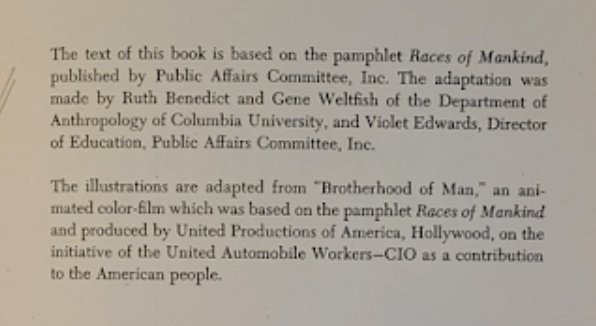
In 1943, Benedict and her colleague Gene Weltfish published a pamphlet that created controversy among bigots and made the case for a shared humanity: The Races of Mankind

The pocket-sized publication was a full-on attack on common misconceptions. "Some people have shouted that if we got into our veins the blood of someone with a different head shape, eye color, hair texture, or skin color, we should get some of that person's physical and mental characteristics. . . . Modern science has revealed this to be pure superstition."

The response was massive and unexpected. Hate mail oozed into her departmental postbox. . . . The FBI dispatched interviewers to check up on the Columbia [University] department. . . The public controversy spurred sales. Churches and civic groups would eventually place orders for as many as three-quarters of a million copies of The Races of Mankind, which became one of the most widely distributed texts on the subject of its time.

I read that last bit -- "churches and civic groups would eventually place orders" -- and a little bell dinged in my mind. Hang on... That sounds familiar. Was that...?? 

Yes, it was! In the summer of 2021, during a family reunion, I wrote about a book that my siblings and I remember from our childhood, called In Henry's Backyard. I saw a copy of this ancient text at my brother and sister-in-law's house, and learned that the United Autoworkers -- the most progressive union of its time -- was involved in adapting the book into a movie. And both book and movie were based on Benedict's pamphlet! 

The post is here: a childhood book and a dream for humanity.

An amazing coincidence. Plus some evidence that my memory occasionally still functions.

One day I will write about parts of my worlds that are always colliding. It's called All Roads Lead to Allen Ginsberg.

12.16.2022

this leftist yellowstone fan rejects the claim that's it a right-wing show

Season 5 of "Yellowstone" is streaming now. I love this show, and I'm waiting for the full season to post on Prime before I bingeing this latest installment.

I was surprised to learn that the current take on Yellowstone describes it as right-wing -- that people claim the show espouses right-wing beliefs and values. 

Taylor Sheridan, the show's creator, disagrees. So do I. 

And I wrote this, below, before I read Sheridan's response.

* * * *

I frankly don't understand how this show can be seen as representing so-called red-state values. It makes me wonder if the folks writing these pieces have actually seen the show. Could it be they've seen the cast and the setting, and read a few bullet points, and assumed they know the show? It wouldn't be the first time that cultural critics have made that mistake, and unfortunately right-wingers aren't the only ones guilty of it. 

Yellowstone, at bottom, is about land. Who owns the land, how did they come to own it? Is their claim to the land legitimate -- is it based on economic right, or settler's laws, or stewardship? How will the land be used -- for profit, for preservation, for community? 

Indigenous issues are front and centre, and the portrayal of Native issues is not only sympathetic, but nuanced, complex, and seemingly authentic. How can a show that highlights and sympathizes with Native American issues be said to be (politically) conservative? 

Women's perspectives are always present in Yellowstone, including those of Native women. The women of Yellowstone are fully realized people. They're not: window-dressing, or only reacting to men, or stereotyped, or stock characters. 

Yellowstone is also about trauma, and how trauma plays out in the lives of individuals, families, and entire communities. This is also a progressive take on the human condition.

And most importantly, Yellowstone is anti-capitalist. The root cause of every trauma is profit. The bad guys are the ones who care only about the bottom line, stock dividends, wringing profit out of every acre. Cowboys and ranchers have conflict with the Rez and with the tribal police, but (in this show) they are both coming from a place of honesty and love. The developers are coming from Wall Street.

Like all quality series, Yellowstone is complex and multi-layered: family saga, romances, coming-of-age, culture clashes, history, and politics are all rolled together. Every hero is also an anti-hero; no one (except perhaps the land developers) is purely good or evil. All these parts play out against a backdrop of gorgeous scenery, with the pace and violence of an action-adventure movie. Yellowstone is very violent, sometimes a little over-the-top, so if that's not your thing, don't even try it.

* * * * 

I wrote this post before reading this interview with Taylor Sheridan in The Atlantic, so I'm pleased to see the show's creator confirm my point of view. I'm also a big fan of the modern western genre, so it was great to read Sheridan credit The Unforgiven, the movie that began the new, progressive re-imagining of the western.

Sheridan insists that Yellowstone is not a “red-state show.” “They refer to it as ‘the conservative show’ or ‘the Republican show’ or ‘the red-state Game of Thrones,’ ” he told me. “And I just sit back laughing. I’m like, ‘Really?’ The show’s talking about the displacement of Native Americans and the way Native American women were treated and about corporate greed and the gentrification of the West, and land-grabbing. That’s a red-state show?”

Sheridan is right that the show’s politics are not easy to pin down. Yes, its red-state milieu—all those guns and horses and big, open vistas—along with its veneration of honest toil, cowboy masculinity, violence, and characters who have a general resistance to change may have drawn rural dads who fear, like John Dutton, the end of their own ways of life in a changing America.

But Yellowstone doesn’t have an explicit ideology that maps onto a traditional red–blue spectrum. It’s a mishmash of generally anti-capitalist, anti-modernist populism; pro-rancher libertarianism; conservative environmentalism (I know, today that sounds like an oxymoron, but it has sturdy Teddy Rooseveltian roots); and a sympathetic, pro–Native American revolt of the oppressed. The series isn’t a sop to conservative values, or at least it’s not only that. What Sheridan is up to is slyer, or maybe just more muddled.

Sheridan told me he aims to do “responsible storytelling,” to depict the moral consequences of certain behaviors and decisions. He says he was strongly influenced by Clint Eastwood’s 1992 film, Unforgiven, which “upended” the black-hat/white-hat conventions of the traditional Western. Eastwood “let the sheriff be a bully and the hero be this drunken, vicious killer.” He “shattered the myth of the American Western,” Sheridan said. “So when I stepped into that world, I wanted there to be real consequences. I wanted to never, ever shy away from, This was the price.”

The biggest price—and this theme runs through much of Sheridan’s work—is the one exacted by capitalism and the gentrifiers and financiers who snooker the good people who still work with their hands. Despite his professed admiration for Eastwood’s revisionist Western, Sheridan subscribes artistically to something that looks like the old cowboy way. If his work has a higher moral plane, it’s one governed by cowboy virtues: honor, bravery, physical labor, respect for tradition, and a willingness to die—and kill—in defense of your family and your land.

Noel Murray, writer of this Atlantic piece, seems to be setting up a dichotomy that doesn't exist. Sheridan's admiration for The Unforgiven is not in opposition to Yellowstone's values. The modern western is simply a more honest telling. It brings to the foreground stories that were entirely absent from Hollywood-style mythmaking of the Old West. Stories of women, enslaved people, immigrants. Stories told through a working-class and often anti-capitalist lens. And an often heartbreaking honesty about the systematic destruction of Indigenous land and culture. What Murray calls "cowboy virtues" are the same values and virtues found on the Rez -- setting up often unresolvable conflicts.

So excited to watch Season 5!

12.14.2022

what i'm reading: gods of the upper air, outstanding nonfiction by charles king

Gods of the Upper Air: How a Circle of Renegade Anthropologists Reinvented Race, Sex, and Gender in the Twentieth Century
 by Charles King is a compelling, fascinating, impeccably researched, and thoroughly readable work of narrative nonfiction. 

It is one of the very best nonfiction books I've read. I borrowed it from the library, but ended up buying it for my bookshelf, and my copy is bristling with sticky notes marking passages I found especially illuminating. 

Despite all this, I've been finding writing about Gods of the Upper Air extremely challenging. 

Rather than continuing to think myself in circles, I'm taking an easier route: sharing snips from some published reviews (with repetitive facts snipped out), plus a brief note about why I picked up the book in the first place.

Snips from reviews

This is from the publisher, but I find it an accurate assessment.
A dazzling group portrait of Franz Boas, the founder of cultural anthropology, and his circle of women scientists, who upended American notions of race, gender, and sexuality in the 1920s and 1930s--a sweeping chronicle of how our society began to question the basic ways we understand other cultures and ourselves.

At the end of the 19th century, everyone knew that people were defined by their race and sex and were fated by birth and biology to be more or less intelligent, able, nurturing, or warlike. But one rogue researcher looked at the data and decided everyone was wrong. Franz Boas was the very image of a mad scientist: a wild-haired immigrant with a thick German accent. By the 1920s he was also the foundational thinker and public face of a new school of thought at Columbia University called cultural anthropology. He proposed that cultures did not exist on a continuum from primitive to advanced. Instead, every society solves the same basic problems--from childrearing to how to live well--with its own set of rules, beliefs, and taboos.

Boas' students were some of the century's intellectual stars: Margaret Mead, the outspoken field researcher whose Coming of Age in Samoa is one of the most widely read works of social science of all time; Ruth Benedict, the great love of Mead's life, whose research shaped post-Second World War Japan; Ella Deloria, the Dakota Sioux activist who preserved the traditions of Native Americans of the Great Plains; and Zora Neale Hurston, whose studies under Boas fed directly into her now-classic novel, Their Eyes Were Watching God. Together, they mapped vanishing civilizations from the Arctic to the South Pacific and overturned the relationship between biology and behavior. Their work reshaped how we think of women and men, normalcy and deviance, and re-created our place in a world of many cultures and value systems.

Gods of the Upper Air is a page-turning narrative of radical ideas and adventurous lives, a history rich in scandal, romance, and rivalry, and a genesis story of the fluid conceptions of identity that define our present moment. 

New York Times:

By Jennifer Szalai

During the 1930s, the New York-based anthropologist Franz Boas grew increasingly worried about events in his native Germany. He was in his 70s, and close to retiring from Columbia University, where he taught his students to reject the junk science underpinning the country’s restrictive immigration laws, colonial expansion and Jim Crow. Born into a Jewish burgher family, Boas was horrified to see how the Nazis took inspiration from Americans’ pathbreaking work in eugenics and state-sanctioned bigotry. He started to put the word “race” in scare quotes, calling it a “dangerous fiction.”

Boas is at the center of Charles King’s “Gods of the Upper Air,” a group portrait of the anthropologist and his circle, who collectively attempted to chip away at entrenched notions of “us” and “them.” “This book is about women and men who found themselves on the front lines of the greatest moral battle of our time,” King writes, “the struggle to prove that — despite differences of skin color, gender, ability or custom — humanity is one undivided thing.”

A century ago, the prospect of a common humanity seemed radical to an American public that had been schooled in the inherent superiority of Western civilization. Boas and his disciples argued for pluralism and tolerance at a time when cross-cultural empathy was deemed not just threatening but almost unfathomable.

. . . His ideas were particularly appealing to women who chafed at the patriarchal order. Men were constantly spouting specious and self-serving theories of what was natural; here was a man suggesting that those things might not be so natural after all.

. . . The then-dominant school of anthropology propped up a narrative tracing “the stages of human culture,” from “savagery” through to “barbarism” and finally to “civilization.” Mainstream scholars insisted that white supremacy was justified by head measurements and heel length.

. . . This looks to be the perfect moment for King’s resolutely humane book, even if the United States of the early 20th century isn’t quite the perfect mirror. Boas and his circle confronted a bigotry that was scientifically endorsed at the time, and they dismantled it by showing it wasn’t scientific at all; today’s nativists and racists generally don’t even pretend to a scientific respectability, resorting instead to a warped version of cultural relativism for fuel in their culture war. 
Kirkus:
In this deeply engaging group biography, King . . . recounts the lives and work of a handful of American scholars and intellectuals who studied other cultures in the 1920s and ’30s, fighting the “great moral evils: scientific racism, the subjugation of women, genocidal fascism, the treatment of gay people as willfully deranged.”  . . . .
King offers captivating, exquisitely detailed portraits of these remarkable individuals—the first cultural relativists—who helped demonstrate that humanity is “one undivided thing,” that race is “a social reality, not a biological one,” and that things had to be “proven” before they could shape law, government, and public policy.
. . . King’s smoothly readable story of the stubborn, impatient Boas and his acolytes emphasizes how their pioneering exploration of disparate cultures contradicts the notion that “our ways are the only commonsensical, moral ones.” Rich in ideas, the book also abounds in absorbing accounts of friendships, animosities, and rivalries among these early anthropologists.

This superb narrative of debunking scientists provides timely reading for our “great-again” era.

Why I originally picked up this book

On a visit to the U'mista Cultural Centre in Alert Bay (something we do whenever we have out-of-town guests), we saw an exhibit about the work done by Boas, with his local ethnographer, George Hunt. Boas and Hunt studied the cultures of the coastal peoples on whose traditional territories I live and work.

George Hunt's descendants form a huge clan, with many famous artists and other notables among them, including the Cranmers, whose life works keep their culture alive in so many ways.

Boas and Hunt knew these Nations as the Kwatiul (pronounced kwa-gi-youth). Port Hardy is built on the traditional territory of the Kwakiutl. All the Nations who are originally from this area are referred to as  Kwakwaka'wakw (pronounced kwak-wok-yuh-wak), which means Kwak'wala-speaking people. 

When I saw George Hunt and the Kwakiutl mentioned in a review, I immediately put the book on hold. I'm so glad I did!

A note about a word

I have known for a very long time that racial theory is pseudoscience, that there is no biological basis of race, that it is a purely social construct. I make it a point to never use the word race when describing anyone, and to never refer to someone's race. I have done this for decades.

Instead I use the words color, or racialized, or ethnic background, or heritage, and so on, depending on what is appropriate. 

I hope more people will join me to move the needle that little bit.

Also I hope people will read this book.

12.10.2022

in which i have nothing new to say: just write for rights #w4r22

It's that time of year again: time to Write for Rights

Looking back on my write for rights posts for the last several years, it appears that I've been recycling ideas for a long time! And I'm about to do it again. Why spend more time writing this annual blog post, when I could be writing letters? And really, what more is there to say? Here's most of what I wrote last year.

Why do we need Write for Rights? Look at the case thumbnails

Why is this a good thing to do with your time? Wmtc W4R 2019:
All through this year, I've been struggling with cynicism and despair about the state of our planet and the state of democracy. So even though all the warm and fuzzy reasons I've listed in the past (and below) are true and valid, the most important reason to Write For Rights is deadly serious. The world is seriously fucked up. Many, if not most, of us who care about the world feel helpless in the face of such enormous, complex, and intractable problems. Whether or not we will collectively succeed in making a difference on a global scale, we can each make a difference on an individual scale. Amnesty International provides us with an opportunity to do that.
Why is this a great form of activism? I originally wrote this in 2014, and since then I've been recycling it annually. I tell myself that rather than come up with something new, I'll use the time to Write for Rights.
1. It's easy. Amnesty makes it really easy to participate. Read, type, send.

2. You can do do it from any computer. No meetings to attend, no schedule to keep. Just more of something you do all the time anyway: typing.

3. It's free. No need to donate money. The most this will cost you is postage.

4. You'll feel good about yourself. Enjoy that warm buzz you get from voluntarily helping other people. There's nothing quite like it.

5. You can choose how much to participate. Write one letter, write two letters, write three. Spend 10 minutes writing or spend an hour.

6. You can choose what to focus on. Write about an issue in your own country. Write about an issue in your country of origin. Write for children, or for women, or for LGBT people, or for workers, or for environmental activists, or for another issue that you care about.

7. You're busting stereotypes. We supposedly live in a selfish age where all we care about is I, me, mine. Challenge yourself to say it ain't so.

8. It works globally. Every fight against injustice begins with someone shining a light in a dark place. Be that light.

9. It works locally. When political prisoners are released, they often attest to the difference letters from strangers made in their lives: that knowing they were not forgotten helped them survive.

10. You enjoy your own human rights every day. Why not use them to help someone who can't? It doesn't take much time. It's not difficult to do. And it works.

11.27.2022

planned obsolescence, future landfill, and premium-priced durability: in which we buy an expensive new washer

One of the things I hate most about our current world is planned obsolescence. 

There's a "wmtc's greatest hits" long piece unpacking planned obsolescence, as it relates to capitalism and our deteriorating environment: "we work to buy things that are built to die so that we must work to buy more things that will break". (This post sparked an interesting long discussion, now lost to the ether.) 

When we look at the cost of basic living now, compared with our parents' or grandparents' generations -- home internet, computers, mobile phones, etc. -- we need to include this. We buy and re-buy, over and over, items that our parents may have replaced once in their lifetimes, if at all.

And the life cycle of products continue to shrink. Things we bought when we first moved to Canada in 2005 lasted longer than the same items purchased in 2015. We once bought a can opener that was literally single-use. A coffee grinder that I used five times before it broke. And on and on.

Wmtc readers had another good discussion about this after I bought an extremely expensive office chair. Talk about privilege! I was embarrassed to spend almost $1,000 on a chair. The alternative, however, was spending $200-300 for a chair that would fall apart in less than two years. My expensive chair, purchased in 2009, is still like new in 2022.

This kind of buying is a privilege, only feasible for those with discretionary income or credit. Folks with less income end up buying crap because it's all they can afford -- another form of the cost of poverty

Planned obsolescence preys on bargain hunters. The quest to wring maximum use from every dollar actually means spending more in the long run.

Planned obsolescence keeps people in debt, or in poverty, or prevents them from living a better life with greater comforts and supports.

Planned obsolescence is killing our planet. The Earth is filling up with phones, and computers, and appliances, and plastic toys, everything else that we buy, and re-buy, and re-buy.

* * * *

I think about this all the time, but most recently it's on my mind because our washing machine broke. 

The Whirlpool washer that was in our home when we bought it suddenly stopped spinning. The one appliance repair person in our little town is away for an extended period of time. Through some intense sleuthing, I found a repair person in the next town, about 45 minutes away -- but he doesn't make service calls.*

We disconnected the washer, loaded it into the car, and drove to Port McNeill. The following day, Repair Person called: it can't be fixed. The part that broke isn't available, as the breakdown of this part signals the end of the machine. By tracing the serial number, he learned that the washer was manufactured seven years ago -- and that is the full lifespan of the machine. 

Seven years? For a washer?? That is ludicrous.

Now we had to drive back to Port McNeill, pick up the faulty washer, and re-install it. We would use a lot of electricity drying sopping wet clothes, but at least we'd have something in the interim. Envisioning our hydro bills would be a great incentive to buy a new washer, pronto.

As I started to research, I saw that almost every washer had only a one-year warranty. Hmmm.

Repair Person recommended we look into Huebsch, sold in the US as Speed Queen. They manufacture washers for laundromats and hotels, and also they have a few consumer models, which are built to the same specs as the commercial machines. Repair Person doesn't sell appliances or earn commissions. He said, "If you can afford it, it will last the rest of your life."

I investigated. Huebsch washers and dryers cost about twice as much as standard consumer models from Whirlpool, LG, Samsung, and most other household brands. They are supposed to last decades, rather than years. There are only two authorized Huebsch dealers in the province, and amazingly, one is in Port McNeill! 

I'm not thrilled at the expense, but to us this is a no-brainer. What's the point of spending $600 or $800 on a washer that will last less than 10 years? 

My only hesitation was that the capacity of these washers is much smaller than those of the popular brands: 3.2 cubic feet, compared with 5 cubic feet or higher. Here's what I've learned. The other companies have competed to offer more and more capacity -- without improving the internal works. The motors of these large-capacity machines can't handle the loads, so the machines are destined to break down quickly. Huebsch has avoided this by sticking with the old-fashioned 3.2 capacity.

I wasn't completely sure that the Huebsch could accommodate our largest item, which would be a queen-sized comforter. I read online that 3.2 cubic feet was enough for a queen comforter -- but I couldn't take a chance. There's no drycleaner in our area, so if I couldn't wash a blanket -- including old blankets that certain dogs like to snuggle in -- I'd be out of luck. So just to be sure, we brought a (fur-free) blanket with us to try. It fit. End of story.

This is how we ended up spending $1,750 -- tax and delivery putting us at about $2,200 -- on a washer. According to everyone, it will run smoothly for at least 25 years.**

I'm fortunate, I'm privileged, we can handle this. But it is so wrong.

------

* Repair Person is disabled, and I'm guessing that only working out of his shop eliminates accessibility concerns. I didn't know this until we met him. It was great to see a wheelchair-user running his own business -- and he's quite senior, too. He sells mobility scooters and repairs computers, too. And in the summer lives on his boat. In my old writing life, this guy would make a great story.

** Next year, we are probably going to buy the matching dryer, to reduce our electricity use with a more efficient machine. 

11.24.2022

my experience working with a personal trainer, plus trying to find the next step

My history with strength training has been fraught with failure and injuries. Time and again, I would be highly motivated, armed with a book or set of videos, only to end up worse than when I started. Back spasms, severe muscle strains, deep joint pain, all requiring long periods of rehab -- not the results I was looking for! 

In early 2020, a union sister turned me on to Katy Bowman's Nutritious Movement. Using Katy's methods and stretches, I was able to reduce and then eliminate the lower back pain that had plagued me for decades. I increased my range of motion and felt much looser and more fluid. Hurrah! I wrote about that experience here.

I kept up with the stretching, but as motivated as I am, if I do it on my own, I end up rushing through, doing the bare minimum. Katy's philosophy and exercises are amazing, but they can be very time-consuming. Also, her workouts are not aerobic. I already dedicate about five hours a week to cardio exercise. Adding Nutritious Movement becomes a prohibitive time commitment.

Early last year, the wonderful folks at truLocal were promoting Nielsen Fitness, a personal training company based in Toronto. Like so many businesses, Nielsen converted to a virtual model during covid -- one-on-one sessions via videoconferencing, with a free assessment and trial session to start. I decided to try it.

Nielsen had a good and detailed intake questionnaire, where I was able to specify my goals: I want to improve strength, balance, and flexibility. The end. Just as importantly, I was able to specify my not-goals: no weighing, no measuring. 

I signed up for 12 lessons. The consultant tried to sell me on three times per week, but there's just no way. I wanted one weekly session, and kind of got pushed into twice weekly. As it turned out, because of scheduling, I often ended up having one session per week -- and I enjoyed that the most. 

Incidentally, I think "three times a week or you don't see results" must be another fitness myth. It should be chucked in the bin, along with 10,000 steps, eight glasses of water, and "no pain, no gain". With either weekly or twice-weekly sessions, I absolutely saw progress. My strength, flexibility, and balance all improved. And this included a six-week break.

I had a great experience, one that confirmed everything I have heard about working with a personal trainer.

* She knew a wide range of modifications, so I could progress through different exercises at my own level.

* She designed workouts that were more challenging than I would do on my own, both in skill level and duration. 

* She challenged me to go further than I thought I could, while always respecting my limitations.

* She was highly encouraging and motivating. This isn't a must for me, but I enjoyed it and found it helpful.

* The workout was dynamic and aerobic, so I felt that I had gotten a very complete hour, even more than I do on the treadmill. 

* It was slightly awkward to do this by video. I had to tilt the laptop camera up or down for each exercise. But it wasn't a big deal, and certainly worth it to have a great, personalized workout without leaving the house.

* Nielsen sent me a set of resistance bands, both "mini bands" and "super bands", along with a set of handles and a nice bag, pictured here. These are really useful and they threw them in at no extra cost.

The result: I worked hard, saw progress, went further than I thought I could, and had no injuries. 

I enjoyed the experience very much -- but it is out of my price range. The 12 sessions were a gift I gave myself, an investment in my health. But this is not something I can work into my budget long-term. I don't think the industry's prices are exorbitant, considering it's a personal service, using someone's time and expertise. It's just not in our budget.

So where to go from here? I think my best bet for expertise with affordability is a fitness app. I don't mind paying for a good app; the price for a full year may be less than one personal session. But there are so many fitness apps, I find the field overwhelming. Most seem to emphasize weight loss, or on the other end, body building. I take one look at the choices and run screaming.

This listicle from Forbes reviews several apps, rating pros and cons for each. I'm going to use it as a base for discovery. The trainer recommended one that is on this list: Nike Training Club. I'll report back.

11.21.2022

things i heard at the library: an occasional series: #35

This TIHATL is a hybrid of two well-trod library tropes: The Customer Who Refuses To Be Helped and Left Behind By Technology. It makes for sad, frustrating interactions and irate customers.

R needs to do something on the internet. He hates the library's computers. He hates Windows 10. He is convinced that our public computers and Windows 10 are the causes of his problems.

He marches triumphantly into the library with a used laptop that he purchased, announcing that, at last, he has a copy of Windows XP. He also has a newly purchased ethernet cable. And he's convinced that this combination -- both, unbeknownst to him, outdated -- will solve his problems.

I explain that we have no way to use the cable, that we can only connect to the internet wirelessly. This infuriates him. "Why not? What kind of crap operation are you running here? What is wrong with this library?"

I try everything I know to get his laptop to pick up the library's free wifi, but it will not. This also infuriates him. Fortunately -- and a bit surprisingly -- he does not blame me. 

After a while I convince him to move to one of our public computers. This also involves getting him to pack up his laptop, his jacket, and all the papers he has strewn across the table. It's like dealing with a 5-year-old, with none of the cute factor.

He sits at the computer for about five seconds before he starts complaining. "Where's the search box on this crappy thing?"

Incidentally, R is hearing-impaired, so we're both shouting. He also has very bad body odour, and I am highly sensitive to smells. He looks disheveled and unkempt. 

I show him how to open a browser and find Google. He tells me what he's looking for, and waits for me. I explain that I won't be doing this for him. He angrily types in his search, bashing the keyboard, then clicks on the first link without looking at it. "What am I supposed to do now? These damn computers! Windows 10 garbage! What kind of library is this, anyway? Why can't I use my laptop! What kind of garbage is this!" and so on.

At one point in his rant R says, "I ran my own business for 40 years! I never had these problems!". This gives some insight into what he may be experiencing. Presumably, he's been competent and independent in the past, and now finds himself helpless and frustrated in a world that has left him behind. Unfortunately, my empathy for him cannot help him. I also wonder if this is actually true.

Also while ranting, R says he wants to buy a typewriter and use Canada Post. He has said this several times at the library. It must be an expression of frustration and a longing for something simpler. He hasn't actually tried to buy a typewriter, or asked us how he might go about that.

When I last saw R, he was using Google and writing down whatever he found, with pen and paper. His handwriting is illegible and his grasp of written English is marginal.

Based on his searches, I think he may be sending some kind of promo or advertising to various companies -- which is even sadder, as I can't imagine what this would look like. 

I really want to help this man. But he is so invested in being right, and so frustrated that he cannot navigate the world, which now feels so foreign to him, that he refuses to be helped. Instead, he wastes money on an outdated laptop, and ends up feeling more aggrieved than when he started.

* * * *

Before writing this post, I checked the things i heard at the library label, to see when I last wrote about this issue. I came up with this similar story, written in March 2020. 

11.11.2022

11.11

Revolutionary thought of the day:

I would like to see every single soldier on every single side, just take off your helmet, unbuckle your kit, lay down your rifle, and set down at the side of some shady lane, and say, nope, I aint a gonna kill nobody. Plenty of rich folks wants to fight. Give them the guns.

Woody Guthrie

11.05.2022

i need something lighter: my two favourite dog vids plus a golden oldie

Being confronted with pit bull bigotry has triggered a lot of sadness for me. To feel better, I am sharing my two favourite reels. These make me laugh every single time.


Bonus round: a blast from the past. 

It occurs to me that the expressions "blast from the past" and "golden oldies" are themselves golden oldies. We said these things "back in the day" -- an expression I hate and try never to use. 


Many thanks to my esteemed partner for always knowing what will bring me joy.

11.03.2022

something new: in which i defend pit bulls challenge bigotry without losing my cool

I was at a nail salon. Not an upscale spa, a loud, basic, ramshackle kind of nail salon. Two women sitting side by side for pedicures were speaking loudly and drowning out all the other noise. 

Loud Woman One was telling the whole salon about her upcoming trip to San Francisco, where her grandchild lives. She was listing all the things to do in San Francisco. Then she was telling the whole salon about traveling with her dog.

Loud Woman Two says, loudly, "You know what dogs I hate? I hate pit bulls. They are horrible dogs. They bite people. They kill people."

My head jerked up. I stared in their direction. 

San Francisco Tour Guide said, "Well, the thing about pit bulls is, sometimes, if they have good parents, they might be OK. My daughter's ex-boyfriend had a pit bull. He got him when he was a puppy, and he trained him very well, and it's a very sweet dog now. He also has a Min Pin, and the Min Pin weighs 12 pounds, and you know what, that little dog is the boss."

Breed Bigot says, "That dog is probably not really a pit bull. If it was, it would be horrible and vicious."

I tried to look away. 

I wasn't sitting near them and I wasn't involved in the conversation (although they were talking loudly enough for everyone in the room to hear). 

I tried to look away. 

But I felt sick. I literally felt sick to my stomach. I knew if I didn't say something I'd feel sick all day.

I called over to them, "Pit bulls are no more dangerous than any other dog. You're repeating myths and lies."

They continued talking, oblivious.

I tried again. "Excuse me! Excuse me, what you're saying about pit bull dogs is not true. It's bigotry. It's like saying, 'All Koreans are this,' or 'All Black people are that'. Pit bulls are ordinary dogs. They are often the victims of abuse."

Breed Bigot wouldn't look at me. She turned her face away.

Tour Guide said, "It's like I was saying, good parents make good dogs."

I said, "I hear what you're saying. I agree." I looked at Breed Bigot, but she was refusing all eye contact. "I'm sorry to interrupt, but you're repeating lies. What you're saying is bigotry. It's wrong." I stared at her. "Statistics show that pit bulls do not bite more than any other dog."

Tour Guide said, "Do you know down in the US, which dogs bite the most? Golden Retrievers. It's because there are so many of them there, so they are where most of the bites come from. So you see, statistics can say anything."

Ignoring the idiocy of this statement, I said, "I hear what you're saying. Thank you."

Then I stopped.

I let Tour Guide have the last word.

I apologized to the person doing my nails, and ended the conversation.

So what's new?

In the past, I would have gone right over to them, gotten in their faces. Raised my voice. Expounded on the virtues of pit bulls and their victimization. And I don't know what else. Because when I'm in that zone, I can't think. I'm pure anger.

Then in those old days, I might have been slightly (but only slightly) embarrassed afterwards, depending on how far I went. I might (or might not) apologize for going too far. But a younger version of myself could be counted on to let loose. It never felt like a choice.

So here I am. I'm 61 years old, sixtyfuckingone years old, and I have finally figured out how to speak up without attacking. I can finally control my emotions enough, manage my anger enough, keep my composure enough, to speak up without making a scene. 

I still haven't figured out how to shut up completely, and I'm sure I never will. But at least I didn't bite her head off.

11.01.2022

what i'm reading: the night watchman by louise erdrich

I read Louise Erdrich long ago, in the 1980s and '90s, devouring several titles, including Love MedicineThe Beet Queen, and my favourite, Tracks. Erdrich remained on my radar, but somehow I didn't pick up another of her books for decades -- until now. And I'm so glad I did.

The Night Watchman, which won the 2021 Pulitzer Prize for Fiction, is a captivating, transcendent novel, a book that does many things at the same time, and all of them achingly beautiful.

Although the story takes place in the 1950s, and was inspired by Erdrich's grandfather's papers -- and his activism on behalf of his people -- this book doesn't have the feel of historical fiction. To me it reads more like a story of personal journeys and relationships, against a backdrop of reservation life.

Thomas, who works as a night watchman, is organizing to defend his people from the federal Termination Bill, that -- quite literally -- will make his tribe disappear. Patrice, Thomas' niece, is trying to locate her sister, who has also disappeared -- into the city, whether by choice or against her will, we don't know.

The story follows both these struggles, along with pieces of the journeys of people in Thomas' and Patrice's kinship circles, seen in varying degrees. There's a lot of humour, not a little sadness, and richly drawn portrayals of iron-willed love and throat-catching intimacy. Hardships are presented matter-of-factly, without melodrama; they are just the fabric of life. The characters are vivid, the relationships are complex, and even the less likeable community members are seen through a compassionate lens. 

As with most Indigenous-created fiction, there is a spiritual or mystical element, too. Erdrich skillfully weaves this into the plot and allows its meaning to remain ambiguous.

There is also the spectre of violence against women, especially missing and murdered Indigenous women. Erdrich lets us bear witness to this grim reality, in a way that is highly effective and memorable, but not graphic.

I closed this book feeling that the author had guided me through a journey. I had that feeling that is my greatest praise for any novel: I was sorry it had ended.