Showing posts with label us politics. Show all posts

4.14.2025

greg palast: trump lost -- and our most hallowed media didn't tell us

Allan recently shared with me a sobering piece by Greg Palast. It illustrates so much of what is wrong with both the US's fake electoral system and the major media. Palast -- an impeccable researcher -- has run the numbers, and he reveals a simple truth: Trump lost. 

Millions of Americans have had their right to vote stolen through corrupt, antidemocratic, and racist lawmaking. Because guess what? Most victims of this vote-theft are Black.

As in Bush v. Gore in 2000 and in too many other miscarriages of Democracy, this election was determined by good old “vote suppression,” the polite term we use for shafting people of color out of their ballot. We used to call it Jim Crow.

Palast's analysis of this voter suppression may not tell us anything we didn't already know, but seeing the numbers is still stunning. And hearing so many Canadians ridicule Americans for electing this maniac, I feel compelled to share this as widely as I can.

Certainly this was not the first US election to be manipulated by the right wing, but it is certainly the most consequential.

Trump lost. That is, if all legal voters were allowed to vote, if all legal ballots were counted, Trump would have lost the states of Wisconsin, Michigan, Pennsylvania and Georgia. Vice-President Kamala Harris would have won the Presidency with 286 electoral votes.

And, if not for the mass purge of voters of color, if not for the mass disqualification of provisional and mail-in ballots, if not for the new mass “vigilante” challenges in swing states, Harris would have gained at least another 3,565,000 votes, topping Trump’s official popular vote tally by 1.2 million.

Stay with me and I’ll give you the means, methods and, most important, the key calculations.

But if you’re expecting a sexy story about Elon Musk messing with vote-counting software from outer space, sorry, you won’t get that here.

As in Bush v. Gore in 2000 and in too many other miscarriages of Democracy, this election was determined by good old “vote suppression,” the polite term we use for shafting people of color out of their ballot. We used to call it Jim Crow.

Go here to see the numbers and read the rest of the story.

Palast concludes:

Question: If these vote suppression laws—notorious example: Georgia’s SB 202—had no effect on election outcomes, then why did GOP legislators fight so hard to pass these laws? The answer is clear on the Brennan Center’s map of states that passed restrictive laws. It’s pretty much Trump’s victory map.


2.24.2025

in which i scour the internet for signs of resistance and wonder if anyone is organizing a general strike

Where is the resistance? 

My question is not "where is the outrage, why is no one resisting," and so forth.

There is always resistance. I know it's out there. It must be happening. But who is organizing what and where -- that's not visible from a distance.

Looking at mainstream media, we have the usual "hundreds rally", or overviews of one or two Democrats and a scattering of judges.

In the socialist and anarchist media, workers are always rising. The world is always on the brink of a workers' revolution. One fine day they might be right, but they are certainly not a barometer of anything.

I'm also not talking about the so-called #ResistanceTM. The Democrats are ciphers. Utterly absent. Kamala Harris has disappeared. A blatant and obvious reminder that Democrats gonna Democrat: Party Über Alles.

Some Republican voters are apparently angry -- and this is important. Will our side understand the imperative to work with disgruntled conservatives? Or are we too consumed with anger and blame to welcome temporary allies wherever we find them? If Trump and Musk are to be stopped, it will take the active participation of non-fascist Republicans. 

Simple Sabotage Field Manual, a DIY resistance guidebook published by the OSS (precursor of the CIA) in 1944, is the number one search and download on Project Gutenberg. So there's that.

I've been wondering if some federal workers are planning a general strike. Talking on Signal or Discord, forming groups and coalitions. They wouldn't even have to risk their lives by demonstrating in the streets. They could simply stay home. A mass sick-out.

It could build from something barely noticeable to massive over the course of a workweek. 

It could include all federal workers. Office workers. Lawyers. Lab workers. Tech writers. Accountants. Kitchen workers. System analysts. Mailroom staff. Janitors. Statisticians. It should (but of course it wouldn't) include defense workers, contractors, secret service guards.  

Staying home as an act of resistance. Musk wants fewer federal workers, let's see what happens without them.

And then -- in my fantasy -- with federal workers showing the way, we could see a widespread general strike, calling for Trump's impeachment, arrest, prosecution, and sentencing. 

Why the hell not. Every action begins with an idea. Every idea begins with a dream.

Of course it would violate Rule Number One of all serious activism. Has the groundwork been laid? Have coalitions been built? Are people prepared? I'm guessing no, no, and no.

But this is an emergency. Maybe it has to happen organically. Maybe the rules don't apply. 

Or maybe it is happening. 

How can I support? 

2.21.2025

thoughts about what's happening in the u.s.

I haven't been able to write anything coherent about what's happening in the US. All I have is a jumble of disconnected thoughts and emotions. Mostly I push them aside, needing to focus on work, union, and family. 

I guess this is a What's Happening in the US Brain Dump. I'm not even going to try to weave it into an essay. Even this brain dump has been sitting in drafts for more than a week.

* * * * 

Last night, a friend and I had our regular semi-monthly video call. This friend works for the federal government, and is queer. They are also really smart: they are leaving the country. 

As soon as our call started, I said: when are you leaving? I said, please don't wait. And we agreed: they won't be one of those families who waited just too long, not reading the signs around them, and were trapped to a horrific fate. The Jewish families who could have left Nazi Germany, but waited too long.

The words that I find myself repeating again and again: we don't know how far this will go. We don't know how far this will go.

Because these people do not respect the rule of law

That's the bottom line. 

They do not respect the rule of law, the Constitution, the checks and balances. Throughout my lifetime, throughout United States history, those safeguards, those imperfect systems, have been stretched, frayed, twisted, corrupted. They have been abused and misused. But they have still existed. They have endured. Now we see the final death throes. This putsch does not recognize any boundaries. As my friend said, no guard rails. 

I loathe hearing and reading "we will get through this". Who is we in that sentence? A comfortable middle-class (or above) income, a cis/hetero family, white skin, may get you through it. Just because you're not being rounded up, your kids aren't in cages, you're not being called vermin, your family is safe: "we'll get through this"? Fuck you. 

I'm a Jew. I know in my bones that we don't always get through this. 

And even worse: Jewish people who defend this. Jewish people who care about Israel more than humanity. My loathing for those people knows no bounds.

I remember being shocked and so angry to learn that in some states, after a law is declared unconstitutional, the state keeps the laws on the books and continues to enforce it. A rogue state, if you will. Now we have a rogue nation.

Which is the other thing I keep asking. When will the nations of the world treat the US for it is, a rogue nation? That there no longer exists the US the ally. The US is North Korea. Iran. And Russia, perhaps literally. 

With the Orwellian pronouncement that Ukraine started the "war" with Russia -- 1984 come to reality -- maybe this has begun. Maybe "allies" are re-thinking.

The sight of Elon Musk in the Oval Office shocked me and turned my stomach. 

Living in a country where the economy is so intertwined with the US's brings that home faster. It's easy to talk about a trade war. It's harder to talk about an actual war. Canada has the world's largest supply of fresh water. Water is more valuable than oil. Where will that go?

None of this came out of nowhere. It's been building since the Reagan era. The steady march to fascism. We can be sure this march has not arrived at its destination.

De-regulation, unchecked capitalism, the revoking of what's left of a social safety net. Neocolonialism; corporate colonialism.

Mass incarceration, voter suppression, fraudulent elections. Bush v Gore. 

The constant disinformation, an Orwellian world where white so-called Christian men are victims, and attempts at inclusion are enemies of the state. 

Solidarity with persecuted Afrikaners. 

The Gulf of Mexico, Panama, Gaza. 

Crippling economics are met with scapegoating, and now round-ups. 

The endless war with shadowy intent, a shifting landscape of enemies.

The racism, both wide and deep, stoked into fury by the advent of a Black POTUS. 

Media amplifying the messages 24/7, broadcasting fiction and fantasy disguised of news. (If you doubt this, watch Fox News if you can stand it, or read Naomi Klein's Doppelganger if you can't.)

No conventional forms of protest are effective. No demonstration, no letter-writing campaign, will save Americans from this nightmare. Those forms of protest are only effective within a democracy. Or at least within a country that cares about world opinion. Or at least a country where sanctions can be brought to bear. Or at least. I don't know what.

11.14.2024

my post-election venting copied from facebook

This post says nothing new or original or the slightest bit interesting. I just want to preserve what I've been posting on Facebook* over the last week.

I'm going in order of posting, rather than the reverse-chrono of blogging and social media. Also not including likes and comments, as those use full names.


* Yep, I'm old.

11.03.2024

u.s. voting, "trump is a symptom," genocide, and reality: further thoughts

image: self-righteousness and left activism
Yesterday I wrote about, among other things, why Americans should vote Democrat despite their very obvious shortcomings, blindspots, corrupt partisanship, militarism, support for the Israeli apartheid regime... and so on.

The reason is simple. Life will be substantially worse for ordinary people under another Trump presidency.

Life for workers will be worse.

Life for most women will be worse.

Life for most people of colour will be worse.

Life for all transgender people will be worse.

What little is left of US democracy may well be revoked.

The courts will be more biased than they are now. Justice will be less accessible than it is now.

It will be open season for bigtory of all types -- racism, misogyny, Islamophobia, antisemitism, homophobia, and especially transphobia. Even more than it is now.

There will be no progress on gun-law reform -- and there will be no possibility of progress on gun reform. This means that children will continue to die. Teachers will continue to die. Americans will continue to be slaughtered by their fellow citizens who have unfettered access to assault weapons. Parents will continue to live in fear that every day their children go to school, they may not return, or may live through unspeakable trauma. 

There will be zero progress on climate change, and zero possibility of progress.

A convicted felon and a rapist will be President of the United States. Almost every POTUS has been a war criminal. That doesn't in any way negate, balance, or validate putting a convicted felon in the White House.

My socialist comrades -- or people who I once regarded as comrades -- are correct about many things. Trump is a symptom, not the disease. Harris will enable genocide and other horrors. True and true. But when I hear that there is no real difference between a Trump presidency and a Harris presidency, I can only believe they are full of shit. And I must conclude that they are putting their high-minded principles, and perhaps their self-image, ahead of basic empathy and compassion. 

I wonder if leftist Canadians who are so adamant about the need to vote for neither Harris nor Trump have actually tried to imagine what it would be like for themselves and their loved ones living in the US under another Trump presidency. If they have, and still hold this belief, they are fools. If they have not, they are dangerously deficient in empathy.

American lives are not more important than Palestinian lives. Neither are they less important.

If this makes me less purely leftist, less socialist, less whatever-the-fuck, than these self-righteous revolutionaries, I couldn't give a fuck, and perhaps I should be glad.

11.02.2024

elections: here some relief, there... only fear

I rarely -- almost never -- write about politics anymore, either Canadian or US. But of course the upcoming US election is weighing heavily on my mind, as it surely is on yours. 

Good, sane people everywhere can only watch in horror and disbelief as the US becomes increasingly bizarre and unhinged. We've all run out of adjectives. It is simply surreal. 

Why I still vote NDP

I had another election on my mind, too. There was a provincial election in BC: the incumbent progressive NDP trying to fend off a Conservative surge. 

There's a lot of anger against the NDP government, most of it based on ignorance and lies from the right, and magical thinking from the left. As governments go, the BC NDP government was as good as it gets. They've been focused on improving life for ordinary Canadians in ways that make a real difference -- healthcare, childcare, housing. 

Their part in the criminalization of the Wet'suwet'en land defenders is very troubling. The pipeline blockaded by land defenders was approved by the elected Wet'suwet'en council, but is opposed by the hereditary chiefs. Amnesty, environmental groups, and many Indigenous allies see this as an end-run around the principles and intent of DRIPA.

It's true that the elected councils are vestiges of colonialism, brought in by the Indian Act. However, they exist, and the Nations elect them. Should we discount elected councils and chiefs because of their origins? Do we have the right to do that -- or are we conveniently siding with the view of the Indigenous people who we agree with? I'm not sure. Whatever the answer to this complicated question, no sitting government will allow a blockade to continue, and no sitting government, of any party, will say no to a pipeline.

Similarly, the BC NDP walks an impossible balance: being too pro-logging for environmentalists, and being too green for the industries (and workers) who would cut down every tree, extract every living creature from the ocean, and uproot every acre of earth in service of short-term jobs and profits. A party that doesn't support logging in BC will never form the government.

I'd rather have a government that allows controlled logging, and also strengthens public healthcare, builds housing, creates affordable childcare, raises wages, and supports workers than a government that allows uncontrolled logging and privatizes everything. The pipeline and the logging is a given. The rest of it is up for grabs. 

A nail-biter

It was a wild election, with some ridings needing automatic recounts and others decided by absentee ballots. The NDP formed the government with the minimum number of seats needed for a majority. The Greens won two seats; with proportional representation, they would have won eight. Our own MLA (provincial representative) lost, the riding flipping to Conservative, which is unsurprising. But most importantly, we escaped the orgy of privatization and cutbacks that would have followed a Conservative win.

US-style Canadian trolls are already trying to manufacture doubt about the outcome, accusing Elections BC of all kinds of malfeasance. 

American insanity, and some leftist insanity, too

About the US election, what is there to say? The anxiety and fear of good-hearted, right-thinking Americans is justifiably soaring. What will happen if Trump wins -- and what will happen if he loses? Fascists are making death threats against election workers and their families. Fascists with a higher level of education have hundreds of lawsuits ready to drop, to slow and attempt to invalidate results. I assume wmtc readers know about this, but just in case, a primer: Republican Party efforts to disrupt the 2024 United States presidential election.

One sad and infuriating bit, for me, is the response of many leftists, exhorting people to not vote for Harris, because the Democrats, like the Republicans, support the ongoing genocide and dispossession of the Palestinian people.

I find this by turns infuriating and depressing.

US foreign policy does not change. There is no "cut the military budget" party. No "stop supporting dictators" party. No "break ties with Israel" party. Trump's love of dictators in Russia and North Korea is only a new variation of the long history of US support for (and often installation of) dictators the world over. Neither party will stop that vile madness.

But to say there will be no difference between a Harris presidency and a Trump presidency is wildly disingenuous, incredibly ignorant, and unforgiveably callous. The socialist activists I know who exhort US voters to shun both parties fall into the third category. 

A Facebook contact recently explained a bit of this thinking: they said that Trump is a symptom, not the disease. I agree. But what do we normally do with symptoms of diseases that have no imminent cure? Do we refuse to treat them, allow people to wither and die, because the disease itself cannot be cured? 

I've heard versions of this all my life. Don't donate to food banks because it allows governments to not provide adequate supports. Don't work with grassroots groups facilitating abortion access, or helping rape victims, don't teach people who didn't finish high school, because those things "let governments off the hook". 

Choosing to help people who have been fucked over by capitalism and patriarchy doesn't preclude working to change those conditions. Can a person who needs to terminate a pregnancy wait for their state to pass better laws? Should we let families suffer from hunger and malnutrition until we achieve a more just and caring society? 

Sure, Trump is a symptom. When looked at through a socialist lens, everything that's wrong with our world is a symptom. And we need to treat the symptom to the best of our very limited ability.

I had to unfollow some really smart, interesting, and engaged socialist activists, because I can no longer bear this peculiarly leftist brand of bothsiding. Right-wing cruelty is on display every day. I expect it from them. This left-wing cruelty is infuriating and heartbreaking.  

Hypocrisy? Not really and who cares

I voted Democrat in 1992, and for a third party in 1996 and 2000. My vote was of no consequence, thanks to the US system, and I was free to not vote for a party I despised. Those who blamed third-party voting for the debacle of the 2000 election are either short-sighted, misinformed, or party hacks.

In 2004 I voted Democrat. I hated the Dems as much as I ever did, but I felt the popular vote count might be important. Turns out it was not, thanks again to the Dems themselves.

That was the last time I voted in a US election.

If I still lived in the US, I would absolutely vote Democrat now. This, and I stand in solidarity with the Palestinian people, and am horrified and grieving over Israel's extermination of the Indigenous population. I would vote Democrat because it is an emergency.

In her acceptance speech for the Democratic nomination, Kamala Harris uttered the words "the rights of the Palestinian people". I have never heard a POTUS candidate say that before. Just words, of course -- but words we could try to build on. Not voting Democrat will not help the Palestinian people, but the harm that choice could bring is unfathomable.

As we hold our collective breath: I want to cry tears of joy

On August 1 of this year, I posted this on Facebook. 
It's been 20 years since I last voted in the US and my disgust at the DNC and my feelings about the sham democracy are well documented. But the idea of a brown woman being POTUS thrills me and I will cry tears of joy when she is elected. Just as I did when Obama was elected, even though I knew who he truly was and what his election would (and wouldn't) bring. The US is the US. I'm not expecting anything other. But I want Harris to fucking kick that felon's butt. I want to see a fucking landslide, a decisive victory. I want to cry at her inauguration.

10.07.2024

what i'm reading: the wolf, outstanding nonfiction by nate blakeslee

current/international edition
The Wolf: A True Story of Survival and Obsession in the West by Nate Blakeslee is a masterpiece. It is truly one of the best works of narrative nonfiction that I've read.  (The book is also published under the title American Wolf, with the same subtitle.) 

This book had been on my radar since it was published in 2017, and I found a used hardcover at Powell's this year. I was almost afraid to read it, as I thought it might be too sad. Now I'm so glad I didn't let that stop me (and it shouldn't stop you).

Blakeslee's earlier book, Tulia: Race, Cocaine, and Corruption in a Small Texas Town has been on my List even longer; it was published in 2006. Now I will be sure to move it up in the queue.


original cover


I scarcely know how to write about a book that enthralls me like The Wolf has. It is a page-turner, with exciting, vivid scenes of wild nature unfolding before your eyes. It is also an education on how that wild nature is hostage to humans, and how humans are hostage to politics. And it is a view into a human community that has grown around a deep love of the wild, and an obsessive desire to be close to it and protect it.

Blakeslee weaves these threads together in a gripping tale. You could almost call it a multigenerational family saga -- both the generations of wolf families, and their enemies, the humans who are aligned against them.

You know I love and am deeply fascinated by wolves. So yeah, I'm primed to love this book. But my interest is also why I'm extremely discriminating in what I'll read on this subject. I stick to the big names in the field and can't be bothered with the mundane. That's why I can confidently praise this book so highly. 

There is heartbreak. You have to know that going in. Towards the end, I was weeping, and I'm sure you will be, too. But it's not the horror of animal cruelty, which I cannot read about and very much avoid. It's the heartbreak of losing a character that you have come to know, respect, and revere. Blakeslee also brings you the meaning that arose from that heartbreak, and there is comfort in that. There are also happy endings, too -- and if not happy, then positive and satisfying.

If you love and value the bits of wild that are left on our planet -- and if you believe that we humans must steward those wild places -- I recommend this book. Also, if you simply love to read good books: this is one.

8.17.2024

why i call kamala harris by her last name and wish you would too

Here's a question for progressive folks following the US election campaign: Why do you call Kamala Harris "Kamala" and call Tim Walz "Walz"?

* * * * 

A long time ago, way back in the late 80s, Allan and I would watch a local news broadcast together. We're talking regular TV, "the news" on three times daily -- two local broadcasts (one at 6:00, one at 10:00 or 11:00 pm), and one national broadcast.

During the sports portion of the broadcast, the sports anchor would talk about Mattingly -- Don Mattingly of the New York Yankees, Ewing -- Patrick Ewing, of the New York Knicks, and Chrissie -- tennis great Chris Evert. She wasn't Evert. She was Chrissie.

There were some pioneering broadcasters, notably on ESPN, who broke with this tradition and called female athletes by their last names, but it was unusual, and ESPN was not yet the giant it would later become.

Women's team sports, for the most part, were ignored completely. Big female sports stars were usually called by their first names. Chrissie, Martina, Steffi. Mary Lou. 

The reason for this is simple: sexism. Women's sports were not taken seriously. Calling Chris Evert Chrissie was infantilizing and disrespectful, reflecting the way women's sports were served to the public.

Through the 1990s and 2000s, women's sports grew in stature. The groundbreaking US legislation that mandated funding parity for male and female sports programs -- usually referred to as "Title 9" (Title IX) -- began to bear fruit. Young female athletes received better coaching and had more opportunities. Women's college sports became more visible and more exciting. ESPN broke new ground with a 24-hour sports-news cycle, so they needed more events to cover. That organization also had a progressive mandate to report on sports with less sexism and racism. 

I don't doubt that there are local sportscasters in Texas or Florida -- or hell, in upstate New York or rural Alberta -- that refer to Serena, Simone, or Megan, but at this point, they are likely the exceptions. Sportscasters and sportswriters routinely referring to Williams, Biles, and Rapinoe is a sign of a less sexist view of women's sports.

Can we please apply this to the political sphere?

Surely if we can refer to female athletes by their last names, we can give female candidates for the presidency of the United States the same respect?

During Hillary Rodham Clinton's presidential campaigns, most people referred to her as Hillary. Some said this was to distinguish between Hillary Clinton and Bill Clinton. Really? So during the 2016 presidential election campaign, while Hillary Clinton was running against Donald Trump, if we heard the name Clinton, we might think someone was referring to Bill Clinton, who left public office in 2001? 

Another excuse given for calling female candidates by their first names is that we feel like we know them, we believe they are our friends, so we're on a first-name basis with them. Why, then, didn't anyone call Obama Barack? And how can this be said of a woman who so many voters and pundits despise? 

A more likely suspect is the feminist age-gap: why younger women are more likely to change their last names when they marry, why they don't mind being referred to as girls rather than women. I don't get it, but those are personal choices (although with political implications). We're talking about the professional, national, and international stage. Different standards  should apply.

Office workers are still routinely called girls and health-care workers can't seem to make it past ladies. To be clear: these workers refer to themselves and their co-workers as girls and ladies. I've worked in both of these environment (combined) for decades, and the habit seems impervious to change. Every time I hear someone refer to a group of social workers, hospital workers, library workers -- any group of women working in a predominantly female field --  as girls or ladies I want to cry or scream. Or I felt that way when I was younger. Now I just feel the sadness and resignation of defeat. 

Ladies should go the way of mulatto. Lady is not only sexist, but its roots are classist and tied to gender norms -- what was considered "ladylike", i.e. acceptable female behaviour. Someone will point out that the roots of a word are not important if the word is now used in a different context. Then why are we no longer using master bedroom and grandfathered in? Because those expresisons are rooted in slavery. The same applies to ladies, a word rooted in classism. Yet it is so prevalent I despair of it ever changing. 

We are finally seeing gender-neutral terms for various jobs become the norm: writer, actor, lawyer, doctor, athlete, politician, flight attendant, cleaner, housekeeper. Speech patterns are finally reflecting reality: people of different genders do all kinds of jobs. There is no need -- never has been a need -- to qualify a job title with --ess or lady. The job is the job. 

So why is the name not the name?

I don't expect anyone to change their speech habits after reading this post. Perhaps a writer with a wider reach can at least open up the conversation. The candidates are Trump, Vance, Harris, and Walz.

5.21.2024

polarization is not the problem. the problem is fascism.

Art by Maaike Hartjes
"The problem today is that society is so polarized. We need to come together and find common ground."

I hear and read this a lot these days. 

In this analysis, opposing points of view are characterized as "extreme". The best option, it is said, lies in the middle. 

This is a deceptive and potentially dangerous belief.

When mainstream views move so far to the right that the ideas, if put into action, would destroy democracy and civil society, then it is our responsibility to oppose those views. 

When bigotry and hate are rallying cries, it is our duty to stand in opposition, and in solidarity with the targets.

When political actions offend our core values, we must call them out and oppose them.

And if that appears polarizing, it's not the fault of the people trying to build a better world -- or trying to save the crappy one we have.

The opposite of extremism may not be extreme

The "polarization is the problem" view assumes that both ends of the spectrum are always extreme, and that a common-sense approach always lies somewhere in the middle. 

So as the right wing has become more and more extreme, the definition of "centrist" -- supposedly middle ground -- has moved further to the right, too. In conversations with Canadians, I have been absolutely amazed that this is a novel concept:  people don't  seem to realize that centre is a relative term

There is no active extreme left in either the US or Canada. There may be random individuals on the extreme left, but there is no political party representing those views, no widespread people's movement, no groundswell of public opinion. 

The parties and viewpoints that oppose the extreme right are either moderate centre-right (Liberal Party, most of Democratic Party) or moderate center-left (NDP, some of Democratic Party). The Liberals, Democrats, and NDP are only far-left in a Fox News-induced fantasy world -- and through the polarization lens.

Take a look at those parties' platforms, the bills they put forward, how they vote. Not so very long ago, their positions were considered quite moderately liberal. The evidence for that is all around us: it's what's left of the public sector that the right-wing has been demolishing since the Reagan/Mulroney era. Advocating for public healthcare, affordable housing, public education, a fair tax code, green energy, and decent jobs is not extreme. Wanting an inclusive society is not extreme.

Define "greater good"

"We need to come together to work for the greater good." 

This is a familiar refrain from the "polarization is the problem" mindset. But how should those with opposing viewpoints work together -- and why?

I can agree that in Parliament and Congress it would be best if political parties could work together. If a party votes yes for something when they put it forward, and vote no on the same thing when another party puts it forward, that is partisanship. It values party loyalty over society at large. It's counterproductive, childish, and wrong. 

But when parties' values are opposed to each other, finding a so-called middle ground isn't necessarily a reasonable goal. Take healthcare, for example. If one party wants to expand the public health system, and one party wants to privatize it, those two parties can't find a middle ground and they shouldn't try. 

Should the party that wants to expand public health care "compromise" and allow some privatization? Of course not! That party should oppose all privatization and seek to roll back whatever privatization has already taken place. Those are the actions that align with their values, and presumably the values of their voters. Finding so-called common ground would mean betraying their values, their voters, and the public health system.

After hearing "we need to come together to work for the greater good," we must insist: define greater good

Can't we all just coalition?

What about a coalition? In most parliamentary systems of government, in countries throughout the world, parties enter into coalitions from time to time. Can Canada do that? Would we want it to? 

I would probably support an NDP-Liberal coalition government, so those parties could work together to defeat the Conservatives. When this was attempted in 2009, it was scuttled by a weak Liberal leader, public ignorance, and propaganda, with a huge assist from the Canadian media. Prime Minister Stephen Harper said a coalition would "overturn the results of an election" -- and no one challenged or corrected him.** (If they did it was not amplified to the point where anyone could hear it.) 

A coalition would be exciting, scary, potentially amazing. Potentially disastrous. Alas, we'll probably never know. It seems highly unlikely that we'll see a coalition government in Canada. But we could try. 

If working together for the greater good means defeating the Conservatives -- who, in the Canadian context, are far-right -- then working together is a laudable goal.

Good guys vs. fascists

All my adult life, I've heard that's it's wrong to think in terms of us vs. them. But I've never believed that. Of course it's wrong when applied to nationality or ethnic background or so-called "race". But my own us vs. them has nothing to do with personal characteristics. My us vs. them is not even about class. It's about worldviews. Values. Right and wrong. 

There are those who want justice, peace, equity. Who want everyone to have a safe and affordable place to live, quality healthcare, quality education. Those who value democracy. Who want everyone to be free to live and love as they choose, to create the families that they want, without government or religious interference. 

And there are those who want profit, empire, and power. Warmongers. Hatemongers. People who believe that where their ancestors were born makes them superior. People who think their life choices should be the only ones available. People who want to reverse social progress. As an old boss of mine, Oz Elliott, used to say: good guys and fascists. 

Being a good guy doesn't mean staying neutral or searching for common ground. It means standing up for what is right.

Polarization is, in reality, resistance. And in the face of fascism, bigotry, and hate, it's exactly what we need.

-----

** For some US readers: A coalition does no such thing. Everyone who was elected is still elected.  What differs is who forms the government.

5.17.2024

the propaganda discrediting student protests is sad, frustrating, and incredibly hypocritical

The student movement opposing Israeli apartheid brings my heart so much joy. When I was in university, a similar movement calling for divestment from South Africa played a significant role in the fall of that apartheid. It has the potential to do the same now. Yet mainstream politicians and media -- many of whom attended university during a time of tremendous protest and unrest -- are working overtime to discredit the protestors and their movement. Their efforts appear to be successful. It's disgusting, and incredibly hypocritical.

Ignorance? Why?

The upshot: we are supposed to believe that the protesting students are ignorant pawns being controlled by outsiders. Supposedly they don't even know what they're protesting! 

Why would that be? Why wouldn't students in universities throughout North America be knowledgeable about the situation in the Middle East? One might disagree with their opinions or their stance, but why would we assume they are ignorant?

Did students protesting the war in Vietnam know what they were protesting? Of course they did. Students now have even greater access to information, from more sources, then those students -- the current protestors' grandparents -- did. Of course there is false and misleading information out there. There always has been. We manage to sift through rumour and disinformation, and arrive at our own opinions. Why can't these students? Answer: they can.

Outside agitators

The charge of being controlled by outsiders is probably the oldest tactic in the anti-movement playbook. Southern plantation owners said their enslaved workers were happy until northern abolitionists meddled in their affairs. Striking workers are routinely said to be pawns of their unions, who supposedly have a separate and nefarious agenda. Revolutions the world over are blamed on "outside agitators". Translation: these people are too stupid to organize themselves.

Some of the protestors at the campus occupations are not students. People from the community may get involved to show solidarity and lend support. There's nothing unusual about that, and nothing wrong with it. It doesn't mean the students aren't self-organized. 

Freaks and provocateurs

We've long seen how the media singles out the odd-looking, the radical-looking, the menacing-looking for interviews. Anyone with purple hair, multiple piercings, and facial tattoos is an easy choice. Ordinary-looking, middle-class-appearing people don't make the nightly news. 

And don't forget the impact of hired provocateurs. This, too, has been a feature of mainstream reporting on movements from time immemoriam. The use of provocateurs -- hired by local police departments or the FBI or right-wing media -- has been proven many times over. Yet accusations of provocateurs are dismissed as fantasy or paranoia.

"The stereotypes about today’s students are often ludicrously far from reality"

In a New York Times opinion piece, Elizabeth Spiers writes: "Dear Boomers, the Student Protesters Are Not Idiots".

Appearing last week on "Morning Joe," Hillary Clinton lamented what she views as the ignorance of students protesting the war in Gaza. The host, Joe Scarborough, asked her about "the sort of radicalism that has mainstream students getting propaganda, whether it's from their professors or from the Chinese Communist government through TikTok." Ms. Clinton was happy to oblige. "I have had many conversations, as you have had, with a lot of young people over the last many months," she said. "They don't know very much at all about the history of the Middle East or frankly about history in many areas of the world, including in our own country."

I've taught students at the college level for 12 years, most recently at New York University's journalism school. I've also seen and heard the assumptions made about them by some of their elders — administrators, parents and others. So it's no surprise now to hear protesters described as "spoiled and entitled kids" or delicate "snowflakes" who cower in their safe spaces and don't believe in free speech. Billionaires like Ken Griffin, Bill Ackman and, of course, Donald Trump — as entitled as anyone — have been particularly vocal in their disdain, calling the students in one instance "whiny" and demanding that they be punished for protesting. Representative Mike Lawler, a Republican from New York, even suggested that TikTok should be banned in part because "you're seeing how these kids are being manipulated by certain groups or entities or countries to foment hate on their behalf and really create a hostile environment here in the U.S."

Whether they realize it or not, Ms. Clinton, Mr. Lawler and the rest are engaging in a moral panic about America's youth that is part of a larger effort to discredit higher education in general. That effort includes fearmongering about diversity programs and critical race theory. But it starts with students.

In the current panic, the protesters are described as somehow both terribly fragile and such a threat to public safety that they need to be confronted by police officers in riot gear. To justify the police department's excessive response at Columbia University, Deputy Commissioner Kaz Daughtry showed Newsmax viewers a large chain and a book with the title "Terrorism" that had been recovered from one site of protest. The former was a common bike chain Columbia sells to students and the latter was part of Oxford University Press's lovely "Very Short Introductions" series, which covers topics from animal behavior to Rousseau and black holes. . . . 

High-profile public figures of all ideological stripes have varyingly called for the students to be kicked out of their institutions, made unemployable or sent to prison. They've floated implausible scenarios in which the protests turn deadly. Students brave enough to risk their financial aid and scholarships are derided as childish rather than principled. And though they are educated to participate in civic life, as soon as these students exercise their First Amendment rights, they are told that protecting private property is a more pressing public concern. It's as though some older adults simply can't wrap their heads around the idea that college students, who are old enough to marry, have families and risk their lives for their country, are capable of having well thought-out principles. . . . 

In my experience, the stereotypes about today's students are often ludicrously far from reality. College students of this generation have far more knowledge about complex world events than mine or Ms. Clinton's did, thanks to the availability of the internet and a 24/7 news cycle fire-hosed directly into their phones. Representative Lawler may be correct that some portion of that information comes from clips on TikTok, and social media can be misleading, but there's no evidence that college students are more likely to be misled by TikTok than people Mr. Lawler's age and older are likely to be misled by Facebook. In fact, research indicates that younger people are more savvy and skeptical about media, and more likely to triangulate among different sources to see if something is true.

They may also be more sensitive to the horrors of children being killed here and elsewhere because they grew up participating in active shooter drills and watching the aftermath of mass shootings on the news. They are less financially secure than generations prior, and less likely to believe that institutions will save them or reward them for loyalty and hard work. But they are not babies, and they are not oblivious or naïve. And their ideas and actions cannot be dismissed just because some bad actor — no mass movement is without them — does or says something stupid.

For years, for decades, I've heard members of the Baby Boomer generation brag about student protest during the late 1960s and early 1970s. No matter that those protests didn't take off in earnest until middle-class white students lost their student draft deferments and were at risk of being sent to the killing fields. And no matter that after those protests, most students graduated, married, took jobs, lived an average life, and never attended a rally or a demonstration again. The fact is, they did that. They stood in the crowd, they raised signs, they chanted. And guess what? They smoked weed, which was illegal, and I bet that there were people in the crowd who were ignorant of certain issues. But they did it. And they helped end a war.

What makes you think the current protestors are any different?

6.26.2022

the end of roe: a day we expected for so long still has the power to shock and stun us

We've been expecting this for 20 years.

More than forty years of anti-abortion legislation, escalating every year and every decade, then Trump, then finally, the leaked draft. 

So I thought I was prepared -- mentally, emotionally. Hell, for more than 15 years I've been saying that Roe is irrelevant for millions of American women

We all thought we were prepared.

We were wrong.

Every progressive person I know, every feminist, every advocate for justice -- every message board, every private Facebook page, everyone -- has said the same thing. We are raging. Grieving. Stunned. Horrified.  

I cannot express how angry I am. I'm far too angry to be eloquent. I'm going to the stupid and lazy thing, and capture my postings on Facebook.


Attribution omitted


I had to take a break from Facebook when I started seeing posts blaming the repeal of Roe on people who didn't vote for Hillary Clinton in 2016. 

For sure, voting Americans had a stark choice in 2016, a referendum on Trump or not-Trump. About 74 million voters still voted for Trump, and another 88 million (give or take) chose not to vote. A second Trump presidency was the final nail in Roe's coffin.

But for gods' sake, widen your lens. 

The Democrats caused this every bit as much, or more, than the Republicans. 

One party did everything in its power, on all levels, to chip away at abortion rights in preparation for the eventual repeal of Roe v. Wade. They spent untold millions of dollars, unleashed dozens of strategies. Took over one state legislature after the next. Took over school boards. Stacked the judiciaries. Passed the legislation that led to Webster, Rust, Casey, and Carhart II. They were relentless..

The other party couldn't even utter the word abortion. The Democrats' plan to defend Roe boiled down to this: "You must vote for us, no matter what -- no matter what we do or don't do -- because the other party will take away 'a woman's right to choose'." That was never going to be enough. 

As the Republicans turned increasingly radical, the Democrats became what the Republic used to be. The handful of passionate liberals in the party are accused of class warfare and blamed for the success of the radical right.

Perhaps if the Democrats were interested in something beyond getting elected -- if the party actually cared about defending liberal democracy -- we wouldn't be where we are now. Or at least we would have stood a fucking chance.

How can you defend a right you can't even fucking say? 

5.06.2022

the end of roe and how we got here


With the unprecedented leak of the SCOTUS draft brief, and official confirmation of the politicization of the Court, we see the final nails pounded in the coffin of Roe v. Wade -- a turning point which somehow still shocks many people, despite the exceedingly clear regression to this point over the past 40 years.

Given this, it seems strange to me that I haven't blogged about abortion rights in more than two years.

Strange, because this is the issue I care most about, above all else. 

Strange, because I've spent a good portion of my life thinking, writing, organizing, and supporting abortion rights and abortion access.

Strange, because I am angry and hurting about this. But I suspect I am angry at different people than many readers may be.

Partly I stopped writing about Roe and US abortion rights because I feel I have nothing left to add to the discourse -- nothing to write that I haven't written again and again. Here in 2018, I re-ran my essay from 2005. No matter how many ways I find to say it, it comes down to two points.

One. Abortion rights are essential to human rights, to justice, and to basic equality for all people. Abortion rights are the sine qua non of women's freedom, and the bottom line of equality for any person who can become pregnant.
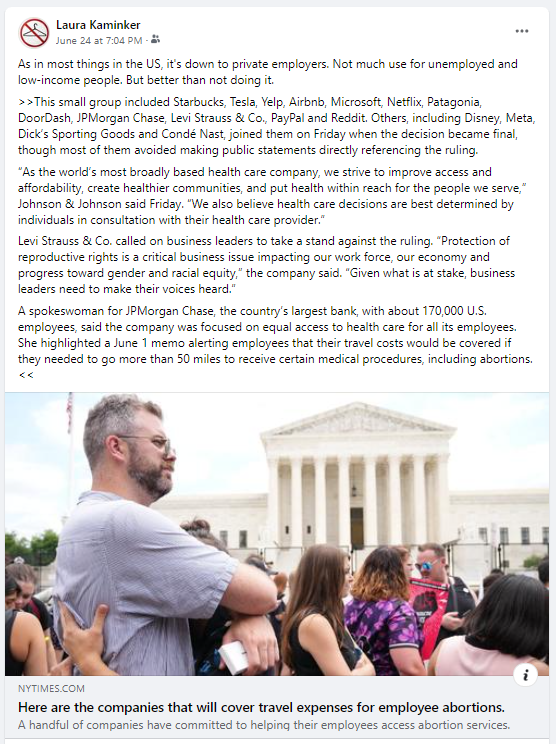
Two. Roe v Wade is meaningless for millions of American women, and has been for decades. Abortion rights have been steadily impeded, eroded, and erased for more than 40 years, a process that began with the passage of the Hyde Amendment in 1976, gathered momentum when Ronald Reagan became president in 1980, and has barrelling downhill ever since. This includes the 16 years of Democrat presidencies. 

And partly I stopped writing about Roe and US abortion rights because I have been so angry and frustrated that people were -- with extreme laws passed in Mississippi and Texas --  now finally paying attention. That sounds counter-intuitive and is not a good way to approach activism! But I just could. not. stand it.

1976 Hyde Amendment (only affects poor people, so who cares)
1984 Global Gag Rule (only affects poor people in other countries, so who cares)
1989 Webster; 1992 Casey -- both losses for reproductive freedom, but left Roe intact, so who cares
And on and on. (Start your timeline here, then here.) As long as Roe had not been overturned, most liberals and Democrats were willing to look away. 

For a majority of Democrat voters, the most important thing to know about abortion rights were: vote Democrat because of the Supreme Court, because we can't let them overturn Roe v Wade.

And while the majority obsessed over Roe, Roe became increasingly irrelevant. 

I'm not suggesting Roe actually is irrelevant.  But it's been hollowed out. It's a shadow. A shell.

The anti-abortion-rights movement had everything it needed to succeed. 

They were extremely organized, extremely well-funded, and very strategic. They got their people elected to state legislatures and began to work the system, passing every type of abortion-rights restrictions anyone could dream up, taunting the court challenges, knowing that eventually, with enough states becoming hostile to abortion, they would accomplish their only objectives: increasing numbers of low-income women and pregnant people would lose control of their reproduction, and the country would move one step closer to overturning Roe v Wade.

The anti movement has had other factors in its favour. In addition to money, organization, and strategy, they had the Democrats. Abortion became a dirty word, replaced by the euphemism "a woman's right to choose". Bill Clinton said let's make abortion "safe, legal, and rare" -- with little or no attention paid to the myriad laws, supports, and resources it would take to make such a thing possible.

They had the "muddled middle" -- to use Katha Pollitt's excellent expression -- whose discomfort with the idea and reality of abortion made it easy to look away. Shamed by stigma created by anti-abortion-rights zealots and the media who support them, most were happy to look away.

There are other reasons, too.

Roe v. Wade was never a strong ruling; it was always vulnerable to attack. The right to abortion is more secure in Canada -- although it is often under threat and must always be protected and defended! -- because the 1988 ruling in R v Morgentaler is a much broader decision. 

The US's obsession with states' rights, and the right wing's expert exploitation of it, have left millions vulnerable, not only on reproductive justice, but on so many fronts.

The US's lack of an organized healthcare system leaves millions vulnerable to assaults on reproductive freedom. If you lack basic healthcare, that's going to include a lack of access to reproductive needs.

The mainstream media's adoption of the disgusting lie "pro-life" -- the greatest PR coup of the modern world -- did untold damage. 

But be assured of one thing. Our side has been planning for this for decades, too, with abortion funds, underground networks, and direct action. It's a much more successful strategy than voting Democrat.

As always, the Guttmacher Institute is your best source for data on all aspects of reproductive justice. 

If you want to help, donate to abortion funds: National Abortion Federation, National Network of Abortion Funds. Canada has one, too.

If you live in a free state and have the resources, you can host a person traveling for abortion from a slave state. It's incredibly important and deeply gratifying work. NNAF can help you find a network. 

9.04.2021

the only lesson to be learned from afghanistan: war is a waste

Veterans for Peace protest, 2016
As the US finally ends its occupation of Afghanistan, watching the media obsess on the specifics of the pullout has brought me no end of head-shaking. The violent chaos of the exit makes for sensational images and startling headlines, always good for the business of media. But it's also a shell game, designed to narrow our attention and ask the wrong questions.

Twenty years of occupation and the pullout is the problem? This brings to mind Donald Rumsfeld's response to revelations of torture at the Abu Ghraib prison: banning cameras.

Ezra Klein had a similar thought.

In 2005, two of my colleagues at The American Prospect, Sam Rosenfeld and Matt Yglesias, wrote an essay I think about often. It was called "The Incompetence Dodge," and it argued that American policymakers and pundits routinely try to rescue the reputation of bad ideas by attributing their failure to poor execution. At the time, they were writing about the liberal hawks who were blaming the catastrophe of the Iraq war on the Bush administration’s maladministration rather than rethinking the enterprise in its totality. But the same dynamic suffuses the recriminations over the Afghanistan withdrawal.

To state the obvious: There was no good way to lose Afghanistan to the Taliban. A better withdrawal was possible — and our stingy, chaotic visa process was unforgivable — but so was a worse one. Either way, there was no hope of an end to the war that didn't reveal our decades of folly, no matter how deeply America's belief in its own enduring innocence demanded one. That is the reckoning that lies beneath events that are still unfolding, and much of the cable news conversation is a frenzied, bipartisan effort to avoid it.

Focusing on the execution of the withdrawal is giving virtually everyone who insisted we could remake Afghanistan the opportunity to obscure their failures by pretending to believe in the possibility of a graceful departure. It's also obscuring the true alternative to withdrawal: endless occupation. But what our ignominious exit really reflects is the failure of America's foreign policy establishment at both prediction and policymaking in Afghanistan.

"The pro-war crowd sees this as a mechanism by which they can absolve themselves of an accounting for the last 20 years," Senator Chris Murphy, Democrat of Connecticut, told me. "Just think about the epic size of this policy failure. Twenty years of training. More than $2 trillion worth of expenditure. For almost nothing. It is heartbreaking to watch these images, but it is equally heartbreaking to think about all of the effort, of lives and money we wasted in pursuit of a goal that was illusory."

Let's widen the lens. Why was the US in Afghanistan for 20 years

Canadians -- incredibly -- believed the "mission" in Afghanistan (no war please, we're Canadian) was for women's freedom! This was perfect for the country's positive self-image, and its apparently unshakeable belief in its military as a force for good in the world. 

In the US, the invasion of Afghanistan was supposedly a response to the attacks of September 11, 2001. Conveniently forgotten: the invasion was planned well before that date. Like all US invasions, the real goals were corporate interests and imperialism.

The history of multiple invasions and occupations of Afghanistan, by both the Soviet Union and the US, is long and complex, and I wouldn't begin to attempt to unravel it in a blog post. This interview with historian Ali Olomi in Vox makes for interesting reading.

Olomi, who is the host of the podcast Head on History, discussed the US’s funding of some factions of the mujahedeen, or Afghan guerrilla fighters, during the 1970s and ’80s; America’s rolling reasoning for its involvement in Afghanistan post-2001; and whether the US, even without soldiers present, is really gone.

Every US-led invasion carries a veneer of high-minded pretense, whether that is stopping the spread of communism or making the world safe from terrorism. Of course the US doesn't have exclusive rights to this type of propaganda. Since I've read a lot about resistance to "the Great War," Belgian babies and nuns spring to mind. The ruling class has been selling high-minded wars to the populace since time immemorial. Hence the term cannon-fodder.

I recall the testimony of one of the war resisters from our Toronto group. He was the former serviceperson with the highest rank and the most to lose. Stationed on an aircraft carrier, he had plotted the targets they had been ordered to bomb, and overlaid it with the route of a major US-backed pipeline. Voilà, a match! He realized what he and his division were protecting, who and what they were risking their lives for.

I applaud Joe Biden for having the guts to exit Afghanistan. The New York Times notes that, "In the end, the argument that won the day is that the future of Kenosha is more important than defending Kabul." (As far as I can tell, this "argument" was a random Twitter response to a White House tweet.) 

Sadly, the idea that military funds will be redirected to rebuilding US infrastructure and social programs is likely fantasy. If that does happen -- if the US's gargantuan military budget substantially shrinks and those funds are re-directed for the social good -- then Joe Biden will be a president of phenomenally historic stature. 

From my perspective, it's extremely difficult to imagine. But from 2016 on, I've been completely wrong about US politics. Nothing would please more than to be wrong on this, too.