Showing posts with label activism. Show all posts

2.24.2025

in which i scour the internet for signs of resistance and wonder if anyone is organizing a general strike

Where is the resistance? 

My question is not "where is the outrage, why is no one resisting," and so forth.

There is always resistance. I know it's out there. It must be happening. But who is organizing what and where -- that's not visible from a distance.

Looking at mainstream media, we have the usual "hundreds rally", or overviews of one or two Democrats and a scattering of judges.

In the socialist and anarchist media, workers are always rising. The world is always on the brink of a workers' revolution. One fine day they might be right, but they are certainly not a barometer of anything.

I'm also not talking about the so-called #ResistanceTM. The Democrats are ciphers. Utterly absent. Kamala Harris has disappeared. A blatant and obvious reminder that Democrats gonna Democrat: Party Über Alles.

Some Republican voters are apparently angry -- and this is important. Will our side understand the imperative to work with disgruntled conservatives? Or are we too consumed with anger and blame to welcome temporary allies wherever we find them? If Trump and Musk are to be stopped, it will take the active participation of non-fascist Republicans. 

Simple Sabotage Field Manual, a DIY resistance guidebook published by the OSS (precursor of the CIA) in 1944, is the number one search and download on Project Gutenberg. So there's that.

I've been wondering if some federal workers are planning a general strike. Talking on Signal or Discord, forming groups and coalitions. They wouldn't even have to risk their lives by demonstrating in the streets. They could simply stay home. A mass sick-out.

It could build from something barely noticeable to massive over the course of a workweek. 

It could include all federal workers. Office workers. Lawyers. Lab workers. Tech writers. Accountants. Kitchen workers. System analysts. Mailroom staff. Janitors. Statisticians. It should (but of course it wouldn't) include defense workers, contractors, secret service guards.  

Staying home as an act of resistance. Musk wants fewer federal workers, let's see what happens without them.

And then -- in my fantasy -- with federal workers showing the way, we could see a widespread general strike, calling for Trump's impeachment, arrest, prosecution, and sentencing. 

Why the hell not. Every action begins with an idea. Every idea begins with a dream.

Of course it would violate Rule Number One of all serious activism. Has the groundwork been laid? Have coalitions been built? Are people prepared? I'm guessing no, no, and no.

But this is an emergency. Maybe it has to happen organically. Maybe the rules don't apply. 

Or maybe it is happening. 

How can I support? 

12.26.2024

things i heard at the library, an occasional series # 42: why i'm not letter-writing this year, part 1 #w4r2024


This is the first time in 16 years that I am not spending Christmas and Boxing Day writing letters. This time of year, I normally participate in Write for Rights, Amnesty International's global human rights letter-writing event. I decided to give myself the year off, for two reasons -- one positive, one not so much.

I've tried many times to organize a group for Write for Rights, but never found enough interest to get it off the ground. This changed with the amazing team now working at the Port Hardy Library. We are offering our customers the opportunity to participate in Write for Rights for an entire month, beginning on December 10, International Human Rights Day.

I reached out to Amnesty Canada, and they sent a great package of swag -- t-shirts, buttons, bandanas, pens, water bottles. Our team created a beautiful display, featuring petitions for each case, and a box for letters.

For every letter they write, customers receive one entry to a draw for a prize package. We do the mailing, and I'm paying the postage as my donation.

The prize package includes a copy of Letters to a Prisoner, a beautiful, wordless picture book about what Write for Rights is all about, which Amnesty sent us. 

This program has shown me something about Write for Rights that I had forgotten: many people don't know these issues exist. Many people do, of course. Some folks, after seeing our Facebook posts, have come in specifically to write letters. But for many people, the cases are beyond eye-opening -- they are staggering. They didn't know that peaceful activists are targetted, jailed, tortured, and even killed, or their families threatened or killed, for standing up for their communities. 

As people scan through this year's cases, I hear quiet gasps, or expressions of shock and horror. I see people brush away tears.

This program is very labour-intensive for library staff. Multiple times each day, we explain what Write for Rights is, what the cases are, what we are inviting them to do. I've been so impressed with our staff's willingness and energy for doing this. It's a powerful reminder of the role public libraries play in education. 

As always, I am grateful to the good people at Amnesty whose Herculean efforts make Write for Rights happen.

Stay tuned for the second and unhappy reason I am not letter-writing this year.

8.22.2024

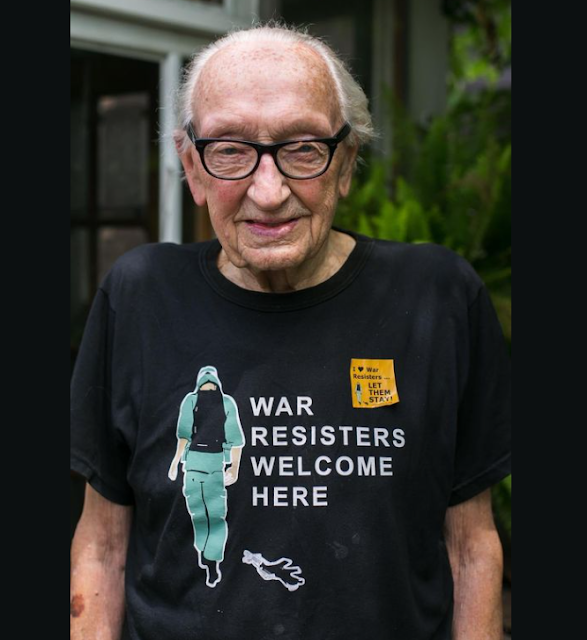
lee zaslofsky, rest in power

This week I learned that a friend and comrade from my Toronto days has died: Lee Zaslofksy. 

Lee was a leader in the War Resisters Support Campaign, supporting men and women who refused to participate in the invasion and occupation of Iraq. For a long time, Lee was the coordinator of the network as it found housing, funds, employment, and community for war resisters coming to Canada. But "coordinator" is a shallow title that doesn't convey what Lee did; his work was much deeper and broader than coordination. Lee supplied friendship and community. He gave of himself. He showed up. He loved.

When you're involved in high-stakes activism, where your work has serious impacts on people lives, people form powerful bonds. You might know very little about someone's background or their day-to-day life, discovering bits of their story as time goes on. Sometimes you might not see or speak with each other in between meetings. Other times you'll speak five times a day. Activist comrades occupy a unique space in your life, different from an ordinary friendship. The passion of your commitment, the depth of your belief, your shared desire to move your cause forward, your deep respect for each other, creates a love that I am grateful to have experienced, more than once in my life. 

Through the War Resisters Support Campaign, I worked with people that I feel incredibly fortunate to have known, so lucky that my life intersected with theirs.

Lee was one of those people to me. Lee will always be on my list of people I am so grateful and fortunate to have known. 

I recall that we didn't always agree on everything, and sometimes differed in our visions of how to move our great project forward. We would become very heated and passionate. I recall him banging the table for emphasis -- and the next time he saw me, hugging me tightly.

Lee was a Vietnam War deserter. He had been a home healthcare aide. He had been a staffer in Jack Layton's office, when Jack was on the Toronto city council. He loved the country of Vietnam, and visited as often as he could, for long periods of time, and had boyfriends there. He was born in Brooklyn, and became a Canadian citizen as soon as he was eligible (as did I).

That might be the sum-total of what I knew about Lee's biography. But I knew much more important things: his principles, his passion for justice, his belief in human potential. His crazy sense of humour, that might elicit anything from an eye-roll to hilarity. The love that poured from him.

His death has hit us all so hard -- all the "resisters and campaigners," we used to say. Now a loose collection of people scattered around North America and beyond, some of us in touch on social media, others not at all, but our bond endures. 

Lee Zaslofsky, rest in power, my friend.

5.17.2024

the propaganda discrediting student protests is sad, frustrating, and incredibly hypocritical

The student movement opposing Israeli apartheid brings my heart so much joy. When I was in university, a similar movement calling for divestment from South Africa played a significant role in the fall of that apartheid. It has the potential to do the same now. Yet mainstream politicians and media -- many of whom attended university during a time of tremendous protest and unrest -- are working overtime to discredit the protestors and their movement. Their efforts appear to be successful. It's disgusting, and incredibly hypocritical.

Ignorance? Why?

The upshot: we are supposed to believe that the protesting students are ignorant pawns being controlled by outsiders. Supposedly they don't even know what they're protesting! 

Why would that be? Why wouldn't students in universities throughout North America be knowledgeable about the situation in the Middle East? One might disagree with their opinions or their stance, but why would we assume they are ignorant?

Did students protesting the war in Vietnam know what they were protesting? Of course they did. Students now have even greater access to information, from more sources, then those students -- the current protestors' grandparents -- did. Of course there is false and misleading information out there. There always has been. We manage to sift through rumour and disinformation, and arrive at our own opinions. Why can't these students? Answer: they can.

Outside agitators

The charge of being controlled by outsiders is probably the oldest tactic in the anti-movement playbook. Southern plantation owners said their enslaved workers were happy until northern abolitionists meddled in their affairs. Striking workers are routinely said to be pawns of their unions, who supposedly have a separate and nefarious agenda. Revolutions the world over are blamed on "outside agitators". Translation: these people are too stupid to organize themselves.

Some of the protestors at the campus occupations are not students. People from the community may get involved to show solidarity and lend support. There's nothing unusual about that, and nothing wrong with it. It doesn't mean the students aren't self-organized. 

Freaks and provocateurs

We've long seen how the media singles out the odd-looking, the radical-looking, the menacing-looking for interviews. Anyone with purple hair, multiple piercings, and facial tattoos is an easy choice. Ordinary-looking, middle-class-appearing people don't make the nightly news. 

And don't forget the impact of hired provocateurs. This, too, has been a feature of mainstream reporting on movements from time immemoriam. The use of provocateurs -- hired by local police departments or the FBI or right-wing media -- has been proven many times over. Yet accusations of provocateurs are dismissed as fantasy or paranoia.

"The stereotypes about today’s students are often ludicrously far from reality"

In a New York Times opinion piece, Elizabeth Spiers writes: "Dear Boomers, the Student Protesters Are Not Idiots".

Appearing last week on "Morning Joe," Hillary Clinton lamented what she views as the ignorance of students protesting the war in Gaza. The host, Joe Scarborough, asked her about "the sort of radicalism that has mainstream students getting propaganda, whether it's from their professors or from the Chinese Communist government through TikTok." Ms. Clinton was happy to oblige. "I have had many conversations, as you have had, with a lot of young people over the last many months," she said. "They don't know very much at all about the history of the Middle East or frankly about history in many areas of the world, including in our own country."

I've taught students at the college level for 12 years, most recently at New York University's journalism school. I've also seen and heard the assumptions made about them by some of their elders — administrators, parents and others. So it's no surprise now to hear protesters described as "spoiled and entitled kids" or delicate "snowflakes" who cower in their safe spaces and don't believe in free speech. Billionaires like Ken Griffin, Bill Ackman and, of course, Donald Trump — as entitled as anyone — have been particularly vocal in their disdain, calling the students in one instance "whiny" and demanding that they be punished for protesting. Representative Mike Lawler, a Republican from New York, even suggested that TikTok should be banned in part because "you're seeing how these kids are being manipulated by certain groups or entities or countries to foment hate on their behalf and really create a hostile environment here in the U.S."

Whether they realize it or not, Ms. Clinton, Mr. Lawler and the rest are engaging in a moral panic about America's youth that is part of a larger effort to discredit higher education in general. That effort includes fearmongering about diversity programs and critical race theory. But it starts with students.

In the current panic, the protesters are described as somehow both terribly fragile and such a threat to public safety that they need to be confronted by police officers in riot gear. To justify the police department's excessive response at Columbia University, Deputy Commissioner Kaz Daughtry showed Newsmax viewers a large chain and a book with the title "Terrorism" that had been recovered from one site of protest. The former was a common bike chain Columbia sells to students and the latter was part of Oxford University Press's lovely "Very Short Introductions" series, which covers topics from animal behavior to Rousseau and black holes. . . . 

High-profile public figures of all ideological stripes have varyingly called for the students to be kicked out of their institutions, made unemployable or sent to prison. They've floated implausible scenarios in which the protests turn deadly. Students brave enough to risk their financial aid and scholarships are derided as childish rather than principled. And though they are educated to participate in civic life, as soon as these students exercise their First Amendment rights, they are told that protecting private property is a more pressing public concern. It's as though some older adults simply can't wrap their heads around the idea that college students, who are old enough to marry, have families and risk their lives for their country, are capable of having well thought-out principles. . . . 

In my experience, the stereotypes about today's students are often ludicrously far from reality. College students of this generation have far more knowledge about complex world events than mine or Ms. Clinton's did, thanks to the availability of the internet and a 24/7 news cycle fire-hosed directly into their phones. Representative Lawler may be correct that some portion of that information comes from clips on TikTok, and social media can be misleading, but there's no evidence that college students are more likely to be misled by TikTok than people Mr. Lawler's age and older are likely to be misled by Facebook. In fact, research indicates that younger people are more savvy and skeptical about media, and more likely to triangulate among different sources to see if something is true.

They may also be more sensitive to the horrors of children being killed here and elsewhere because they grew up participating in active shooter drills and watching the aftermath of mass shootings on the news. They are less financially secure than generations prior, and less likely to believe that institutions will save them or reward them for loyalty and hard work. But they are not babies, and they are not oblivious or naïve. And their ideas and actions cannot be dismissed just because some bad actor — no mass movement is without them — does or says something stupid.

For years, for decades, I've heard members of the Baby Boomer generation brag about student protest during the late 1960s and early 1970s. No matter that those protests didn't take off in earnest until middle-class white students lost their student draft deferments and were at risk of being sent to the killing fields. And no matter that after those protests, most students graduated, married, took jobs, lived an average life, and never attended a rally or a demonstration again. The fact is, they did that. They stood in the crowd, they raised signs, they chanted. And guess what? They smoked weed, which was illegal, and I bet that there were people in the crowd who were ignorant of certain issues. But they did it. And they helped end a war.

What makes you think the current protestors are any different?

2.03.2024

i used to be an activist: another piece of myself has gone missing. or maybe it's on hiatus.

In my experience, the best activism begins like this.

I used to be an activist.

Not being actively involved in a grassroots movement, a part of myself is lost. It's an intentional choice, given the realities that I cannot change. It's what I need. But it's a loss. There's a part of my life that I truly miss.

My purpose and meaning

I've been an activist my entire life. 

I would usually focus on one issue, and explore what I could do within it. South Africa apartheid. Reproductive rights. Violence against women. At-risk youth. Abortion access. US war resisters in Canada. Labour. Each of these, for a time, was a central focus of my life. What gave my life meaning and purpose.

Writing was also part of this. At its best, when I could snag the opportunity, my writing was advocacy. And it certainly was my meaning and purpose. But my activism was in its own sphere. 

When I first became active, I was not a leader. I wasn't even much of a joiner! I wasn't comfortable in group settings; I hadn't found my niche. Realizing my potential as a leader, and becoming comfortable within activist spaces, were big areas of personal growth.

I quickly realized I wanted to work in the grassroots. A group of like-minded people, drawn together by a shared purpose, figuring out a way forward, planning actions, creating opportunities for others to get involved. 

My areas of focus developed organically, expressions of what was important to me, what was most on my mind. I took breaks between issues. I chose what to do next and it chose me.

Throughout most of this time, I didn't work full-time. I was more than full-time busy, but I could cycle through my writing, my various day-jobs, my friends and relationships, and my activism. 

It broke down, and I almost broke down with it

When I became a local union leader, I was also working full-time. This was a big adjustment; more than that, it was unsustainable. I have a chronic health condition, and it was -- to use the common euphemism -- extremely challenging to take care of my health while working and unioning. 

I did that for five years. I have no regrets -- I think back on that time with great pride and joy -- but it took a great toll. Before we decided to move to BC, I had already decided not to run for re-election, and to take a less intensive role in the local.

After we moved, my new local union was led by a group of super smart, talented, badass leaders. I knew I would be active, but I also wanted to put strict limits on my involvement. Now I'm a steward, and a member of my local executive. I was on the last bargaining committee, and I would like to be on the next one. Union is an important part of my life -- I love knowing and working with union people -- but it's well contained.

So here I am

My current work is very challenging and demanding. I love it, but it's full-on. When I'm not working, I very much want a quiet, focused life, and I've committed to that. Reading, writing, cooking, walking. Solo pursuits like working on a puzzle or practicing piano. Time with friends and family. When possible, some travel.  

That I can even talk about this is a sign of my great privilege. It's no accident that most people cannot be active in issues they care about. Our society -- the economic system -- is structured in a way that keeps us busy, too busy to question and work on dismantling the system itself. Full-time work, or more likely, multiple part-time jobs, leaves little enough time for the demands of family, and even basic pleasures, never mind changing the world. For millions who also live with chronic illness -- often linked to trauma -- accomplishing just the basics is a huge undertaking.

And it just gets harder all the time. As capitalism continues its death spiral, the cost of living rises, supports shrink, and life just gets harder. Food insecurity is on the rise. More seniors are living in poverty. These statistics are always lower than reality, defining poverty too low, and not measuring hidden poverty. People choosing between eating and staying warm. Parents skipping meals so their children can eat. Seniors caught shoplifting food. Tiny increases in benefits don't even approach the rising cost of living. More people starve, and freeze, or barely scrape by. 

That we can even talk about this in a nation as wealthy as Canada is a disgrace. And it is completely preventable. Meanwhile, profits soar.

What I'd be doing, if I could 

There are two issues right now that I'd like to be more active in: the movement against Israeli apartheid, and end-of-life choice. But when I think about how I might do that, it breaks down. 

I write letters, I sign petitions, I stay informed. But I'm not out there trying to get others to write letters or meet with their MPs. I'm not organizing, I'm not leading.

Recently my MP had a petition, focusing on a way to remove more harmful waste from the ocean, and an important step for coastal communities like mine. I thought I would solicit signatures in my town. I wanted to... and I never did. 

I joined Labour for Palestine and have attended a few meetings, but I couldn't follow through. 

Dying With Dignity Canada suggests many ways to get involved, but I haven't taken the first step.

I never adopted the language of spoon theory, because I had these ideas decades before the term was coined and popularized. But no matter how we visualize it, time and energy are finite. Health comes first.

It's not only health. I want a quieter, more focused life. A life with more white space on my calendar. In this sense, what I want and what I need align.

Maybe tomorrow, maybe some day

If I'm lucky enough to stay alive and healthy and mobile past retirement, perhaps I'll find my way back to activism.

I have similar thoughts on travel. I don't know if or when we will travel again, other than for family visits. Now in our early 60s, we know our priority must be putting ourselves in the best position for a semi-comfortable retirement, or at least a retirement without poverty. 

I know this, yet travel nags at me. It's not just something I love: it's who I am. Not traveling is giving up a part of myself.

The same is true for activism. My work adds value to the community. I am involved in advocacy -- for my community, and for library workers. Perhaps that is a form of activism, but I miss the grassroots. 

This is my choice, and it isn't. I'm choosing to be more mindful of my health, to not burn out. I didn't choose the conditions that make that necessary. 

Everything in life is a trade-off. Every choice brings both opportunity and loss. I'm truly happy with my life now. And these pieces of myself are left behind.

I'm not fishing for validation or approval. Just putting this out there.

---------

Some related reading:

"I used to be an activist." by Daniel Giles Helm.

My first activist step, by Nicole Bedford

I'm a "spoonie": here's what I wish more people knew about chronic illness, by Kirsten Schultz 

The original spoon theory post by Christine Miserandino

1.16.2024

historic news: south korea bans dog meat trade

I could hardly believe my eyes when I saw the email from HSI Canada: South Korea has banned the dog meat industry.

Humane Society International Korea, along with many other organizations and individuals, have been working on this for decades. I think everyone echoes JungAh Chae, director of HSI/Korea, who said: "This is history in the making I never thought I would see in my lifetime".

Decades ago, I saw a tiny, incredibly brief, blurry image from a dog-meat market, a millisecond in a documentary about dogs. I have never been able to get the image out of my mind. 

We contribute a small monthly donation to HSI Canada, and I follow their news -- although I often won't open their emails, for fear of what I may see. The dog-meat industry is a big focus of their work -- rescuing and rehoming dogs destined for slaughter, and campaigning locally to shut down the industry. This has already been successful in several countries, along with many regional and municipal bans on the industry.

I doubt anyone wants to argue with me about this, but just in case, here, in advance, are answers to the standard questions and objections.

No, I am not vegan. Yes, I support animal welfare initiatives in all forms. There is no contradiction in this. I can eat meat and still oppose inflicting needless suffering, abuse, or cruelty to sentient beings. 

There is no requirement to be an absolutist in our moral and ethical choices. In fact, the false construct that only absolutes are valid is often used as to justify immoral and unethical behaviour.  

Yes, I believe it's all right to eat some animals and not others. This is, in fact, an almost universal belief among humans, across all eras and all cultures. The humane treatment of animals is more important to me than anyone's personal decisions about what to eat.

I don't believe that campaigning against the dog-meat industry is imposing western values on non-western cultures. In every case, the principal campaigners -- the people driving the change -- are local. They are working to change values, then to create laws based on those values. At bottom, that's what most activism is about. 

The details of the new South Korean law, which provides compensation for workers in the dog meat industry, are incredible.

My heart is full of appreciation and admiration for everyone who has worked to make this historic win possible.

+ + + + + 

BREAKING: South Korea bans the dog meat industry with historic vote at National Assembly as animal campaigners 'overjoyed'

'This is history in the making I never thought I would see in my lifetime,' says JungAh Chae, director of HSI/Korea

SEOUL—South Korea's National Assembly has today voted through a ban on the dog meat industry in what animal campaigners at Humane Society International/Korea have called "history in the making." Up to 1 million dogs a year are factory farmed and killed for human consumption in the country. The ban, which comes into force in six months' time with a three-year phase out, will make the breeding, slaughter and sale of dogs and dog meat for human consumption illegal from 2027, with penalties of up to three years' imprisonment or a fine of up to 30 million KRW.*

This news follows considerable public and political momentum. With over 6 million pet dogs now living in Korean homes, demand for dog meat is at an all-time low. A 2023 Nielsen Korea opinion poll shows that 86% of South Koreans won't eat dog meat in the future and 57% support a ban.

JungAh Chae, executive director of Humane Society International/Korea, which has campaigned tirelessly for a ban, welcomed the news by saying: "This is history in the making. I never thought I would see in my lifetime a ban on the cruel dog meat industry in South Korea but this historic win for animals is testament to the passion and determination of our animal protection movement. We reached a tipping point where most Korean citizens reject eating dogs and want to see this suffering consigned to the history books, and today our policymakers have acted decisively to make that a reality. While my heart breaks for all the millions of dogs for whom this change has come too late, I am overjoyed that South Korea can now close this miserable chapter in our history and embrace a dog-friendly future."

Dog farmers, slaughterers and restaurant owners will be eligible to apply for compensation, and after review, government support will be offered to transition or close those businesses, similar to the Models for Change program run by HSI/Korea. Since 2015, HSI has helped 18 dog farmers across South Korea switch to growing crops such as chili plants and parsley, or water delivery and other livelihoods.

HSI/Korea urges the government to use the three-year phase out period to work with animal groups including HSI/Korea to rescue as many dogs as possible in a state-sponsored, coordinated effort.

Kitty Block and Jeff Flocken, respectively CEO and president of HSI globally, issued a joint statement, saying: "This is a truly momentous day for our campaign to end the horrors of the dog meat industry in South Korea, and one we have been hoping to see for a very long time. Having been to dog meat farms, we know only too well the suffering and deprivation these desperate animals endure in the name of an industry for whom history has now thankfully called time. This ban signals the end of dog meat farming and sales in South Korea, and we stand ready to contribute our expertise until every cage is empty."

South Korea now joins a growing list of countries and territories across Asia that have banned the dog meat trade (with varying degrees of enforcement), including Hong Kong, Taiwan, the Philippines, India, Thailand and Singapore, as well as the cities of Shenzhen and Zhuhai in mainland China, Siem Reap province in Cambodia, and 45 cities, regencies and provinces in Indonesia.

[Go to original for links.]

12.03.2023

write for rights 2023: my fifteenth year #w4r2023


2023 marks the fifteenth year that I have participated in Amnesty Interntional's Write for Rights.

Fifteen years ago, I chose one case, one person. I wrote to officials about them, and wrote to them as well. 

I upped the ante a bit more every year, until the year (date unknown!) when I challenged myself to write a letter for every featured case. Since then I've written at least one letter for each of the 10 featured cases, and at least one letter of support.

In 2014 I also joined Amnesty's Urgent Action Network. Urgent Action sends you cases on an occasional basis; you write to officials on their behalf if you can. I respond to about half the emails I receive, depending on what's going on in my life. 

There is one more piece I want to add: I want to organize a virtual letter-writing group event. This is an obvious step for me, but so far I haven't been able to get it off the ground. But I haven't let go of the idea. Eventually I'll figure it out.

I'm not sharing this to win praise or admiration. I'm sharing it to encourage you to write with me.

It's very easy

My annual W4R letter-writing takes about an hour -- and that's because I choose to write for every case, 10 global cases plus one from Canada. You could easily do the whole thing in 15 or 30 minutes.

The only cost involved is international stamps, as I like to send paper mail when possible. I consider this part of my end-of-year charitable donations (albeit not the tax-deductible kind). If postage money is a barrier, you can easily choose only cases that can be contacted by email.

Amnesty offers tons of support. There are sample letters, toolkits, case cards. If you're intimidated by doing this on your own, there are groups you can join to help motivate you. There are also resources for educators and organizers. 

This year there was even an option to receive a paper kit by postal mail. That's a lot of paper, so I didn't order a kit, but if it would help motivate you, sign up for Write For Rights and Amnesty will send you one.

It works

Amnesty has developed Write For Rights because it works: go here and scroll to "success stories".

Last year, people in more than 200 countries took over 4.6 million actions -- letters, emails, tweets, petitions. They helped individuals in dire circumstances, while exposing conditions and highlighting urgent issues.

Write For Rights saves lives. It gives comfort and support to people who are suffering for their activism. It shows families of these heroes that they are not alone. 

W4R 2023: this year's global cases

This year's global cases focus on these individuals, countries, and human rights.

➤ Maung Sawyeddollah, in Myanmar, is exposing Facebook's role in the murderous campaign against people from the Rohingya ethnic group. 

➤ In Australia, two Indigenous people known as Uncle Pabai and Uncle Paul are fighting to save their ancestral lands from the ravages of climate change. To save a culture that has been passed down through generations for thousands of years, they have gone to court to demand Australia take immediate and meaningful action against climate change.

➤ Thapelo Mohapi, in South Africa, is in hiding and fears for his life. Thapelo is a leader of Abahlali baseMjondolo, a grassroots movement working to improve the lives of people in South Africa. Members of the group are being targetted and murdered.

➤ In Tunisia, Chaima Issa speaks out against an autocratic government. She has been arrested, detained, and banned from meeting with others or speaking in public. She remains defiant, despite facing decades in prison.

➤ Rocky Myers is an intellectually disabled Black man in the US state of Alabama. He is on death row for murder, despite there being no evidence linking him to the crime. His trial was a riddled with issues, including a witness who has since admitted that they lied. After nearly 30 years on death row, Rocky could be executed at any time. 

➤ Justyna Wydrzyńska, in Poland, has been arrested, prosecuted, and convicted for helping women access safe abortions.  

➤ In the United Arab Emirates, Ahmed Mansoor is being held in an isolation cell. Ahmed's "crime" is speaking the truth about the UAE, providing the world with a very rare glimpse of the rampant human rights violations in that country -- including fake trials, and the detention and torture of dissenting voices. For more than a year, no one knew where Ahmed was being held. Now he faces a decade in prison.

➤ Thulani Maseko, in the southern African nation of Eswatini, endured more than a year in prison, until he was executed in his own home. Thulani's "crime" was defending human rights in a country ruled by an absolute monarchy.

In Brazil, the son of Ana Maria Santos Cruz organized "Walks of Peace", where people would speak out against police abuses. He was repeatedly threatened, and then murdered. Ana continues to fight for justice for her son.

➤ In Kyrgyzstan, Rita Karasartova leads the Institute for Public Analysis and is a member of a democracy movement. For her peaceful work against poverty and injustice, Rita was arrested, detained, and denied access to healthcare. She is now under house arrest, charged with attempting to "violently overthrow the government".

Human rights abuses in our own backyard

In the list of annual cases, Amnesty reserves one spot for the letter-writer's country. I love this idea. It reminds us that urgent human rights issues don't happen only in faraway lands. The cases in Canada usually involve Indigenous peoples, and are often taking place in my own province -- still known as "British Columbia".

➤ The Wet'suwet'en First Nation is under threat from a huge pipeline being constructed through their traditional and unceded territory. Wet'suwet'en land defenders have been harassed, intimidated, forcibly removed, and criminalized by the RCMP, Canada's national police force. They need our support.

6.23.2023

what i'm reading: the story of jane: the legendary underground feminist abortion service

When I first got involved in pro-choice activism, way back in 1981*, I heard about a group called Jane. Or maybe the Jane Collective. Or maybe Call Jane. No one knew for certain what they were called, only what they did. The women of Jane learned how to perform abortions, and helped women safely terminate pregnancies when abortion was still illegal in the United States. 

That was the sum total of what I knew about Jane. 

Now that abortion is again illegal in many US states, and impossible to access in most others -- and now that people outside the reproductive rights community have finally woken up to this reality -- Jane is in the spotlight. There are now several movies about Jane, both documentaries and feature films, many long feature articles have been written, and there's more than one book about it.

This book -- The Story of Jane: The Legendary Underground Feminist Abortion Service, published in 1995, reissued in 2019 -- was written by a member of Jane. It's both a history lesson and a how-to guide. 

Putting abortion on the agenda

The Story of Jane paints a very clear picture of the landscape of women's health and reproductive freedom -- and the lack thereof -- at that time. Everyone concerned about reproductive rights should read this book, if only for that reason. 

As I've written countless times in this blog, and as countless other movement activists say, abortion is the sine qua non of liberation for women (and any person who can become pregnant). Without the ability to control our reproduction, we are slaves -- to our bodies, to governments, to other people's ideologies. The Story of Jane is a stark reminder of this.

But here's something that may surprise you: previous to the women's liberation movement (as it was then called), abortion and birth control were not talked about as women's issues. Although vast social revolutions -- the civil rights movement and the peace movement -- were re-shaping society, contraception, abortion, and violence against women** were considered personal issues, or medical issues. Women weren't part of the conversation. Or there was no conversation at all.

Feminist consciousness raising -- an instrument of the women's liberation movement -- brought a new perspective: the personal is political. Seen through this lens, the epidemic of violence against women, the lack access to birth control, and the criminalization of abortion, were not personal obstacles to be borne or somehow overcome. They became social and political issues, central to women's autonomy and personhood, necessary for all people to fully participate in the world. 

Jane was part of that change.

Two intertwined stories

This book is not only a history lesson. It's an inquiry into the nature of activism, feminism, and radical transformation. In a sense, The Story of Jane is two stories.

One story is the very practical aspects of how a group of women with no prior training in healthcare came to provide an underground, illegal service that offered counseling, abortion, and after-care -- that eventually performed 11,000 safe, illegal abortions -- that inspired "Jane" services in other cities -- and that was determined that the process itself would give women full control and agency through the entire experience. 

The women of Jane needed to answer innumerable questions and navigate countless challenges.

How to reach women who wanted to terminate pregnancies.

How to provide counseling that was effective and nonjudgemental.

Where services could be provided.

How to keep themselves safe while they engaged in these illegal activities.

How to find and safely integrate new members, as the service grew.

How to find a person who could perform safe abortions.

How to assist in procedures.

And eventually, how to perform abortions themselves.

The other story is about the power dynamics, and the potential for transformation, in radical activism. The women of Jane wanted to create a group that didn't replicate the power hierarchies of the larger society, one in which decisions were made through consensus by a group of equals. What they created was definitely not the former, and not quite the latter. 

This part of the story resonated deeply with me. Readers who have been involved with radical  grassroots activism, especially in the creation of something new, are likely to recognize themselves, too.  

Women as the authors of their own lives

Everything Jane did was grounded in feminist theory. Abortion wasn't something done to a woman. It was more than a choice: the woman was an active participant in the process.

Until the late 1960s, modern medicine was almost exclusively a male domain. Patients had virtually no decision-making power, and female patients were the bottom of the food chain. This most definitely included OB/GYN care.

Griswold, the landmark 1965 Supreme Court decision that legalized contraception, applied only to married couples. Single women were prohibited from accessing birth control until 1972 (Eisenstadt v. Baird). Most women didn't even understand their own anatomy and physiology, and there was little or no opportunity for education. 

The women's liberation movement changed that. Jane was on the very forward edge of that transformation.

The women of Jane were determined that a "Jane abortion" was not only physically safe, but was also a positive experience. It offered not only safety, but agency. It brought (in their own words) "a feminist perspective which [women] could use as a tool to understand and improve their lives". Jane "wanted women to grow from their contact with the service". 

In this new paradigm, the decision to terminate a pregnancy had the potential to be incredibly empowering. As one Jane client put it, "I've just had an illegal abortion and it was the best medical experience I've ever had". 

Groups are hard

I was very interested in Jane's group dynamics, which I recognized from my own experiences with both the Haven Coalition, a network supporting women traveling to New York City to access abortion services, and the War Resisters Support Network, which supported U.S. soldiers opposed to the invasion and occupation of Iraq. 

Anyone who has been involved with complex, high-stakes, and potentially dangerous activism will find the stories of how Jane shared information and made decisions edifying, and possibly validating. I especially related to the structure that evolved organically (and not necessarily intentionally): a series of concentric circles, based on who was entrusted with certain information.

As a feminist organization, Jane struggled with the dynamics that would churn through all feminist organizations of its day: it was mostly white, heteronormative, and middle class. I remember a Haven member observing that Haven was their most consistent cross-class experience. We were mostly women of privilege helping mostly women without. This was part of Jane as well.

That imbalance creates a lot of opportunity for awareness and growth. It can sometimes be awkward and it can sometimes be unintentionally offensive. It necessitates a lot of difficult conversations. It can be challenging, both to live with and to try to change.

Some members of Jane were people of colour, and at least one woman of colour was part of the inner circle, and in the book, she attests to the true sisterhood that existed among the group. But of course her presence didn't doesn't change the basic dynamics of power, class, and privilege.

How they got away with it... until they didn't

Jane operated in a kind of netherworld of open secrets. Thousands of women found Jane, through cryptic flyers, ads in the alternative press, and word of mouth. Hospitals and physicians, ministers and lawyers, police and professors: all referred women to Jane. The Chicago police looked the other way, and police department employees and the families of police officers used the service. 

Jane adopted many complicated practices to keep themselves and their patients safe. But Jane was heavily surveilled; eventually one of their locations was raided and some members were arrested. The story of the arrest and aftermath are gripping and sometimes ironically amusing.

Once the women of Jane learned that the police raid was not ordered from above -- and in fact "if certain higher-ups had been on duty that day, the bust would not have happened" -- the group swung back into action. It was a reduced group, but it survived and continued its work. That takes some kind of courage.

The Story of Jane is full of surprising and enlightening details. Here are some things I learned.

* Members of the clergy were integral to the early pro-abortion-rights movement. I knew that faith leaders were important in both the civil rights and peace movements, but I didn't realized they had been so active in the early fight for abortion rights, too. Ministers referred women to Jane and other illegal alternatives, and were able to use their moral standing -- their bullet-proof vestments -- to push for reform.

* During the raid and arrests, the police kept demanding, "Where is he? Where is the doctor? Where is he?". But there was no "he". The police could not conceive that this was all taking place without a doctor, and in fact without any men at all.

* At the time of the raid and arrest, hundreds of women were waiting for Jane abortions. Jane members called each one to discuss their options. Abortion clinics in New York and Washington DC, where abortions were already legal, said, "If your women can get to us, we'll give them free abortions." 

* When an experimental abortion procedure became available in a different city, about 20 Jane clients agreed to try it. Jane chartered a bus and the women travelled together. The opposition was huge, vocal, and borderline violent -- and from within the abortion-rights movement. The women on the bus became a team, determined to continue, and supported each other throughout the experience. This was a fascinating and largely unknown piece of movement history.

Words of their own

In the epilogue, I appreciated Kaplan's analysis of Roe v. Wade, what it was and was not. 

Roe was never feminist. It was a validation of the rights of doctors to make decisions for their patients. It was not a validation of a woman's right to decide whether and when to bear a child. 

I'll end this review with two quotes from Kaplan's book. This is the final paragraph:
The service embodied a shift in consciousness, from asking for something to doing it ourselves. Deborah told me that she tries to convey to her students that if a thing needs to be done, we can do it, figure it out, step by step. We in Jane learned that social change is not a gift given by leaders and heroes, but is accomplished by ordinary people working together. We make it happen by what we choose to do. 
And this, a member reflecting on her decision to become involved.
I was . . . a law-abiding citizen with a fairly strong belief in the rule of law. It [being involved in Jane] gave me a new image of myself, not only of doing something that was against the law, but, more important, being part of a group of people taking matters into their own hands, because the law was not meeting their needs.
--------

* In 1981 I attended pro-choice actions, but wasn't yet an organizer. The main focus of my activism at that time was anti-apartheid. I became a pro-choice organizer in 1985 or 1986.

** The expressions "domestic violence," "relationship violence," and "intimate partner violence" were not used at this time. In the larger world, this abuse was called "wife beating". People in the movement called it "violence against women".

12.10.2022

in which i have nothing new to say: just write for rights #w4r22

It's that time of year again: time to Write for Rights

Looking back on my write for rights posts for the last several years, it appears that I've been recycling ideas for a long time! And I'm about to do it again. Why spend more time writing this annual blog post, when I could be writing letters? And really, what more is there to say? Here's most of what I wrote last year.

Why do we need Write for Rights? Look at the case thumbnails

Why is this a good thing to do with your time? Wmtc W4R 2019:
All through this year, I've been struggling with cynicism and despair about the state of our planet and the state of democracy. So even though all the warm and fuzzy reasons I've listed in the past (and below) are true and valid, the most important reason to Write For Rights is deadly serious. The world is seriously fucked up. Many, if not most, of us who care about the world feel helpless in the face of such enormous, complex, and intractable problems. Whether or not we will collectively succeed in making a difference on a global scale, we can each make a difference on an individual scale. Amnesty International provides us with an opportunity to do that.
Why is this a great form of activism? I originally wrote this in 2014, and since then I've been recycling it annually. I tell myself that rather than come up with something new, I'll use the time to Write for Rights.
1. It's easy. Amnesty makes it really easy to participate. Read, type, send.

2. You can do do it from any computer. No meetings to attend, no schedule to keep. Just more of something you do all the time anyway: typing.

3. It's free. No need to donate money. The most this will cost you is postage.

4. You'll feel good about yourself. Enjoy that warm buzz you get from voluntarily helping other people. There's nothing quite like it.

5. You can choose how much to participate. Write one letter, write two letters, write three. Spend 10 minutes writing or spend an hour.

6. You can choose what to focus on. Write about an issue in your own country. Write about an issue in your country of origin. Write for children, or for women, or for LGBT people, or for workers, or for environmental activists, or for another issue that you care about.

7. You're busting stereotypes. We supposedly live in a selfish age where all we care about is I, me, mine. Challenge yourself to say it ain't so.

8. It works globally. Every fight against injustice begins with someone shining a light in a dark place. Be that light.

9. It works locally. When political prisoners are released, they often attest to the difference letters from strangers made in their lives: that knowing they were not forgotten helped them survive.

10. You enjoy your own human rights every day. Why not use them to help someone who can't? It doesn't take much time. It's not difficult to do. And it works.

8.15.2022

what i'm reading: the leak: great junior graphic for the young activist in your life

It starts with a trip to the dentist. Ruth Keller swears she brushes her teeth and flosses daily, yet the cavities are piling up. The dentist lectures, her mom scolds. No one believes that Ruth takes proper care of her teeth -- but she does. 

Then Ruth and a friend see workers dumping something into the lake. 

Ruth already writes an online newletter. She gets to work investigating, and repurposes her newsletter into an exposé. 

In The Leak, Kate Reed Petty and Andrea Bell have created an updated and more complex descendant of Harriet, from the classic Harriet the Spy. Ruth is the perfect young hero: smart, brave, misunderstood, flawed -- learning and growing.

Ruth dives headlong into her activism -- rashly, clumsily, and with great courage. Some adults oppose her and try to stop her. A couple of adults recognize her potential and offer guidance and support. Ruth is smart and resourceful and finds a way through, but not without a cost. As she exposes the truth about her town's poisoned water, many hard truths are exposed to her.

The story references the real-life story of the poisoned water in Flint, Michigan. There's an explanatory epilogue that would come off as unnecessary and didactic in an adult novel, but I appreciate it for younger readers. 

I would have loved this book as a child. In many ways, I was Ruth -- a writer, an activist, straddling the line between my nerdy preferences and my need to fit in. Ruth's journey would have been the perfect fantasy for me, but this book would have wide appeal for many young readers. 

I loved Kate Reed Petty's debut novel, True Story. On Petty's website I see she has written another junior graphic, which I will now look for. I'm looking forward to whatever she writes next.

5.06.2022

the end of roe and how we got here


With the unprecedented leak of the SCOTUS draft brief, and official confirmation of the politicization of the Court, we see the final nails pounded in the coffin of Roe v. Wade -- a turning point which somehow still shocks many people, despite the exceedingly clear regression to this point over the past 40 years.

Given this, it seems strange to me that I haven't blogged about abortion rights in more than two years.

Strange, because this is the issue I care most about, above all else. 

Strange, because I've spent a good portion of my life thinking, writing, organizing, and supporting abortion rights and abortion access.

Strange, because I am angry and hurting about this. But I suspect I am angry at different people than many readers may be.

Partly I stopped writing about Roe and US abortion rights because I feel I have nothing left to add to the discourse -- nothing to write that I haven't written again and again. Here in 2018, I re-ran my essay from 2005. No matter how many ways I find to say it, it comes down to two points.

One. Abortion rights are essential to human rights, to justice, and to basic equality for all people. Abortion rights are the sine qua non of women's freedom, and the bottom line of equality for any person who can become pregnant.

Two. Roe v Wade is meaningless for millions of American women, and has been for decades. Abortion rights have been steadily impeded, eroded, and erased for more than 40 years, a process that began with the passage of the Hyde Amendment in 1976, gathered momentum when Ronald Reagan became president in 1980, and has barrelling downhill ever since. This includes the 16 years of Democrat presidencies. 

And partly I stopped writing about Roe and US abortion rights because I have been so angry and frustrated that people were -- with extreme laws passed in Mississippi and Texas --  now finally paying attention. That sounds counter-intuitive and is not a good way to approach activism! But I just could. not. stand it.

1976 Hyde Amendment (only affects poor people, so who cares)
1984 Global Gag Rule (only affects poor people in other countries, so who cares)
1989 Webster; 1992 Casey -- both losses for reproductive freedom, but left Roe intact, so who cares
And on and on. (Start your timeline here, then here.) As long as Roe had not been overturned, most liberals and Democrats were willing to look away. 

For a majority of Democrat voters, the most important thing to know about abortion rights were: vote Democrat because of the Supreme Court, because we can't let them overturn Roe v Wade.

And while the majority obsessed over Roe, Roe became increasingly irrelevant. 

I'm not suggesting Roe actually is irrelevant.  But it's been hollowed out. It's a shadow. A shell.

The anti-abortion-rights movement had everything it needed to succeed. 

They were extremely organized, extremely well-funded, and very strategic. They got their people elected to state legislatures and began to work the system, passing every type of abortion-rights restrictions anyone could dream up, taunting the court challenges, knowing that eventually, with enough states becoming hostile to abortion, they would accomplish their only objectives: increasing numbers of low-income women and pregnant people would lose control of their reproduction, and the country would move one step closer to overturning Roe v Wade.

The anti movement has had other factors in its favour. In addition to money, organization, and strategy, they had the Democrats. Abortion became a dirty word, replaced by the euphemism "a woman's right to choose". Bill Clinton said let's make abortion "safe, legal, and rare" -- with little or no attention paid to the myriad laws, supports, and resources it would take to make such a thing possible.

They had the "muddled middle" -- to use Katha Pollitt's excellent expression -- whose discomfort with the idea and reality of abortion made it easy to look away. Shamed by stigma created by anti-abortion-rights zealots and the media who support them, most were happy to look away.

There are other reasons, too.

Roe v. Wade was never a strong ruling; it was always vulnerable to attack. The right to abortion is more secure in Canada -- although it is often under threat and must always be protected and defended! -- because the 1988 ruling in R v Morgentaler is a much broader decision. 

The US's obsession with states' rights, and the right wing's expert exploitation of it, have left millions vulnerable, not only on reproductive justice, but on so many fronts.

The US's lack of an organized healthcare system leaves millions vulnerable to assaults on reproductive freedom. If you lack basic healthcare, that's going to include a lack of access to reproductive needs.

The mainstream media's adoption of the disgusting lie "pro-life" -- the greatest PR coup of the modern world -- did untold damage. 

But be assured of one thing. Our side has been planning for this for decades, too, with abortion funds, underground networks, and direct action. It's a much more successful strategy than voting Democrat.

As always, the Guttmacher Institute is your best source for data on all aspects of reproductive justice. 

If you want to help, donate to abortion funds: National Abortion Federation, National Network of Abortion Funds. Canada has one, too.

If you live in a free state and have the resources, you can host a person traveling for abortion from a slave state. It's incredibly important and deeply gratifying work. NNAF can help you find a network. 

2.27.2022

frank showler: called to be faithful


Frank Showler, born in 1919, died last week at the age of 102. 

Frank was a foundational figure in the social-justice activist community, seemingly participating in every demonstration, rally, vigil, and campaign. It was a universal saying: It's not a demo until Frank shows up. And show up he did, to an astonishing degree.

Frank didn't just show up for causes. He showed up for people. He was one of the warmest, most generous, compassionate people I have ever met. Although everyone around me had known each other for many years, and I was a newcomer, Frank made me feel like an old friend. To Frank, no one was an outsider.

I met Frank through the War Resisters Support Campaign, which fought for the right of former soldiers who refused to participate in the invasion and occupation of Iraq to remain legally in Canada. I am incredibly fortunate that my path intersected with Frank's. The years of our friendship were but a small portion of his long life, but a treasured part of mine, a part of great value. (I feel this way about all my war resister campaign friends.) 

Frank was a World War II war resister. For refusing to fight, he was arrested and sentenced to a series of work camps. When he was assigned alternative service working in a hospital, he organized the low-wage orderlies.

Doing refugee work in South America, Frank met Isabel, the beginning of a lifelong partnership in love and in movements. By the time I met Frank, Isabel had already died. But most people knew them as Frank and Isabel, inseparable.

Long ago, I wrote about an event Allan and I attended in Toronto, called "I Object: Three Generations of War Resisters Speak Out" (post is here; comments are missing). Although I am an atheist to my core, I will never forget something Frank said that night: War is contrary to the mind of Christ. A minister with the United Church, pacifist at the time, told him that. The church changed its unpopular stance, but Frank said he saw no evidence that Jesus had changed his mind. 

If you asked Frank, how do you keep going -- bearing witness, protecting the weak, fighting for the disenfranchised, speaking out against war -- when the problems are so huge, and the powers are so great, he would reply: We are not necessarily called to be successful. We are called to be faithful.

Although I do not have religious faith, I hear this as a call to live our values. Something to always strike for, however imperfect our efforts.

Yesterday I attended a Quaker meeting (on Zoom) that was a memorial to Frank Showler. Everyone who spoke told the same type of stories. It was clear how deeply he will be missed. I encourage you to take some time and scroll through some of these Facebook posts memorializing him.

I was incredibly fortunate to know Frank, and I will miss him. 

Frank Showler, ¡Presente!

12.10.2021

take a social media human rights challenge: write for rights 2021 #w4r21

Advanced planning is no match for the calendar! Despite my early preparation, December 10 -- Human Rights Day -- still caught me off-guard. I haven't reviewed any cases or set any time aside. 

I recently finished an excellent book called Digital Minimalism: Choosing a Focused Life in a Noisy World. (I have a review in drafts... coming soon-ish.) My usual time crunch plus thinking about this book gave me an idea for a new personal challenge: substitute 15 minutes of social media per day with one human-rights letter, on paper.

Rather than scrolling through my friends' updates and the latest hilarious memes, I'll visit the Write for Rights Canada homepage, choose one case, and write one letter.

I'll do this once a day, every day, for 10 days, until I've written a letter for every case.

I invite you to join me in this challenge.

Why do we need Write for Rights? Look at the case thumbnails

Why is this a good thing to do with your time? Wmtc W4R 2019:
All through this year, I've been struggling with cynicism and despair about the state of our planet and the state of democracy. So even though all the warm and fuzzy reasons I've listed in the past (and below) are true and valid, the most important reason to Write For Rights is deadly serious. The world is seriously fucked up. Many, if not most, of us who care about the world feel helpless in the face of such enormous, complex, and intractable problems. Whether or not we will collectively succeed in making a difference on a global scale, we can each make a difference on an individual scale. Amnesty International provides us with an opportunity to do that.
Why is this a great form of activism? I originally wrote this in 2014, and since then I've been recycling it annually. I tell myself that rather than come up with something new, I'll use the time to Write for Rights. 
1. It's easy. Amnesty makes it really easy to participate. Read, type, send.

2. You can do do it from any computer. No meetings to attend, no schedule to keep. Just more of something you do all the time anyway: typing.

3. It's free. No need to donate money. The most this will cost you is postage.

4. You'll feel good about yourself. Enjoy that warm buzz you get from voluntarily helping other people. There's nothing quite like it.

5. You can choose how much to participate. Write one letter, write two letters, write three. Spend 10 minutes writing or spend an hour.

6. You can choose what to focus on. Write about an issue in your own country. Write about an issue in your country of origin. Write for children, or for women, or for LGBT people, or for workers, or for environmental activists, or for another issue that you care about.

7. You're busting stereotypes. We supposedly live in a selfish age where all we care about is I, me, mine. Challenge yourself to say it ain't so.

8. It works globally. Every fight against injustice begins with someone shining a light in a dark place. Be that light.

9. It works locally. When political prisoners are released, they often attest to the difference letters from strangers made in their lives: that knowing they were not forgotten helped them survive.

10. You enjoy your own human rights every day. Why not use them to help someone who can't? It doesn't take much time. It's not difficult to do. And it works.
If you're joining W4R from Canada, these are the cases being highlighted this year. I really appreciate that Amnesty Canada always includes a human rights violation taking place at home. These usually involve Canada's unacceptable treatment of Indigenous people. This year, however, it focuses on Prime Minister Trudeau's obstruction of global vaccine equity.

12.03.2021

get ready for write for rights 2021 #w4r21

Write for Rights, Amnesty International's annual global human rights campaign, begins on December 10. I like to think of W4R as a month-long event, and generally spend the month of December -- and often part of January -- writing my letters. 

Amnesty recently sent this:

5 ways you can get ready to Write for Rights on or around December 10!  

Get the cases: Read their stories, watch the videos, sign the online actions and send tweets to get warmed up. 

Find a local event: Join a virtual or socially distanced event near you — several are happening this week — or host your own

Join the Canada-wide Virtual Marathon: Drop in between 12:00 pm-8:00 pm EST on Friday, December 10th to write letters and hear from special guests, including people we're supporting in current and past Write for Rights campaigns. Details to come!

Check out more resources: Get the letter-writing guide, sample letters and materials for young people.

Show your solidarity: Join the photo solidarity action in support of Bernardo Caal Xol and the threatened Maya Q’eqchi’ communities he represents.  

Here's how I get ready:

1. Block out some time each week to write at least one letter on paper. Letters sent through the paper mail mean more than emails or tweets.

2. Buy international stamps. These can be pricy, but I think of them as a human-rights donation.

3. Check my supply of envelopes, usually two per case, sometimes three.

4. Check on printer ink cartridges.

5. Bookmark this year's cases.

I used to have a sixth step: deciding which cases I would address. Then some years ago, I challenged myself to write a letter for every case, plus at least one solidarity letter to an individual. I've done that ever since.

Stayed tuned for my annual W4R post on December 10.

12.01.2021

tom morello on the iww and the soundtrack to the good good fight

In October, The New York Times published this piece by musician and activist Tom Morello. I've read it several times, and shared it on social media, and still I can't stop re-reading and listening. When something moves me like that, you know I have to preserve it on this blog.

I am and always will be a Wobbly at heart. I often feel I was born in the wrong era. Rather than sitting across the table and trying to persuade an employer to put a few more scraps in a contract, I should have organized to down tools and bring the sweatshop to a halt.

I'm re-posting Morello's essay here. The original has embedded song clips. Hopefully you'll be able to access it without hitting a paywall.

*  *  *  *

SONGS OF JUSTICE, SONGS OF POWER

By Tom Morello

Mr. Morello has spent over three decades melding music and political activism as a power guitarist with Rage Against the Machine, Audioslave and Bruce Springsteen and the E Street Band, with the acoustic chords of the Nightwatchman and in protests around the country.

Harmonizing and hell-raising, rhythm and rebellion, poetry and politics, singing and striking. The Industrial Workers of the World — the shock troops of the early-20th-century labor movement — virtually invented the protest song for the modern age.

The I.W.W. was formed in 1905, advocating a militant revolutionary unionism, a cocktail of socialist, syndicalist and anarchist labor theory put into practice. It was always known as a singing union, and its songs were written by hobos and the homeless, itinerant workers and immigrants. I.W.W. songs — like "The Preacher and the Slave and "Solidarity Forever" — looked an unjust world square in the eye, sliced it apart with satire, dismantled it with rage and then, with mighty sing-along choruses, raised the roofs of union halls and holding cells, "from San Diego up to Maine, in every mine and mill."

The goal of the Industrial Workers of the World — or Wobblies, as members were widely known — was revolution, not just winning strikes. Unlike other unions of the time, it accepted all workers as members: Black people, women, unskilled laborers, sex workers, immigrants of every race and creed. It sought to forge "one big union" of the entire global working class and used direct action, sabotage and the power of song in class war against the ruling class. Its reputation as a kick-ass union fueled by kick-ass songs remains the stuff of legend.

"Solidarity Forever" by Tom Morello: the Nightwatchman [click through to original to listen]

Its songs, some more than 100 years old, addressed the same issues facing us today: poverty, police brutality, immigrant rights, economic and racial inequality, militarism, threats to civil liberties, union busting. "Casey Jones (The Union Scab)," "We Have Fed You All a Thousand Years," "Bread and Roses," "Ain't Done Nothin' if You Ain't Been Called a Red" — often set to familiar tunes and popular hymns of the day, these songs united workers from diverse backgrounds under the banner of solidarity. What's the antidote for divide and conquer? Work together, fight together, sing together.

Defiant and hopeful, these songs have an unapologetic mission: to fan the flames of discontent by lifting the spirits of those fighting for a more just and humane planet. The I.W.W. aimed to "create a new society within the shell of the old," and I hope you can hear that new world echoing here, where song meets struggle.

The Wobbly songwriters also laid the sonic and ideological groundwork for those who followed: Woody Guthrie, Lead Belly, Pete Seeger, Paul Robeson, Utah Phillips, Bob Dylan, Phil Ochs, Nina Simone, Bruce Springsteen, the Clash, Public Enemy, Billy Bragg, Ani DiFranco, System of a Down and Rage Against the Machine. Without them, there'd be no "This Land Is Your Land," no "We Shall Overcome," no "Masters of War," no "London Calling," no "Killing in the Name."

Much of my career has been one long audition to become a part of that legacy. I'm a union man and an unapologetic musical rabble-rouser. I've been a member of the Local 47 musicians' union in Los Angeles for 32 years, and I'm a proud card-carrying member of the Industrial Workers of the World — it lives on! My mom was a union high school teacher, and the Morellos were hardworking coal miners in central Illinois. The cause of workers' rights is in my blood.

I've been greatly influenced by many of the songs and songwriters who carried that red union card. Playing acoustic protest music under my folk singer Nightwatchman moniker, I've written and sung dozens of tunes that owe a significant debt to this union's remarkable musical history. My song "Hold the Line," from my new album, is an example of how I've tried to carry forward that legacy.

"Hold the Line" by Tom Morello (feat. grandson) [click through to original to listen]

My guide has been Joe Hill, who epitomized the I.W.W.'s anarcho poet warrior. He is my favorite musician of all time, even though there are no known recordings of him playing or singing. He was a tireless crusader for justice through his music, and his jams are a fine starting point for aspiring rebels. Hill was an I.W.W. organizer and a true musical and political revolutionary. He walked it like he sang it. That's why the mine owners and the other bosses out West, and the politicians who did their dirty work, were afraid of him. And in the end, that's why in 1915 he was executed in Utah on a trumped-up murder charge.

"A pamphlet, no matter how good, is never read more than once, but a song is learned by heart and repeated over and over," Hill famously said. His songs ("There Is Power in a Union," "We Will Sing One Song," "Joe Hill's Last Will") are sung today and will be tomorrow.

I've traveled far to pay my respects to the heroes of the I.W.W. I've placed flowers on Mother Jones's grave in Mount Olive, Ill. I've hummed "The Internationale" at the resting place of Big Bill Haywood's ashes in the Kremlin wall. And while on tour in Sweden, I made the hundred-mile trek from Stockholm to Gavle, Hill's birthplace.

I sat by a little tree in the backyard that blooms where his ashes were spread, and I sang "I Dreamed I Saw Joe Hill Last Night," written in the 1930s by Earl Robinson from a poem written by Alfred Hayes in the years after Hill's death. The tiny room in the building where he and his family lived now serves as a union headquarters and museum. Fascists bombed the place 20 years ago. After all these years, they're still afraid of Hill; they're still afraid of his songs.

And they should be.

"I Dreamed I Saw Joe Hill Last Night" by Tom Morello: the Nightwatchman
click through to original to listen] 

The songs live on wherever working people stand up for their rights, dreaming and scheming and struggling for something better than what was handed to them. These tunes are still sung on picket lines, at the barricades and through the tear gas haze of Group of 8 protests. They're even more relevant now as workers throughout the country — like those at Kellogg's, Nabisco and John Deere — are striking and taking to the picket line.

The I.W.W.'s mighty music of equality, justice and freedom is a reminder of struggles won and lost, as well as the battle hymns of struggles to come.

So get out there and start creating that new world. Maybe learn some of these world-changing jams. Then write some of your own.

9.01.2021

ed asner, rest in power

People of my generation loved Ed Asner for his portrayal of Lou Grant on "The Mary Tyler Moore Show", and Allan and I both remember enjoying the spinoff "Lou Grant".*

But in my home, Ed Asner was admired for more than his canny character acting. Asner was a union man. He was president of the actors' union, a visible and vocal supporter of the United Farm Workers, and an outspoken critic of the brutal Reagan regime. With Ralph Waite, Asner co-founded a group of actors that supported human rights issues in El Salvador, where the US was lethally meddling at the time. It is widely believed that Asner's outspoken activism led to the cancellation of the popular, Emmy Award-winning "Lou Grant," and that he was blacklisted from the entertainment business for many years.

In Ed Asner, American SocialistThe Nation's John Nichols writes:
"When we can discuss socialism rationally. It will be as if a heavy curtain has been lifted from man’s eyes.” Those were not the words of Karl Marx or Eugene Victor Debs, though either of those radical thinkers might well have uttered them.
Those were the words of Ed Asner, the actor who became a household name in the role of gruff but lovable Lou Grant, the boss at a TV station, in the 1970s TV comedy The Mary Tyler Moore Show. He then carried the character over, with a new job as a Los Angeles newspaper editor, to one of the most socially conscious programs in the history of television, the eponymous Lou Grant of the late 1970s and early ’80s. 
When he died Sunday, at age 91, after a storied career that included multiple runs on Broadway, dozens of TV and movie roles, and even a star turn as the voice of Carl Fredricksen in the Academy Award–winning 2009 film Up, the Associated Press obituary described Asner as a “liberal.” Asner chose more robust language. A self-proclaimed “old-time lefty,” he proudly embraced the label “socialist” at a time when many of the most radical people in public life avoided it.
This 1982 profile from the Washington Post is a great read: "The Actor as Activist". It closes with this.
Yesterday he announced that he and his colleagues in entertainment would play an increasingly active role in political matters, that they have no expertise, it's true, but "we are all American citizens and our visibility gives us a special responsibility."

And does he think that in the process they're losing their identities as actors? "I hope to furbish my identity as a concerned human being," Asner said. "If it costs the actor, then so be it."

With Dennis Weaver, 1978

Eastern Airlines strike, 1989

With Cesar Chavez


* "Sopranos" fans might want to check out a young Nancy Marchand, whose character Mrs. Pynchon was modeled after Katharine Graham, owner of the Washington Post.