Showing posts with label war and peace. Show all posts

5.17.2024

the propaganda discrediting student protests is sad, frustrating, and incredibly hypocritical

The student movement opposing Israeli apartheid brings my heart so much joy. When I was in university, a similar movement calling for divestment from South Africa played a significant role in the fall of that apartheid. It has the potential to do the same now. Yet mainstream politicians and media -- many of whom attended university during a time of tremendous protest and unrest -- are working overtime to discredit the protestors and their movement. Their efforts appear to be successful. It's disgusting, and incredibly hypocritical.

Ignorance? Why?

The upshot: we are supposed to believe that the protesting students are ignorant pawns being controlled by outsiders. Supposedly they don't even know what they're protesting! 

Why would that be? Why wouldn't students in universities throughout North America be knowledgeable about the situation in the Middle East? One might disagree with their opinions or their stance, but why would we assume they are ignorant?

Did students protesting the war in Vietnam know what they were protesting? Of course they did. Students now have even greater access to information, from more sources, then those students -- the current protestors' grandparents -- did. Of course there is false and misleading information out there. There always has been. We manage to sift through rumour and disinformation, and arrive at our own opinions. Why can't these students? Answer: they can.

Outside agitators

The charge of being controlled by outsiders is probably the oldest tactic in the anti-movement playbook. Southern plantation owners said their enslaved workers were happy until northern abolitionists meddled in their affairs. Striking workers are routinely said to be pawns of their unions, who supposedly have a separate and nefarious agenda. Revolutions the world over are blamed on "outside agitators". Translation: these people are too stupid to organize themselves.

Some of the protestors at the campus occupations are not students. People from the community may get involved to show solidarity and lend support. There's nothing unusual about that, and nothing wrong with it. It doesn't mean the students aren't self-organized. 

Freaks and provocateurs

We've long seen how the media singles out the odd-looking, the radical-looking, the menacing-looking for interviews. Anyone with purple hair, multiple piercings, and facial tattoos is an easy choice. Ordinary-looking, middle-class-appearing people don't make the nightly news. 

And don't forget the impact of hired provocateurs. This, too, has been a feature of mainstream reporting on movements from time immemoriam. The use of provocateurs -- hired by local police departments or the FBI or right-wing media -- has been proven many times over. Yet accusations of provocateurs are dismissed as fantasy or paranoia.

"The stereotypes about today’s students are often ludicrously far from reality"

In a New York Times opinion piece, Elizabeth Spiers writes: "Dear Boomers, the Student Protesters Are Not Idiots".

Appearing last week on "Morning Joe," Hillary Clinton lamented what she views as the ignorance of students protesting the war in Gaza. The host, Joe Scarborough, asked her about "the sort of radicalism that has mainstream students getting propaganda, whether it's from their professors or from the Chinese Communist government through TikTok." Ms. Clinton was happy to oblige. "I have had many conversations, as you have had, with a lot of young people over the last many months," she said. "They don't know very much at all about the history of the Middle East or frankly about history in many areas of the world, including in our own country."

I've taught students at the college level for 12 years, most recently at New York University's journalism school. I've also seen and heard the assumptions made about them by some of their elders — administrators, parents and others. So it's no surprise now to hear protesters described as "spoiled and entitled kids" or delicate "snowflakes" who cower in their safe spaces and don't believe in free speech. Billionaires like Ken Griffin, Bill Ackman and, of course, Donald Trump — as entitled as anyone — have been particularly vocal in their disdain, calling the students in one instance "whiny" and demanding that they be punished for protesting. Representative Mike Lawler, a Republican from New York, even suggested that TikTok should be banned in part because "you're seeing how these kids are being manipulated by certain groups or entities or countries to foment hate on their behalf and really create a hostile environment here in the U.S."

Whether they realize it or not, Ms. Clinton, Mr. Lawler and the rest are engaging in a moral panic about America's youth that is part of a larger effort to discredit higher education in general. That effort includes fearmongering about diversity programs and critical race theory. But it starts with students.

In the current panic, the protesters are described as somehow both terribly fragile and such a threat to public safety that they need to be confronted by police officers in riot gear. To justify the police department's excessive response at Columbia University, Deputy Commissioner Kaz Daughtry showed Newsmax viewers a large chain and a book with the title "Terrorism" that had been recovered from one site of protest. The former was a common bike chain Columbia sells to students and the latter was part of Oxford University Press's lovely "Very Short Introductions" series, which covers topics from animal behavior to Rousseau and black holes. . . . 

High-profile public figures of all ideological stripes have varyingly called for the students to be kicked out of their institutions, made unemployable or sent to prison. They've floated implausible scenarios in which the protests turn deadly. Students brave enough to risk their financial aid and scholarships are derided as childish rather than principled. And though they are educated to participate in civic life, as soon as these students exercise their First Amendment rights, they are told that protecting private property is a more pressing public concern. It's as though some older adults simply can't wrap their heads around the idea that college students, who are old enough to marry, have families and risk their lives for their country, are capable of having well thought-out principles. . . . 

In my experience, the stereotypes about today's students are often ludicrously far from reality. College students of this generation have far more knowledge about complex world events than mine or Ms. Clinton's did, thanks to the availability of the internet and a 24/7 news cycle fire-hosed directly into their phones. Representative Lawler may be correct that some portion of that information comes from clips on TikTok, and social media can be misleading, but there's no evidence that college students are more likely to be misled by TikTok than people Mr. Lawler's age and older are likely to be misled by Facebook. In fact, research indicates that younger people are more savvy and skeptical about media, and more likely to triangulate among different sources to see if something is true.

They may also be more sensitive to the horrors of children being killed here and elsewhere because they grew up participating in active shooter drills and watching the aftermath of mass shootings on the news. They are less financially secure than generations prior, and less likely to believe that institutions will save them or reward them for loyalty and hard work. But they are not babies, and they are not oblivious or naïve. And their ideas and actions cannot be dismissed just because some bad actor — no mass movement is without them — does or says something stupid.

For years, for decades, I've heard members of the Baby Boomer generation brag about student protest during the late 1960s and early 1970s. No matter that those protests didn't take off in earnest until middle-class white students lost their student draft deferments and were at risk of being sent to the killing fields. And no matter that after those protests, most students graduated, married, took jobs, lived an average life, and never attended a rally or a demonstration again. The fact is, they did that. They stood in the crowd, they raised signs, they chanted. And guess what? They smoked weed, which was illegal, and I bet that there were people in the crowd who were ignorant of certain issues. But they did it. And they helped end a war.

What makes you think the current protestors are any different?

3.22.2024

what i'm reading: operation paperclip: the secret intelligence program that brought nazi scientists to america

Many years ago, I wrote about how the label conspiracy theory is used to shut down inquiry and squelch the questioning of authority: two words, part one, two words part two. */**

Never have I been more aware of this than after reading two books about real events that could easily sound like the wacky imaginings of the tinfoil hat crew. 

Both books are impeccably researched and written.

The subjects of both books are incontrovertible fact. 

Both are about programs organized and run by members of the US government, kept secret from most people in government -- something many people believe is impossible to do. 

The first book, I wrote about here: Poisoner in Chief: Sidney Gottlieb and the CIA Search for Mind Control. The capsule summary: 

From the early 1950s to at least the mid-1970s, a tiny group of men within the CIA, led by Gottlieb, conducted research into biological and chemical weapons, experimenting on human subjects who lives were considered expendable. 

Without informed consent from their subjects, and usually without the subjects' knowledge at all, these CIA men tortured people (and to a lesser extent, animals) by feeding them LSD and applying other techniques of psychological torture. This went on for decades and involved thousands of vulnerable people -- drug users, prison inmates, psychiatric patients. Gottlieb also invented deadly new poisons and ways to secretly administer them, with the goal of assassinating foreign leaders. The program was known as MK-ULTRA.

The second book, I read earlier this year: Annie Jacobsen's Operation Paperclip: The Secret Intelligence Program That Brought Nazi Scientists to America. (Unsurprisingly, these two bizarre and shameful pieces of US history intersect.)

These were not easy books to read -- the content is highly disturbing -- but I'm very glad I read both. I wish everyone would.

Here's what happened, in the briefest form possible

Immediately after the end of World War II, a small and highly classified group within the US government began to smuggle Nazi scientists out of Germany and into the United States. 

The program expanded and continued throughout the 1950s. In all, more than 1,600 Nazis were safeguarded this way.

This program was not reserved for the rank-and-file, the "we were only following orders" Nazis. Quite the opposite. Operation Paperclip gave a new lease on life to elite, high-ranking Nazi scientists, men who were part of Hitler's and Himmler's inner circle. 

Paperclip included the highest-level specialists in their fields: biological weapons, chemical weapons, and atomic weapons. They were also sadistic, amoral men who devised and carried out hideous experiments on human beings. They were war criminals. 

The American officials in charge of Operation Paperclip were not Nazis or Nazi sympathizers. They didn't give a fuck about the scientists' politics or what they had used their scientific knowledge for. They had only one, single-minded purpose.

The Nazis were miles -- light years -- ahead of the United States in the development of biological and chemical weapons, and the men of Operation Paperclip wanted their knowledge. 

Some were obsessed with keeping the scientists away from the Soviet Union. (The Soviets had a similar program and were also scooping up Nazi scientists as fast as they could.) Others were obsessed with the military implications of these weapons. All were neutral about something that should defy neutrality.

Some people within the program raised objections. Some within government, and in a position to curtail the program, raised objections. Those men were overruled and excised from decision-making positions.  

In theory, Operation Paperclip screened for war criminals and required the rescued scientists to undergo "denazification". In reality, none of that happened. War criminals were given new identities. Their families were relocated to the US. Many became US citizens. They were treated well and enjoyed comfortable, long lives. 

Content warnings, at least for me

As a child, I was inundated with Holocaust education. I remember coming home from Hebrew school after one of these lessons -- numb, nauseated, and unable to sleep. It's one thing to know this happened. It's another thing to know it would have happened to you. 

In the late 1980s and early 1990s, there was a series of highly-regarded documentaries about the Holocaust. After watching one of them, I declared myself done. I decided I would never read or watch anything Holocaust-related, ever again. I felt I had nothing left to learn that could possibly do any good, and I was done exposing myself to this personalized horror. 

(This is specifically about Hitler's Holocaust. I have learned a lot about many genocides, in the past and present, and all over the globe.)

I don't know why it didn't occur to me that reading Operation Paperclip (the book) would require me to break that vow, and in a big way. Of course, in order to understand the import and implications of Operation Paperclip (the program), it is necessary to understand what these Nazi scientists did. 

So. I learned something new about the Holocaust. New-to-me details about the system of slavery used by the Nazis that I hadn't known. This was among the worst things I've ever heard of in my life. 

For a while, I didn't think I could continue reading. The details were so hideous; it felt so traumatic. But I was very motivated to read this book, for many reasons, so I continued. I'm glad I did, but/and now I know more things I wish I didn't know. If you read this book, which I hope you do, brace yourself.

Review in a nutshell

This is an outstanding book, an absolute tour de force of investigation and narrative nonfiction. 

One final note

In both Poisoner in Chief and Operation Paperclip, there is reference to something that has never been declassified. Hidden facts that neither Stephen Kinzer nor Annie Jacobsen were able to crack. A location so secret, so deeply classified, that it is still not known what went on there. Given what has been declassified and what is known, this may be the most disturbing idea of all.

---------

* Written before I understood how to use post titles properly

** Posted only weeks before the date after which all comments are wiped out.

11.03.2023

from the archives: my journey to palestinian solidarity and the myth of the self-hating jew (a three-part story)

This seems like a good time to re-post this three-part series. It remains one of the best pieces I've written. 

Part one, my Jewish identity: my journey to palestinian solidarity and the myth of the self-hating jew

Part two, my awakening: my journey to palestinian solidarity and the myth of the self-hating jew, part 2

Part three, my response to typical anti-Palestine and pro-Zionist arguments: my journey to palestinian solidarity and the myth of the self-hating jew, part 3 and final.

There were many interesting comments on the original posts, now gone. I'll make commenting available on this post, with the caveat that this blog is not a forum for debate, nor for racism, anti-Semitism, or Islamophobia.


10.29.2023

a genocide is happening right now and nations are doing nothing to stop it

Right now the State of Israel is committing genocide against the people of Gaza. Many humans around the globe are horrified, grieving, raging. But people with the power to stop it are either defending it or remaining silent. And as we know, silence equals complicity.

In this post, I have collecting my Facebook posts from the past weeks, saving them here for my own reference, in reverse chronological order. 

I have turned off commenting on this post. 

29 October

Blaming victims for their own deaths is different than seeing actions in context. Or: providing political context is not victim-blaming.

"The left" was supposedly insensitive and morally bankrupt about the deaths of the Israelis terrorized and killed on October 7. I can't speak for "the left" (obviously), but I can say this. What happened on October 7 was mind-boggling, terrorizing, murderous, horrendous, and absolutely undeserved -- because no human beings deserve to be slaughtered. And I can say that Israeli apartheid, imperialism, and the continuing subjugation of Palestinians stoked Paliestinian hatred, put Israelis at risk, and led directly to terrorist violence. Both of these things are true.

I don't see anti-Semitism in that sentence, and the idea that there's a "fine line" between denouncing apartheid and hating Jews is bullshit. Maybe some who speak out against apartheid do hate Jews -- I've never encountered it, but of course it may exist, since Jew-hating is a popular pastime -- but that doesn't mean the two are the same or even similar. (I've encountered plenty of antisemitism, but none of it was connected to the anti-apartheid movement.)

It's important to write and talk about these things, and I'm glad that is happening, but meanwhile the world is debating these concepts WHILE GENOCIDE IS TAKING PLACE.

* * * *

Between 200 and 300 people were arrested in Grand Central Terminal two days ago, in a demonstration organized by Jewish Voices for Peace. I know that there were huge protests all over the world, but this, in my hometown, from Jewish people... it makes me weep. A feeling so profound, I cannot name it.


28 October

My friend Beth reports: 

There is now no land or cell phone service in Gaza, no power, no water, no internet.  Henceforth the people can be obliterated in a vaccuum.  And no government cares.

Jews who have wondered how the world let the Holocaust happen, where are you now?? What can possibly justify this slaughter???


This was taken in Grand Central Terminal, NYC, on Friday October 27. Lots of arrests. I'm heartened to see so many people willing to get arrested for peace.


27 October

Join Amnesty, the world's conscience, in demanding a ceasefire.


From The Globe and Mail:

Aid convoys to Gaza were ‘set up to fail,’ UN official says, as humanitarian crisis worsens

By Geoffrey York, Mark MacKinnon

With aid convoys stalled and dwindling, and Gaza on the verge of civil disorder, a senior United Nations official says the Palestinian territory and its humanitarian workers are victims of a system that was “set up to fail.”

Philippe Lazzarini, the head of the UN agency for Palestinian refugees, known as UNRWA, told The Globe and Mail that some of Gaza’s two million people will soon be dying from Israel’s siege of the territory, not just from the relentless bombardments that have reportedly killed thousands. Water, food, fuel and medicine are all nearly exhausted.

Mr. Lazzarini described a riot that erupted Thursday in a southern district of Gaza after people were falsely told in text messages that the UN would be distributing food there. “Civil order is breaking down,” he said. “People are just completely desperate.”

Aid agencies were able to get 40 trucks of relief supplies into Gaza from Egypt last weekend, and Western leaders said that was just the beginning, with an increase in the daily number of trucks expected. Instead, the number has dropped, with only 34 trucks entering the territory over four days this week. Aid trucks have routinely been held for many hours at Israeli inspection zones, with Israel saying it must ensure that no weapons or fuel are reaching Hamas fighters.

Before this war, Mr. Lazzarini noted, Israel was able to inspect about 500 trucks daily at the Kerem Shalom crossing between Israel and Gaza. “So why does it take so long now for a handful of trucks?” he asked.

“It’s a very good question. There is certainly a lack of will. If there was a will, we would have much more. … The system in place today is set up to fail.”

........

“Everything is crumbling and collapsing,” Mr. Lazzarini said. “People are struggling the entire day to try to find some clean water. Sooner or later, under our watch, we will see people dying not just because of the bombardment but also because of the impact of the siege being imposed on the population of Gaza. How is this possible, when this is unfolding live, 24 hours a day, on all possible media, social media and television?”

The world’s focus on a small number of aid trucks is “almost disgraceful” when it is abundantly clear that the convoys are a tiny percentage of what is needed to avert deaths from starvation or dehydration, he said. The siege has resulted in the “collective punishment of an entire population.”

“You have a weakened community of the people. They are completely exhausted after two weeks of war. Many of them are displaced two or three times. They don’t find clean water or proper food.”

UNRWA had warned that it would have to halt its humanitarian operations in Gaza if it did not receive fuel supplies by Wednesday night. It was able to push the deadline back by tightly rationing its use of fuel, he said.

“We have given less to hospitals, given less to bakeries, and that has allowed us to go one or two more days. Maybe we will decide not to go to our shelters every day, just to add one day or two. But we are coming to the end. We’ve done all possible to ration our limited remaining resource. We have agonizing decisions all the time. We are on the edge of a breakdown of our operations.”

........

He added that the situation in the West Bank, the other half of the Palestinian Territories – which he characterized as “already boiling” before Oct. 7 – was also deteriorating rapidly. He described a dangerous mix of economic pain, as Palestinians who work in Israel have lost their jobs since the Hamas attacks, alongside a rising number of attacks on Palestinians being carried out by Jewish settlers who live in illegal settlements in the occupied territory.

“All this is a recipe for more violence,” Mr. Lazzarini said, pointing out that October has already seen the highest death toll among Palestinians in the West Bank in two decades, since the height of the last intifada. More than 90 West Bank Palestinians have died in clashes with Israeli security forces since the start of the war in and around Gaza.

.......

Mr. Lazzarini said the hardest part of his job has been managing the organization while 43 of UNRWA’s 13,000 staff members have been killed over the past three weeks, a number he said roughly correlated with an overall situation that has seen more than 7,000 Palestinians killed, according to the Ministry of Health in Hamas-ruled Gaza.

Just like the rest of Gaza, UNRWA staff have lost homes and families, and many have become aid recipients themselves.

“It’s deeply distressful to see so many colleagues, not just our staff [who have died] but all the other staff who have lost kids, have lost relatives. It’s just endless,” he said. “You feel powerless. Your word is not enough any more. Being UN is not enough any more to bring safety. You feel that Gaza is definitely a place where there is no safe place for anyone.”

* * * *

25 October

Please read this powerful, honest, heartbreaking essay by Hala Ayan, a Palestinian American writer, psychologist, and professor. 

Why Must Palestinians Audition for Your Empathy?

Oct. 25, 2023 

By Hala Ayan

I’ve moved back to the United States twice since my birth. Once as a child, after the Iraqi invasion of Kuwait. Then again for graduate school. I’d had the privilege of a youth — adolescence and young adulthood — in countries where being Palestinian was fairly common. The identity could be heavy, but it wasn’t a contested one. I hadn’t had to learn the respectability politics of being a Palestinian adult. I learned quickly.

The task of the Palestinian is to be palatable or to be condemned. The task of the Palestinian, we’ve seen in the past two weeks, is to audition for empathy and compassion. To prove that we deserve it. To earn it.

In the past couple of weeks, I’ve watched Palestinian activists, lawyers, professors get baited and interrupted on air, if not silenced altogether. They are being made to sing for the supper of airtime and fair coverage. They are begging reporters to do the most basic tasks of their job. At the same time, Palestinians fleeing from bombs have been misidentified. Even when under attack, they must be costumed as another people to elicit humanity. Even in death, they cannot rest — Palestinians are being buried in mass graves or in old graves dug up to make room, and still there is not enough space.

If that weren’t enough, Palestinian slaughter is too often presented ahistorically, untethered to reality: It is not attributed to real steel and missiles, to occupation, to policy. To earn compassion for their dead, Palestinians must first prove their innocence. The real problem with condemnation is the quiet, sly tenor of the questions that accompany it: Palestinians are presumed violent — and deserving of violence — until proved otherwise. Their deaths are presumed defensible until proved otherwise. What is the word of a Palestinian against a machinery that investigates itself, that absolves itself of accused crimes? What is it against a government whose representatives have referred to Palestinians as “human animals” and “wild beasts?” When a well-suited man can say brazenly and unflinchingly that there is no such thing as a Palestinian people?

It is, of course, a remarkably effective strategy. A slaughter isn’t a slaughter if those being slaughtered are at fault, if they’ve been quietly and effectively dehumanized — in the media, through policy — for years. If nobody is a civilian, nobody can be a victim.

***

In 2017, I published a novel about a Palestinian family. It was published by a respectable publisher, got a lot of lovely press, was given a book tour. I spoke on panels, to book clubs. I answered questions after readings. There was a refrain that kept coming up. People kept commenting on how human the story was. You’ve humanized the conflict. This is a human story.

Of course, literature and the arts play a crucial role in providing context — expanding our empathy, granting us glimpses into other worlds. But every time I was told I’d humanized the Palestinians, I would have to suppress the question it invoked: What had they been before?

A couple of weeks ago, in a professional space, someone called Palestinians by name and spoke of the seven decades of their anguish. I sat among dozens of co-workers and realized my lip was quivering. I was crying before I understood it was happening. I fled the room, and it took 10 minutes for me to stop sobbing. I didn’t immediately understand my reaction. Over the years, I’ve faced meetings, classrooms and other institutional spaces where Palestinians went unnamed or were referred to only as terrorists. I came of professional age in a country where people lost all sorts of things for speaking of Palestine: social standing, university tenure, journalist positions. But in the end, I am undone not by silence or erasure but by empathy. By the simple naming of my people. By increasing recognition that liberation is linked. By spaces of Palestinian-Jewish solidarity. By what has become controversial: the simple speaking aloud of Palestinian suffering.

These days, everyone is trying to write about the children. An incomprehensible number of them dead and counting. We are up at night, combing through the flickering light of our phones, trying to find the metaphor, the clip, the photograph to prove a child is a child. It is an unbearable task. We ask: Will this be the image that finally does it? This half-child on a rooftop? This video, reposted by Al Jazeera, of an inconsolable girl appearing to recognize her mother’s body among the dead, screaming out, “It’s her, it’s her. I swear it’s her. I know her from her hair”?

***

Take it from a writer: There is nothing like the tedium of trying to come up with analogies. There is something humiliating in trying to earn solidarity. I keep seeing infographics desperately trying to appeal to American audiences. Imagine most of the population of Manhattan being told to evacuate in 24 hours. Imagine the president of [ ] going on NBC and saying all [ ] people are [ ]. Look! Here’s a strip on the edge of the Mediterranean Sea. That’s Gaza. It is about the same size as Philadelphia. Or multiply the entire population of Las Vegas by three.

This is demoralizing work, to have to speak constantly in the vernacular of tragedies and atrocities, to say: Look, look. Remember? That other suffering that was eventually deemed unacceptable? Let me hold it up to this one. Let me show you proportion. Let me earn your outrage. Absent that, let me earn your memory. Please.

I don’t hesitate for a second to condemn the killing of any child, any massacre of civilians. It is the easiest ask in the world. And it is not in spite of that but because of that I say: Condemn the brutalization of bodies. By all means, do. Condemn murder. Condemn violence, imprisonment, all forms of oppression. But if your shock and distress comes only at the sight of certain brutalized bodies? If you speak out but not when Palestinian bodies are besieged and murdered, abducted and imprisoned? Then it is worth asking yourself which brutalization is acceptable to you, even quietly, even subconsciously, and which is not.

Name the discrepancy and own it. If you can’t be equitable, be honest.

There is nothing complicated about asking for freedom. Palestinians deserve equal rights, equal access to resources, equal access to fair elections and so forth. If this makes you uneasy, then you must ask yourself why.

***

Here is the truth of the diasporic Palestinians: They are not magically diasporic. Their diaspora-ness is a direct result of often violent, intentional and illegal dispossession. One day a house is yours; one day it is not. One day a neighborhood is yours; one day it is not. One day a territory is yours; one day it is not. This same sort of dispossession is grounded in the same mind-set and international complicity that is playing out in Gaza.

I’m a poet, a writer, a psychologist. I’m deeply familiar with the importance of language. I’ve agonized over an em dash. I’ve spent afternoons muttering about the aptness of a verb. I pay attention to language, my own and others. Being Palestinian in this country — in many countries — is a numbing exercise in gauging where pockets of safety are, sussing out which friends, co-workers or acquaintances will be allies, which will stay silent. Who will speak.

Here’s another thing I know as a writer and psychologist: It matters where you start a narrative. In addiction work, you call this playing the tape. Diasporically or not, being Palestinian is the quintessential disrupter: It messes with a curated, modified tape. We exist, and our existence presents an existential affront. As long as we exist, we challenge several falsehoods, not the least of which is that, for some, we never existed at all. That decades ago, a country was born in the delicious, glittering expanse of nothingness — a birthright, something due. Our very existence challenges a formidable, militarized narrative.

But the days of the Palestine exception are numbered. Palestine is increasingly becoming the litmus test for true liberatory practice.

In the meantime, Palestinians continue to be cast paradoxically — both terror and invisible, both people who never existed and people who cannot return.

Imagine being such a pest, such an obstacle. Or: Imagine being so powerful.

Hala Alyan is a clinical psychologist and professor in New York City. She is the author of the novels “Salt Houses” and “The Arsonists’ City,” and several collections of poetry, including the forthcoming “The Moon That Turns You Back.”

* * * * 


21 October


20 October

Headline of Nicholas Kristof's column: "We must not kill Gazan children in order to protect Israel's children." I'm glad he's writing this but WHY DOES THIS EVEN NEED TO BE SAID????? WTF people??? And seriously, if you believe for one moment that Israel did not bomb that hospital, you need a crash course in the history of imperialism.


* * * *

The Onion: Dying Gazans Criticized For Not Using Last Words to Condemn Hamas


19 October

Gabor Mate: The Beautiful Dream of Israel Has Become a Nightmare

As a Jewish youngster growing up in Budapest, an infant survivor of the Nazi genocide, I was for years haunted by a question resounding in my brain with such force that sometimes my head would spin: “How was it possible? How could the world have let such horrors happen?”

It was a naïve question, that of a child. I know better now: such is reality. Whether in Vietnam or Rwanda or Syria, humanity stands by either complicitly or unconsciously or helplessly, as it always does. In Gaza today we find ways of justifying the bombing of hospitals, the annihilation of families at dinner, the killing of pre-adolescents playing soccer on a beach.

In Israel-Palestine the powerful party has succeeded in painting itself as the victim, while the ones being killed and maimed become the perpetrators. “They don’t care about life,” Israeli Prime Minister Benjamin Netanyahu says, abetted by the Obamas and Harpers of this world, “we do.” Netanyahu, you who with surgical precision slaughter innocents, the young and the old, you who have cruelly blockaded Gaza for years, starving it of necessities, you who deprive Palestinians of more and more of their land, their water, their crops, their trees — you care about life?

There is no understanding Gaza out of context — Hamas rockets or unjustifiable terrorist attacks on civilians — and that context is the longest ongoing ethnic cleansing operation in the recent and present centuries, the ongoing attempt to destroy Palestinian nationhood.

The Palestinians use tunnels? So did my heroes, the poorly armed fighters of the Warsaw Ghetto. Unlike Israel, Palestinians lack Apache helicopters, guided drones, jet fighters with bombs, laser-guided artillery. Out of impotent defiance, they fire inept rockets, causing terror for innocent Israelis but rarely physical harm. With such a gross imbalance of power, there is no equivalence of culpability.

Israel wants peace? Perhaps, but as the veteran Israeli journalist Gideon Levy has pointed out, it does not want a just peace. Occupation and creeping annexation, an inhumane blockade, the destruction of olive groves, the arbitrary imprisonment of thousands, torture, daily humiliation of civilians, house demolitions: these are not policies compatible with any desire for a just peace. In Tel Aviv Gideon Levy now moves around with a bodyguard, the price of speaking the truth.

I have visited Gaza and the West Bank. I saw multi-generational Palestinian families weeping in hospitals around the bedsides of their wounded, at the graves of their dead. These are not people who do not care about life. They are like us — Canadians, Jews, like anyone: they celebrate life, family, work, education, food, peace, joy. And they are capable of hatred, they can harbour vengeance in the hearts, just like we can.

One could debate details, historical and current, back and forth. Since my days as a young Zionist and, later, as a member of Jews for a Just Peace, I have often done so. I used to believe that if people knew the facts, they would open to the truth. That, too, was naïve. This issue is far too charged with emotion. As the spiritual teacher Eckhart Tolle has pointed out, the accumulated mutual pain in the Middle East is so acute, “a significant part of the population finds itself forced to act it out in an endless cycle of perpetration and retribution.”

“People’s leaders have been misleaders, so they that are led have been confused,” in the words of the prophet Jeremiah. The voices of justice and sanity are not heeded. Netanyahu has his reasons. Harper and Obama have theirs.

And what shall we do, we ordinary people? I pray we can listen to our hearts. My heart tells me that “never again” is not a tribal slogan, that the murder of my grandparents in Auschwitz does not justify the ongoing dispossession of Palestinians, that justice, truth, peace are not tribal prerogatives. That Israel’s “right to defend itself,” unarguable in principle, does not validate mass killing.

A few days ago I met with one of my dearest friends, a comrade from Zionist days and now professor emeritus at an Israeli university. We spoke of everything but the daily savagery depicted on our TV screens. We both feared the rancour that would arise.

But, I want to say to my friend, can we not be sad together at what that beautiful old dream of Jewish redemption has come to? Can we not grieve the death of innocents? I am sad these days. Can we not at least mourn together?

* * * *

Bomb and death threats prompt major Muslim group to move annual banquet

A national Muslim civil rights group said Thursday it is moving its annual banquet out of a Virginia hotel that received bomb and death threats possibly linked to the group's concern for Palestinians caught in the Israel-Hamas war.

The Council on American-Islamic Relations, or CAIR, canceled plans to hold its 29th annual banquet on Saturday at the Marriott Crystal Gateway in Arlington, just across the Potomac River from Washington, D.C. The group, which has used the hotel for a decade, will imove the banquet to an undisclosed location with heightened security, the group's statement said.

* * * * 

18 October

You claim your point of view is righteous and just. Then why is it necessary to silence opposing views? Job offers pulled, academic admissions rescinded, books removed from prestigious conference. Hiding behind specious claims of anti-Semitism -- while pretending that all Palestinian people are terrorists. Jewish people should know better, and should do better.


* * * * 

Canadians, you can make tax-deductible donations to humanitarian aid to Gaza through the CJPME Foundation. 

As I'm sure you know, Facebook posts are being blocked, job offers are being rescinded, people have been fired, novels (longlisted for the Booker Prize!) dropped from international book fairs -- all for showing support to the Palestinian people. And in at least one instance, for being Palestinian. 

This week Israel dropped bombs on a hospital -- and we're being censored for supporting the victims. 

17 October

I hope American Jews who are still defending Israel's actions in Gaza will read and heed this column by Michelle Goldberg. She is a Jewish person who supports Israel and who sympathizes with Jews who equate Hamas' attacks in Israel with genocide. I hope that any of my American Jewish friends who are still seeing my feed (i.e. have not yet un-followed me) will read and share this with their own communities.

Piling Horror Upon Horror

Michelle Goldberg
New York Times
October 16, 2023

Watching from afar as people race toward an abyss, I find it hard to know what to write except “no,” over and over. In the face of massacres that for Jews around the world brought back memories of genocide, the language of some Israeli leaders has, in turn, become murderous. On the cusp of a likely ground invasion of Gaza, many people I’ve spoken to, Jewish and Palestinian alike, are terrified that this rhetoric will become reality.

Isaac Herzog, Israel’s president, said that the “entire nation” of Gaza was “responsible” for the attacks at a news conference on Friday, telling reporters, “It is not true, this rhetoric about civilians not being aware, not involved.” Herzog later clarified that civilians are not legitimate targets, but his words, coming from a member of Israel’s center-left Labor Party, were still chilling, suggesting a broad political consensus that Gazans are collectively to blame for the horror that befell Israel. “All gloves are off,” Ron Prosor, a distinguished Israeli diplomat, told Politico.

In such an environment, the ruling Israeli right, some of whose members spoke of forcing Palestinians out of Israel even before Hamas’s latest rampage, has little to restrain it. Tally Gotliv, a member of the Knesset from Benjamin Netanyahu’s Likud party, urged the use of “doomsday weapons” on Gaza. Another member of Likud called for a second nakba, the Arabic word referring to the mass expulsion of Palestinians at Israel’s creation in 1948.

I can empathize with liberal Jews both in Israel and throughout the diaspora who feel too overwhelmed, at this moment of great fear and vulnerability, to protest the escalating suffering inflicted on Palestinians. It is not fair that events are moving too quickly to give people time to grieve the victimization of their own community before being asked to try to prevent the victimization of others. Nevertheless, as atrocities are piled on atrocities, I hope Jews will attend to what is being threatened in our name. And all Americans should pay attention, given how much our country underwrites Israel’s military.

In Gaza, mass death has already begun. Last week the defense minister, Yoav Gallant, announced that Israel was cutting off Gaza’s water, electricity, food and fuel. There was hopeful reporting over the weekend that at the urging of President Biden’s administration, water to a town in Gaza’s south had been turned back on, but for many, drinking water is still unavailable. The Associated Press reported on Sunday that clean water has run out in U.N. shelters across Gaza. On Saturday, UNICEF reported that, according to local sources, more than 700 children in Gaza had been killed. The number by now is surely higher.

Some readers, I suspect, will respond that while this is all terrible, it is also all Hamas’s fault. In many ways, I agree. Hamas’s terror is clearly the immediate cause of the hell raining down on Gaza; most countries attacked as Israel was attacked would respond with war. That does not, however, license Israeli indifference, or worse, to the lives of civilians. Israelis have a right to their rage; I imagine that if I were Israeli, I would share it. But incitement against Palestinians, the overwhelming majority of whom have nothing to do with Hamas terrorism, is leading us toward somewhere even darker than where we are right now.

Influential voices in America are intensifying the bloodthirsty atmosphere. Appearing on “Fox News Sunday,” the Republican senator Tom Cotton of Arkansas dismissed worries that mass civilian casualties in Gaza will work to Hamas’s advantage on the world stage. “As far as I’m concerned, Israel can bounce the rubble in Gaza,” he said. That phrase, “bounce the rubble,” is a reference to a Winston Churchill quote about apocalyptic military overkill. To Cotton’s right, the language is even more incendiary. “If it comes down to ethnic cleansing — you want to cleanse my people, I’ll cleanse yours first,” said Joel Pollak, a senior editor at large at Breitbart News, on the webcast of the leading young conservative Charlie Kirk.

We can already see where the total dehumanization of Palestinians leads. This weekend, a 6-year-old boy in Illinois was allegedly stabbed to death by his landlord, who is also accused of gravely injuring the boy’s mother. According to the local sheriff’s office, the victims were targeted “due to them being Muslim and the ongoing Middle Eastern conflict involving Hamas and the Israelis.”

If this is the atmosphere in parts of the United States, it is exponentially more fevered in Israel. On Monday morning I spoke to Diana Buttu, a Canadian Palestinian lawyer in Haifa who once served as a legal adviser for the Palestine Liberation Organization. “I can understand what my grandmother felt in 1948 when she fled” from a town near Nazareth, Buttu said. “Because it’s a climate of total fear that you’re next. And this isn’t just in the Gaza Strip; it’s also spread to the West Bank.” Already, according to Al Jazeera, at least 55 Palestinians in the West Bank have been killed, some by soldiers and others by settlers. Haaretz reported that five Palestinians were shot dead by settlers in the village of Qusra. A message to the village on WhatsApp said, “We have no red lines. We’ll punish you in order to make an example out of you.”

Buttu sent me a link to a mostly Hebrew-language Telegram group with over 82,000 subscribers in which people had posted celebratory photographs of dead and injured Palestinians. “The people of Gaza are not innocent!” said an introductory message for English speakers. If and when those who believe this act on it, we can’t pretend we weren’t warned.

16 October

I stand with Fred. I stand for peace and justice for all people, including Palestinians. I also believe in the right of every person to express their views. Thank you Fred Hahn for being a voice for truth and justice. Please share and tag CUPE Ontario.


13 October

"Israel has a right to defend itself." That's what the Zionists say. 

Any Jewish person who defends or rationalizes this has lost their way.


12 October

As per usual, anything less than 100%, unequivocal, lockstep support for Israel meets accusations of antisemitism and support of terrorism. I am so friggin sick of that. I hope Fred Hahn does not apologize for anything he has said.

Sharing this oldie but goodie from wmtc (with all the great comments gone: a simple lesson: how to tell the difference between hatred of a people and criticism of a nation's policies


11 October

Here's something to think about. Every Israeli attack on Gaza -- every single bomb, every blockade, every shooting, every bulldozing, every siege -- and there have been many -- for years and for decades -- have been attacks on civilians. ALL OF THEM. This does not justify the Hamas attacks in any way. It does, however, make me wonder at all the horror and sadness being poured out for Israeli dead -- all the shock over civilian targets. I've never heard that kind of shock and horror when Israeli bombs drop on the civilians of Gaza.

Is it really so shocking that after a country isolates, abuses, and subjugates a people, that some of those subjugated people will strike back with violence? Is it shocking that Israel's imperialism has put its own people at risk? Not only isn't it shocking, it's inevitable.


10 October

Does "Never Again" mean never, for all the world's peoples, or does it only mean never again *to us*? Because if you don't support freedom and independence for Palestine, if you support Israel's apartheid state, you're not concerned with humanity. You're only concerned with your own kind. How does that square with the rest of your values? 

Hearts are breaking for the deaths of Israelis, and rightly so. But for the deaths of Gaza? Silence.


Israel Can’t Imprison Two Million Gazans Without Paying a Cruel Price

Gideon Levy

Get email notification for articles from Gideon Levy

Oct 9, 2023

Behind all this lies Israeli arrogance; the idea that we can do whatever we like, that we’ll never pay the price and be punished for it. We’ll carry on undisturbed.

Behind all this lies Israeli arrogance; the idea that we can do whatever we like, that we’ll never pay the price and be punished for it. We’ll carry on undisturbed.

We’ll arrest, kill, harass, dispossess and protect the settlers busy with their pogroms. We'll visit Joseph’s Tomb, Othniel’s Tomb and Joshua’s Altar in the Palestinian territories, and of course the Temple Mount – over 5,000 Jews on Sukkot alone.

We’ll fire at innocent people, take out people’s eyes and smash their faces, expel, confiscate, rob, grab people from their beds, carry out ethnic cleansing and of course continue with the unbelievable siege of the Gaza Strip, and everything will be all right.

We’ll build a terrifying obstacle around Gaza – the underground wall alone cost 3 billion shekels ($765 million) – and we’ll be safe. We’ll rely on the geniuses of the army's 8200 cyber-intelligence unit and on the Shin Bet security service agents who know everything. They’ll warn us in time.

We’ll transfer half an army from the Gaza border to the Hawara border in the West Bank, only to protect far-right lawmaker Zvi Sukkot and the settlers. And everything will be all right, both in Hawara and at the Erez crossing into Gaza.

It turns out that even the world's most sophisticated and expensive obstacle can be breached with a smoky old bulldozer when the motivation is great. This arrogant barrier can be crossed by bicycle and moped despite the billions poured into it and all the famous experts and fat-cat contractors.

The Gaza Palestinians are willing to pay any price for a moment of freedom. Will Israel learn its lesson? No.

We thought we’d continue to go down to Gaza, scatter a few crumbs in the form of tens of thousands of Israeli work permits – always contingent on good behavior – and still keep them in prison. We’ll make peace with Saudi Arabia and the United Arab Emirates and the Palestinians will be forgotten until they’re erased, as quite a few Israelis would like.

We’ll keep holding thousands of Palestinian prisoners, sometimes without trial, most of them political prisoners. And we won’t agree to discuss their release even after they've been in prison for decades.

We’ll tell them that only by force will their prisoners see freedom. We thought we would arrogantly keep rejecting any attempt at a diplomatic solution, only because we don’t want to deal with all that, and everything would continue that way forever.

Once again it was proved that this isn’t how it is. A few hundred armed Palestinians breached the barrier and invaded Israel in a way no Israeli imagined was possible. A few hundred people proved that it’s impossible to imprison 2 million people forever without paying a cruel price.

Just as the smoky old Palestinian bulldozer tore through the world’s smartest barrier Saturday, it tore away at Israel’s arrogance and complacency. And that’s also how it tore away at the idea that it’s enough to occasionally attack Gaza with suicide drones – and sell them to half the world – to maintain security.

On Saturday, Israel saw pictures it has never seen before. Palestinian vehicles patrolling its cities, bike riders entering through the Gaza gates. These pictures tear away at that arrogance. The Gaza Palestinians have decided they’re willing to pay any price for a moment of freedom. Is there any hope in that? No. Will Israel learn its lesson? No.

On Saturday they were already talking about wiping out entire neighborhoods in Gaza, about occupying the Strip and punishing Gaza “as it has never been punished before.” But Israel hasn’t stopped punishing Gaza since 1948, not for a moment.

After 75 years of abuse, the worst possible scenario awaits it once again. The threats of “flattening Gaza” prove only one thing: We haven’t learned a thing. The arrogance is here to stay, even though Israel is paying a high price once again.

Prime Minister Benjamin Netanyahu bears very great responsibility for what happened, and he must pay the price, but it didn’t start with him and it won’t end after he goes. We now have to cry bitterly for the Israeli victims, but we should also cry for Gaza.

Gaza, most of whose residents are refugees created by Israel. Gaza, which has never known a single day of freedom.

9 October

I can see how if a person sees only US or Canadian mainstream sources, it could seem like Hamas attacked Israel out of the blue, unprovoked. That's how one-sided the coverage is. There's no context. Occupation, pogroms, blockades, deliberate power and water outages, settlers claiming more and more land, a denial of the very right to exist. The daily brutality that Americans and Canadians are rarely, if ever, exposed to. When a colonized people lash out, it is never out of the blue.


8 October

When the oppressed rise up against their oppressor, they are not starting a war.

Israeli lawmaker blames pogroms against Palestinians for ‘terrible’ attacks

Ofer Cassif says he warned the situation would ‘erupt’ if Israel did not change its treatment of Palestinians.

By Eliyahu Freedman

8 Oct 2023

An Israeli lawmaker has told Al Jazeera that his party warned about events like Saturday’s Hamas attack on Israel if the country’s government continued its illegal occupation of Palestinian lands.

Hamas launched a multipronged assault at dawn on Saturday with thousands of rockets fired at Israel, and the Gaza-based group’s fighters infiltrating Israeli towns and illegal settlements.

The attack left at least 600 Israelis dead, including dozens of soldiers, with bodies strewn on roads. Meanwhile, at least 313 Palestinians have been killed and more than 1,700 others wounded in Israeli bombardments of the besieged Gaza enclave.

Ofer Cassif, a member of the Knesset and leftist Hadash coalition, said he warned the situation would “erupt” if the Israeli government of Prime Minister Benjamin Netanyahu did not change its policies towards Palestinians. Hadash has four seats in the 120-member Knesset.

“We condemn and oppose any assault on innocent civilians. But in contrast to the Israeli government that means that we oppose any assault on Palestinian civilians as well. We must analyse those terrible incidents [the attacks] in the right context – and that is the ongoing occupation,” Cassif said.

“We have been warning time and time again… everything is going to erupt and everybody is going to pay a price – mainly innocent civilians on both sides. And unfortunately, that is exactly what happened,” he said.

“The Israeli government, which is a fascist government, supports, encourages, and leads pogroms against the Palestinians. There is an ethnic cleansing going on. It was obvious the writing was on the wall, written in the blood of the Palestinians  – and unfortunately now Israelis as well,” he added.


11.11.2022

11.11

Revolutionary thought of the day:

I would like to see every single soldier on every single side, just take off your helmet, unbuckle your kit, lay down your rifle, and set down at the side of some shady lane, and say, nope, I aint a gonna kill nobody. Plenty of rich folks wants to fight. Give them the guns.

Woody Guthrie

5.23.2022

rtod: nope, i ain't gonna kill nobody

 Revolutionary thought of the day:

I would like to see every single soldier on every single side, just take off your helmet, unbuckle your kit, lay down your rifle, and set down at the side of some shady lane, and say, nope, I ain't gonna kill nobody. Plenty of rich folks wants to fight. Give them the guns.

Woody Guthrie

4.23.2022

we can stand with ukraine but i cannot stand the hypocrisy

Every day brings new images of war crimes and atrocities, destruction and suffering in Ukraine.

Every day brings new declarations of love and solidarity for the Ukrainian people.

And every day I shake my head and seethe over the hypocrisy of the US, US media, and of many Americans, wondering: Does any of this look familiar to you?

What is currently happening in Ukraine has happened in every single US-led invasion and occupation. Mass graves. Torture. Rape. Hospitals destroyed. Apartment buildings, schools and houses of worship bombed. The wholesale slaughter of civilians (sometimes referred to as "insurgents"). The US has done it all -- and not in the distant past. The US has spent the last two decades committing war crimes in Iraq and Afghanistan. The list of US invasions is very long, especially if you count the ones that supposedly didn't happen.

I am not suggesting that Ukrainians are not suffering. Nor am I rationalizing or excusing Putin's actions. That should be clear. These are war crimes -- horrific, heinous, unforgiveable.

And so it was when the perpetrator was the US.

If you stand with Ukraine, you should have stood with Iraq.

If you condemn Putin, you should have condemned Bush, Cheney, and Blair. After winning the Nobel Peace Prize, Obama bombed seven countries. Biden continues the tradition, condemning Putin while dropping bombs on Syria.

Americans were given rationalizations. First Iraq invaded Kuwait. Like Americans cared about Kuwait, or knew it existed? 

Iraq had weapons of mass destruction -- so said the only country to use weapons of mass destruction -- twice, and on civilians. Later, oops, turns out Iraq didn't have them after all. Of course the US knew that all along.

These excuses have a long, long history. Gulf of Tonkin. Remember the Maine. Get them over there before they get us over here. And don't forget good old humanitarian reasons. Hundreds of millions around the globe have been killed, maimed, displaced, and traumatized in the name of US's humanitarianism.

US media -- much of it owned by the corporations that benefit from endless war -- performed its usual sleight-of-hand, branding any dissent as unpatriotic, mindlessly parroting "support the troops", inviting former US military commanders to offer "analysis" while providing no serious discussion of alternatives, and ignoring the very existence of the peace movement.

And now, irony of ironies, the US media mocks how Russians are seeing the war portrayed in their state-run media. Here's a headline for you: U.S. says Russia trying to create pretext for imminent invasion. Do tell.

* * * * *

Note: the following was written in late February, shortly after news broke about the Russian invasion of Ukraine.

No US troops. No Canadian troops. No troops.

Some Canadians are calling on the government for military intervention in Ukraine. Naturally the spokespeople for Canadian Forces want that. That's their job.

The situation is mind-boggling and horrendous beyond description. Why would we want to add to the killing?

Perhaps it's easier for me to see this clearly, because it is usually my country of origin doing the invading and killing.

My friend WGH asked for some tips about how to talk about this, especially to a young person in their life who is in the military and eager to join the fray. I don't know if I have any sage advice, but here are my thoughts.

First and most importantly: we must question whether other countries getting involved militarily can actually help -- or whether that will only increase the risk of a much more widespread, prolonged, and possibly global war with Russia. In my view, the latter is much more likely.

We must ask, will killing Russian soldiers change Putin's directives? Does Putin care if Russian soldiers die? It would appear not. Killing a bunch of Russian military will only amount to more people dying.

Canadians like to believe that Canadian soldiers are deployed to protect civilians. In reality, the military is used to advance political agendas. If the war in Ukraine escalates and spreads, it will not be about Ukraine. It will be about global power -- and many, many, many more people will die.

The people who send troops to war are not the people who die in those wars. Our duty is to protect young people and not let them be sacrificed for goals that may not be achievable.

I'm greatly heartened and incredibly impressed by the anti-war protests in Russia. I know exactly how those people feel, watching helplessly as their own country commits war crimes. But Russians protest at much greater risk than I ever did.

This story from Vox outlines a number of ways the US (and, by extension, Canada) could help Ukraine without escalating the war.

Right now it seems the most important things to do are to tell the federal government that we do not want Americans and Canadians to intervene militarily -- but we do want our government to do everything we can to help Ukrainian refugees. And we can help refugees ourselves, by donating, by advocating for them, and by being a welcoming presence in our communities.

2.27.2022

frank showler: called to be faithful


Frank Showler, born in 1919, died last week at the age of 102. 

Frank was a foundational figure in the social-justice activist community, seemingly participating in every demonstration, rally, vigil, and campaign. It was a universal saying: It's not a demo until Frank shows up. And show up he did, to an astonishing degree.

Frank didn't just show up for causes. He showed up for people. He was one of the warmest, most generous, compassionate people I have ever met. Although everyone around me had known each other for many years, and I was a newcomer, Frank made me feel like an old friend. To Frank, no one was an outsider.

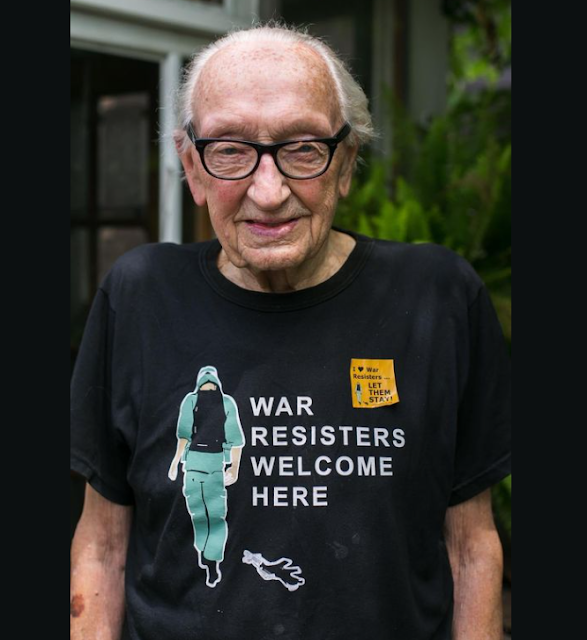
I met Frank through the War Resisters Support Campaign, which fought for the right of former soldiers who refused to participate in the invasion and occupation of Iraq to remain legally in Canada. I am incredibly fortunate that my path intersected with Frank's. The years of our friendship were but a small portion of his long life, but a treasured part of mine, a part of great value. (I feel this way about all my war resister campaign friends.) 

Frank was a World War II war resister. For refusing to fight, he was arrested and sentenced to a series of work camps. When he was assigned alternative service working in a hospital, he organized the low-wage orderlies.

Doing refugee work in South America, Frank met Isabel, the beginning of a lifelong partnership in love and in movements. By the time I met Frank, Isabel had already died. But most people knew them as Frank and Isabel, inseparable.

Long ago, I wrote about an event Allan and I attended in Toronto, called "I Object: Three Generations of War Resisters Speak Out" (post is here; comments are missing). Although I am an atheist to my core, I will never forget something Frank said that night: War is contrary to the mind of Christ. A minister with the United Church, pacifist at the time, told him that. The church changed its unpopular stance, but Frank said he saw no evidence that Jesus had changed his mind. 

If you asked Frank, how do you keep going -- bearing witness, protecting the weak, fighting for the disenfranchised, speaking out against war -- when the problems are so huge, and the powers are so great, he would reply: We are not necessarily called to be successful. We are called to be faithful.

Although I do not have religious faith, I hear this as a call to live our values. Something to always strike for, however imperfect our efforts.

Yesterday I attended a Quaker meeting (on Zoom) that was a memorial to Frank Showler. Everyone who spoke told the same type of stories. It was clear how deeply he will be missed. I encourage you to take some time and scroll through some of these Facebook posts memorializing him.

I was incredibly fortunate to know Frank, and I will miss him. 

Frank Showler, ¡Presente!

11.11.2021

11.11 readers' advisory meets "at your library" in the north island eagle

Celebrate and Commemorate Remembrance Day with a Good Book or Three

Readers have told me they enjoy the themed booklists I’ve shared. Remembrance Day is an occasion to share another list. The Great War, as it was known at the time, has inspired countless authors, poets, playwrights, and screenwriters. Many authors have used the horrors of World War I as a lens to explore issues of war and the scars it leaves on all involved. Here are some excellent titles that may be of interest.

Title: Regeneration, The Ghost Road, The Eye in the Door (The Regeneration Trilogy)
Author: Pat Barker
What you’ll find: These novels, written in the 1990s by British novelist Pat Barker, were inspired by the real-life memoirs of soldier and poet Siegfried Sassoon. They are widely thought to be among the best historical fiction of our time.

Title: A Farewell to Arms
Author: Ernest Hemingway
What you’ll find: This 1929 novel is a classic for a reason. It is told in the first-person by an American serving as a medic in Italy, and explores war, love, courage, resistance, and so much more. A rich and deeply moving book.

Title: All Quiet on the Western Front
Author: Erich Maria Remarque
What you’ll find: This is often called both the greatest war novel of all time, and the greatest anti-war novel of all time. It is even more poignant for being told from the German point of view. 

Title: Birdsong
Author: Sebastian Faulk
What you’ll find: This family saga follows two parallel plots: a British soldier at the front in Amiens, and his granddaughter who is trying to understand his experiences, 60 years later. This book is lushly romantic, yet also deeply realistic.

Title: The Absolutist
Author: John Boyne
What you’ll find: Set in the trenches, this novel explores passion, jealousy, heroism, and betrayal. It’s chock full of tension and suspense, and a very surprising ending.

Title: The Winter Soldier
Author: Daniel Mason
What you’ll find: A young medical student enlists in the war effort, expecting heroism. Instead, he finds a desolate, freezing outpost, and decisions that will haunt him for a lifetime. A gripping saga of war, medicine, love, and redemption. 

Title: Fear
Author: Gabriel Chevallier
What you’ll find: This gripping novel is based on the author’s own experiences as a nineteen-year-old soldier in France. First published in 1939 – and banned until 1950 – it speaks to the vast gulf between the public, official view of war and the lived experiences of those who suffer through it. 

Title: At Night All Blood Is Black
Author: David Diop
What you'll find: This story of a Sengalese soldier serving with the French forces, explores some surprising themes of vengeance, responsibility, and shame, along with racism and colonialism. It is unsparing and very graphic, also brutally honest and riveting.

Title: A Duty to the Dead
Author: Charles Todd
What you’ll find: This is the first book in a series featuring Bess Crawford, whose belief in honor and responsibility leads her to volunteer as a battlefield nurse. Her promise to fulfill a soldier’s dying wishes draws Bess into murder, intrigue, and tragedy, and tests her determination and courage.

-------

See also:

11 people on war

11 anti-war books

11 anti-war books part 2

11 anti-war songs

Robert Fisk: Do those who flaunt the poppy on their lapels know that they mock the war dead?

9.04.2021

the only lesson to be learned from afghanistan: war is a waste

Veterans for Peace protest, 2016
As the US finally ends its occupation of Afghanistan, watching the media obsess on the specifics of the pullout has brought me no end of head-shaking. The violent chaos of the exit makes for sensational images and startling headlines, always good for the business of media. But it's also a shell game, designed to narrow our attention and ask the wrong questions.

Twenty years of occupation and the pullout is the problem? This brings to mind Donald Rumsfeld's response to revelations of torture at the Abu Ghraib prison: banning cameras.

Ezra Klein had a similar thought.

In 2005, two of my colleagues at The American Prospect, Sam Rosenfeld and Matt Yglesias, wrote an essay I think about often. It was called "The Incompetence Dodge," and it argued that American policymakers and pundits routinely try to rescue the reputation of bad ideas by attributing their failure to poor execution. At the time, they were writing about the liberal hawks who were blaming the catastrophe of the Iraq war on the Bush administration’s maladministration rather than rethinking the enterprise in its totality. But the same dynamic suffuses the recriminations over the Afghanistan withdrawal.

To state the obvious: There was no good way to lose Afghanistan to the Taliban. A better withdrawal was possible — and our stingy, chaotic visa process was unforgivable — but so was a worse one. Either way, there was no hope of an end to the war that didn't reveal our decades of folly, no matter how deeply America's belief in its own enduring innocence demanded one. That is the reckoning that lies beneath events that are still unfolding, and much of the cable news conversation is a frenzied, bipartisan effort to avoid it.

Focusing on the execution of the withdrawal is giving virtually everyone who insisted we could remake Afghanistan the opportunity to obscure their failures by pretending to believe in the possibility of a graceful departure. It's also obscuring the true alternative to withdrawal: endless occupation. But what our ignominious exit really reflects is the failure of America's foreign policy establishment at both prediction and policymaking in Afghanistan.

"The pro-war crowd sees this as a mechanism by which they can absolve themselves of an accounting for the last 20 years," Senator Chris Murphy, Democrat of Connecticut, told me. "Just think about the epic size of this policy failure. Twenty years of training. More than $2 trillion worth of expenditure. For almost nothing. It is heartbreaking to watch these images, but it is equally heartbreaking to think about all of the effort, of lives and money we wasted in pursuit of a goal that was illusory."

Let's widen the lens. Why was the US in Afghanistan for 20 years? 

Canadians -- incredibly -- believed the "mission" in Afghanistan (no war please, we're Canadian) was for women's freedom! This was perfect for the country's positive self-image, and its apparently unshakeable belief in its military as a force for good in the world. 

In the US, the invasion of Afghanistan was supposedly a response to the attacks of September 11, 2001. Conveniently forgotten: the invasion was planned well before that date. Like all US invasions, the real goals were corporate interests and imperialism.

The history of multiple invasions and occupations of Afghanistan, by both the Soviet Union and the US, is long and complex, and I wouldn't begin to attempt to unravel it in a blog post. This interview with historian Ali Olomi in Vox makes for interesting reading.

Olomi, who is the host of the podcast Head on History, discussed the US’s funding of some factions of the mujahedeen, or Afghan guerrilla fighters, during the 1970s and ’80s; America’s rolling reasoning for its involvement in Afghanistan post-2001; and whether the US, even without soldiers present, is really gone.

Every US-led invasion carries a veneer of high-minded pretense, whether that is stopping the spread of communism or making the world safe from terrorism. Of course the US doesn't have exclusive rights to this type of propaganda. Since I've read a lot about resistance to "the Great War," Belgian babies and nuns spring to mind. The ruling class has been selling high-minded wars to the populace since time immemorial. Hence the term cannon-fodder.

I recall the testimony of one of the war resisters from our Toronto group. He was the former serviceperson with the highest rank and the most to lose. Stationed on an aircraft carrier, he had plotted the targets they had been ordered to bomb, and overlaid it with the route of a major US-backed pipeline. Voilà, a match! He realized what he and his division were protecting, who and what they were risking their lives for.

I applaud Joe Biden for having the guts to exit Afghanistan. The New York Times notes that, "In the end, the argument that won the day is that the future of Kenosha is more important than defending Kabul." (As far as I can tell, this "argument" was a random Twitter response to a White House tweet.) 

Sadly, the idea that military funds will be redirected to rebuilding US infrastructure and social programs is likely fantasy. If that does happen -- if the US's gargantuan military budget substantially shrinks and those funds are re-directed for the social good -- then Joe Biden will be a president of phenomenally historic stature. 

From my perspective, it's extremely difficult to imagine. But from 2016 on, I've been completely wrong about US politics. Nothing would please more than to be wrong on this, too.