3.18.2022

it's all about respect: why the librarians of vancouver island are taking job action

I have at least five posts in the works, but zero time to write them, because I am once again involved in a job action for library workers. I have refrained from writing about it thus far, but I feel a deep need to capture some of this on wmtc. 

In some ways, the context is much different from the 2016 strike I led against the City of Mississauga. That local comprised 400 members, ranging from Pages to Senior Librarians, and members of CUPE run their own local. We first had to break away from a composite local to re-establish our independence, and then had to forge solidarity in a large unit with greatly disparate interests, and very little trust in their union. It was a monumental undertaking -- and a hugely successful one.

My present situation is very different. I belong to BCGEU. The 48 members of my bargaining unit are all librarians with a professional designation. I am a member of the bargaining committee, but not steering our course as I did in my former role.

The frontline library workers in the system belong to CUPE. Union members have cultivated deep solidarity between the unions -- which makes this job action possible.

The two contexts demand different strategies, and different skills and experience.

Yet in many ways, the two job actions are extremely similar -- because in so many ways, all strikes and all labour disputes come down to the same thing. Workers want respect. We want respect for our labour and for our skills. 

The principal ways employers can show workers respect is by paying a living wage, and providing safe and humane working conditions. When either of these factors are lacking, and workers are fortunate enough to belong to a union, a job action may ensue.

Although I love my job as a librarian and library manager, I do not love the actions and attitudes of my employer. This story from my earliest days on the job perfectly illustrates some of the issues. I was not able to share it here, for reasons which will be obvious, but as we are now in job action, I've decided to communicate more freely. 

Day 1: communications

On my very first day on my new job, I was not told where to report. I was staying in the proper city, but there is more than one library branch in that city and I was never told where to go. 

I was supposed to meet administrators at 9:00 a.m. I had to wait in my hotel room until someone reported to work at 9:00, who could then pick up my messages and give me the required information. Then I had to drive to an unfamiliar place, find parking, get access to a building, and so forth. I was almost an hour late on my very first day.

The person who neglected to give me the information did tell the others why I was late. This can be viewed as a simple oversight, which it was. But after more than three years with this employer, I can tell you it is a whopping big pattern that is constantly and consistently repeated. I'll exercise restraint and call it "internal communication problems".

Day 2: interpersonal

The following day I was meeting a high-level administrator at a different location. She gave me directions and told me how to access the staff entrance. I misunderstood her directions and waited at the wrong door. It was December and I was waiting outside for 45 minutes. My phone (still with an out-of-province provider) was going straight to voicemail so I wasn't getting her calls.

Eventually a call got through, and I hurried to her office, full of apologies. This was her greeting: I've been waiting for an hour! My whole morning is messed up! Where were you? I was so taken aback, I struggled to explain what I thought. She spat her answer through gritted teeth: You need to take better notes!

I was dumbstruck. I thought of how I would have handled such an occurrence, with a new employee who was also new to the area and the entire system. How any decent supervisor would respond. 

Day 7: trust, respect, priorities

The following week, my manager told me I was invited to a meeting with them, their own manager, and the top administrator (the person from Day 2). My manager was acting very strangely, not making eye contact, and left in a hurry. I had no idea why.

A union steward had been assigned to the meeting. Again, I had no idea what was going on. The steward also didn't know. 

The way the chairs were arranged in the meeting, I was sitting alone, facing four people. The union steward was not sitting beside me. (Note to stewards: don't do this.) The subject of the meeting? A blog post I had written praising my new job and new employer. I was read the riot act and received notice that I was to change or remove certain aspects of the post. (I removed the post completely.)

Note that the post was laudatory. Note, too, that I had no local contacts, so there was almost no chance that library users would read the post. No matter. I had mentioned the name of the library system, and for that, I was subjected to an inquisition.

The steward confirmed that the matter was not disciplinary because no policy regarding social media had been shown to me. My head was spinning. So this might have been disciplinary?? I documented a blow-by-blow account of a strike against my former employer, and I was never met with discipline.

Every day, all the days: autonomy, trust, respect, safety, cost of living

Like nurses and teachers, librarians struggle against a lack of professional autonomy. (Gee, what do these three professions have in common??) 

Our employers frequently limit our decision-making capacities. 

Deskilling and deprofessionalization are constant concerns. 

We are not consulted or included in decisions that impact us, our staff, and our branches. Decisions are made by people who don't understand the realities of frontline public service.

We struggle with workload, as staffing models are skeletal, but plans and goals are voluminous.

We are treated disrespectfully, and our working conditions are often unsafe and scary.

And then there is the cost of living. In 2021, the cost of living rose 4.8% in Canada. So far this year it's even worse. No wage increase can keep up, but more is needed to help us cope.

Some of these issues can be mitigated by provincial safety codes, when staff are vigilant and hold employers accountable. 

Some of these issues can be mitigated through collective agreements.

That's why we're on strike.

3.01.2022

12 reasons bojack horseman is my favourite show of all time (thoughts after re-watch)

Allan and I first watched "BoJack Horseman" in real time, from 2014 to January 2020. We liked it from the start, but as the show deepened in meaning and intensity, we became increasingly invested, amazed, moved, and sometimes awed. 

At times BH became so emotionally intense, we would be left stunned and weeping at the end of an episode, especially (as we started to notice) the penultimate episode of each season. Yet the show is a comedy -- and remains funny throughout.

A few months ago, we re-watched the show straight through, all six seasons. The re-watch confirmed my conclusion that this is simply the best series ever made. In the title of this post, I've edited that statement into "my favourite show". But in my mind, it's simply the best, ever.*

Here's why.

1. It's hilarious. BH uses every kind of humour -- incisive satire, zany sight gags, dark head-shakers, silly shtick, and of course, an endless array of animal puns. 

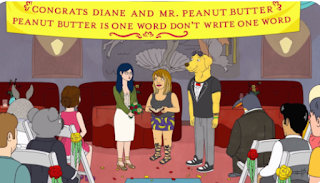
One of the show's running sight-gags

On the rewatch, we paused to capture all the incidental background humour, the kind pioneered by Matt Groening in The Simpsons -- names of stores, titles of books, road signs. One read: "Stop pausing and just watch the show!"

2. It's a brilliant send-up of the entertainment industry -- skewering it, but also peeling back the obvious to explore the hunger that drives it.

3. It voices so much truth. Characters voice intimate, raw, emotional truths -- truths that grab your heart, truths that you recognize with a gasp, a pang. Every episode seems to contain at least one of these moments -- yet it never feels forced or overdone, because. . .

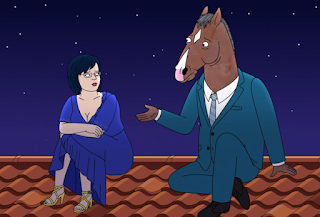
Emotional truths: talks on the roof

4. BH is character-driven. The characters are complex -- even the seemingly simple ones. They journey, they struggle, they grow, or they don't. All hilariously. And painfully. You know them. You care.

5. It's original. BH employs an incredibly inventive, original, and effective use of animation, far beyond what's used in most adult-animation shows. There are some eye-popping, show-stopping episodes, such as the incredible "Fish Out of Water," that have gotten a lot of attention. But there are many bold techniques: an animation-within-animation style used in certain flashback scenes, a night-sky background attached to a specific emotional memory, a character's face covered by crude scribbles. This show could only have been created with animation. 

6. It's complex. BH is the best treatment of the nexus of childhood trauma, mental health, self-loathing, and addiction that I've ever seen -- a kaleidoscopic view that forces us to think, re-think, and think again. 

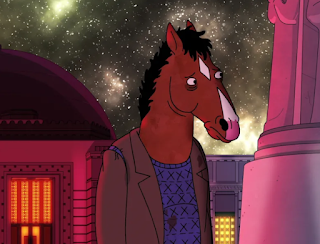
A visual effect signalling... something
7. It explores the big existential questions. How do we live with the knowledge of our own mortality? Why am I here, does my life have meaning? How do we embrace love and hope, knowing that our time is so short? How can I live with my mistakes? And yep, this is a comedy.

8. BH demands compassion. BoJack is a self-absorbed asshole. He does some terrible things. But the more we understand him, the more we root for him, the more we want others to forgive him, but. . .

9. BH demands accountability. Trauma might turn some people into abusive assholes, but that doesn't excuse their behaviour, because, guess what, everyone has suffered. All the assholes, and all the nice people, too, so. . .

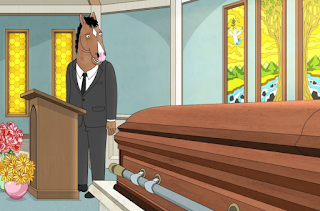
This might be the best 20 minutes of TV you ever see.
10. The ground keeps shifting. Because it's all true, at the same time. Which tells us that we must find a way to bring compassion, treat each other with care, forgive each other when we can, forgive ourselves, but also accept the consequences when we inevitably fall short. 

Each of these 10 preceding reasons are part of why I love this show. But the most astonishing thing about BoJack Horseman is that. . .

11. It does all these things at the same time. I have never laughed so much and wept so much from the same show. And. . .

12. It does everything right. Six seasons, 77 episodes, and barely a misstep or a sour note or a false moment. An absolute triumph. 

Thank you Raphael Bob-Waksberg and Lisa Hanawalt! And thank you, Will Arnett. The role of a lifetime.


------

* This position was previously held by "The Larry Sanders Show". . . and the two have much in common. 

Bonus track: two references to abortion as a positive force in a woman's life, the right decision without regret. I will be forever grateful.

2.27.2022

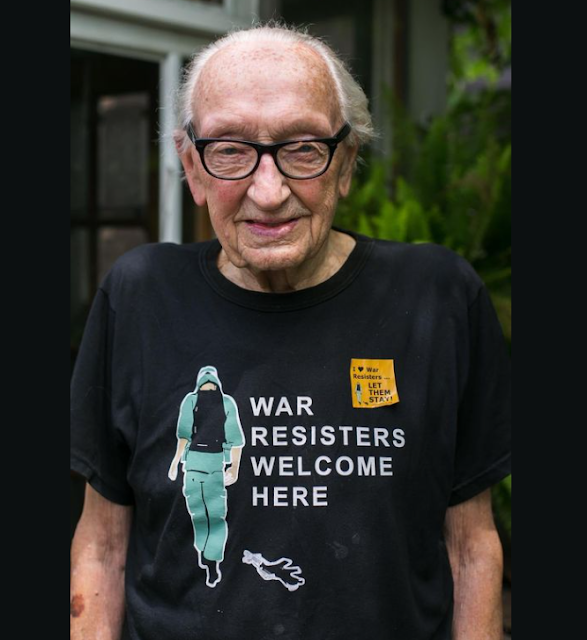
frank showler: called to be faithful


Frank Showler, born in 1919, died last week at the age of 102. 

Frank was a foundational figure in the social-justice activist community, seemingly participating in every demonstration, rally, vigil, and campaign. It was a universal saying: It's not a demo until Frank shows up. And show up he did, to an astonishing degree.

Frank didn't just show up for causes. He showed up for people. He was one of the warmest, most generous, compassionate people I have ever met. Although everyone around me had known each other for many years, and I was a newcomer, Frank made me feel like an old friend. To Frank, no one was an outsider.

I met Frank through the War Resisters Support Campaign, which fought for the right of former soldiers who refused to participate in the invasion and occupation of Iraq to remain legally in Canada. I am incredibly fortunate that my path intersected with Frank's. The years of our friendship were but a small portion of his long life, but a treasured part of mine, a part of great value. (I feel this way about all my war resister campaign friends.) 

Frank was a World War II war resister. For refusing to fight, he was arrested and sentenced to a series of work camps. When he was assigned alternative service working in a hospital, he organized the low-wage orderlies.

Doing refugee work in South America, Frank met Isabel, the beginning of a lifelong partnership in love and in movements. By the time I met Frank, Isabel had already died. But most people knew them as Frank and Isabel, inseparable.

Long ago, I wrote about an event Allan and I attended in Toronto, called "I Object: Three Generations of War Resisters Speak Out" (post is here; comments are missing). Although I am an atheist to my core, I will never forget something Frank said that night: War is contrary to the mind of Christ. A minister with the United Church, pacifist at the time, told him that. The church changed its unpopular stance, but Frank said he saw no evidence that Jesus had changed his mind. 

If you asked Frank, how do you keep going -- bearing witness, protecting the weak, fighting for the disenfranchised, speaking out against war -- when the problems are so huge, and the powers are so great, he would reply: We are not necessarily called to be successful. We are called to be faithful.

Although I do not have religious faith, I hear this as a call to live our values. Something to always strike for, however imperfect our efforts.

Yesterday I attended a Quaker meeting (on Zoom) that was a memorial to Frank Showler. Everyone who spoke told the same type of stories. It was clear how deeply he will be missed. I encourage you to take some time and scroll through some of these Facebook posts memorializing him.

I was incredibly fortunate to know Frank, and I will miss him. 

Frank Showler, ¡Presente!

2.21.2022

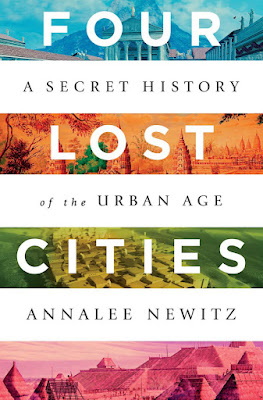
what i'm reading: four lost cities: a secret history of the urban age by annalee newitz

Wmtc readers may know that I am endlessly fascinated with ancient civilizations. Allan and I will go anywhere to see ruins from antiquity or Neolithic sites. My desire to see the remains of ancient civilizations has driven much of our travel, and the list of places I still want to go (most of which I will likely not see) are all sites of ruins or past civilizations. I wrote about ancient civilizations for a children's encyclopedia series, and discovered so much of the world through that research.

Four Lost Cities: A Secret History of the Urban Age by Annalee Newitz is a terrific book for anyone who shares this fascination. Newitz visits four sites of past societies: Çatalhöyük (Turkey), Pompeii (Italy), Angkor (Cambodia), and Cahokia (United States). She interviews archaeologists around the world, and reviews the latest research, much of which questions and contradicts previously held ideas about these places and the people who built them. 

Unlike most archaeology of previous eras, current studies focus on the lives of ordinary people, rather than the elites. Studies are driven by data, rather than biases and preconceptions about values. She writes: "In a sense, data archaeology represents the democratization of history. It's about looking at what the masses did, and trying to reconstruct their social and even psychological lives." 

The book is written in a light, breezy style, and full of fascinating insights and factoids. 

In Çatalhöyük, the Neolithic settlement in modern-day Turkey, tiny living spaces were jammed together in a honeycomb of cells -- accessed through the roof, via ladders. The door to the outside was on the ceiling. 

The people of Çatalhöyük did not value material wealth or an elite based on material goods. This is interesting, but less remarkable when one considers that they settled there after a nomadic existence. Hunter-gatherer and nomadic societies can't amass material goods: it would be antithetic to their survival.

In Pompeii, "middlers" -- a proto- middle class -- were formed by liberti, former slaves who participated in Roman society, and whose children became citizens. Although I've been to Pompeii and the nearby (and even more fascinating) Ercolano, I had no idea that the Roman government organized relief and re-settlement efforts on behalf of the survivors of the cataclysms of 79 CE.

For me, the most remarkable stories in Four Lost Cities are from Cahokia. I've seen some ancient mounds, as these North American earthworks are known, along the Natchez Trace in Mississippi. And I know about so-called Hopewell Culture in what is now southwest Ohio. But I had no idea that a huge archaeological excavation has been unfolding in Illinois.

A thousand years ago, huge pyramids and earthen mounds stood where East St. Louis sprawls today in southern Illinois. Majestic urban architecture towered over the sticky mud of the Mississippi River floodplains, and elevated walkways wound between densely packed neighborhoods, public plazas, and outlying farms. Ceremonial poles, painted and adorned with ritual objects, were planted in mound tops like signposts. The city was so impressive that word about it spread up and down the Mississippi and its tributaries, from Wisconsin down to Louisiana. Thousands of people came to the city, drawn by tales of its elaborate parties, pageants, and games. Some came to have fun, but others were in search of a new kind of civilization. Many visitors were so impressed that they never left.

The city became an immigrant sanctuary, its neighborhoods bursting with people drawn from cultures all across the southern United States. At the city's apex in 1050, the population exploded to as many as 30,000 people. It was the largest pre-Columbian city in what later became known as north America, and bigger than Paris at the time.

Unfortunately, Newitz doesn't adequately explain how much of this is known. Population size and trade routes are relatively easy to understand, based on what is found in a given site and the origins of those materials. But how do archeologists know why people migrated to a site? If this knowledge is indeed based on data, rather than assumptions, I would have liked more explanation of what led to these conclusions. 

The book does touch on some of the process -- laser technologystratigraphy, sophisticated soil analysis -- but I could have used more distinction between what is known and what is hypothesis.

At the end of the book, Newitz devotes an entire chapter to a takedown of Jared Diamond, author of Collapse and Guns, Germs, and Steel, among other books. I am a huge fan of both of those books, and while I understand that many prominent researchers disagree with Diamond's theories, this bit felt unnecessary and out of context. It also at least partially misrepresents Diamond's premise. And of course Diamond has no opportunity to respond. 

Some of the criticism simply makes no sense. Newitz paraphrases an archaeologist who says:

And when it comes to Mayan "collapse," they point out that there are still millions of Mayans living in Mexico. Can a culture that still thrives really be said to have collapsed?

Diamond didn't say the Mayan people were extinct. Nor did he say their entire culture was obliterated. He wrote about the disappearance of the Mayan empire -- the organized society that built Chichen Itza, Tulum, Palenque, and dozens of other ceremonial sites. That empire most certainly did disappear, and it was already gone when Spain began its conquest of the area. The fact that there are still descendants of the people who built that empire does not prove otherwise. 

Perhaps, as Newitz claims, Diamond has misled the public. Perhaps his theories are out of step with current archaeological thought (which doesn't necessarily make them wrong). Regardless, the portion of this book that supposedly responds to Diamond's theories seems misplaced and out of context.

Strangely, Four Lost Cities is marketed and promoted as something it is not. It is not a book about lessons that can be gleaned from the practices of past civilizations. On that topic, there are a few paragraphs at the very end of the book, but they are vague and entirely speculative statements one finds in general conclusions.

Perhaps, like the people of Pompeii, we'll muster relief efforts that help people rebuild in new places. We might attempt to design a radically different kind of metropolis, like Domuztepe, that continues the traditions of the previous ones while incorporating new ideas. Maybe this process will lead to more sustainable cities built in places that can resist the worst effects of climate change. That might sound like a Utopian impossibility, but not if we learn from our urban failures.

I wonder at the publishing decisions that led to this, as misrepresenting a book's subject matter could only lead to confusion or disappointment. 

Despite this minor complaints, I very much enjoyed Four Lost Cities and recommend it if the subject matter interests you. Or if you dislike the work of Jared Diamond.

2.04.2022

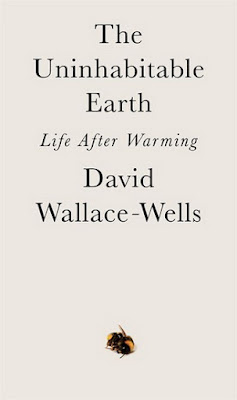
what i'm reading: the uninhabitable earth by david wallace-wells: a handbook for despair

The Uninhabitable Earth: Life After Warming by David Wallace-Wells is a book about the not-distant future: what will happen to the planet as climate change continues.

I waited a long time to read this book -- first because of a very long waitlist at the library, but later because I was so ambivalent about reading it. When I finally had the book in my hands, I read the introduction... and was stopped cold. I felt a great weight of futility: whatever knowledge I would gain from reading this book would be utterly useless.

And so, full disclosure: this is a "what i'm reading" post about a book I didn't fully read. In 18 years of writing wmtc, this is a first.

Instead, I did the librarian readers' advisory read: first chapter, some random paragraphs throughout the book, conclusion. 

My failure to read the entire book is absolutely no reflection on the book itself. In fact, it's the opposite: a tribute to the power and effectiveness of Wallace-Wells' research and writing. 

New Dewey classification: nonfiction horror

Tl;dr? Climate change is much, much worse than you think, and is occurring much, much faster than you think. The final boarding call has already been sounded. The Save Humanity Express is leaving the station. But it hasn't quite departed. If we all run really, really fast, there is still a small window of time to save what we can. But only if everyone is onboard.

The book is based on all the available science, and is impeccably researched. The author's truth-telling is meant to sound the alarm by painting a clear picture of what anthrogenic (human-caused) climate change will actually look like, as it continues to worsen around the globe. 

In the introduction, Wallace-Wells offers a few different scenarios, including a worst-case (eight degrees) that he says is unlikely to happen. Then he writes:

Between that scenario and the world we live in now lies only the open question of human response. Some amount of further warming is already baked in, thanks to the protracted processes by which the planet adapts to greenhouse gas. But all of those paths projected from the present -- to two degrees, to three, to four, five, or even eight -- will be carved overwhelmingly by what we choose to do now. There is nothing stopping us from four degrees other than our own will to change course, which we have yet to display. . . .

The devastation we are now seeing all around us is a beyond-best-case scenario for the future of warming and all the climate disasters it will bring.

What that means is that we have not, at all, arrived at a new equilibrium. It is more like we have taken one step out on the plank off a pirate ship. Perhaps because of the exhausting false debate about whether climate change is "real," too many of us have the developed a misleading impression that its effects are binary. But global warming is not "yes" or "no," nor is it "today's weather forever" or "doomsday tomorrow". It is a function that gets worse over time as we continue to produce greenhouse gas. . . . The last few years of climate disasters may look like about as much as the planet can take. In fact, we are only just entering our brave new world, one that collapse below us as soon as we set foot on it.

And this is where my hopelessness kicks in.

The opposite of hope

My own understanding of history, both ancient and modern, lead me to have zero hope. 

The degree of collective will and cooperation that it would take to meaningfully slow and halt climate change do not exist and are extremely unlikely to be formed. I say "extremely unlikely" rather than "will not" because I am not so arrogant as to predict the future. However, nothing that I'm aware of, in the history of the world, leads me to any other conclusion.

The knowledge exists. The means exist. The will exists in some people. And the power exists in some people. But the will and the power do not exist in the same sectors. And the powers that oppose -- and will continue to strenuously oppose -- the massive shift in power and priorities required are enormous and ubiquitous. 

Global cooperation does not exist. Global concern for humans does not exist. Billions of people around the globe have not been vaccinated against covid-19. First-world countries have not shared their resources to vaccinate people in poorer countries on the necessary scale. Even though it would help all of humanity if everyone on earth was vaccinated against covid, this does not happen. Such a vaccination effort would be incredibly simple compared to the global cooperation necessary to halt climate change, but still, it is not done.

Humanity has not collectively decided that every human being deserves the three most important resources to sustain life: adequate shelter, adequate food, and clean water. Millions upon millions lack these worldwide, including so many in the wealthiest countries in the world. The resources exist, the knowledge exists. The will to make this happen -- both globally and in our own backyards -- does not.

If the world can't manage this, how could it possibly marshal the collective will and resources to halt climate change?

Wallace-Wells includes many reviews or roundups of beliefs, literature, and attitudes about climate change. Paragraphs are crammed with thickets of name-checks. I suspect most readers will not be familiar with his references, and it smacks a bit of showing off. 

In the meantime, environmental panic is growing, and so is despair. Over the last several years, as unprecedented weather and unrelenting research have recruited more voices to the army of environmental panic, a dour terminological competition has sprung up amoung climate writers, aiming to coin the new clarifying language -- in the mode of Richard Heinbert's "toxic knowledge" or Kris Bartkus's "Malthusian tragic" -- to give epistemological shape to the demoralizing, or demoralized, response of the rest of the world. 

The author lists with various attributions: eco-nihilism, climate nihilism, climatic regime, climate fatalism, ecocide, and "making a psychoanalytic argument against the relentless public-facing optimism of enviromental advocacy, ...'human futilitarianism'". 

Giving the author the benefit of every doubt, I can assume this book is meant to horrify us into action, but for me it has quite the opposite effect. Human futilitarianism indeed.

What can "we" do, the individual

Of course I still believe we must do what we can. But what difference will it make: that, I do not know. 

Are we all doing what we can? Being totally honest, I can't say that I am. Can you?

I try to be environmentally conscious in my choices. Like most people I know, I make many small-scale green choices all the time. But do I seriously inconvenience myself or radically change my lifestyle? I fly to visit family and friends, and one day I hope to travel again. If I have the opportunity to travel to Cambodia to see Angkor Wat, would I go? Absolutely I would. Life is short. I want to do the things I want to do. And: I have no belief that sacrificing a meaningful vacation will reduce greenhouse emissions in any meaningful way.

This is the kind of thing, when I had a large readership, that I would get roasted for. Entitlement, leftist hypocrite, blah blah blah. But I'm just being honest. As container ships criss-cross the globe by the hundreds of thousands, as businesspeople and honeymooners and touring musicians and politicians fly all over the globe, as North American consumers buy cheap, guaranteed-to-fall-apart-and-need-replacing goods made in China, would my sacrifice amount to anything? 

If there were no air travel, it would make a difference. We saw that during the global covid lockdown, when air and water quality improved around the planet. But -- being uncomfortably honest here -- I am not prepared to voluntarily sacrifice something I love, something that gives my life meaning, for future eventualities. 

In this I believe I am like most people. I am punting to the next generation.

But here's my more important bottom line: each individual concerned person could do every individual green act possible, but without a shift away from capitalism, no substantial progress will be made. Until and unless private profit is removed from the equation, we will not halt and reverse climate change. 

What can "we" do, the corporate and political

In the end, Wallace-Wells doesn't so much as draw a conclusion as make a statement. 

But, all told, the question of how bad things will get is not actually a test of the science; it is a bet on human activity. How much will we do to stall disaster, and how quickly?

These are the only questions that matter. . . .

The emergent portrait of suffering is, I hope, horrifying. It is also, entirely, elective. If we allow global warming to proceed, and to punish us with all the ferocity we have fed it, it will be because we have chosen that punishment -- collectively walked down a path of suicide. If we avert it, it will be because we have chosen to walk a different path, and endure. . . .

Instead, we assign the task to future generations, to dreams of magical technologies, to remote politicians doing a kind of battle with profiteering delay. This is why this book is also studded so oppressively with "we," however imperious it may seem. The fact that climate change is all-enveloping means it targets all of us, and that we must all share in the responsiblity so we do not all share in the suffering -- at least not all share in so suffocatingly much of it.

That we may be the solution, but it is also the problem.

How can we do this? Where is the lever I can pull, the party I can vote for, the alternative reality I can enter, where "we" collectively solve the world's problems? 

Can we build affordable housing near well-paid jobs, to end the long, carbon-spewing commutes that plague most North American lives? 

Can we build huge amounts of affordable, reliable, public transit? 

Can we choose to buy locally-made consumer goods, to curtail global shipping routines... when there are none? Even the most strenuous effort to "buy local" will provide only a small fraction of first-world needs.

Can we force corporations to manufacture locally, which would create millions of jobs and drastically reduce emissions? 

For each of these questions: can a political party that calls for this be elected, and if it was, could it succeed? No and no. The forces aligned against it would be far too powerful. Democracy -- as currently practiced, laden with corporate interests and the governments who do their bidding -- is incompatible with the will needed to halt climate change. 

Many of my friends answer this question with a call to revolution. I agree that nothing short of revolution could bring about the necessary changes. But even those who call for revolution don't agree on what a post-revolutionary world should or would look like. And even if we did agree, "we" -- the forces for good, so to speak -- don't have the power to create that post-revolutionary green world, as opposed to the many other less desirable outcomes that (history shows) are more typical of revolutions.

Wallace-Wells writes:

There will be those, as there are now, who rage against fossil capitalists and their political enablers; and others, as there are now, who lament human short-sightedness and decry the consumer excesses of contemporary life. There will be those, as there are now, who fight as unrelenting activists, with approaches as diverse as federal lawsuits and aggressive legislation and small scale protests of new pipelines; nonviolent resistance; and civil-rights crusades. And there will be those, as there are now, who see the cascading suffering and fall back into an inconsolable despair. There will be those, as there are now, who insist that there is only one way to respond to the unfolding ecological catastrophe -- one productive way, one responsible way.

This book needs a warning sticker: guaranteed to damage your mental health. I doubt the author's purpose was to advance fatalism and despair, but that's what they've done. 

1.30.2022

memories of great-aunt betty

An important family matriarch passed away this week, at the age of 96. Betty MacDowell was my partner Allan's great-aunt, his father's mother's sister. She was one of the warmest, kindest, most good-hearted people I've ever known, and I wanted to share a few memories and write a little tribute to her.

I first met Betty in 1990, when we were visiting Vermont, where Allan grew up. Betty invited us over for a family dinner, along with Mary (her sister, Allan's grandmother), her son and daughter-in-law (Allan's cousins), and their children, who were then little kids. 

This dinner is memorable for me for several reasons. 

Although Allan and I met in the summer of 1985, and we had been living together since January 1987, this was the first time I had met these folks, and it was the first time Allan had seen them in many years. At that time, Allan had no active relationships with any of his family except with his grandmother. Although we didn't know it at the time, this dinner was the beginning of Allan slowly re-connecting with his family.

The table was overflowing with fresh, homemade food. For dessert there was a berry pie made with berries Betty had picked from her garden that morning. I felt like a Fresh Air Fund child, simply agog that such a thing was possible. (Betty's pies were amazing; they are even mentioned in her obituary.)

Everyone was very nice and friendly, but Betty was especially warm and welcoming, and I sensed she had made a special effort to include us. I was really touched, and I wrote her a thank-you note (sent in the mail, the only way one could send a note in those days). I said that she had treated both of us like family, and it meant a lot to me.

She wrote back, in her perfect schoolteacher handwriting, and said, You are family -- the word "are" was underlined twice -- and you will always be welcome in my home.

After that, we visited Betty whenever we were in Vermont, sometimes staying in her spare bedroom or in a trailer outside her neat and cozy home. She lived on land that was once part of her family's farm, across a wide yard from the log-cabin home her son and daughter-in-law built, where they raised their family and still live. (The yard now contains solar-energy cells.) It's a beautiful, peaceful area, and it eventually figured into my desire to live someplace quieter and more beautiful.

Somewhere along the way, Betty and I started corresponding by mail. As a child and teenager, I used to write letters with my Aunt Lillian (who was also my great-aunt, my grandmother's sister), and writing to Betty recalled that for me. (I'm looking forward to continuing this personal tradition with my grand-niece, now six years old.) 

At some point Betty discovered digital photography and started making and selling her own greeting cards. I looked forward to seeing beautiful flowers from her garden, or some outdoor scene, along with her news. She would catch us up on the extended family, tell us about the weather in northern Vermont (snow country), whether a bear had visited her garden, whatever was new in her world.

One thing Betty and I had in common was a love of travel. She had travelled all over the world. When we visited, I loved hearing memories of snorkeling the Great Barrier Reef or camping out in some scenic location. She also shared many memories of growing up on a farm, especially sugaring. This was totally different than the urban backgrounds of my own relatives. For me it was a window into another world.  

I have no idea about Betty's politics or religious views. I mention this because it's very different from my original family. Brooklyn Jewish folks? You always know their opinions! I came to appreciate and respect the less vocal, more private demeanors of the rural Vermonters. I do know Betty was an extremely kind, accepting person. I cannot imagine a judgemental or bigoted word coming from her. 

I remember two little exchanges along those lines. Once, on a Vermont visit when we were already planning to emigrate to Canada, I mentioned that some people had been quite negative about our choice. Betty said immediately and quite sharply, "That's not their business!". Many years later, during the Trump years, she wrote in a letter, "You and Allan made a very smart decision to leave the US." She said something similar to me the last time we were in Vermont.

Betty lived a rich, full life -- rich with the love of family and friends, full with experience. She was very close with her children, children-in-law, and grandchildren, and in the last months of her life, was able to meet her great-grandchild. She died peacefully with family by her side. 

We were supposed to visit Oregon and California in 2020, then Vermont and Massachusetts in 2021. Covid pushed everything off by at least one year, so we didn't make that second trip. I'm sorry that we weren't able to see Betty again, but I'm very glad we visited the Vermont family in 2017 (both of us) and 2018 (Allan only) before we moved west.

You can see her obituary here.

1.25.2022

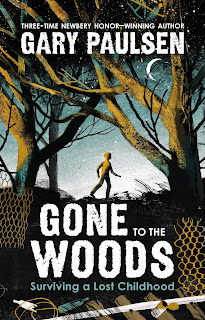
what i'm reading: gone to the woods, a riveting memoir by author gary paulsen

Gary Paulsen wrote some of the best children's literature, most famously Hatchet.

The tale of a boy who must survive on his own in the woods until he is at last rescued, Hatchet (published in 1986) is a go-to book for librarians facing the challenge of a reluctant reader, and many kids' favourite book. I read it for the first time when working as a children's librarian, and loved it. I wrote about Hatchet here.

In 2021, shortly before he died at age 82, Gary Paulsen published Gone to the Woods: Surviving a Lost Childhood, a remarkable autobiography. Gone to the Woods is written as children's nonfiction, but I cannot recommend it strongly enough to readers of all ages.

Gone to the Woods is told in the third person, about a character referred to as "the boy". As a very young child, the boy endures an almost total lack of parenting, then a fairy tale of love and living off the land... then a brutal separation and loss. His young life becomes a series of dislocations and separations -- and total neglect. As a preteen and young teen, the boy lives on his own, surviving by his keen intelligence, self-education, mental strength, and bold courage. 

Salvation begins in the form of the library, and a canny, sensitive librarian. She understands what's at stake and does everything exactly right -- gradually, gradually, ever so gradually, making the library the boy's refuge. Eventually, the boy "reads like a wolf eats". (When you get to the part about the library, have a box of tissues handy!)

The book is gripping and suspenseful, a true page-turner. Similar to Hatchet, it's packed with tips and tricks of survival -- survival in the woods, on a farm, and in a harsh, urban landscape. 

For young readers, it's exactly the kind of book that can help children in troubled circumstances feel less alone. 

For adult readers, it's a view into several hidden, fascinating worlds, heart-wrenching but also uplifting.

For all of us, it's a testment to how the presence of a caring adult can make a profound and lasting difference in a child's life. 

After reading Gone to the Woods, I was so sorry that I was unable to tell Paulsen how much I loved the book, and thank him for writing it. Paulsen died in October 2021. 

I have purposely not revealed much about the actual plot. I loved the way the story unfolded, taking the reader through the same sudden and harsh transitions that the boy experienced. If you want more plot description, this review in The New York Times will help.

Also: the extreme neglect that the boy endures clearly constitutes abuse, but Paulsen does not describe (or even allude to) being physically or sexually abused. Readers concerned with that have nothing to fear, for themselves or any young readers. 

Read this book!


--------
* I notice that post was meant to be part of a series contrasting older children's literature with more contemporary counterparts. Some months later, I finished graduate school and started working full-time... and the series didn't go anywhere.

1.21.2022

what i'm watching: best of 2021 (april to december)

As I mentioned here, I've decided to stop posting my entire "what i'm watching" list for the year. Instead I'm going to do an annual best-of. I'm also realigning this with the calendar. 

For 2021, I'm starting with April, where last year's 2020-21 list left off. Next year I'll be able to start with January.

So... these are the best series and movies I saw from April 2021 to December 2021. Within the two categories below, they are in no particular order. (It's not a countdown.)

Five Stars: the best of the best
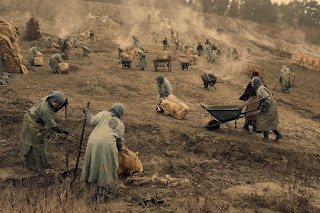
The Colonies
The Handmaid's Tale (S1-4, series so far)
This is one of the best series I've ever seen, and the most difficult to watch. S1 especially was so intense, that I could only watch one episode at a time, then needed to switch to something lighter. Why watch a series packed with rape, horrific state violence, fascism, and woman-hating? Because the writing, acting, and production is stellar. Because it feels all too plausible. And because it is a story of resistance. (Special shout-out to Toronto, playing itself for a change!)

Sophie: A Murder in West Cork
This true-crime mini-series was suspenseful and compelling. It sensitively captures the grief that follows a sudden, violent death, and the outrage at the blatant miscarriage of justice. 

Lupin (S1-2, series so far)
Joyous cons, daring and brilliant heists, biting social commentary about racism and colonialism, plus a literary meta-theme: it doesn't get much better than this. A perfect series, especially for crime lovers.

Bo Burnham Inside
Burnham filmed, edited, and performed this film, completely solo, while in covid lockdown. It is clever, cutting, incredibly insightful, often profound. The artist manages to perfectly send-up so many cultural trends and tropes, but always with a voice that is warm and compassionate, never snarky or mocking. It left me feeling that I had taken a journey with Burnham. Later I learned he was the creator of 2018 film "Eighth Grade," which was all kinds of brilliant (four stars here).

Never Have I Ever (S1 rewatch + S2, series so far)
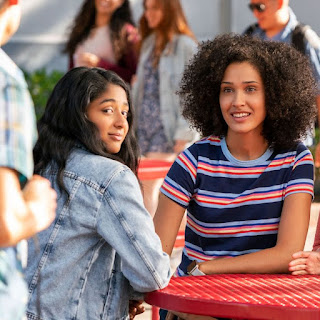
This is one of the best teenage series ever made. Hilarious, warm, and deeply authentic, it made my heart squeeze with all the joy and pain of growing up. The social commentary about racism and sexism is perfectly woven in, never preachy. The representation of queers and people of colour is beautiful and seems completely natural. And the acting is absolutely amazing.

In the Heights
The film adaptation of Lin-Manuel Miranda's Broadway musical, a love letter to his (and my) former New York City neighbourhood. It's a joyous celebration of a place and the people who create it -- a positive look at something usually maligned -- wrapped in a ribbon of Latin and modern music and dance styles. It was so enjoyable! It also made me regret not seeing the Broadway production, which was running while I was still regularly visiting the area.

Yellowstone (S4)
After the extremely violent, cliffhanger ending of S3, Yellowstone S4 was all about healing, recovery -- and revenge. Some subplots wrapped up with deep emotions, while others are still open to future possibilities. I love the Native issues, the bold female anti-hero who continues to deepen in complexity, and the many visions of what love can look like. This show continues to be absolutely gripping, exploring both external and internal conflicts more deeply with every season. 

Four Stars: worth every minute

The Death and Life of Marsha P. Johnson (2017)
A documentary tribute to a transgender woman of colour who was a pioneering activist, and a look at the trans and gay liberation movements through the lens of one person's life. Moving, inspiring, sad, beautiful.

Ted Lasso (S1 only)
This show is sweet, warm, and funny, and manages to be feel-good without being sticky. I hated S2, couldn't get past the first episode, but S1 was wonderful.

Lovecraft Country (S1)
A wild, genre-blending, mind-bending exploration of Jim Crow America through adventure, fantasy, and horror. I stopped watching about halfway through but intend to go back. Weird and captivating.

Derry Girls (S1-2, series so far)
Teenage girls coming of age in Northern Ireland -- Catholic school and family madness against a backdrop of The Troubles. Wonderful characters, warm humour -- and another feel-good show I could tolerate. That makes three this year, which must be a record for me.

Mare of Easttown (one season, full series)
A female detective trying to solve a murder and disappearances, while coping with her own loss and grief. The premise sounds hackneyed, but the show feels new and authentic. Excellent acting by Kate Winslet, many fully realized female characters, and a strong portrayal of gritty, downtrodden, small-town America. A dark show, with just enough hope.

Barry (S1-2, series so far)
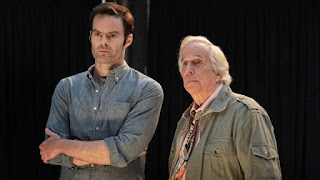
A darkly funny crime comedy with great characters and some outstanding performances by Bill Hader, Henry Winkler, and many others. S3 is supposed to be out this year, which is a great excuse to rewatch the series so far.

Your Honor (one season, full series)
Both a crime drama and an intimate family story, Your Honor explores what happens when deeply held moral beliefs clash with profound love and loyalty. Like The Handmaid's Tale (above), this series is unrelenting, with zero comic relief. It starts in a dark place and goes down from there. 

The Frontier (2015)
A tense, stylish, dark crime/neo-noir, chock full of double-crossing thieves and creepy characters, with a claustrophobic feel. Really fun stuff if you like noir.

Lucifer (S1-6, full series)
Hilarious, sexy, raunchy, genre-blending, and thoroughly entertaining, Lucifer is part detective/cop show and part "Buffy the Vampire Slayer". Major points for full-on bisexuality in both male and female characters, and some truly meaningful and sometimes profound character growth. Also: worst series finale ever. Honestly, I can't believe how bad the last 30 minutes of the show were. 

A Song For You (2016)
This documentary chronicles and pays tribute to "Austin City Limits," the greatest TV music show of our time. I don't have access to it anymore, and I miss it -- both to watch great performances and as a way to discover new sounds.

Loudermilk (S1-2 only)
A dark comedy about a recovering curmudgeon. Really good, until it wasn't.

The Inbetweeners (S1-3, full series rewatch)
A raucous, ridiculous, hilarious teenage comedy about awkward, misfit friends. Thoroughly enjoyable. Warning: do not watch the movie!

Line of Duty (S1-5 rewatch + new S6)
Suspenseful, twisty, unpredictable thriller about police corruption. Not your typical cop show by any means. Who is H?

Goliath (S1-3 rewatch plus new S4)
Crime, noir, paranoid thriller, legal drama -- all of those, plus some romance and family drama. I was grossly disappointed by S4, but loved the first three seasons.
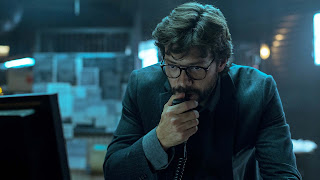
How can you not love The Professor?
Money Heist S5 (final season)
I didn't know how they would keep this series going after S2. Every successive season seemed even more improbable than the last, but somehow it just got better and better, adding layers to backstories and relationships. The final season was gripping and very emotional. Add The Professor to the list of my favourite anti-heroes.

The Hitch-Hiker (1953)
An odd and slightly surreal noir, with the distinction of being written and directed by the great Ida Lupino. 

True Grit (2010)
Great characters, including a strong young female lead, lots of western-style violence and more than a little humour -- a really solid movie. Part of my ongoing new interest in the Modern Western genre. 
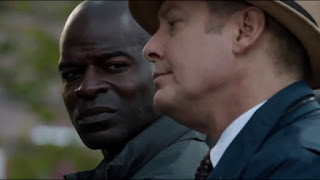
Greatest anti-heroes ever
The Blacklist S8
In S8, Raymond Reddington (or whoever he is) falls in love, and lets himself believe he can carve out a normal life in the midst of his chaos. This season had a deep emotional resonance, in addition to the show's usual suspense, adventure, violence, and humour. I found Red's love interest much more credible than any of Elizabeth's relationships. I continue to love both Raymond and Dembe, and will follow them anywhere.

Corporate (S1-S3, series so far)
I kept expecting this show to tank. How long can a satirical workplace comedy spin before it becomes a parody of itself? To my surprise, the show stayed funny, dark, relevant, and unpredictable. The episode "Black Dog" (S3e2) is the best portrayal of the illness of depression I've ever seen in popular culture -- unexpectedly emotional and real, while never losing the comic edge. Bravo.

The Morning Show (S1-2, series so far)
Great acting, relevant stories, compelling drama, biting humour, and real-world politics -- a nearly flawless combination. Unraveling the actions and consequences of workplace sexual harassment, seeing the impact on perpetrators and victims, packs a big punch.

A note, a plea: please, please, won't someone show us what women really look like in proper context? A tough, gritty TV journalist in West Virginia, covering stories of coal mines and mountaintop removal, would not go to work in full, professionally-crafted makeup. The portrayal is supposed to be realistic -- so why not tone down the glamour? As soon as I see the beautiful Reese Witherspoon in full Hollywood-style makeup, I'm pulled out of the show and am looking at the actor instead of the character. I see this in many supposedly realistic series. Obviously all actors are wearing makeup. But why not use a look that's somewhat realistic? Major points for series that don't do this, like Mare of Easttown. 

* * * *

Honourable Mention
Frank of Ireland
AP Bio
Endeavour (S1-4 rewatch, plus S5-7, series so far)
Hacks
How to with John Wilson
Rita

Comedy before sleep
Big Bang Theory (S8-12, remainder of series)
Superstore (S1-6, full series)

* * * *

Recap of previous years

- Canadian musicians and comedians (2006-07 and 2007-08)
- my beverage of choice (2008-09)
- famous people who died during the past year (2009-10)
- where I'd like to be (2010-11)
- vegetables (2011-12)
- big life events in a year full of Big Life Changes (2012-13)
- cheese (2013-14)
- types of travels (2014-15)
famous people who died plus famous people who died, part 2 (2015-16)
- the picket line (2016-17)
- movies (2017-18)
2018-19: 1-5 ☮s
2019-20: 1-5 💉s
2020-21: 1-5 😷s (without the tear!)
1.17.2022

we movie to canada: wmtc's annual movie awards are retired, replaced with best-of list

Last year, I realized that the new format of my annual movie awards was problematic. 

Beginning with 2018-19, rather than grouping movies by rating (all the 5s together, all the 4s together, and so on), I started listing all the titles alphabetically, showing the rating for each. 

As a personal list of what I've been watching, this is fine. But as a potential guide for readers, it's less than helpful. Most people I know are always looking for their next great series or movie. With an alphabetical list, they would have to go through the entire list, reading every description or comb through to pick out the top ratings.

I realized this last year, and it's been bothering me ever since. I was actually planning on re-organizing the three movie posts that I had done this way. This morning I sat down to that, and realized... no. Too much work without much payoff.

Looking ahead, I've decided to use a new format.

First, I'm realigning the viewing list with the calendar year. There was a reason my movie awards were geared to the baseball season, rather than the calendar, but that reason hasn't been relevant in many years. I'll now post in January about what I've watched the previous year.

In addition, I'm going to post a best-of instead of an exhaustive list -- basically the 4s and 5s from the former system. I'm still going to track everything I watch, but I won't post the complete list on wmtc.

Stay tuned (or don't!) for the best of 2021 list. To avoid repetition, the 2021 list will be what I watched from April to December, then future lists will take in the full year.

most useless and annoying advice ever: it's cheaper if you make it yourself

I did not make this myself.
Ever since moving to Canada, people have been telling me how I could make something myself for less money than I paid for it. Curtains, chair coverings, scarves. Kitchen gadgets. Dog needs. Skin care products. And food of all types. 

You can make that yourself, so much cheaper. 

I've heard this so often and from so many people, one might think everyone in Canada was crafting everything by hand. Which would not explain the crowds buying cheap merchandise in Canadian Tire.

Similarly, in certain Canadian circles, there is disdain for hiring someone for any personal or home labour. Snow shoveling, house cleaning, dogwalking, lawn care. Oo-hoo, look at you, throwing money away instead of picking up a shovel! It seems I am finally old enough for people to give me a pass on this one. The hidden joys of aging!

I find this "you can make it cheaper yourself" mentality annoying on so many levels. One, it's my money. I can spend it however I want, and I'd rather do so without your judgement. Two, isn't your time worth anything? My time is more valuable than money. Money can be earned, but time is a nonrenewable resource. (Yes, I know this is a privilege.) Three, mind your own business!

Perhaps this is not a Canadian thing at all. I don't know if people dole out this "advice" throughout the rest of the US. But I can tell you no one does in New York City! 

Long before the pandemic forced everyone inside, New Yorkers had everything delivered to their apartments. Since everyone walks or takes public transportation everywhere, deliveries are a way of life. So is paying for convenience. New Yorkers eat at restaurants or takeout almost every night of the week. They drop off their laundry. They hire dogwalkers. They rent car shares. And most of all, they have everything delivered. It's not an easy city to live in. Everyone who can afford to buys every convenience possible. And nobody ever tells you how you could make things more cheaply yourself.

Like Elaine Benes, I love a "big salad". In fact, one of my favourite meals are salads with lots of different ingredients. I love chopped-salad restaurants, and happily spend $16 or $18 to choose 10 different ingredients tossed in freshly-made, creative dressing. I am not often in an area with these restaurants, but when I am, I enjoy this very much.

Big salads are something I will never make for myself. I cook a lot, and I do quite a lot of other food prep. We do sometimes have a protein salad for dinner, but it's much more simple: lettuce, tomato, mini cucumber, chicken, cheese. I'm the only big salad fan in the house, plus, it's just too much effort.

In our previous suburban home, there were no restaurants that offered big salads. The closest we came was when Whole Foods opened a Mississauga location, but a salad bar is not the same. And of course there is nothing like this in my tiny little town now.

But now big salads have come to supermarkets! This has been a great development for me. I take a packaged salad kit, add a hardboiled egg and some grated cheese, and I have the perfect dinner. If I have some leftover grilled chicken or salmon on hand, I throw that in instead of the egg. 

This is one of my favourite meals and it helps me eat more vegetables -- more raw vegetables, which is even better. The only downside is there is a lot of plastic waste. This disturbs me... but not enough to stop buying the salads. 

But salad kits are expensive! 

In my experience, if you mention salad kits -- or if a busybody sees you buying a few in the supermarket -- or if you look for information online about a salad kit... You can make that cheaper yourself! 

Is this even true -- can you make the salad more cheaply yourself? I don't know. I haven't tested this claim, because I don't care. But some years ago, I wondered if Whole Foods' delicious, expensive tuna salad would be less expensive to make at home, and discovered it was only slightly more expensive to buy than to create. Sometime after that post, the store's prices went up, and later I started using less expensive tuna (for environmental reasons), so the balance would have changed. But the assumption that the prepared tuna salad was vastly more expensive than homemade was incorrect.

The salad kit I ate for dinner last night contained: white cabbage, red cabbage, kale, romaine lettuce, shredded carrots, cilantro, crispy noodle strips, and slivered almonds, and dressing. I added an egg and a bit of grated cheese. 

  • If I had made this myself, how much cheaper would it be? It's not a $6.00 salad versus a free dinner. After I'm done buying all those ingredients, what have I spent? 
  • Unless I used two entire heads of cabbage, an entire head of lettuce, and an entire bunch of kale within the upcoming week -- which I won't be able to do -- some of the vegetables will go bad. I would be wasting money and wasting food.
  • I can buy all different flavour combinations of salad kits, and eat different ones whenever I like. Having variety helps me maintain a healthy diet.
  • And finally -- but most importantly -- making this salad myself is too much effort for the end result. Everyone has (or should have) a personal time vs money formula. I would much rather spend $6 than make this complicated salad myself, and if I had to make it myself, I wouldn't eat it.

In short, it's a no-brainer: healthy, convenient food that I enjoy is worth the price of the kit.

I don't care if I could make it cheaper myself! 

1.16.2022

welcome to the world, asher


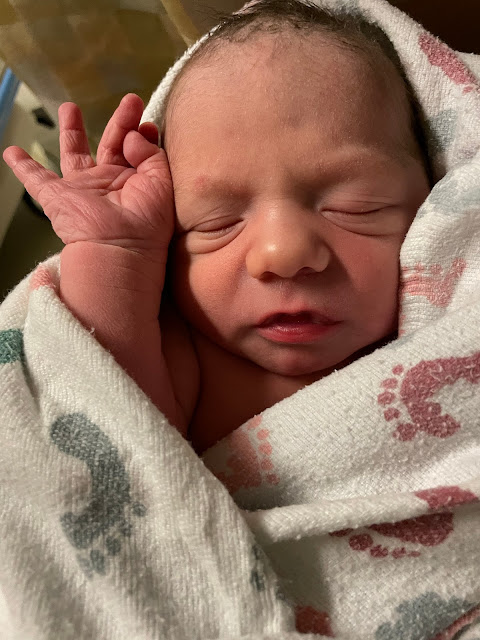
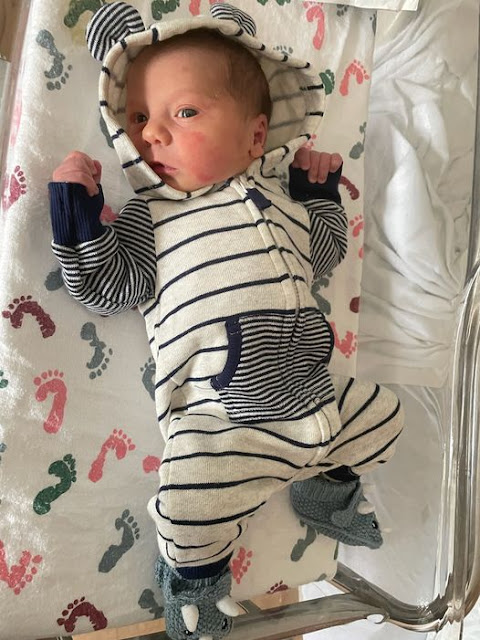
This beautiful little human is Asher, the newest member of our family. 

Asher joins Sophia in the next generation, the child of one of my nephews and niece(-in-law)s. My brother and sister(-in-law) now have two grandchildren, and my mom has two great-grands! 

Asher was born on January 13 in Berkeley, California. When I texted with the Dad this morning, he said: "We are deliriously happy. He is the most amazing thing I've ever seen."

1.13.2022

sidney poitier, rest in power

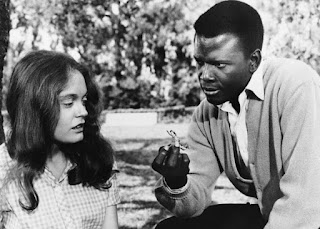
Sidney Poitier was one of my favourite actors. He starred in two of my favourite movies that I watched as a child: "A Patch of Blue" and "To Sir, With Love". Of course I loved him in "Guess Who's Coming to Dinner," "A Raisin in the Sun," and "Lilies of the Field", but it was those two early films that imprinted him in my heart.

Both those early movies led me to books, and I watched and read both, several times. 

I have a personal memory connected to Patch of Blue. The story revolves around the friendship between a Black man, played by Poitier, and a young woman who is white -- and blind. Selina is isolated and uneducated; she lives with her drunk, abusive grandfather and her mother, who is a sex worker. Through a chance meeting, the two become great friends and fall in love. Of couse Selina doesn't know that her friend is Black. Their friendship, let alone their love, is forbidden.

When I was 10, I spent the summer with my grandparents and great-aunts in Brooklyn. They were wonderful to me and I have only happy memories of them. They were also horribly racist. One night I watched A Patch of Blue on TV, not for the first time, and was telling them about it. They thought the movie was very sad, because "they loved each other but could never be together". I said, "Because he was so much older than her." They all gasped in horror, and fell all over each other correcting me, "No! They can't be together because he's a Negro!" They were genuinely concerned that I didn't understand this very important life lesson.

A Patch of Blue is about racism, about the unnecessary cruelty that keeps these two good people apart. But to my relatives, the movie was a tale of star-crossed lovers: how sad that she fell in love with a Negro and didn't realize it. Not how unjust and ridiculous it was that these two people should be apart. I always associate the movie with that conversation; I look back on it with amusement.

(A Patch of Blue was also part of the beginning of my interest in disability, along with a children's book called Follow My Leader about a boy who is blinded and his guide dog.)

I loved A Patch of Blue, but when I saw To Sir, With Love, I fell in love with Sidney Poitier. He was a great actor, a steadfast activist, and an incredibly important figure in film. I'm thinking a Sidney Poitier film fest in chez Kaminker-Wood is in order.

1.08.2022

"at your library" in the north island eagle: goodbye for now, see you at the library

Goodbye for Now… See You at the Library

This is my final At Your Library column. I'm grateful to Kathy O’Reilly, indefatigable publisher of The Eagle, for giving me this opportunity. When I came to Port Hardy – exactly three years ago – I didn't know a soul, and now I feel so much a part of our community. This column has extended our library's reach into that community, and I hope you have enjoyed it.

To stay in touch with what's happening at the Vancouver Island Regional Library (VIRL), consider subscribing to Well Read, VIRL's monthly newsletter. It will keep you up to date on new services, special events, and highlights from our collection. To subscribe, go to virl.bc.ca > news > Well Read. You can read it online, or click on "Sign up for our e-Newsletter" to receive it by email every month.

Another great way to stay in touch is "Meet Me in the Stacks", a podcast presented by a group of VIRL librarians. You can find "Meet Me in the Stacks" wherever you subscribe to podcasts, or you can listen online through the VIRL website. Go to virl.bc.ca/podcast or to listen online, go to virl.bc.ca/podcast/listen-now/.

Your favourite VIRL branch is also on Facebook, and you can follow the branch page for news and updates. 

To review and sum up, here's everything you need to know.

* Reading is great. 

* Read to your kids and grandkids. Help them read on their own. It's super important to their healthy development.

* The library has so much more than books. Check out our e-resources!

* Everything at the library is free of charge.

* Everyone can have a library card.

* We are here to help you.

To stay in touch with me, email me at lkaminker@virl.bc.ca. Hope to see you soon!

"at your library" in the north island eagle: we heart your small or home-based business

Small or Home-Based Business? Your Library Can Help

So many people in our North Island communities have been opening new businesses lately! It seems like every edition of The Eagle features at least one story about a new business in one of our towns. Some are "bricks and "mortar" businesses that we can physically visit, while others are home-based operations that reach potential customers through Facebook and other social media. 

Everyone in our towns wants to support local businesses – including your library. If you've ever considered starting your own business, or if you're currently developing a fledging business of your own, your library can help. Check out our "e-resources" – powerful databases available to you, free of charge, with your library card.

Wherever you are in your business development, we have e-resources to support and assist you. Whether you're writing a business plan, researching the competition, launching a marketing plan, creating a logo, learning how to keep your books – and so much more – your library can help. 

* Business Plan Handbook is a huge collection of actual business plans created by entrepreneurs who were looking for funding for their small businesses. There are sample business plans from all sectors – manufacturing, retail, and service industries. You can learn what makes a successful business plan and begin to create your own.

* Business Source Premiere is a comprehensive collection of articles and guides on every area of business, including marketing, management, accounting, banking and finance. You can use this e-resource to research company profiles, research markets, conduct SWOT analyses, even read papers from world-class business schools. Another great plus: you can use Business Source Premiere to access trade publications in many fields. These publications are quite expensive to subscribe to, but our e-resource lets you browse and read them for free.

* LinkedIn Learning (formerly called Lynda.com) is an amazing platform for self-education. This e-resource contains thousands of video tutorials on hundreds of topics. All the videos are professionally made, very high quality, with no interruptions for ads or the questionable content that you'll find on YouTube. Learning how to use social media to grow your business, beyond just having a Facebook page? Need to learn about spreadsheets to track your marketing contacts? Designing a logo? Hiring an assistant for the first time? LinkedIn Learning can help you get there.

To find these free e-resources, go to virl.bc.ca > learn > all databases. The e-resources are listed in alphabetical order. What you'll find may surprise you.

* Books! The library has a huge selection of books on all these topics, too. We can help you find and request whatever you need.

It all starts with your library card. Stop by your local branch to get one today, or apply online at virl.bc.ca > get help > get a library card, or virl.bc.ca, then scroll to the very bottom, and click on "get a library card". 

"at your library" in the north island eagle: build early literacy with storytimes

Build Early Literacy with Storytimes – Every Day in Port Hardy

In a year when we desperately needed good news, the Port Hardy branch of the Vancouver Island Regional Library (VIRL) had the best news: a huge increase in hours. And one of the best things about those new hours is the daily storytime. 

At 10:00 every morning, Tuesday through Saturday, you can come to the Port Hardy Library and participate in a storytime. There’s no need to sign up in advance or even let us know you're coming. Just take your little one – your own child, a grandchild, or a group of little ones you take care of – and show up at the library. 

Storytimes are fun for kids, but the reason to attend goes way beyond entertainment. 

By the time a child starts kindergarten, we want them to have "reading readiness". Reading readiness is closely tied to early school success, and early school success is closely tied to increased life chances. This means when we help children build reading readiness, we are helping them succeed in life! And hearing stories read aloud is one of the best ways to build reading readiness.

When a child listens to a story, they learn a huge array of language skills. They build vocabulary and reading comprehension, learn how to pay attention and to follow a story, they learn the sounds and rhythms of language.

Storytimes engage children's imaginations, which is one of the most important ways they learn about the world. It introduces children to new ideas and new fun things, like dinosaurs, whales, and trains. 

Hearing stories help children cope with their feelings, and navigate scary things that all children go through, such as conflicts with siblings. It helps them learn about how other people feel, which builds empathy and compassion.

Stories teach about culture, from Halloween and Thanksgiving to cedar weaving and the Big House.

Attending a storytime at the library is an opportunity for your child to build social skills, to interact with other adults, and even to learn a little patience.

Plus, storytimes bring families to the library, where they can borrow books to read with their children at home. It helps children associate the library with a fun and happy activity, and you know we love that.

Thanks to our dedicated library staff, and to the Mount Waddington Family Literacy Society, we're able to offer this amazing opportunity, every day that the library is open, for free.

And all you have to do is show up. 

1.02.2022

not a resolution part two: habit tracking and 85% thinking

If there's a universal truth about getting older, it must be that we need to take better care of ourselves. Habits -- or the lack of habits -- that we could get away with in our 20s become more difficult in our 30s, barely possible in our 40s, and downright self-destructive in our 50s and beyond.

Like many people, as I've gotten older, I've been more motivated to take better care of myself -- physically and mentally. To that end, I have found two indispensable tools: habit tracking, and something I call "85 percent thinking".

The whys and hows of habit tracking

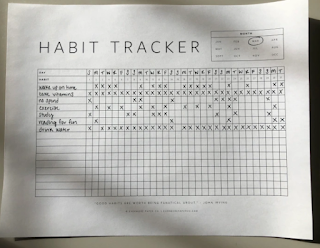
Random habit tracker I found online
Habit tracking is the practice of tracking how you're doing with various habits that you're trying to work into your life. Habit tracking is:

- focusing: it provides a daily reminder of your goals,

- motivating: ticking the box or tapping the green square is a form of mental reward, and

- factual: it provides visual evidence of what you've been doing or not doing. In other words, it keeps you honest.

The format you use to track your habits should be whatever is easiest and most natural for you. 

There are dozens of habit-tracking apps, or you can treat yourself to a special notebook, or use your favourite pen on graph paper. I avoid the fancy stuff -- try googling bullet journals -- because I don't want the tracker to become an end in itself, a cute time-waster of limited value.

I use a spreadsheet. A spreadsheet is:

- convenient: I keep it open on my computer's toolbar. 

- flexible: I can easily add new habits or gray-out columns that I'm no longer tracking. 

- tidy: if I used paper, I'd be annoyed at erasures or cross-outs. 

- easy: dates on the vertical, habits on the horizontal, and you're good to go. Excel (or whatever program you use) can insert the days and dates, saving you from repetitive writing.

There are dozens of habit-tracking apps that you can use on your phone. I purposely don't use an app, because:
- most have ads and other distractions,
- I like to archive all my past trackers, so I want files I can save independently,
- I don't want to obsess: with an app, I'd be likely to check it throughout the day, and
- I want fewer reasons to pick up my phone.

Using a spreadsheet works for me, but many people find a notebook is easier.

The content of the habit tracker is also totally personal. 

My tracker includes health goals, such as minutes per day of exercise and meditation, stretching before exercise, plus any simple habits I'm trying to get better about -- things like caring for my dry skin, wearing my mouth guard at night (apparently it doesn't protect your teeth if you don't use it, go figure!), or having a mug of herbal tea when I feel like eating but I know I'm not hungry. I also track days I read, and days I blog, because both of those are important to me. 

My 2022 tracker has 17 habits, some daily, and some weekly. If you're new to the idea, it might be better to start small, with five habits, or even three. When tracking itself becomes a habit, you can add more variables.

I also find it helpful to have a mix of "gimmes" -- goals that you are doing anyway and unlikely to drop -- and more challenging goals that you might do less frequently, but are cause for a bit of self-congratulation when you meet them.

I usually use one tracker for a full year. Boxes either get an x for "yes I did that", or a number, such as minutes spent doing something. Every morning, with my first cup of coffee, I open the tracker and record how I did on the previous day. At the end of the year, I archive the file and start a new tracker.

The important thing, of course, is finding what works for you, then using it. And if the first format you try doesn't fit, you can try something else.

This year I'm experimenting with a section for weekly habits. There are five or six habits I'd like to do on a weekly basis, and I'm seeing if attaching a day of the week to each one helps me do them more consistently: this on Monday, this on Tuesday, and so on. 

Based on the popularity of books like James Clear's Atomic Habits, Make Your Bed by William McRaven, The 5 AM Club by Robin Sharma, and a zillion other, similar titles, it would appear that many people are striving in this direction. The sheer number of books and apps and advice can be overwhelming. I think it's best to keep it simple. Grab a notebook or open a spreadsheet and let the tracking begin.

However... the goal is not to check every box, every day. 

85 percent thinking

One of my biggest pitfalls, something I've worked hard to recognize and reduce over years, is All Or Nothing thinking. All Or Nothing says that unless you do something all the way, it's not worth doing at all. All Or Nothing recognizes only two possibilities: on or off. But real life is seldom so simple. If we recognize only two possibilities, we're setting ourselves up for failure.

In my mid-30s, when I was writing professionally, I had a run for a while writing about eating disorders. It was through those assignments that I first recognized my own disordered thinking about food and dieting. I reached out to one of the therapists I had interviewed, and worked with her for some time. It was difficult work and it had an enormous impact on my life.

This therapist taught something she called 85 percent thinking. Whatever you're doing, whether it's eating healthfully, getting more exercise, or any other goal, if you're doing it 85 percent of the time, you're doing well. 

We're not machines that can be programmed to perfection. We're humans, with real lives, full of things we cannot control. That accounts for the other 15 percent.

To do anything well, especially to learn new habits, we need discipline and commitment and inner strength. But to be humane, we also need compassion, and flexibility, and forgiveness -- and we must extend those to ourselves. That, too, is the other 15 percent.

Habit tracking + 85% thinking = compassionate and realistic success

Habit tracking keeps me focused and motivated, and helps keep me honest. 

Eighty-five percent thinking keeps me sane. 

Eighty-five percent thinking does not come naturally to me. My natural tendency is obsession. But I want to reject obsessive thinking, reject beating myself up, reject the rigid, unrealistic confines of All Or Nothing. I consciously choose 85% thinking, a little bit, every day.

1.01.2022

not a new year's resolution part one: precepts and generalities for 2022

A few years ago, I wrote in this blog:

I don't do New Year's Resolutions, but I do enjoy using the revolution of our Earth around the Sun as an excuse to take stock in where I am and think about where I'm going.

This is not a Big Promise To Do Something; it's not even goal-setting. In my ongoing work to free myself from a strong tendency towards All Or Nothing, to not paint myself into a corner, to not create Rules which I then use to limit my experiences, I don't even set concrete goals.

My thinking takes the form of general precepts that I'm trying to remember.

My guideposts for 2022 are pretty simple.

* Continue to work only the hours I am paid, to take breaks, and to work at a human pace.

* Continue ongoing digital minimalism: less social media, breaks from texting, enjoy analog pursuits.

* Pay attention to my important long-distance friendships.

* Spend time outdoors when weather and time permits.

* Continue doing what I can to stay healthy physically and  mentally. (New post coming soon.)

I am looking forward to several things this year.

* Seeing my mother and other family if at all possible.

* Zoom dates with close friends on a regular basis. (This is new.)

* Being active in my union.

* Allan and I have been working on financial goals, and I'm looking forward to those advancing.

* I'm more physically fit than I have been in many years, and I'm looking forward to maintaining that.

I hope you're being kind to yourself and looking forward to 2022 with at least cautious optimism.

happy new year from wmtc


Peace, Love, Good Health, and Solidarity to all.

Here's to a peaceful and healthy 2022.