1.21.2022

what i'm watching: best of 2021 (april to december)

As I mentioned here, I've decided to stop posting my entire "what i'm watching" list for the year. Instead I'm going to do an annual best-of. I'm also realigning this with the calendar. 

For 2021, I'm starting with April, where last year's 2020-21 list left off. Next year I'll be able to start with January.

So... these are the best series and movies I saw from April 2021 to December 2021. Within the two categories below, they are in no particular order. (It's not a countdown.)

Five Stars: the best of the best
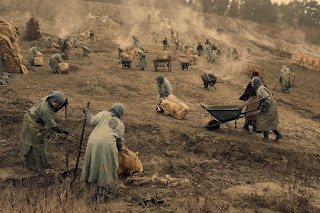
The Colonies
The Handmaid's Tale (S1-4, series so far)
This is one of the best series I've ever seen, and the most difficult to watch. S1 especially was so intense, that I could only watch one episode at a time, then needed to switch to something lighter. Why watch a series packed with rape, horrific state violence, fascism, and woman-hating? Because the writing, acting, and production is stellar. Because it feels all too plausible. And because it is a story of resistance. (Special shout-out to Toronto, playing itself for a change!)

Sophie: A Murder in West Cork
This true-crime mini-series was suspenseful and compelling. It sensitively captures the grief that follows a sudden, violent death, and the outrage at the blatant miscarriage of justice. 

Lupin (S1-2, series so far)
Joyous cons, daring and brilliant heists, biting social commentary about racism and colonialism, plus a literary meta-theme: it doesn't get much better than this. A perfect series, especially for crime lovers.

Bo Burnham Inside
Burnham filmed, edited, and performed this film, completely solo, while in covid lockdown. It is clever, cutting, incredibly insightful, often profound. The artist manages to perfectly send-up so many cultural trends and tropes, but always with a voice that is warm and compassionate, never snarky or mocking. It left me feeling that I had taken a journey with Burnham. Later I learned he was the creator of 2018 film "Eighth Grade," which was all kinds of brilliant (four stars here).
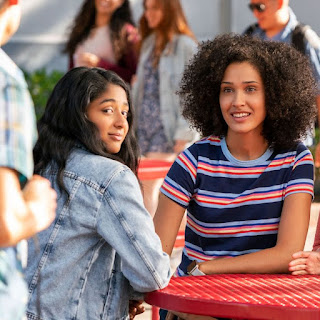
Never Have I Ever (S1 rewatch + S2, series so far)
This is one of the best teenage series ever made. Hilarious, warm, and deeply authentic, it made my heart squeeze with all the joy and pain of growing up. The social commentary about racism and sexism is perfectly woven in, never preachy. The representation of queers and people of colour is beautiful and seems completely natural. And the acting is absolutely amazing.

In the Heights
The film adaptation of Lin-Manuel Miranda's Broadway musical, a love letter to his (and my) former New York City neighbourhood. It's a joyous celebration of a place and the people who create it -- a positive look at something usually maligned -- wrapped in a ribbon of Latin and modern music and dance styles. It was so enjoyable! It also made me regret not seeing the Broadway production, which was running while I was still regularly visiting the area.

Yellowstone (S4)
After the extremely violent, cliffhanger ending of S3, Yellowstone S4 was all about healing, recovery -- and revenge. Some subplots wrapped up with deep emotions, while others are still open to future possibilities. I love the Native issues, the bold female anti-hero who continues to deepen in complexity, and the many visions of what love can look like. This show continues to be absolutely gripping, exploring both external and internal conflicts more deeply with every season. 

Four Stars: worth every minute

The Death and Life of Marsha P. Johnson (2017)
A documentary tribute to a transgender woman of colour who was a pioneering activist, and a look at the trans and gay liberation movements through the lens of one person's life. Moving, inspiring, sad, beautiful.

Ted Lasso (S1 only)
This show is sweet, warm, and funny, and manages to be feel-good without being sticky. I hated S2, couldn't get past the first episode, but S1 was wonderful.

Lovecraft Country (S1)
A wild, genre-blending, mind-bending exploration of Jim Crow America through adventure, fantasy, and horror. I stopped watching about halfway through but intend to go back. Weird and captivating.

Derry Girls (S1-2, series so far)
Teenage girls coming of age in Northern Ireland -- Catholic school and family madness against a backdrop of The Troubles. Wonderful characters, warm humour -- and another feel-good show I could tolerate. That makes three this year, which must be a record for me.

Mare of Easttown (one season, full series)
A female detective trying to solve a murder and disappearances, while coping with her own loss and grief. The premise sounds hackneyed, but the show feels new and authentic. Excellent acting by Kate Winslet, many fully realized female characters, and a strong portrayal of gritty, downtrodden, small-town America. A dark show, with just enough hope.
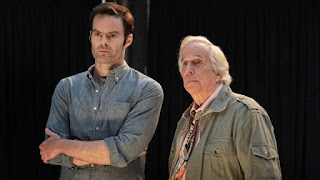
Barry (S1-2, series so far)
A darkly funny crime comedy with great characters and some outstanding performances by Bill Hader, Henry Winkler, and many others. S3 is supposed to be out this year, which is a great excuse to rewatch the series so far.

Your Honor (one season, full series)
Both a crime drama and an intimate family story, Your Honor explores what happens when deeply held moral beliefs clash with profound love and loyalty. Like The Handmaid's Tale (above), this series is unrelenting, with zero comic relief. It starts in a dark place and goes down from there. 

The Frontier (2015)
A tense, stylish, dark crime/neo-noir, chock full of double-crossing thieves and creepy characters, with a claustrophobic feel. Really fun stuff if you like noir.

Lucifer (S1-6, full series)
Hilarious, sexy, raunchy, genre-blending, and thoroughly entertaining, Lucifer is part detective/cop show and part "Buffy the Vampire Slayer". Major points for full-on bisexuality in both male and female characters, and some truly meaningful and sometimes profound character growth. Also: worst series finale ever. Honestly, I can't believe how bad the last 30 minutes of the show were. 

A Song For You (2016)
This documentary chronicles and pays tribute to "Austin City Limits," the greatest TV music show of our time. I don't have access to it anymore, and I miss it -- both to watch great performances and as a way to discover new sounds.

Loudermilk (S1-2 only)
A dark comedy about a recovering curmudgeon. Really good, until it wasn't.

The Inbetweeners (S1-3, full series rewatch)
A raucous, ridiculous, hilarious teenage comedy about awkward, misfit friends. Thoroughly enjoyable. Warning: do not watch the movie!

Line of Duty (S1-5 rewatch + new S6)
Suspenseful, twisty, unpredictable thriller about police corruption. Not your typical cop show by any means. Who is H?

Goliath (S1-3 rewatch plus new S4)
Crime, noir, paranoid thriller, legal drama -- all of those, plus some romance and family drama. I was grossly disappointed by S4, but loved the first three seasons.
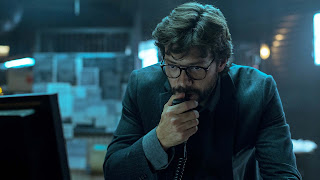
How can you not love The Professor?
Money Heist S5 (final season)
I didn't know how they would keep this series going after S2. Every successive season seemed even more improbable than the last, but somehow it just got better and better, adding layers to backstories and relationships. The final season was gripping and very emotional. Add The Professor to the list of my favourite anti-heroes.

The Hitch-Hiker (1953)
An odd and slightly surreal noir, with the distinction of being written and directed by the great Ida Lupino. 

True Grit (2010)
Great characters, including a strong young female lead, lots of western-style violence and more than a little humour -- a really solid movie. Part of my ongoing new interest in the Modern Western genre. 
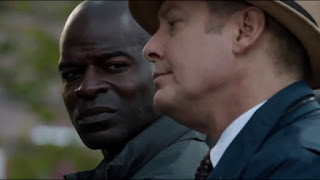
Greatest anti-heroes ever
The Blacklist S8
In S8, Raymond Reddington (or whoever he is) falls in love, and lets himself believe he can carve out a normal life in the midst of his chaos. This season had a deep emotional resonance, in addition to the show's usual suspense, adventure, violence, and humour. I found Red's love interest much more credible than any of Elizabeth's relationships. I continue to love both Raymond and Dembe, and will follow them anywhere.

Corporate (S1-S3, series so far)
I kept expecting this show to tank. How long can a satirical workplace comedy spin before it becomes a parody of itself? To my surprise, the show stayed funny, dark, relevant, and unpredictable. The episode "Black Dog" (S3e2) is the best portrayal of the illness of depression I've ever seen in popular culture -- unexpectedly emotional and real, while never losing the comic edge. Bravo.

The Morning Show (S1-2, series so far)
Great acting, relevant stories, compelling drama, biting humour, and real-world politics -- a nearly flawless combination. Unraveling the actions and consequences of workplace sexual harassment, seeing the impact on perpetrators and victims, packs a big punch.

A note, a plea: please, please, won't someone show us what women really look like in proper context? A tough, gritty TV journalist in West Virginia, covering stories of coal mines and mountaintop removal, would not go to work in full, professionally-crafted makeup. The portrayal is supposed to be realistic -- so why not tone down the glamour? As soon as I see the beautiful Reese Witherspoon in full Hollywood-style makeup, I'm pulled out of the show and am looking at the actor instead of the character. I see this in many supposedly realistic series. Obviously all actors are wearing makeup. But why not use a look that's somewhat realistic? Major points for series that don't do this, like Mare of Easttown. 

* * * *

Honourable Mention
Frank of Ireland
AP Bio
Endeavour (S1-4 rewatch, plus S5-7, series so far)
Hacks
How to with John Wilson
Rita

Comedy before sleep
Big Bang Theory (S8-12, remainder of series)
Superstore (S1-6, full series)

* * * *

Recap of previous years

- Canadian musicians and comedians (2006-07 and 2007-08)
- my beverage of choice (2008-09)
- famous people who died during the past year (2009-10)
- where I'd like to be (2010-11)
- vegetables (2011-12)
- big life events in a year full of Big Life Changes (2012-13)
- cheese (2013-14)
- types of travels (2014-15)
famous people who died plus famous people who died, part 2 (2015-16)
- the picket line (2016-17)
- movies (2017-18)
2018-19: 1-5 ☮s
2019-20: 1-5 💉s
2020-21: 1-5 ðŸ˜·s (without the tear!)

1.17.2022

we movie to canada: wmtc's annual movie awards are retired, replaced with best-of list

Last year, I realized that the new format of my annual movie awards was problematic. 

Beginning with 2018-19, rather than grouping movies by rating (all the 5s together, all the 4s together, and so on), I started listing all the titles alphabetically, showing the rating for each. 

As a personal list of what I've been watching, this is fine. But as a potential guide for readers, it's less than helpful. Most people I know are always looking for their next great series or movie. With an alphabetical list, they would have to go through the entire list, reading every description or comb through to pick out the top ratings.

I realized this last year, and it's been bothering me ever since. I was actually planning on re-organizing the three movie posts that I had done this way. This morning I sat down to that, and realized... no. Too much work without much payoff.

Looking ahead, I've decided to use a new format.

First, I'm realigning the viewing list with the calendar year. There was a reason my movie awards were geared to the baseball season, rather than the calendar, but that reason hasn't been relevant in many years. I'll now post in January about what I've watched the previous year.

In addition, I'm going to post a best-of instead of an exhaustive list -- basically the 4s and 5s from the former system. I'm still going to track everything I watch, but I won't post the complete list on wmtc.

Stay tuned (or don't!) for the best of 2021 list. To avoid repetition, the 2021 list will be what I watched from April to December, then future lists will take in the full year.

most useless and annoying advice ever: it's cheaper if you make it yourself

I did not make this myself.
Ever since moving to Canada, people have been telling me how I could make something myself for less money than I paid for it. Curtains, chair coverings, scarves. Kitchen gadgets. Dog needs. Skin care products. And food of all types. 

You can make that yourself, so much cheaper. 

I've heard this so often and from so many people, one might think everyone in Canada was crafting everything by hand. Which would not explain the crowds buying cheap merchandise in Canadian Tire.

Similarly, in certain Canadian circles, there is disdain for hiring someone for any personal or home labour. Snow shoveling, house cleaning, dogwalking, lawn care. Oo-hoo, look at you, throwing money away instead of picking up a shovel! It seems I am finally old enough for people to give me a pass on this one. The hidden joys of aging!

I find this "you can make it cheaper yourself" mentality annoying on so many levels. One, it's my money. I can spend it however I want, and I'd rather do so without your judgement. Two, isn't your time worth anything? My time is more valuable than money. Money can be earned, but time is a nonrenewable resource. (Yes, I know this is a privilege.) Three, mind your own business!

Perhaps this is not a Canadian thing at all. I don't know if people dole out this "advice" throughout the rest of the US. But I can tell you no one does in New York City! 

Long before the pandemic forced everyone inside, New Yorkers had everything delivered to their apartments. Since everyone walks or takes public transportation everywhere, deliveries are a way of life. So is paying for convenience. New Yorkers eat at restaurants or takeout almost every night of the week. They drop off their laundry. They hire dogwalkers. They rent car shares. And most of all, they have everything delivered. It's not an easy city to live in. Everyone who can afford to buys every convenience possible. And nobody ever tells you how you could make things more cheaply yourself.

Like Elaine Benes, I love a "big salad". In fact, one of my favourite meals are salads with lots of different ingredients. I love chopped-salad restaurants, and happily spend $16 or $18 to choose 10 different ingredients tossed in freshly-made, creative dressing. I am not often in an area with these restaurants, but when I am, I enjoy this very much.

Big salads are something I will never make for myself. I cook a lot, and I do quite a lot of other food prep. We do sometimes have a protein salad for dinner, but it's much more simple: lettuce, tomato, mini cucumber, chicken, cheese. I'm the only big salad fan in the house, plus, it's just too much effort.

In our previous suburban home, there were no restaurants that offered big salads. The closest we came was when Whole Foods opened a Mississauga location, but a salad bar is not the same. And of course there is nothing like this in my tiny little town now.

But now big salads have come to supermarkets! This has been a great development for me. I take a packaged salad kit, add a hardboiled egg and some grated cheese, and I have the perfect dinner. If I have some leftover grilled chicken or salmon on hand, I throw that in instead of the egg. 

This is one of my favourite meals and it helps me eat more vegetables -- more raw vegetables, which is even better. The only downside is there is a lot of plastic waste. This disturbs me... but not enough to stop buying the salads. 

But salad kits are expensive! 

In my experience, if you mention salad kits -- or if a busybody sees you buying a few in the supermarket -- or if you look for information online about a salad kit... You can make that cheaper yourself! 

Is this even true -- can you make the salad more cheaply yourself? I don't know. I haven't tested this claim, because I don't care. But some years ago, I wondered if Whole Foods' delicious, expensive tuna salad would be less expensive to make at home, and discovered it was only slightly more expensive to buy than to create. Sometime after that post, the store's prices went up, and later I started using less expensive tuna (for environmental reasons), so the balance would have changed. But the assumption that the prepared tuna salad was vastly more expensive than homemade was incorrect.

The salad kit I ate for dinner last night contained: white cabbage, red cabbage, kale, romaine lettuce, shredded carrots, cilantro, crispy noodle strips, and slivered almonds, and dressing. I added an egg and a bit of grated cheese. 

  • If I had made this myself, how much cheaper would it be? It's not a $6.00 salad versus a free dinner. After I'm done buying all those ingredients, what have I spent? 
  • Unless I used two entire heads of cabbage, an entire head of lettuce, and an entire bunch of kale within the upcoming week -- which I won't be able to do -- some of the vegetables will go bad. I would be wasting money and wasting food.
  • I can buy all different flavour combinations of salad kits, and eat different ones whenever I like. Having variety helps me maintain a healthy diet.
  • And finally -- but most importantly -- making this salad myself is too much effort for the end result. Everyone has (or should have) a personal time vs money formula. I would much rather spend $6 than make this complicated salad myself, and if I had to make it myself, I wouldn't eat it.

In short, it's a no-brainer: healthy, convenient food that I enjoy is worth the price of the kit.

I don't care if I could make it cheaper myself! 

1.16.2022

welcome to the world, asher


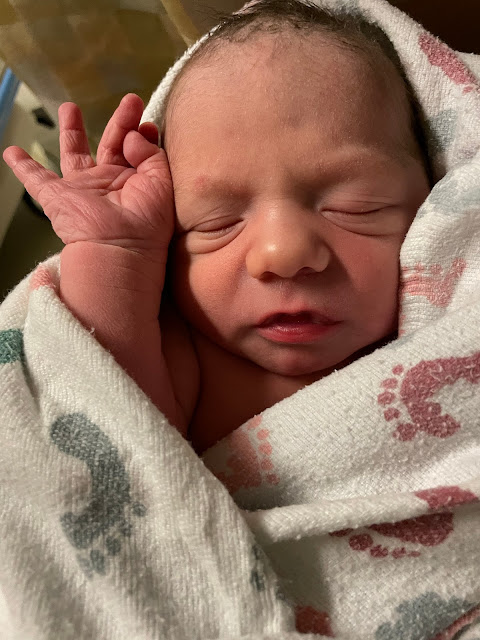
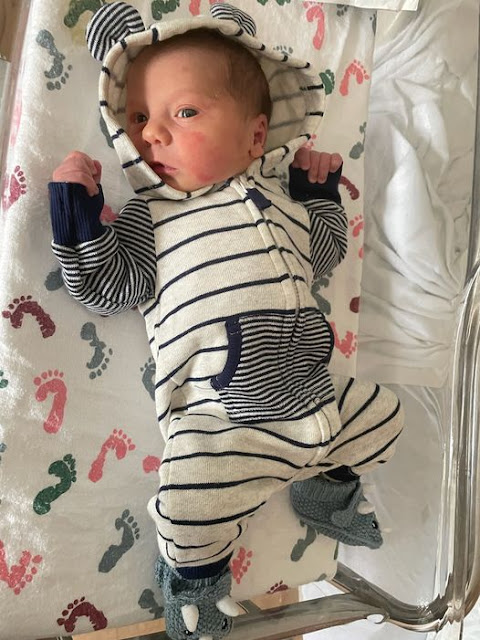
This beautiful little human is Asher, the newest member of our family. 

Asher joins Sophia in the next generation, the child of one of my nephews and niece(-in-law)s. My brother and sister(-in-law) now have two grandchildren, and my mom has two great-grands! 

Asher was born on January 13 in Berkeley, California. When I texted with the Dad this morning, he said: "We are deliriously happy. He is the most amazing thing I've ever seen."

1.13.2022

sidney poitier, rest in power

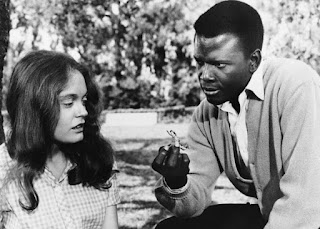
Sidney Poitier was one of my favourite actors. He starred in two of my favourite movies that I watched as a child: "A Patch of Blue" and "To Sir, With Love". Of course I loved him in "Guess Who's Coming to Dinner," "A Raisin in the Sun," and "Lilies of the Field", but it was those two early films that imprinted him in my heart.

Both those early movies led me to books, and I watched and read both, several times. 

I have a personal memory connected to Patch of Blue. The story revolves around the friendship between a Black man, played by Poitier, and a young woman who is white -- and blind. Selina is isolated and uneducated; she lives with her drunk, abusive grandfather and her mother, who is a sex worker. Through a chance meeting, the two become great friends and fall in love. Of couse Selina doesn't know that her friend is Black. Their friendship, let alone their love, is forbidden.

When I was 10, I spent the summer with my grandparents and great-aunts in Brooklyn. They were wonderful to me and I have only happy memories of them. They were also horribly racist. One night I watched A Patch of Blue on TV, not for the first time, and was telling them about it. They thought the movie was very sad, because "they loved each other but could never be together". I said, "Because he was so much older than her." They all gasped in horror, and fell all over each other correcting me, "No! They can't be together because he's a Negro!" They were genuinely concerned that I didn't understand this very important life lesson.

A Patch of Blue is about racism, about the unnecessary cruelty that keeps these two good people apart. But to my relatives, the movie was a tale of star-crossed lovers: how sad that she fell in love with a Negro and didn't realize it. Not how unjust and ridiculous it was that these two people should be apart. I always associate the movie with that conversation; I look back on it with amusement.

(A Patch of Blue was also part of the beginning of my interest in disability, along with a children's book called Follow My Leader about a boy who is blinded and his guide dog.)

I loved A Patch of Blue, but when I saw To Sir, With Love, I fell in love with Sidney Poitier. He was a great actor, a steadfast activist, and an incredibly important figure in film. I'm thinking a Sidney Poitier film fest in chez Kaminker-Wood is in order.

1.08.2022

"at your library" in the north island eagle: goodbye for now, see you at the library

Goodbye for Now… See You at the Library

This is my final At Your Library column. I'm grateful to Kathy O’Reilly, indefatigable publisher of The Eagle, for giving me this opportunity. When I came to Port Hardy – exactly three years ago – I didn't know a soul, and now I feel so much a part of our community. This column has extended our library's reach into that community, and I hope you have enjoyed it.

To stay in touch with what's happening at the Vancouver Island Regional Library (VIRL), consider subscribing to Well Read, VIRL's monthly newsletter. It will keep you up to date on new services, special events, and highlights from our collection. To subscribe, go to virl.bc.ca > news > Well Read. You can read it online, or click on "Sign up for our e-Newsletter" to receive it by email every month.

Another great way to stay in touch is "Meet Me in the Stacks", a podcast presented by a group of VIRL librarians. You can find "Meet Me in the Stacks" wherever you subscribe to podcasts, or you can listen online through the VIRL website. Go to virl.bc.ca/podcast or to listen online, go to virl.bc.ca/podcast/listen-now/.

Your favourite VIRL branch is also on Facebook, and you can follow the branch page for news and updates. 

To review and sum up, here's everything you need to know.

* Reading is great. 

* Read to your kids and grandkids. Help them read on their own. It's super important to their healthy development.

* The library has so much more than books. Check out our e-resources!

* Everything at the library is free of charge.

* Everyone can have a library card.

* We are here to help you.

To stay in touch with me, email me at lkaminker@virl.bc.ca. Hope to see you soon!

"at your library" in the north island eagle: we heart your small or home-based business

Small or Home-Based Business? Your Library Can Help

So many people in our North Island communities have been opening new businesses lately! It seems like every edition of The Eagle features at least one story about a new business in one of our towns. Some are "bricks and "mortar" businesses that we can physically visit, while others are home-based operations that reach potential customers through Facebook and other social media. 

Everyone in our towns wants to support local businesses – including your library. If you've ever considered starting your own business, or if you're currently developing a fledging business of your own, your library can help. Check out our "e-resources" – powerful databases available to you, free of charge, with your library card.

Wherever you are in your business development, we have e-resources to support and assist you. Whether you're writing a business plan, researching the competition, launching a marketing plan, creating a logo, learning how to keep your books – and so much more – your library can help. 

* Business Plan Handbook is a huge collection of actual business plans created by entrepreneurs who were looking for funding for their small businesses. There are sample business plans from all sectors – manufacturing, retail, and service industries. You can learn what makes a successful business plan and begin to create your own.

* Business Source Premiere is a comprehensive collection of articles and guides on every area of business, including marketing, management, accounting, banking and finance. You can use this e-resource to research company profiles, research markets, conduct SWOT analyses, even read papers from world-class business schools. Another great plus: you can use Business Source Premiere to access trade publications in many fields. These publications are quite expensive to subscribe to, but our e-resource lets you browse and read them for free.

* LinkedIn Learning (formerly called Lynda.com) is an amazing platform for self-education. This e-resource contains thousands of video tutorials on hundreds of topics. All the videos are professionally made, very high quality, with no interruptions for ads or the questionable content that you'll find on YouTube. Learning how to use social media to grow your business, beyond just having a Facebook page? Need to learn about spreadsheets to track your marketing contacts? Designing a logo? Hiring an assistant for the first time? LinkedIn Learning can help you get there.

To find these free e-resources, go to virl.bc.ca > learn > all databases. The e-resources are listed in alphabetical order. What you'll find may surprise you.

* Books! The library has a huge selection of books on all these topics, too. We can help you find and request whatever you need.

It all starts with your library card. Stop by your local branch to get one today, or apply online at virl.bc.ca > get help > get a library card, or virl.bc.ca, then scroll to the very bottom, and click on "get a library card". 

"at your library" in the north island eagle: build early literacy with storytimes

Build Early Literacy with Storytimes – Every Day in Port Hardy

In a year when we desperately needed good news, the Port Hardy branch of the Vancouver Island Regional Library (VIRL) had the best news: a huge increase in hours. And one of the best things about those new hours is the daily storytime. 

At 10:00 every morning, Tuesday through Saturday, you can come to the Port Hardy Library and participate in a storytime. There’s no need to sign up in advance or even let us know you're coming. Just take your little one – your own child, a grandchild, or a group of little ones you take care of – and show up at the library. 

Storytimes are fun for kids, but the reason to attend goes way beyond entertainment. 

By the time a child starts kindergarten, we want them to have "reading readiness". Reading readiness is closely tied to early school success, and early school success is closely tied to increased life chances. This means when we help children build reading readiness, we are helping them succeed in life! And hearing stories read aloud is one of the best ways to build reading readiness.

When a child listens to a story, they learn a huge array of language skills. They build vocabulary and reading comprehension, learn how to pay attention and to follow a story, they learn the sounds and rhythms of language.

Storytimes engage children's imaginations, which is one of the most important ways they learn about the world. It introduces children to new ideas and new fun things, like dinosaurs, whales, and trains. 

Hearing stories help children cope with their feelings, and navigate scary things that all children go through, such as conflicts with siblings. It helps them learn about how other people feel, which builds empathy and compassion.

Stories teach about culture, from Halloween and Thanksgiving to cedar weaving and the Big House.

Attending a storytime at the library is an opportunity for your child to build social skills, to interact with other adults, and even to learn a little patience.

Plus, storytimes bring families to the library, where they can borrow books to read with their children at home. It helps children associate the library with a fun and happy activity, and you know we love that.

Thanks to our dedicated library staff, and to the Mount Waddington Family Literacy Society, we're able to offer this amazing opportunity, every day that the library is open, for free.

And all you have to do is show up. 

1.02.2022

not a resolution part two: habit tracking and 85% thinking

If there's a universal truth about getting older, it must be that we need to take better care of ourselves. Habits -- or the lack of habits -- that we could get away with in our 20s become more difficult in our 30s, barely possible in our 40s, and downright self-destructive in our 50s and beyond.

Like many people, as I've gotten older, I've been more motivated to take better care of myself -- physically and mentally. To that end, I have found two indispensable tools: habit tracking, and something I call "85 percent thinking".

The whys and hows of habit tracking

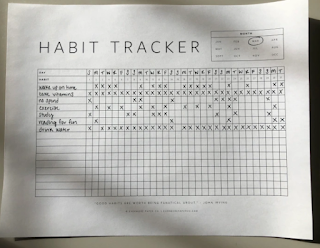
Random habit tracker I found online
Habit tracking is the practice of tracking how you're doing with various habits that you're trying to work into your life. Habit tracking is:

- focusing: it provides a daily reminder of your goals,

- motivating: ticking the box or tapping the green square is a form of mental reward, and

- factual: it provides visual evidence of what you've been doing or not doing. In other words, it keeps you honest.

The format you use to track your habits should be whatever is easiest and most natural for you. 

There are dozens of habit-tracking apps, or you can treat yourself to a special notebook, or use your favourite pen on graph paper. I avoid the fancy stuff -- try googling bullet journals -- because I don't want the tracker to become an end in itself, a cute time-waster of limited value.

I use a spreadsheet. A spreadsheet is:

- convenient: I keep it open on my computer's toolbar. 

- flexible: I can easily add new habits or gray-out columns that I'm no longer tracking. 

- tidy: if I used paper, I'd be annoyed at erasures or cross-outs. 

- easy: dates on the vertical, habits on the horizontal, and you're good to go. Excel (or whatever program you use) can insert the days and dates, saving you from repetitive writing.

There are dozens of habit-tracking apps that you can use on your phone. I purposely don't use an app, because:
- most have ads and other distractions,
- I like to archive all my past trackers, so I want files I can save independently,
- I don't want to obsess: with an app, I'd be likely to check it throughout the day, and
- I want fewer reasons to pick up my phone.

Using a spreadsheet works for me, but many people find a notebook is easier.

The content of the habit tracker is also totally personal. 

My tracker includes health goals, such as minutes per day of exercise and meditation, stretching before exercise, plus any simple habits I'm trying to get better about -- things like caring for my dry skin, wearing my mouth guard at night (apparently it doesn't protect your teeth if you don't use it, go figure!), or having a mug of herbal tea when I feel like eating but I know I'm not hungry. I also track days I read, and days I blog, because both of those are important to me. 

My 2022 tracker has 17 habits, some daily, and some weekly. If you're new to the idea, it might be better to start small, with five habits, or even three. When tracking itself becomes a habit, you can add more variables.

I also find it helpful to have a mix of "gimmes" -- goals that you are doing anyway and unlikely to drop -- and more challenging goals that you might do less frequently, but are cause for a bit of self-congratulation when you meet them.

I usually use one tracker for a full year. Boxes either get an x for "yes I did that", or a number, such as minutes spent doing something. Every morning, with my first cup of coffee, I open the tracker and record how I did on the previous day. At the end of the year, I archive the file and start a new tracker.

The important thing, of course, is finding what works for you, then using it. And if the first format you try doesn't fit, you can try something else.

This year I'm experimenting with a section for weekly habits. There are five or six habits I'd like to do on a weekly basis, and I'm seeing if attaching a day of the week to each one helps me do them more consistently: this on Monday, this on Tuesday, and so on. 

Based on the popularity of books like James Clear's Atomic Habits, Make Your Bed by William McRaven, The 5 AM Club by Robin Sharma, and a zillion other, similar titles, it would appear that many people are striving in this direction. The sheer number of books and apps and advice can be overwhelming. I think it's best to keep it simple. Grab a notebook or open a spreadsheet and let the tracking begin.

However... the goal is not to check every box, every day. 

85 percent thinking

One of my biggest pitfalls, something I've worked hard to recognize and reduce over years, is All Or Nothing thinking. All Or Nothing says that unless you do something all the way, it's not worth doing at all. All Or Nothing recognizes only two possibilities: on or off. But real life is seldom so simple. If we recognize only two possibilities, we're setting ourselves up for failure.

In my mid-30s, when I was writing professionally, I had a run for a while writing about eating disorders. It was through those assignments that I first recognized my own disordered thinking about food and dieting. I reached out to one of the therapists I had interviewed, and worked with her for some time. It was difficult work and it had an enormous impact on my life.

This therapist taught something she called 85 percent thinking. Whatever you're doing, whether it's eating healthfully, getting more exercise, or any other goal, if you're doing it 85 percent of the time, you're doing well. 

We're not machines that can be programmed to perfection. We're humans, with real lives, full of things we cannot control. That accounts for the other 15 percent.

To do anything well, especially to learn new habits, we need discipline and commitment and inner strength. But to be humane, we also need compassion, and flexibility, and forgiveness -- and we must extend those to ourselves. That, too, is the other 15 percent.

Habit tracking + 85% thinking = compassionate and realistic success

Habit tracking keeps me focused and motivated, and helps keep me honest. 

Eighty-five percent thinking keeps me sane. 

Eighty-five percent thinking does not come naturally to me. My natural tendency is obsession. But I want to reject obsessive thinking, reject beating myself up, reject the rigid, unrealistic confines of All Or Nothing. I consciously choose 85% thinking, a little bit, every day.

1.01.2022

not a new year's resolution part one: precepts and generalities for 2022

A few years ago, I wrote in this blog:

I don't do New Year's Resolutions, but I do enjoy using the revolution of our Earth around the Sun as an excuse to take stock in where I am and think about where I'm going.

This is not a Big Promise To Do Something; it's not even goal-setting. In my ongoing work to free myself from a strong tendency towards All Or Nothing, to not paint myself into a corner, to not create Rules which I then use to limit my experiences, I don't even set concrete goals.

My thinking takes the form of general precepts that I'm trying to remember.

My guideposts for 2022 are pretty simple.

* Continue to work only the hours I am paid, to take breaks, and to work at a human pace.

* Continue ongoing digital minimalism: less social media, breaks from texting, enjoy analog pursuits.

* Pay attention to my important long-distance friendships.

* Spend time outdoors when weather and time permits.

* Continue doing what I can to stay healthy physically and  mentally. (New post coming soon.)

I am looking forward to several things this year.

* Seeing my mother and other family if at all possible.

* Zoom dates with close friends on a regular basis. (This is new.)

* Being active in my union.

* Allan and I have been working on financial goals, and I'm looking forward to those advancing.

* I'm more physically fit than I have been in many years, and I'm looking forward to maintaining that.

I hope you're being kind to yourself and looking forward to 2022 with at least cautious optimism.

happy new year from wmtc


Peace, Love, Good Health, and Solidarity to all.

Here's to a peaceful and healthy 2022.

12.30.2021

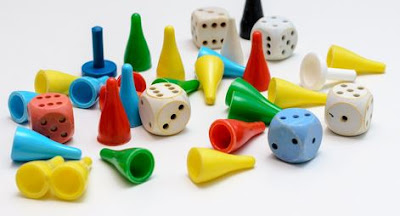
an analog breakthrough: in which we play tabletop games and this makes me very happy

In a few recent posts, I mentioned two details of my life that seemed to be in direct opposition to each other. 

One, I want to move further down the path of digital minimalism, spending less time on social media, more time with long-distance friends, and more time with analog pursuits.

And two, I love games of all kinds, especially board or tabletop games* -- but my partner does not. The resurgence of the popularity of board games, and the explosion of new games on the market, has been a source of frustration for me, because of Allan's total lack of interest.

Suddenly, this has changed! Allan has agreed to a games night! Hooray!

At the time of this momentous announcement, the only games we owned were backgammon, Scrabble, and Trivial Pursuit. I did some research to find a selection of games we might like. They needed to be:

- good for two players,

- not super difficult to learn,

- not involve free-form storytelling or lookup tables, and

- last no more than 60 -- or at most 90 -- minutes for a typical game.

After researching online and soliciting ideas from Facebook friends, I purchased:
- Ticket to Ride (European edition)
- Pandemic (original edition)
- Bananagrams
- Qwirkle
- Sherlock Holmes (Baker Street Irregulars edition)

The most-recommended game by far was Ticket to Ride. Pandemic was particularly appealing to me because it's cooperative, rather than competitive. We've played each of those once so far. Both games seemed very complex and were a little daunting at first, but we were able to figure them out and get into the rhythms of play during the course of one game. I'm really looking forward to the Sherlock Holmes game, too. Each edition comes with 10 cases; players search "foggy London town" for clues.

In addition to these analog pursuits, I've also re-instituted Music Night, which we used to do regularly, but fell out of the habit many years ago. Our work schedules give us three nights together each week. My plan is to use one of those for either music or games, alternating every-other week. The plan is also flexible: if we're very engrossed in a series and don't want to skip a night, no harm will be done.

If you have a favourite tabletop game, please feel free to leave it in comments. I probably won't buy any more just yet, but I'm sure I'll want to expand our choices at some point.

------

* I want to stay away from videogames: I find them unbelievably addictive, and am looking for less screen time, and fewer opportunities for repetitive strain injuries.

12.26.2021

a reading plan for 2022, plus how the 2021 plan fared

I'm enjoying my new-ish habit of having a reading plan for the year ahead. I like having the structure and the direction. But I also like -- and need -- to keep it flexible. It's not a reading challenge. No x number of books for the year, no goal at all. I can (and do) read any book I want whether or not it's part of the plan. I'm also not tracking my reading that's not off-plan, although if I really like a book I'll probably write about it. 

So how did the 2021 plan go? Pretty great! The plan is below, with my current comments in italics. The nonfiction is all reviewed on this blog; the fiction is only reviewed if I liked it (with the exception of literary thrillers or literary crime, and the occasional series, which I don't review).

Nonfiction

Ghosts of Gold Mountain: the Epic Story of the Chinese Who Built the Transcontinental Railroad, Gordon Chang 

Sometimes You Have to Lie: The Life and Times of Louise Fitzhugh, Renegade Author of Harriet the Spy, Leslie Brody

The Sword and the Shield: the Revolutionary Lives of Malcolm X and Martin Luther King Jr., Peniel E. Joseph

Janis: Her Life and Her Music, Holly George-Warren

Poisoner In Chief: Sidney Gottlieb and the CIA Search for Mind Control, Stephen Kinzer 

A Mind Spread Out on the Ground, Alicia Elliott

Mad at the World: A Life of John Steinbeck, William Souder

Men Explain Things to Me, Rebecca Solnit Read a few essays, will continue.

The Skin We're In: A Year of Black Resistance and Power, Desmond Cole

The Heartbeat of Wounded Knee: Native America from 1890 to the Present, David Treuer

The Uninhabitable Earth: Life After Warming, David Wallace-Wells

Digital Minimalism: Choosing a Focused Life in a Noisy World, Cal Newport

Fiction 

Charlie Savage, Roddy Doyle

Gilead, Marilynne Robinson Read in part, not continuing with trilogy.

The Cold Millions: A Novel, Jess Walter

There There, Tommy Orange

The Resisters, Gish Jen

True Story: A Novel, Kate Reed Perry

Blacktop Wasteland: A Novel, S. A. Cosby Loved!

Girl, Woman, Other, Bernardine Evaristo

The Stone Angel, Margaret Laurence 

YA

The Bridge, Bill Konigsberg

Sia Martinez and the Moonlit Beginning of Everything, Raquel Vasquez Gilliland

Children's

A List of Things That Will Not Change, Rebecca Stead (miscategorized as YA)

Continuing to read more by: I did not read more by any of these authors, but I did pick up books by all of them at Powell's in Portland.

Frans de Waal

Carl Safina

Robert Sapolsky

Giving my brain a break between nonfictions

Martin Beck, Per Wahlöö and Maj Sjöwall Read nine of ten, probably should have stopped after seven.

Parker, Donald Westlake as Richard Stark

Long-term goals I did none of these! And two other long-term goals aren't even on this list. Perhaps I should choose one long-term reading goal for the year.

Orwell still to read: three titles

Dickens still to read: four titles

Re-start weekly chapters of Gotham: A History of New York City to 1898 and Greater Gotham: A History of New York City from 1898 to 1919. (Project started in 2018 but abandoned later that year.)

This year's plan is much longer. This is probably a bad idea.

Nonfiction

A Mind Spread Out on the Ground, Alicia Elliott

Men Explain Things to Me and The Mother of All Questions, Rebecca Solnit essay collections

The Uninhabitable Earth: Life After Warming, David Wallace-Wells

A Primate's Memoir, Robert Sapolsky

The Other Slavery: The Uncovered Story of Indian Enslavement in America, Andrés Reséndez

Four Lost Cities: A Secret History of the Urban Age, Annalee Newitz

Say Nothing: A True Story of Murder and Memory in Northern Ireland, Patrick Radden Keefe

The Turning Point: A Year That Changed Dickens and the World, Robert Douglas-Fairhurst 

Killers of the Flower Moon: The Osage Murders and the Birth of the FBI, David Grann

Animal, Vegetable, Junk: A History of Food, from Sustainable to Suicidal, Mark Bittman

Galileo and the Science Deniers, Mario Livio

Nine Nasty Words: English in the Gutter: Then, Now, and Always, John McWhorter

Four Fish: the Future of the Last Wild Food, Paul Greenberg

The Doctors Blackwell: How Two Pioneering Sisters Brought Medicine to Women and Women to Medicine, Janice P. Nimura

Hate: Why We Should Resist It with Free Speech, Not Censorship, Nadine Strossen

Permanent Record, Edward Snowden

Bob Dylan: Behind The Shades Revisited, Clinton Heylin

The Trials of Nina McCall: Sex, Surveillance, and the Decades-Long Government Plan to Imprison "Promiscuous" Women, Scott W. Stern 

Made in China: A Prisoner, an SOS Letter, and the Hidden Cost of America's Cheap Goods, Amelia Pang

Gods of the Upper Air: How a Circle of Renegade Anthropologists Reinvented Race, Sex, and Gender in the Twentieth Century, Charles King

The Escape Artist, Helen Fremont

The Last Job: "The Bad Grandpas" and the Hatton Garden Heist, Dan Bilefsky

Republic of Detours: How the New Deal Paid Broke Writers to Rediscover America, Scott Borchert

Natural Causes: An Epidemic of Wellness, the Certainty of Dying, and Killing Ourselves to Live Longer, Barbara Ehrenreich

Fiction (will likely try many of these without reading... or so I think)

Charlie Savage, Roddy Doyle

The Resisters, Gish Jen

Girl, Woman, Other, Bernardine Evaristo

Razorblade Tears, S. A. Cosby

Marley, Jon Clinch

Christine Falls, John Banville as Benjamin Black

Stay and Fight, Madeline ffitch

Gods With A Little G, Tupelo Hassmann

The Memory Police, Yoko Ogawa

The Electric Hotel, Dominic Smith

Against the Loveless World, Susan Abulhawa

Simon the Fiddler, Paulette Jiles

Station Eleven, Emily St. John Mandel

Moon of the Crusted Snow, Waubgeshig Rice

Damnation Spring, Ash Davidson

The Other Black Girl, Zakiya Dalila Harris

The Weight of Ink, Rachel Kadish

The Goldfinch, Donna Tartt

The Night Watchman, Louise Erdrich (I've read all her early books, but have not read her recently)

YA

One of Us is Next, Karen M. McManus

Children's

Gone to the Woods: Surviving a Lost Childhood, Gary Paulsen

The Leak, Kate Reed Perry

Kaleidoscope, Brian Selznick

Pumpkinheads, Rainbow Rowell 

Look Both Ways: A Tale Told in Ten Blocks, Jason Reynolds

To give my brain a break

Harlem Detective series, Chester Himes (Have read two of eight.)

John le Carré re-reads (Read one this year... so good!)

Long-term goal

Weekly chapters of Gotham: A History of New York City to 1898 and Greater Gotham: A History of New York City from 1898 to 1919. (Project started in 2018 but abandoned later that year.)

* * * *

One thing is obvious: this plan is too long! I hope I can use it without feeling defeated, because I can't narrow it down any further right now.

12.16.2021

what i'm reading: digital minimalism: choosing a focused life in a noisy world

Cal Newport's Digital Minimalism: Choosing a Focused Life in a Noisy World is an essential book for our time. Newport argues -- quite persuasively -- that smartphones and their constant connection to social media are degrading our quality of life. He offers ample proof of this, and offers a plan that readers can use to break their smartphone and social media addictions.

Newport is not anti-technology. He's a professor of computer science and is not suggesting a return to pre-modern life. He acknowledges and enjoys the convenience that mobile phones and mobile computing have brought us.

His issue is strictly with the smartphone, which is purposely designed to foster dependence or addiction, and which now enables us to be connected to the chatter of social media at every waking moment.

Newport calls for us to be more intentional about how we use technology, to ensure we are cultivating rich lives offline, rather than let our digital lives swamp us. He simply wants us to make our own choices, instead of letting app designers make them for us. He writes:
One of the first things that became clear during this exploration is that our culture's relationship with these tools is complicated by the fact that they mix harm with benefits. Smartphones, ubiquitous wireless internet, digital platforms that connect billions of people—these are triumphant innovations! Few serious commentators think we'd be better off retreating to an earlier technological age. But at the same time, people are tired of feeling like they've become a slave to their devices. This reality creates a jumbled emotional landscape where you can simultaneously cherish your ability to discover inspiring photos on Instagram while fretting about this app's ability to invade the evening hours you used to spend talking with friends or reading.
We didn't sign up for this

Much of Newport's argument is framed around the issue of autonomy. Most of us didn't see the vast technological change of the digital age until it was upon us.
These changes crept up on us and happened fast, before we had a chance to step back and ask what we really wanted out of the rapid advances of the past decade. We added new technologies to the periphery of our experience for minor reasons, then woke one morning to discover that they had colonized the core of our daily life. We didn't, in other words, sign up for the digital world in which we're currently entrenched; we seem to have stumbled backward into it. 
This nuance is often missed in our cultural conversation surrounding these tools. In my experience, when concerns about new technologies are publicly discussed, techno-apologists are quick to push back by turning the discussion to utility—providing case studies, for example, of a struggling artist finding an audience through social media, or WhatsApp connecting a deployed soldier with her family back home. They then conclude that it's incorrect to dismiss these technologies on the grounds that they're useless, a tactic that is usually sufficient to end the debate.
The techno-apologists are right in their claims, but they're also missing the point. The perceived utility of these tools is not the ground on which our growing wariness builds. If you ask the average social media user, for example, why they use Facebook, or Instagram, or Twitter, they can provide you with reasonable answers.
Each one of these services probably offers them something useful that would be hard to find elsewhere: the ability, for example, to keep up with baby pictures of a sibling's child, or to use a hashtag to monitor a grassroots movement.
The source of our unease is not evident in these thin-sliced case studies, but instead becomes visible only when confronting the thicker reality of how these technologies as a whole have managed to expand beyond the minor roles for which we initially adopted them. Increasingly, they dictate how we behave and how we feel, and somehow coerce us to use them more than we think is healthy, often at the expense of other activities we find more valuable. What's making us uncomfortable, in other words, is this feeling of losing control—a feeling that instantiates itself in a dozen different ways each day, such as when we tune out with our phone during our child's bath time, or lose our ability to enjoy a nice moment without a frantic urge to document it for a virtual audience.
We all know people who can't hold a face-to-face conversation without checking their phones, who interrupt conversations to answer texts or read out items from their feed, who seemingly cannot enjoy a moment without putting it on Facebook or Instagram. Most of us know people who are online almost every waking moment. Many people -- more than will ever admit it -- disappear into social media for large parts of their days. We also spend more time on social media than we realize.
NYU professor Adam Alter, whom I introduced earlier in this book, details a typical story of such underestimation in [his book] Irresistible. While researching his book, Alter decided to measure his own smartphone use. To do so, he downloaded an app called Moment, which tracks how often and how long you look at your screen each day. Before activating the app, Alter estimated that he probably checks his phone around ten times a day for a total of about an hour of screen time.
A month later, Moment provided Alter the truth: on average, he was picking up his phone forty times per day and spending around a total of three hours looking at his screen. Surprised, Alter contacted Kevin Holesh, the app developer behind Moment. As Holesh revealed, Alter is not an outlier. In fact, he's remarkably typical: the average Moment user spends right around three hours a day looking at their smart-phone screen, with only 12 percent spending less than an hour. The average Moment user picks up their phone thirty-nine times a day.
As Holesh reminds Alter, these numbers probably skew low, as the people who download an app like Moment are people who are already careful about their phone use. "There are millions of smartphone users who are oblivious or just don't care enough to track their usage," Alter concludes. "There's a reasonable chance they're spending even more than three hours on their phone each day."
We all have reasons that we use social media. Newport argues that although our reasons may be valid, and we do derive some value from social media use, the quality of our social media interactions is very low and adds little to our lives. When you drastically cut down your social media use, once you get accustomed to new habits, you may notice that you don't miss it. Whether you spend 20 minutes on Facebook or Instagram, or 40 minutes, or 60 minutes, you come away with the same low value. And for many people, those shallow, low-value interactions have gradually come to replace more meaningful interactions.

In a section about "solitude deprivation" -- the name describes the problem -- Newport writes:
A good way to investigate a behavior's effect is to study a population that pushes the behavior to an extreme. When it comes to constant connectivity, these extremes are readily apparent among young people born after 1995—the first group to enter their preteen years with access to smartphones, tablets, and persistent internet connectivity. As most parents or educators of this generation will attest, their device use is constant. (The term constant is not hyperbole: a 2015 study by Common Sense Media found that teenagers were consuming media—including text messaging and social networks—nine hours per day on average.) This group, therefore, can play the role of a cognitive canary in the coal mine. If persistent solitude deprivation causes problems, we should see them show up here first.
And this is exactly what we find.
My first indication that this hyper-connected generation was suffering came a few years before I started writing this book. I was chatting with the head of mental health services at a well-known university where I had been invited to speak. This administrator told me that she had begun seeing major shifts in student mental health. Until recently, the mental health center on campus had seen the same mix of teenage issues that have been common for decades: homesickness, eating disorders, some depression, and the occasional case of OCD. Then everything changed. Seemingly overnight the number of students seeking mental health counseling massively expanded, and the standard mix of teenage issues was dominated by something that used to be relatively rare: anxiety.
She told me that everyone seemed to suddenly be suffering from anxiety or anxiety-related disorders. When I asked her what she thought caused the change, she answered without hesitation that it probably had something to do with smartphones. The sudden rise in anxiety-related problems coincided with the first incoming classes of students that were raised on smartphones and social media. She noticed that these new students were constantly and frantically processing and sending messages. It seemed clear that the persistent communication was somehow messing with the students' brain chemistry.
Of course, there may or may not be a connection between the sharp rise of anxiety in young people and smartphone use: a correlation does not indicate a causal relationship. But a correlation does mean it's worth thinking about and exploring. Because really, can spending nine hours a day connected to social media be healthy?

A potential solution: a values-based philosophy

In Newport's views, a few "life hacks" and a little willpower are inadequate tools to address this issue. He offers a program -- first, a foundation of values, then a set of principles derived from those values, then a collection of practices that rest on those principles, and finally, a three-step process to put the system into place. This is one thing I like and admire about Newport's work: it is values-based. I've come to learn that good leadership, good work -- indeed, a good life -- stems from choices that are grounded in our own values. 

I also like Newport's recognition that a one-size-fits-all plan is impossible. He acknowledges our individuality and our unique needs, writing more from the perspective of "here are some things that are working for some people, which you may want to try," rather than a rigid prescriptivism. This helped me think about the specifics of my own life, and how I might become more intentional in my time use.

One reason I enjoyed this book so much is that Newport's attitude aligns very nicely with my own. I have always been very protective of my time, very intentional about how I use it. As a young adult, I earned my income three different ways, while cultivating my fledgling writing career, being an activist, and having a social life, and a romantic life. I needed to be highly disciplined about how I used my time. Once I developed good practices, I learned to be less strict with myself, but I never stopped being very intentional in how I spend my time.

From the publisher:
Digital minimalists are all around us. They're the calm, happy people who can hold long conversations without furtive glances at their phones. They can get lost in a good book, a woodworking project, or a leisurely morning run. They can have fun with friends and family without the obsessive urge to document the experience. They stay informed about the news of the day, but don't feel overwhelmed by it. They don't experience "fear of missing out" because they already know which activities provide them with meaning and satisfaction.

Now, Newport gives us a name for this quiet movement, and makes a persuasive case for its urgency in our tech-saturated world. Common-sense tips like turning off notifications, or occasional rituals like observing a digital Sabbath, don't go far enough in helping us take back control of our technological lives, and attempts to unplug completely are complicated by the demands of family, friends, and work. What we need instead is a thoughtful method to decide what tools to use, for what purposes, and under what conditions.
Customers who bought this item also bought 

A few years ago, I wrote about The Attention Merchants by Tim Wu. Wu traces the history of the "you are the product" business model, and ends with a impassioned argument against social media. Digital Minimalism is the perfect companion to The Attention Merchants

I highly recommend reading them both -- in succession, if possible. Wu's focus is on data mining: the massive corporate profits that are reaped through our personal information, along with our blithe disregard of the impacts of those transaction, the world it has created. Newport's focus is on the personal impacts, and how this trend has eroded and degraded our quality of life. 
 
Together, the two books build an extremely strong case against smartphones and social media.

Digital minimalism, personal edition

I notice that I ended my review of The Attention Merchants with this:

By the time I finished the book, I challenged myself to take a holiday from social media and reclaim my own attention span. Some of you know that because of my health issues, I struggle with low concentration. Perhaps the effects are exaggerated for me... or perhaps not. I want to spend less time with little bits of information scrolling in front of my eyes. When it comes to information, I want quality over quantity. I'm experimenting with it now, but I'm not sure I'll ever go back

Some of the changes I made did turn out be permanent (I said goodbye to Twitter), others did not (I re-installed the Facebook app on my phone). Now I'm assessing my current habits with Newport's advice in mind, and thinking about whether I want to go a few steps further.

My inability to concentrate has been, at times, a serious problem. In my late 30s, when I was first bringing my fibromyalgia under control, I learned that, on some days, it was best to stop trying. I'd go for a swim, make a cup of tea, and watch re-runs of "Xena: Warrior Princess". That was all my brain could handle. I seldom experience that severity any more, but I've learned to work in short bursts with frequent "micro breaks". 

This is why I came to social media relatively late, when most of my friends were already using it. I knew it would be a big time suck, a giant distraction. Believe it or not, when home internet was first introduced, I resisted signing up. I already felt so distracted and pulled in so many different directions -- and now the biggest distraction would be in the very place where I was trying to write. Having an offline place to write, separate from the connected computer, would have gone a long way.

I'm already practicing pieces of this philosophy

About than 10 years ago, I realized I wasn't reading as many books as I wanted, as I had done in the past. I was consuming a lot of information -- news stories, magazine features, blogs -- but I wasn't spending enough time with the purposeful, quiet reading that is a foundation of my enjoyment of life. No longer being able to read at night (because of fibro) had robbed me of my book-reading time, and I had gradually and unintentionally replaced that with reading online.

I wanted to read more books. To that end, I made two changes. I decided to consume less news, and to set aside time to read during the day. 

I immediately felt positive benefits. I felt happier! I felt calmer! I felt more like myself. I have continued that practice ever since. I am less informed on day-to-day happenings, but I don't care. I'm still informed on issues, which is what matters to me, and I am still aware of big stories, although I seldom know many details about them (and don't care). More importantly, I am reading more books. 

This is the perfect example of the kind of practice Newport espouses: reducing a digital habit in order to free up more time for an analog pursuit of greater personal value. 

Next steps

For now, I've decided not to adopt Newport's three-part plan, as I feel I'm already on the right path, but many of his examples of digital minimalist practices sparked ideas for my own life. I am making (and tracking) certain changes. When I assess whether these changes bring me more focus and contentment, I'll know if I want to go further. 

- I'm only using social media at designated times and for a designated duration.

- Since all my friends and family (except my partner) are now long-distance, I'm creating opportunities for more meaningful, quality interactions, rather than only seeing friends through social media or the occasional email thread (although email is an important piece of staying in touch). I've invited friends to have regularly scheduled Zoom calls, whether monthly or every other month.

- I got in a habit of keeping my phone handy while watching movies or series when I'm alone at night (on nights my partner is working). I'm in a few group text threads that are fun and important to me, and I'd end up chatting in the thread during shows. Now I'm trying to keep my phone charging in another room while I watch. This is the same dynamic that led me to give up game-threading, even though I valued and enjoyed our Red Sox community: I wanted to stop multi-tasking, and focus more on the game/movie/show. Multitasking makes me feel busy and scattered, the exact opposite of why I watch shows and baseball.

- We're going to try for one screen-free night each week, alternating between a music night and a board game night.

- I've identified my main analog enjoyments (besides reading) and I will ensure that I spend time with at least one, every week.

To the critics

I'd like to respond to two common criticisms of Digital Minimalism.

In many of Newport's examples, digital technology is used to facilitate some analog activity -- for example, watching YouTube videos to learn how to build something. Many people claim this is ironic and hypocritical. It is neither. 

Again, Newport is not anti-technology. He fully recognizes and enjoys the many ways technology can improve our lives. He merely wants us to use technology intentionally, in ways that improve our lives and strengthen real connection. 

In my own life, reading e-books, writing this blog, spending time with long-distance friends on Zoom or WhatsApp, and taking piano lessons online, are all part of digital minimalism -- the intentional use of technology to support activities that give my life meaning. I'm sure you have many examples in your own life.

The second criticism is that Newport himself does not use social media, and never has. People claim that someone who has never used social media is not qualified to write about it or make judgements. One-word response: research. Newport has done extensive research into how and why people use social media. He probably knows more about why people use social media than most people who use it.

12.10.2021

take a social media human rights challenge: write for rights 2021 #w4r21

Advanced planning is no match for the calendar! Despite my early preparation, December 10 -- Human Rights Day -- still caught me off-guard. I haven't reviewed any cases or set any time aside. 

I recently finished an excellent book called Digital Minimalism: Choosing a Focused Life in a Noisy World. (I have a review in drafts... coming soon-ish.) My usual time crunch plus thinking about this book gave me an idea for a new personal challenge: substitute 15 minutes of social media per day with one human-rights letter, on paper.

Rather than scrolling through my friends' updates and the latest hilarious memes, I'll visit the Write for Rights Canada homepage, choose one case, and write one letter.

I'll do this once a day, every day, for 10 days, until I've written a letter for every case.

I invite you to join me in this challenge.

Why do we need Write for Rights? Look at the case thumbnails

Why is this a good thing to do with your time? Wmtc W4R 2019:
All through this year, I've been struggling with cynicism and despair about the state of our planet and the state of democracy. So even though all the warm and fuzzy reasons I've listed in the past (and below) are true and valid, the most important reason to Write For Rights is deadly serious. The world is seriously fucked up. Many, if not most, of us who care about the world feel helpless in the face of such enormous, complex, and intractable problems. Whether or not we will collectively succeed in making a difference on a global scale, we can each make a difference on an individual scale. Amnesty International provides us with an opportunity to do that.
Why is this a great form of activism? I originally wrote this in 2014, and since then I've been recycling it annually. I tell myself that rather than come up with something new, I'll use the time to Write for Rights. 
1. It's easy. Amnesty makes it really easy to participate. Read, type, send.

2. You can do do it from any computer. No meetings to attend, no schedule to keep. Just more of something you do all the time anyway: typing.

3. It's free. No need to donate money. The most this will cost you is postage.

4. You'll feel good about yourself. Enjoy that warm buzz you get from voluntarily helping other people. There's nothing quite like it.

5. You can choose how much to participate. Write one letter, write two letters, write three. Spend 10 minutes writing or spend an hour.

6. You can choose what to focus on. Write about an issue in your own country. Write about an issue in your country of origin. Write for children, or for women, or for LGBT people, or for workers, or for environmental activists, or for another issue that you care about.

7. You're busting stereotypes. We supposedly live in a selfish age where all we care about is I, me, mine. Challenge yourself to say it ain't so.

8. It works globally. Every fight against injustice begins with someone shining a light in a dark place. Be that light.

9. It works locally. When political prisoners are released, they often attest to the difference letters from strangers made in their lives: that knowing they were not forgotten helped them survive.

10. You enjoy your own human rights every day. Why not use them to help someone who can't? It doesn't take much time. It's not difficult to do. And it works.
If you're joining W4R from Canada, these are the cases being highlighted this year. I really appreciate that Amnesty Canada always includes a human rights violation taking place at home. These usually involve Canada's unacceptable treatment of Indigenous people. This year, however, it focuses on Prime Minister Trudeau's obstruction of global vaccine equity.

12.03.2021

get ready for write for rights 2021 #w4r21

Write for Rights, Amnesty International's annual global human rights campaign, begins on December 10. I like to think of W4R as a month-long event, and generally spend the month of December -- and often part of January -- writing my letters. 

Amnesty recently sent this:

5 ways you can get ready to Write for Rights on or around December 10!  

Get the cases: Read their stories, watch the videos, sign the online actions and send tweets to get warmed up. 

Find a local event: Join a virtual or socially distanced event near you — several are happening this week — or host your own

Join the Canada-wide Virtual Marathon: Drop in between 12:00 pm-8:00 pm EST on Friday, December 10th to write letters and hear from special guests, including people we're supporting in current and past Write for Rights campaigns. Details to come!

Check out more resources: Get the letter-writing guide, sample letters and materials for young people.

Show your solidarity: Join the photo solidarity action in support of Bernardo Caal Xol and the threatened Maya Q’eqchi’ communities he represents.  

Here's how I get ready:

1. Block out some time each week to write at least one letter on paper. Letters sent through the paper mail mean more than emails or tweets.

2. Buy international stamps. These can be pricy, but I think of them as a human-rights donation.

3. Check my supply of envelopes, usually two per case, sometimes three.

4. Check on printer ink cartridges.

5. Bookmark this year's cases.

I used to have a sixth step: deciding which cases I would address. Then some years ago, I challenged myself to write a letter for every case, plus at least one solidarity letter to an individual. I've done that ever since.

Stayed tuned for my annual W4R post on December 10.

12.01.2021

emergency preparedness: in which climate change plus living in a remote community push this 60-year-old into more responsible adulthood

In all our many years together, Allan and I never had an emergency kit in our home, or anything even approaching one. 

In New York, I never felt the need. Everything was in such easy reach all the time. It seemed nearly impossible to be cut off. We lived through more than one major blackout, and a kit wouldn't have made any difference. Even 9/11 didn't lead me there. 

I've always viewed emergency preparedness as a hedge against anxiety and worry. If it helps you worry less, that's great. Use every tool you can find. But I'm not a worrier, and although I do have some anxiety, it's never about external events that would cause lockdown or evacuation.

When we emigrated to Canada, I saw the big public health campaigns around preparedness, asking everyone to be able to shelter in place for 72 hours. Still, living in a densely populated area full of resources, it never felt real. 

When we moved to an apartment in a high-rise tower with frequent elevator outages, I recognized that we could be stuck on the 19th floor for an extended period of time. I put together a kit of emergency food and water, a flashlight, and batteries. I'm pretty sure Allan thought it was silly.

And then we moved to a small town in a remote region. 

There are frequent power outages. 

There is one road connecting the community to the larger world. 

There is no cell service on the roads between communities. 

We're not in a wildfire area, as it never gets dry here. Of course that could change. But it is an earthquake zone and a tsunami zone. 

And it's on an island. Everything in town is trucked here via ferries from the mainland. 

Recently there have been massive flooding and mudslides in our province, caused by the atmospheric rivers that are part of climate change. Parts of highways have been destroyed.  Thousands of people have been evacuated. Regions have been isolated. And horribly, we all know this is only going to get worse. It's time to be better prepared.

For our drive from Ontario to BC, we bought an emergency kit for the car, and we keep it there permanently. But now I'm adding home kits, too, both for shelter-in-place and a go-bag. 

The home kit is easy. I just need to gather a few things we have anyway, so they're in one place, and buy more emergency food and water.

A go-bag requires a bit more effort. We've settled on buying this from the Red Cross, and adding a few things: cash in small denominations, blankets, a battery-operated radio (and batteries), a few other things. I'm also creating a list of things to take from the house, and putting the list in the kit: medications, dog food, extra leashes, and so on. During an emergency is not the best time to be running around your house trying to remember what you need to take with you.

I'm willing to bet that almost everyone who reads this blog already had something like this in their home, and are amazed and possibly horrified that we do not. But by the end of this week, we will. 

tom morello on the iww and the soundtrack to the good good fight

In October, The New York Times published this piece by musician and activist Tom Morello. I've read it several times, and shared it on social media, and still I can't stop re-reading and listening. When something moves me like that, you know I have to preserve it on this blog.

I am and always will be a Wobbly at heart. I often feel I was born in the wrong era. Rather than sitting across the table and trying to persuade an employer to put a few more scraps in a contract, I should have organized to down tools and bring the sweatshop to a halt.

I'm re-posting Morello's essay here. The original has embedded song clips. Hopefully you'll be able to access it without hitting a paywall.

*  *  *  *

SONGS OF JUSTICE, SONGS OF POWER

By Tom Morello

Mr. Morello has spent over three decades melding music and political activism as a power guitarist with Rage Against the Machine, Audioslave and Bruce Springsteen and the E Street Band, with the acoustic chords of the Nightwatchman and in protests around the country.

Harmonizing and hell-raising, rhythm and rebellion, poetry and politics, singing and striking. The Industrial Workers of the World — the shock troops of the early-20th-century labor movement — virtually invented the protest song for the modern age.

The I.W.W. was formed in 1905, advocating a militant revolutionary unionism, a cocktail of socialist, syndicalist and anarchist labor theory put into practice. It was always known as a singing union, and its songs were written by hobos and the homeless, itinerant workers and immigrants. I.W.W. songs — like "The Preacher and the Slave and "Solidarity Forever" — looked an unjust world square in the eye, sliced it apart with satire, dismantled it with rage and then, with mighty sing-along choruses, raised the roofs of union halls and holding cells, "from San Diego up to Maine, in every mine and mill."

The goal of the Industrial Workers of the World — or Wobblies, as members were widely known — was revolution, not just winning strikes. Unlike other unions of the time, it accepted all workers as members: Black people, women, unskilled laborers, sex workers, immigrants of every race and creed. It sought to forge "one big union" of the entire global working class and used direct action, sabotage and the power of song in class war against the ruling class. Its reputation as a kick-ass union fueled by kick-ass songs remains the stuff of legend.

"Solidarity Forever" by Tom Morello: the Nightwatchman [click through to original to listen]

Its songs, some more than 100 years old, addressed the same issues facing us today: poverty, police brutality, immigrant rights, economic and racial inequality, militarism, threats to civil liberties, union busting. "Casey Jones (The Union Scab)," "We Have Fed You All a Thousand Years," "Bread and Roses," "Ain't Done Nothin' if You Ain't Been Called a Red" — often set to familiar tunes and popular hymns of the day, these songs united workers from diverse backgrounds under the banner of solidarity. What's the antidote for divide and conquer? Work together, fight together, sing together.

Defiant and hopeful, these songs have an unapologetic mission: to fan the flames of discontent by lifting the spirits of those fighting for a more just and humane planet. The I.W.W. aimed to "create a new society within the shell of the old," and I hope you can hear that new world echoing here, where song meets struggle.

The Wobbly songwriters also laid the sonic and ideological groundwork for those who followed: Woody Guthrie, Lead Belly, Pete Seeger, Paul Robeson, Utah Phillips, Bob Dylan, Phil Ochs, Nina Simone, Bruce Springsteen, the Clash, Public Enemy, Billy Bragg, Ani DiFranco, System of a Down and Rage Against the Machine. Without them, there'd be no "This Land Is Your Land," no "We Shall Overcome," no "Masters of War," no "London Calling," no "Killing in the Name."

Much of my career has been one long audition to become a part of that legacy. I'm a union man and an unapologetic musical rabble-rouser. I've been a member of the Local 47 musicians' union in Los Angeles for 32 years, and I'm a proud card-carrying member of the Industrial Workers of the World — it lives on! My mom was a union high school teacher, and the Morellos were hardworking coal miners in central Illinois. The cause of workers' rights is in my blood.

I've been greatly influenced by many of the songs and songwriters who carried that red union card. Playing acoustic protest music under my folk singer Nightwatchman moniker, I've written and sung dozens of tunes that owe a significant debt to this union's remarkable musical history. My song "Hold the Line," from my new album, is an example of how I've tried to carry forward that legacy.

"Hold the Line" by Tom Morello (feat. grandson) [click through to original to listen]

My guide has been Joe Hill, who epitomized the I.W.W.'s anarcho poet warrior. He is my favorite musician of all time, even though there are no known recordings of him playing or singing. He was a tireless crusader for justice through his music, and his jams are a fine starting point for aspiring rebels. Hill was an I.W.W. organizer and a true musical and political revolutionary. He walked it like he sang it. That's why the mine owners and the other bosses out West, and the politicians who did their dirty work, were afraid of him. And in the end, that's why in 1915 he was executed in Utah on a trumped-up murder charge.

"A pamphlet, no matter how good, is never read more than once, but a song is learned by heart and repeated over and over," Hill famously said. His songs ("There Is Power in a Union," "We Will Sing One Song," "Joe Hill's Last Will") are sung today and will be tomorrow.

I've traveled far to pay my respects to the heroes of the I.W.W. I've placed flowers on Mother Jones's grave in Mount Olive, Ill. I've hummed "The Internationale" at the resting place of Big Bill Haywood's ashes in the Kremlin wall. And while on tour in Sweden, I made the hundred-mile trek from Stockholm to Gavle, Hill's birthplace.

I sat by a little tree in the backyard that blooms where his ashes were spread, and I sang "I Dreamed I Saw Joe Hill Last Night," written in the 1930s by Earl Robinson from a poem written by Alfred Hayes in the years after Hill's death. The tiny room in the building where he and his family lived now serves as a union headquarters and museum. Fascists bombed the place 20 years ago. After all these years, they're still afraid of Hill; they're still afraid of his songs.

And they should be.

"I Dreamed I Saw Joe Hill Last Night" by Tom Morello: the Nightwatchman
click through to original to listen] 

The songs live on wherever working people stand up for their rights, dreaming and scheming and struggling for something better than what was handed to them. These tunes are still sung on picket lines, at the barricades and through the tear gas haze of Group of 8 protests. They're even more relevant now as workers throughout the country — like those at Kellogg's, Nabisco and John Deere — are striking and taking to the picket line.

The I.W.W.'s mighty music of equality, justice and freedom is a reminder of struggles won and lost, as well as the battle hymns of struggles to come.

So get out there and start creating that new world. Maybe learn some of these world-changing jams. Then write some of your own.