6.26.2022

the end of roe: a day we expected for so long still has the power to shock and stun us

We've been expecting this for 20 years.

More than forty years of anti-abortion legislation, escalating every year and every decade, then Trump, then finally, the leaked draft. 

So I thought I was prepared -- mentally, emotionally. Hell, for more than 15 years I've been saying that Roe is irrelevant for millions of American women

We all thought we were prepared.

We were wrong.

Every progressive person I know, every feminist, every advocate for justice -- every message board, every private Facebook page, everyone -- has said the same thing. We are raging. Grieving. Stunned. Horrified.  

I cannot express how angry I am. I'm far too angry to be eloquent. I'm going to the stupid and lazy thing, and capture my postings on Facebook.


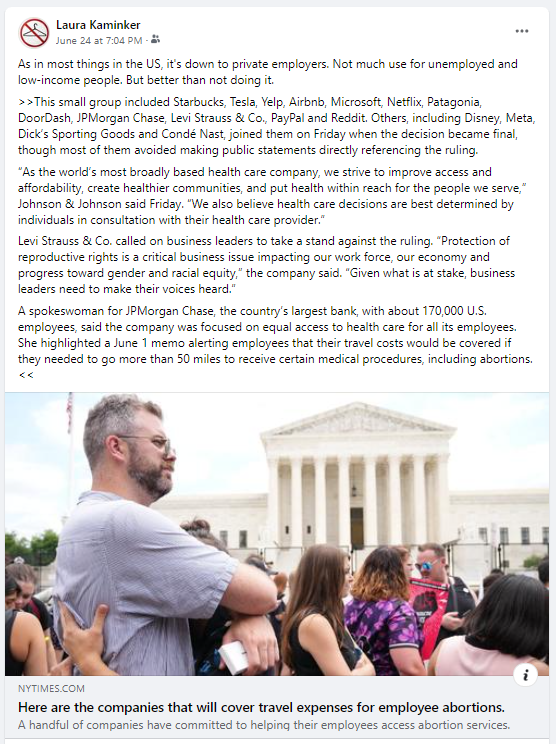
Attribution omitted


I had to take a break from Facebook when I started seeing posts blaming the repeal of Roe on people who didn't vote for Hillary Clinton in 2016. 

For sure, voting Americans had a stark choice in 2016, a referendum on Trump or not-Trump. About 74 million voters still voted for Trump, and another 88 million (give or take) chose not to vote. A second Trump presidency was the final nail in Roe's coffin.

But for gods' sake, widen your lens. 

The Democrats caused this every bit as much, or more, than the Republicans. 

One party did everything in its power, on all levels, to chip away at abortion rights in preparation for the eventual repeal of Roe v. Wade. They spent untold millions of dollars, unleashed dozens of strategies. Took over one state legislature after the next. Took over school boards. Stacked the judiciaries. Passed the legislation that led to Webster, Rust, Casey, and Carhart II. They were relentless..

The other party couldn't even utter the word abortion. The Democrats' plan to defend Roe boiled down to this: "You must vote for us, no matter what -- no matter what we do or don't do -- because the other party will take away 'a woman's right to choose'." That was never going to be enough. 

As the Republicans turned increasingly radical, the Democrats became what the Republic used to be. The handful of passionate liberals in the party are accused of class warfare and blamed for the success of the radical right.

Perhaps if the Democrats were interested in something beyond getting elected -- if the party actually cared about defending liberal democracy -- we wouldn't be where we are now. Or at least we would have stood a fucking chance.

How can you defend a right you can't even fucking say? 

6.24.2022

rotd: the actual status of the poorest woman is the possible status of every woman

Revolutionary thought of the day:
“The actual status of the poorest and most unfortunate woman in society determines the possible status of every woman.”

From the mission statement of the Illinois Women's Alliance (1888), quoted by Susan Faludi in "Feminism Made a Faustian Bargain With Celebrity Culture. Now It’s Paying the Price"

6.22.2022

getting home: horrific customer service from pacific coastal airlines

On the way home, I flew from from San Francisco (SFO) to Vancouver (YVR) on United Airlines, then from Vancouver to Port Hardy (YZT) on Pacific Coastal. Pacific Coastal flies out of a separate terminal, not connected to YVR proper. You need a shuttle or a taxi to get there.

This part was my fault

I didn't wake up as early as I'd like -- very unusual for me -- so I was rushing to get out. In my haste I must have picked up the wrong address on Google Maps. I was driving along when the directions told me to get off the highway and take a detour. I thought there was an accident or some other obstruction, and that Google Maps was taking me on some alternate route to the airport. Bad move.

I followed directions for a while, driving in circles, unable to figure out what was going on, getting more tense as the time ticked away. At one point I got back on the highway, followed directions from a later exit, and found myself back where I had first gotten off. Oh my god.

Now I was flustered. I pulled over and looked at Google Maps on my phone, and realized what had happened. I got back on the highway and drove like hell to the rental car return.

Thus ends the portion of this episode that was my fault. 

Note to United Airlines: Canada is not in the U.S.

At the rental car return, of course there is a huge long line of people returning cars. Nice rental car person checks my now not-quite-full-gas-gauge (from driving around in circles) but says, "OK that's full". Thank you! 

Then he's telling me how to get to the airport -- with a mask, and an accent, and talking fast (because he probably says this 10,000 times on every shift). I had to say, "I'm sorry, I'm not understanding you." After two repeats, I finally got it.

Up elevator, down escalators, through various doors, jump on the air train, get off at International terminal. Can't find United. It is now 7:20. Flight leaves 8:30. Cannot find United. Cannot see flight on departure board. Ask three more people. I'm at Aisle 12, United is Aisle 2. Run. I'm not a runner. Run run run. Almost cannot breathe.

There's a long line, but I cut to the last agent on the counter and ask for help. She decides to take me. Yay!

ID, vaccine check, then wait wait wait. Long wait. She calls over a supervisor. They mutter to each other. I hear the supervisor say, "That's because it's too late, the flight has closed." Oh noooo!!!

I'm like, are you sure, can I run there, etc. Nope, you would never make it, it's in a different terminal. Different terminal? Yes, it's been changed to the domestic terminal. Flight to Canada. Domestic terminal.

At that point I realized that even without the 15 minute detour driving around random San Francisco streets, I would not have made the flight. Damn.

She says I'm confirmed for an 11:00 pm flight, standby for a 7:00 pm flight. 

There are only two flights each day from Vancouver to Port Hardy at this time of year -- at 8:30 am and 3:10 pm. So if I'm on either of those flights, I'm staying over in Vancouver. Which means another hotel, change fee for the Pacific Coastal flight, plus I have work on Tuesday and really want to be home on Monday. 

Then wait, wait, wait, wait... long wait. Agent goes to another terminal, wait, wait, wait, then... "OK, I have you on an 11:05 a.m. flight to Vancouver." I actually said, "I love you." She might think I am a stalker.

Then I walk a long long loooong way to the domestic terminal. The security line is 30 minutes. So there is absolutely no way that I would have made that 8:30 flight, even without my driving screwup. This made me feel better.

The worst possible customer service

My 11:30 flight was on time and I cleared customs with almost two hours (1:45) before my flight to Port Hardy.

Then I waited. Everyone waited. Hundreds of passengers were waiting -- for their luggage. I was waiting at the luggage carousel watching the time tick down, wondering if I was going to miss my flight to Port Hardy. 

(Please don't tell me "This is why I don't check my luggage." That is nice if it works for you. It does not work for me, especially when I travel alone.)

I tried to check in online, but got error messages. The Pacific Coastal website would not let me check in. 

After an hour, I finally got my luggage, and jumped in a cab, arriving at the South Terminal 30 minutes before my flight. 

And I was told that I “missed” the flight because I arrived 30 minutes before the flight, rather than 40 minutes. 

Another passenger was going through the same thing. He was late because the shuttle from the Main Terminal to the South Terminal did not arrive.

The counter agents kept repeating they were sorry, but I would have to fly the following day. It was an issue of “weight and balance”. This is hard to believe, since I had reserved a seat and paid for luggage to be checked – thus weight and balance were already accounted for.

I'll tell you right now. I was crying. I was not yelling – I would never do that – but I was crying and pleading. One of the counter agents laughed at me and mocked me for crying.

And then, while this was happening, I heard the first boarding call.

Yes, exactly no passengers had boarded the plane. 

The counter staff made it sound like the airplane’s doors were already locked – while in fact no passengers had boarded at all! 

The plane is empty, passengers are just lining up to board, I am 30 minutes early, and told I “missed” my flight?! There is no rational reason for this.

Mocking Agent told me he had booked me for the first flight the following day, and said, sarcastically, “The flight leaves at 8:30. Try to be on time.” 

It was not enough to refuse to let me board when the plane is empty, he had to make snide comments, too. A person who sees a customer crying and distraught and chooses to mock them should not be working front-of-house.

Then, Pacific Coastal charged me a $105 “reservation reactivation fee”. 

It took the agent less than three minutes to book me on another flight. And they charged me $105 for the inconvenience and indignity.

And then... they called standby passengers. Seriously. They were able to take a handful of standby passengers, but not two passengers who had reservations and were 30 minutes early, rather than 40 minutes early, because of airport issues.

The terminal was packed and very noisy. I am sound-sensitive at the best of times, but in the state I was in, the noise was unbearable. I went outside, called Allan for the millionth time, sobbing like a child. Then I managed to get a grip, and booked the last room in an airport hotel. 

So in addition to the $105 change fee, Pacific Coastal’s inflexibility also cost me another $325 for hotel accommodations and dinner.

As I said in my complaint letter to Pacific Coastal:

I understand that a 40-minute window for check-in is Pacific Coastal policy. The policy states, “Failure to be checked-in prior to closing may result in the cancellation of your entire reservation.” It may result – not will result. May means it’s a possibility – not a hard rule. 

Since the first boarding call hadn’t even been announced, the staff could have been flexible. They could have acknowledged that I had waited an hour to retrieve my luggage in the Main Terminal. They might have admonished me, reminded me to arrive earlier next time, and then checked me in. It was certainly possible to do.  

It’s not like I had cut it close, showing up a few minutes before takeoff. Nor was I late because of negligence or poor planning. Those 10 minutes were completely out of my control.

To refuse a customer who is 10 minutes late, through no fault of their own, then charge them a “reservation reactivation” fee, and force them to spend the night in a hotel and fly the next day, and to mock them in the process, is some of the worst customer service I have ever seen. 

If another airline served Port Hardy, I would certainly never fly Pacific Coastal again. Much to my dismay, I will have no choice to continue to use this airline – which is why your staff can get away with this terrible customer service.

I'm not expecting much in the way of response, but I'll let you know what happens. 

6.20.2022

can you give a few dollars to help a giver in need?

From a wmtc party: clockwise: P, Chelsea,
Jericho, Diego, Kim, Tala.

Some of you may recognize an occasional wmtc commenter "Dharma Seeker". Dharma Seeker -- whose name is Kim -- is a terrible situation right now. One of her dogs has been stolen, she will soon have nowhere to live, and her car has broken down.

I have organized a fundraiser in her behalf.

I  have known Kim since 2007, when she answered my ad for a dogwalker and we instantly became friends.

Kim is a steadfast protector and defender of animals. One of my treasured memories of Kim is when my partner and I were getting ready to say goodbye to our dog Cody. Our other dog, Tala, was very sensitive, and not used to being alone. I asked Kim if she could come over and walk Tala while we took Cody to the vet this one last time. Kim lived 30 minutes away. She dropped what she was doing, drove over, picked up Tala's leash and went out walking. Just like that. That's the kind of person she is.

Kim started a pet food bank, so people in crisis wouldn't have to give up their animals. She did this completely on her own -- she saw a need and she took action. 

She has given so much to the world, especially to animals and the people who love them. I'm hoping some of that giving can come back around to her.

Like many people, Kim struggles with mental health issues. She has had challenges over the years in finding stable housing for herself and her dogs and cats, but she has never, no matter how difficult the situation, given up on an animal.

This year Kim found herself in an abusive living situation. There was verbal, emotional, and physical violence. (This was not from a partner.) One day Kim came home to find an empty crate. Her housemates had taken her beloved dog River. They have refused to say what they did with him or where he is. Can you imagine such a nightmare??

Now Kim has nowhere to live, doesn't know where her dog is, and on top of all that, her car broke down -- the car she may soon be living in. Social services are working on finding her pet-friendly housing, but that may take months. Kim has missed a lot of work from the stress of this ordeal, and is worried about retaining her job.

Kim needs $1500 for car repairs, and if we could get her an additional $500 she could have a tiny bit of security until social housing comes through for her. Any amount will help. $5 - $10 - anything. It will all help and be deeply appreciated.

Go here to donate. 

Thank you in advance for your generosity.

6.19.2022

the day in the oakland area

[Written after being home for a week.]

On the way out of Shelter Cove, I stopped at the general store, just to see it. It is tiny. And it is the only store in town. 


After that, back on the long and winding road, ending at Highway 101. From there, I drove south to San Pablo, in the East Bay, outside of Oakland and Richmond. This portion of Highway 101 doesn't have spectacular views, but it was still scenic and relaxing. 

I had booked a little Airbnb a few blocks from where another nephew J, his partner C, and my grand-nephew (now five months old) live. (The nephews and nieces and partners I visited are my brother's adult children; my sister's adult children live in New York State and New Jersey.)

I had approximately the same amount of time in San Pablo as I did in Shelter Cove: dinner and the evening, a full day, then leave the following morning. J, like me, is an intrepid urban explorer and tour guide, and he showed me several really interesting spots in the Richmond-Oakland area. Previously I had been to Oakland for baseball, but hadn't seen anything else, so this was a real treat. Here are some highlights.

Point Molate is one of many "points" in the East Bay, little peninsulas that each have their own character. That character is often very pricey real estate and upscale shopping. Point Molate, however, is completely undeveloped. 

The area has been the subject of a decades-long, ongoing land dispute. (A series of articles on Point Molate's "unique and colorful history" begins here.) While the land is being fought over, it's been left wild. There are miles of hiking and bike trails, with some interesting landmarks: abandoned, boarded-up barracks, and Winehaven Castle, a fortress-like brick complex that was once the largest winery in the country. The empty buildings give the area a haunted, dystopian look. (In this aerial view, the barracks are on the right, the fortress on the left.)

At the very tip of the peninsula is San Pablo Harbor, a tiny, funky outpost of counterculture. Floathouses and sculptures constructed for Burning Man share the space with a flock of goats and a "pirate" barbeque joint. On the weekends there is live music. The website makes it seem more developed and commercial than it looks -- but also has great video views, if you're interested.

These are some not-very-good cell phone pics of San Pablo Harbor. As I've mentioned, I purposely didn't take our camera on this trip, but I did occasionally miss it!


The pirate himself, at the smoker


Later in the day, this time with C, we walked around Lake Merritt, a human-constructed lagoon in downtown Oakland. From the LakeMerritt.org website:

Lake Merritt in Oakland, California is one of the most unique urban spaces in the United States. Its three mile shoreline in the center of an exceptionally diverse city is a special place where nature and nurture migrate and mingle daily. This tidal lagoon is home to the United States' oldest designated wildlife refuge dating from 1870. 

If you love cities and public space, this is an amazing place. On our three-mile walk around the water, we passed a huge drumming circle with all manner of percussion; a long row of vendors selling Caribbean food, crafts, and mushrooms; boat rentals; gardens; lots of birds (herons, egrets, pelicans, several different kinds of ducks); a nature centre, and lots more. It was super interesting. (Also super sunny, and for the second time on this trip, I wasn't wearing sunscreen. After my sunburn in Shelter Cove, I meant to buy some... but did not.)

Earlier in the day, J and I also stopped at the site of a former factory that has been brilliantly converted: the Ford Motor Company Assembly Plant, now a National Park Service site. It's used for performances, craft fairs, and all kinds of cultural events. While we were there, it was the finish line for a community 5K.

The giant building is adjacent to Rosie the Riveter WWII Home Front, where the Rosie the Riveter concept and image were born! We were too early to tour this, but it is absolutely on my list for the next time I'm in the Bay Area. 

We also had a great breakfast in Berkeley, and Ethiopian food, a mainstay of Oakland, for dinner. This was in a neighbourhood that J and C used to live in, now clearly a hipster haven.

The biggest highlight of San Pablo -- Asher, my grand-nephew -- was with us the whole time, world's happiest and most chill baby. In keeping with my work on being more comfortable sharing photos of myself, here you go.

I've also added more pics to the post about Shelter Cove.

6.10.2022

the day in shelter cove

View from Wedding Point, Shelter Cove
Yesterday was amazing and so special.

My niece E took me on a tour of the little community and local topography. We went to lookout points and beaches; saw seals lazing in the sun, sea lions throwing back their heads and barking, and a few whale spouts; took a few short walks. 

We saw all the local spots. A little volunteer-run library that looks and feels like a used bookstore -- really well organized -- and they have storytimes! The three restaurants in town -- two only open on weekends. The little general store. An abundance of natural beauty that is just off the charts. All of this in a 5 or 10 minute drive from their home. In fact, we stopped at the house for a quick lunch -- homemade, organic, vegan, and delicious -- on the deck, then resumed our tour.

I purposely didn't bring the camera on this trip, but I did take a couple of quick cell-phone pics. Unfortunately and not purposely, I forgot to pack sunscreen and am now quite red. I don't normally let that happen, but oh well.

We had dinner at the one open restaurant with some family of T's that lives in town. They were super friendly, warm people, and it was a treat to meet more of E's world. The restaurant has -- of course -- a spectacular ocean view. After dinner, E, T, and I stayed up late talking, which was really fun, and a great opportunity to get to know T better. This is a beautiful home filled with so much love.

It was so wonderful to spend the day with E. It's been many years since we've done that, and we are as close as ever. So much love. 

Here are a few more cell-phone pics from Shelter Cove. They're not very good, but the scenery is very forgiving!


Today I drive to the Bay Area!

6.09.2022

greetings from shelter cove, california (look it up!)

On the 101
I am at the home of my niece E and her partner T, in a remote part of California known as the "Lost Coast". It is so beautiful and peaceful and quiet here -- not unlike where I live. The Lost Coast has much in common with the North Island, more like living in Port Alice or Quatsino than what most people associate with California.

So, to catch up.

* * * *

I had an easy trip from Port Hardy to southern Oregon. It's a multi-stage journey, and everything clicked. 

I spent the next four days hanging out with (in various combinations) my brother, sister-in-law, nephew, nephew's partner, grand-niece (now 7 years old), and mother (soon to be 91) -- eating amazing food, drinking in amazing scenery, soaking up the love.

It was especially wonderful to get to know my grand-niece Sophia a bit more. Seven is a magical age, and I really enjoyed her company. I hope that, despite being long-distance, I am able to cultivate a relationship with her as time goes by. I had a special relationship with a great-aunt, and I'd love that to be part of my life and Sophia's.

My mother is declining. She is in very good physical health, but her cognitive health is beginning to fail. Or more accurately, the decline that has been happening gradually over years has accelerated. So far, with the ongoing (and often heroic) efforts of my brother and SIL, she lives independently. We monitor, and discuss, and wonder when that will no longer be possible. It's sad, but it's not tragic. She has a very good quality of life and seems very happy.

* * * *

I stayed in Ashland/Talent for four-plus days, then yesterday I drove six hours to Shelter Cove. The drive itself is a highlight of this trip that I was really looking forward to.

I picked up Highway 5 in the Medford area, following it west to Grant's Pass, then drove the length of Route 199 from Grant's Pass to Crescent City, California. 

The road snakes through deep forest and mountain passes, touching tiny, remote communities. I passed quirky folk art, myriad cannibis sellers, and several flags from the "State of Jefferson". I stopped in lovely, quiet rest areas and ate at shaded picnic tables, checking my progress on the posted maps. 

After the road crosses California's rural and remote far north, it meets the ocean at Crescent City. From there, I followed the famed US Highway 101 -- called, depending on where you live, 101, The One-Oh-One, the Pacific Coast Highway, the PCH, Pacific Highway, or the Freeway (and maybe some other names I haven't run into). Allan and I have driven this coastal route several times -- including once the entire length from the Olympic Peninsula to Mexico. But no matter, there is nothing quite like arriving at the Pacific. It is always majestic and breathtaking. I stopped several times for views. 

The 101 snakes through redwood forests -- giant, old-growth trees growing right beside the roadway, on both sides, giving the drive a sense of mystery and wonder.

At Redway, I left the 101, and drove a long, windy road full of switchbacks, hairpin turns, and sharp changes in elevation, for about a hour, before arriving at Shelter Cove. Check it out on Google maps. It is indeed the Lost Coast.

My niece and her partner live a low-impact life in this remote coastal community. After a vegan dinner, we walked less than five minutes down the street and watched the sun set on the ocean. On the way back we saw fox and skunk. 

This morning we ate breakfast on the deck, where you can hear the sound of the surf, and with a view of a beach and the King mountain range.

6.02.2022

if you're going to live in a small town, it's good to find one with an airport

I'm grateful this tiny airport exists!
Today begins my solo trip to visit family in Oregon and California. I'm super excited! Traveling from Port Hardy, here's what it entails:

  • Fly from Port Hardy to Vancouver. The plane is tiny and the view is spectacular.
  • Stay overnight in an aiport hotel in Vancouver.
  • Fly from Vancouver to San Francisco, and San Francisco to Medford, Oregon.

Travel is very different when you don't live near a major airport! And I'm also traveling to a town without a major airport. The way home is less complicated, because I'm flying from San Francisco -- SF to Vancouver, Vancouver to Port Hardy, in the same day, without staying over in Vancouver.

I'm not complaining! I love travel and I'm always happy to be going anywhere. Unlike many people, I don't even hate air travel. Travel = good.

I'm very happy there's a small airport in town. Otherwise it would take an entire day of travel to get to Vancouver: drive for five hours, arrive at ferry at least an hour in advance, then a two-hour ferry. Then a bus or cab to the airport. 

This is a strictly family-visit trip, in keeping with my intention to only travel to visit friends and family for some years.

5.30.2022

what i'm reading: animal, vegetable, junk: a history of food, from sustainable to suicidal, by mark bittman

Mark Bittman's Animal, Vegetable, Junk: A History of Food, from Sustainable to Suicidal is fascinating, readable, and wide-ranging nonfiction. With clear and simple language, Bittman unpacks the many threads that have determined, throughout history, how we humans feed ourselves. As an alternate subtitle, I might suggest "How Imperialism and Capitalism Ruined the Planet and Everything On It". Or perhaps, "Finally, A Book With Hope".

This is a great book for anyone curious about the nexus of economic and political systems, oppression, and food. Even if you don't think you're interested in the history of food, if you enjoy history, this is a terrific book.

Bittman looks at history through a consistently anti-capitalist, anti-imperialist, and social justice lens. I especially appreciate Bittman's consistent recognition that the problems caused by the industrial food system cannot be solved on an individual, consumer level. To use an example from our current cultural moment, first-world childhood obesity will not corrected by admonishing parents to get their kids more exercise. Individual choices impact individual health; that much is obvious. But people can only choose what is available to them and what they can afford. Individual change will never be, can never be, enough.

Throughout, Bittman gives special focus to how food systems impact Indigenous people, people of colour, and impoverished and low-income people -- and workers.
Since the first enslaved people grew and processed sugar on Madeira, Western food has relied on brutal labor practices. It still does. From industrial agriculture's perspective, labor is a necessary evil -- a nuisance.

Small and biodiverse farms are still labor-intensive. But large farms minimize labor in every way possible, relying instead on chemicals, seeds, and machines.

Yet food always comes back to labor. Without workers, none of us would eat. And just about every hand that helps bring food to our tables belongs to a person who may well be worried about putting food on their own. Eight of the ten worst-paying jobs in the United States involve food. Of the twenty million food system jobs that constitute the largest private labor force in our economy, almost all earn wages that hover around the poverty line. At least a third of farmwokers earn less than the official poverty wage, which is twenty thousand dollars per year per family. That's just about enough to pay for a minimally nutritious diet for a family of four, leaving approximately zero for every other expense other than an unrealistically low rent.

Many of these jobs are repetitive, demeaning, and dangerous. Workers are denied basic rights like regular bathroom breaks; a reliable schedule; freedom from abuse, harassment, and wage theft; and the right to organize and bargain collectively.

That's how the system was designed to work.

And from much later in the book:

Addressing mistreated workers in our food system will require a cascade of changes to the status quo, which makes it a good place to start. And awareness of food-chain labor has accelerated in recent years. It's no coincidence that the "Fight for $15" -- the movement to institute a minimum hourly wage of fifteen dollars in place of the current federal minimum of $7.25 -- began at KFC, McDonald's, and Burger King. 
Animal, Vegetable, Junk introduced me to a new idea: industrial farming is best thought of as an extraction industry, like mining, logging, and commercial fishing. Industrial farming is a health issue, a labour issue, an animal-welfare issue, and of course a climate change issue. The situation is dire, almost beyond comprehension.

The book's penultimate chapter is about the industrial farming of animals. This was very difficult to read, touching on my worst cognitive dissonance. Any thinking person would be disturbed by it. One can choose to be vegan, but that, in itself, will not end or even reduce industrial animal torture. I have taken steps to opt out of factory farming, but there are areas I have not addressed, especially dairy and eggs. Mostly I force myself to look, and feel sick.

Thankfully, in the final chapter, Bittman offers hope. And in this case -- unlike other books I've read where a paragraph of obligatory platitudes are tacked on at the end -- this hope is real. In "The Way Forward," Bittman profiles a diversity of alternative food and health systems and programs that exist and are working. Some are spearheaded by governments, others by self-organized cooperatives -- from Brazil, Chile, Mexico, India, France, Denmark, and some in the United States. 

These positive examples were amazing, and well worth the read. But to truly understand why the alternatives are needed, and what they represent, I hope you will read the full book.

Bittman's writing is simple and clear, and (mostly) refreshingly jargon-free. (The book is heavy on acronyms, but that may be unavoidable.) I first became aware of Bittman through "The Minimalist," his old column in the New York Times. In many ways, he taught me how to cook. Creating delicious, healthy food with a few simple ingredients is an art form. But it turns out Bittman knows a hell of a lot more than that.

See also

You may enjoy reading this excellent review of Animal, Vegetable, Junk in the New York Times. The reviewer, Ted Genoways, wrote a book called The Chain: Farm, Factory, and the Fate of Our Food. It has been on my list since its publication in 2014, but I haven't had the heart to read it.

I was pleased to see Bittman mention and praise the book Salt Sugar Fat: How the Food Giants Hooked Us by Michael Moss (my review is here) -- an important and under-recognized book. I photocopied the selected reading list Animal, Vegetable, Junk for future reference, and was pleased to see that I've read a handful of the titles.

Obviously Bittman is writing from a United States context. In some ways things are a bit better in Canada. But I hope Canadians who will read this book know that all the same problems plague Canadian society, too. As I always say, "better than the United States" is a very low bar.

5.23.2022

rtod: nope, i ain't gonna kill nobody

 Revolutionary thought of the day:

I would like to see every single soldier on every single side, just take off your helmet, unbuckle your kit, lay down your rifle, and set down at the side of some shady lane, and say, nope, I ain't gonna kill nobody. Plenty of rich folks wants to fight. Give them the guns.

Woody Guthrie

5.21.2022

dog agility, worm composting, and morning tea: three things going on with me

Does it make sense to create compost when you don't garden? I don't know, but I'm doing it.

Worms, but no garden

So, I'm not gardening. 

The Urban Worm Bag v2
Since moving to a cool, wet, temperate climate, I haven't done any successful gardening. My little mini gardens in southern Ontario were fun because they were incredibly easy. They also helped me enjoy being outdoors within the densely packed suburban landscape. 

Now, gardening is much more challenging, and I am able to enjoy the outdoors any time, whether that means sitting on our deck, talking long walks through the woods, or strolling on the beautiful empty beach. Working full-time, with limited time to myself, I really don't want to spend any of it gardening.

Last year, I tried to establish a small garden, and thought I would try vermicomposting -- composting with worms. The garden was a bust, but I've decided to continue my wriggling adventure. 

Why create composting if you're not gardening?

  • It reduces waste. We don't have organics recycling here, and it feels really wasteful. Most of what can go in the organics bin can be used as worm food.
  • The worm castings (compost created by worms) will improve the soil for all the plants already growing in our yard, including the raspberry bushes that Allan is trying to re-establish.*
  • Working with worms, creating this miniature ecosystem, just appeals to me. I want to try it. 

The worm adventure was supposed to start last year, but the worms I ordered never made it here. I had already set up my Urban Worm Bag, organics scrap bin, and so on. So this year, I tried again. 

The worms were shipped from Wormbox, a company in Montreal. They assured me they have successfully shipped live worms to every Canadian province and territory, including remote locations, and that the worms would arrive alive. They wait to ship until there are three consecutive days of temperatures above freezing in Montreal and the worms' destination. That finally happened in early May!

The clock was ticking. With a long weekend coming up, and no mail delivery on Saturdays, I was starting to worry. But hurrah, the little creatures arrived on Friday morning, well packed and wriggling. Now they are in their new home, and my project begins.

Canine agility

Now that I am not taking piano lessons (at least for now), I'm planning to do some agility with Kai, and possibly with Cookie, too. 

I've been thinking about this since we bought our home in 2019. It's great physical exercise and mental stimulation for dogs, and having watched agility competitions on video, and once in person, I've always wanted to try it.

Will Kai ever do this? Time will tell!
Decent equipment is quite expensive. And while building a DIY agility course is A Thing, you may recall that I am not a DIY person. I have zero interest in building or macgyvering this equipment. I've decided to start with one piece of equipment -- one event, so to speak -- and gradually add on, as I can and want to spend more. Agility World has periodic specials where one obstacle is deeply discounted, so I'll track that as I go. (There is also the much less expensive Aosom, but I've read the equipment is quite flimsy and falls apart easily.)

This is decidedly not for competition. Just as my piano lessons were not intended for performance, my interest in canine agility will not leave my backyard. I find the human capacity to fashion nearly every activity into a competition simply baffling. I'm just hoping my dogs and I enjoy this and benefit from it.

A momentous life change

I am not drinking coffee in the morning. I am drinking tea! While not quite on the level of moving to Canada or becoming a librarian, I believe this qualifies for Big Change status.

I love coffee, and I'm completely addicted to caffeine. Although I've cut back by mixing regular and decaf, I've given up trying to eliminate it from my diet. I've gone caffeine-free for months at a time for various reasons, but I have no wish to do that permanently. I figure if caffeine is my worst vice, I'm doing pretty good. Caffeine may even have some health benefits -- although that's not why I love coffee.

I do have sleep issues, though. Like many people, I sometimes struggle mightily with insomnia. And because of this, I've always had a strict cut-off. Coffee in the morning, and strong black tea in the afternoon, but never after 4:00.

Allan and I picked up the afternoon tea habit during our trip to Ireland in 2001. It was November, and every day we'd arrive at a bed-and-breakfast, chilly and windswept. And the host would say, I'll put the kettle on. It became an enjoyable habit.

When we got home, we found a New York source for Bewley's Irish Breakfast tea, and with both of us working at home most days, a tradition was born.

When we moved to the Toronto area, I found it too difficult to get Bewley's, and we switched to Red Rose, the Canadian equivalent of Lipton. Now that we can get anything from anywhere, we're back to Bewley's. 

(We do also have decaf black tea in various flavours, which Allan drinks all the time, and herbal teas in a range of flavours, which I drink both hot and iced. I find iced herbal tea a good way to stay hydrated: tastier than water, but with nothing added.)

Recently I realized I really shouldn't be having caffeine in the afternoon, at all. Cutoff or no, it could be impacting my sleep. So I'm trying -- quite painfully -- to give up my afternoon caffeine. 

I made this decision right after a box of Bewley's arrived in the mail, plus a shopping miscommunication landed a huge box of Red Rose in the house at the same time. I can't return either of them, I don't want them sitting around getting stale, and it's more than I want to give away.

So I had an idea. Maybe I could try drinking tea in the morning, and seeing if I can get enough of a caffeine fix to start the day. When we've travelled in places with bad (or no) coffee but good tea, I have had tea in the morning. Maybe it would be possible?

I bought a teapot, and the experiment has begun. I still miss coffee, so I don't know if this will be permanent. But so far, I appear to be surviving.

And by the way, since giving up afternoon caffeine two months ago, I have had only one night of insomnia -- far less than usual.

* There were amazing raspberries bushes when we moved in. Then we cut them down -- as I read you were supposed to -- and they never returned. Allan is starting over.

5.07.2022

rebecca traister, 2019: "our fury over abortion was dismissed for decades as hysterical"

Rebecca Traister, writing in New York magazine in 2019:

Which is why I am almost as mad at many on the left, theoretically on the side of reproductive rights and justice, who have refused, somehow, to see this coming or act aggressively to forestall it. I have no small amount of rage stored for those in the Democratic Party who have relied on the engaged fury of voters committed to reproductive autonomy to elect them, at the same time that they have treated the efforts of activists trying to stave off this future as inconvenient irritants. 
This includes, of course, the Democrats (notably Joe Biden) who long supported the Hyde Amendment, the legislative rider that has barred the use of federal insurance programs from paying for abortion, making reproductive health care inaccessible to poor women since 1976. During health-care reform, Barack Obama referred to Hyde as a “tradition” and questions of abortion access as “a distraction.” I’ve spent my life listening to Democrats call abortion a niche issue — and worse, one that is somehow repellent to voters, even though support for Roe is in fact among the most broadly popular positions of the Democratic Party; seven in ten Americans want abortion to remain legal, even in conservative states.
You can try to tell these Democrats this — lots of people have been trying to tell them for a while now — but it won’t matter; they will only explain to you (a furious person) that they (calm, wise, knowledgeable about politics) understand that we need a big tent and can’t have a litmus test and please be reasonable: we shouldn’t shut anyone out because of a difference on one issue. (That one issue that we shouldn’t shut people out because of is always abortion). Every single time Democrats come up with a new strategy to win purple and red areas, it is the same strategy: hey, let’s jettison abortion! (If you object to this, you will be told you are standing in the way of the greater progressive project). . . .
Also about how, for years, I’ve listened to Democratic politicians distance themselves from abortion by calling it tragic and insisting it should be rare, instead of simply acknowledging it to be a crucial, legal cornerstone of comprehensive health care for women, people with uteruses, and their families. I have seethed as generations of Democrats have argued that if we could just get past abortion and focus instead on economic issues, we’d be better off. They never seem to get that abortion is an economic issue, and that what they think of as economic issues — from wages and health care to housing and education policy — are at the very heart of the reproductive justice movement, which understands access to abortion to be one (pivotal!) part of a far broader set of circumstances that determine if, when, under what circumstances, and with what resources human beings might have and raise children.
Read the whole thing here.

5.06.2022

the end of roe and how we got here


With the unprecedented leak of the SCOTUS draft brief, and official confirmation of the politicization of the Court, we see the final nails pounded in the coffin of Roe v. Wade -- a turning point which somehow still shocks many people, despite the exceedingly clear regression to this point over the past 40 years.

Given this, it seems strange to me that I haven't blogged about abortion rights in more than two years.

Strange, because this is the issue I care most about, above all else. 

Strange, because I've spent a good portion of my life thinking, writing, organizing, and supporting abortion rights and abortion access.

Strange, because I am angry and hurting about this. But I suspect I am angry at different people than many readers may be.

Partly I stopped writing about Roe and US abortion rights because I feel I have nothing left to add to the discourse -- nothing to write that I haven't written again and again. Here in 2018, I re-ran my essay from 2005. No matter how many ways I find to say it, it comes down to two points.

One. Abortion rights are essential to human rights, to justice, and to basic equality for all people. Abortion rights are the sine qua non of women's freedom, and the bottom line of equality for any person who can become pregnant.

Two. Roe v Wade is meaningless for millions of American women, and has been for decades. Abortion rights have been steadily impeded, eroded, and erased for more than 40 years, a process that began with the passage of the Hyde Amendment in 1976, gathered momentum when Ronald Reagan became president in 1980, and has barrelling downhill ever since. This includes the 16 years of Democrat presidencies. 

And partly I stopped writing about Roe and US abortion rights because I have been so angry and frustrated that people were -- with extreme laws passed in Mississippi and Texas --  now finally paying attention. That sounds counter-intuitive and is not a good way to approach activism! But I just could. not. stand it.

1976 Hyde Amendment (only affects poor people, so who cares)
1984 Global Gag Rule (only affects poor people in other countries, so who cares)
1989 Webster; 1992 Casey -- both losses for reproductive freedom, but left Roe intact, so who cares
And on and on. (Start your timeline here, then here.) As long as Roe had not been overturned, most liberals and Democrats were willing to look away. 

For a majority of Democrat voters, the most important thing to know about abortion rights were: vote Democrat because of the Supreme Court, because we can't let them overturn Roe v Wade.

And while the majority obsessed over Roe, Roe became increasingly irrelevant. 

I'm not suggesting Roe actually is irrelevant.  But it's been hollowed out. It's a shadow. A shell.

The anti-abortion-rights movement had everything it needed to succeed. 

They were extremely organized, extremely well-funded, and very strategic. They got their people elected to state legislatures and began to work the system, passing every type of abortion-rights restrictions anyone could dream up, taunting the court challenges, knowing that eventually, with enough states becoming hostile to abortion, they would accomplish their only objectives: increasing numbers of low-income women and pregnant people would lose control of their reproduction, and the country would move one step closer to overturning Roe v Wade.

The anti movement has had other factors in its favour. In addition to money, organization, and strategy, they had the Democrats. Abortion became a dirty word, replaced by the euphemism "a woman's right to choose". Bill Clinton said let's make abortion "safe, legal, and rare" -- with little or no attention paid to the myriad laws, supports, and resources it would take to make such a thing possible.

They had the "muddled middle" -- to use Katha Pollitt's excellent expression -- whose discomfort with the idea and reality of abortion made it easy to look away. Shamed by stigma created by anti-abortion-rights zealots and the media who support them, most were happy to look away.

There are other reasons, too.

Roe v. Wade was never a strong ruling; it was always vulnerable to attack. The right to abortion is more secure in Canada -- although it is often under threat and must always be protected and defended! -- because the 1988 ruling in R v Morgentaler is a much broader decision. 

The US's obsession with states' rights, and the right wing's expert exploitation of it, have left millions vulnerable, not only on reproductive justice, but on so many fronts.

The US's lack of an organized healthcare system leaves millions vulnerable to assaults on reproductive freedom. If you lack basic healthcare, that's going to include a lack of access to reproductive needs.

The mainstream media's adoption of the disgusting lie "pro-life" -- the greatest PR coup of the modern world -- did untold damage. 

But be assured of one thing. Our side has been planning for this for decades, too, with abortion funds, underground networks, and direct action. It's a much more successful strategy than voting Democrat.

As always, the Guttmacher Institute is your best source for data on all aspects of reproductive justice. 

If you want to help, donate to abortion funds: National Abortion Federation, National Network of Abortion Funds. Canada has one, too.

If you live in a free state and have the resources, you can host a person traveling for abortion from a slave state. It's incredibly important and deeply gratifying work. NNAF can help you find a network. 

4.29.2022

my happy kitchen life (i still love my instant pot -- but it is not a good slow-cooker)

Don't get rid of your slow-cooker!
Since moving to a remote region with very limited food choices, I've upped my cook-ahead game to levels I never thought possible. I'm really enjoying it. Here's my routine.

My happy kitchen life

1. I order a box from truLOCAL -- locally sourced, humanely raised, healthy meat and seafood. Vast selection, super high quality food, brilliant customer service. They. Are. Awesome.

2. I spend a half-day cooking -- skillet, Instapot (yes, I know, I just like calling it that), and oven. I usually make four dishes, sometimes five, each good for 3 or 4 dinners. 

3. I put all the food into my ever-growing collection of Pyrex, and pop it all in the freezer. 

4. One box from truLOCAL gives me at least two, sometimes three, cooking sessions of this size. 

This gives us dinner for the four nights that my partner works on his day-job, and we don't eat dinner together. On the other three days, Allan makes dinner one night, and two nights we go out or get takeout. 

In short, Instapot + truLOCAL + Pyrex = my happy kitchen life.

In the summer, I'll order an additional truLOCAL box, usually the small size, just for grilling. Steak, burgers, salmon, bone-in chicken breasts, beef sausages -- anything and everything for the grill.

[In case you don't know me, this is not stealth marketing and I'm not using affiliate links. truLOCAL subscribers can earn points for referrals, but you'd need my name and code for that, and I'm not offering it in this post.]

The Instant Pot is a crappy slow-cooker

There's only one aspect of the Instapot that I don't like: it is not a good slow-cooker. It simply does not get hot enough. 

Several online sources confirm this observation, such as here, here, here, and here.

Some folks mention a possible workaround of adjusting the temperature of the slow-cook setting. On the model I have, the Ultra, you can adjust the temperature slightly, but it makes no appreciable difference. No matter how many hours the food cooks, it never gets hot enough to truly break down ingredients and blend flavours.

When I bought my Instapot, I gave away my slow-cooker. Now I'm buying a new one. 

What I'm cooking

Here's what I've been making using my truLOCAL box. All are cooked in the Instapot unless otherwise noted. All are cooked ahead and frozen, unless noted "day-of".

-- chicken and rice, using boneless, skinless chicken thighs (Why did I ever cook chicken breasts? Thighs are so much better.)

-- turkey sausage and bean stew, with canned tomatoes, white beans, and black beans

-- turkey sausage, white bean, and kale stew

-- linguini with meat sauce, using ground bison (incredibly quick and easy)

-- "mexican" style penne, using ground bison, salsa, black beans, and corn (another super easy one -- I will usually make one of these very fast and easy pasta dishes per cooking session)

-- cheeseburger casserole, quick and easy pasta #3

-- pork tenderloin in honey-garlic; skillet and oven

-- faux fried rice, made with brown rice, ground turkey, snow peas, and shredded carrots; skillet; rice in instant pot, then added to skillet

-- beef stir fry, similar to above but with sliced steak

-- meatballs, made with ground bison

-- old-fashioned pot roast with root vegetables

-- duck legs, this recipe cooked ahead, then served with basmati rice made day-of

-- pork chops, this recipe cooked ahead, then served with little potatoes boiled or roasted, made day-of

-- split pea soup with bacon (incredible bacon from truLOCAL!)

-- lentil soup with ham

-- minestrone soup with turkey sausage

-- beef, barley, mushroom casserole

-- roast beef, served with roast potatoes made day-of

-- chicken noodle soup, noodles cooked separately in advance, then added when re-heating

-- wild salmon fillets in butter and garlic; skillet, day-of

-- wild-caught scallops in butter and garlic; skillet, day-of

-- chicken broth -- I make this for myself, not for cooking, but for a warm, caffeine-free hot drink

... and probably several more that I've tried once and forgotten. 

4.27.2022

what i'm reading: say nothing: a true story of murder and memory in northern ireland

Say Nothing: A True Story of Murder and Memory in Northern Ireland is without a doubt one of the best nonfiction books I have ever read. 

I'm in awe of Patrick Radden Keefe's ability to weave together so many disparate and often contradictory sources to re-create a story that is incredibly detailed and complex, yet fashion it into an addictive page-turner. 

The book is loaded with vivid details and surprising revelations -- until the very end. A blend of true-crime, spy thriller, history, and incisive feature journalism, Say Nothing is a tour de force of narrative nonfiction.

Keefe uses a brutal and tragic incident that took place in Belfast in 1972 as a focal point to unpack and examine the Troubles. The Troubles is a euphemistically quaint and minimizing name for a complex and prolonged undeclared war. It was a war of violence and politics, language and identity, public relations and extreme secrecy.

I was obsessed with Ireland and Irish history for about 10 years. It started with this book in 1989 and was finally capped with our trip to Ireland in 2001.* But you don't need any particular interest in or knowledge of Ireland to follow Say Nothing. The bare facts will be adequate.**

Two elements of this book were especially compelling for me. 

Say Nothing raises many questions about the use of violence in independence and liberation movements. It's easy to label a group that employs violence as terrorists. But what of the state government that employs the same methods, on a much larger scale? Can independence be won without violence? Has that ever happened? Modern western thought pretends that violence is never justified (except by states, for anything labelled national security) -- a view largely held by people privileged to never need it.

Another theme running through Say Nothing is the shapeshifting presence of Gerry Adams. How many people have been a high-ranking leader of a group labelled a terrorist organization, a peace broker, and a successful politician in the modern arena? One of the very few is Nelson Mandela. There are many parallels, and I suspect if one read a true account of the ANC, their work and methods were not all that different than the IRA's. Yet Mandela is revered as a freedom fighter and Gerry Adams -- well, it depends what side you're on. A terrorist, a politician, a great leader, a lying scumbag? I highly doubt readers of Say Nothing will come away with an impression of Adams as a Mandela-like figure. But he is undoubtedly a fascinating figure.

Don't worry about any of these things. Just read this book. If you enjoy great nonfiction, you will love this.

I've now put Patrick Radden Keefe's most recent book, Empire of Pain: The Secret History of the Sackler Dynasty, on my to-read list.

----------

* When I was planning our trip to Ireland, and especially while we were there, people constantly asked if I have Irish ancestry. I do not. I've never been asked this regarding any other travel, including to countries that have seen substantial emigration to the United States, such as Italy. It's as if people don't conceive of Ireland as a place folks might just want to visit, without a motive. 

It's a beautiful country, and we had an awesome trip. We saw natural wonders, history, Neolithic passage tombs and stone circles. We heard traditional music every night in beautiful small-town pubs, where folks would sometimes erupt in spontaneous song. From the ruins of a ring fort, we watched a border collie herd cows. In Dublin we saw a Brian Friel play and hung out with James Joyce's nephew. I fell in love with Murphy's. History was everywhere. Also rainbows.

** Here's more than you need to know.

150 years of struggle for independence culminates in the Revolutionary Period (1912-1922), most famously including the Easter Rising of 1916.

1919-1922 Irish War of Independence, Irish Civil War: Irish Republic Army (IRA) vs Britain Army and Royal Ulster Constabulary (RUC) (called something else at first, but this is the name normally used). This maps roughly as Catholic vs. Protestant, but only roughly, as some key Irish independence leaders were also Protestant.

The war ended with the hated partition of Ireland into two separate countries.

The Free State, later the Republic of Ireland, or simply Ireland, is most of the island, to the south.

North Ireland comprises the six northern counties, and is part of the United Kingdom -- i.e. part of Britain. It is majority Protestant. There was a long history of discrimination and persecution of the Catholic minority.

People who fight for a united Ireland are known as republicans. They are largely, although not exclusively, Catholics.

People who want Northern Ireland to remain part of Britain are known as loyalists or unionists. They are largely Protestants.

Republicans fought a guerrilla war to attempt to expel the occupying British from Northern Ireland. Loyalists, British Army, and the police force sought to eradicate them. This period, known as the Troubles, lasted from the late 1960s until 1998.

That's it, you're good to go.