7.11.2005

going back

I'm very interested in what people to do to heal. I'm intrigued by people's private healing rituals, as well as public forums such as speak-outs. South Africa's Truth and Reconciliation Hearings fascinated me. (A good movie was made about them.)

I found this story very moving.
KONJEVIC POLJE, Bosnia and Herzegovina

About 500 Bosnian Muslim men set out on foot at 7:30 a.m. Sunday from this quiet farming village in eastern Bosnia on the third and final day of their re-enactment of the "march of death" a decade ago this week.

Bearing Bosnian and Bosnian-Muslim flags, the men completed their solemn retracing of the route taken by an estimated 15,000 Muslim men during the war in Bosnia. They had fled the town of Srebrenica in panic in July 1995, after lightly armed United Nations peacekeepers failed to protect them from advancing Serb forces. The Serbs killed more than 7,000 of the fleeing Muslims in ambushes and mass executions that war crime judges later declared genocide.

On Sunday, the column of Muslims marching through the woods here were again surrounded by hundreds of armed Serbs, but on this day the Serbs were police officers assigned to protect the marchers.

. . .

As the men made their way up dirt roads and mountain paths that, a decade ago, were filled with thousands of panicked Muslims, they spoke calmly. Ali Hodzic Naziv, the man who shook hands with the Serb policeman, said he was marching in memory of his two teenage sons, who disappeared somewhere in these forests.

Mr. Naziv, 53, a burly man who was evacuated from Srebrenica for medical treatment after he was shot in the left leg in 1993, was in pain after two days of walking. But he said it would make him feel better to see the route his sons, who stayed behind, took during their final hours.

"I have to hold on for my sons," he said as he struggled up a muddy path. "I will make it, if God lets me."

Amir Halicic, a wiry 20-year-old, said he was walking to understand what his father experienced when he successfully fled in 1995. He said his father told him he was too frightened to march, that he never wanted to walk through those forests again.

Mr. Halicic, 10 when Srebrenica fell, said he fled separately with his mother and grandfather. Two of them survived. "I didn't have a childhood," he said. "My grandfather was killed right in front of my eyes."

Near the front of the column was a tall, sunburned man who said he was returning to Srebrenica for the first time in 10 years. That man, Gary Kremer, had been a surgeon with the Dutch peacekeepers who were overwhelmed by Serb forces here in 1995. He said a Muslim he befriended during the war had invited him to march. Survivors from Srebrenica, who have bitterly complained that the Dutch did not do enough to protect them, seemed to treat him well.

Change was evident. When skull fragments were found at a spot where the column stopped to remember those killed in a large ambush, Muslim men came forward to photograph the remains with the cameras in their cellphones. Along most of the route, rebuilt homes and mosques, and newly planted fields, abound in what was a deserted no man's land of burned houses in 1995.

But the reality of what occurred here, and Bosnia's continuing struggles, sunk in as the march ended. The march stopped by a partially exhumed mass grave near Srebrenica. Staring down at exposed femurs, skulls and tibias, some of the exhausted marchers wept.
Events like these are often referred to as "closure," but that implies an end result. Healing is an ongoing process.

Nothing really to add, just some thoughts while looking at headlines this morning. And now to work.

backwards

A commenter seems to think we oppose military recruitment efforts because we oppose George Bush. He's got it all backwards.

We oppose this immoral, senseless war.

We oppose young people risking their lives, limbs and sanity in order to kill people who are not their enemies and have done them no harm.

We oppose young people having so few options that they're willing to kill and risk death for a shot at education and advancement.

We don't oppose the war because it's Bush's! We oppose the war. We would oppose any president who lied to the country in order to start a war for profit and distraction. We oppose this president because he did (among many other important reasons).

happy birthday wmtc

We move to canada is one year old today!

Let's see, what was happening in my life on July 11, 2004?

- Our immigration application had been in the queue for five weeks.

- I was spending my days and nights trying to elect John Kerry.

- The Yankees were seven games up in the AL East.

- I didn't know any of you great people.

Today:

- The Red Sox are two games up in the AL East.

- I am 50 days away from moving to Canada.

- We are renting a house in the exact location I wanted.

- I am part of this supportive community.

It's been a big year!

* * * *

Last year at this time:

- About 780 Americans, English, and don't forget Polands, were still alive.

- Some 10,000 Iraqis were still alive.

- Thousands of people still had two legs, two arms and functioning eyes, who are now adapting to life with a permanent disability.

Let's never forget what's at stake.

7.10.2005

shame

Salman Rushdie speaks about human rights.
In honor-and-shame cultures like those of India and Pakistan, male honor resides in the sexual probity of women, and the "shaming" of women dishonors all men. So it is that five men of Pakistan's powerful Mastoi tribe were disgracefully acquitted of raping a villager named Mukhtar Mai three years ago. Theirs was an "honor rape," intended to punish a relative of Ms. Mukhtar for having been seen with a Matsoi woman. The acquittals have now been suspended by the Pakistan Supreme Court, and there is finally a chance that this courageous woman may gain some measure of redress for her violation.

Pakistan, however, has little to be proud of. The Human Rights Commission of Pakistan says that there were 320 reported rapes in the first nine months of last year, and 350 reported gang rapes in the same period. The number of unreported rapes is believed to be much larger. The victim pressed charges in only one-third of the reported cases, and a mere 39 arrests were made. [Ed note: anti-violence groups working in Pakistan estimate the number of reported rapes to be much lower, possibly 10% of the total.] The use of rape in tribal disputes has become, one might say, normal. And the belief that a raped woman's best recourse is to kill herself remains widespread and deeply ingrained.

For every Mukhtar Mai there are dozens of such suicides. Nor is courage any guarantee of getting justice, as the case of Shazia Khalid shows. Dr. Khalid was raped last year in the province of Baluchistan by security personnel at the hospital where she worked. A Pakistani tribunal failed to convict anyone of the crime.

. . .

The "culture" of rape that exists in India and Pakistan arises from profound social anomalies, its origins lying in the unchanging harshness of a moral code based on the concepts of honor and shame. Thanks to that code's ruthlessness, raped women will go on hanging themselves in the woods and walking into rivers to drown themselves. It will take generations to change that. Meanwhile, the law must do what it can.

In Pakistan, the Supreme Court has taken one small but significant step in the matter of Mukhtar Mai; now it is for the police and politicians to start pursuing rapists instead of hounding their victims. As for India, at the risk of being called a communalist, I must agree that any country that claims to be a modern, secular democracy must secularize and unify its legal system, and take power over women's lives away, once and for all, from medievalist institutions like Darul-Uloom. [Read the whole essay here.]
Rape is not a women's issue. It's a human issue.

Two good places to learn more about international women's human rights are Equality Now and MADRE. I especially appreciated MADRE's statement on the London bombings.

7.09.2005

fan mail

Has anyone else gotten mail from this guy?

Both Redsock and I have received similarly charming emails from someone identifying himself as Joe Blow. However, neither of us replied with as much wit and gusto as Crabletta.

7.08.2005

perspective

I'm loathe to praise the Poodle, who dragged his country into a useless and immoral war, and only a bit less reluctant to quote conservative columnist John Tierney again. But...

It was just so refreshing to watch people recover from hardship without the attendant flag-waving, patriotic songs and war-mongering that goes on here. I happened to catch Blair's post-G8 press conference on C-Span yesterday, and what can I tell you, I was impressed. John Tierney thought so, too.
Tony Blair was as eloquent as ever when he faced the press at the G-8 summit meeting yesterday, but what was most impressive was what he didn't say. After uttering three sentences of gratitude to the other leaders for their support after the London attacks, he dropped the subject of terror.

. . .

Television and print editors rushed to assign what is known in the business as the "Fear Stalks" story, as in, "We need a 'Fear Stalks Suburban Bus Riders.' " The commuters' alarm was shared by local experts. South Dakota's homeland security officials were reported to be "monitoring the situation closely."

I don't mean to minimize the bloodshed in London. I lived in New York in 2001 and later in Baghdad during months of car bombings. But I got the most useful lessons about terrorism when I moved to suburban Maryland just in time for the snipers to begin their famous spree near my home in 2002.

I could have written a "Fear Stalks" story about myself as I walked home from the subway the evening after the spree began. I was more tense than I had ever been in New York or Baghdad.

The assurances that the police were on the case meant nothing because there was obviously no way to stop one guy with a rifle from shooting me that evening.

That's the same situation we're in after the London attacks: it's clear that no one can stop terrorists from killing. Spending billions on airport security has simply diverted them to transit systems, and spending billions on transit systems could at best divert them somewhere else: stores, restaurants, sidewalks. Terrorists don't even need bombs. They could simply adopt the snipers' technique for spreading fear.

President Bush briefly admitted last summer to Matt Lauer that the war on terror couldn't ever be won, but he got so much criticism that he promptly backtracked. It was a textbook Washington gaffe: perfectly true but terribly inconvenient.

. . .

But I think that we'd be better off reconsidering our definition of victory in the war on terror. Calling it a war makes it sound like a national fight against a mighty enemy threatening our society... [Column here.]
This speaks to something Kyle mentioned in a comment yesterday. I wish more Americans would get hip to this. But of course, if they did, how would their government sell the war?

Gwynne Dyer, a writer from London - who I am now told is really Canadian! my goodness - had a similar perspective, though he was less impressed with Blair.
Tony Blair flew down from the G-8 summit in Scotland to be with Londoners in their time of trial, and you can hardly blame him. It's not that we needed him -- it was only four smallish bombs, and the emergency services were doing their job just fine -- but the tabloid newspapers would have crucified him if he hadn't shown up and looked sympathetic in public.

No doubt he was feeling sympathetic, too, but his words rang false. The accent was British, but the words were the sort that come from President Bush -- all about defending British values and the British way of life. He didn't mention God, so he's still British, but I'm pretty sure I even heard him use Bush's favorite words, "freedom" and "resolve." I'm also pretty certain that this cut very little ice with most Londoners .

This town has been dealing with bombs for a long time. German bombs during the Blitz in September-December 1940 killed 13,339 Londoners and seriously injured 17,939 more. In 1944 this city was the first in the world to be hit by pilotless cruise missiles (the V-1s or "buzz-bombs"), and later that year it was the first to be struck by long-range ballistic missiles (the V-2s).

During the whole of World War II, about 30,000 Londoners were killed by German bombs and three-quarters of a million lost their homes. Then, between 1971 and 2001, London was the target of 116 bombs set by various factions of the Irish Republican Army, although they only killed 50 people and injured around 1,000. And not once during all those bombs did people in London think that they were being attacked because of their values and their way of life.

It was clear to them that they were being attacked because of British policies abroad, or the policies of Britain's friends and allies.

. . .

I do recall thinking, however, that it was a good thing the bombs had gone off here, not in some American city. Even in London, terrorist bombs will be used by the Bush administration as an argument for locking people up, taking away civil liberties, even for invading some other country. One bomb in an American city, and it would have a free run down to 2008.

Whereas in London, it doesn't work like that.
Dyer's very good column is here.

what i'm watching: murderball

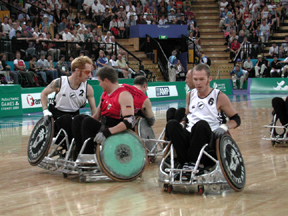
Murderball is a new movie to put on your "must see" list. It's about wheelchair rugby, a rough-and-tumble sport played by quadriplegics. That may sound like an oxymoron, but once you've seen wheelchair rugby, you'll understand the word quadriplegic in a different way.

I covered wheelchair rugby at the 1996 Paralympic Games in Atlanta, and have interviewed rugby players for various wheelchair sports stories along the way. It's an irresistible sport - fast, aggressive, strategic. It also happens to be Canadian in origin. The Canuck quads who dreamt it up called in Murderball, hence the name of the movie.

The New York Times reviewed it yesterday, and some photos of the sport here, here and here.

blog of note

AndyM of funcentral is very funny. And very smart.

He brings us Doonesbury (and more), he knows how to spread Santorum, and, most importantly, he asks excellent questions.

I see by Andy's last question that he and Redsock would have a lot to talk about.

hypocrisy all around

Some of you may have missed yesterday's heated discussion.

LonePrimate fleshed out his position on his own blog.

B.W. Ventril, who used to live across the street from where the London bus blew up, shares his thoughts on Camus and London mayor Ken Livingston.

RobfromAlberta makes a simple statement of empathy.

G muses on the cycle of violence.

For me, there's no contradiction between loathing Bush's imperialist policies, and feeling deep sympathy for the victims in London and the people who love them. My heart breaks for the people of Falluja, and Tel Aviv, and Kabul, and London, and New York.

I see no reason why in condemning George Bush's actions, I must condone the actions of the bus bombers.

The people of Iraq and Afghanistan have every right to live in peace, and to live in whatever kind of society they choose.

The people of London have the same right.

I can easily imagine how the people of London feel today, because I've been there. I can well remember how I felt on September 11, 2001, and in the days and weeks thereafter. Yes, in Iraq every day is 9/11. I agree. But our anger over the senseless deaths in Iraq shouldn't numb us to London's pain. I see far too much of that from "our" side.

Why do we have to choose? Can't we stand in sympathy with all victims of violence? When your sister is blown to bits, what matters the political affiliations of her murderer? Does the murderer's claim to victimhood make your sister any less dead? If your sister lived in a country where her leaders were hell bent on senseless war, must she pay the ultimate price for their stupidity?

After 9/11, I was horrified by the war-talk that raged through the US. But I was equally horrified by the victim-blaming streaming from certain sectors of the left.

The people in the World Trade Center that morning had no more control over U.S. imperialism than the people who hijacked the planes. It's ridiculous to say "this will keep happening until we demand an end to US imperialism," or the like. The ordinary people killed by terror do not have the power to affect that change, and should not be made to suffer for it.

And what makes the terror-apologists so sure that it would end? This is part of the hypocrisy. By implying that the Islamist terrorists are merely reacting to Western policy, the apologists demean the very people they urge us to understand. Am I to believe that if only the US and Israel would leave them alone, the Islamic Fundamentalists would all be chanting peace prayers? Bullshit. People have their own agendas. Are we so arrogant to believe that the actions of all the world are only reactions to us? George Bush is a murderer - for sure. But there are other murderers in the world, with their own independent agendas.

The people on that London bus, the people in the World Trade Center, and the people of Falluja - none of them deserved it. It's all barbaric, it's all unjust, and it all must be condemned.

media hypocrisy

Today one of the New York tabloids sports a photograph of a bloodied victim of the London bombings with the screaming headline: "Barbarians".

I agree.

Tomorrow I'd like them to show a similarly bloodied victim of George Bush's bombings, with the same headline.

7.07.2005

karl rove, traitor

Ted Rall has some interesting things to say about Karl Rove.

I'm linking to the Common Dreams version of Rall's piece, because I find Rall's blog a little difficult to deal with it. But there it is, for those interested.

Perhaps everyone knew this but me, as I don't follow these types of stories too well. Apparently Karl Rove was Time reporter Matthew Cooper's source. Rall asks:
Do Republicans have a shred of patriotism or loyalty to American legal principles left?

and

Do Democrats have the slightest spine left?
No, and no. Certainly not.

Rosa Brooks of the L.A. Times has something to say about Judith Miller. I don't care for Brooks calling Miller "competitive and heartless". That's totally irrelevant. I also find it sexist, as I can't imagine a male journalist being described this way. Aside from that, Brooks aptly reminds us
It was Miller, more than any other reporter, who helped the White House sell its WMD-in-Iraq hokum to the American public. Relying on the repeatedly discredited Ahmad Chalabi and her carefully cultivated administration contacts, Miller wrote story after story on the supposedly imminent threat posed by Saddam Hussein.
Brooks closes with this:
If a source with a clear political motivation passes along classified information that has no value for public debate but would endanger the career, and possibly the life, of a covert agent, is a journalist ethically permitted to "out" the no-good sneak? You bet. And if the knowledge that they can't always hide behind anonymity has a "chilling effect" on political hacks who are eager to manipulate the media in furtherance of their vested interests, that's OK with me.

But Miller still won't testify. Even though, ethically, there should be no obligation to go to jail to cover for a sleazeball.

It's possible (though not likely) that Miller is covering for a genuine whistle-blower who fears retaliation for fingering, gee, Karl Rove, for instance, as the real source of the leak.

But I have another theory. Miller's no fool; she understood the lesson of the Martha Stewart case: When you find yourself covered with mud, there's nothing like a brief stint in a minimum-security prison to restore your old luster.
Read the column here.

london

As a New Yorker, and someone who loves London, my heart goes out to Londoners this morning as they cope with the aftermath of the bombings. Ghastly things - both terrorist and otherwise - happen all over the globe every day. But bombings of public transportation are disquieting, to the say the least, to those of us who live in big cities.

I hope the UK's involvement in Iraq wasn't a preciptating factor. I also hope Blair doesn't use the attacks as an excuse for retaliatory bombing of innocent people, the way Bush would.

7.06.2005

the new beds arrive

Buster seems to be pretty happy with his new mats.

b on new mats 016


b on new mats 011


b on new mats 017


Cody won't go near them yet. She's making sure he survives before she sets foot on them.

cody 001


Now I understand why so many bloggers post nonsense like this. Once you have a digital camera, it's very tempting and strangely fun.

he'll think about it tomorrow

Did you guys see Fearless Leader in drag?

Hey, I'm pressed for time this morning, gotta find posts where I can. ALPF...?

more cool canadians

Adrian Bradbury and Kieran Hayward, self-described "average Canadians," are following the activist maxim: each one, reach one.
Each night, over 40,000 children in rural Uganda walk as many as 12 kilometres to urban centres such as the town of Gulu, just to sleep in relative safety and to avoid abduction. Yet no one seems to notice.

That's where GuluWalk comes in.

For the entire month of July, Adrian Bradbury and Kieran Hayward, the organizers of GuluWalk are walking 12.5 kilometres into downtown Toronto each night.

The pair, who refer to themselves as "average Canadians," spend the night on the street and then walk back home in the morning. And then they head to work.

The goal of the walk is twofold: to show support for the children and to get signatures on a petition asking the Canadian government to push the issue on the international stage.
You can read about their journey - or join them - through Gulu Walk. Star story here.

7.05.2005

calling all canadian ex-pats

Canadians, this is war!
Canada's Ambassador Declares War on Fox News

Ambassador Frank McKenna has undertaken a public relations effort to reach the more than 1 million Canadians living in the United States, a group he calls the "Canadian diaspora."

McKenna says the effort is to boost support for Canada here, and to counter what he says is the "Fox factor," referring to the Fox News Channel, America's most popular cable news network, and its most highly rated show, "The O'Reilly Factor."

McKenna told the Toronto Star that he wants to arm Canadians with facts that will enable them to debate Americans and to lobby when Washington makes decisions that can hurt Canadians.

But most importantly, he says, Canadians in the U.S. should counteract Fox News, alleging that the network often spreads disinformation and creates a false picture of his homeland.

"We know we're a bit of prey for the Fox News type of shows," he told the Star.

The ambassador said he has sent out 6,000 pieces of literature to Canadians in his battle with Fox, and plans to mail to some 100,000 Canadians in the weeks ahead.
OK, it's not really war. But it is kind of funny. (Thanks to ALPF.)

essential reading

This is not a meme.

In an email conversation with David Cho, I mentioned something about the "top 10 or 20 most important American novels". David said he'd be interested in seeing my list of those. I've been mulling it over, and have come up with said list.

Now for the inevitable disclaimers. This is my own idiosyncratic list, so certain authors aren't on it. For example, there's no Don DeLillo or Thomas Pynchon, two important American writers who I simply cannot read. (Not for lack of trying.)

On the other hand, it's not a "Laura's favorite books" list. It's a list of 20 novels that are important to American literature and to an understanding of the American experience. It's only American, so there's no Dickens, no Joyce, no Orwell, no Dostoevsky. And it's only novels, so all the great American playwrights are left off, as well as my friend Walt Whitman.

So, from a former English major and a voracious reader and appreciator of literature: the Twenty Most Important American Novels. (In no particular order.)

1. The Grapes of Wrath - John Steinbeck
2. The Adventures of Huckleberry Finn - Mark Twain
3. The Adventures of Augie March - Saul Bellow
4. Beloved - Toni Morrison
5. Invisible Man - Ralph Ellison
6. The Great Gatsby - F. Scott Fitzgerald
7. The Jungle - Upton Sinclair
8. Catch 22 - Joseph Heller
9. Moby Dick - Herman Melville
10. Charlotte's Web - E.B. White
11. The Sound and the Fury - William Faulkner
12. The Catcher in the Rye - J.D. Salinger
13. An American Tragedy - Theodore Dreiser
14. The Sun Also Rises - Ernest Hemingway
15. U.S.A. Trilogy - John Dos Passos
16. The House of Mirth - Edith Wharton
17. Ironweed - William Kennedy
18. To Kill a Mockingbird - Harper Lee
19. Native Son - Richard Wright
20. Portnoy's Complaint - Philip Roth

Honorable Mentions (at David's suggestion, books that I considered but ultimately didn't put on my Top 20):
All The Pretty Horses - Cormac McCarthy
On The Road - Jack Kerouac
The Good Earth - Pearl Buck
Slaughterhouse 5 - Kurt Vonnegut

Also-rans from authors already on the list:
Henderson the Rain King - Bellow
Tender Is the Night - Fitzgerald
Absalom Absalom - Faulkner
In Our Time - Hemingway

december 12, 2000

Another day of infamy.

Many of us have been angrily sputtering since Sandra Day O'Connor announced her retirement, and not because of the likely politics of her successor. Although the timing was a surprise, O'Connor's retirement should not have come as a shock. She hinted at it when she installed Bush as president in 2000.

It's true that O'Connor was the deciding vote in many a welcome 5-4 decision. But she was also the deciding vote in Bush v. Gore, the poison tree from which so much evil fruit has sprung. (Pardon the overheated metaphor there, the analogy is still apt.)

Sheldon Drobny, one of the founders of Air America Radio, compares O'Connor's Bush v. Gore decision to the movie "Judgment at Nuremberg": Supreme Court Justice O'Connor: 'She Never Knew it Would Come to This'.

7.04.2005

competitive advantage

I had seen this story reported in US newspapers. I didn't understand the Canadian significance - until Lone Primate sent the CBC link, and someone (I think ALPF) pointed this out:
The factory will cost $800 million to build, with the federal and provincial governments kicking in $125 million of that to help cover research, training and infrastructure costs.

Several U.S. states were reportedly prepared to offer more than double that amount of subsidy. But Fedchun said much of that extra money would have been eaten away by higher training costs than are necessary for the Woodstock project.

He said Nissan and Honda have encountered difficulties getting new plants up to full production in recent years in Mississippi and Alabama due to an untrained - and often illiterate - workforce. In Alabama, trainers had to use "pictorials" to teach some illiterate workers how to use high-tech plant equipment.

"The educational level and the skill level of the people down there is so much lower than it is in Ontario," Fedchun said.

In addition to lower training costs, Canadian workers are also $4 to $5 cheaper to employ partly thanks to the taxpayer-funded health-care system in Canada, said federal Industry Minister David Emmerson.

"Most people don't think of our health-care system as being a competitive advantage," he said.
What a sad commentary on the state of things in the US. People here are so used to blaming unions (i.e., paying people a living wage and offering them some modicum of job protection) for the absence of manufacturing jobs. This is an interesting bit of truth-telling.

who's walking where?

Danny Schechter writes about Live 8. I agree with him.

I know some wmtc readers are excited about the concerts (Hi G!). Let's not debate it. Each to her/his own. For my part, this is bread and circuses.

"The Limits of 'Live 8' and the G8 in Making Poverty History".