I've heard sportscasters say some pretty dumb things, but this has got to land CBC's Brian Williams in the Top Ten All-Time Dumbest.
Moments ago, Shani Davis became the first African American man to win an individual gold medal in a Winter Olympics. Davis took the gold for speed skating, in the 1000-meter event.
Said Williams: "Davis is from the south side of Chicago. He put on a White Sox cap after his race, perhaps some Jim Croce music playing in the background..."
Jim Croce?
Can you think of anything less "south side of Chicago" than Jim Croce?
For those who don't understand the reference, the words "the south side of Chicago" are found in the lyrics of an old pop song. For those who don't understand the stupidity, the song has nothing to do with Chicago. Less than nothing. Ask 100 - no, 1,000 - Chicagoans to reel off a few things their city is known for. I guarantee you none of them will name "Bad, Bad Leroy Brown".
What's more, Davis's mother moved her family to the far north end of Chicago when Shani was 10, to be closer to a skating rink.
Hello, Brian? Here's a dollar. Go buy yourself a metaphor.
2.18.2006

the gates, reloaded
Long-time readers may remember my enthusiasm for The Gates, the Christo project in New York's Central Park.
I was thrilled to still be living in New York when the project happened, and I blogged about it incessantly. Old posts: when The Gates first opened, why I cared about it (in response to a reader's question), my thoughts on Gates detractors, and finally, my impressions after seeing it for the first time. (I went twice, once without a camera and once with - plus, the second time, there was snow on the ground.)
Also, some Gates fun here.
Reading these old posts, I see I was considering buying something to remember the experience. I was also happy about the little freebie giveaway, which now resides in a small clip frame near my desk.
As we got ready to leave New York, the idea of owning a signed print from the project appealed to me more and more. Allan and I both enjoyed The Gates so much, and it seemed so fitting to bring something very special, and very New York, to our new home. We decided to splurge.
Back in present-day Port Credit, I'm on another round of fixing up the house: ordering shades for the living room windows, hanging curtains in the kitchen, framing some photos, putting things on the walls. To these ends, we had our prized poster framed and hung it over the couch.
It looks like this, in a simple black frame, with Christo's signature in the bottom left margin. Click to enlarge.
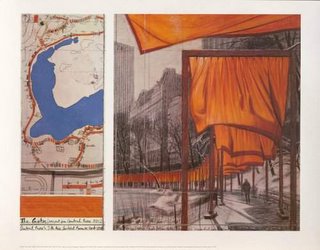
I also just noticed that I saw The Gates exactly one year ago! The day we took the print in for framing was actually a year to the day; quite the coincidence. When we walked into a local art gallery with our print, the curator couldn't believe her eyes: she had just printed her own photos from The Gates and was choosing one to have enlarged and framed. Must have been something in the air.
I was thrilled to still be living in New York when the project happened, and I blogged about it incessantly. Old posts: when The Gates first opened, why I cared about it (in response to a reader's question), my thoughts on Gates detractors, and finally, my impressions after seeing it for the first time. (I went twice, once without a camera and once with - plus, the second time, there was snow on the ground.)
Also, some Gates fun here.
Reading these old posts, I see I was considering buying something to remember the experience. I was also happy about the little freebie giveaway, which now resides in a small clip frame near my desk.
As we got ready to leave New York, the idea of owning a signed print from the project appealed to me more and more. Allan and I both enjoyed The Gates so much, and it seemed so fitting to bring something very special, and very New York, to our new home. We decided to splurge.
Back in present-day Port Credit, I'm on another round of fixing up the house: ordering shades for the living room windows, hanging curtains in the kitchen, framing some photos, putting things on the walls. To these ends, we had our prized poster framed and hung it over the couch.
It looks like this, in a simple black frame, with Christo's signature in the bottom left margin. Click to enlarge.

I also just noticed that I saw The Gates exactly one year ago! The day we took the print in for framing was actually a year to the day; quite the coincidence. When we walked into a local art gallery with our print, the curator couldn't believe her eyes: she had just printed her own photos from The Gates and was choosing one to have enlarged and framed. Must have been something in the air.
2.17.2006
olympic check-in
I'm thoroughly enjoying watching The Olympics. I'm not watching in any organized, concerted way, just turning on the TV more than I normally would and tuning in to whatever sport is on. (Unless it's figure skating, then I turn it off.)
I'm really enjoying the coverage at the venues themselves, which is informative, purely sports-oriented and not overly patriotic. What a great change from US coverage! I could use more information about the sports, as I think Olympics coverage should assume that most people watching don't normally follow these sports, and need some instruction. However, since I'm often just watching highlights - for example, of curling - the announcers might be doing a lot of this and I'm just not catching it.
One thing I love about Olympics coverage these days is the total lack of sexism. This probably dates me, but I well remember coverage of women's sports that reeked of blatant sexism. Not any more. Progress!
The only thing I don't like about the CBC coverage is Brian Williams. Almost everything about him annoys me. I especially dislike his automatic assumption that anyone accused of cheating has cheated. Even with casual viewing, I've heard him do this many times already, and I think it's wrong. Anyone can be accused of anything, and when someone says "I didn't do it," they might be telling the truth. Not according to Mr Williams.
His opinionated commentary bothers me in general. I'm interested in sports; I'm not interested in one man's opinions. He seems to inject himself into the story whenever possible. Hey Brian, it's not about you.
(US readers, this isn't this guy, it's this guy.)
Other than that, I'm loving it. I don't know how many medals Team Canada has won so far, and I don't care. I just love seeing these incredible athletes do their thing.
I'm really enjoying the coverage at the venues themselves, which is informative, purely sports-oriented and not overly patriotic. What a great change from US coverage! I could use more information about the sports, as I think Olympics coverage should assume that most people watching don't normally follow these sports, and need some instruction. However, since I'm often just watching highlights - for example, of curling - the announcers might be doing a lot of this and I'm just not catching it.
One thing I love about Olympics coverage these days is the total lack of sexism. This probably dates me, but I well remember coverage of women's sports that reeked of blatant sexism. Not any more. Progress!
The only thing I don't like about the CBC coverage is Brian Williams. Almost everything about him annoys me. I especially dislike his automatic assumption that anyone accused of cheating has cheated. Even with casual viewing, I've heard him do this many times already, and I think it's wrong. Anyone can be accused of anything, and when someone says "I didn't do it," they might be telling the truth. Not according to Mr Williams.
His opinionated commentary bothers me in general. I'm interested in sports; I'm not interested in one man's opinions. He seems to inject himself into the story whenever possible. Hey Brian, it's not about you.
(US readers, this isn't this guy, it's this guy.)

Other than that, I'm loving it. I don't know how many medals Team Canada has won so far, and I don't care. I just love seeing these incredible athletes do their thing.
conspicuous consumption
I don't know how many of you have ever been to Whole Foods. They have three locations in Canada - Vancouver, Toronto, and in the Toronto suburb of Oakville. When Whole Foods opened its first location in New York City a few years ago, it was a Big Thing. I immediately fell in love with it and contrived to shop there whenever possible, even though it was nowhere near where we lived, and despite prices that put it in the "indulgence" category.
Whole Foods is a combination of an extremely upscale supermarket, a health food store and a specialty food outlet. They have a giant selection of organic produce, organic food products of every description, huge organic meat, fish, cheese and bakery departments, and - what they're especially famous for in New York - prepared food. Everything is freshly prepared in the store with all organic ingredients, and the selection is vast.
Buying freshly prepared food from specialty markets - that is, bringing home already prepared, but healthy and delicious, dinners - is very big in New York, and Whole Foods outdid every other seller. In addition, their space is beautiful, and their customer service is perfect. In a city where shopping is often a zoo-like experience, this is big.
Last week we checked out the Whole Foods in Toronto, and yesterday we went to the one in Oakville, partly in search of certain foods we haven't been able to find in our local Loblaws, but partly just because I love them. The one in Toronto, in the upscale Yorkville neighbourhood, is very nice. But the one in Oakville is the true Whole Foods Experience. It's huge, gorgeous, and the prepared food section rivals the one in New York.
There's a downside, of course. That two Whole Foods can be successful in the GTA belies any stereotype of frugal Canadians, because their prices can be outrageous. You have to really watch what you're putting in your cart, lest you find that the bunch of seedless grapes you've just selected comes to $28 or that little goat cheese salad is $14.50. (Someone near us at the prepared-food counter quipped, "Another name for this place is Whole Paycheque".)
At the same time, there are bargains to be found, especially the Whole Foods brand, 365. The prepared food is no more expensive than other prepared food - that is, much more than cooking for yourself, much less than eating in a restaurant - but it's so much better.
To the health-food store community and the labour movement, Whole Foods is an Enemy. Although they're supposed to be an excellent company to work for, the owner is notoriously anti-union. They're also accused of using their giant volume purchasing to strong-arm suppliers.
An independent health food store in our neighbourhood, Alternatives, just went out of business; their branch in Oakville tanked last month. I'd be extremely surprised if the advent of Whole Foods in the area didn't at least hasten its demise, if not kill it outright.
I don't necessarily believe, as some people do, that any independently owned store is good and any large chain is evil. But for the folks who owned and worked at Alternatives, Whole Foods is certainly not a good thing.
Despite these very real negatives, since moving to Canada, I've missed shopping at Whole Foods. When we stayed at my mom's over US Thanksgiving, we visited the one nearest her and stocked up on a few things. But mostly I've missed what you can't stock up on: delicious prepared dinners. I was surprised and disappointed that suburban supermarkets here don't offer that, since I'd think busy working families would really enjoy it. But it's very expensive and labour-intensive for stores to introduce, and I guess people don't expect it, so it doesn't exist. I've had to get used to cooking more, which doesn't thrill me.
Which brings us back to Oakville. It's only 15 minutes away, a short hop on the QEW, and it made me very happy. So it seems likely we'll be supporting their healthy, delicious, spacious, corporate, anti-union, over-priced store on a semi-regular basis.
Whole Foods is a combination of an extremely upscale supermarket, a health food store and a specialty food outlet. They have a giant selection of organic produce, organic food products of every description, huge organic meat, fish, cheese and bakery departments, and - what they're especially famous for in New York - prepared food. Everything is freshly prepared in the store with all organic ingredients, and the selection is vast.
Buying freshly prepared food from specialty markets - that is, bringing home already prepared, but healthy and delicious, dinners - is very big in New York, and Whole Foods outdid every other seller. In addition, their space is beautiful, and their customer service is perfect. In a city where shopping is often a zoo-like experience, this is big.
Last week we checked out the Whole Foods in Toronto, and yesterday we went to the one in Oakville, partly in search of certain foods we haven't been able to find in our local Loblaws, but partly just because I love them. The one in Toronto, in the upscale Yorkville neighbourhood, is very nice. But the one in Oakville is the true Whole Foods Experience. It's huge, gorgeous, and the prepared food section rivals the one in New York.
There's a downside, of course. That two Whole Foods can be successful in the GTA belies any stereotype of frugal Canadians, because their prices can be outrageous. You have to really watch what you're putting in your cart, lest you find that the bunch of seedless grapes you've just selected comes to $28 or that little goat cheese salad is $14.50. (Someone near us at the prepared-food counter quipped, "Another name for this place is Whole Paycheque".)
At the same time, there are bargains to be found, especially the Whole Foods brand, 365. The prepared food is no more expensive than other prepared food - that is, much more than cooking for yourself, much less than eating in a restaurant - but it's so much better.
To the health-food store community and the labour movement, Whole Foods is an Enemy. Although they're supposed to be an excellent company to work for, the owner is notoriously anti-union. They're also accused of using their giant volume purchasing to strong-arm suppliers.
An independent health food store in our neighbourhood, Alternatives, just went out of business; their branch in Oakville tanked last month. I'd be extremely surprised if the advent of Whole Foods in the area didn't at least hasten its demise, if not kill it outright.
I don't necessarily believe, as some people do, that any independently owned store is good and any large chain is evil. But for the folks who owned and worked at Alternatives, Whole Foods is certainly not a good thing.
Despite these very real negatives, since moving to Canada, I've missed shopping at Whole Foods. When we stayed at my mom's over US Thanksgiving, we visited the one nearest her and stocked up on a few things. But mostly I've missed what you can't stock up on: delicious prepared dinners. I was surprised and disappointed that suburban supermarkets here don't offer that, since I'd think busy working families would really enjoy it. But it's very expensive and labour-intensive for stores to introduce, and I guess people don't expect it, so it doesn't exist. I've had to get used to cooking more, which doesn't thrill me.
Which brings us back to Oakville. It's only 15 minutes away, a short hop on the QEW, and it made me very happy. So it seems likely we'll be supporting their healthy, delicious, spacious, corporate, anti-union, over-priced store on a semi-regular basis.
2.16.2006
good news
I took this as a good sign.
Liberals unwilling to prop up HarperYesterday I read this letter to the editor in the Globe And Mail, from an astute man in Vancouver:
Graham says onus now on Bloc and NDP to support Conservative minority
Opposition Leader Bill Graham said he will not be afraid to defeat Prime Minister Stephen Harper's minority Conservative government, even though the Liberal Party will spend much of the year in a leadership race.
Mr. Harper must either accommodate Liberal positions on key issues such as child care and income-tax cuts or turn to the New Democratic Party and Bloc Quebecois for support in the House of Commons, Mr. Graham said in an interview with The Globe and Mail.
He placed the onus for avoiding a quick election on the New Democrats and the Bloc, saying they triggered the last election out of political opportunism.
"We're not in the business of propping up the government," he said. "We're the Official Opposition. And that is our role, and we will stick to our points where they are important to the future of the country.
"Other parties will have to decide whether they want to compromise on this, because they're the ones — the Canadian public very well knows — that put us in this position. They're the ones that created the Harper government. They're the ones that are going to have to accommodate it."
My take on Canadian politics is that, every decade or so, Canadians forget how much they dislike the Conservative Party and what it stands for and give it a chance to govern. Given the appalling, but not surprising, arrogance of Stephen Harper since the election, I suspect Canadians' memories will be well refreshed by the time his minority government falls in the next year or two. - Henry SpornSounds good to me.
shame
The United Nations released a report today calling on the United States to release or bring to trial everyone being held in the Guantanamo Bay prison, Cuba, and to shut the facility down.
The report is a summary of an investigation by five UN experts. It calls on the US government "to close down the Guantanamo Bay detention centre and to refrain from any practice amounting to torture or cruel, inhuman or degrading treatment." The UN report is found here..
It comes as no surprise that the US discredits and ignores the report. It's not like they give a shit about human rights, or international opinion, or... anything except their own agenda. Not much new there. But these kinds of reports are important nonetheless. Reliable third parties must document the abuses of the most powerful. It's bad enough the US rewrites its own recent history; they can't be allowed to rewrite it for the entire world.
One of the US's complaints about the UN report is that the investigators rejected an invitation to visit Guantanamo. The US had invited the experts to the prison - but wouldn't let them interview the people being held there. Because they were not to be given free access, the investigators refused to go. Their findings were instead based on interviews with former detainees, public documents, media reports, lawyers and a questionnaire filled out by the U.S. government.
The Guantanamo Bay prison is one of the great shames of the United States. If there was ever justification for imprisoning the people held there - without charges, without trials, without even the protections that POW status would confer - it has long, long since vanished. These prisoners are the often forgotten victims of the US's war of terror.
AP story here.
The report is a summary of an investigation by five UN experts. It calls on the US government "to close down the Guantanamo Bay detention centre and to refrain from any practice amounting to torture or cruel, inhuman or degrading treatment." The UN report is found here..
It comes as no surprise that the US discredits and ignores the report. It's not like they give a shit about human rights, or international opinion, or... anything except their own agenda. Not much new there. But these kinds of reports are important nonetheless. Reliable third parties must document the abuses of the most powerful. It's bad enough the US rewrites its own recent history; they can't be allowed to rewrite it for the entire world.
One of the US's complaints about the UN report is that the investigators rejected an invitation to visit Guantanamo. The US had invited the experts to the prison - but wouldn't let them interview the people being held there. Because they were not to be given free access, the investigators refused to go. Their findings were instead based on interviews with former detainees, public documents, media reports, lawyers and a questionnaire filled out by the U.S. government.
The Guantanamo Bay prison is one of the great shames of the United States. If there was ever justification for imprisoning the people held there - without charges, without trials, without even the protections that POW status would confer - it has long, long since vanished. These prisoners are the often forgotten victims of the US's war of terror.
AP story here.
2.15.2006
reality
Well, I guess we have a doctor. I felt comfortable with her, certainly enough for now. I suppose the real test of any doctor is what they do when something changes, but there's no way to know that in advance. For now, though, this is fine.
I haven't gotten any temp work yet. There's something likely for next week, so I'm trying to enjoy my freedom while I can - swimming, reading, taking Cody to the off-leash park. I am dreading temping, with a fervor out of all logical proportion. I know it will be fine. I do. But I have a completely sick dread of it anyway.
I think the full effects of losing my great writing gig is just hitting home. When I wrote the first manuscript, I was under such enormous pressure - moving preparations, Buster's illness, saying goodbye to friends and family in New York, and still working my weekend job. I sometimes felt on the verge of exploding. (Indeed, I did have at least one full-scale panic attack.)
Even under those difficult conditions, I enjoyed the work. I was so looking forward to writing the next manuscript under greatly improved circumstances - without a day job, working away in our cozy little house near the lake.
But no.
Believe me, I'm well aware that I have little to complain about in the larger sense. My non-writing work is always in demand, so there's little danger of serious financial crisis. And I still have writing work I enjoy, it just doesn't pay enough to live on. My working life will return to what it's usually been - part word processing, part writing. It was just savouring that taste of full-time writing, then having it snatched away, that sucks.
I'm off to enjoy my day. For those interested, a long discussion about censorship and so-called obscenity laws is going on here.
I haven't gotten any temp work yet. There's something likely for next week, so I'm trying to enjoy my freedom while I can - swimming, reading, taking Cody to the off-leash park. I am dreading temping, with a fervor out of all logical proportion. I know it will be fine. I do. But I have a completely sick dread of it anyway.
I think the full effects of losing my great writing gig is just hitting home. When I wrote the first manuscript, I was under such enormous pressure - moving preparations, Buster's illness, saying goodbye to friends and family in New York, and still working my weekend job. I sometimes felt on the verge of exploding. (Indeed, I did have at least one full-scale panic attack.)
Even under those difficult conditions, I enjoyed the work. I was so looking forward to writing the next manuscript under greatly improved circumstances - without a day job, working away in our cozy little house near the lake.
But no.
Believe me, I'm well aware that I have little to complain about in the larger sense. My non-writing work is always in demand, so there's little danger of serious financial crisis. And I still have writing work I enjoy, it just doesn't pay enough to live on. My working life will return to what it's usually been - part word processing, part writing. It was just savouring that taste of full-time writing, then having it snatched away, that sucks.
I'm off to enjoy my day. For those interested, a long discussion about censorship and so-called obscenity laws is going on here.
2.14.2006
some sheep make some noise
Here's something I love about Canada. The media says things like this:
Other newsworthy events took place yesterday: Four U.S. soldiers were killed by a roadside bomb in Afghanistan and Iran began enriching uranium in its deadly game of nuclear brinkmanship, but the press corps here was interested in only one story — why it took almost 24 hours for the world to find out that U.S. Vice-President Dick Cheney had accidentally shot a man in the face during a weekend Texas hunting trip.At the gym yesterday, I happened to see a CNN headline saying Scottie was "grilled" about the shooting. I was thinking, oh yeah, I can imagine the grilling, what'd they do, ask one follow-up question? But apparently the White House press corps rented a spine for the day.
After five years of largely accepting the Bush administration's version of events on everything from Iraq's illusory weapons of mass destruction to the bungled response to hurricane Katrina, the White House press corps suddenly turned aggressive yesterday, refusing to accept spokesman Scott McClellan's explanations of why the public had been left in the dark about Mr. Cheney's hunting mishap.
final piece
We have appointments today with a nearby family doctor. If we like her - or, if I like her, since it's more important to me - the last piece of our settling-in puzzle will be in place. This was the issue I was most concerned about, because I've had bad doctors, and finding a good one changed my life, and because I heard it was very difficult to find a doctor who's accepting new patients in the Toronto area.
I wasn't seriously worried, as there are walk-in clinics everywhere. I went to trouble and expense to make sure we had a good six-months' supply of all our medications, and just hoped for the best.
As it turned out, there were several doctors accepting new patients in Mississauga. Now I'm crossing my fingers that I like this one, or enough to start out, anyway.
It will be our first time using our wonderful and amazing Ontario Health cards.
* * * *
Back in the Old Country, 26.9 inches of snow fell in Central Park in 24 hours - breaking the previous record set in 1869! Can't say I'm sorry I missed that.
I wasn't seriously worried, as there are walk-in clinics everywhere. I went to trouble and expense to make sure we had a good six-months' supply of all our medications, and just hoped for the best.
As it turned out, there were several doctors accepting new patients in Mississauga. Now I'm crossing my fingers that I like this one, or enough to start out, anyway.
It will be our first time using our wonderful and amazing Ontario Health cards.
* * * *
Back in the Old Country, 26.9 inches of snow fell in Central Park in 24 hours - breaking the previous record set in 1869! Can't say I'm sorry I missed that.
2.13.2006
what a coincidence
From United for Peace and Justice:
As if losing their homes, jobs, and family members were not enough, displaced Katrina survivors are now at risk of being denied their Constitutional right to vote in Louisiana elections.Here's how you can help.
Under Louisiana's current election plans, a high percentage of the state's registered voters who have relocated to other cities and states are in danger of being excluded from the voting process. Many of them are low-income African Americans and immigrants.
Few of Louisiana's displaced residents are in a position to return to New Orleans and other Louisiana cities to vote. For instance, on Monday, February 13th, FEMA's short-term hotel program expires for most of the 26,000 displaced hurricane survivors, yet most of these evacuees have not been provided with long-term, or even transitional, housing solutions. To protect evacuees' right to vote, it's vital that Louisiana set up satellite voting centers in other parishes and states where large numbers of displaced residents are temporarily residing.
For satellite voting to be incorporated into Louisiana's election regulations, Governor Kathleen Blanco must act by early next week, but until now, she's waffled on the issue.
shall make no law
Congress shall make no law respecting an establishment of religion, or prohibiting the free exercise thereof; or abridging the freedom of speech, or of the press; or the right of the people peaceably to assemble, and to petition the Government for a redress of grievances.This is the First Amendment to the Constitution of the United States of America. It was ratified in 1791, four years after the Constitution was ratified, along with the other nine amendments that comprise the Bill of Rights.
I'm a First Amendment nut. I view unfettered freedom of speech as one of the backbones of a free society, along with freedom of religion, the right to assemble, and the right to bodily integrity (not mentioned in the US Constitution).
When the First Amendment is in trouble, I have no trouble knowing where I stand. When the Nazis wanted to march through Skokie, Illinois, I was only 17, but it seemed clear to me that they must be allowed to do so. In the nearly 30 years since, my beliefs have been clarified and strengthened. Whether it be a t-shirt I agree with or a billboard I detest, I support every person's right to publicly express her or his views. The way to fight hate, in my opinion, is not to censor it, but to bring it out in the light of day. Fight messages of hate with messages of tolerance. Fight propaganda with truth.
Way back when our immigration applications were being processed, I had an extended email conversation with a woman who lives in Toronto. She's very progressive, and is also involved in queer issues. She was upset over the latest Fred Phelps outrage, and was both hurt and contemptuous that he was allowed to practice his brand of bigotry so publicly in the US. I remember her saying, "One person like that has the ability to hurt so many people. I don't see what on earth that has to do with free speech."
She was taken aback with my response, defending his right to spew. When she said, "In Canada, we believe..." I took it to mean that Canada's anti-hate-speech law has nearly universal acceptance. Since moving here, I've read several editorials and columns from Canadians who disagree with that, so now I see it isn't quite so one-sided.
I also see the laws in a new light. One way the US and Canada can be contrasted is individual vs community. Both countries value both, to be sure, but to me the emphasis is unmistakable. In the US, the individual's right to freedom of expression is supposed to trump any other concern. (Supposed to. Don't confuse John Ashcroft's and Alberto Gonzales's America with true American values.) Canada's anti-hate-speech law curtails an individual's right to say whatever he pleases in favour of the comfort of the community, and a community's right to exist free of harassment.
I still oppose it.
When looking online for more information about this from a Canadian perspective, most of what I found was written by Christian Conservatives bemoaning their right to spread homophobia. I obviously disagree with their views, but I don't know why they should be enjoined from publicly stating them.
This column was a little more moderate, although still from a conservative point of view. I was disappointed to find only conservatives and reactionaries opposed to the hate-speech laws, but no liberals or progressives. If this is an accurate representation, rather than an error in my research, it confirms a right-wing stereotype about the left. I'm hoping it's not the case.
As the "cartoon riots" were being discussed and debated last week, this caught my eye. Doug Saunders, writing in the Globe And Mail, ended his column with this:
As the riots were getting under way this week, Britain's Labour government attempted one solution to the dilemma, a law to make such cartoons completely illegal. Britain's Racial and Religious Hatred Bill would have outlawed any disrespectful expressions toward religions. It was drafted in response to an equally ill-conceived law that passed last summer in the wake of the July 7 bombings, which outlaws the expression of intolerant or hateful ideas in places of worship.Although I found the C-250 Bill when it was read in the House of Commons, I was unable to locate the text of the law itself, or even its proper name. Wikipedia is down and I can't find the exact law on any Canada government information site. I must not know what to look for. If you can fill me in, I'll edit this post to include your information.
That's one response to the multiple ironies of offence-giving cartoons versus offensive religious practices: Pass laws against unpleasant thoughts and ideas. During the long and angry parliamentary debate, it emerged that all manner of posters, cartoons, jokes and even sermons would be rendered illegal, as they implicitly are in Canada's unfortunate hate-speech laws.
The British government tried to define this sharia-like law as a necessary tool in a diverse society. As it turned out, the debate taught a more important lesson -- that what social diversity requires is not "tolerance," as the cliche would have it, or even laws to make our expressions sound "tolerant," but rather a greater latitude for intolerance.
Rowan Atkinson, the normally silent comedian of Mr. Bean fame, was suddenly rendered articulate, and spoke eloquently on Monday of the "right to criticize and ridicule religious beliefs and practices." To everyone's surprise, his side won: After Tony Blair made the mistake of leaving the House of Commons for five minutes, the bill came to a swift vote, and it was defeated by exactly one "Nay" -- indicating just how sharp this division has become. The Tory whip was forced to resign.
"Something I feel that I have learnt over this long campaign," Mr. Atkinson said afterward, in a surprisingly non-squeaky voice, "is that hate legislation, no matter how well-intended, is never more than a mechanism to paper over the cracks in society.
"Of course, I would sympathize with anyone who says, 'I would rather look at the wallpaper than the cracks,' and if such legislation can provide short-term comfort to vulnerable communities, that is all to the good. But it will never provide any solutions to the ills of society. In the absence of other action, behind the paper, the wall will continue to crumble."
A strikingly non-funny line from a master of visual humour. But if there was a lesson this week, it was that dreadful jokes can have a useful effect.
[Update: new commenter Wangmo posted a link to the hate-speech amendment to Canada's Criminal Code. Thank you!]
What are your thoughts about laws criminalizing hate propaganda? Why does Canada need this law? Whose interests does it serve? When can government censorship be justified?
2.12.2006
protest, canadian style
Hundreds of Muslims protested in Toronto and Montreal yesterday, peacefully raising their voices against the insulting depiction of the prophet Mohammed in European newspapers.
According to the CBC, about 250 people demonstrated near McGill University in Montreal and another 200 people marched in front of the Danish consulate in Toronto. (Does that mean there were really 1,000 people at each? Veteran demonstrators will know what I mean.) Apparently there was one arrest in Montreal, of a man who was shouting profanities about Islam.
In Europe, there were several peaceful protests, many people condemning both the cartoons and the violent responses to their publication.
Four days ago, the student newspaper of the University of Prince Edward Island published the infamous cartoons. CBC: "Two thousand copies of The Cadre were distributed on campus Wednesday, but university administration ordered them removed. Officials say the cartoons have already caused enough violence around the world."
The school's student union came out in support of the administrators' decision, and the newspaper's editors complied, returning all the remaining copies.
In the US, student journalists often conflict with school administrators, with the school calling publications offensive and inappropriate, and newspaper staff citing principles of free speech. This can be a huge issue in the US, where high schools and universities routinely demand students surrender their Constitutional rights. Courts have divided over the issue.
In P.E.I., the newspaper was technically owned by the student union, which was demanding the return of the newspapers. It sounds like it was pretty clear cut and the editors didn't put up a fight.
I'm reading about free speech vs hate speech laws in Canada, and I'll post something for us to discuss. Please stay tuned and hold your comments.
According to the CBC, about 250 people demonstrated near McGill University in Montreal and another 200 people marched in front of the Danish consulate in Toronto. (Does that mean there were really 1,000 people at each? Veteran demonstrators will know what I mean.) Apparently there was one arrest in Montreal, of a man who was shouting profanities about Islam.
In Europe, there were several peaceful protests, many people condemning both the cartoons and the violent responses to their publication.
Four days ago, the student newspaper of the University of Prince Edward Island published the infamous cartoons. CBC: "Two thousand copies of The Cadre were distributed on campus Wednesday, but university administration ordered them removed. Officials say the cartoons have already caused enough violence around the world."
The school's student union came out in support of the administrators' decision, and the newspaper's editors complied, returning all the remaining copies.
In the US, student journalists often conflict with school administrators, with the school calling publications offensive and inappropriate, and newspaper staff citing principles of free speech. This can be a huge issue in the US, where high schools and universities routinely demand students surrender their Constitutional rights. Courts have divided over the issue.
In P.E.I., the newspaper was technically owned by the student union, which was demanding the return of the newspapers. It sounds like it was pretty clear cut and the editors didn't put up a fight.
I'm reading about free speech vs hate speech laws in Canada, and I'll post something for us to discuss. Please stay tuned and hold your comments.
2.11.2006
what i'm reading: the diary of samuel pepys online
Since January 2003, I have been reading The Diary of Samuel Pepys, online, at PepysDiary.com.
Samuel Pepys (pronounced "peeps") lived in London, England, in the 17th Century. For ten years, he kept a meticulous diary, a highly unusual concept for its day. Pepys - or Sam, as the diary readers all call him - wrote about the major political, religious and military events of the time, as well as the mundane dealings of every day life - food and drink, servants and neighbours, family feuds and marital spats. Luckily for us, Sam was a man of endless curiosity. He loved new inventions and innovations, and he loved books, music, theatre and art. (He also loved women.) The Diary of Samuel Pepys is a literary landmark, a great repository of history and a treasure trove of 17th Century London life.
A little more than three years ago, the incomparable Phil Gyford had the idea to put the entire diary online. Like many people, Gyford had wanted to read Pepys' diary but was intimidated by its massive length. Using the most recent version of the Diary that is in the public domain (that is, no longer copyright protected), Gyford decided to post an entry each day, to read the work in manageable bits, and to encourage others to read along.
It's been a huge success. The site is now inhabited by a regular group of readers and annotators who explain, augment and discuss entries. Some are experts in various fields that relate to the diary, some are amateur historians, most are just interested readers. Through the work of Phil and all the annotators, the characters are all linked with bios and all manner of background information is explicated.
This is the main diary site, here's an FAQ, and the "story so far" page can bring you up to date. Here's an NPR interview with Phil Gyford shortly after he began the site, and another from the BBC.
I read the Diary weekly, catching up on entries for the past week as if they were a chapter in a novel. And why did I post this today? From the entry for Friday 6 February 1663:
Samuel Pepys (pronounced "peeps") lived in London, England, in the 17th Century. For ten years, he kept a meticulous diary, a highly unusual concept for its day. Pepys - or Sam, as the diary readers all call him - wrote about the major political, religious and military events of the time, as well as the mundane dealings of every day life - food and drink, servants and neighbours, family feuds and marital spats. Luckily for us, Sam was a man of endless curiosity. He loved new inventions and innovations, and he loved books, music, theatre and art. (He also loved women.) The Diary of Samuel Pepys is a literary landmark, a great repository of history and a treasure trove of 17th Century London life.
A little more than three years ago, the incomparable Phil Gyford had the idea to put the entire diary online. Like many people, Gyford had wanted to read Pepys' diary but was intimidated by its massive length. Using the most recent version of the Diary that is in the public domain (that is, no longer copyright protected), Gyford decided to post an entry each day, to read the work in manageable bits, and to encourage others to read along.
It's been a huge success. The site is now inhabited by a regular group of readers and annotators who explain, augment and discuss entries. Some are experts in various fields that relate to the diary, some are amateur historians, most are just interested readers. Through the work of Phil and all the annotators, the characters are all linked with bios and all manner of background information is explicated.
This is the main diary site, here's an FAQ, and the "story so far" page can bring you up to date. Here's an NPR interview with Phil Gyford shortly after he began the site, and another from the BBC.
I read the Diary weekly, catching up on entries for the past week as if they were a chapter in a novel. And why did I post this today? From the entry for Friday 6 February 1663:
And so to a bookseller’s in the Strand, and there bought Hudibras again, it being certainly some ill humour to be so against that which all the world cries up to be the example of wit; for which I am resolved once again to read him, and see whether I can find it or no.You know who I immediately thought of, right? Hudibras is Sam's Rick Mercer!
what i'm reading: the plot against america by philip roth
I didn't expect to write another "what i'm reading" post so soon, but I'm so absorbed in this book that I had to post: The Plot Against America by Philip Roth.
I'm not sure how familiar Canadians are with Philip Roth. He's an important American writer, very prolific, often confounding. His first novel was Goodbye, Columbus (1959), Plot Against America came out in 2004, and there's a long, long list in between.
Roth is both profound and playful, and his writing is hugely varied - he's not a writer for whom you can read one or two books and declare you know him. Some of his novels are among my favourite books; others I found unreadable. But without a doubt he is a great American voice. I'm hoping he wins the Nobel Prize in his lifetime.
Roth has also been very influential in bringing other voices to US audiences, most notably Milan Kundera and Primo Levi. One can imagine a direct line following the Eastern European experience, beginning with Kafka, then Roth, then Kundera. Roth is the branch of the family that came to America.
When The Plot Against America begins, it is 1939, in a working-class Jewish neighbourhood in Newark, New Jersey. Everything is historically accurate: it is exactly 1939.
Then something different happens: the Republicans do not nominate Wendell Willkie to challenge Franklin Delano Roosevelt's bid for an unprecedented third term. They nominate Charles Lindbergh. Lindbergh: hero, celebrity, friend of the Nazis, virulent anti-Semite. (This is true, too, except he wasn't nominated.) During the campaign, Lindbergh keeps his most objectionable sentiments under his hat, and the media - then known as "the press" - goes along for the ride. Lindy seduces the public with his plain-spoken charm, and runs on one simple promise: I will keep the US out of another war.
He wins. FDR goes home to Hyde Park. A Nazi-sympathizer sits in the White House. It begins.
I am finding this book so gripping, so terrifying, and so completely believable, that I have to keep reminding myself that it didn't happen this way. I keep thinking, thank god I'm in Canada already, before this happens. Obviously, that's part of Roth's point.
The Plot Against America is not told as history. The narrator is a nine-year-old boy, who experiences these world events as personal, family history. So the book is also a coming-of-age story, and Roth is brilliant at this. The narrator's milieu is very familiar to me: it's the culture in which my parents grew up. My parents grew up in Brooklyn, but for these purposes, it's the same thing.
I don't know if the impact of this book would be as great for a reader who wasn't from the US, or who wasn't Jewish. I'm finding it sometimes almost too scary to read.
Have you seen the movie The Garden of the Finzi-Continis? (I've mentioned it repeatedly in this blog, it's one of my minor obsessions, like George Orwell.) Finzi-Continis is about Italian Jews on the eve of their destruction, and it's the best movie I've ever seen about the Holocaust. There is no violence; you never see a concentration camp or a murder. The comfortable Italian Jews are slowly stripped of their lives. They adapt to one indignation, and then another, rationalizing and adjusting, as people do, as they gradually become second-class citizens. And then, it happens. I don't know if I've ever been so affected by a movie - so completely chilled, so frightened - as I was at the end of that one.
I am about halfway through The Plot Against America, and I purposely haven't read anything that might reveal plot. So I don't know if the American Jews, and their country, make it out alive.
Late addition: In this alternate universe, where the US does not enter the war against Germany or Japan, leaving the British and Canada to struggle virtually alone against the Nazis, Canada emerges as a safe haven for American Jews. Canadian readers will be justly proud of their country's role in this imagined nightmare.
I'm not sure how familiar Canadians are with Philip Roth. He's an important American writer, very prolific, often confounding. His first novel was Goodbye, Columbus (1959), Plot Against America came out in 2004, and there's a long, long list in between.
Roth is both profound and playful, and his writing is hugely varied - he's not a writer for whom you can read one or two books and declare you know him. Some of his novels are among my favourite books; others I found unreadable. But without a doubt he is a great American voice. I'm hoping he wins the Nobel Prize in his lifetime.
Roth has also been very influential in bringing other voices to US audiences, most notably Milan Kundera and Primo Levi. One can imagine a direct line following the Eastern European experience, beginning with Kafka, then Roth, then Kundera. Roth is the branch of the family that came to America.
When The Plot Against America begins, it is 1939, in a working-class Jewish neighbourhood in Newark, New Jersey. Everything is historically accurate: it is exactly 1939.
Then something different happens: the Republicans do not nominate Wendell Willkie to challenge Franklin Delano Roosevelt's bid for an unprecedented third term. They nominate Charles Lindbergh. Lindbergh: hero, celebrity, friend of the Nazis, virulent anti-Semite. (This is true, too, except he wasn't nominated.) During the campaign, Lindbergh keeps his most objectionable sentiments under his hat, and the media - then known as "the press" - goes along for the ride. Lindy seduces the public with his plain-spoken charm, and runs on one simple promise: I will keep the US out of another war.
He wins. FDR goes home to Hyde Park. A Nazi-sympathizer sits in the White House. It begins.
I am finding this book so gripping, so terrifying, and so completely believable, that I have to keep reminding myself that it didn't happen this way. I keep thinking, thank god I'm in Canada already, before this happens. Obviously, that's part of Roth's point.
The Plot Against America is not told as history. The narrator is a nine-year-old boy, who experiences these world events as personal, family history. So the book is also a coming-of-age story, and Roth is brilliant at this. The narrator's milieu is very familiar to me: it's the culture in which my parents grew up. My parents grew up in Brooklyn, but for these purposes, it's the same thing.
I don't know if the impact of this book would be as great for a reader who wasn't from the US, or who wasn't Jewish. I'm finding it sometimes almost too scary to read.
Have you seen the movie The Garden of the Finzi-Continis? (I've mentioned it repeatedly in this blog, it's one of my minor obsessions, like George Orwell.) Finzi-Continis is about Italian Jews on the eve of their destruction, and it's the best movie I've ever seen about the Holocaust. There is no violence; you never see a concentration camp or a murder. The comfortable Italian Jews are slowly stripped of their lives. They adapt to one indignation, and then another, rationalizing and adjusting, as people do, as they gradually become second-class citizens. And then, it happens. I don't know if I've ever been so affected by a movie - so completely chilled, so frightened - as I was at the end of that one.
I am about halfway through The Plot Against America, and I purposely haven't read anything that might reveal plot. So I don't know if the American Jews, and their country, make it out alive.
Late addition: In this alternate universe, where the US does not enter the war against Germany or Japan, leaving the British and Canada to struggle virtually alone against the Nazis, Canada emerges as a safe haven for American Jews. Canadian readers will be justly proud of their country's role in this imagined nightmare.
question
Why are books so much more expensive in Canada than in the US? Does anyone know?
We are accustomed to buying books so much more cheaply. This is hard to get used to.
Please note, I'm not asking where to find discount books in the GTA. Thanks to readers, guidebooks and the internet, I have a good idea of that already, along with a Chapters discount card. I'm wondering why the big price difference exists.
We are accustomed to buying books so much more cheaply. This is hard to get used to.
Please note, I'm not asking where to find discount books in the GTA. Thanks to readers, guidebooks and the internet, I have a good idea of that already, along with a Chapters discount card. I'm wondering why the big price difference exists.
2.10.2006
torino
The XX Olympic Games open today in Torino. I've been hugely impressed at how big the winter Olympics are here in Canada. It completely makes sense, of course, this being a winter country with a natural affinity for the winter sports. You don't see nearly the attention paid to the winter Olympics in the US.
I got a CBC broadcast schedule in my Globe And Mail this morning. It's going to be hard to get any writing done this weekend.
I also can't wait to see how much coverage the 2006 winter Paralympics receive. As far as US media coverage, if the Paralympics are the Olympics' poor neighbour, the winter Paralympics are the squirrels in their backyard. Even in the world of disability sports, the winter Paralympics are barely noticed, probably because the two premiere wheelchair sports - racing and basketball - are in the summer games.
But Canada has a great sledge hockey team, and great disabled skiers, so I'll be watching for them.
I always have mixed feelings about the Olympics - I dislike the nationalism, and the presence of professional athletes, as well as the corrupt, self-righteous IOC. But I love great athleticism, so I put aside the negatives. In general, the Olympics are more palatable here in Canada, where patriotism is so much less obnoxious than where I am from.
I got a CBC broadcast schedule in my Globe And Mail this morning. It's going to be hard to get any writing done this weekend.
I also can't wait to see how much coverage the 2006 winter Paralympics receive. As far as US media coverage, if the Paralympics are the Olympics' poor neighbour, the winter Paralympics are the squirrels in their backyard. Even in the world of disability sports, the winter Paralympics are barely noticed, probably because the two premiere wheelchair sports - racing and basketball - are in the summer games.
But Canada has a great sledge hockey team, and great disabled skiers, so I'll be watching for them.
I always have mixed feelings about the Olympics - I dislike the nationalism, and the presence of professional athletes, as well as the corrupt, self-righteous IOC. But I love great athleticism, so I put aside the negatives. In general, the Olympics are more palatable here in Canada, where patriotism is so much less obnoxious than where I am from.
more t.o.
Allan and I spent the afternoon in Toronto yesterday. Checking out the map before we left, I had a minor revelation: I'm starting to know my way around. For a limited area of the city, I've gotten my bearings and know where things are in relation to each other. It's a good feeling! Also one I thought would take much longer to achieve, since we don't live in the city.
No big new sights to report, just a nice day of wandering and exploring, including a pub lunch at the Black Bull on Queen West.
No big new sights to report, just a nice day of wandering and exploring, including a pub lunch at the Black Bull on Queen West.
2.09.2006
the company that became a country
When I first looked into Canadian history, I was amazed to learn how much of the land was formerly owned by the Hudson's Bay Company. Because the 336-year-old company is about to pass out of Canadian control, bought by US gazillionaire Jerry Zucker, there is some concern about what will happen to its vast repository of Canadian history.
Much of the company's documents and artifacts are already housed in the official archives of Manitoba and in the Manitoba Museum of Man and Nature. But some objects of great historical value are still owned by HBC. In addition, there's the question of continued funding for the Hudson's Bay Company History Foundation, and the two HBC heritage museums.
From yesterday's Globe And Mail:
Much of the company's documents and artifacts are already housed in the official archives of Manitoba and in the Manitoba Museum of Man and Nature. But some objects of great historical value are still owned by HBC. In addition, there's the question of continued funding for the Hudson's Bay Company History Foundation, and the two HBC heritage museums.
From yesterday's Globe And Mail:
When a private company changes hands, that's business news. When a private company is also a national icon and repository for more than three centuries of papers, artifacts and art related to Canada's very genesis, it's news for the history books, and also for the policy-makers watching over national heritage.The Globe And Mail story quotes the new HBC ownership as being "very sensitive to the historical importance of the material" and "pledged to honour the undertakings with the Manitoba Museum." Like, what else are they going to say? Still, it's good to know it's being talked about, and these pledges, for whatever they're worth, are being made.
The issue arises because Jerry Zucker, the South Carolina financier, is taking over Canada's Hudson's Bay Co. with a $15.25-a-share offer worth $1.1-billion. "It's the only company that became a country," notes Peter C. Newman, author of Empire of the Bay. And with the transfer of the company could go artifacts and art that are part of this country's DNA.
Founded in 1670 by a stroke of Charles II's royal pen, HBC was first known as the Company of Adventurers -- greedy and daring men given a charter to be "true Lordes and Proprietors" of all the lands whose rivers drained into Hudson Bay. At its early 19th-century peak, that definition encompassed 1.5-million square miles. An area of woods, barrens, prairies and tundra vaster than the Holy Roman Empire, it was traversed by trappers and mappers bringing furs and reports in to company men, who, half-mad with cold and isolation, kept and sent meticulous records back to London.
"Talk to any natural scientist or historian," says Newman. "These people in their little outposts across the North are one of the only records of early Canada -- geography, geology, social history, of illnesses, weather, mosquitoes, everything."
In 1994, HBC donated many of its treasures to the public. An estimated $49-million worth of documents went to the Provincial Archives of Manitoba; meanwhile, objects (carvings, early company kettles, guns and a pair of Midewiwien, Ojibwa religious scrolls -- a collection whose value is as much as $10-million) were given to the Manitoba Museum of Man and Nature. And HBC established a foundation to continue to help underwrite the housing and preservation of its gift -- a model of how corporations should treat their own legacies.
But important material is still owned by HBC, and its fate is what is now of interest.
Subscribe to:
Posts (Atom)