6.29.2023

too much honesty can be a very bad thing: a story about a birthday present

This post is written with permission.
Recently on Facebook I announced that Allan, my partner, turns 60 this year, and he has already chosen a very special birthday present. We are going to buy him an electric guitar and amp, and he's going to learn how to play an instrument for the first time. 

I'm super jazzed about this! I love that Allan wants to learn something new, that he wants to be more in touch with music, one of his great passions. I also love it because it speaks well for his mental health. Allan lives with depression, and this is a good barometer of how well it's managed right now.

But besides all that, Allan is incredibly difficult to buy gifts for, and his birthday has been a source of hurt feelings for me in the past. I would think long and hard, plan and shop, only to receive a tepid response, a polite thank you, and I'd know the idea fell flat. Nothing I gave him ever got a "wow". Anything "wow," he just buys for himself.

I've been aware that this dynamic touched on some bad memories from childhood: my father would reject gifts from me and my siblings. Birthdays and Father's Day was an occasion for him to tell us we bought the wrong size, or spent too much money, or didn't understand what he asked for, or whatever we did "wrong". Yeah.

That's the backdrop. 

And this culminated in the Great DFW Debacle of 2003.

Allan's favourite author is David Foster Wallace, and he is a huge fan of Infinite Jest. Allan's also a collector-slash-hoarder. In his late 30s he was collecting (among other things) different editions of Jest. The British edition, a paperback with a new cover, a copy Wallace signed for him at a reading, and so on. I had heard Allan talk about an edition of Jest that contained a printing error. It had caché because it was from a limited print run, the typo being fixed in subsequent printings.

Months before Allan's birthday, I hunted for a signed copy of this edition. I emailed with several people, found a copy in the UK, double and triple confirmed that the typo on whatever page was indeed there, and bought it. I had never done anything like that before, and I was so pleased with myself! At last, I had an awesome gift for Allan. I also told him that I finally had a special gift that he would love. Told him more than once, because me. A lot of build-up. Sigh.

After much anticipation, the big day arrived. Allan opened his gift, looked at me blankly and said, "Why did you buy me this?"

. . . .

. . . .

He already owned a copy of Jest with the typo. 

I was heartbroken. 

He said, "Well, signed is nice. I didn't have this edition signed." 

Too late.

I decided, that's it, I'm done. I'm not doing this anymore. Here's a gift card or some cash, go shopping. To me this felt thoughtless and generic, but over the years, he has enjoyed it.

* * *

When Allan turned 50, I created a scavenger hunt for cash in various denominations hidden all over the house. He mostly suffered through it. He loved finding the money, but didn't enjoy playing the game. Back to gift cards.

Last year I actually gave Allan a gift he truly enjoyed. I had taken a wonderful short city trip with a very dear friend who I hadn't seen in many years. I also travel a bit for work. Allan was envious. So for his birthday last year I arranged a short trip to Victoria, and he really enjoyed it. That was quite expensive (rental car and hotel) and we couldn't do it that annually. So, a great idea, but a one-off.

I also want to add that Allan usually makes a big fuss over my birthday and it's always great. This issue only goes in one direction!

So that's the backstory. The announcement of a special gift for his 60th -- already exactly what he wants -- was more than exciting. It was a huge relief.

* * * *

A postscript. Some months after the DFW Debacle, in a Red Sox discussion forum that Allan belongs to, someone posted a question: "My wife gets me birthday presents I don't really like. Should I tell her?" Allan posted a reply: No. Do not. Under no circumstances should you ever tell her. 

Correct answer.

6.25.2023

in which an email reminds me to resurrect a very old post: join athena to change amazon

Do you support Athena?

Athena is a broad coalition of people and organizations who seek to change Amazon's practices through a variety of tools and tactics, including from the inside. 

In a braindump called the post of orphaned notes, I found this.

athena is organizing against amazon, and you can help -- even if you use amazon. especially if you use amazon.

That's the title of an empty post, sitting in drafts since December 2020. When I received an email from Athena about Juneteenth, I thought it was finally time to post about them.

Athena invites everyone -- Amazon workers, customers, shareholders, and anti-Amazon activists -- to join their coalition to improve Amazon's working conditions, business practices, and environmental practices, and to push back against Amazon surveillance.

Fighting a behemoth as powerful as Amazon is akin to overthrowing an empire. Every legal  option must be on the table. (Although no empire has ever been overthrown entirely by legal means -- since the empire controls the law.) Certainly when it comes to a corporate empire, boycotts alone are pointless.

A personal boycott of Amazon, like any personal boycott, is fine if it works for you. I have a few personal boycotts myself. But I don't delude myself: my not shopping at Walmart makes no difference to Walmart. 

No boycott could never be widespread enough to make even a tiny dent in Amazon's corporate empire. It's also not reasonable to ask people to pay more for a product offered at a lower price elsewhere, or to pay for shipping when a free-shipping option is available, or to track everything Amazon owns, including their streaming platform. 

Then there are folks who rely on Amazon. "Shop local" works if you live in a big metropolitan area, but for many people who live in rural and remote areas, boycotting Amazon would be a difficult sacrifice. I do "try local first," as we say here. And I do buy directly from companies' websites whenever possible. Amazon is not my first go-to. But it's an option that I can't afford to ignore.

That's why I support Athena.

The Athena coalition has come together on these principles.

Corporations like Amazon are dangerous to our communities, our democracy, and our economy. Together, we need to:

  • Govern our own communities. It’s we who should decide what is best for us in our communities — not big corporations. We can stop Amazon’s sweetheart tax deals from local governments, draining of public resources, and big-footing into our neighborhoods with no regard for the rest of us.

  • Put our health before their bottom line. Amazon relies on, and profits off, the oil and gas that poisons our communities and worsens our climate crisis. It’s time to end that.

  • Shield our local economies, so they can thrive.  Amazon is so big it can prey on and manipulate customers, small businesses, and help themselves to tax money that should go to schools, housing, transit, and whatever else our communities need. No more.

  • Protect people from Amazon’s dangerous surveillance. We must block Amazon from selling and using technologies to track us at home and work, mining our personal data for profit, and fueling harmful and discriminatory policing of immigrants and communities of color.

Here's Athena's Juneteenth email that prompted me to finally post about this.

* * * *

Every year, through MLK Day, Black History Month, and now Juneteenth, Amazon plans to cover its website, pitch newspapers, and run ads celebrating itself for what it claims to be its commitment to Black people, from its workers, to small businesses and its customers.

This Juneteenth, Amazon decided to stay quiet, knowing that this movement will continue to spotlight their offensive celebrations (like offering dress up day or chicken and waffles instead of a day off and attempting to put Jeff Bezos’ name alongside that of MLK) and redirect back to the how Amazon is part of, serves and chooses to profit from anti-Black systems.

Here are some things Amazon could have not ignored on Juneteenth:

  • Amazon can stop supporting Cop City. Amazon sits on Atlanta Police Foundation’s board that is proposing to destroy the equivalent of 298 football fields in Weelaunee Forest to build a mock city near one of America’s largest Black populations. The purpose of this city is to train police across the nation on military tactics against civilian populations and activists, and people are fighting back.

  • Amazon could end its Ring-police partnerships. Amazon collaborates with over 2,500 police departments across the US, providing them with warrantless access to footage from Ring cameras, giving police unprecedented power. Sometimes even without consent from owners of Ring devices. During the George Floyd uprisings, the LAPD was found to request footage seeking surveillance of protestors. Ring’s privacy protections are so bad that Amazon had to pay over $30M for illegally surveilling its own customers, including children.

  • Amazon can stop paying Black workers less than white workers. NELP found that Amazon is paying Black workers 63 cents on every dollar paid to their white coworkers in its Shakopee, Minnesota warehouse.

  • Amazon can stop targeting Black neighborhoods for pollution. Breathing exhaust from high concentrations of vehicles puts people, especially elders and kids, at increased risk of asthma, cancer and heart attacks and may cause premature births and miscarriages in parents. Consumer Reports and The Guardian recently showed how Amazon opens their facilities deep inside Black and brown communities.

  • Amazon can stop targeting the unhoused. In King County, Washington, home to Amazon’s Seattle headquarters, Black adults are evicted almost 6x more than white adults, contributing to Black adults making up nearly 30% of the unhoused, which is 4x more than their percentage of the population. When its city council considered a very small tax on ultra wealthy corporations to support affordable housing programs, Amazon threatened to pause its expansion, and heavily leaned on local government until it was killed.

  • Amazon can stop targeting Black worker organizers. Amazon can end its pattern of targeting Black workers for termination and retaliation for worker organizing. From the peak of COVID lockdown, Chris Smalls was one of several Black workers being fired after advocating for safe warehouses, all the way to just last week when Amazon was forced to reinstate Jennifer Bates, who it illegally fired after her shareholder activism.

  • Amazon can end its plan to destroy sacred South African land. Amazon is pushing through against the will of indigenous people, to build a massive site on top of sacred land commemorating one of the first African fights against colonialism.

  • Amazon can stop funding racist lawmakers. When we found that many January 6th insurrection supporters were lawmakers supported by Amazon, Amazon vowed to end donations to them. That is until it didn’t: right before elections.

  • Amazon can stop helping ICE. Black immigrants are 7% of the undocumented population but over 20% of those in deportation proceedings. By providing the Department of Homeland Security specialized cloud computing technology, Amazon is directly fueling and profiting from ICE’s inhuman detention and deportation system.

What not to miss this week:

  • Bernie Sanders launches Senate Investigation into Amazon labor practices. On Tuesday morning, Sen Sanders, as chair of the Senate Committee on Healthy, Education, Labor and Pension, launched an investigation into workplace health and safety practices at Amazon.

  • NY Warehouse Worker Protection Act in Effect! Starting this week, all Amazon workers across New York State are protected by the WWPA, which greatly limits Amazon’s ability to use quotas and surveillance to push workers into serious injuries. ALIGN NY, Amazon Labor Union, Teamsters and RWDSU led the way to this victory.

  • Keep Standing with Writers. In LA and NYC, join picket lines with Writers Guild of America to win a fair contract with Amazon Studios and others. RSVP to your local picket location.

Go here to join Athena.


6.23.2023

what i'm reading: the story of jane: the legendary underground feminist abortion service

When I first got involved in pro-choice activism, way back in 1981*, I heard about a group called Jane. Or maybe the Jane Collective. Or maybe Call Jane. No one knew for certain what they were called, only what they did. The women of Jane learned how to perform abortions, and helped women safely terminate pregnancies when abortion was still illegal in the United States. 

That was the sum total of what I knew about Jane. 

Now that abortion is again illegal in many US states, and impossible to access in most others -- and now that people outside the reproductive rights community have finally woken up to this reality -- Jane is in the spotlight. There are now several movies about Jane, both documentaries and feature films, many long feature articles have been written, and there's more than one book about it.

This book -- The Story of Jane: The Legendary Underground Feminist Abortion Service, published in 1995, reissued in 2019 -- was written by a member of Jane. It's both a history lesson and a how-to guide. 

Putting abortion on the agenda

The Story of Jane paints a very clear picture of the landscape of women's health and reproductive freedom -- and the lack thereof -- at that time. Everyone concerned about reproductive rights should read this book, if only for that reason. 

As I've written countless times in this blog, and as countless other movement activists say, abortion is the sine qua non of liberation for women (and any person who can become pregnant). Without the ability to control our reproduction, we are slaves -- to our bodies, to governments, to other people's ideologies. The Story of Jane is a stark reminder of this.

But here's something that may surprise you: previous to the women's liberation movement (as it was then called), abortion and birth control were not talked about as women's issues. Although vast social revolutions -- the civil rights movement and the peace movement -- were re-shaping society, contraception, abortion, and violence against women** were considered personal issues, or medical issues. Women weren't part of the conversation. Or there was no conversation at all.

Feminist consciousness raising -- an instrument of the women's liberation movement -- brought a new perspective: the personal is political. Seen through this lens, the epidemic of violence against women, the lack access to birth control, and the criminalization of abortion, were not personal obstacles to be borne or somehow overcome. They became social and political issues, central to women's autonomy and personhood, necessary for all people to fully participate in the world. 

Jane was part of that change.

Two intertwined stories

This book is not only a history lesson. It's an inquiry into the nature of activism, feminism, and radical transformation. In a sense, The Story of Jane is two stories.

One story is the very practical aspects of how a group of women with no prior training in healthcare came to provide an underground, illegal service that offered counseling, abortion, and after-care -- that eventually performed 11,000 safe, illegal abortions -- that inspired "Jane" services in other cities -- and that was determined that the process itself would give women full control and agency through the entire experience. 

The women of Jane needed to answer innumerable questions and navigate countless challenges.

How to reach women who wanted to terminate pregnancies.

How to provide counseling that was effective and nonjudgemental.

Where services could be provided.

How to keep themselves safe while they engaged in these illegal activities.

How to find and safely integrate new members, as the service grew.

How to find a person who could perform safe abortions.

How to assist in procedures.

And eventually, how to perform abortions themselves.

The other story is about the power dynamics, and the potential for transformation, in radical activism. The women of Jane wanted to create a group that didn't replicate the power hierarchies of the larger society, one in which decisions were made through consensus by a group of equals. What they created was definitely not the former, and not quite the latter. 

This part of the story resonated deeply with me. Readers who have been involved with radical  grassroots activism, especially in the creation of something new, are likely to recognize themselves, too.  

Women as the authors of their own lives

Everything Jane did was grounded in feminist theory. Abortion wasn't something done to a woman. It was more than a choice: the woman was an active participant in the process.

Until the late 1960s, modern medicine was almost exclusively a male domain. Patients had virtually no decision-making power, and female patients were the bottom of the food chain. This most definitely included OB/GYN care.

Griswold, the landmark 1965 Supreme Court decision that legalized contraception, applied only to married couples. Single women were prohibited from accessing birth control until 1972 (Eisenstadt v. Baird). Most women didn't even understand their own anatomy and physiology, and there was little or no opportunity for education. 

The women's liberation movement changed that. Jane was on the very forward edge of that transformation.

The women of Jane were determined that a "Jane abortion" was not only physically safe, but was also a positive experience. It offered not only safety, but agency. It brought (in their own words) "a feminist perspective which [women] could use as a tool to understand and improve their lives". Jane "wanted women to grow from their contact with the service". 

In this new paradigm, the decision to terminate a pregnancy had the potential to be incredibly empowering. As one Jane client put it, "I've just had an illegal abortion and it was the best medical experience I've ever had". 

Groups are hard

I was very interested in Jane's group dynamics, which I recognized from my own experiences with both the Haven Coalition, a network supporting women traveling to New York City to access abortion services, and the War Resisters Support Network, which supported U.S. soldiers opposed to the invasion and occupation of Iraq. 

Anyone who has been involved with complex, high-stakes, and potentially dangerous activism will find the stories of how Jane shared information and made decisions edifying, and possibly validating. I especially related to the structure that evolved organically (and not necessarily intentionally): a series of concentric circles, based on who was entrusted with certain information.

As a feminist organization, Jane struggled with the dynamics that would churn through all feminist organizations of its day: it was mostly white, heteronormative, and middle class. I remember a Haven member observing that Haven was their most consistent cross-class experience. We were mostly women of privilege helping mostly women without. This was part of Jane as well.

That imbalance creates a lot of opportunity for awareness and growth. It can sometimes be awkward and it can sometimes be unintentionally offensive. It necessitates a lot of difficult conversations. It can be challenging, both to live with and to try to change.

Some members of Jane were people of colour, and at least one woman of colour was part of the inner circle, and in the book, she attests to the true sisterhood that existed among the group. But of course her presence didn't doesn't change the basic dynamics of power, class, and privilege.

How they got away with it... until they didn't

Jane operated in a kind of netherworld of open secrets. Thousands of women found Jane, through cryptic flyers, ads in the alternative press, and word of mouth. Hospitals and physicians, ministers and lawyers, police and professors: all referred women to Jane. The Chicago police looked the other way, and police department employees and the families of police officers used the service. 

Jane adopted many complicated practices to keep themselves and their patients safe. But Jane was heavily surveilled; eventually one of their locations was raided and some members were arrested. The story of the arrest and aftermath are gripping and sometimes ironically amusing.

Once the women of Jane learned that the police raid was not ordered from above -- and in fact "if certain higher-ups had been on duty that day, the bust would not have happened" -- the group swung back into action. It was a reduced group, but it survived and continued its work. That takes some kind of courage.

The Story of Jane is full of surprising and enlightening details. Here are some things I learned.

* Members of the clergy were integral to the early pro-abortion-rights movement. I knew that faith leaders were important in both the civil rights and peace movements, but I didn't realized they had been so active in the early fight for abortion rights, too. Ministers referred women to Jane and other illegal alternatives, and were able to use their moral standing -- their bullet-proof vestments -- to push for reform.

* During the raid and arrests, the police kept demanding, "Where is he? Where is the doctor? Where is he?". But there was no "he". The police could not conceive that this was all taking place without a doctor, and in fact without any men at all.

* At the time of the raid and arrest, hundreds of women were waiting for Jane abortions. Jane members called each one to discuss their options. Abortion clinics in New York and Washington DC, where abortions were already legal, said, "If your women can get to us, we'll give them free abortions." 

* When an experimental abortion procedure became available in a different city, about 20 Jane clients agreed to try it. Jane chartered a bus and the women travelled together. The opposition was huge, vocal, and borderline violent -- and from within the abortion-rights movement. The women on the bus became a team, determined to continue, and supported each other throughout the experience. This was a fascinating and largely unknown piece of movement history.

Words of their own

In the epilogue, I appreciated Kaplan's analysis of Roe v. Wade, what it was and was not. 

Roe was never feminist. It was a validation of the rights of doctors to make decisions for their patients. It was not a validation of a woman's right to decide whether and when to bear a child. 

I'll end this review with two quotes from Kaplan's book. This is the final paragraph:
The service embodied a shift in consciousness, from asking for something to doing it ourselves. Deborah told me that she tries to convey to her students that if a thing needs to be done, we can do it, figure it out, step by step. We in Jane learned that social change is not a gift given by leaders and heroes, but is accomplished by ordinary people working together. We make it happen by what we choose to do. 
And this, a member reflecting on her decision to become involved.
I was . . . a law-abiding citizen with a fairly strong belief in the rule of law. It [being involved in Jane] gave me a new image of myself, not only of doing something that was against the law, but, more important, being part of a group of people taking matters into their own hands, because the law was not meeting their needs.
--------

* In 1981 I attended pro-choice actions, but wasn't yet an organizer. The main focus of my activism at that time was anti-apartheid. I became a pro-choice organizer in 1985 or 1986.

** The expressions "domestic violence," "relationship violence," and "intimate partner violence" were not used at this time. In the larger world, this abuse was called "wife beating". People in the movement called it "violence against women".

6.16.2023

rip cormac mccarthy: an indelible impression, for better or worse

The recent death of Cormac McCarthy has me thinking about his dark genius, and my contrary views of his best (and worst) writing.

I know exactly when and how I discovered McCarthy. In the early 1990s, I was volunteering, and later teaching, at a New York City youth centre called The Door. Another teacher there was reading All The Pretty Horses, which had just been published. The teacher, who was also an artist, named McCarthy as his favourite writer. It was a rave review, and I picked up the book.

The beauty of the language stunned me. In those days I read mostly fiction, and I hadn't come across any contempotary fiction that sounded like this -- spare, rhythmic, majestic, dark, brutal, unstinting in both violence and beauty. I heard echoes of Faulkner, but brought into a new world: Faulkner as McCarthy's literary grandfather. 

Saul Bellow, another of my touchstones at the time, wrote of McCarthy's "absolutely overpowering use of language, his life-giving and death-dealing sentences". Reading McCarthy, I found myself re-reading certain sentences, saying them aloud, turning over the words, savoring and marveling at the beauty -- as I do when I read Shakespeare. 

I went back to McCarthy's earlier work, and read Blood Meridian, Child of God, and Suttree, then bought and read The Crossing (1994) and Cities of the Plain (1998) as soon as they came out. Along with All The Pretty Horses, this is the Border Trilogy, a masterpiece of American fiction. 

There are a few scenes in The Crossing, and one scene in particular, that I have never forgotten -- although I wish I could. Reading it hurt physically, a pain my chest like a heartbreak. To this day, it hurts to think about. I loved these books, but I hated the terrible pictures they put in my head. It's through McCarthy that I discovered that violence against animals is the one thing I cannot read about.

Then McCarthy stopped publishing for a while, and I forgot that he used to be one of my favourite writers.

Then came the two books that are said to be his masterpieces: No Country for Old Men (2005) and The Road (2006). I tried them both and could. not. read. them. The writing seemed like self-parody, the creepy darkness an overdone gimmick. It was if McCarthy decided to write a McCarthyesque novel. You want dark? I'll give you dark. You want gothic? I'll out gothic the gothic. I'll push all the Cormac McCarthy buttons, string them all together, and vomit the results onto the page. The critical raves baffle me. 

I'm sad that these are his most famous works, and also mystified that they are considered his best. I may re-read the Border Trilogy to recall the tremendous beauty of his writing. It can't hurt any more than it already does.

6.15.2023

a garden that is exactly the right size + an update on my worms

In southern Ontario, I put seedlings in the ground, watered them, and they produced and produced and produced. I gave vegetables to co-workers, came up with recipes, and donated to food banks. My garden-ettes were tiny but mighty.

Two years ago, I attempted the same here in Vancouver Island North and it led to absolutely nothing: in which the cool coastal climate kicks my ass: my first #gardenfail. I carefully cultivated seedlings indoors, only to see them die the moment they were put in the ground. Now I know why so many people here have greenhouses in their backyards.

After that disappointment, I took a year off, and didn't plant anything last year. 

This year we started a seed library at the Port Hardy library branch. It's been super popular, and it inspired me to checkout a few seed packets. 

In response to my various challenges, a friend suggested I try container gardening. It's a brilliant idea: easier on my knees, no need to dig up weeds to clear a space, and almost no weeding. It also feels much easier -- true to its name, it feels more contained.

I started very simple: three plants, and three inexpensive, non-decorative pots. I can imagine a gorgeous array of containers of all different shapes and designs, which beautifully fits my aesthetics. But minimal investment will cut down on potential disappointment, so I'm keeping it super simple, at least for now. 

I planted beets, carrots, and snap peas. 


I got an assist from my very own worm compost, and some chicken wire leftover from our attempts to keep Cookie at home.


Today I started the process of hardening off the seedlings, something I didn't know about on my first go-round. 


While in the process of moving the plants outside and in again, I discovered this: snap peas!


Maybe there's hope? As the Magic 8-Ball says, reply hazy, try again.

Nothing's hazy about the worms, though. They are thriving! My first harvest, in September 2022, produced about one kilo of rich, black compost. 


Then in April of this year, we harvested more than twice that amount! So I must be doing something right.

I found a great supplier in Alberta, cutting out thousands of kilometres of shipping, not to mention incompetence. I also resolved a few unknowns and settled into a routine that seems to keep the little guys very happy.

We're using the worm compost for new grass seed, Allan's attempt at reviving the raspberry patch, and of course, my little seedlings. The worms are great incentive to keep going with the container gardening.

5.29.2023

what i'm reading: madame restell (nonfiction version) (corrected and updated)

In March, I wrote about My Notorious Life, historical fiction by Kate Manning, based on the life Ann Trow Lohman, who was known as Madame Restell. I loved the book. 

Then, by beautiful coincidence, I stumbled on this book while in Powell's City of Books in Portland: Madame Restell: the Life, Death and Resurrection of Old New York's Most Fabulous, Fearless, and Independent Abortionist, by Jennifer Wright.

Madame Restell was a larger-than-life figure, a fiercely independent woman who grew fabulously wealthy by performing abortions -- at a time when being an independent -- and independently wealthy -- woman was as socially unacceptable as being an abortionist. 

It was also a time when abortion services were in very high demand. Reliable contraception was practically nonexistent, and what did exist was illegal. Rape was only considered a crime under certain, very narrow circumstances; wealthy men considered themselves entitled to their servants in every way. When said servants became pregnant, they were dismissed. Work available to women was limited to a few other poorly-paid grinds and sex work. A huge number of women supported themselves and their children through sex work, which of course led to many pregnancies, and many orphans. Childbirth was -- and still is -- much more dangerous than termination. 

This was also a time when male "doctors" were actively pushing midwives and other women practicing folk medicine out of business, by spreading lies about them, having them arrested, and whatever other means they could devise. I write "doctors" in quotes because these were men with virtually no training. Anyone who could afford it could pay a fee, attend a course, and become a doctor, without ever having touched a patient.

Germ theory was in its infancy, and American "doctors" discredited it. Midwives had learned that fewer women died in childbirth if the attending midwife washed her hands before delivering the baby. Doctors would not practice such "superstition": they would work on a cadaver, then stick their unwashed hands into a pregnant woman. Women were infinitely safer in the hands of midwives than of doctors, and doctors were determined to squash the competition.

Add to this that great enemy of women and self-appointed guardian of purity Anthony Comstock, after whom the Comstock Laws are named. Comstock was Madame Restell's nemesis. He resorted to trickery and entrapment, playing on her desire to help, in order to have her arrested. Comstock's treachery wasn't the first time Madame Restell was arrested, but it was the last.

Madame Restell is an engaging portrait of a renegade, and Wright uses Restell's life as a lens through which to see late nineteenth century New York. It was a time of extreme income inequality, misogyny, anti-immigrant bigotry and ignorance. In other words, a time much like our own -- but so much worse. Wright makes the parallels and connections very explicit. 

Then, as now, I was infuriated by the rampant hypocrisy among Restell's haters and critics. She was constantly denounced and shamed by the public, yet became fabulously wealth supplying that same public with contraception and abortions. Wright calls Restell's Fifth Avenue mansion "a middle finger to the establishment that wanted to pretend her profession didn't exist".

A few were brave enough to defend her. Wright quotes a Reverend Charles McCarthy as publicly denouncing Comstock, noting that abortion was an accepted fact among the elite, and plenty of male doctors provided them. He was especially vocal about the subterfuge, fraud, and entrapment that led to Restell's arrest. [Reading The Story of Jane: the Legendary Underground Feminist Abortion Service, by Laura Kaplan, I am again reminded of the key role that progressive clergy have played in the struggle for reproductive justice.]

Much of the country was tired of Comstock and his morality police, but that didn't deter him. This was a man who bragged about how many people had killed themselves after he launched campaigns against them.

As it happens, I've been reading a lot about this period of time in New York City, so the material was a little redundant for me -- but in no way is that a fault of the book. Wright writing style is breezy and chatty, sprinkled liberally with sarcasm, dark humour, and references to the present time: nonfiction for the internet age.  

I loved Wright's handling of the mystery surrounding Madame Restell's death. This also made me appreciate and love the final chapters of My Notorious Life even more.

In an epilogue, Wright summarizes the current climate for people experiencing unwanted pregnancies -- or wanted pregnancies that have become lethal time bombs -- in the United States today. I know this well, but reading it was still nauseating and horribying. She writes:
If this frightens you -- if it fills you with dread, as it does for me, that your daughters will grow up with fewer rights than their mothers and grandmothers had, and that the use of their bodies will be dictated by legislators who have never met htem -- then, please remind them of history.

By and large, Americans don't like learning history. They like learning propaganda. They enjoy stories that are exclusively about how America is great and always has been. Do not let your children believe in a fictitious, rosy version so the past where every woman was happily a mother. Tell them the true hsitory of this country, where abortion has always been commonly practiced. 

And tell them your own history.

My greatest fear is not that abortion rights will be taken away in America. That is horrible. But that is already a reality for many people and has been for some time. It's that we will stop being angry about it. I am frightend that my daughter will grow up thinking her position as a second-class citizen, whose health and goals are less important to people in power than her capacity to breed, is normal and right. That she will think that this is just how things are. 

I have only one complaint about Madame Restell. It saddens me that a writer who supports full reproductive justice, including the human right to safe and legal abortion, felt the need to walve the flag of her own motherhood. It seems like Wright (or perhaps her publishers) felt that she needed to qualify her support for abortion rights by telling readers how much she loves her daughter. 

The two are in no way incompatible: the majority of women who have abortions are already mothers, and another big chunk want to be mothers in the future (stats, stats, stats). We should not have to -- we do not have to -- concede this ground to the lies and propaganda of the anti-abortion-rights/anti-woman/anti-human-rights fascists.

However, this is a political disagreement. Madame Restell: the Life, Death and Resurrection of Old New York's Most Fabulous, Fearless, and Independent Abortionist is a very good and worthwhile read.

5.26.2023

twelve reasons i loved the pacific northwest labor history association conference

I mentioned here that I recently enjoyed two back-to-back opportunities, one for work and one for union. 

Through my union, I was extremely fortunate to attend the annual conference of the Pacific Northwest Labor History Association, this year held in Tacoma, Washington.

This was amazing timing for me, both logistically and in terms of my ongoing labour history self-education. Between labour book club, my own reading, and now this conference, I've recently absorbed a big chunk of learning, with overlapping and criss-crossing connections that are very satisfying.

I plan to write about the conference in more depth, but meanwhile thought I'd get some thoughts out in a listicle. As always in my lists, these are not in any particular order.

And so, twelve things I loved about the PNWLHA annual conference:

1. Synchronicity. The first book the labour book club read was The Cold Millions by Jess Walter. And the first event of the conference was an interview with two authors of historical fiction set in the Pacific Northwest: Karl Marlantes and Jess Walter. I was able to ask Jess Walter a question that came up in our group's discussion. How cool is that?

2. Radicalism. This was very much a gathering of labour activists outside of the structures and confines of unions. Opportunities like this allow us to explore a broader spectrum of possibilities, which we can then use to move our unions forward. 

3. Belonging. As I said in 2009 when I attended the International Socialists' Marxism conference for the first time: this is my tribe. It's a powerful feeling to be among your own people, and it's soothing: an antidote for frustration and despair.

4. History. I believe the only way to understand where we are is by understanding where we came from and how we got here. 

5. Local history. I was in high school when I learned that the main roads where I grew up in Rockland Country, New York, were originally traveled by Native Americans. I've been fascinated by local history -- wherever I am -- ever since. 

6. Young workers! This was by far the most exciting event I attended: a panel of young labour activists. Of course I'm aware of the organizing going on in Amazon, Starbucks, and the fast-food industry -- but there is so much more -- and it so much better -- than I knew. I'll write more about this.

7. The keynote: "Reckoning with the Past to Move Forward". The keynote speaker was Moon-Ho Jung, a historian at the University of Washington. His speech was riveting, and set the radical tone for the day. More about this later, too.

8. The Washington State History Museum. The conference was held in this beautiful (but strange) building, and included admission and free time to see the exhibits. There was an exhibit by Japanese American artists called "Resilience -- a Sansei Sense of Legacy ," about Executive Order 9066; "Fine Lines," about cartooning; and a permanent collection. Interesting factoid: Lynda Barry, Gary Larson and Matt Groening all grew up in Washington State.

9. "Labor Wars of the Northwest". There was a screening of this documentary, which was great for someone like me who needs an overview. There was also some protest from PNWLHA members who claim the movie "is telling the boss' story," and want the organization to withdraw their association with the film. Although I didn't understand their cause, I appreciated that they were given a forum.

10. The IWW! The International Workers of the World are a constant theme in my reading and thinking. This conference was bursting with Wobby goodness.

11. Women. You can't talk about the IWW without highlighting the matriarchs of the movement. The courageous and outrageous organizing by women in labour was everywhere in this conference.

12. How history is constructed. Much of this conference, both overtly and indirectly, was about how history is written -- who writes the official stories, what sources are available to us, how we access other versions of our own histories. This is also linked to literacy, to a web of literacies that working people are often denied. 

5.25.2023

tina turner, rest in power


She was a force of nature. A powerhouse. She had many lives, transcending all of the usual music-industry categories. We will all miss her. 

Allan has a really nice tribute to her, with some great clips: here.

5.15.2023

in which a restaurant server protects my alone time and i am very grateful

One day last week, I drove from Vancouver to Tacoma. It was raining the whole way, visibility was poor, and I had car trouble. It wasn’t horrendous, but it was stressful. Then that night, I attended a program. 

The following day, before beginning a full day of programming, I decided to treat myself to a nice breakfast. So far on the trip I had been eating very light breakfasts in my room with food I had with me, and was looking forward to eggs, bacon, potatoes, the whole deal.

As I walked into the hotel restaurant, the server approached me and asked, “Are you from Canada?” I was taken aback. She said, “The couple over there wants to know if you want to join them for breakfast.” In an almost empty restaurant, a senior couple was furiously waving hello.

Oh, no. No no no.

I reluctantly walked over to their table. “I guess you are here for the conference?”

The server mouthed silently to me: “I’m sorry!” I tried silently to convey “not your fault”.

So how did these people know I was Canadian? The previous night, I attended the conference kick-off event: a historian interviewed two authors of historical fiction that take place in the Pacific Northwest. One of the authors was Jess Walter, who wrote The Cold Millions – the first book my labour book club read!

I had planned to ask Jess Walter a question, somethng that our group had discussed. I was called on first, and identified myself as a librarian, union, here from Canada, and facilitating a labour book club. (Apparently this made me a bit of a celebrity! Throughout the conference, people were greeting me and asking about the LBC.)

So there I am at breakfast, pounced on before I sit down. I said politely, “I’m not very social in the morning.”

The woman said, “That’s fine, you don’t have to be!” 

Then the two of them asked me questions for the entire length of breakfast. When they weren’t forcing me to speak, they were chattering nonstop.

The woman told me that this annual conference is held in three locations on a rotating basis: Washington, Oregon, and British Columbia. The Canadian trustee has resigned, and they are looking for a replacement. "There’s nothing to it, it’s not much work at all.” Uh-huh.

Here comes the kicker.

The trustees are responsible for organizing the events. I would be the only Canadian trustee, so it would my job to organize a conference! This is the time I'm attending an event from this group -- previously I didn't know they existed -- and she is asking me to organize a conference! By myself! And telling me it’s not much work! This is what my mother would call chutzpah.

She told me that after the conference, the group was having its AGM and elections. I nodded politely, and said nothing. At some point I may have said, “I work full-time and am active in my union. I’m not looking for anything else to do.” But I doubt she was listening.

Fast-forward to the following morning. I tried again to have my quiet breakfast. The same server was there and she rushed over to me. “I’m so sorry! I didn’t know what else to do!” 

She didn’t need to explain. I assured her: “It wasn’t your fault. What else could you do?”

She said, “I felt so bad for you! I heard you say ‘I’m not very social in the morning,’ and she said ‘You don’t have to be’ – then talked nonstop! Oh my god, I’m so sorry!”

She said she would seat me where no one could see me, and gave me a lovely table, near a window with a view. She was still apologizing when she suddenly looked past me and said, “They’re here! Don’t worry, I’m on it!” Then she rushed off.

A few minutes later she returned. “I seated them where they can’t see you. There’s no way I’m letting them do this to you again! You deserve a quiet breakfast. Don't worry, I will protect you.”

Refilling my coffee, she said, “I felt so bad yesterday. I’m never letting anyone ruining someone’s alone time again.”

She fussed over me and made sure that every little thing about my breakfast was perfect. 

It was so sweet.

While she was in the kitchen, I left her a ridiculously large tip and a scribbled thank you note. Then I walked quickly out of the restaurant with my head down.

5.12.2023

in which i finally visit the seattle central library and am completely blown away

I mentioned here that I had two great opportunities, back to back, one for work and one for my union. The work trip was a Reconciliation Retreat.

For the BCGEU, I applied for and was selected to attend the Pacific Northwest Labor History Association's annual conference. (I was one of two BCGEU members who attended.) It was a fantastic conference. I plan to write a lot about it, but cannot do that just yet. 

Instead, I will pick some low-hanging fruit from the trip to capture here. One of those is the Seattle Central Library.

* * * * 

In Seattle, I met up with a longtime wmtc reader, the first time we had met in person. J is a kindred spirit, and he guided us on a very bookish tour of Seattle. We saw a beautiful Carnegie library, a university library that looks like a cathedral, and Ada's, an indie bookstore for techies, with an amazing cafe and just an awesome vibe. And possibly some other beauties that I may be forgetting. 

Seattle booklovers recently enjoyed this independent bookstore bingo.


This was all very good. And it was lovely to see some of Seattle, with all its cafes and food and skyline and water. 

But the Seattle Central Library is next-level. Library nirvana. 

Previous to this trip, I had been to Seattle twice -- once in 1996 on our way to Alaska (including a ballgame at the hideous old Kingdome), and again on a west-coast baseball trip in 2002, at what was then called Safeco Field. The mammoth Central Library, designed to much fanfare by Rem Koolhaas, opened in 2004. (When it comes to ballpark competition, no city will ever top Seattle for Most Improved.) 

Even though we're now on the west coast, Seattle hasn't yet figured into any of our travel plans. Plus I'm now a bit obsessed with Portland and plan to go whenever we can. But I will have to go back to Seattle to spend more time in this crazy wonderful library.

J said I was like a kid in a candy store. Perhaps a kid whose been deprived of sugar and all the candy is free. 

First of all, it's huge. Eleven stories, 363,000 square feet of space, and a gazillion windows. (Actually 10,000 windows.) 

And it has everything. 

The best dedicated youth space I have ever seen. 

A Children's Center that is separate, off to the side, so kids can make noise and be sheltered from adults. I was stunned by the size of both the space and the collection. All five of my library branches could fit in this Children's Center. 

Massive amounts of public space for reading, studying, relaxing, working. 

338 public computers. 338 public computers, yo!

An extensive research collection focusing on Seattle and the PNW. 

Information booklets so beautifully designed that every public library should learn from them.

So much natural light, and views, views, views. 

Just... so much. 

Many people hate the building's design and shape, but I really like it. The colour schemes are weird, and I don't understand The Red Floor at all, but I appreciate the boldness. It is anything but bland. 

If you're unfamiliar with the design, here's an image search. And another of the big, yellow escalator that was featured in every story when the library opened. 

I had a couple of very brief exchanges with some library workers. 

At the reference desk:

Me: "Is this a good place to work?"

They: "Uuuuyyyyeah... ummm... like any place, it has its pros and cons."

Me: "Are you union?"

They: "Yes, are you?"

Me: "Yes, I am."

They: "I think it's important."

Me: "Me, too."

In the Children's Centre, the librarian was practically glowing, a woman very obviously in love with her job. 

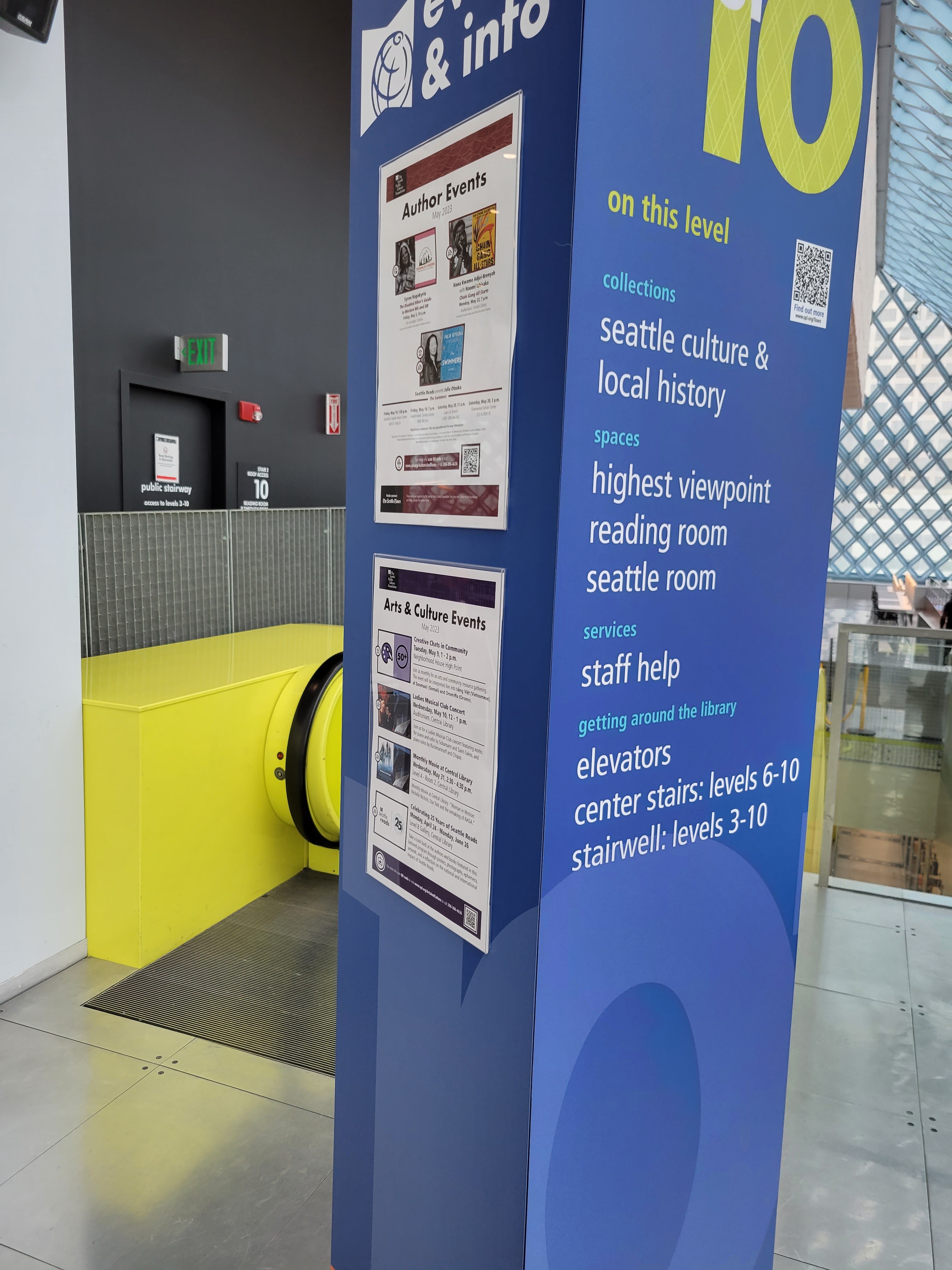
I took only a few pictures, and only with my cell phone. The pics are nothing special, but I had to have them.

Part of the teen space.

The sign shown in the photo above.


Dewey numbers on the Book Spiral


Here are a few other cell-phone pics from the rest of our day. 

The Suzzallo and Allen Libraries at the University of Washington, which locals call You-Dub.


The cafe at Ada's, with a great mobile and the beautiful logo. The full name of the store is Ada's Technical Books & Cafe -- named for Ada Lovelace, of course.


Sign at Ada's Cafe

"We filter coffee, not people."