Showing posts with label what i'm watching. Show all posts

6.02.2025

what i'm watching: a complete unknown: not very profound (or kind) thoughts about this movie

Bobby, Suze, the Village, the Jacket
Several people have asked me to share my thoughts about "A Complete Unknown," James Mangold's fictional biopic about Bob Dylan in the early 1960s.

Allan and I were in no rush to see it, because we love Bob Dylan, and we are well familiar with the public versions of his story.

Allan dislikes fictional biopics, and while we watched the movie last night, I remembered why I also seldom watch them. I'm actually going into my various watchlists and deleting every movie of this genre. There are at least a dozen movies like this waiting; now I've lost interest in them all.

To me, "A Complete Unknown" was like a checklist of 1961-1965 Bob Dylan. I imagined someone holding a clipboard, checking off each person and each item. Here's Alan Lomax. Here's Albert Grossman. Harold Leventhal. Tom Wilson. Woody Guthrie, Johnny Cash, Joan Baez, and Suze Rotolo (here called Sylvie). Check, check, check.  There's the cap. There's the jacket. The motorcyle. Check, check, check. Folk City, the Gaslight. Walter Cronkite, the Vietnam War, the civil rights movement, the Cuban Missile Crisis. Check, check, check.

Predictably, it all leads up to the most famous incident of early Dylandom, the most-told tale, the hotly debated and revised and rewritten Dylan Goes Electric at the 1965 Newport Festival. We wondered if Mangold would repeat the legend of the ax-wielding Pete Seeger. I won't spoil it for you.

It appears that most of the casting for this movie was based on looks, which seems to be how this type of movie is made. Woman with long black hair equals Joan Baez. Heavy man equals Albert Grossman. The actor playing Baez lacked any semblance of the singer and activist's beauty and charisma, and above all, her rich, melodious voice and incredible guitar playing. Maybe that's to be expected, but it still felt like a seventh-generation photocopy.

For those who don't know this story, the film is a history lesson. For those who do, it's a hackneyed re-creation, plus a few scenes that in all likelihood did not happen. I got nothing out of it. Had I been watching alone, I would have turned it off halfway through.

For those wishing to know something about Bob Dylan, I recommend Martin Scorsese's 2005 documentary "No Direction Home". Even Scorsese's "Rolling Thunder Revue: A Bob Dylan Story" -- a fictional, somewhat surreal homage to the greatest rock tour of all time -- captured more Dylan than this movie that tried to adhere so closely to the real story.

I'm guessing this was a much better movie if you didn't know much about Dylan and don't value him as I do.

1.19.2025

we movie to canada: best of "what i'm watching" 2024

These are the best movies and series I watched in 2024, in no particular order.

Five stars: the best of the best

Ripley
This latest adaptation of Patricia Highsmith's novel The Talented Mr. Ripley is not to be missed. Visually seductive, almost unbearably suspenseful, it's the Ripley adaptation to make you forget all others. Andrew Scott's portrayal of Tom Ripley is bone chilling -- so mesmerizing that the viewer forgets whose side you're supposed to be on. And with eight episodes to delve into the story, it really does justice to the novel. 

Poor Things
This quirky social satire swept me away. It's hilarious, deeply moving, and brilliantly biting. Through the "naif discovers the world" trope, it weaves an uplifting philosophy of personal autonomy, self-created identity, love without possession or control, and the basic humanity and equality of all people, all wrapped in inventive steampunk design. Emma Stone's performance as Bella Baxter is one for the ages. Along with last year's "Everything Everywhere All At Once," I want to re-watch this, and will probably get more out of it. 

May December
Funny, sad, and uncomfortable in all the right ways, this drama inspired by real events sends your reactions flip-flopping -- and leaves you questioning each flip and flop. It's a thoughtful and nuanced portrayal of a difficult subject, something you believe to be clear-cut: you want it to be black-and-white, but it just refuses to be so. Thought-provoking and surprising.

Tell Me Who I Am (2019)
This documentary introduces twin brothers, raised in the same home. Alex lost his memory in an accident at age 18; Marcus helped him reconstruct their childhood -- or some version of it. It's impossible to say more without spoilers. The movie opens a rabbit-warren of questions about memory, reality, and our construction of the stories of our lives. It's intense, shocking, even harrowing, but ultimately hopeful. 

Barbie
I loved this movie. It was playful, funny, moving, powerful, and decidedly feminist.  

Blacklist S10
Ever since Blacklist got rid of you-know-who at the end of S8, the show deepened in emotional resonance, and James Spader turned in some of his best work of the entire show -- which is really saying something. S10 was suspenseful, sad, and stunning. I loved this series, despite its flaws, and will probably watch the whole thing again.

Slow Horses S3-S4
This British thriller about a group of misfit spies continues to do everything right. Great writing, great acting, suspense, humour, mystery, and the incredible Gary Oldman, eclipsing the other excellent performances. If you enjoy spy thrillers, don't miss this.

Killers of the Flower Moon
My expectations for this film were very high -- a movie adaptation of a great nonfiction book, Indigenous and American history, Martin Scorsese. I was not disappointed. Scorsese combines history, true-crime, mystery, romance -- greed, murder, betrayal -- into an American epic.

L.A. Confidential rewatch (1997)
I was wondering how this classic would stand up. The answer: it is one of the greatest neo-noirs of the modern era, second only to "Chinatown" (which we re-watched last year), and a truly outstanding movie of any genre. Taut, visually gorgeous, complex without being too convoluted to follow -- crisp, stinging noir-style dialogue that doesn't descend into parody -- brilliantly understated acting -- and breathtaking twists. Back in the 90s, this is the movie that sent us on a hunt to find others like it. We discovered a genre, but learned how rare movies of this caliber are.

Better Call Saul S1-S5 (full series)
I was not a fan of "Breaking Bad," and until now, I've had a strong dislike of Bob Odenkirk. I found Odenkirk in Breaking Bad unwatchable. Allan convinced me to try this series, and I'm so glad he did. Stepping out from his tiresome shtick, Odenkirk gives a brilliant, nuanced, unforgettable performance. The series transcends the crime-thriller genre, exploring the bonds of family and friendship, loyalty and betrayal, love and loneliness, our attempts to control our own lives, and the forces that make that impossible. Few shows are both suspenseful and heartbreaking. One of the very best series we've seen.

The Hateful Eight (2015)
I'm still bingeing the modern western genre, and my new interest in the films of Quentin Tarantino, sparked by "Django Unchained," made this a must-see. As you might expect from Tarantino, this movie is fast-paced, hilarious, gruesome, and meaningful. I'm glad I've acquired a taste for his over-the-top, humorous violence, like a secret language I suddenly understand. If you also understand that language, this movie is nearly perfect. Or it might actually be perfect. 

Heartstopper S1-S3 (full series so far)
This is my current favourite, heart-squeezing, tear-inducing, teen coming-of-age story. It's a celebration of love in all its many beautiful forms. Where "Sex Education" invents a world where queer kids can always be themselves, and are never bullied or rejected by anyone but maladjusted adults, Heartstopper's world is more realistic, which makes it all the more meaningful. I'm in love with Nick and Charlie's love. 

Le Samourai (1967)
A tense and complex noir thriller from the master, Jean-Pierre Melville. From the seductive cinematography of black-and-white Paris, to the crisp, taut dialogue, to the understated acting, this film is perfect in every way. Alain Delon sets the bar high as a professional hitman trying to do his job and save his own skin. 

Four stars: worth every minute, highly recommended

Shrinking S1 rewatch + S2 (full series so far)
Season 2 of this smart comedy-drama is much deeper and quite a bit sadder than S1. Last year, I wrote that the series is about "grief, loss, therapy, honesty, and reclaiming joy". Now I'll add self-awareness, self-deception, forgiveness, and mortality. It's a truly great show. 

A Nearly Normal Family
This eight-part series explores what a family will do to protect each other, and asks if protecting others is more important than the truth, and even more important than ourselves. If it were a book, I'd call it a literary thriller -- honest, authentically human, moving, and suspenseful, with some great twists.

Hollywood Con Queen
This short docuseries reveals a con so elaborate and far-reaching that it seems like improbable fiction -- but it's based on reporting by an investigative journalist. If it were fiction, it might be funny, but in fact it was horribly cruel. A strange and fascinating doc.

No Sudden Move (2021)
A crime thriller that subtly shifts into hidden history and social commentary, without losing its edge, is a rare and beautiful thing. There's street-level crime, then there's the crime and greed at the top, the kind that hurts more people -- and kills the planet. Like "A Nearly Normal Family," above, this is the movie version of a literary thriller.

The Pigeon Tunnel
Errol Morris on John Le Carré. What more do you need to know? 

Private Property (1960)
This gritty noir was considered prurient and shocking when it was released, and more than 60 years later, it has lost little of its power. It's a true film noir, unyielding in its cynical and depressing worldview.

Burn After Reading (2008)
This dark, satirical comedy from the Coen brothers is great fun. Brad Pitt is hilarious as the mimbo, but the star-laden cast keeps the viewer at arms-length. It's impossible not to see George Clooney, John Malkovich, and even the great Frances McDormand as actors, rather than their characters. 

The Holdovers
This bittersweet comedy-drama may be Paul Giamatti's best work. Director Alexander Payne puts aside his usual ironic distance, and the results are profound and completely absorbing.

The Green Glove Gang S1
An excellent heist comedy, plus seniors playing real people, without mocking or resorting to caricatures. 

Good Girls S1-S4 (full series)
A heist comedy that quickly turns dark, with underlying anti-capitalist and anti-sexist themes. I really enjoyed this. 

Tinker Tailor Soldier Spy (2012)
The classic adaptation of the classic John Le Carré spy novel. 

Seven Psychopaths (2012)
This crime-comedy-satire from Martin McDonagh is dark comedy at its best. McDonagh manages to do it all and mock it all at the same time.

A Serious Man (2009)
Another dark comedy from the Coen Brothers, with some profound thoughts about faith, love,  misfortune, and mortality woven in. Apparently it's regarded as one of The Greatest Films. I wouldn't put it in that category, but there's a lot going on; it would probably benefit from a second viewing.

Strange Fruit: The Biography of a Song (2002)
This documentary unpacks the haunting song of the title, along with the man who wrote it, and the woman who made it famous. I wrote about it here.

Night of the Hunter (1955)
This classic noir thriller is chilling, suspenseful, and just a wee bit campy. With a screenplay by James Agee, directed by Charles Laughton, the film has quite the pedigree, and was highly influential. Robert Mitchum is brilliant as the master of deception, the beloved preacher who is about as far from holy as it gets. Unlike "Private Property" (above), Night of the Hunter lets in a little light, veering away from the most cynical of all possible endings -- and it works.

Belfast (2021)
Coming of age during The Troubles, brought to you by Kennth Branagh. A lovely film.

The Taking of Pelham One Two Three (1974)
The original subway-hijacking thriller is tense and suspenseful, but understated, played always on a human level. Like all good films from this era, the look and feel -- both cityscapes and subway scenes -- are so authentic, that you can lose yourself in the action, in a way that (for me) big-budget so-called action films cannot match.

Mr. Monk's Last Case (2023)
Tony Shaloub treats us to one more turn as the incomparable Adrian Monk. Like the brilliant series, the movie is funny, sometimes profound, a little corny, and in the end, uplifting. I am so in love with Shaloub's portrayal of the incredibly irritating, incredibly loveable, deeply damaged detective. Monk fans, see this movie.

Santa Clarita Diet S1-3 (full series)
A zombie comedy not trying to tell us anything, just making us laugh. A lot. Timothy Olyphant and Drew Barrymore are hilarious and loveable.

The Ballad of Buster Scruggs (2018)
Our rethink of the Coen Brothers and my modern-western binge came together for this one. At times silly, hilarious, sad, dramatic, and occasionally profound, the film hits all the right notes. Too many recognizable faces plus the anthology format marred it a bit for me, but it was still very satisfying.

Series Noire rewatch, S1-S2 (full series, 2014-2016)
We absolutely love this crazy crime comedy from the Quebecois team of François Létourneau, Jean-François Rivard, and Vincent-Guillaume Otis. It's hilarious, sad, and occasionally profound, full of self-referential irreverence, without hitting you over the head with its cleverness -- although it has cleverness to spare. 

Special mention

Django (1966)
After I fell in love with Quentin Tarantino's "Django Unchained" (and I watched it again, so Allan would see it), we wanted to see this classic Giallo / Spaghetti Western that Tarantino pays homage to. It's a completely ridiculous movie -- creepy, grotesque, unintentionally hilarious -- and it out-tops Tarantino's over-the-top violence. 

Honourable mentions: worth seeing

The Lincoln Lawyer S3

Huge in France S1 (full series so far) (2019)

"Unknown" series: The Lost Pyramid, Cosmic Time Machine

STEVE! (martin): a Documentary in Two Pieces

Previous "we movie to canada" awards

- Canadian musicians and comedians (2006-07 and 2007-08)
- my beverage of choice (2008-09)
- famous people who died during the past year (2009-10)
- where I'd like to be (2010-11)
- vegetables (2011-12)
- big life events in a year full of Big Life Changes (2012-13)
- cheese (2013-14)
- types of travels (2014-15)
- famous people who died plus famous people who died, part 2 (2015-16)
- the picket line (2016-17)
- movies (2017-18)
2018-19: 1-5 ☮s
2019-20: 1-5 💉s
2020-21: 1-5 😷s (without the tear!)
2021: best of 2021 april to december
2022: best of 2022
2023: best of 2023

12.23.2024

yellowstone has always been political: thoughts on season 5 (contains mild spoilers)

When the final season of "Yellowstone" first dropped, there was a lot of chatter online that the show had "become political", even that it had become a mouthpiece for Trumpism. Having watched -- and loved -- the first four seasons of the series, I was baffled. For one thing, I couldn't image the Duttons, the ranching family at the centre of the neo-western / family saga / action / romance series, throwing their lot in with anyone as garish, crude, and dishonourable as Trump. Of course the Duttons would vote Republican, I didn't imagine they'd be supporting Bernie Sanders anytime soon, but I couldn't see the show veering off into MAGA territory. 

More importantly, though, I wondered if a fair portion of the audience might not be getting it. Because the Yellowstone series has always been political. 

Yellowstone has always been political

At its most basic, thematic level, Yellowstone is about land. 

Who owns the land, who uses the land, and for what purpose. Land as identity, land as a vehicle for profit, land as a sacred trust. 

This is as political as it gets. Native Americans, settlers, the environment, capitalism. Differing views of humankind's relationship to nature, of land stewardship, of purpose. These are often the most political issues of our world. In The Yellowstone -- not the show, the place -- Native reservation and casino, National Park, cattle ranch, vacation boomtown -- this is inherently and profoundly political.

In case you missed it, they threw up some billboards

In Season 5, the political messaging becomes heavy-handed. Perhaps, with the show's end in sight, Taylor Sheridan wanted to make sure we all "got it". Perhaps the earlier seasons were crafted by better writers, who had less at stake than Sheridan. And perhaps viewers who found Yellowstone suddenly political were reacting to some of the awkward and more obvious billboards. 

In the first episode of S5, there's a particularly clunky scene at the Montana-Canada border. Some RCMP officers on horseback (their jackets say POLICE, I suppose to not confuse an American audience?) confront a group of American ranchers in a skirmish about stolen horses. 

The Canadian police declare: "It might be the Wild West on that side, but on this side rules are the foundation of order, and order holds the flanks of a civilized society." Kayce Dutton, both rancher and Wildlife officer, dismisses the Canadians as "sheep", and asserts his property rights, daring the order-keepers to challenge him.

Some progressive commentators were horrified, because don't all right-thinking Americans see the rule of law as sacrosanct? Well, do they? Do progressive people agree that the rule of law supersedes all? I don't think so. If we did, how would Harriet Tubman and Rosa Parks be heroes? Ranching and chattel slavery: the laws defied in these examples are very different. But both situations assert that there are values more important than what a government declares to be the law.

Yet even with these awkward, heavy-handed moments, I can't see the politics being telegraphed here as Trumpism.

The Duttons and their culture are staunch libertarians. The show conveniently omits some of the gross contradictions of the libertarian right. We don't see health care, or schools, or even how electricity is produced and delivered -- any of the shared resources that even libertarians might use. We only see the "freedoms" that Taylor Sheridan wants us to see. But there's nothing sinister about that. A grand, stirring series about, say, organizing factory workers probably won't show you the dark side of labour unions, either. 

But here's the thing. If Yellowstone's politics were Trumpism, would the show consistently acknowledge that the land was stolen, taken by force, from the original inhabitants? If it were MAGA, would the show be chock-full of incredibly fierce, smart women -- women who are the unquestioned head of their families -- and strong men who consistently and honourably defer to them?

If the show followed Trump values, would it be anti-fracking? Would it portray environmental vandalism as heroic civil disobedience? And would it emphatically insist that the best use of land is no use at all -- that the highest purpose land can have is wilderness? This is a far cry from Drill Baby Drill. 

An elegy for a way of life

In addition to the family drama, romance, murder, intrigue, and tragedy, Season 5 is an elegy.

Yellowstone S5 lifts up the cowboys' and ranchers' cultures, bathed in a warm glow of love and deep respect, and asks us to admire and mourn it. It shows us a way of life that is flawed, dangerous, often cruel and ugly, and at the same time, profoundly beautiful. A philosophy that worships individual freedom, yet is consciously steeped in community. A culture that is dying, but remains alive, because people are choosing to create it and live it. 

As with other worlds we have seen onscreen, such as the "Godfather" saga, the cowboy and ranching culture is rife with contradictions: violence, cruelty, love, honour; respect for nature and dominance over it; machismo and equality; the bonds of chosen family above all. As a cultural ethnography, it compares to books of previous eras such as A Tree Grows in Brooklyn and Call It Sleep that elegized the urban immigrant experience: something both ugly and beautiful. Something to be endured and celebrated.

The billboarding can get tiresome. One character -- a vegan environmentalist whose presence is sometimes used as a foil -- actually says, "People think you're all a bunch of misogynist bigots who ruin the environment, but that's not what I found here." Right. We got it. Yellowstone asks us to see cattle ranchers as environmental stewards. That may be a tough sell, but compared to the multinational corporations that want to build condos, malls, and luxury resorts on the same land, they are.

I wonder if those who see right-wing politics in Yellowstone are reacting to a work that humanizes a culture that they reflexively oppose.

I also cross-reference some books I recently read -- or tried to, but couldn't, because they were too heartbreaking: Vanishing New York: How a Great City Lost Its Soul and How to Kill a City. The same forces that are destroying New York, San Francsico, and other great cities around the globe are the same forces ruining Montana: unchecked greed, arrogant entitlement, the blind quest for profit, and total disregard for the environment -- whether that environment is natural or human-created.

In Yellowstone, references to New York, Los Angeles, and San Francisco are often used as a shorthand for these forces, not unlike the way progressives use "Texas" as a stand-in for many things we despise. When you're tempted to yell at the screen that New York is more than entitled elites looking for unspoiled wilderness to use as vacation playgrounds, you might remember that Texas is more than xenophobic, homophobic book-banners, and fetus-fetishers.

I suppose you could watch Yellowstone yelling at your screen about the virtues of veganism and the joys of urban life. Or you could maybe learn something about how some other people live.


* I watched S1-4 on Prime, then S5 got paywalled behind Paramount Plus. But only the first half of Season 5 was available. I don't read entertainment news, so I didn't know why the second half of the show was delayed. (I do now.) I waited -- and waited and waited -- for the remaining episodes of S5 to drop before ponying up for Paramount. My plan is to complete Yellowstone, watch both prequels -- "1883" and "1923" -- and possibly "Landman," then cancel Paramount. There's nothing on it that I care about that I don't have access to elsewhere. I'm particularly curious how the prequels approach Indigenous/settler issues.

4.26.2024

"strange fruit" documentary: a nexus of the past and present, and a personal sense of loss

We recently watched "Strange Fruit: The Biography of a Song," a documentary we found on Kanopy. Kanopy's catalogue includes a vast number of documentaries, many of dubious quality; we're skeptical every time we click on one. "Strange Fruit" was good -- not great, but solid, and worth watching.

Strange Fruit: the song and reason

Strange Fruit, the song, bears witness to the violent persecution of Black Americans. The history of the song coincides with another shameful episode of the American experience -- the persecution of socialists and progressive thinkers.

If you aren't familiar with the song -- made famous by the great jazz singer Billie Holiday, and performed by many others through the years -- it is about lynching. 

The lyrics:

Southern trees bear strange fruit
Blood on the leaves and blood at the root
Black bodies swinging in the southern breeze
Strange fruit hanging from the poplar trees

Pastor scene of the gallant south
The bulging eyes and the twisted mouths
Scent of magnolias, sweet and fresh
Then the sudden smell of burning flesh

Here is a fruit for the crows to pluck
For the rain to gather, for the wind to suck
For the sun to rot, for the trees to drop
Here is a strange and bitter crop
Lynching was, of course, murder. And it was terrorism, intended to enforce the codes of white supremacy known as Jim Crow. 

It was also entertainment, a public spectacle. This is one of the most disgusting parts of the history. It certainly smashes any notion that these murders were perpetrated by a few "bad apples".  

It was also allowed to happen. 

There was strong and consistent activism against lynching. More than one anti-lynching bill was brought forward in Congress. And one Southern fillibuster after the next made sure it didn't become law. 

Of course, no law should have been needed. Murder is already illegal. But in these crimes, no one was ever charged. No one was held accountable.

I am purposely not including some of the most disgusting and lurid aspects of this hideous practice, for the same reasons I did not include details of the torture of concentration camp victims in a recent post about Operation Paperclip. If you don't know about the history of lynching in the United States, I encourage you to learn about it. (Colson Whitehead's The Underground Railroad must have educated many people about this.)

It has not ended

Lynching is still happening. What is the ongoing murder of Black Americans by police if not lynching? 

Mass incarceration and capital punishment are also lynching. Perhaps one could argue that those means of controlling Black people are part of the judicial system, and lynching is technically "extra-judicial"? That would be, as we say, a distinction without a difference. Slavery was legal, too. 

"Strange Fruit: The Biography of a Song" was released in 2002, so the examples of contemporary lynchings are now dated: Amadou Diallo, the unarmed, 23-year-old man who was shot 41 times by police after reaching for his wallet, and Abner Louima, who was raped, tortured, and permanently disabled by police. If the film was made today, the most obvious reference would be George Floyd. But there would be so many examples to chose from.

It's not known how many Black Americans were the victims of lynchings from the 1830s until the 1960s. All we know is there were thousands -- probably more than 5,000. 

Allan wondered if the total number of lynching victims of the past would be exceeded by the number of victims of police killings. And if we count mass incarceration, then that number is dwarfed by millions. 

The songwriter: another history of persecution

Before watching this film, I didn't know who wrote "Strange Fruit," and I was under the impression -- false, as it turns out -- that it was written specifically for Billie Holiday. 

"Strange Fruit" was written by Lewis Allen, which was a pseudonym for Abel Meeropol.

When I heard that name -- Meeropol -- it hit me like a jolt. I have only heard that name in one context: it was the last name of the family that adopted the Rosenberg children -- the children left orphaned by the executions of Julius and Ethel Rosenberg. I thought, was that a common last name, is this a coincidence?

Abel Meeropol's sons were interviewed extensively in this documentary, and as we watched, it began to dawn on me that these men, incredibly, were those children. 

And if you don't know this shameful and disgusting piece of US history, here's something else to look up. During the height of anti-communist hysteria in the US, the Rosenbergs were accused of passing nuclear secrets to the Soviets. They were communists, and they were Jewish, and this fed the persecution. On June 19, 1953, Ethel Greenglass Rosenberg and Julius Rosenberg were murdered by the United States government.

The documentary shows how communism had been popular in the US, and that in the 1920s and 30s, members of the American Communist Party marched and sang and openly discussed their beliefs -- as was their right.

Abel Meeropol was a teacher in DeWitt Clinton High School in the Bronx, and as such, a member of the New York City Teachers Union. In those days, before the labour movement struck its fateful deal with government -- guaranteeing workers certain rights (which are constantly violated), in exchange for labour peace (which is strictly and often illegally enforced) -- the labour movement was more radical, and many members were communists. To paraphrase someone in the film: in no way was the teachers' union an arm of the communist party, but many members of the union were communist or had communist leanings.

The documentary eventually reveals that the brothers being interviewed were indeed adopted by the Meeropols, and their birth parents were Ethel and Julius Rosenberg. There is even footage of them, shot from a distance, leaving Sing Sing Prison on their last visit with their parents.

A sense of loss: the long goodbye

As a socialist and a Jew, the story of the Rosenbergs affects me profoundly. And now, hearing the name Meeropol affects me, too. It makes me miss my mother. 

My mother is still alive, and in good physical health, and I am grateful for that. But she has dementia. In the past -- not even the distant past, just a few years ago -- after seeing this documentary, I would have called her. I would have said the name Meeropol and she would have said, "The family that adopted the Rosenberg children!". She read their book, We Are Your Sons, and told me a lot about the Rosenberg case. My mother knew a lot of history, and for all I know, she already knew that "Strange Fruit" was written by the adopted father of the two Meeropol children. 

My mother and I used to talk about everything. She loved history, and we frequently talked about history and politics. Many times, she told me how the night before the Rosenbergs were scheduled to be executed, thousands of people filled New York City's Union Square, and similar protest rallies were held all over the world, calling for clemency. 

Right now, as I write this, I can hear my mother's voice saying this. And I miss her.

----------

Post-scripts

Jewish-Americans?

In "Strange Fruit: The Biography of a Song," a person interviewed expresses their surprise upon learning that the songwriter was "not only white, but a Jewish-American". They say this as if it was strange that the writer would be Jewish. First of all, Jewish songwriters abounded in that era -- Irving Berlin and George Gershwin being the most famous, but there were many others. More importantly, no one should be surprised that a white person protesting bigotry and persecution was Jewish.  Jewish people were always disproportionately represented in the civil rights movement. The reasons should be obvious.

I was also weirded out by the expression Jewish-American, which two people in the documentary use. As I thought about it, I realized it's not wrong. We say Italian-American, Irish-American, and surely Jewish-American is a similar idea. Perhaps the speakers, who were both Black, were mirroring the African-American, which was the preferred terminology of the time. But it's a strange expression nonetheless. We would normally say the songwriter was Jewish, or a Jewish man. 

The Rosenberg Fund for Children

Michael Meeropol founded The Rosenberg Fund for Children, with this mission.

The Rosenberg Fund for Children was established to provide for the educational and emotional needs of children whose parents have suffered because of their progressive activities and who, therefore, are no longer able to provide fully for their children. The RFC also provides grants for the educational and emotional needs of targeted activist youth. 

A list of their board members, past and present, is instructive and moving.

1.08.2024

we movie to canada: best of "what i'm watching" 2023

These are the best movies and series I watched in 2023, in no particular order.

Five stars: the best of the best

Kimi
This overlooked thriller is as taut and suspenseful as it gets. Zoë Kravitz is brilliant as the agoraphobic tech worker who must face her fear in order to bring a crime to light. But the real star is a screenplay (David Koepp) and direction (Steven Soderbergh) that doesn't waste a word or a single frame.  

Women Talking
A powerful story about women collectively liberating themselves from an oppressive, authoritarian religious community. Sarah Polley wrote and directed this film based on the Miriam Toews novel of the same name, which itself was a fictional account of documented events. Based on a true story, and true stories that are all around us. See it.

I Lost My Body (2019)
This intense, inventive animated film will haunt me for years to come. It is suffused with existential heartache: the pain of mortality, loneliness, and regret. I haven't seen anything like it since BoJack Horseman -- but this one comes without comic relief. (Interesting that these two works that I found so meaningful are both animated.) I Lost My Body is one of the very best things we saw in 2023, and/but it was almost too painful to watch.

I'm a Virgo S1
What would happen to a 13-foot-tall Black man in 21st Century America? Boots Riley, the genius behind Sorry to Bother You (2018), again finds a way to reflect and skewer our world through fantasy comedy. This series is absolutely astonishing, with layers upon layers of meaning. I can't wait to see where it goes.

I Lost My Body: the loneliness of the human condition
Descendant
In 2019, the wreckage of the ship Clotilda was found in Alabama's Mobile River: it was the last known ship to bring kidnapped, enslaved African people to America, legally. Filmmaker Margaret Brown spent four years with the community of Africatown -- where many residents are descendants from the people held captive on that ship -- exploring how the discovery impacted their lives.

Everything Everywhere All At Once
Add my voice to the chorus proclaiming the wonders of this movie. 

Shining Girls re-watch (S1, full series)
Last year, I wrote this about Shining Girls:

This genre-blending thriller/mystery/sci-fi series is mind-blowing, and features yet another insanely good performance by Elisabeth Moss. I'm planning on re-watching: now that I know the outcome, I can concentrate on clues and how it all fits together. 

I did that, and I loved the series again, possibly even more than I did the first time. 

Bicycle Thieves (1948)
Kanopy streaming service -- available free through your library -- is great for exploring classics that you haven't seen, or perhaps saw long ago. This story of a working-class man trying to eke out a living in the bleak, starving world of post-war Italy, his young son in tow, is gripping, heartbreaking, and masterful.

Hunters S1-2 (S1 re-watch + full series)
I don't know why Hunters is so under-recognized and under-rated. A conspiracy thriller with a good dose of comedy, it benefits from great acting by Al Pacino (finally doing television!), Lena Olin, and Dylan Baker, among others. Think Buffy the Vampire Slayer meets Operation Paperclip. I gave S1 a 4 out of 5, but after seeing both seasons in succession, I moved it to the top category. Not for the violence-averse.

Chinatown (1974)
Chinatown is what all noir movies aspire to. It's one of the best movies from an era of great moviemaking. Yes, it was directed by a rapist and pedophile, but it's a great movie. If you see it, you are not condoning the director's crimes. I promise.

The Sting (1973)
The Sting is one of the all-time great con movies. Pure joy. Plus Paul Newman! This movie is so good, it almost made me like Robert Redford. (Not really, but that's how good it is.)

Butch Cassidy and the Sundance Kid (1969)
See above. When I was a kid, this was one of my favourite movies, and watching it now brought me that same kind of uncritical joy. The movie inspired a (probably bad) TV show called Alias Smith and Jones, which I also watched avidly, back in the day. 

Fitzcarraldo (1982)
Would we have thought this movie was great if we didn't know the crazy backstory, if we weren't already fascinated by Werner Herzog, if we didn't know Mick Jagger was originally cast in it, if there hadn't been a blood feud between Herzog and Klaus Kinski? That's a question with no answer, but we did thoroughly enjoy the film. We also watched My Best Fiend, Werner Herzog's ode to his relationship with Klaus Kinski, and Burden of Dreams, Les Blank's 1982 documentary about the making of Fitzcarraldo. 

Unpregnant: teenage abortion without apology
Unpregnant
Now that people are finally making honest movies about abortion, I plan to see them all. This one did everything right -- humour, honesty, authentic teen relationships, and just the right amount of political context. Thanks to the horrific US anti-abortion laws, a new subgenre is developing: the abortion road trip.

Reservation Dogs S3
Season 3 of this stellar show included more of what we might call magical realism, but what an Indigenous worldview would embrace as simply part of the web of life, some of which is unseen, and occasionally revealed. The episode dealing with the death of an elder must be the best piece of Indigenous culture ever seen by a mainstream audience. I also found the boarding school / residential school episode pretty much perfect. Through the whole series, the young actors are so good. 

Never Have I Ever S4
I didn't think they could do it, but Devi Vishwakumar's coming-of-age stayed brilliant through four seasons. Funny, sad, sweet, and authentic. Nearly perfect.

Triangle: Remembering the Fire
This HBO documentary is a great, concise overview of an important piece of women's/labour/New York City/American history. Even if you know all about the Triangle fire, you'll be glad you saw this. For the full story, see if you can get your hands on a copy of Triangle: The Fire That Changed America by David Von Drehle. 

All the Beauty and the Bloodshed
This documentary about the artist and activist Nan Goldin is notable for the brutal honesty with which Goldin bares her life -- a stark and welcome contrast to the typical sanitized biopic. Although Goldin's activism exposing the Sackler family's culpability in the opioid crisis is one of the film's central themes, the film is not about the Sacklers or the drug crisis. It's about Nan Goldin. It's fascinating, gripping, and at times a bit grueling.  

"Forget it, Jake. It's Chinatown."
ER S1-5 (1994 - 1999)
Re-watching ER for the first time since it originally aired reminded me of what a great show it is -- at least for the first five seasons. I'm currently slogging through the rest of the series, as original cast members fall away and the show becomes a soap opera set in a hospital. Which is not to say it's not entertaining. 


Four stars: highly recommended

Rita S1-S5, full series
I'm so glad I went back to this. Rita is such a refreshing protagonist -- smart, sexy, iconoclastic, utterly independent, often wrong, always fierce. If her free spirit is partly a mask over the pain of early trauma, that doesn't make her any less free. A joyous and sometimes sad show that deepened with every season.

Outside In (2017)
A man gets out of prison, having served 20 years for a crime he didn't commit. The emotional fallout impacts many lives in a small Pacific Northwest town. Really well done.

Wojnarowicz: F**k You F*ggot F**ker
Art, AIDS, and activism in 1980s New York. A moving portrait of a pioneer. Coincidentally, the subject matter intersects with All the Beauty and the Bloodshed, above. 

The Old Man S1
Jeff Bridges plays a Vietnam veteran and former spy, and John Lithgow plays his former handler. Also, there are dogs. The first season was a credible and exciting thriller. We've been waiting for S2.

Shrinking S1
I really enjoyed this smart, funny, and sad show, a comedy about grief, loss, therapy, honesty, and reclaiming joy. Add another title to the list of smart adult drama-sitcoms, which for me includes Episodes, Silicon Valley, Hacks, and a few others.

Severance S1
A strange and exciting sci-fi thriller about -- at bottom -- labour and capitalism. Related to Sorry to Bother You, but without the humour. Definitely waiting for S2.

Perry Mason S1-2 (full series so far)
We were happy to see the return of this smart, stylish, retro noir, an origin story and prequel to the old Perry Mason TV show. I hope it continues.

American Experience: Butch Cassidy and the Sundance Kid
A short, factual look at the daring and charismatic outlaws who inspired the 1969 movie. American Experience documentaries are consistently excellent. I'm glad several of them have made it onto Kanopy, Prime, and occasionally Netflix.

Succession S1-4 (full series)
Although this series sometimes felt repetitive, it was utterly addictive. I've heard people question the value of a show about rich assholes. To me, interesting characters, complex relationships, good writing, and great acting are the elements of a great series. The backdrop hardly matters. Plus, any really good series will peel back the assholic behaviour to reveal the pain and trauma that drives it. 

Unknown: Cave of Bones
When Allan and I can't agree on what to watch, we can always reach for some nature, anthropology, or archeology doc. This is a fascinating look at new research on early hominids, and the likelihood that they were more advanced than previously thought.

The Killing (1956)
This early Stanley Kubrick film, which Kubrick co-wrote with the seminal hardboiled crime writer Jim Thompson, is classic noir. You know the heist is doomed to fail, but how many lives will be lost or wrecked in the process, and whether or not anyone will get away clean, are always open questions.  

C'est comme ça que je t'aime (Happily Married) S1-2 (full series)
A crime comedy by the makers of Series Noire? Say no more! This series belongs to the "what lurks beneath the quiet suburbs" tradition -- taken to an extreme. Of course, like most crime films, it requires a certain suspension of disbelief. But it's funny, insightful, and super twisty. 

Our Flag Means Death S1-2, full series so far
Love, loss, discovery, and revenge on the high seas. A fun -- and sometimes sad -- dark comedy, full of LGBTQ love. Thoroughly enjoyable.

Vjeran Tomic: The Spider-Man of Paris
A documentary, told in the first person, by the man who pulled off the greatest art heist in the history of Paris.

Lupin S1-2 rewatch + S3 (full series)
More Parisian art heists! Despite some twists that were simply not credible, even in the world of criminal fantasy, Lupin S3 was still great. The anti-racist, anti-capitalist, and literary angles add depth, and Paris adds sparkle.

The Banshees of Inisherin
This story's descent into tragic darkness somehow feels both shocking and inevitable. It's very, very sad, and more than a little strange, with an all-star Irish pedigree. 

The Sound of Metal
A drummer in a metal-punk duo is losing his hearing, and with it, his identity. What kind of future he will choose, what new self will emerge, is what he and the audience must discover. A moving exploration of disability, identity, and recovery.

Slap Shot (1977)
Paul Newman always said that Slap Shot was his favourite of his own films, and that it was the most fun to make. With George Roy Hill's light touch, and a hilarious screenplay by Nancy Dowd, this sweet comedy has a loose-jointed feel that draws you in, warm and welcoming. The following year, Dowd won the Oscar for Best Screenplay for Coming Home. With The Sting and Butch Cassidy, Slap Shot makes three George Roy Hill movies this year, and each a gem. 

Honourable mentions: worth seeing

Jospeh Campbell and the Power of Myth, with Bill Moyers
We watched this when it first aired on PBS in 1988. I bought the book and became a huge fan. All these years later -- and knowing the standard criticisms of Campbell's ideas -- I am still interested and impressed. 

Helvetica
A documentary about a font? Sure, why not? It missed a few obvious opportunities that would have greatly improved it, but solid and worth seeing.

Bill Russell: Legend
An incredible athlete, an outspoken civil rights activist, and a prickly, cantankerous man. This two-part bio-doc is not perfect, but it is excellent.

I'm Thinking of Ending Things
Charlie Kaufman's movies are always challenging to parse and invariably provoke good post-watch discussions. Which is not the same thing as saying I like them. But I do continue to see them. Sad note: in the role played by Jesse Plemons, I kept imagining Philip Seymour Hoffman. 

Previous "we movie to canada" awards

- Canadian musicians and comedians (2006-07 and 2007-08)
- my beverage of choice (2008-09)
- famous people who died during the past year (2009-10)
- where I'd like to be (2010-11)
- vegetables (2011-12)
- big life events in a year full of Big Life Changes (2012-13)
- cheese (2013-14)
- types of travels (2014-15)
- famous people who died plus famous people who died, part 2 (2015-16)
- the picket line (2016-17)
- movies (2017-18)
2018-19: 1-5 ☮s
2019-20: 1-5 💉s
2020-21: 1-5 😷s (without the tear!)
2021: best of 2021 april to december
2022: best of 2022

11.14.2023

an obvious life hack: how to make streaming more affordable and still enjoy ad-free viewing

Much ink is being spilled, metaphorically speaking, about the changing trends in subscription-based streaming services. Headlines scream that shows on Netflix and Prime will now include ads, implying that users will pay the same rates plus see ads, as we did with cable TV. 

But that's not true (at least not yet). So far, most streaming services have started offering a tiered system, with a less expensive, ad-supported level, and a more expensive level without ads.

For Netflix, the difference is substantial: $5.99 vs. either $16.49 or $20.99 for the two ad-free options. Disney also has three tiers: $7.99 with ads, $11.99 or $14.99 without. Amazon's deal is worse: in order to avoid an upcoming price increase for Prime Video, you'll need to pay an additional three dollars a month. (These are Canadian prices only, of course.)

No ads. Ever.

No one likes price increases, and I'm no exception. But for me, ads are a deal-breaker. I'd go back to watching on DVD before I'd subject myself to advertising during shows. No question.

The only time we see ads are on YouTube. We've opted not to subscribe to YouTube Premium -- me, because I don't use it often, and Allan, because he's more motivated to keep expenses down. (The apps that block ads on YouTube can't be used on our streaming devices.) But I don't watch full movies or series on YouTube, so it's not a big deal.

Up until now, I've enjoyed the convenience of subscribing to multiple platforms at the same time. With the price increases, the convenience feels more like a luxury. 

Streaming on rotation

So I'm using a simple solution: rotate monthly subscriptions according to what we want to watch. 

As my thrifty partner points out, you can only watch one show/series/movie at a time. (Even if you follow several series at a time, your eyeballs are only one at any given moment.) So when you're watching something on one platform, you're still paying for all the other service that you're not currently watching. 

Like most people, I find the movies and series I want to watch scattered across different platforms, and there's a limited number of shows that interest me from any one service. Take AppleTV+ as an example. When we first got Apple's streaming service, I thought it was amazing -- so many great shows! Then we saw five or six really good shows*, a few others...  and that was it. There was nothing else we were interested in.

So why not rotate?

Subscribe to Netflix to watch specific titles, then after you've seen what you're there for, find something that appeals on a different service, subscribe to that one, and cancel Netflix. Keep an eye on what other services are offering, cancel and subscribe, mix and match. 

It will take a bit more planning, for sure. I'll put reminders on my calendars for the monthly renewals. That's not a big deal, plus if I miss one, it's not a disaster. (I acknowledge this is challenging for some people. I have many challenges, but staying organized is not one of them.) 

Current streaming lineup

Right now, I'm subscribing to Disney and Crave on annual plans. I fell for what appeared to be a better value, imagining I would want to continue indefinitely. When those annual subscriptions run out, I'll put those on rotation, too. 

I'll continue to subscribe to Prime, to get free shipping on Amazon.

I want to get Paramount, to finish "Yellowstone," then watch the two Yellowstone prequels; I've been waiting for the second half of Yellowstone S5 to drop. Now I'll also wait for a good break from some other service, cancelling something before I get Paramount. 

There is one Canada-only snag: when licensing runs out, shows disappear. With this mix-and-match approach, I may miss something I wanted to see. But that's what downloads are for.

Many people will choose lower prices over ad-free, because paying less or "saving" money is more important than not seeing advertising. And for some people, Netflix may suddenly become affordable. But I can't imagine that many people will go back to cable -- expensive, tons of ads, limited viewing options, scheduled (as opposed to on-demand), and for the most part, crappy shows.

------

* Best: Bad Sisters, Shining Girls, Slow Horses, The Morning Show (S1 and S2 only). 

Very good: Severance. 

Good: Ted Lasso (S1 only, emphatically!), Truth Be Told (S1-S2), For All Mankind (S1-S2), Shrinking.

8.18.2023

rip robbie robertson

The news that Robbie Robertson died hit me hard. Although he's not the last surviving member of The Band (Garth Hudson recently turned 86), he was my last surviving deep connection to music that is so close to my heart. 

I rarely feel a famous person's death in a personal way. Usually I think that's sad or what a shame, they were so young or I know they were sick for a long time. Thoughts, not feelings. I could compare this to how I feel when an acquaintance I only know briefly loses a family member. It's sad, and I care, but I'm not affected emotionally. 

Once in a while, I can honestly say that the death of a famous person has brought me grief. This was one of those times. 

It also makes me think of times like this -- which will be much worse, much deeper -- that lie ahead. The deaths of a generation of musicians who had huge cultural impacts has already started. A few whose deaths I will genuinely grieve are on the horizon.

To put down in pixels what Robbie Robertson, Rick Danko, The Band, and "The Last Waltz" have meant to me through the years somehow reduces it to cliche. The film, especially, weaves its way through my life, from skipping school to see it at Radio City Music Hall (twice!) in 1978, to introducing Allan to it in the 1980s, when it quickly became a touchstone of a shared love, to first buying the soundtrack on LP and then on DVD. I know every frame of that movie, every moment. I've obsessed on every shot and every note.

I don't even want to attempt to explain this. Anything I could write would be a cheap imitation, a fifth-generation photocopy, a lifeless cliche. It would reduce something profound into mere words. 

I love to read and think about art -- books, film, paintings, architecture, all of it. But at the same time, all my life I've shied away from too much analysis, too much intellectualizing, about the art that means the most to me. I experience the art that I love best in a place that has no words.*

Robbie's music brought great joy to my life, and also meaning. I love that later in life, he openly embraced his Indigenous heritage. He was a great-looking man at every age. And his music, well, it will always be alive for me.

There are some famous people who, even though you've never met them (or if you did, you were a handshake or an autograph among millions), you truly feel they are part of your life. Almost like an extended family, in that their presence feels so real to you. Robbie Robertson was one of those people for me.


* I recently read two books that explore, among other things, how art makes us feel: The Violin Conspiracy by Brendan Slocumb and The Goldfinch by Donna Tartt.

1.02.2023

we movie to canada: best of "what i'm watching" 2022

Here are the best movies and series I watched in 2022. They're not in order -- it's not a countdown -- just a list of all the really good stuff.

Five stars: the best of the best

BoJack Horseman re-watch
My favourite show of all time. I'm trying not to call it "the greatest show of all time," but I believe it is.

Reservation Dogs S1-2, full series so far.
Hilarious, heartbreaking, and meaningful, Rez Dogs is the first show on mainstream TV to be completely Indigenous-created, and using all Indigenous actors. The writing and acting are incredible, and the way Indigenous realities are worked into the stories is perfect. I hope everyone will watch this!

The Expanse S6
The final season of this stellar show did not disappoint. Although I am not a science fiction fan by any means, I'm glad I don't reject a show based on genre. This series is as good as it gets: gripping, moving, surprising, with complex characters and deep political and social resonance. I'll probably watch it again.

We Need to Talk About Cosby, 4-part documentary series
This deeply disturbing documentary series is a must-see. I'm grateful to Kamau Bell for making the film, to every woman who agreed to speak with him, and to all who didn't, just for surviving.  

The Power of the Dog (2021)
This is Jane Campion's version of a western: a quietly intense psychological thriller set in an isolated Montana homestead. Utterly riveting and not at all predictable. I had to watch the ending twice. 

Slow Horses S1-S2, full series so far
This is a top-notch spy thriller, full of paranoia and corruption, with great writing and great characters -- but everything pales beside Gary Oldman's incredible performance. We re-watched S1 right before S2 dropped on AppleTV+, and are eagerly awaiting S3.

The Capture S2
This thriller takes you on a wild, twisty, breathless ride into the outlandish but utterly plausible world of government surveillence and corporate media manipulation. The Capture may be the greatest show you've never heard of.

Unforgotten S4
The final season of this cold-case forensic show left us a little heartbroken and wanting more. Unforgotten is especially notable for the emotional resonance of each case. In most detective shows, the corpse is just a premise -- a prop. Unforgotten shows you the web of loss that radiates from every violent death. Nicola Walker is brilliant.

The Handmaid's Tale S5
This show continues to be one of the very best, with everything clicking -- writing, acting, character development, and of course, politics. Elisabeth Moss is surely one of the great actors of this or any generation. 

Shining Girls S1, full series
This genre-blending thriller/mystery/sci-fi series is mind-blowing, and features yet another insanely good performance by Elisabeth Moss. I'm planning on re-watching: now that I know the outcome, I can concentrate on clues and how it all fits together. 

In the Heat of the Night (1967)
The death of the great Sidney Poitier led me to re-watch several of his movies (with more to come). In this one, Poitier's understated performance and Rod Steiger's subtle character development create something truly brilliant. One of the best American films of any era.

The Janes
This documentary about the underground (and illegal) abortion network in 1970s Chicago was beautifully done. Importantly, the story is told by the women themselves. I'm grateful to Tia Lessen and Emma Pildes for capturing and preserving our history.

To Sir With Love (1967)
More from Sir Sidney. I wondered if this would hold up. It does, and then some.

Four stars: worth every minute, highly recommended

Bad Sisters S1, full series
Comedy, drama, mystery, revenge, and sisterhood -- plus Irish accents! What more do you need? Don't miss this. It's both intense and fun.

Yellowstone S4
The fourth season of Yellowstone was the best yet, packed with everything that makes this show great. 

Black Butterflies S1, full series
This French thriller is super suspenseful, twisty, and exciting. Stories are revealed in multiple timelines that force you to rethink what you thought you knew -- again and again. It lost the 5-star rating only because I found the ending unsatisfying, but it was still amazing. Not for the violence-averse.

How to Change Your Mind, 4-part documentary series
Michael Pollan's exploration of the potential for clinical use of psychedelics was truly eye-opening. The series was fascinating and sometimes deeply moving. Having seen this, I now want to read the book -- and I want to get in a clinical trial for PTSD. (Allan feels the same way.) This lost the 5-star rating only for its treatment of the CIA's LSD experiments: too short, and too neutral. Another sentence or two would have been more accurate and appropriate.

Summer of Soul
This documentary about the 1969 Harlem Cultural Festival is packed with astounding footage of so much great music. It's worth watching for Mahalia Jackson alone; her performance makes all the other superstars appear as mere humans.

Perry Mason S1, series so far
This stylish neo-noir prequel has all the makings of a classic. I've just learned it will be back for S2 next year, a great excuse to rewatch S1. If you like noir-ish mysteries and hardboiled detective stories, you'll enjoy this.

Never Have I Ever S3
This series was everything I love in a young-adult show: honest, funny, affirming, authentic, with just the right amount of angst. 

Sex Education S1-S3, full series so far
What a beautiful surprise this was! If some of it was a bit far-fetched, it more than compensated with laughs and tears. 

Atypical S2-4
This show grew both funnier and more meaningful as time went on. Along with the two series listed above, this was a trifecta year for young people's comedy/drama/coming-of-age. 

Nomadland
Dramatizing a nonfiction book is tricky, but the sparse, quiet production and Frances McDormand's brilliant (as usual) performance made it appropriately heartbreaking. I came to feel that using a fictional story to illustrate these issues was a smart move.

No Time to Die
Did you know I love James Bond movies? This just might be my all-time favourite. Lucky for me, I don't see spoilers.

The Laundromat
This 2019 social satire was a great surprise. What starts out as a simple family story turns into an exploration of the grievous harm done by legal corporate tax evasion. It's on this list because I want everyone to see it.

Leave No Trace
This somber story of a father and daughter living on their own in the woods gradually reveals its political heart. A sad and meaningful film.

The Blacklist S9
How can this show still be so good?? The death of a central character refreshed and renewed the series. James Spader continues to amaze me.

Louis Armstrong's Black and Blues
I know quite a bit about Louis Armstrong, but this documentary includes newly discovered footage and archival recordings of Satchmo talking to friends. Armstrong bios always try to explain away his Uncle Tom tendencies and his refusal to utter one single word of support for the civil rights movement, while he was the most famous Black man on the planet. This show is no different, and it inadvertently strengthens my disappointment in this.

Colin in Black and White S1, full series
Ava DuVernay and Colin Kaepernick's genre-blending (part documentary, part dramatization) film really hits the mark. Parts may seem obvious to more informed viewers, but I can hope a less enlightened audience found it eye-opening.

M*A*S*H S1-S11, full series
I started re-watching MASH years ago, then lost access. In 2022 I re-started and watched it end-to-end. Without a doubt, this is one of the best TV shows of all time. For almost the entire 11 seasons, it was funny, poignant, sometimes heartbreaking, and always unapologetically political. The show lost a lot when Gary Burghoff left, but MASH at its worst was still miles above most shows at their best. By the way, the often-repeated claim that Alan Alda demanded that his character be shown in the operating room in every episode is obviously untrue. Alda also wrote, co-wrote, or directed many episodes. Even with the solid esemble cast, Alda was MASH.

Honourable mentions: worth seeing

Kids in the Hall (2022)
The Dig (2021)
Ozark S4
Hacks S2
Derry Girls S3
Island of the Sea Wolves (Vancouver Island nature show)
The Worst Person in the World
Dead to Me
Wayne (Thank you to the wmtc reader who suggested this!)

Recap of previous years

- Canadian musicians and comedians (2006-07 and 2007-08)
- my beverage of choice (2008-09)
- famous people who died during the past year (2009-10)
- where I'd like to be (2010-11)
- vegetables (2011-12)
- big life events in a year full of Big Life Changes (2012-13)
- cheese (2013-14)
- types of travels (2014-15)
- famous people who died plus famous people who died, part 2 (2015-16)
- the picket line (2016-17)
- movies (2017-18)
2018-19: 1-5 ☮s
2019-20: 1-5 💉s
2020-21: 1-5 😷s (without the tear!)
2021: best of 2021 april to december

12.16.2022

this leftist yellowstone fan rejects the claim that's it a right-wing show

Season 5 of "Yellowstone" is streaming now. I love this show, and I'm waiting for the full season to post on Prime before I bingeing this latest installment.

I was surprised to learn that the current take on Yellowstone describes it as right-wing -- that people claim the show espouses right-wing beliefs and values. 

Taylor Sheridan, the show's creator, disagrees. So do I. 

And I wrote this, below, before I read Sheridan's response.

* * * *

I frankly don't understand how this show can be seen as representing so-called red-state values. It makes me wonder if the folks writing these pieces have actually seen the show. Could it be they've seen the cast and the setting, and read a few bullet points, and assumed they know the show? It wouldn't be the first time that cultural critics have made that mistake, and unfortunately right-wingers aren't the only ones guilty of it. 

Yellowstone, at bottom, is about land. Who owns the land, how did they come to own it? Is their claim to the land legitimate -- is it based on economic right, or settler's laws, or stewardship? How will the land be used -- for profit, for preservation, for community? 

Indigenous issues are front and centre, and the portrayal of Native issues is not only sympathetic, but nuanced, complex, and seemingly authentic. How can a show that highlights and sympathizes with Native American issues be said to be (politically) conservative? 

Women's perspectives are always present in Yellowstone, including those of Native women. The women of Yellowstone are fully realized people. They're not: window-dressing, or only reacting to men, or stereotyped, or stock characters. 

Yellowstone is also about trauma, and how trauma plays out in the lives of individuals, families, and entire communities. This is also a progressive take on the human condition.

And most importantly, Yellowstone is anti-capitalist. The root cause of every trauma is profit. The bad guys are the ones who care only about the bottom line, stock dividends, wringing profit out of every acre. Cowboys and ranchers have conflict with the Rez and with the tribal police, but (in this show) they are both coming from a place of honesty and love. The developers are coming from Wall Street.

Like all quality series, Yellowstone is complex and multi-layered: family saga, romances, coming-of-age, culture clashes, history, and politics are all rolled together. Every hero is also an anti-hero; no one (except perhaps the land developers) is purely good or evil. All these parts play out against a backdrop of gorgeous scenery, with the pace and violence of an action-adventure movie. Yellowstone is very violent, sometimes a little over-the-top, so if that's not your thing, don't even try it.

* * * * 

I wrote this post before reading this interview with Taylor Sheridan in The Atlantic, so I'm pleased to see the show's creator confirm my point of view. I'm also a big fan of the modern western genre, so it was great to read Sheridan credit The Unforgiven, the movie that began the new, progressive re-imagining of the western.

Sheridan insists that Yellowstone is not a “red-state show.” “They refer to it as ‘the conservative show’ or ‘the Republican show’ or ‘the red-state Game of Thrones,’ ” he told me. “And I just sit back laughing. I’m like, ‘Really?’ The show’s talking about the displacement of Native Americans and the way Native American women were treated and about corporate greed and the gentrification of the West, and land-grabbing. That’s a red-state show?”

Sheridan is right that the show’s politics are not easy to pin down. Yes, its red-state milieu—all those guns and horses and big, open vistas—along with its veneration of honest toil, cowboy masculinity, violence, and characters who have a general resistance to change may have drawn rural dads who fear, like John Dutton, the end of their own ways of life in a changing America.

But Yellowstone doesn’t have an explicit ideology that maps onto a traditional red–blue spectrum. It’s a mishmash of generally anti-capitalist, anti-modernist populism; pro-rancher libertarianism; conservative environmentalism (I know, today that sounds like an oxymoron, but it has sturdy Teddy Rooseveltian roots); and a sympathetic, pro–Native American revolt of the oppressed. The series isn’t a sop to conservative values, or at least it’s not only that. What Sheridan is up to is slyer, or maybe just more muddled.

Sheridan told me he aims to do “responsible storytelling,” to depict the moral consequences of certain behaviors and decisions. He says he was strongly influenced by Clint Eastwood’s 1992 film, Unforgiven, which “upended” the black-hat/white-hat conventions of the traditional Western. Eastwood “let the sheriff be a bully and the hero be this drunken, vicious killer.” He “shattered the myth of the American Western,” Sheridan said. “So when I stepped into that world, I wanted there to be real consequences. I wanted to never, ever shy away from, This was the price.”

The biggest price—and this theme runs through much of Sheridan’s work—is the one exacted by capitalism and the gentrifiers and financiers who snooker the good people who still work with their hands. Despite his professed admiration for Eastwood’s revisionist Western, Sheridan subscribes artistically to something that looks like the old cowboy way. If his work has a higher moral plane, it’s one governed by cowboy virtues: honor, bravery, physical labor, respect for tradition, and a willingness to die—and kill—in defense of your family and your land.

Noel Murray, writer of this Atlantic piece, seems to be setting up a dichotomy that doesn't exist. Sheridan's admiration for The Unforgiven is not in opposition to Yellowstone's values. The modern western is simply a more honest telling. It brings to the foreground stories that were entirely absent from Hollywood-style mythmaking of the Old West. Stories of women, enslaved people, immigrants. Stories told through a working-class and often anti-capitalist lens. And an often heartbreaking honesty about the systematic destruction of Indigenous land and culture. What Murray calls "cowboy virtues" are the same values and virtues found on the Rez -- setting up often unresolvable conflicts.

So excited to watch Season 5!

7.27.2022

the game report: an update that is not completely analog

Back in December of last year, I blogged about starting a game night at home, rotating every-other week between games and music. I was super happy about it. 

Seven months later, I can report mixed results -- mostly mixed because my partner really doesn't like games. This has always been a source of frustration for me. For some reason (unknown to me) he decided to give it a try, but doing something you really don't like on a regular basis is not much fun. 

It hasn't been a total washout. Plus... we've become addicted to a new-to-us videogame.

Not a gamer, but I love games

We don't have a gaming system and generally don't play videogames -- not because I'm opposed to them (or think they're evil, as some people seem to), but because I know I would find videogames incredibly addictive. I'd rather use my screen time watching movies or series. But there have been some exceptions.

Sometime in the early 2010s, we stumbled on Angry Birds on our Roku. We really enjoyed it and played the full game (with no power-ups) for three stars. Recently, I tried to get the newer Angry Birds Reloaded on our AppleTV. It wouldn't play properly, and apparently it never has on AppleTV, for anyone, ever. 

But while trying to make that work, we stumbled on Badland. Now we're hooked. At least I am. Allan claims to be ambivalent, but he looks pretty hooked to me.

The internet tells me Badland is an adventure/platforming game. You guide a character (called a clone) through a series of challenges (called checkpoints). Each checkpoint requires different strategies and you have to figure out what they are. This is the kind of simple but challenging game I enjoy. 

I love Badland's steampunk-style graphics and sound effects. It's very challenging and endlessly frustrating, which of course makes it very satisfying. 

Although I am addicted to Badland, I don't want to play it alone. Allan and I play as a team, taking turns, or handing off the controller when a checkpoint gets too frustrating. Sometimes we'll watch a one-hour episode of a series, then play Badland for the rest of the evening.

Allan and I have three nights each week together, and I'm confining my videogame play to those. Althought this conflicts with my movement towards digital minimalism, I'm enjoying it too much to care.

Tabletop games: how we fared

Here are the games we played and the results - good, bad and mixed.

  • Qwirkle. This is the game we've played the most because it's the one Allan likes best -- or at least dislikes least. It's fast, fun, a little challenging but not mind-bending. A good combination of luck and strategy.
  • Ticket to Ride. This is my favourite of the new games we acquired. There are decisions to make and things to think about, yet it moves along quickly. I'm hoping Allan will still agree to play it once in a while.
  • Pandemic. This game appears to be impossible to win, at least with two players. It's a cooperative (not competitive) game, and I want to play it with all hands -- Allan and I together playing six different players. Allan finds it too much work. I understand that, as I've been introduced to board games that I feel that way about. I'm holding out hope that we will play again, or will play with friends/visitors. 
  • Sherlock Holmes, Consulting Detective. This was the game I was most looking forward to, and it's turned out to be a total bust. It's beautifully designed, and the story and clues are very well written. But the entire game consists of reading (voluminous) clues -- and nothing else. There are no actions or decisions or movement. Just a lot of reading. It feels more like an assignment than a game. This was an expensive disappointment. I now also see that reviews of board games may be not be useful to me, as this game got rave reviews.
  • Banagrams. I love anagrams, but it turns out you can get too much of a good thing. I play (and am obsessed with) the New York Times' Spelling Bee daily, and I also play Wordscapes, and that's plenty of word games for now. It's possible when I finish Wordscapes -- I'm on level 5,400-something out of 6,000 -- I'll like Banagrams more.
  • Rummikub. I looked for games that are similar to Qwirkle, and ended up with Rummikub. Azul was also in the running, but the price was prohibitive. We haven't played this one yet, and I'm looking forward to it.

3.01.2022

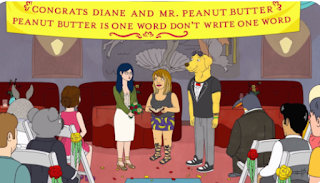
12 reasons bojack horseman is my favourite show of all time (thoughts after re-watch)

Allan and I first watched "BoJack Horseman" in real time, from 2014 to January 2020. We liked it from the start, but as the show deepened in meaning and intensity, we became increasingly invested, amazed, moved, and sometimes awed. 

At times BH became so emotionally intense, we would be left stunned and weeping at the end of an episode, especially (as we started to notice) the penultimate episode of each season. Yet the show is a comedy -- and remains funny throughout.

A few months ago, we re-watched the show straight through, all six seasons. The re-watch confirmed my conclusion that this is simply the best series ever made. In the title of this post, I've edited that statement into "my favourite show". But in my mind, it's simply the best, ever.*

Here's why.

1. It's hilarious. BH uses every kind of humour -- incisive satire, zany sight gags, dark head-shakers, silly shtick, and of course, an endless array of animal puns. 

One of the show's running sight-gags

On the rewatch, we paused to capture all the incidental background humour, the kind pioneered by Matt Groening in The Simpsons -- names of stores, titles of books, road signs. One read: "Stop pausing and just watch the show!"

2. It's a brilliant send-up of the entertainment industry -- skewering it, but also peeling back the obvious to explore the hunger that drives it.

3. It voices so much truth. Characters voice intimate, raw, emotional truths -- truths that grab your heart, truths that you recognize with a gasp, a pang. Every episode seems to contain at least one of these moments -- yet it never feels forced or overdone, because. . .

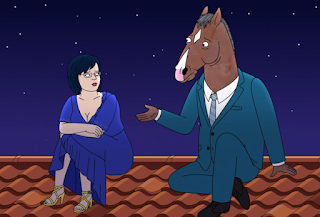
Emotional truths: talks on the roof

4. BH is character-driven. The characters are complex -- even the seemingly simple ones. They journey, they struggle, they grow, or they don't. All hilariously. And painfully. You know them. You care.

5. It's original. BH employs an incredibly inventive, original, and effective use of animation, far beyond what's used in most adult-animation shows. There are some eye-popping, show-stopping episodes, such as the incredible "Fish Out of Water," that have gotten a lot of attention. But there are many bold techniques: an animation-within-animation style used in certain flashback scenes, a night-sky background attached to a specific emotional memory, a character's face covered by crude scribbles. This show could only have been created with animation. 

6. It's complex. BH is the best treatment of the nexus of childhood trauma, mental health, self-loathing, and addiction that I've ever seen -- a kaleidoscopic view that forces us to think, re-think, and think again. 

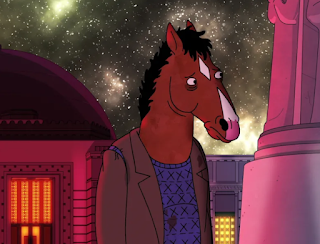
A visual effect signalling... something
7. It explores the big existential questions. How do we live with the knowledge of our own mortality? Why am I here, does my life have meaning? How do we embrace love and hope, knowing that our time is so short? How can I live with my mistakes? And yep, this is a comedy.

8. BH demands compassion. BoJack is a self-absorbed asshole. He does some terrible things. But the more we understand him, the more we root for him, the more we want others to forgive him, but. . .

9. BH demands accountability. Trauma might turn some people into abusive assholes, but that doesn't excuse their behaviour, because, guess what, everyone has suffered. All the assholes, and all the nice people, too, so. . .

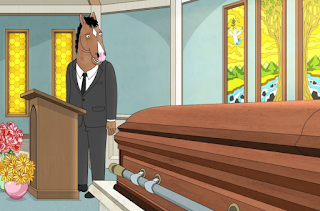
This might be the best 20 minutes of TV you ever see.
10. The ground keeps shifting. Because it's all true, at the same time. Which tells us that we must find a way to bring compassion, treat each other with care, forgive each other when we can, forgive ourselves, but also accept the consequences when we inevitably fall short. 

Each of these 10 preceding reasons are part of why I love this show. But the most astonishing thing about BoJack Horseman is that. . .

11. It does all these things at the same time. I have never laughed so much and wept so much from the same show. And. . .

12. It does everything right. Six seasons, 77 episodes, and barely a misstep or a sour note or a false moment. An absolute triumph. 

Thank you Raphael Bob-Waksberg and Lisa Hanawalt! And thank you, Will Arnett. The role of a lifetime.


------

* This position was previously held by "The Larry Sanders Show". . . and the two have much in common. 

Bonus track: two references to abortion as a positive force in a woman's life, the right decision without regret. I will be forever grateful.