Showing posts with label children's books. Show all posts

2.17.2024

what i'm reading: a first time for everything, delightful autobiographical tween graphic

A First Time for Everything, by Dan Santat, is a perfect tween book. 

It's funny, sweet, honest, sometimes poignant but not sad. It's a gentle comfort for every kid who has ever felt awkward and different, and an incentive for everyone who is afraid to try new things. 

It's a sensitive and perceptive portrayal of how groups are formed. We often hear that kids can be cruel, and we see that in this book. But kids can be kind, too, and the book affirms that.

I read this book a while ago, and had been planning on writing a group review with some other tween graphics dealing with friendship. I read a few, flipped through a bunch more, and didn't find anything that came close to this book in quality or authenticity. I found each of them either too heavy-handed and preachy or too superficial and vapid. 

In A First Time for Everything, Dan Santat, the author of several children's books, tells the story of the class trip to Europe that he took in middle school. 

In school, Santat had some very embarrassing experiences and was bullied. Now he just wants to keep his head down and make it through middle school without further humiliations. The last thing he wants is anything involving a school group, and certainly not a group that includes some of the same girls who had bullied him. 

At first, it's as awful as he expects. But then Dan tries something new. And it makes him happy. Then he tries another new thing. And he enjoys it. He makes a new friend. He crushes on a girl, who is nice to him. A teacher encourages him. And... Dan starts to enjoy himself. He starts to feel comfortable in his own skin.

The new experiences young Dan has are very small, but they are meaningful. With each new experience, he gains a bit of confidence. And those small steps give him the confidence to try a slightly bigger steps, until he becomes a bit brave, a bit bold, and has a great time doing so.

Santat's portrayal of the beauty and power of the first crush and the first kiss are dead-on. In fact, I found all of it dead-on. 

In flashbacks, we learn more about young Dan's prior bad experiences, which deepens our understanding of his growth. Knowing that Santat wrote this about his life, his own experiences, makes the story more poignant -- and makes you cheer Dan's triumph even more.


One thing I absolutely loved about A First Time for Everything was Santat's inclusion of actual photos he took on the trip, along with a little who's who guide to the characters. 


A First Time for Everything is not so much a coming-of-age story as a journey of self-discovery. It's the best tween graphic I've read in a very long time.

1.05.2024

the secret pocket: children's books on residential schools, reading for reconciliation, and other library things

This post started as a standard "what i'm reading" post. But as I thought about it, I realized that it touches on several other themes that are important to me: history, Reconciliation, libraries, readers' advisory... and maybe some others I'm not seeing yet.

The Secret Pocket

In September, for National Day for Truth and Reconciliation, I was updating a list of children's books about residential schools, and found The Secret Pocket, by Peggy Janicki. It immediately became my favourite children's book about the residential school experience.

The Secret Pocket tells the story -- in the first person -- of a Dakelh girl who was taken away from her family when she was four years old. She is brought to a place far away from her home, where the children are always hungry and cold. The girls are forbidden to speak their own language, and are frequently punished -- often by the withholding of food.

The older girls sew hidden pockets into their clothes. They secretly gather materials and sew at night, then use the pockets to hide pieces of apples, carrots, and bread to share with the younger girls, and the girls who are hungriest.

In the Dakelh culture before contact, sewing skills were passed down through generations of women. The girls who were a bit older when they were forcibly removed from their families already had this knowledge. So not only were they helping to feed each other, they were keeping a piece of their culture alive.  

The Secret Pocket records and preserves the stories that the author's mother told her about her own experience -- a story of courageous, creative, and collective resistance. I highly recommend it to all adult readers as well as children. 

How to talk to kids about...

Canadian schools now teach about Canada's colonization of Indigenous people, and about the Residential Schools, at every grade level. It's about time! My Canadian-born friends never learned about this when they were growing up. Many of them lived right near a Residential School but never knew about the genocidal system that they represented, let alone what went on behind the prison walls. 

Many people I know are particularly upset at learning that Duncan Campbell Scott was one of the principal architects of the system that vowed to "kill the Indian in the child". (Apparently this phrase is falsely attributed to Scott. Nevertheless, he created the system that tried to make it a reality.) In school, my Canadian friends and co-workers learned about Scott as a celebrated Canadian poet. They learned about his dark legacy as adults, through Reconciliation education through their workplaces. 

(Incidentally, those three names -- Duncan, Campbell, and Scott -- are found all over Vancouver Island place-names. I hope one day those names will be expunged, and places returned to their ancestral names.)

Reconciliation education stands in stark contrast to so many school districts in the United States that are no longer teaching about slavery. This choice is truly Orwellian, even surreal. And so indicative of the progress of the fascist state.

There are ways to talk with children about difficult topics, in age-appropriate ways. I'm no student of education, so I'm not well-versed in method and curricula, but I see it taking place all around me. 

Reading for Reconciliation

For non-Canadian readers, Reconciliation is the process of educating ourselves about the historical (and ongoing) colonization and oppression of the Indigenous people who live in what is now called Canada, and finding ways to create more equity and justice. 

This work is happening in workplaces, schools, unions, churches, and other organizations, and it is also happening on a personal level. Individual Canadians are taking responsibility for learning, and to the extent that we can, for decolonizing our lives. The 94 Calls to Action created by the Truth and Reconciliation Commission provide a framework for this. 

Obviously not every Canadian cares about this, and a certain percentage of the non-Indigenous population is blatantly hostile to the idea. But evidence also shows that huge numbers of non-Indigenous Canadians care deeply about this and are finding ways to participate in acts of Reconciliation.

One of the ways that Canadians further their own Reconciliation journeys is through reading. Books written by Indigenous authors, both fiction and nonfiction, for every age group and nearly every genre, are burgeoning in sales, libraries, and book clubs. I find this especially heartening when I consider that much of the subject matter in these books is disturbing -- and many people (unfortunately, in my view) avoid reading anything with disturbing content. 

I want to note that in Indigenous Relations: Insights, Tips & Suggestions to Make Reconciliation a Reality, author Bob Joseph lists reading work by Indigenous authors as a tangible act of Reconciliation.

If you have not already done so, I highly recommend reading Joseph's 21 Things You May Not Know About the Indian Act. It's a short, highly accessible book, and my number one pick for beginning Reconciliation awareness. Here's a very good interview with Bob Joseph in The Tyee.

Weđź’“booklists

Many library systems, including mine, offer booklists -- lists curated by librarians, grouped by subgenre, age group, or subject matter, to highlight hidden gems and help customers choose titles.

Booklists are an important form of readers' advisory. Staffing levels -- in every library in North America -- are very low, and in many libraries, there may be no professional staff who have been trained in readers' advisory. Even if staff are available, many customers won't ask for reading recommendations, for various reasons. So most libraries offer various forms of passive readers' advisory. Booklists are a part of that. 

In our system, lists are created by any staff who have an interest. A call goes out, staff sign up for topics within an audience group (adult, youth, or children), or suggest creative list ideas. We put our annotated picks into a template, so the lists have a uniform look and feel. Our lists are always diverse and current, and many are really creative.

I love readers' advisory, and my position doesn't give me much opportunity to keep those skills alive, so when the call goes out, I always raise my hand. It's an opportunity "to librarian". Right now I'm working on two adult lists -- current travel memoirs, and memoirs and biographies. I almost always choose nonfiction lists, with one exception: I love the challenge of creating diverse lists of modern classics. I also sometimes contribute to lists of children's books, which is how I found The Secret Pocket.

12.18.2022

worlds collide: more notes on "gods of the upper air"

Gods of the Upper Air, by Charles King, which I recently wrote about, highlights several books that were highly influential in their time, for good and for ill.

In The Passing of a Great Race, published in 1916, a man named Madison Grant foretold the extinction of the "Nordic" race and their descendants. Drawing from the pseudoscience of the day and bolstered by (as King puts it) "the steely assurance of a New York patrician with something to say," Grant warned how "subspecies" of humans would populate the United States and drive out the civilized classes. These subspecies included Irish, Italians, Greeks -- any non-Nordics, and of course, Jews. In those days, there was no race called white -- further proof that the concept is a social fiction. 

The Passing of a Great Race was hailed as a milestone in the application of scientific ideas to history and public policy. It inspired an entire generation of acolytes who would go on to write their own treatises, advise policy makers, and push through new legislation. Three-quarters of American universities, from Harvard to the University of California, introduced courses on eugenics, many of them using Grant as a primary text. Lothrop Stoddard -- a young, well educated New Englander who was frequently grouped with Grant among America's most reliable racial scientists -- went on to write the best-selling The Rising Tide of Color (1920), which warned of racial inundation by the dark-skinned, and The New World of Islam (1921), which surveyed the threat to the West of a "Mohammedan revival" among Arabs, Turks, and Persians.

Later, on the other side of the spectrum, Margaret Mead's Coming of Age in Samoa also became a best-seller. Mead's groundbreaking book demonstrated that culture exerts a strong influence on psychological, social, and sexual development. The book revealed to an astonished public that different cultures with different values also produce healthy children and adults -- and introduced the idea that many issues prevalent in American society were neither genetic nor inevitable, but instead were products of culture. Although Coming of Age, first published in 1928, is now outdated and reflects many of the failings of its time, it is still considered a landmark work of social science.

As famous as Mead's book is, its influence was eclipsed by that of Patterns of Culture, published by anthropologist Ruth Benedict in 1934. Using her fieldwork studying societies in the South Pacific, southwest United States, and the west coast of Canada, Benedict illustrated how any culture represents just a small sample of the vast spectrum of human behaviour. Patterns of Culture is a foundational text for the very concept of diversity.

So here's where the worlds collide. 

In 1943, Benedict and her colleague Gene Weltfish published a pamphlet that created controversy among bigots and made the case for a shared humanity: The Races of Mankind

The pocket-sized publication was a full-on attack on common misconceptions. "Some people have shouted that if we got into our veins the blood of someone with a different head shape, eye color, hair texture, or skin color, we should get some of that person's physical and mental characteristics. . . . Modern science has revealed this to be pure superstition."

The response was massive and unexpected. Hate mail oozed into her departmental postbox. . . . The FBI dispatched interviewers to check up on the Columbia [University] department. . . The public controversy spurred sales. Churches and civic groups would eventually place orders for as many as three-quarters of a million copies of The Races of Mankind, which became one of the most widely distributed texts on the subject of its time.

I read that last bit -- "churches and civic groups would eventually place orders" -- and a little bell dinged in my mind. Hang on... That sounds familiar. Was that...?? 

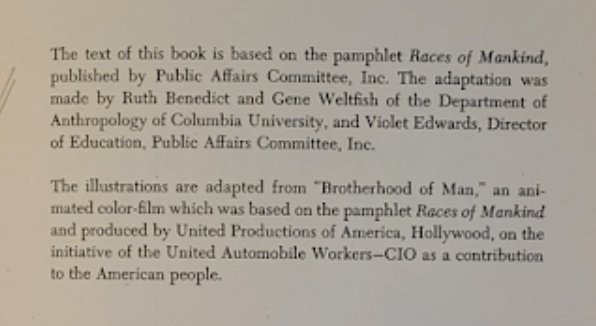
Yes, it was! In the summer of 2021, during a family reunion, I wrote about a book that my siblings and I remember from our childhood, called In Henry's Backyard. I saw a copy of this ancient text at my brother and sister-in-law's house, and learned that the United Autoworkers -- the most progressive union of its time -- was involved in adapting the book into a movie. And both book and movie were based on Benedict's pamphlet! 

The post is here: a childhood book and a dream for humanity.

An amazing coincidence. Plus some evidence that my memory occasionally still functions.

One day I will write about parts of my worlds that are always colliding. It's called All Roads Lead to Allen Ginsberg.

8.15.2022

what i'm reading: the leak: great junior graphic for the young activist in your life

It starts with a trip to the dentist. Ruth Keller swears she brushes her teeth and flosses daily, yet the cavities are piling up. The dentist lectures, her mom scolds. No one believes that Ruth takes proper care of her teeth -- but she does. 

Then Ruth and a friend see workers dumping something into the lake. 

Ruth already writes an online newletter. She gets to work investigating, and repurposes her newsletter into an exposĂ©. 

In The Leak, Kate Reed Petty and Andrea Bell have created an updated and more complex descendant of Harriet, from the classic Harriet the Spy. Ruth is the perfect young hero: smart, brave, misunderstood, flawed -- learning and growing.

Ruth dives headlong into her activism -- rashly, clumsily, and with great courage. Some adults oppose her and try to stop her. A couple of adults recognize her potential and offer guidance and support. Ruth is smart and resourceful and finds a way through, but not without a cost. As she exposes the truth about her town's poisoned water, many hard truths are exposed to her.

The story references the real-life story of the poisoned water in Flint, Michigan. There's an explanatory epilogue that would come off as unnecessary and didactic in an adult novel, but I appreciate it for younger readers. 

I would have loved this book as a child. In many ways, I was Ruth -- a writer, an activist, straddling the line between my nerdy preferences and my need to fit in. Ruth's journey would have been the perfect fantasy for me, but this book would have wide appeal for many young readers. 

I loved Kate Reed Petty's debut novel, True Story. On Petty's website I see she has written another junior graphic, which I will now look for. I'm looking forward to whatever she writes next.

1.25.2022

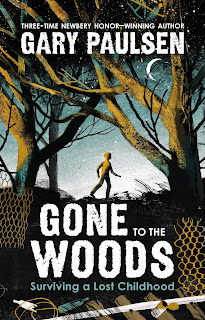
what i'm reading: gone to the woods, a riveting memoir by author gary paulsen

Gary Paulsen wrote some of the best children's literature, most famously Hatchet.

The tale of a boy who must survive on his own in the woods until he is at last rescued, Hatchet (published in 1986) is a go-to book for librarians facing the challenge of a reluctant reader, and many kids' favourite book. I read it for the first time when working as a children's librarian, and loved it. I wrote about Hatchet here.

In 2021, shortly before he died at age 82, Gary Paulsen published Gone to the Woods: Surviving a Lost Childhood, a remarkable autobiography. Gone to the Woods is written as children's nonfiction, but I cannot recommend it strongly enough to readers of all ages.

Gone to the Woods is told in the third person, about a character referred to as "the boy". As a very young child, the boy endures an almost total lack of parenting, then a fairy tale of love and living off the land... then a brutal separation and loss. His young life becomes a series of dislocations and separations -- and total neglect. As a preteen and young teen, the boy lives on his own, surviving by his keen intelligence, self-education, mental strength, and bold courage. 

Salvation begins in the form of the library, and a canny, sensitive librarian. She understands what's at stake and does everything exactly right -- gradually, gradually, ever so gradually, making the library the boy's refuge. Eventually, the boy "reads like a wolf eats". (When you get to the part about the library, have a box of tissues handy!)

The book is gripping and suspenseful, a true page-turner. Similar to Hatchet, it's packed with tips and tricks of survival -- survival in the woods, on a farm, and in a harsh, urban landscape. 

For young readers, it's exactly the kind of book that can help children in troubled circumstances feel less alone. 

For adult readers, it's a view into several hidden, fascinating worlds, heart-wrenching but also uplifting.

For all of us, it's a testment to how the presence of a caring adult can make a profound and lasting difference in a child's life. 

After reading Gone to the Woods, I was so sorry that I was unable to tell Paulsen how much I loved the book, and thank him for writing it. Paulsen died in October 2021. 

I have purposely not revealed much about the actual plot. I loved the way the story unfolded, taking the reader through the same sudden and harsh transitions that the boy experienced. If you want more plot description, this review in The New York Times will help.

Also: the extreme neglect that the boy endures clearly constitutes abuse, but Paulsen does not describe (or even allude to) being physically or sexually abused. Readers concerned with that have nothing to fear, for themselves or any young readers. 

Read this book!


--------
* I notice that post was meant to be part of a series contrasting older children's literature with more contemporary counterparts. Some months later, I finished graduate school and started working full-time... and the series didn't go anywhere.

1.08.2022

"at your library" in the north island eagle: build early literacy with storytimes

Build Early Literacy with Storytimes – Every Day in Port Hardy

In a year when we desperately needed good news, the Port Hardy branch of the Vancouver Island Regional Library (VIRL) had the best news: a huge increase in hours. And one of the best things about those new hours is the daily storytime. 

At 10:00 every morning, Tuesday through Saturday, you can come to the Port Hardy Library and participate in a storytime. There’s no need to sign up in advance or even let us know you're coming. Just take your little one – your own child, a grandchild, or a group of little ones you take care of – and show up at the library. 

Storytimes are fun for kids, but the reason to attend goes way beyond entertainment. 

By the time a child starts kindergarten, we want them to have "reading readiness". Reading readiness is closely tied to early school success, and early school success is closely tied to increased life chances. This means when we help children build reading readiness, we are helping them succeed in life! And hearing stories read aloud is one of the best ways to build reading readiness.

When a child listens to a story, they learn a huge array of language skills. They build vocabulary and reading comprehension, learn how to pay attention and to follow a story, they learn the sounds and rhythms of language.

Storytimes engage children's imaginations, which is one of the most important ways they learn about the world. It introduces children to new ideas and new fun things, like dinosaurs, whales, and trains. 

Hearing stories help children cope with their feelings, and navigate scary things that all children go through, such as conflicts with siblings. It helps them learn about how other people feel, which builds empathy and compassion.

Stories teach about culture, from Halloween and Thanksgiving to cedar weaving and the Big House.

Attending a storytime at the library is an opportunity for your child to build social skills, to interact with other adults, and even to learn a little patience.

Plus, storytimes bring families to the library, where they can borrow books to read with their children at home. It helps children associate the library with a fun and happy activity, and you know we love that.

Thanks to our dedicated library staff, and to the Mount Waddington Family Literacy Society, we're able to offer this amazing opportunity, every day that the library is open, for free.

And all you have to do is show up. 

8.14.2021

a childhood book and a dream for humanity: in henry's backyard (1948)

When I was a child, my family had a book called In Henry's Backyard. My siblings and I read it repeatedly. The book tells the story of a man who learns that all the "races of man" are equal.

Over many years and decades, my brother has mentioned this book, an artifact from our youth. With the advent of the internet, I was able to suggest a few sites where he might be able to find a copy of In Henry's Backyard. And he did.

During our recent vacation, hanging out on the deck of my brother and sister-in-law's home, my brother mentioned the book, and I was excited to hold it in my hands, a piece of my personal history.

Seeing the cover was transporting! By today's standards, the illustrations are racist caricatures, and the concepts are all drawn from stereotypes. But in the context of its time, this book was decidedly anti-racist

In Henry's Backyard disputes claims of racial superiority. Its claims: physical differences between humans are superficial; humans of all colours have equal potential; humans of all colours may be good or bad, smart or stupid, kind or unkind.

Here's the inside blurb of In Henry's Backyard.

As my brother read a random page aloud, I suddenly remembered a line from the book. One portion refutes the idea that brain size is somehow linked to intelligence, a concept that was in vogue at the time. I called out, Wait wait wait . . . and the biggest brain belonged to an imbecile! Long-term memory, eh?

As I paged through the front matter, I was even more amazed to see this.

Imagine my surprise -- and my pride -- at discovering that In Henry's Backyard this book was born of the labour movement! The UAW! Walter Reuther! My heart swells thinking of it.

* * * *

I was recently involved in a discussion about the book Julie of the Wolves, by Jean Craighead George. (George also wrote one of my favourite childhood books, My Side of the Mountain, which I mentioned here, in a post about the book Hatchet.) In Julie of the Wolves, Inuk people are referred to as Eskimos, now an antiquated and derogatory term.

A colleague suggested this book doesn't belong on our shelves. And they were right. Children don't need to read Julie of the Wolves; there are far more modern and relevant books that cover the same ground. 

But I felt the need to put Julie in context. The intent of the book was not racist. George was using the terminology of the time. We might also point out that George was white, and was telling an Inuit story. It would be better for Inuk to tell their own stories. True enough. But in 1972, telling a positive story about an Inuit person and about wolves was itself progressive.

Similarly, I would never suggest that In Henry's Backyard should be reprinted, and it certainly doesn't belong on library shelves today. But it shouldn't be dismissed as offensive or hidden as an embarrassment. In the context of its time, it was light-years ahead. As my brother said, "It makes a point that is yet to be embraced."

4.25.2021

what i'm reading: sometimes you have to lie: the life and times of louise fitzhugh, renegade author of harriet the spy

Until very recently, I didn't know anything about Louise Fitzhugh and had not thought about her at all. 

Of course, as a child I read and loved Harriet the Spy, Fitzhugh's iconic and groundbreaking children's book. For a good portion of my life, I dreamed of writing a similar book. Many years ago, when I started writing serial fiction for a children's magazine, I bought a handful of tween books to re-read, and Harriet was among them. But I knew nothing about its author.

On my birthday last year, my book-loving partner surprised me with a copy of Sometimes You Have to Lie: the Life and Times of Louise Fitzhugh, Renegade Author of 'Harriet the Spy'. This was a thoughtful addition to my biography reading list.

It was an inspired gift: the book turned out to be fascinating! Louise Fitzhugh's life was very interesting, and author Leslie Brody digs deep into the historical context, revealing several hidden histories along the way. 

Louise Fitzhugh was principally a visual artist, and she wrote several other books. But the most noteworthy parts of her "life and times" are Fitzhugh's original family background, a window into lesbian history, and a capsule history of children's literature and publishing.

Fitzhugh's parents had been a golden couple; their wedding was the social event of their Southern town. But when the relationship soured, and Fitzhugh's mother sought a divorce, the father used his privilege and power to destroy his ex-wife. The local newspaper (which he owned) and the all-male court proceedings conspired to gaslight Fitzhugh's mother and strip her of custody of her infant daughter. Louise, raised by her paternal grandmother and an African American servant, was told that her mother was dead. 

When Louise's father remarried, her smart stepmother knew that young Louise needed to know the truth sooner rather than later. Imagine learning that your mother, who you thought was dead, lived in your town! Later, when Louise got her first job with the local newspaper and spent time in the "morgue" (newspaper archives), she learned the public version of the story for the first time. 

Brody tells this story with both great compassion and the proper social context: how a wealthy, white patriarch used the system that was designed by and for others like him, to discredit and destroy a woman who got in his way. 

Fitzhugh was queer -- and out. She lived as a couple with several different women during her lifetime, and was part of a very lively lesbian social scene, made up of professional women, mostly (but not only) in the arts and/or entertainment fields. Sometimes You Have to Lie is a window into this rich subculture, which thrived in bars and beach houses throughout New York City and The Hamptons. 

Published in 1964, Harriet the Spy was a groundbreaking work, part of the vanguard of a sea change in children's literature. Where most children's literature had been written for parents, full of moralizing and no shortage of condescension, the new kid-lit spoke to children with respect, and reflected the realities of their children's lives. Sometimes You Have to Lie situates Harriet in that context, and offers a mini-history of children's publishing.  

To a lesser extent, but still present in the book, there is also the context of the civil rights movement and the escalating war in Vietnam. This isn't discussed in detail, but it is part of the backdrop of Louise Fitzhugh's life and her motivations. Ending both segregation and the war were important to Fitzhugh, and both figure into her life and art.  

Sometimes You Have to Lie: the Life and Times of Louise Fitzhugh, Renegade Author of 'Harriet the Spy'  is a fast, lively, and enjoyable read, great for anyone who loves history, has an interest in LGBT history, loves children's books, or just loves a well-crafted biography.

4.03.2021

beverly cleary, rest in peace, and thank you

Beverly Cleary, who died last week at the astounding age of 104, was a pivotal figure in the world of children's literature. Her books are treasures; her influence can scarcely be measured.

Cleary was one of the first authors to feature young characters who were realistically imperfect. If she was not the first, then certainly she was the first popular, widely-read writer who, as The Atlantic put it, "saw children as they are". 

Before Henry Huggins and Ramona, before Otis and Ellen and Ralph S. Mouse, children's literature was preachy and moralistic. The sanitized characters bore little resemblance to actual children. Books typically stood above children, and spoke at them. Cleary's books stood beside children and reflected them. 

Cleary's books were among the first that respected children -- their intelligence, their experiences. This would become the norm, of course, but it started somewhere, and that somewhere is Beverly Cleary. 

From a tribute (not the obit) in The New York Times:

The much-adored author of 42 books for children, who was declared a "Living Legend" by the Library of Congress in 2000, died on Thursday at the age of 104.

To borrow a response from Cleary's most famous character, Ramona Quimby: "Guts! Guts! Guts!" What else is there to say?

Cleary's novels — "The Mouse and the Motorcycle," "Henry and Ribsy" and "Ralph S. Mouse," just to name a few — are now in the hands of a third generation of readers. Her books are a cornerstone of modern children's literature, front and center in the bedtime canon, and among the first that many young children enjoy on their own. She was the recipient of every accolade available to authors of books for young readers — from the Newbery Medal to the National Book Award — and will remain alive in the imagination of every child who met Ramona and Beezus Quimby, Henry Huggins, Otis Spofford, Ellen Tebbits or any one of her dear, flawed, funny characters, and thought: "That's me."

I also loved this context for Cleary's most popular character, Ramona. 

One could argue that Ramona was the forerunner of what is now known as "girl power." Before Junie B. Jones and Ivy and Bean arrived on bookshelves, before words like "fierce" and "boss" migrated from zoos and office parks onto girls' T-shirts, she was strutting around with her hands on her hips, signing her name with a flourish — whiskers, pointy ears and a tail on the Q. No heart over the "i" for this girl.

"She was not a slowpoke grown-up," Cleary wrote in "Ramona and Her Mother". "She was a girl who could not wait. Life was so interesting she had to find out what happened next."

Right now I happen to be reading a biography of Louise Fitzhugh, who created the prototype of girl power for my generation, and many to follow. Harriet the Spy was published in 1964, Beezus and Ramona in 1955. I think Fitzhugh must have been influenced by Cleary... but I'll find out. 

Many women cite Nancy Drew as a character that inspired them, and certainly series like the Nancy Drew and Hardy Boys mysteries gave children agency. But those characters are fantasies. Fantasies are useful and important, but they don't bring children recognition, a feeling of belonging, a comfort that they are not alone, that readers find from realistic depictions of lives and feelings.

From a 21st Century perspective, Cleary's books exhibit a seeming total absence of diversity. Every character is white, as was the custom of the day. But girlsGirls are front and centre. Girls have agency. Girls are the boss. At the time, this was diversity.

Henry Huggins was the first book I ever read. Naturally I read it many, many times. As you may know, the story involves a boy who finds a lost dog, so skinny that its ribs are showing, hence the name Henry gives the pup. 

Here's the part that is an indelible memory. The original owner shows up and insists the dog is his. He and Henry argue. They agree to let the dog decide, each person calling the dog, hoping the dog will choose him. The interloper uses the dog's original name, which of course Henry never knew. Unfair! Then Henry realizes he, too, can use the dog's old name... and Ribsy runs to him. Hurrah!

My family didn't have a dog yet, and I dreamed of finding a Ribsy and taking him home. Little did I know!

This 2011 interview with Cleary in The Atlantic is wonderful: "Beverly Cleary: 'I Just Wrote About Childhood as I Had Known It'".

The official Beverly Cleary website gives a great perspective on the characters she created.

Beverly Cleary, thank you, thank you, thank you!

9.06.2020

"at your library" in the north island eagle: kids bogo at the library

Kids BOGO At the Library

September is Literacy Month in BC, and your library will be celebrating in a big way. During the month of September, we are offering "Kids BOGO". BOGO usually means "Buy One, Get [Another] One", but this BOGO is "Borrow One, Get One". When you borrow a children's book, your child will receive another book – to keep. Both books are free!

The Vancouver Island Regional Library, the Mt. Waddington Family Literacy Society, and The Book Nook, Port Hardy's bookstore, have teamed up to offer this special, month-long event. Kids BOGO will take place at your libraries in Port Alice, Port Hardy, Port McNeill, Sointula, and Woss.

We have a nice stack of shiny new books to give away, including some hot titles that kids always ask for. We want as many children as possible to receive books, so there is a limit of one free book per child. Supplies are limited, so come to your library branch as soon as you can to claim your child's free book.

The Library and the Literacy Society are very grateful for the generous support of PacificCARE Family Enrichment Society. PacificCARE has helped fund some wonderful projects, such as last year's "Let's Make Soup in a Jar!" and all the books we donated recently to the RCMP's toy drive. PacificCARE's generous support of the toy drive made it possible for us to put more books in children's hands through this exciting BOGO program.

September 6 is Read a Book Day. Read a Book Day encourages everyone to read a book, either to themselves or to someone else. According to a 2019 study, 27% of adults have not read a book in the last year. That number makes me happy, because it means 73% of adults have been reading! How many leisure activities can boast such a solid participation?

Why read? So many reasons!

Reading improves memory and concentration.

Reading reduces stress, by taking our minds away from our daily lives.

Reading helps strengthen our brains, and slows the cognitive decline that happens as we age.

Reading builds empathy. When we read, we enter the thoughts, hopes, and dreams of other people, who are often from very different backgrounds and circumstances.

Through reading, we travel through time and to distant countries and different worlds.

And thanks to your library, you can do all this for free. Visit your library on Read a Book Day – or any day – and well help you find your next great read. 

Give yourself the gift of finding time to read.

5.17.2020

what i'm reading: prairie fires: the american dreams of laura ingalls wilder

I read Little House on the Prairie when I was very young, and eventually went on to read the whole Little House series. I didn't know any other girls named Laura -- there were at least five in my Master's program, but it wasn't a popular name back then -- and I was infatuated with the idea that the Laura in the story grew up to write the book I was holding in my hands. Even then, I wrote stories, and fantasized that I would write a similar series that children would love.

The series was always said to be autobiographical, but it is also fiction. When I picked up Prairie Fires: The American Dreams of Laura Ingalls Wilder by Caroline Fraser, I was curious how much the books reflected Wilder's life -- and how that pioneer girl came to write such an enduring (if now dated) children's series.

Prairie Fires is revelatory. It's meticulously researched, and the writing is both precise and accessible. It's a fascinating read.

The elephant in the room

We can't talk about LIW and her celebrated books without addressing the racism embedded in them. There is racist language in the Little House books -- degrading comments about Indigenous people -- language that young Laura heard her father and other adults use.

"Pa" Ingalls believes "the only good Indian is a dead Indian," but young Laura is also fascinated by Indians. To her, Indians represent freedom, and the wildness of the untamed land, which she loved and revered -- another racist myth.

But focusing on these details may obscure the larger picture. LIW wrote about her settler family and community -- not "settlers" as the term is now used, but actual settlers, the first European people who made permanent habitation on land recently stolen by the United States government.

Prairie Fires addresses this immediately, with a clear-eyed view of what happened to the original inhabitants of the prairie and the woods that the Ingalls family and others like them claimed as their own. The book first offers an overview of the US's treatment of the Indigenous people during westward expansion, then focuses on the specific story that intersects with the Ingalls. The land on which they settled was stolen from the Osage people, who (as was typical) entered into an agreement with the US government, and were then betrayed -- repeatedly. By the time the Ingalls enter the picture, the Osage are desperate, facing starvation. The outcome was bloody and ugly.

Fraser tells this part of the story with obvious empathy for the Osage people, and great respect for their leaders, who behaved ethically until the end -- and also with respect for those who chose to break with those leaders, and acted out of anger and revenge. Like all contact stories, it is staggering in its outright injustice and cruelty, and heartbreaking. And although we all know the broad outlines of what happened, any time we can read about the fate of specific nations, that's a positive thing.

From bad to worse to impossible

Reading Prairie Fires, I learned a lot about US history, especially the incredible trials faced by the settlers on the great plains. They were doomed to fail in so many ways.

First, they bought into a dream, a land rush, which supposedly would lead to a prosperous life -- but the size of their claims were too small to ever be self-supporting, and the land was utterly inhospitable to farming. Although this was known by some, the message was drowned out by profiteering promoters.

This wasn't the first time that immigrants and hardscrabble city-dwellers were induced to follow an ill-conceived dream, and it wouldn't be the last. As Fraser writes, "Fundamentally, the question was whether national decisions of significant economic import, affecting thousands of citizens, would be governed by Enlightenment science of by huckster fantasy." In US history, the answer to that question is always certain.

The settlers were doomed by the arrogant and ill-conceived notion that "empty" land, as they saw the prairies, could naturally be changed into farmland. But there was simply not enough rain, and stripping the grasses from the land made that exponentially worse. The farming settlers actually changed the climate. Fraser writes, "Scientists estimate it took a thousand years for an inch of topsoil to accumulate on the arid high plains. It was the work of a moment to blow it away." In 1935, 850 million tons of topsoil blew away. Children died of "dust pneumonia". Animals died when their nostrils became stuffed with sand or else starved when their grass disappeared.

If you've read The Grapes of Wrath or perhaps seen Ken Burns' excellent documentary about the Dust Bowl era, you may know that monoculture farming and the absence of crop rotation caused untold damage.

Fraser unpacks the many forces at work, some natural but most human-caused, that led to widespread crop failure and starvation. Much of it was driven by the profit motives of the railroad companies, a predatory banking system, and an economic system rigged to benefit large-scale operators and middlemen. But it also arose from a foundational belief in "the pioneer spirit", as Fraser writes, "treasuring the fantasy that a fistful of dollars and a plow could magically produce not only a farm but a nation."
But the Dust Bowl was no act of god or freak accident of nature. It was one the worst man-made ecological disasters of all time. Farmers had done this, and they had done it to themselves. It was small farmers, in particular, who were responsible, since they were more likely to cultivate intensively and less likely to employ any form of crop rotation or erosion control. As scholars have noted, settlers had boasted of their prowess in dominating the landscape, bragging of 'busting' and 'breaking' the land. Well, now it was broken.
Then there were the locusts. I won't give you the details, out of respect for friends with entomophobia. Let's just say that it sounds like a 1950's B sci-fi movie. Months of back-breaking, penny-pinching labour would be destroyed in minutes.

The disasters just kept coming -- droughts, locusts, debt, fire, extreme deprivation, near starvation. No one would have written a children's book that gave an honest account of the Ingalls' lives. It would simply be too gruesome, easily crossing the line from adventure to inappropriate. LIW's books took this grim material and shaped it into something noble, stirring, and triumphant -- and in doing so, helped cement the romantic view of western expansion that so many Americans grew up with.

If you have an interest in history, even if you don't particularly care about LIW or the books she wrote, I highly recommend reading the first parts of Prairie Fires -- the introduction, "On the Frontier," and "Part I, The Pioneer". It is fascinating.

A double biography, more than I wanted

LIW's story embodies so much of American history. She was 62 years old when she wrote her first book! Then, after a lifetime of near-poverty and extreme frugality, she became wealthy and famous. She is certainly worthy of a serious and important biography.

But Prairie Fires is really a double biography -- of LIW and her daughter, Rose Wilder Lane.

The stories of these two women are inseparable. They had what Fraser calls an "editorially incestuous" relationship. RWL edited LIW's work, and apparently many scholars, editors, and other book people have claimed that RWL was the real author and ghostwriter of the Little House series. Fraser offers evidence that this was not the case -- although I wouldn't call it definitive. But there is no doubt that the strong, working collaboration between LIW and RWL produced most of LIW's work.

RWL is a strange and fascinating figure. She traveled around the world and published widely. She is credited with being one of three women who founded libertarian politics -- taking a distant third to Ayn Rand and Isabel Mary Paterson. In general, she lived an unusual, tempestuous, and dramatic life.

To me it is clear that RWL was mentally ill. She repeatedly sabotaged her own chances for happiness and prosperity. Although she was paid very generously, earning more than LIW would ever see until her old age, RWL burned through everything she had and was always in debt. She betrayed old friends and repeatedly destroyed relationships, often ending up completely alone. She was prone to bizarre obsessions, which she indulged until she was destitute.

Fraser does mention that RWL was depressed, and had a breakdown. But mostly she seems to regard RWL as a bad person with inexplicably bad behaviour. I felt sorry for RWL, but the author seems to have little sympathy for her.

Fraser doesn't idealize LIW; she is presented as a real human, with faults and blind spots like anyone else. But the book continually contrasts the two women -- LIW as the rational, patient, frugal, hard-working adult, and LIW as an impulsive, melodramatic, exaggerating woman who acts like a wild adolescent.

RWL's story often overshadows LIW's. Perhaps it is bound to do so, as LIW's life was steady, planned, and orderly, while her daughter's life was impulsive and erratic, full of travel, strange relationships, and poor decisions. Even so, I felt that too much time was spent on RWL, and I sometimes lost the thread of LIW's story.

Desperate for help, yet refusing all offers

Another interesting aspect of this book, for me, was learning more about the social and political context of LIW's life. Although LIW's story is founded on one of the most enormous government giveaways in history -- free land -- the pioneers and the farmers were virulently anti-government.

Not all agricultural communities are conservative. The Norwegian and Swedish farmers who settled in Minnesota brought their socialist values with them. Agrarian socialism, and a less political cooperative farming, is a thread running through U.S. history.

But the culture of central Missouri, where LIW spent most of her life, was ultra conservative and (although the word was not yet coined) libertarian. Even though they faced tremendous suffering during the Great Depression, they loathed President Franklin Roosevelt and detested his New Deal. I've never understood this, and Prairie Fires gave me more insight. (I still have little respect for this thinking, and like all libertarianism, it was wildly hypocritical -- but I do understand it a bit better now!)

Overall, an excellent book

I don't want to overstate my issues with this book. Fraser's research and writing are impeccable. Prairie Fires is essential reading for anyone whose life was touched by the Little House series, or is interested in the evolution of American literature, and especially anyone interested in the myth-making of the frontier and the American west.

The media release for Prairie Fires offers a good synopsis.
Millions of readers of Little House on the Prairie believe they know Laura Ingalls—the pioneer girl who survived blizzards and near-starvation on the Great Plains, and the woman who wrote the famous autobiographical books. But the true saga of her life has never been fully told. Now, drawing on unpublished manuscripts, letters, diaries, and land and financial records, Caroline Fraser—the editor of the Library of America edition of the Little House series—masterfully fills in the gaps in Wilder's biography. Revealing the grown-up story behind the most influential childhood epic of pioneer life, she also chronicles Wilder's tumultuous relationship with her journalist daughter, Rose Wilder Lane, setting the record straight regarding charges of ghostwriting that have swirled around the books.

The Little House books, for all the hardships they describe, are paeans to the pioneer spirit, portraying it as triumphant against all odds. But Wilder's real life was harder and grittier than that, a story of relentless struggle, rootlessness, and poverty. It was only in her sixties, after losing nearly everything in the Great Depression, that she turned to children's books, recasting her hardscrabble childhood as a celebratory vision of homesteading—and achieving fame and fortune in the process, in one of the most astonishing rags-to-riches episodes in American letters.

7.15.2018

things i heard at the library: an occasional series: #29

It's TIHATL, Summer Reading Club edition!

Summer Reading Club is in full swing in Canadian libraries. In more than 2,100 libraries around Canada, kids are earning prizes and recognition for reading. Thanks to Toronto Public Library and a certain sponsoring bank, we all have lots of free stuff to give away.

The most popular kids' series ever,
still going strong after almost 15 years.
Our motives are simple: kids who read during the summer do better in school in September. SRC also helps remind parents of pre-readers to read with their little ones daily.

Our children's library is very busy. The first day of SRC, we signed up 180 kids! After two weeks, we're well over 600 participants. When kids register, or when they come in to "report" and collect prizes, it's a great time for some one-on-one conversations with our young customers. Some won't say one word without their parents' prompting, but others are so forthright and articulate! It's really a pleasure chatting with them. What have I heard?

"My favourite books are the ones where things happen, and you know, you don't know what's going to happen, and you think things won't happen, and then they do happen!"

"I love reading about space, and planets, and the universe. I'm going to be an astronaut and go to Mars -- when I'm six!" This boy was amazing. At not yet six years old, he knew so much about astronomy! And he wasn't just regurgitating facts without engaging, as you sometimes see with kids who are on the autism spectrum. This boy was relaxed and social, and had clearly synthesized what he had read. We had a great conversation about his impending Mars visit. His mom and I looked at each other in amazement.

Two sisters wanted to read about... it sounded like churchills.

"Miss, can we bring our churchills to the library?"

"Your ... what?"

"Our churchills!"

"I'm not getting it. Can you say that again?"

"Our CHURCHILLS! Can we bring our CHURCHILLS to the library?!!"

Finally I am forced to admit, "I don't know what that is."

"They are little animals, they have a shell, and their little arms and legs and head sticks out of the shell, and when they're afraid, they can go inside it. We have two baby churchills and we want to bring them to the library!"

I try not to laugh. They are hearing the word from their parents, who are new English speakers.

"Do you mean turtles?"

"Yes, yes, tur-tills!" Without missing a beat, they now begin to pronounce the world tur-till with great enunciation.

"I don't think your turtles would be very happy at the library."

"We would help them! We would show them all the books!"

"But you know what, all the kids would want to see the turtles and pet them, there would be a huge crowd, and I think the turtles might be afraid."

They nod with great seriousness.

I ask, "Would you like to read some books about turtles?"

"Yes yes yes yes yes!!!"

"Do you want to read stories with characters who are turtles, like Franklin, or information about turtles?"

"Information! Information about tur-tills! Tur-till information!"

The book on having a turtle as a pet is nowhere to be found, but we find lots of books about turtles in the wild. I try to shield them from books about endangered sea turtles, but they are too fast for me. Fortunately, they are only looking at the pictures, so they're not bothered by the sad stuff.

"Tur-tills! Tur-tills! Mommy Mommy we have books about tur-tills!!"

Currently the hottest ticket, by the
creator of Captain Underpants
* * * * *

[What should we set for your first reading goal? How many books will you read before you come in for your first prize?]

"100! No, 500! No, one thousand! No, three. Three books."

[What kind of books do you like to read?]

The most common answers are Diary of a Wimpy Kid, Dork Diaries (Wimpy Kid for girls), Harry Potter (still and apparently forever), Percy Jackson (hero of the Rick Riordan series), Narnia, Charlie and the Chocolate Factory. For the younger readers, the most popular answers include Disney Princesses, Ninjago, Pokemon, LEGO, Barbie, various superheroes, and Transformers. (Notice anything?)

For graphic fiction (which kids call comic books), girls are still looking for anything by Raina Telgemeier, especially her new adaptation of The Baby-Sitters Club. Everyone is still reading Amulet. This year's kids have not heard of Bone, but I can talk them into trying it. This is especially great because, being slightly out of fashion, Bone is easy to find.

The graphic hybrids are hugely popular: Geronimo Stilton and related spinoffs, Big Nate, Captain Underpants, Dog Man (this year's runaway hit), and the seemingly eternal Diary of a Wimpy Kid. I often steer girls to Marissa Moss' Amelia's Notebook series, which predates Dork Diaries and is way better.

If you phrase the question, "Do you like funny books, scary books, adventures, mysteries...?" the number one answer, by a huge margin, is funny. Scholastic has the results of a survey about what kids and parents look for in books.

The best answer I heard in a long time was: "I like books with words and pictures! I'm very particular about what I read."

3.29.2015

what i'm reading: the golden compass by philip pullman

The Golden Compass, by Philip Pullman, has been on my to-read list since it was first published in the mid-1990s. Although I generally don't read fantasy fiction, after reading an outstanding review in The New York Times Book Review, I was very intrigued. Thanks to the Teen Book Club I facilitate at the library, I recently had an excuse to read it: The Golden Compass (published as Northern Lights in the UK) is our March title.

This is an absolutely wonderful book. Lyra Belacqua, a smart, spunky 11-year-old girl, is wholly believeable as our powerful, but very human, hero. She lives in a world recognizable to us, but different - a parallel universe which unfolds naturally, without the ponderous world-building that I find so tedious in more typical adult fantasy fiction.

The book is chock-full of adventure, mystery, and action, with just the right touch of thoughtful reflection thrown in. It's an excellent youth or tween read, which is to say it's fast-paced, written in a clear and straightforward style, and with the darker, scarier, and potentially violent material handled with discretion and a gentle touch. There is sadness and loss and frightening elements, as there should be, but there's nothing graphic.

The Golden Compass is sometimes called a youth novel, but it lives on the younger side of that spectrum, perfect for a 10- or 11-year-old who is a good reader. Why, then, is it catalogued in the adult section of our library? I can only speculate that it might have been a response to "challenges" - meaning controversy and calls for banning or limiting access in the library.

To an adult reader, the reason for the challenges - though silly, in my view - are obvious. On the surface The Golden Compass is a straightforward fantasy-adventure, but on another level it can be read as a critique of The Church. The book is certainly not anti-religion or anti-spirituality, but it is a harsh condemnation of the institutional Church - the Church of the Inquisition, the Church of intolerance, and most of all, the Church that has harbored and protected known pedophiles for centuries, allowing countless children's lives to be shattered.

There are other aspects to which some Christian readers might object: our hero is herself identified with Christ imagery. But I believe the principal objections would focus on a negative portrayal of the institution of organized religion.

Some critics see Pullman's His Dark Materials trilogy (The Golden Compass is book one) as a response to C. S. Lewis' The Narnia Chronicles, with its clearly Christian underpinnings. Not being a reader of fantasy, and never having read Narnia (I read and enjoyed The Lion, the Witch and the Wardrobe as a child, but stopped there), I can't comment on these critiques. There are many comparisons online, but most focus on film adaptations - not a reliable way to critique a book!

The 2007 movie adaptation of The Golden Compass was greeted with articles like "The Chronicles of Atheism" and "The Golden Compass: A Primer on Atheism". This is nonsense, of course. I'm pretty sure anyone who says the movie version of The Golden Compass is about atheism hasn't seen it. For this, I'll turn to the late, great Roger Ebert's review of the movie.
For most families, such questions will be beside the point. Attentive as I was, I was unable to find anything anti-religious in the movie, which works above all as an adventure. The film centers on a young girl named Lyra (Dakota Blue Richards), in an alternative universe vaguely like Victorian England. An orphan raised by the scholars of a university not unlike Oxford or Cambridge, she is the niece of Lord Asriel (Daniel Craig), who entrusts her with the last surviving Alethiometer, or Golden Compass, a device that quite simply tells the truth. The Magisterium has a horror of the truth, because it represents an alternative to its thought control; the battle in the movie is about no less than man's preservation of free will.
One of the better pieces I've found on this subject was by Jenn Northington, writing on Tor.com, for Banned Books Week 2013.
One could argue that while the disdain for organized religion and bureaucracy registers in Pullman’s books as well as in his interviews, it doesn’t prevent them from containing all kinds of mystical elements. There are witches with super powers, embodied souls in the form of daemons, a trip to the underworld. One could further say that they promote a sense of spirituality and a belief in the possibility of things beyond our comprehension. There’s a word for that; some call it faith. This argument, of course, is unlikely to hold weight with anyone who objects to the series. In matters of taste there can be no dispute, and each reader finds something different in a book.
If The Golden Compass works equally well as a great children's read, and a response to a famous fantasy series, and a critique of a social institution, that is quite a feat, and Pullman deserves huge recognition for pulling it off. The symbolic meanings are there for discussion and debate, but the solid base of the book is vivid, highly accessible, and simply excellent.

10.20.2014

the so-called "y.a. debate" rages on, but doesn't a debate have two sides?

In June of this year, Slate ran a now-infamous piece called "Against YA," in which Ruth Graham argued that adults shouldn't read young-adult fiction, and should be embarrassed if they do. A flood of posts and essays were written in response; my own response is here. In the short term, as far as I can tell, not a single writer agreed with Graham.

Despite this lopsided showing, some headline writer (possibly here) dubbed this "The Great Y.A. Debate," and the name stuck. There must be people out there who agree with Graham - surely hers was not an original idea - but one cranky article does not a debate make.

I did find a few interesting essays that used Graham's piece as a springboard to unpack some interesting ideas and cultural trends.

A. O. Scott, in The New York Times Magazine, is one reader who found himself agreeing with Graham, and asking himself why. Scott's The Death of Adulthood in American Culture joins the crowded field of "things ain't what they used to be" stories, gazing fondly back on a time when a cultural elite drew a very bright line between "high" and "low" culture, a line that, if it still exists, is too blurry to locate and carries little cultural currency. Scott, however, reflects on his nostalgia and acknowledges its curmudgeonly (and sexist, exclusionary) nature. It's a nicely ambivalent essay... and it has very little to do with youth fiction.

In Henry James and the Great Y.A. Debate, Christopher Beha, writing in The New Yorker, uses the same so-called debate to muse on the state of the novel, how literature from different eras reflect entirely different worldviews, and why the work of Henry James is still, in Beha's view, relevant to the contemporary reader. It's a good piece, worth reading, and again, none of its ideas are stated or implied in Graham's essay in Slate.

Beha offers this comments on A. O. Scott's piece.
...Scott’s essay is an expression of great ambivalence. He isn’t happy about this trend in movies, but he also isn’t sure how justified his unhappiness is. He admits to “feeling a twinge of disapproval when I see one of my peers clutching a volume of ‘Harry Potter’ or ‘The Hunger Games,’ ” but he quickly adds that he’s “not necessarily proud of this reaction.” He is scrupulously mindful of what it means for a self-described “middle-aged white man” to pine for an earlier era of cultural authority. Indeed, the real subject of Scott’s essay turns out to be not the infantilization of culture but the decline of cultural—if not political or economic or social—patriarchy, and the ways in which this decline is reflected in the culture itself. He takes this change to be the underlying subject of several of the past decade’s prestige TV dramas—particularly “The Sopranos,” “Mad Men,” and “Breaking Bad.” In Scott’s view, Tony Soprano, Don Draper, and Walter White are “the last of the patriarchs.”

This is where the essay becomes a little confused, in my opinion. If we really are living through the decline of the cultural authority of the straight white male, that seems like a rich and appropriate subject for a sophisticated work of narrative art. The fact that we find this decline represented on television seems in this sense a sign of cultural maturity, one that cuts against the idea that our culture reflects an “essentially juvenile vision of the world.” Many shows now grapple more honestly with the world as it actually exists than did the sitcoms that I grew up watching, in which mom and dad had all the answers and were waiting in the wings to save us from our mistakes.

The strong ambivalence running throughout Scott’s piece emerges from the fact that he sees an intimate, even necessary connection between the decline of the straight white male’s stranglehold on the culture as a whole (which he views as all to the good) and the rise to dominance of a juvenile strain within popular culture in particular (which he likes a lot less). But even assuming that both of these things are going on, it’s not at all clear how much they have to do with one another. There is a difference between art that merely enacts a culture’s refusal to grow up—say, a Y.A. fantasy turned summer blockbuster marketed at adults—and art that engages thoughtfully with that refusal.
The New Yorker also pointed to a 2008 article by Jill Lepore (one of my favourite writers in that magazine's circle), illustrating the long history of self-appointed reading gatekeepers. This one was a librarian who was horrified by E. B. White's Stuart Little. And not just any librarian: it was Anne Carroll Moore, who invented the idea of the children's library. Great reading: The Lion and the Mouse.

Throughout, I am left wondering if anyone on the "against" side of "Against Y.A." has read any youth fiction other than The Fault in Our Stars or The Hunger Games and has read any children's fiction other than Harry Potter. Often I'm left wondering if they've read even those, or merely read about them.

These essays are all worth reading... as are many youth novels.


5.25.2014

things i heard at the library: an occasional series: #13

A boy, maybe age 8, was confused about what he needed. He said he needed "chapter books about the human body," which sounded to me like two things - books about the human body for a school project, and chapter books, meaning junior fiction that is not a picture book, not a series, and not a graphic novel. But he was convinced he needed "chapter books about the human body." He would not be helped, casting aside everything I found for him, and getting increasingly frustrated.

Following him around the library (it's a Sunday, so I'm working overtime, not at my own location), I ran into his parents and his older sister. Boy's Father said, "Is he giving you a hard time?" He said this nicely, not in a mean or menacing way.

I said, "Oh no, he's fine. I'm just trying to understand what he's looking for." I had books from two popular funny series in my hands.

Boy's Father took them from me and said, "No, this is garbage. We're not reading these."

I said, "Since he needs a chapter book, why don't we look for something better."

"What does that mean, 'chapter book'?" BF asked.

"Fiction--" I began.

"No. No fiction," BF said. "Let him read about science, or history, or let him practice his math."

I said gently, "He might need to read chapter books for his language skills. Reading fiction will improve his reading, which will help him in all subjects."

Things were getting generally messy, with Mom speaking in their first language, sister filling a cart with all the books she wanted, BF attempting to lecture boy, and boy tuning everyone out. I went back to the reference desk.

The family appeared a bit later. While the rest of the family was at check-out, BF came up to the desk. He clearly wanted to continue our conversation, which I've re-created here to the best of my ability. BF was unfailingly polite throughout, as was I. I made sure to listen closely to what he was saying, and to acknowledge that I heard him, to not rush in with my own answers too soon. I was pleased with myself for being patient, for not arguing, for not being confrontational, while still offering a different perspective. Damn, have I matured!

BF: You know, all that fiction, it's not good for them. It's a drug.

LK: Hmm, well, it could be. But compared to other drugs, it's a pretty positive thing.

BF: No, no, it's an addiction. I see it at home with my eldest. Once they start on those novels, that's all they want to do.

LK: You know, reading anything is good. We believe reading has inherent value.

BF: It's an addiction. It's like movies or video games. Once they start, where does it end.

LK: Do you know, kids who read a lot have greater reading comprehension, and that helps them in all their subjects - science, history, everything. Kids who read a lot do better in school, and that improves their life chances.

BF: Yes, I'll give you that. Reading comprehension is important. But why can't they get that from reading about history, about politics, about science, about the real world? Why do they have to read stupid novels? My eldest at home only wants to read something called Naruto.

I smiled. Manga. It is an addiction!

LK: Does he read anything else?

BF: She. A girl. Her grades are excellent. Very good grades.

LK: So maybe she wants to read Naruto for fun. Would that be OK?

BF: I am all for fun. I don't think children have to work every minute. Fun is good. But those stupid books, they are an addiction. It's what's wrong with our whole society.

LK: Hmm. If I were to pick what was wrong with our society, I don't think I'd say it was too much reading.

We both chuckle. Then:

BF: Do you have religion? Do you have a spiritual life?

Naturally this question took me by surprise. Mentally scrolling through possible answers, I discarded the obvious "That's not really relevant here," or the truthful "No, I don't," as possibly sidetracking an interesting conversation.

LK: Yes, I do. Not sure how that fits in, though.

BF: I'm surprised. I think if you have religion, you would know the answer to this. You would know that we are not helping our children by having them read this awful stuff. All through North America, we emphasize culture, and the arts, and reading, the movies, the plays, the books. Then when we need scientists we have to import them from other countries. Better to develop the science and the math, then bring the arts in later. Once you spoil your brain with arts and reading, you lose the ability to do the science.

LK: Hmm. I don't know about that. I'm a writer and a reader, but I love science.

BF: Perhaps you are exceptional. (Smiling)

LK: (Smiling back) Oh, I don't know... I'm a librarian. I think reading is beneficial for children. For everyone, but especially for children.

BF: At least he should read about the real world. Science, history.

LK: We have a lot of excellent nonfiction he could read, too. Great books on the environment, on animals, on the ancient world - whatever interests him.

BF: Yes? There is nonfiction like that for children?

LK: Absolutely.

BF: OK then, next time we're here I will ask you to help us find some.

LK: It's a deal.

BF: It's been very nice speaking with you. Thank you for your help and have a wonderful day.

4.20.2014

youth books, children's book edition #10, and the best part of my job

I thought readers' advisory was the best part of my job, but that was before I began running our library's teen book club.

Once a month, I spend an evening with a group of teens who choose to spend their evening at the library, talking about books. We hang out, eat snacks, talk about books, talk about life. Although I've never had an interest in book clubs for myself, facilitating these young people's enjoyment of reading is a joy and a privilege.

The teens themselves come from diverse backgrounds and experiences. Most are the first generation of their family born in Canada. Some lead pressured, overly scheduled lives. Others are relatively independent and mature. Some are bursting with ideas and enthusiasm. Some are quiet and speak very little. All of them listen respectfully to each other and encourage each other. This is what I love best. Always, they are kind to each other.

I've read that reading helps people develop empathy and compassion, that readers exhibit a higher degree of empathy than non-readers. I don't know if these teens are such nice people because they read, or if they read because they're nice people, or if it's just a random coincidence. But on the last Monday of every month, these kids make me love my job even more.

* * * *

TBC is also an opportunity for me to venture out of my reading comfort zone and try books I wouldn't normally pick up.

Many TBC members, including me, thought they wouldn't enjoy Cinder, a dystopian-future take on the Cinderella fairytale, by Marissa Meyer. We all ended up tearing through it, cheering for the strong, independent, but damaged main character, hanging on suspense and plot twists, and not guessing the ending.

TBC gave me an excuse to read Coraline, Neil Gaiman's modern classic children's horror novel. I normally don't read horror, and I really had no idea what constituted horror for children. Coraline seems like just the right amount of scary for kids - and me! It's creepy and shivery, in a way that makes you want to keep reading, not in a way that gives you nightmares.

Gaiman follows some standard children's-lit conventions - the child of absent or neglectful parents as a solo adventurer, forced to rescue herself and others from the clutches of something evil - but energizes them with lyrical language and unexpected twists. One member of TBC shares my avoidance of all things scary, so I'm looking forward to seeing what she thought.

Other upcoming TBC selections: The Maze Runner by James Dashner (which I wrote about here), It's Kind of a Funny Story by Ned Vizzini (here), Epic by Conor Kostick, the first book of the favourite adventure series of one of our members, Hate List by Jennifer Brown, and Gauntlgrym by R. A. Salvatore. At our next meeting, we're voting by secret ballot for the last two titles of the year.

10.11.2013

what i'm reading, children's books edition # 9: wonderstruck

Over the summer, I wrote about The Invention of Hugo Cabret by Brian Selznick, a children's book with a suspenseful, convoluted story, lavishly illustrated with Selznick's beautiful pencil drawings. (I scanned several of those images into my earlier post.)

I've just finished Selznick's most recent book, Wonderstruck. Wonderstruck is filled with drawings in the same distinctive pencil style, but it is even better than Hugo Cabret.

The central story of Wonderstruck is more linear, so it's easier to follow. But Selznick employs a brilliant device that adds mystery and suspense to a straightforward story.

The reader follows the story of Ben, a boy from Gunflint Lake, Minnesota, who dreams of wolves, and misses his mother, and travels by himself to New York City. Interrupting Ben's story at intervals is another story, told in wordless pictures, of a girl from a different time and place - a girl who also travels to New York City on her own.

The two stories, one written in text and one illustrated, unfold independently of each other. The reader knows there must be a connection between them, but can we piece the mystery together? The two stories intersect in marvelous, poignant, and satisfying ways. The use of dual plot lines told in different formats is a gutsy choice that really respects the intelligence of the young reader.

I must admit I have an extra attachment to this book, as so many of its elements have been fascinations - or obsessions - of mine at various times in my life: wolves, New York City, Deaf culture, sign language, the American Museum of Natural History, even - amazingly - the New York City Panorama in the Queens Museum of Art, which I frequently recommend to exploring New York-ophiles. The book also pays homage to a classic children's book of an earlier era, E. L. Konigsburg's From the Mixed-up Files of Mrs. Basil E. Frankweiler.

Like Hugo Cabret, Wonderstruck is about the search for our authentic selves, our need to belong, and the creation of families, both biological and chosen. I highly recommend this book. As I tell our young customers at the library, it looks huge, but flip through it - half of it is pictures, and it's a really fast read, because you won't want to put it down.

Postscript: On the Wonderstruck website, there are wonderful essays that provide more context for the many threads of the book. Great stuff: go here.