Showing posts with label sexual assault. Show all posts

9.24.2023

real heroes for real reasons: female athletes moving the world forward

These days I can't blog about events or issues that are meaningful to me until they're old news -- which of course in today's world can mean only days or weeks past. The upside of my delayed response is an opportunity to use a wider lens and see more connections to develop. This is exactly what happened recently with several events related to women and sport.

Soccer players in Spain


In late August, players on the Women's World Cup champion soccer team refused to take the field until an incident of sexual assault or harassment was properly dealt with.

This was a brilliant and heartening episode for so many reasons. 

*** The majority of the players stood together in solidarity, backed by their union -- the oldest union in professional sport. Even after being threatened with fines and sanctions, most players continued their boycott, described in some media as "open rebellion". (Be still my heart!

*** Mainstream media reported this news factually and didn't mock the players. I have no doubt that right-wing media and social went berserk over this -- after all, it was "only" a kiss. But for the mainstream media to treat seriously and factually a nonconsensual kiss on the lips  is a huge change. I noticed as the story played out, the language changed from "unwanted kiss" to "nonconsensual" or "forcible" kiss.

*** Rubiales, who first took the usual tactic of portraying himself as the victim, then apologized, was finally forced to resign

Best of all, the players leveraged their spotlight and position of strength to focus on systemic changes. They won changes both symbolic -- the elimination of the term de futbol femenino (women's soccer) from the team's name -- and substantive, with steps that will eventually secure equal pay with the national men's team.

Tennis players in Forest Hills

Equal pay! What a concept. How fitting to see, just after the events in Spain, Billie Jean King celebrated at the US Open. Fifty years ago King won in straight sets to beat Bobby Riggs in the so-called Battle of the Sexes -- still the most-watched in tennis history. King spearheaded the drive to create a women’s professional tennis tour, equal prize money for men and women, and -- most importantly -- the passage of Title IX. The ascendancy of women's professional sports is a direct result of Title IX.

I have never been a tennis fan, but I remember very well the hype around the Battle of the Sexes. A school friend of mine pointed out that before the match, Riggs was touted as a master of a crafty game with lightning reflexes that compensated for his small stature. There was no way he was going to lose to a girl. After the game, he was suddenly "a 55-year-old man who walked like a duck". Commentators acted as if King had taken advantage of Riggs' advanced age.

In the present day, I love that Coco Gauff thanked King for making her US Open prize money possible. King's strength, commitment, willingness to fight -- and frankly, her tough skin -- ushered in a new era for female athletes.

Gymnasts saying no to winning at any cost


In the hypercompetitive world of elite and elite-aspiring sport, athletes routinely ruin their health and risk ending their careers in pursuit of victory. 

In 2004, pitcher (and homophobic asshole) Curt Schilling may have sacrificed his future to lead the Red Sox to victory in game six of the World Series. 

In 2008, Tiger Woods won the US Open while limping and in obvious pain from a badly injured knee. 

USA Gymnast Kerri Strug "heard a snap" and couldn't feel her left leg during her routine in the 1996 summer Olympics, but willed herself to finish, in her quest to secure a gold medal for her team.

These life-altering and potentially career-ending sacrifices are invariably hailed as heroic. Sportswriters and fans marvel at the players' mental toughness and unstinting determination. And those accolades perpetuate a culture where athletes on all levels -- amateurs, average professionals, and champions -- make dangerous choices in the relentless pursuit of the win. We'll never know how many young pitchers blew out their arm and burned their futures by following the advice of coaches who cared only for the short-term win. We'll never know the innumerable examples that must exist in every level of every sport.

Against this backdrop, the choice made by Olympic gymnast Simone Biles in 2020 was perhaps the most heroic of all. Biles chose her health over the win. 

From an essay by former USA gymnast Rachael Denhollander, author of What Is a Girl Worth? My Story of Breaking the Silence and Exposing the Truth About Larry Nassar and USA Gymnastics:

Simone Biles entered the 2020 Olympic Games with a record 25 World Championship medals and four moves so difficult that she alone out of all the world’s gymnasts could perform them.

But what took place on the competition floor made history in a way no one could have expected. On the first event of the games, which were held in July 2021, the athlete, who has an unparalleled ability to flip and twist, suddenly could no longer find herself in the air. Simone had “the twisties” — a complete loss of ability to perceive her body in space. The condition is known to lead to devastating injuries, as it nearly did for her that day. When she returned to the competition floor, it was to put on her warm-ups, give her team a pep talk and withdraw from competition.

I’ve witnessed many incredible moments in athletics, but as I watched from home that day, I knew I was watching a victory that redefined the others: Simone’s decision to value her own safety, on her own terms, above the voracious demands of an abusive and toxic athletic system. It was a moment so many of us had fought for, for so long.

Denhollander herself made an incredibly courageous choice: she came forward to tell how Larry Nassar, the sexual predator and former doctor for USA Gymnastics, had sexually assaulted her. She was the first player to speak out against Nassar. By the time the serial child sexual abuser was sentenced to 175 years in prison, more then 200 gymnasts had spoken out -- including Biles. Denhollander writes: 

We all knew that Mr. Nassar was a symptom of a much deeper problem -- a broken and abusive system that valued money and medals over the health and safety of its athletes.

Simone defied this system with both words and actions. Her choice to value her safety and well-being spoke the truth that human worth is not a prize we might someday earn. Rather, it is intrinsic to our very being.

Two years later, Biles returned to competition with a definitive win. But that future was unknown when she left competition to focus on her own health.

Here's the most important takeaway from this story: professional sports is work, and athletes are workers. 

[Biles's] triumph is so much more than the competitions she is once again winning, because it is laid on the foundation of the courageous choice she made in 2021. That, even more than her peerless athletic prowess, is what is inspiring her fans. And that’s what makes her victory resonate far beyond the sport, beyond any sport.

Professional athletes aren’t the only ones who face overwhelming pressure to perform on someone else’s terms -- to work past the point of what’s healthy, to define ourselves by what we achieve instead of who we truly are. That pressure is so common that it can be hard to remember there’s any other possibility. But it doesn’t have to be this way. 

Many workers have no choice. In the bad old days before labour activism forced basic changes in labour laws -- and in the present day, in much of the world -- workers must risk their health and sometimes their lives in order to keep their jobs. 

Those of us who have the privilege of choice can set the tone for our colleagues, friends, and family. We can set new boundaries for workers by setting them for ourselves. We can put down the phone, walk away from the keyboard. Take a full lunch break. End the workday earlier to spend time with our families, and our selves. Work is part of life, and it can give our lives meaning. But it is not life itself. 

This is as true for sport as it is for any other arena. 

Incidentally, this is also why watching Major League Baseball doesn't mean we support the decisions of the Commissioner or the team owners, why watching World Cup football isn't tacit approval of FIFA. We cheer for the workers, not the bosses.

A New York Times sports columnist sums it up

The Spanish footballers, Coco Grauf, and Simone Biles were on my mind when I read the final "Sports of the Times" column by New York Times writer Kurt Streeter: "How Coco Gauff Embodies the Biggest Story in Sports".

Which brings me back to a subject I considered often here, one embodied by Gauff hitting that backhand passing shot and walking off with a Grand Slam title and a winner’s check for $3 million: the rise of women in sports.

Think of all we have witnessed in this arena over the last three years.

Think of the W.N.B.A., the league’s leading role in the protests of 2020, and its continued strength as an amalgamation of women who are not afraid to challenge the status quo.

Think of the winning fight by the U.S. women’s national soccer team for equal pay, or how female soccer players across the globe and in the N.W.S.L. stood up against harassing, abusive coaches.

Did you see that volleyball game at the University of Nebraska, with 92,000 fans in the stands? Or all those record-breaking, packed-to-the-gills stadiums at the Women’s World Cup, with 75,000 on hand for the recent final in Australia?

Yep, it’s a new era.

Consider March Madness 2023. This was a year when the men’s event sat in the shadow of the women’s side — with its upsets, tension and quality. With the charismatic Angel Reese leading Louisiana State over Iowa for the national title. With Reese, bold and Black, sparking a conversation on race by taunting her white opponent, Caitlin Clark, the sharpshooting player of the year.

Yes, on the court, track, field or wherever they compete, women can be as challenging, ornery, competitive and controversial as men. That needs to be celebrated.

Where will this end? With a few exceptions, tennis being one, it’s hard to imagine women’s sports getting the kind of attention they deserve any time soon.

Who gets the most money, notice and hosannas in youth sports? By and large, boys.

Who runs most teams and controls most media that broadcast and write about the games? By and large, men.

Who runs the companies that provide the sponsorship money? Yeah, primarily men.

Change is coming. But change will take more time. Maybe a few generations more.

The decks remain stacked in favor of guys, but women continue their fight. When it comes to the games we play and love to watch, that’s the biggest story in sports right now.

. . . . 

How perfect that this year’s U.S. Open would frame that story once again. Flushing Meadows was a two-week gala celebration of the 50th anniversary of Billie Jean King’s successful push for equal prize money at the event — a landmark in sports that still stands out for its boldness.

And how fitting that on this golden anniversary — with Serena Williams now retired, with Billie Jean front and center during tributes all tournament long — Gauff would win her first Grand Slam event and do it by flashing the kind of poise that marks her as an heir to the throne.

Thank you, Coco and Serena. Thank you, Billie Jean, and all the other female and male athletes who have gone against the status quo, emerged victorious, and are still in the fight.

I thank Streeter for his excellent and anti-sexist coverage of women's sports. I thank him, too, for his coverage of the racist murders of George Floyd, Breonna Taylor, and Ahmaud Arbery, and the racist reactions to the upwelling of anger and displays of solidarity that followed.


5.25.2021

what i'm reading: true story by kate reed petty

Kate Reed Petty's True Story is one of the most impressive debut novels you'll ever read. 

It is both a riveting page-turner and a narrative puzzle, twisting and turning in on itself, leaving the reader reeling and uncertain. This book is very smart and very compelling. It is also very difficult to write about without spoiling! But don't worry, I hate when reviewers reveal too much, and always do my utmost to avoid that.

Begin with an incident. A sexual assault. Think Chanel Miller, who was assaulted by Brock Turner, a Stanford University athlete, while she was unconscious. Think Glen Ridge

Add genre references and tropes -- horror, noir, suspense, crime thriller, memoir. Horror and crime movies are especially present. Petty uses these tropes in unexpected ways, to highlight sexism and misogyny, attitudes and stereotypes. I would say Petty gives a feminist reading of the horror and crime genres, but that sounds dry and academic -- and True Story is anything but.

Petty also uses the genre tropes to re-create the fractured memory and dislocation caused by trauma, the way trauma survivors must shape their own scraps of memory into a story, and how people co-opt the stories of others, shaping them into a more easily digestable narrative.

What really happened that night? That clichéd question reverberates through the book, as the stories within stories unfold. Other elements -- more than one unreliable narrator, a ghostwriter, rampant rumour and speculation -- create a story about storytelling.

True Story is the kind of suspense novel I'm always looking for: a great read, but with something deeper, something more substantial.

8.20.2020

the deadliest organized-crime and terrorist enterprise in the history of humanity: the catholic church

In the entire history of human beings on this planet, has there ever been a criminal enterprise more devastating -- to as many people, over as long a period of time -- as the Catholic Church?

The largest empires of the world -- Roman, Spanish, Dutch, British, American -- lasted 500 years at most. The Catholic Church has been at it for thousands of years.

If it was fiction, no one would believe it -- an organized crime network so vast, and so evil, that virtually no aspect of human civilization has been untouched by its rabid influence.

Persecution, torture, and execution of scientists, philosophers, independent thinkers and non-Catholics.

Wars intended to slaughter adherents of other religions. 

Profit from slavery. 

Support for murderous dictatorships all over the world.

The slaughter and forced conversion of Indigenous people all over the world.

Forcing untold numbers of families into poverty, children to starvation and death, women into death from desperation, by prohibiting contraceptives and abortion -- while its aristocracy lives in splendor, by its own rules (including rape, sex, and abortion).

Child sexual abuse on an unimaginable scale, truly a massive child-sex ring, from procurement to cover-up, for more than 1,000 years. 

The perpetuation of murderous anti-Semitism, inciting the terrorism known as pogroms.

The perpetuation of murderous homophobia, and shaming of sexual and gender expression.

All this, and I've probably missed a few crimes. Individual spiritual practices aside, the institutional Roman Catholic Church is a terrorist and organized-crime operation. 

This outburst was brought on by Galileo: Watcher of the Skies. Review to follow.

3.29.2020

is my body keeping score? personal insights (plus brain dump) after reading the book by bessel van der kolk

When I wrote my beyond-rave review of The Body Keeps the Score: Brain, Mind, and Body in the Healing of Trauma, by Bessel van der Kolk, I purposely omitted some personal reaction and connections I had to the book. Here they are.

Moving forward with my own healing

On the list of physical issues that can result from trauma, fibromyalgia is one of the most common -- along with depression, anxiety, stomach issues, and chronic fatigue. I've long ignored the connection between my past experiences and fibromyalgia, but now I feel ready to take it on.

After resisting this for years, I want to try EMDR, for its potential to reduce my fibromyalgia symptoms.

When I made this decision, I thought it might be futile, as I assumed I wouldn't be able to find a practitioner. To my surprise, there are many, not far away! Not in our town or region, but in the closest more populous area. That's about three hours away, but doable.

(Funny how a three-hour drive now seems like no big deal! It helps that it's a beautiful drive through the woods, with mountain views -- not three hours on the 401 or I-95.)

Right now we are all on COVID-19 lock-down, but when the pandemic is over, I am going to contact some EMDR practitioners.

Below is a timeline of how my thoughts on this evolved. Please feel free to skip to the next section, called "The inevitable and useless thought".

EMDR and PTSD

For many years, I've considered myself done -- done with therapy, done with support groups, done with therapeutic activities like Model Mugging and public speaking. Done with dealing with the aftermath of being raped. Also done with resolving any childhood trauma, the result of growing up with a mentally ill, abusive parent. I've done a ton of work around this, and then drew a line under it.

The thought of venturing again into this territory -- sexual assault trauma -- just made me angry. Enough already! It was so long ago. How can it possibly still be affecting me?! I determined I was fully healed, and that was that.

And it probably could be that, for the rest of my life. But maybe I could do better. Maybe I could feel better.

In 2014, I went to France with my mother, and had a rare insight that led me to a huge revelation: PTSD is forever. It is a permanent condition. With work, you can learn how to manage it. But there is no post-PTSD. I believed I was no longer experiencing it -- but that was because I usually don't remember my night terrors. (Posts on this: here and here.)

In 2015, I saw a therapist for anxiety. I already had medication, and my doctor suggested using my employer's EAP to get some cognitive-behaviour therapy. I met a wonderful therapist, and had a few grueling (not CBT) sessions.

This therapist told me there is a strong link between trauma and fibromyalgia, and she suggested I try EMDR. That was the first time I heard of it. I wrote about this on my fibromyalgia blog: here.

In 2016, I read The Evil Hours, a social and cultural history of PTSD (review here). It's an excellent book, and made a big impression on me.

The author is dismissive, even contemptuous, towards EMDR. Whether or not that attitude is justified, I dropped the idea. The thought of doing any further work around trauma angered me. This book gave me permission, so to speak, to not go there.

In 2017, we visited our family in Oregon. (This is when the idea of moving west was born!) (And these are some of the people I would soon be visiting if we weren't under COVID-19 lock-down.) One of my nephews is a therapist, and a psychology professor. I asked him about EMDR. Turns out he is a qualified practitioner. He had some encouraging things to say that, in my mind, brought it back to the realm of the possible.

Also in 2017, we had two family weddings, plus another in 2018 -- which means more opportunities to see my nieces and nephews. At one of these, we were hanging out with a different nephew, who is a holistic medicine practitioner -- acupuncture and craniosacral work. He recommended The Body Keeps the Score.

In late 2018, we relocated from a sprawling suburb in southern Ontario to a remote region of Vancouver Island.

In 2020, I read the book.

Throughout, van der Kolk lists various physical conditions that are related to trauma -- and fibromyalgia always tops the list. (Other conditions are depression, anxiety, and fatigue.) There it was in black and white.

This must have come at just the right time, because all of a sudden, my resistance to the idea was gone. I'm ready to explore another path to healing.

Some other things I've written about my own PTSD:

the tyranny of the subconscious

my subconscious is an annoying bitch

i need a canada for my subconscious

The inevitable and useless thought

The Body Keeps the Score is full of brief references to many horrific forms of abuse. Compared to these, my own experience seems very small.

When I was part of a community of sexual assault and domestic violence survivors*, I frequently thought, What happened to me is nothing compared to what happened to them. I minimized my own trauma relative to someone else's. It's pretty common to do this.

I felt this again while reading The Body Keeps the Score, and you may experience the same feeling. But here's what I've learned.

Maybe what this person endured is objectively worse than what happened to you. Maybe it wasn't. But true or not, it's irrelevant.

Nothing is to be gained from these comparisons. No one is helped by them. No pain is alleviated. And many opportunities may be lost.

Here's the thing. Just as the trauma was not your choice, your brain and your body's reactions to it were not choices. Our brains' reaction to trauma is wholly involuntary.

You did not choose to have night terrors or panic attacks or hypervigilance, or any of the many physical responses to trauma. Your body responded automatically, from a deep, primitive part of the brain, the part that is programmed for your survival.

How you choose to deal with trauma, given enough support and resources, is a choice. But becoming traumatized and the subsequent changes in your brain are not a choice.

It doesn't matter if someone else thinks your experience isn't awful enough to give you PTSD.

Actually, it doesn't even matter if you think it is!

Those are judgments, and the deep, emotional brain is not subject to judgments. It just is.

At some point, I made a decision to let go of the comparisons and the judgment. I can look back to an event decades ago, through the distance of time and all the protective barriers of my rational mind, and think, That shouldn't still be bothering me. It was the worst thing that ever happened to me, but come on, it's been nearly 40 years. Enough already!

But that's my conscious mind speaking, separated from the trauma by time, language, culture, and all the layers of my rational self. When the trauma speaks, that's when I wake up screaming.

In order to heal -- in order to give ourselves the space in which the possibility of healing exists -- we must release ourselves from these judgments. Because even when they are true, they're irrelevant.

Think the thought. Feel the feeling. Put it aside. Carry on.

Brain dump

-- I'm always a proponent of using medication like SSRIs to treat anxiety and depression, and always encourage people to at least try meds. Despite the fact that the drugs enrich the disgustingly corrupt pharmaceutical industry, I have seen meds save relationships, and save lives. The Body Keeps the Score taught me about the limits of medications. I understood that these medications may be over-prescribed, but I didn't understand either the extent or the dangers of this, as I do now.

-- Similarly, I'm always a proponent of talk therapy. When I used to do public speaking about my recovery from sexual assault, I always credited talk therapy as a way to release the poison. The Body Keeps the Score taught me about the limits of talk therapy to effect PTSD and other trauma reactions. Trauma -- especially the sustained traumas of child abuse and neglect -- occurs in a place in the brain where there is no language, a place before language. Survivors of childhood trauma often cannot process talk therapy, because they cannot access their memories in words.

Trauma often blocks memory. When it is remembered, it is recalled in disconnected bits and pieces. Adults who experience trauma can use language to weave together a narrative about their trauma, but that story is a reflection trauma -- not the trauma itself.

I might not be explaining this well. Van der Kolk touches on this again and again, with both the clinical observations and the neuroscience to back it up.

-- Some of the studies that are used to test various neuroscience theories are fascinating. Here's one small example.
Alexander McFarlane is studying how exposure to combat changes previously normal brains. The Australian Department of Defence asked his research group to measure the effects of deployment to combat duty in Iraq and Afghanistan on mental and biological functioning, including brain-wave patterns. In the initial phase McFarlane and his colleagues measured the qEEG in 179 combat troops four months prior to and four months after each successive deployment to the Middle East.

They found that the total number of months in combat over a three-year period was associated with a progressive decrease in alpha power at the back of the brain. This area, which monitors the state of the body and regulates such elementary processes as sleep and hunger, ordinarily has the highest level of alpha waves of any region in the brain, particularly when people close their eyes.

As we have seen, alpha is associated with relaxation. The decrease in alpha power in these soldiers represents a state of persistent agitation. At the same time the brain waves at the front of the brain, which normally have high levels of beta, show a progressive slowing with each deployment. The soldiers gradually develop frontal-lobe activity that resembles that of children with ADHD, which interferes with their executive functioning and capacity of focused attention.

The net effect is that arousal, which is supposed to provide us with the energy needed to engage in day-to-day tasks, no longer helps these soldiers to focus on ordinary tasks. It simply makes them agitated and restless. At this stage of McFarlane's study, it is too early to know if any of these soldiers will develop PTSD, and only time will tell to what degree these brains will readjust to the pace of civilian life.
-- One of healing pathways van der Kolk writes about is the use of therapeutic theatre. One project he mentions is "Theatre of War", which uses the tragedies of Ancient Greece to help give language and healing to PTSD sufferers. This reminded me that I once had a strong interest in the history of theatre, now long forgotten in the annals of Things That I Used to Know.

Further info on Theatre of War:

How Ancient Greek Tragedies Can Help Veterans Deal with PTSD, written by a veteran who initially dismissed the idea of this as total bullshit (vice.com)

Theatre of War: Sophocles' Message for American Veterans (The New Yorker)

On YouTube: 36 minutes, more than an hour -- and incredible, five minutes with the creator of the program here.

-- Reading about neurofeedback was super interesting. In this process, a person learns to control the functioning of different areas of their brain! The results of the studies are quite amazing. It's been especially useful treating ADD and ADHD. It is generally not covered by insurance, and so, rarely used.

-------
* When I did training with a rape-crisis centre, and later, with this sexual violence intervention program, I met many survivors and listened to their stories. Many of them had been victims of child sexual assault -- incest. This is much more common than most people realize. And it is seldom a one-time event. It's often something endured repeatedly for years. Child sexual abuse is a root cause of much substance abuse, self-harm, eating disorders, high-risk sexual behaviour, suicide attempts, inability to maintain relationships, and untold mental illness.

3.25.2019

rotd: frederick douglass, prophet of freedom

Revolutionary thought of the day:
Douglass's great gift, and the reason we know him of today, is that he found ways to convert the scars Covey left on his body into words that might change the world.

David W. Blight, Frederick Douglass, Prophet of Freedom
This is what every abuse survivor, every war resister, every Truth and Reconciliation testifier, is doing: finding ways to convert their scars into change.

It's been a long time since our last ROTD! This book is clearly going to change that.

1.01.2019

what i'm reading: hunger by roxane gay

During the Ontario provincial election, after a hack from the Toronto Sun drew attention to an unpopular view that I had expressed some years earlier, I was the object of right-wing attacks by email and on social media.

Many of these wingnuts referenced my weight in various disgusting ways. This shocked me because, although I am overweight, I'm not unusually heavy, not large enough to be remarkable. No matter. Total strangers mocked me for being overweight, using a whole slew of pejoratives and curse-words. I had never experienced that before.

I confess that even though I couldn't possibly care less what trolls think of me, each time this happened, I felt a brief pang of humiliation and embarrassment. I've always been impervious to right-wing bullying; if anything, I wear it with pride. But these taunts hurt, if only for a split-second. I wish this weren't true. I'm embarrassed to admit it.

I thought of this experience as I read Roxane Gay's powerful book, Hunger: A Memoir of (My) Body. I imagined what it might be like to feel that humiliation and embarrassment all the time, multiplied a thousandfold, day in and day out, year after year. To experience this so often and so typically that you come to expect it and imagine it, even when it might not be happening. I tried to imagine the psychic cost.

Gay makes it easy to imagine and to empathize, as she lays bare her thoughts and emotions in a way few memoirists dare. She lays open her heart to the reader. Even more than that. She opens a vein. Few writers allow themselves to be so vulnerable, so emotionally naked. It's impressive, and sometimes painful to read. I felt that Gay is asking us to bear witness. That's not comfortable or easy to do; it's not supposed to be.

Hunger and Gay's unsettling candor is not just about her weight. It's about why she first began to overeat, to build an armor between her and the world. When she was 12 years old, Gay survived an extremely brutal rape -- a gang rape, in fact, organized by someone she loved and trusted. The circumstances surrounding the assault -- who the perpetrator was, and Gay's relationship to him both before and after the attack -- add even more layers of horror.

Overwhelmed by shame and self-blame, Gay never told her parents. For a long time, she never told anyone. Her isolation amplified her feelings of worthlessness, and set her on the path of an extreme eating disorder.

Gay is a committed and informed feminist. Yet she carries an overwhelming hatred of her body, and an almost elemental self-blame and self-hate.
It would be easy to pretend I am just fine with my body as it is. I wish I did not see my body as something for which I should apologize or provide explanation. I'm a feminist and I believe in doing away with the rigid beauty standards that force women to conform to unrealistic ideals. I believe we should have broader definitions of beauty that include diverse body types. I believe it is so important for women to feel comfortable in their bodies, without wanting to change every single thing about their bodies to find that comfort. I (want to) believe my worth as a human being does not reside in my size or appearance. I know, having grown up in a culture that is generally toxic to women and constantly trying to discipline women's bodies, that is important to resist unreasonable standards for how my body or any body should look.

What I know and what I feel are two very different things.
I think most of us can relate to a gap between what we know and what we feel. Much of Hunger resides in that gap.

Gay writes about how her size and her self-loathing impact everything in her life -- travel, dining in restaurants, shopping, public speaking, exercise. And of course, her relationships. In short, she writes about what it's like to be very fat in a fat-phobic world -- and by extension, what it's like to be a woman in a world where the female appearance is relentlessly policed and judged.

Some of the best pieces in Hunger focus on reality television, the weight-loss industry, and the culture of celebrity fat-shaming. I'm no stranger to this material, but Gay's analysis is trenchant and bracing.

Her writing is spare, and it is blunt. Where it shines the brightest -- and paradoxically, where it's most difficult to read -- is her analysis of the aftermath and enduring effects of the rape. Throughout, she connects her private struggles to the larger public sphere.

Hunger: A Memoir of (My) Body is an important book, both deeply personal and staunchly political.

If you're interested but don't think you'll read it, here are two very good reviews: The New Yorker and The Guardian.

10.28.2018

i need a canada for my subconscious: the kavanaugh hearings and we go on

I avoided the Kavanaugh hearings as long as I could.

I used to take a special interest whenever survivors go public. I'd read everything I could, write letters to newspapers, speak out on social media. Send a note of support to the woman. Find the sisterhood, share the pain. This hurt, but it helped, too. I think most people who have publicly shared private pain will attest to that: it hurts and it helps.

I'm unwilling to do so any longer, or at least I'm unwilling to do it right now. I avoided all of it. I put my head in the sand. But it found me anyway, as my entire Facebook feed filled with news stories, personal essays, memes, and outrage. I could have avoided Facebook, but that felt like punishing myself.

I saved them all. I planned to do one long wmtc post with all the reaction. I found the time, but not the will. I started having PTSD symptoms again. Or I should say, I started remembering them, because apparently I have them a lot but I'm not aware of it.

Really, it all comes down to this: I am so so so so so totally sick of trauma playing out in my life. I can't stand it anymore. I just cannot stand it.

But of course I will stand it. I have to. Millions of people put up with much worse. I'm not feeling sorry for myself. I'm just fed up. And there's nothing for it. I was fed up with the US and I moved to Canada. There's no moving to Canada for my subconscious.

* * * *

the tyranny of the subconscious

my subconscious is an annoying bitch

in which i admit ptsd is forever

3.10.2018

rip barry crimmins: call me lucky to have known him

In late 2015, I blogged about a remarkable documentary: "Call Me Lucky," about the life and times of Barry Crimmins. Barry died last week at the age of 64.

Describing Barry as a comedian somehow seems wrong. He was a social critic who used biting humour and righteous anger to enlighten and to skewer. He was a fierce opponent of any system that furthers war, poverty, and repression, and a stalwart advocate for equality, justice, and peace. He was also a master of wicked one-liners, as his thousands of Twitter followers knew.

Barry was in many ways a cynic and a curmudgeon, but that didn't stop him from being an idealist. He constantly called attention to the mistreatment of children, the kind that happens every day in our own communities. Barry went public with his own horrific story of child sexual abuse. In the 1990s, he became an activist against child pornography, after discovering that AOL chat rooms were harboring pedophiles. As Barry often said, "Child pornography is not protected speech. It's evidence of a crime scene."

In my review of "Call Me Lucky," I noted:
Allan and I met Barry through a baseball discussion list in the 90s, quickly bonding over our politics and, for me, a shared identity as survivors of sexual abuse or assault. We stayed at Barry's place on the Cleveland stop of our 1999 rust-belt baseball tour, and went to a few games together in New York. We lost touch until re-connecting on Facebook. Barry is the master of the political one-liner, and his feed keeps me laughing about the things that anger me the most.
I have mixed feelings about Facebook, but re-connecting with Barry Crimmins is one of the best things I've gotten from social media. We caught his act in Toronto last year, and said hi and exchanged hugs after the show. The world is a poorer place without Barry, but call me lucky to have known him.

Barry Crimmins' obit from Rolling Stone, along with a few video clips, here.

9.24.2017

the strange case of the barney miller rape episode

Watching Barney Miller as my comedy-before-bed sleep aid, I was stunned and amazed by an episode called "Rape" -- Season 4, Episode 15.

A woman comes to the station house, agitated and distressed. Captain Miller, with his usual calm and professional demeanour, leads her to sit down. When he hears "rape," Barney says, "Oh boy" -- as in, oh my, this is serious. He says, "Do you think you can give us a description of the man?"

She pulls from her bag a photograph. There's a brief sight-gag, as the photograph is in a small frame. She says about the photo, "That man is an animal. A degenerate. That man is... my husband." The laugh track booms. Barney rolls his eyes and says, "Oh boy" -- as in "we have a fruitcake."

Barney: "Mrs. Lindsay, are you sure?"

Woman: "What do you mean, am I sure?"

Barney: "I mean, I know you're sure this is your husband. But-- Nick, would you get Mrs. Lindsay a cup of coffee?"

Another crime victim who happens to be in the station house at the time says, "Kind of weird, isn't it? Raped by her husband?"

The woman defends her case to the detectives, and for a while it seems like the show is a lesson about the legitimacy of marital rape -- that the audience is going to learn about marital rape along with the detectives of the 12th Precinct.

"I have some rights, don't I?"
Barney says, "Mrs. Lindsay, we're in kind of a gray area."

She replies through gritted teeth: "What's gray about it? I didn't want to, and he made me."

Eventually, Barney is persuaded to treat the incident as a crime. Detectives bring in the rapist-husband for questioning, and an assistant district attorney appears.

The ADA is a woman, and a feminist. The rapist-husband's defense lawyer acts as if he's never seen a female attorney before. Even Barney is surprised. In 1978 New York City, I don't think the presence of a female ADA would have been shocking.

The ADA says to the victim, "I want you to know we're going to do everything in our power to see that your rights as a human being are preserved."

The woman says with feeling, "That's all I want."

Barney tells the ADA that the law is unclear, and questions why she wants to treat this as a "test-case". The ADA stands strong, and the live audience applauds and cheers -- a little. Dietrich (Steve Landesberg) speculates to the husband that in the future, "Rape will be known as committing a Marvin Lindsay" -- a statement that acknowledges that rape has been committed.

Up to now I have found the episode creepy and uncomfortable, because I'm not sure whose point of view the show is condoning. Then it goes off the rails.

Barney appeals to the woman in one of his famous heart-to-hearts. These little chats -- usually used in minor, personal issues -- often persuade complainants to give the other person another chance. The woman, formerly so angry and self-assured that she marched into a police station, says to her husband, "You want to know how to treat a woman? Ask him," pointing to Barney. "Go ahead," she says to Barney, "tell him how to treat a woman."

Barney has a heart-to-heart with the husband. The couple reconciles. He's going to take her out to dinner and buy her flowers. Suddenly she doesn't care that she was forced to have sex against her will. She'll be more willing if he buys her dinner first. The end.

* * * *

The episode aired in 1978, when marital rape was still considered a "private matter" -- a "domestic disturbance", if that. Kind of makes your head explode, doesn't it? It was all in keeping with the legal view of women and children as property. By the way, this is why second-wave feminists said "the personal is political".

Barney Miller, the sitcom, is a man's world. In the first few seasons, there is a rotating spot used for a female police officer, played first by Linda Lavin. The female cops are always very emotional and highly strung, but they are also good detectives, and discrimination against them is often acknowledged. Those characters fade away after a few seasons, and never return. Barney's wife Liz, played by Barbara Barrie, also fades away. The recurring character of Bernice (usually Florence Stanley), Fish's wife, disappears when Fish (Abe Vigoda) retires. And other than that, female characters are either crime victims or criminals, and the female criminals are usually sex workers.

Looking online for references to this episode, I found this discussion on Democratic Underground, from February 2010. Some commenters claim the episode was groundbreaking, airing the issue of marital rape for the first time; others think it's fine except for the laugh track.

But it isn't just the laugh track, and it isn't just the eye-rolling. The worst part of the episode by far is the positive-outcome rape scenario. That's when a victim decides the rape was OK or not really rape -- in this case, because hubby promised to wine and dine her next time. (Incidentally, I expected to find a definition of "positive-outcome rape scenario" online, but did not. Maybe it's called something else now? TV Tropes calls it "when victim falls for rapist".)

A writer on Critics at Large examines the live audience's response, and sees the episode as a watershed -- and as feminist.
For the first half of the episode the fact that the husband is accused of rape is a laugh line, but the raucousness of the audience track is at odds with the script and characters who are responding more with questioning looks (and genuine questions of law) than comical disbelief. And by episode's end – even though the accuser herself has walked back her charge – the audience forcibly applauds the young female Assistant DA's personal conviction to push established legal boundaries forward.
The same writer references another Barney Miller episode that was strongly feminist, which (for me) makes the rape episode all the more strange.
An earlier episode exposes the same, disconcerting dichotomy. Even more restrained in its scripting, in season two's "Heat Wave" a wife (played by Janet Ward) comes to the 12th to report her husband's physical abuse and struggles visibly with signing the papers. The centrepiece of the episode is a comedic but psychologically nuanced monologue where she oscillates between loving memories of courtship and righteous anger and fear, leading to her walking out without signing – throughout all of which the 1975 audience laughs with distressing nonchalance. But in the final scene, after a long beat, the door opens again and with wordless determination she signs the paper that will send her husband to jail.
When the actor Ron Glass died, HuffPo ran a piece arguing that Barney Miller is largely a show about empathy. The value and the challenge of empathy is indeed a constant theme of Barney Miller -- and the writer points to the rape episode as a strange exception.
Barney Miller aired from 1975-1982, so the social mores of the time are obviously much different than they are today. You’ll occasionally see notable examples of this, like an episode where the detectives are flabbergasted at the idea of a woman accusing her husband of rape (marital rape was still not a crime for years after it was a plot point on Barney Miller). However, besides a few exceptions here and there (like the aforementioned marital rape plot, which paid some lip service to the fact that it was, indeed, an actual issue in some cases, but mostly treated the wife’s complaint as frivolous - the wife turned out to just want her husband to be more romantic during sex), the show somehow manages to not really seem all that out of date on most issues when you watch it today.
Finally, and perhaps most importantly, the ever-awesome TV Tropes puts it in perspective, listing the Barney Miller rape episode under both "Black Comedy Rape" and "Marital Rape License".

I'd be shocked if any sitcoms today used marital rape as a punchline. Wingnuts would say this is an example of censorship through political correctness. I'd say it's an example of the power of feminism to change our world.

1.08.2017

what i'm reading: four realistic youth novels

Young-adult publishers' mania for series, with the emphasis on fantasy, has finally ebbed. There are still plenty of fantasy series to go around, but the new crop of youth novels is chock full of individual titles in the realistic mode. (In YA land, "realistic" means the opposite of fantasy: set in the existing world with real humans only.)

I've recently read four such novels. I chose three of them because the titles and covers intrigued me, and one based on the author's previous novel. Here are my impressions.

Girl Mans Up by M-E Girard
On the ever-expanding LGBTQ youth bookshelf, Girl Mans Up appears to be the first book to feature a butch lesbian, and I must say it's a welcome addition. All the other female gay protagonists I'm aware of are written in the "just like everyone else, but gay" vein, people whose orientation would not be guessed if not already known. Not so for Pen.

Pen is butch and a little bit genderqueer. Her old-world European parents don't understand her. Her guy friends accept her -- as long as she conforms to their expectations. Her brother is her rock of strength and unconditional love. But in order to be fully herself, she'll have to "man up".

The best thing about Pen is that she's comfortable in her own skin. She has no doubts about her identity or gender. Her problems arise from other people's expectations or intolerance. Her problems also stem from her best friend -- who is a jerk, if only Pen can see him clearly.

One could say this is a book where nothing much happens. Life happens. Regular, ordinary, everyday life, as lived by a teen in the process of finding her place in the world. For some readers, this is enough. For me, it's a welcome change from the conveniently placed life-tragedy that yields wisdom, a staple of youth fiction. For many readers, though, it will not be enough, especially clocking in at 384 pages. One thing is certain, you will love Pen.

The Great American Whatever, by Tim Federle
Quinn, the main character of Tim Federle's first youth novel, is coping with the aftermath of his sister's death, and his mother's subsequent depression. He's also gay, and that's not a problem.

Up to now, Quinn has been hiding in his room, wrapped in his love of old movies. When his best friend Geoff convinces him to take a step forward, Quinn meets a hot guy and falls for him.

Quinn is a fun narrator, and his friendship with Geoff is more important to the story than his new crush. Not a lot happens, but enough happens to make it interesting. Things play out realistically, which I appreciate.

If you're well-versed in contemporary youth fiction, the plot, the themes, and even the voice of The Great American Whatever may seem cliched and derivative. The dead older sibling. The parent with serious depression. The parent who walked out. The wise-cracking male narrator. We know them all. But if you're new to realistic youth novels, or just can't get enough of this type of book, TGAW may seem fresh, breezy, fun, and meaningful.

What Light by Jay Asher
Jay Asher is the author of the 2007 blockbuster youth novel 13 Reasons Why, which explores a teen suicide -- its causes and its aftermath. The book, widely promoted and popular at the time of publication, is now seeing a second life with the current interest in bullying. The publisher has released a 10th anniversary edition, a rare honour in the YA world.

It would be a lot to expect Asher to live up to the promise of this earlier, but I did expect a book with some weight and significance. I was very disappointed. What Light is a sweet, fluffy Christmas romance. The characters are flat and lifeless. Thoughts, feelings, and actions are described in excruciating detail. Girls think about boys, shopping, and who gets to own the title of Best Friend.

Of course, many readers love Christmas romances, and there's no harm in that. But there is harm hiding in this snowflake of a book. Sierra falls for Caleb; Caleb has a big secret, something shocking from his past that he is afraid to share with Sierra. The secret turns out to be a violent episode, in which Caleb was completely out of control. Only because of someone else's quick thinking, the episode did not end in tragedy.

The reader is repeatedly told that this incident was a one-time event, that Caleb is a good person who only needs a second chance. I thought Caleb might be dangerous. But apparently with the love and understanding of a nice girl, the past can be left behind and everything can be forgiven.

The audience for this book is almost exclusively female, and I am concerned about what messages they will take away. No matter what's in a guy's past, if he's charming enough and really sorry, you can overlook it. Warnings from parents and friends can be ignored. And if a guy has a problem, a smart girl can fix it. Sierra is a bland, blank character brought to life by her desire to fix Caleb, throwing herself into the project almost immediately after meeting him. It disturbs me that anyone writing for youth in the 21st century thinks this is appropriate.

The Female of the Species by Mindy McGinnis
I've saved the best for last. The Female of the Species is searingly honest, powerfully frank, disturbing in all the right ways, yet ultimately hopeful in a realistic way.

Alex Craft's older sister was abducted, raped, and murdered. (Dead sister, absent father, depressed mother.) In response, Alex has locked herself in mental and emotional armour. Also in response -- this will sound like a spoiler, but isn't -- she has murdered her sister's assailant.

In addition to Alex, trying not to feel, there is Peekay, trying not to be perfect, and trying to get over a broken heart. Good-looking and gifted Jack is trying to create a life with more meaning. Jack simultaneously pursues sex with the classically beautiful Branley and is ashamed of his shallowness. He craves something more lasting and authentic, and finds himself drawn to Alex. The gorgeous Branley, envy of all girls and object of desire of all boys, is collapsing under a self-worth based entirely on beauty and sexual availability. Adam, Peekay's ex, is sleeping with Branley. All are haunted by the memory of Anna, Alex's sister, but rape is not only a memory. Rape is an ever-present possibility.

The Female of the Species is about violence -- the violence and the threat of violence that hangs over every female in our society -- and the coping strategies we employ to deal with it. The violence runs the gamut from washroom graffiti and street harassment to roofies, rape, and murder. Many reviewers have noted that the book is about rape culture, which is true. But Alex and Peekay's volunteer work in an animal shelter show that the violence is not limited to women and girls. It is perpetrated, every day, on the powerless, the very creatures it is our responsibility to protect.

I had two problems with this book, but I'm guessing teen readers won't be bothered by either of them. First, the story is told from three different perspectives -- Alex, Peekay, and Jack -- but they all sound exactly the same. It's a challenge to write in different voices, but as an author, if you're giving three different first-person perspectives, you've accepted that challenge.

My second, more significant problem was that I found Alex's abilities hard to believe. As a revenge fantasy, it totally works. But as reality -- a teenage girl who literally gets away with murder, in a small town, where everyone knows everyone else's business -- it strains credulity. None of the reviewers on Goodreads mention this, so I might be the odd reader for whom Alex's revenge didn't seem real.

Despite this reservation, I can say this is an excellent, hard-hitting, honest and gripping story. It's one of the few youth novels to bring an unflinching eye to violence and the society that has more than enough of it to go around.

9.19.2016

what i'm reading: the evil hours, a biography of post-traumatic stress disorder

The Evil Hours: A Biography of Post-Traumatic Stress Disorder is an outstanding book -- meticulously researched, but written in a compelling, accessible style, and with great humanity and compassion.

Author David J. Morris unearths the social and cultural history of post-traumatic stress disorder (PTSD), the fourth most common psychiatric disorder in the US. He surveys the potential treatments. He explores the role of social justice in our understanding of PTSD.

But above all, Morris confronts the meaning of trauma, in society and in his own life. Morris was a U.S. Marine stationed in Iraq. After narrowly escaping death, he returned home questioning everything he thought he knew -- and eventually having to face the reality of his own trauma. Morris' dual role as both researcher and subject give this book a unique power as history, social science, and personal essay.

People have known for centuries, for millennia, that traumatic events produce after-effects, but different cultures in different eras have explained those effects in different ways. The modern history of trauma is linked to the carnage of 20th Century war. And our current understanding of PTSD owes everything to the Vietnam War, and the experience of returning veterans who publicly opposed the war.

In this way, the history of PTSD encompasses a history of 1960s and 1970s peace activism, especially of the Vietnam Veterans Against the War, a group that began a sea-change in the culture of the United States. As a student of peace, I found this part fascinating.

Taking this even further, Morris links PTSD and social justice. Powerless and marginalized people are more likely to be traumatized by one or more of the four principal causes of PTSD: war, genocide, torture, rape. Taking a social and cultural perspective forces us to confront a world that causes these traumas. In this view, PTSD is not so much an illness as a moral condition brought on by the worst of human society.

The United States Veterans Administration (VA) sees it quite differently. To the VA, PTSD is strictly a medical condition. And this matters greatly, because research about PTSD is almost entirely funded and controlled by the VA. Explaining trauma as purely medical or biological doesn't address the causes at all. In fact, it does the opposite -- it normalizes PTSD as a natural consequence of unavoidable circumstances.

As for treatment, Morris surveys what's out there and finds most of it useless. VA hospitals and insurance companies prefer therapies that can be "manualized" -- made uniform, with a certain number of treatments and little or no emotional engagement from the therapist. Statistically, these types of therapies appear to be useful -- until one learns that the numbers don't include all the patients who drop out! Talk about cooking the books: everyone for whom the treatment isn't working or, in many cases, is actually worsening their symptoms, is simply ignored.

Morris himself feels that therapeutic talks with an empathetic person with some training goes further than neuroscience can. "What they [the VA] seem to want instead," Morris writes, "is mass-produced, scalable, scripted therapies that make for compelling PowerPoint slides."

Readers of this blog may know that I have PTSD. Much of The Evil Hours brought a shock of recognition -- the feeling that someone else is expressing your own thoughts, saying exactly what you've been thinking all along. Morris perfectly articulates how trauma plays out in one's life, the depths of change it brings about.

Morris writes: "We are born in debt, owing the world a death. This is the shadow that darkens every cradle. Trauma is what happens when you catch a surprise glimpse of that darkness.”

In the immediate aftermath of my own trauma, while trying to write about my experience, this is exactly the image I fixated on. We are, all of us, dancing on the edge of a great precipice, usually unaware of how terrifyingly close we are to that edge. Then something happens, and we understand it, not in some theoretical way, but immediately and profoundly, perhaps in a way humans are not equipped to understand. We talk about "the fragility of life" but we don't know what that is -- until we do. Then we spend a lifetime trying to live with the knowledge.

"One of the paradoxes of trauma," writes Morris, "is that it happens in a moment, but it can consume a lifetime. The choice of how much time it is permitted to consume is usually in the hands of the survivor."

The Evil Hours may be very useful for people who are figuring out how to stop PTSD from consuming any more of their lives. It is certainly a must-read for anyone interested in the effects of trauma on the human mind.

4.16.2016

when real life meets the onion: espn wants us to know that rape is traumatic... for the rapist

Ah, the things we miss when we don't follow mainstream media. I didn't even know the sports world was celebrating a rapist.

This week, drinking wine in a hotel room in New Jersey, Allan and I were pleased to discover that the Red Sox were on the ESPN Wednesday night game. A nice treat, or it would have been, if the announcing team (which included one of my most disliked announcers ever) had been able to stop talking about basketball long enough to call the game.

The game was often broadcast in a little box, while we were treated to the important news that hundreds of fans had gathered outside the Staples Centre in Los Angeles. (So many things wrong with that sentence!) Gee, if only ESPN had some other stations so it could broadcast a baseball game in its entirety while still reporting on the earth-shattering news from L.A.

The news that interrupted our baseball game? Kobe Bryant's final game. So I'm thinking, Kobe Bryant, Kobe Bryant, don't I know something else about him... When my memory finally kicked in, I asked Allan, "Kobe, isn't he a rapist?"

Indeed he is. Recapping Bryant's storied career, ESPN made no mention of this, not even to note that Bryant has been "the subject of controversy" or some-such euphemism. Yesterday they remedied that omission. From Deadspin: ESPN Asks How Kobe Bryant Being Credibly Accused Of Rape Affected Kobe Bryant.

That's only slightly sarcastic. From Think Progress:
During the program, ESPN’s Ramona Shelburne — who has been spending time with Kobe during his final days as a player — said she had a “strange” and “provocative” take on the rape charges against him. She did not disappoint.

Shelburne said that being charge with rape “freed” Kobe to “tap into the darker side of himself.” He was then able to “channel all of that rage and fear on to the basketball court,” according to Shelburne.

The comments fit a troubling pattern of ignoring the alleged victim and focusing on the impact the charges had on Bryant, his endorsements and his on-court performance.

"It was traumatic for him. I think that is the right word," Shelburne concluded.

"Traumatic for all concerned we should say, not just Kobe Bryant. There was a woman on the other side," Storm reminded Shelburne before quickly changing the topic.
And from the Onion, from some years back: College Basketball Star Heroically Overcomes Tragic Rape He Committed.

* * * *

In case you are of the opinion that a rapist is no longer a rapist unless he's convicted in a court of law, please be aware that only the tiniest fraction of sexual assaults are ever prosecuted, and of those, few result in conviction. (For example, see the infographic here.)

In the Kobe Bryant rape case, there was a substantial amount of evidence against the basketball star. The victim/survivor declined to testify, and if you've learned anything from the Jian Ghomeshi case, you can imagine why. The victim did bring a separate, civil suit against Bryant, which (of course) was settled out of court. Bryant's public statement included this:
Although I truly believe this encounter between us was consensual, I recognize now that she did not and does not view this incident the same way I did. After months of reviewing discovery, listening to her attorney, and even her testimony in person, I now understand how she feels that she did not consent to this encounter.
And in case you think that media should only focus on Bryant's basketball career, and not mention his rape career, I'd ask you to read or listen to any of the recent media pieces fawning over Bryant and see if they mention anything that isn't purely basketball. I can guarantee they do.

To make the point more eloquently, I give you Deadspin. I thank them for this article, especially the closing paragraph.
When a sports event becomes so big that it produces a flood of coverage, as Kobe Bryant’s season-long goodbye tour has, it’s easy for pundits and reporters to end up in awkward positions simply by virtue of having had to say so much for so long about one thing.

The conversation is even more likely to go sideways when the story in question involves something serious, like a rape investigation. That’s how we ended up with ESPN anchor Hannah Storm and NBA reporter Ramona Shelburne having a very odd conversation on SportsCenter today.

It’s exceedingly strange to suggest that being accused of rape ultimately “freed” Kobe Bryant to become the Black Mamba—a character in Nike commercials and a vicious, selfish shooter—not just because it implicitly paints Bryant, rather than his accuser, as the main principal or victim here, but also because the Black Mamba is nothing more than a branding initiative, a piece of fiction that really doesn’t have any connection to something as grave as a rape allegation.

The Black Mamba comes up, strangely, in the context of Storm and Shelburne talking about how Bryant being accused of rape affected his career and fictional persona. This makes the question of whether or not Bryant raped a woman serve the same function as his rivalry with Shaq, or the development of his post game, and draws a connection between Bryant having been accused of rape and Bryant having, subsequently, come into his athletic prime. As if to heighten the absurdity of the conversation, Shelburne and Storm seamlessly transition from discussing the rape case to a lighthearted bit about whether Bryant will cry tonight.

The fact that Kobe Bryant was accused of rape should absolutely be brought up when talking about him, but it should not be spoken about in vague terms or swept up in the mythologizing of Bryant as a player. Kobe Bryant was once accused of raping a 19-year-old woman in a Colorado hotel room. The criminal case was dropped after the accuser refused to testify. Bryant eventually settled a civil suit with her. None of this has anything to do with basketball.

3.27.2016

a brief thought on ghomeshi (yoko ono was right)

In a country of 35 million
Jian Ghomeshi: was known to be a sexual harasser and a sexual assailant; was employed by the CBC; remained employed by the CBC until public allegations and public outcry forced them to fire him.

Jian Ghomeshi: is good-looking; was a popular radio personality; was immediately framed as a victim by media and members of the public who claimed not to understand why none of this had come to light earlier.

Jian Ghomeshi: was the subject of 23 separate allegations of sexual harassment or assault; was arrested and charged with seven counts of sexual assault, and one count of assault by choking.

Jian Ghomeshi: pled not guilty; was tried; was acquitted on all counts.

Next time you hear about a woman who was sexually assaulted and did not report, think of Jian Ghomeshi. Women put themselves through hell to help other survivors and hold rapists accountable. And this is the outcome. The wonder is that anyone reports at all!

This is like the Rodney King video: witness testimony so parsed and distorted and taken out of context as to lose the reality of its meaning.

This is like an African American on trial in 1960 Mississippi: no matter what the evidence or how great the cause, the outcome is certain. (In this analogy the survivors are the black defendant.)

Women in North America have achieved greater equality than in many places on earth. But even so, Yoko Ono was right: woman is the nigger of the world.

* * * *

Chatelaine: Lucy DeCoutere on the Ghomeshi disaster: The actress and Air Force captain speaks out about the crushing aftermath of the Jian Ghomeshi trial.

Also in Chatelaine: What I wish I’d known before testifying in the Ghomeshi trial, an interview with "Witness #1".

Vice: What the Jian Ghomeshi Trial Tells Us About Victim Blaming, Credibility, and Traumatic Memories

11.28.2015

what i'm watching: call me lucky: a hilarious, heartbreaking, inspiring movie

Barry Crimmins might be the most famous person you've never heard of.

In "Call Me Lucky," a documentary tribute to Crimmins created by Bobcat Goldthwait, an A-list of comics talk about the influence Crimmins had on them and their community: Patton Oswalt, David Cross, Margaret Cho, Marc Maron, Steven Wright, among others. Crimmins toured with Billy Bragg. He won a peace award, handed to him by Howard Zinn; the other recipient sharing the stage: Maya Angelou.

In his younger and wilder days, Crimmins was hugely influential in the rising stand-up comedy scene, although the word influential doesn't quite describe it. In Boston, he was comedy's midwife, and his club was its incubator.

Allan and I met Barry through a baseball discussion list in the 90s, quickly bonding over our politics and, for me, a shared identity as survivors of sexual abuse or assault. We stayed at Barry's place on the Cleveland stop of our 1999 rust-belt baseball tour, and went to a few games together in New York. We lost touch until re-connecting on Facebook. Barry is the master of the political one-liner, and his feed keeps me laughing about the things that anger me the most.

Call Me Lucky is a tribute to Crimmins, and a revelation of his personal journey, a glimpse at where his anger comes from, and how he has used his righteous anger to help others. For many people, Crimmins may seem like a paradox, raging at injustice - raging at almost anything! - but simultaneously overflowing with empathy and compassion. But Barry and I are kindred spirits, so I know there's nothing paradoxical about it. Barry is angry in a way I wish more people - especially more Americans - were.

At one point in Call Me Lucky, Crimmins says:
I feel like there's entire nations that feel like I do. There's entire nations. And you know what? That's why I don't give a shit about American dreams. That's who I am. That's the country I am. I'm of the country of the raped little kids. I'm of the country of the heartbroken. And the screwed over. And the desperate with no chance to be heard. That's what country I'm from.
This made me weep with recognition. A similar idea had been at the heart of my personal development, a key understanding of my self and my values. I realized that I had no patriotism, and I didn't want any. I realized "my people" were not others who happened to be born on the same land mass as I happened to be born on, or people whose mothers had been born into the same religion as my mother. My people were the people fighting for justice. In the fields, in the mines, in the malls, in the factories, in the streets, in the prisons. People working with others to advance the cause of justice, if only the tiniest bit. That is my country. I'm lucky to have found Barry Crimmins living there, too.

There's a lot of humour in this film. And there's a lot of pain, too. Don't be afraid of the pain. As Crimmins says, to paraphrase, if people can survive this, surely you can hear about it. You can witness.

It's a great film. Don't miss it. Call Me Lucky: website, Facebooktrailer, Netflix.

9.28.2015

bernie sanders, the pope, and the politics of amnesia

I see a lot of excitement online, in places like Common Dreams and The Nation, and in my Facebook feed, about Bernie Sanders, supposedly remaking US politics, and Pope Francis, supposedly remaking the Roman Catholic Church.

About Sanders, I shake my head and wonder why long-time Democrat voters do not see him and his candidacy for what it is. About the Pope, I wonder why progressive people allow themselves to care.

Sanders is the new Dean

Bernie Sanders has been praised as a maverick, an independent, and a socialist. All of which may have been true at various points in his political career.

Right now Sanders is running for President as a Democrat. He is not spearheading a movement to build a new alternative. He is not refusing corporate funding and appealing to the grassroots. He is not "challenging politics as usual," as headlines in progressive news sites often say. He is seeking the Democratic nomination, which means he will play within the boundaries of that game.

And that game demands that Bernie Sanders not run for president. I suspect it's already a done deal: that in return for firing up progressive voters and helping them to believe that their cause is the Democrats' cause, he has already been offered a cabinet position, should Hillary become POTUS. I'd be shocked to learn that this is not the case.

However, whether or not there is already a backroom deal in place, we can be assured that Bernie Sanders will not be the Democratic presidential nominee. No matter the size of the crowds at his appearances, no matter the polls. The nominee is not chosen based on crowds, nor on polls.

Just as we have always been at war with Eastasia, there has always been a Bernie Sanders. His name has been Dennis Kucinich, and Howard Dean. His name has been Jesse Jackson, and Paul Wellstone. He exists to reassure and corral the liberal vote. He does his part, then fades away, as the "electable" candidate is tapped for the big show.

I recently saw this headline: Sanders and Trump Offer Two Roads Out of Establishment Politics—Which Will We Follow?. In what way does Sanders offer a "road out of establishment politics"? During his tenure in Congress, he has voted with the Democrats 98% of the time. Sanders is seeking the Democratic candidacy and Trump is seeking the Republican candidacy. What is anti-establishment about that?

Francis is not the new anything

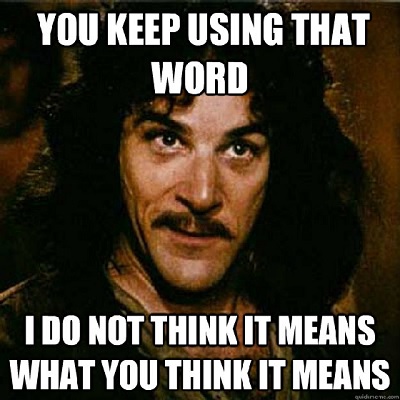
And then there's the "radical pope". If ever there was a time for the "you keep on using that word" meme, surely it is when the word radical is applied to the leader of the largest hierarchy on the planet.

In what way is this pope radical? He has said some things. He has made some statements.

Pope Francis has declared that Catholic priests will temporarily be allowed to absolve the sin of abortion without obtaining special permission from a bishop. And media hailed this as the Church softening its stance on abortion!

Absolution? The Pope should be begging our forgiveness for the untold number of women who have died from illegal abortions, the orphans and desperately poor children whose mothers were denied contraception, the families forced into poverty by the Church's own policies. The Church offers a brief amnesty for women who exercised their human rights? Fuck you.

Pope Francis has made some statements against unchecked capitalism and in sympathy with the world's poor. Has the Church renounced its immense, tax-exempt wealth in order to feed the hungry world?

"God weeps," said this Pope, at child sexual abuse, and similar statements of contrition that survivors have heard from two popes before him. Pope Francis praised his bishops' handling of the sex abuse crisis, only to back down after an outcry from survivors and advocates. One more "carefully choreographed" statement. One more nothing. If survivors themselves had not risen up and demanded the world hear them, the Church would still be playing whack-a-mole with pedophile priests.

Pope Francis has acknowledged that LGBT people are human beings, and perhaps will not suffer eternal damnation for leading their own lives. Gee thanks, Pope.

There is no doubt that Pope Francis has changed the tone of a tone-deaf institution that is decades, if not centuries, behind the times. Because liberation movements - of women, LGBT people, indigenous people, sexual abuse survivors - have changed our very world, the Church was finally forced to acknowledge modernity.

But he has altered nothing of substance, and certainly has not moved one iota towards radical change.

This pope name-dropped the great radical leader Dorothy Day, much as every US politician quotes Martin Luther King, Jr. But besides his speeches in the US, what did Pope Francis actually do? He canonized Father Junípero Serra, a Spanish priest who was actively complicit in the genocide of indigenous peoples of North and South America.

Yet this change of tone and some heartfelt conciliatory speeches are enough for the media - including much alternative media - to hail Pope Francis as a Great Bringer of Change.

Mass amnesia

I watched in wonder as liberal USians hailed Obama as the Great Bringer of Change, then had their hearts broken, as per usual. Yet now, less than a decade later, they appear to be hypnotized again.

Bernie Sanders will not save us. Pope Francis will not save us. We are the people we have been waiting for. If we want radical change, we have to band together and create it ourselves. Idle No More. Occupy Wall Street. Fight for 15. The member organizations of 350.org. Food Inc. No One Is Illegal. Marinaleda. Los Indignados. And a million other groups - groups without names, groups without media coverage - groups of people, acting collectively. This is the way forward.

Vote for Sanders in the primaries. Then dutifully vote for Hillary for president. And wonder why nothing ever changes.

7.28.2015

35 survivors of cosby assaults speak out in new york magazine

In a powerful show of courage, strength, and feminist solidarity, 35 women (of the 46 total) who have officially accused Bill Cosby of sexually assaulting them share their stories in New York magazine.

Read, watch, listen.

5.31.2015

action bronson, hate speech, and protest: rape culture vs. freedom of speech

As part of the NXNE concert series in Toronto, rapper Action Bronson was slated to perform a free concert in Dundas Square. Bronson is apparently known for lyrics and videos that degrade women and glorify rape. He has also bragged about assaulting a trans woman. Many people felt that this performer was inappropriate for a headliner act and a free event in the heart of Toronto.

A petition was circulated calling for NXNE to cancel the Dundas Square show. Eventually they did. Their statement says they will try re-book Action Bronson as a ticketed event in a different venue.

That seems like a good decision.

However, I was less disturbed by another misogynist shock act than by some of the reaction I read on Facebook, from friends and their contacts. It seems that many progressive people believe that what Action Bronson does should be illegal. Others believe that even speaking in support of such expression should be illegal. I find that deeply troubling.

The people in this discussion seemed not to distinguish between a hate crime and hate speech - or indeed between expression and act, at all.

Most were willing to concede that expression condoning and celebrating rape is not the same as rape itself. But because this expression contributes to rape culture, because it perpetuates and normalizes violence against women, it should be illegal.

I recognize rape culture. I resist it and I detest it. And that's one reason I believe we shouldn't criminalize speech.

Shutting down hate speech doesn't make hate go away. But it does shut down all possibility of education. It allows the speaker to play the victim. It may make our society more polite and pleasant - on the surface - but it does nothing to further a society where all women are valued as equals. And inevitably, it will be used against us.

Throughout history, laws banning or criminalizing expression have been used by the powerful against the less powerful, by the dominant culture against the minority. That's why gay literature was labelled as pornography and banned, while male-dominated, heterosexual porn flourished. It's why the Harper Government can call David Suzuki an extremist, and try to ban criticism of the state of Israel.

When speech and expression are curtailed, history shows us who suffers: radicals, dissidents, peace activists.

If we want to be free to protest and to express political views that are offensive to the powerful, we should be prepared to defend potentially offensive expression for everyone. Criminalizing any expression threatens all expression - and it threatens progressive activists most of all.

And what of fantasy? For many, erotica/porn includes bondage, simulated rape, and all manner of acts that would be criminal if nonconsensual. And of course these acts are depicted in literature, photography, video, and the like. Many people find it triggering and offensive. Shall we ban that, too? (Or is it only offensive if it subjugates women?) If we roll back that clock, all our rights are going with it.

Here is some of the Facebook conversation. Indented text is quoted from commenters. I'm quoting liberally in order to not quote out of context, with my own comments below.
If he wrote that song for an individual, and sent that video to them in the mail, it would be considered a hate crime. So what's the difference between that, and releasing his song to the public? The fact that it's not targeted to an individual? His hate is targeted towards the entire female gender. I think we're talking bullshit loopholes and technicalities here.
Protection of public expression is much more than a technicality. If an individual is targeted - threatened, harassed - that is a crime. (Although not rape. Still not rape.) But we distinguish between those private, targeted actions and public expressions - songs, movies, books, poetry, video. In my view, people must be allowed to express whatever they want in those forms, and not do so in fear of arrest.
Hate speech impedes on people's right to live a life free from worry of abuse. You can't be pro freedom of anything if you support hate speech because it prevents people from having certain freedoms - one of those freedoms is the right to feel safe. Bronson's lyrics are hate speech and add to the pre-existing rape culture problem that is plaguing our society. Bronson also publicly admitted to assaulting a trans woman and misgendering her. THIS IS AN ACT OF VIOLENCE. He's a white man whose violent, misogynistic lyrics and music video imagery specifically target women of colour. . . . The KKK are still allowed to have their say, and operate under the guise of "freedom of speech" and look what's happening! You have cops who are KKK members on the Ferguson police force spreading their views and encouraging whites to shoot up innocent black kids by constantly portraying them as thugs. They get away with it because the media has done everything in its power to instil anti blackness into the minds of whites and non-black people of colour.

The freedom to protect hate speech under the guise of freedom of speech only benefits and serves the white rich cis straight able bodied man. They do not suffer from any forms of systematic oppression.
In the society described above, which I readily recognize as reality, which hate speech is more likely to be protected, "Women are bitches" or "Death to cops"? Once certain expression is illegal, who defines and decides what stays and what goes?

Commenters also noted that the expression in question is without artistic value. That may be true, but in my opinion that is (a) subjective and (b) irrelevant. One person's erotica is another person's smut, and to someone else, it's all garbage.

Other commenters noted that speech that promotes rape culture is as bad as rape. What can I say. It takes a luxury of ignorance to express such hyperbole, and it minimizes the trauma and suffering of every rape survivor.

Some commenters mentioned the general offensiveness of the Action Bronson act. Well, freedom of expression is easy if you're raising money for kids with cancer or posting cute puppy videos. Freedom of expression is tested when the expression is most offensive. A society that values freedom of expression allows space on the fringes. A society that values conformity and politeness more than free speech narrows the field.

That's when I realize that Canadians, as a society, do not really value freedom of expression. They value a quietly polite society, where hate is ignored and so said not to exist.
A few of my classmates were having a discussion about "Game of Thrones" One of the women said "I don't like the show, it glorifies rape." One of the men responded, "what is the big deal, rape is everywhere..." The fact that those words flowed so easily from his tongue..... I am an artist, a woman and someone who has been victimized. Free speech, like art, comes with responsibilities and to abuse that freedom is demonstrating a reckless disregard for others. THAT is a crime. It is no different, in MY opinion, than knowingly getting in a car and driving while drunk.
Criminalizing speech completely shuts down the possibility of education. If we arrest the man who said "What's the big deal about rape?" we lose all opportunity for dialogue, not just with that one man, but with every person who now must suppress his or her speech in order to avoid arrest.

These rape-culture thoughts don't go away, but they remain unchallenged. All the arrest teaches is forced conformity. As much as "what's the big deal about rape" pains me deeply, I would rather that thought be expressed openly - I would rather see an atmosphere cultivated where people are free to express any thought - so those thoughts can be challenged, examined, and potentially changed. Perhaps the person who expressed the thought would not be changed, but some listeners to the debate might be.

There is also the very huge issue of who decides what speech is criminal. In our society, it will usually be people like Stephen Harper.
but I think if enough people boycott and protest against his music, it will send the message that this type of hate speech is not tolerated.
Boycott and protest? Absolutely! We should, and we must. But if the expression is declared illegal and banned, we lose the opportunity to protest. We lose a huge opportunity for education. Plus the speaker becomes the victim. The only thing we gain is not having to hear something - but those thoughts are still in the person's brain and heart. The hate hasn't gone away.

* * * *

Update. Some of the people involved in one of the several conversations that led to this post feel they were misrepresented, even ambushed. I believe they think I participated in the Facebook conversation as research for my own writing. This is being characterized as deceptive and hypocritical, and contrary to my own principles of free speech.

The reality: after the discussion on Facebook, I had more to say, but - not wanting to use someone else's Facebook page as my own soapbox any more than I had already - I went to my own venue to continue writing.

This post reflects nothing more than my desire to express myself further. People often leave one venue to discuss ideas further elsewhere, both online and in person. It's not unusual, and certainly not duplicitous.

The opinions quoted and referred to in this post are culled from several different Facebook threads. The indented quotes were copied and pasted directly from one thread, but I found those opinions echoed many times over in many places.

I note, too, that one friend retracted her call for Action Bronson to be prosecuted for hate speech, and felt my blog post should reflect her changed opinion. I note that most people who I saw expressing this opinion did not similarly retract it.

I am inviting the parties who believe themselves misrepresented in this post to explain themselves further in comments. We'll put all their comments through moderation, and of course all wmtc readers will be free to respond.