3.19.2008

five years in

Every year since I started blogging, I've posted something on March 19 to mark the anniversary of the United States' invasion of Iraq. But after listening to Winter Soldier off and on for four days, and reading and thinking so much about the war all week, this morning I was at a loss. I had to look away.

Then tonight I went to a Campaign meeting, full of plans and strategy, full of humour and hope, and it brought me back to myself.

The Campaign is going well, and we may soon have a positive resolution. But meanwhile, we lost another resister. James Burmeister, who was wounded in Iraq and suffers with both physical and emotional scars, turned himself in. James is being held in Ft. Knox, Kentucky, and will likely face court martial. He is not being treated for any of his medical conditions. In fact, we've heard he's being treated very badly.

James had lived in Ottawa for the past 10 months, and was involved in our lobbying efforts. Swift actions by the Liberals could have secured his home in Canada.

James has the complete support of his family, who live in Oregon. His father writes:
On March 4 this year, after months of struggling with PTSD [Post-traumatic stress disorder] and homesickness, James turned himself in to the army. James yearns to heal. There are many, many thousands of other young men and women like my son, needing the support of their own communities, more than anything else. Their knowledge of the true cost of war, the destruction of the human spirit is what we must keep in our hearts. Words alone cannot stop this war. Passionate action by all of us will.

If you want to show your support, James' father asks you to:

• Call Fort Knox, Kentucky and request that Private First Class James Burmeister be released ASAP. Voice your concerns for his medical condition (PTSD) and demand that the public be made aware of the army’s intentions regarding any court-martial he may be facing, and that we be told what sort of discharge the army will be handing him. Demand that this Iraq war veteran be recognized for his courage to not perform illegal or immoral acts and that he be released with a MEDICAL discharge so that he may be able to afford the medical treatments he will likely require for the rest of his life to address his PTSD symptoms. Calls can be directed to Commander: Major Pitcher (502) 624-6247.

• Write a letter of support to James' Congressman in Eugene, Oregon, Mr. Peter DeFazio. DeFazio has publicly stated his opposition to the war in Iraq and is sympathetic to James' cause. Your letter might mention:
- that you are concerned about James’ medical condition
- that you feel that war veterans and conscientious war objectors like Private First Class James Burmeister should not be punished for speaking out against illegal, unethical and immoral acts
- that you are concerned with the treatment James is receiving at Fort Knox and that you request that the Congressman closely monitor the army’s treatment and out-processing of James and their resolution of his case. Letters can be mailed to:
Mr. Peter DeFazio
405 East 8th Avenue, #2030
Eugene, Oregon 97401
USA
Voice: 541.465.6732
Fax: 541.465.6458

* * * *

On the way home from the meeting tonight, I listened to Bruce Springsteen's "Magic". This song always makes me think of the resisters - my friends and, in many ways, my heroes.
We took the highway till the road went black
We'd marked, Truth Or Consequences on our map
A voice drifted up from the radio
And I thought of a voice from long ago

Who'll be the last to die for a mistake
The last to die for a mistake
Whose blood will spill, whose heart will break
Who'll be the last to die for a mistake

The kids asleep in the backseat
We're just counting the miles, you and me
We don't measure the blood we've drawn anymore
We just stack the bodies outside the door

Who'll be the last to die for a mistake
The last to die for a mistake
Whose blood will spill, whose heart will break
Who'll be the last to die for a mistake

The wise men were all fools, what to do

The sun sets in flames as the city burns
Another day gone down as the night turns
And I hold you here in my heart
As things fall apart

A downtown window flushed with light
"Faces of the dead at five"
Our martyr's silent eyes
Petition the drivers as we pass by

Who'll be the last to die for a mistake
The last to die for a mistake
Whose blood will spill, whose heart will break
Who'll be the last to die

Who'll be the last to die for a mistake
The last to die for a mistake
Darlin' your tyrants and kings fall to the same fate
Strung up at your city gates
And you're the last to die for a mistake

wmtc on common dreams

My recent post about not watching the Beijing Olympics, with some slight tweaks, is now on Common Dreams.

what i'm watching: in the valley of elah, redacted

The two Iraq-related movies I most wanted to see this Movie Season were "In The Valley of Elah" and "Redacted". "Elah" was excellent, and appropriately disturbing. We saw "Redacted" last night. I was also interested in this because, as I mentioned here, I used to know Brian De Palma, sometimes hung out with him, so I keep an eye on his work.

Redacted was the most disappointing, over-rated movie I have seen in long, long time.

I was actually scared to see this movie. It's based on a true story: when some American soldiers gang-raped and murdered a 14-year-old Iraqi girl, and murdered several of her family members in an attempt to cover their crime. Brian De Palma plus rape plus Iraq? I thought it might be too violent for me, too graphic, too brutal.

I needn't have worried. Either De Palma purposely kept his penchant for graphic on-screen violence under wraps or he's lost his touch. Although the incident it portrays is horrendous, the movie itself is not particularly disturbing.

It's also not well written, well acted or compelling to watched. I was shocked at how juvenile and stilted the dialogue sounds. Everyone is either a stock character or a billboard for ideas De Palma wanted to work in. Some of it was downright silly.

I was also very bothered by De Palma's attempts at "balance", portraying the violence from all sides as equally wrong.

If another country invaded New York City or Los Angeles, set up bases and checkpoints, held Americans under constant guard, harassed them with random humiliations and violence, and a few enterprising New Yorkers or Angelenos managed to pick off a few of the invaders with guns or bombs, would those Americans be terrorists, too? No. They would be hailed as heroes. Their violence would, to most people, be justified.

Whatever violence the Iraqi so-called insurgents do to Americans, it's terrible for the soldiers and their families, but it's the US' fault for being in Iraq in the first place.

There's no balance here. There was an invasion, now there's an occupation. The people trying to expel the invaders are not the moral equivalents of the invaders themselves.

Apparently, for De Palma, this balance extends even to the peace movement. A fictional anti-war website in which a peace protester rants about wanting to torture American soldiers is disgusting and offensive to me. If there are people in the peace movement like that, I've never met one.

Redacted made a huge buzz at last year's Toronto International Film Festival, as its producers (Canadians Jennifer Weiss and Simone Urdl) had some trouble getting certain images past their distributor. The subject matter and De Palma's name fed the hype.

But I was disappointed to find it was only hype, and not much else.

Movie Season - that stretch of time between the World Series and Opening Day - is coming to a close. This year I'm going to post a wrap-up of all the movies we saw, using my own personal rating system. It's sure to offend some people, and hopefully we'll have some fun with it, too.

let them stay: washington post on war resisters support campaign

There's a long feature in the Washington Post on the resisters and the campaign. The writer hung out at meetings and did in-depth interviews with both resisters and campaigners. Here are the results.
In from the cold they come, gangly young men and graying grandfathers alike, filling a downtown church with the kind of polite anticipation more befitting an afternoon wedding than an antiwar rally. Banners dangle from the choir loft, bearing the same appeal as the T-shirts for sale in the foyer: "Let Them Stay."

Lee Zaslofsky bustles from pew to pew, an anxious organizer making sure everyone is in place on a recent Saturday -- the politicians and academics, the musicians, the pacifists, and a handful of runaway American soldiers seeking refuge in Canada.

Zaslofsky, 63, knows each of the latter by both name and need. There is Jeremy Hinzman, the first one to seek asylum here, in limbo for four years now. And Phil McDowell, the computer geek whose patriotism was put to the test in Baghdad. And Patrick Hart, the veteran worried about lost medical benefits for his sick son. All found their way to Zaslofsky and the quasi-underground network he runs for AWOL Americans crossing the border with little more than what they can fit in a duffel bag.

"You should know, I do love you," he assures each one. "I'm a Vietnam resister."

Across Canada, the remnants of a lost counterculture are rising up again as hundreds of aging draft dodgers reluctantly leave the quiet comforts of their anonymous lives to help an estimated 200 Iraq war deserters who fled north with no promise of asylum.

In truth, they share little beyond the difficult choice they made to forsake their citizenship, and the timeless debate whether theirs was an act of courage or cowardice. What they believe, where they came from, and how they ended up here are as different as 1968 and 2008.

Now this small, tentative band of unlikely brothers, two generations of American resisters, struggles to both find and forget its common ground.

* * *

"You're being stop-lossed!"

Phil McDowell tried to absorb his wife's frantic news in June 2006 that the Army was rescinding his discharge. ...

Full story here. More campaign news soon.

3.18.2008

grandmothers for peace arrested while trying to enlist

grandmas4peace

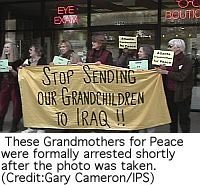
As part of actions across the United States to mark the fifth anniversary of the U.S. invasion of Iraq in 2003, 10 "Grandmothers for Peace", ranging in age from 57 to 80, were arrested Monday while trying to enlist in the United States Army. Acts of civil disobedience are planned this week in at least 17 other U.S. cities.

As exclusively observed by IPS, the Grandmothers for Peace entered the Army Recruiting Station at the Midtown Place Shopping Centre in Atlanta, Georgia at around 9:30 am. The women broke up into three groups, each approaching a different recruiter's desk to engage them in questions.

"When do you get the bonuses? Do you get them right away?" a Grandmother asked.

"You guys are on a fishing expedition to catch people in lies," declared one recruiter, who said her name was "Ms. Reed".

"What we're doing is, we're very much against the Iraq war. We'd like for you to let us enlist," said Bobbie Paul, 58, executive director of Atlanta Women's Action for New Directions.

"We have to make sure people are physically pre-screened," said a recruiter named Kevin Wells.

"Could we enlist today? So the youth don't have to go? Can you give us a list of jobs?" Paul persisted.

"There are regulations we have to follow, set by the government, as far as entry and recruiting," Wells responded.

"Would you take me? I'm 80," said Doris Benit of Kennesaw, Georgia.

"Me personally? Absolutely! But as far as the Army, there is a process," Wells answered.

Read more here.

Also, more terrific JeffR photos from World Against War in Toronto.

why i won't watch the beijing olympics

beijing 2008


I've been meaning to post about China and the Olympics for a long time. Now China's current military crackdown in Tibet has given me an excuse to focus on it.

I clearly remember learning that Beijing would host the 2008 Olympics, how stunned, and disgusted, and betrayed I felt. With that, any lingering illusions I had about the International Olympics Committee were stripped away. Giving the Olympics to China was the final admission of how political, corrupt, and morally bankrupt the IOC is.

In 1980, the United States and Canada boycotted the Moscow Olympics because of the 1979 Soviet invasion of Afghanistan. Japan, West Germany, China, and a few other countries joined the boycott; other countries made protests statements but didn't boycott.

A boycott of the Olympics because of an invasion. Seems kind of quaint now, doesn't it?

No one wants to piss off China. No wants to risk losing that powerful trading partner and access to all those cheap goods. Doing business with China means "staying competitive" - that is, ignoring the labour, safety, consumer and environmental standards your own country has built. And buying "Made In China" lets us all extend our standard of living. We buy artificially cheap products, and never count the true costs.

It's easy to sell cheap when you run sweatshops, dump untreated contaminants into the environment, have zero safety or health standards, and zero quality control.

So the western world, with its massive corporate and consumer power, doesn't just stay out of China's way. We reward China with the Olympics.

* * * *

No one blog post can detail China's many abuses. But although I can't do justice to the subject, I should at least give it a shot. So here, in no particular order, is why I won't be watching the 2008 Beijing Olympics.

  • Tibet: China's continuing occupation of this sovereign, peaceful nation.

  • Darfur: China is Sudan's largest trading partner and the main foreign investor in its oil industry. Most Western oil companies, under pressure from human rights organizations, have withdrawn from Sudan. And although we know that economic isolation and divestment can have a very powerful, positive effect (think South Africa), China continues to do business with Sudan, enabling slavery and genocide.

  • China: The list of China's abuses of its own people is a long and shameful one.

    -- China executes more of its citizens than the rest of the capital-punishment countries combined and doubled. While China has a much larger population than those other countries, its rate of execution is still disproportionate. China has more capital crimes, and is believed to have more hidden executions and political executions, than any other country in the world.

    -- China jails (and also executes) thousands of activists, political dissidents, journalists, and ordinary citizens who attempt free expression. Reporters Without Borders is a good source for civil liberty and human rights abuses in China, as is Human Rights Watch.

    -- China's labour laws are a sad joke. Factory conditions sound like something out of Dickens or Upton Sinclair.

    -- China pollutes water, air and soil with impunity, poisoning and sickening its citizens for generations to come.

    This is the country that has been rewarded with the 2008 Olympic Games.

    Some people believe that the international attention brought by the Olympics can be used to leverage change. Do they really believe that? Or they don't care, and only use this as lip service?

    In the entire history of the universe, has change ever been made, anywhere, by giving a reward before anything has changed?

    If you want to teach your child, or your dog, or your partner, that they must change their behaviour, do you hand them a huge reward, then ask them to change?

    It's pretty basic. It's Psychology 101. If the IOC wanted to use the Olympics to effect change, it would have told China: clean up your act, and we'll consider you for future games. Here's a list of specific changes we want to see. You might have gotten the Olympics, but we won't reward you as long as you continue these crimes.

    * * * *

    An effective consumer boycott of Chinese products is virtually impossible. What's more - as we learned in the pet food scandal - many products labelled Fabriqué au Canada and Made In USA only get their final assembly or processing in those countries, with parts and materials that originate in China. Unless China is forced to deal humanely and fairly with workers, the environment and consumers - or unless North American businesses are forced into a trade embargo - or both - Chinese products will always undersell those made in North America. And we want to buy everything as cheaply as possible, so we can buy, buy, buy, more, more, more.

    There are scattered calls to boycott the Beijing Olympics but they don't get any traction. Not because it's too late. Because no one wants to piss off China.

    I'm just having my own boycott. I usually glue myself to the Olympics. This year my TV will stay off.


    Photo from Reporters Without Borders, thanks to James.
  • 3.17.2008

    palast on why spitzer was set up; greenwald on why the crime is not a crime

    I have two posts percolating, things I've been thinking about for a while; I need to find the time to flesh them out. So while I do that, please read this important expose by Greg Palast.
    While New York Governor Eliot Spitzer was paying an 'escort' $4,300 in a hotel room in Washington, just down the road, George Bush's new Federal Reserve Board Chairman, Ben Bernanke, was secretly handing over $200 billion in a tryst with mortgage bank industry speculators.

    Both acts were wanton, wicked and lewd. But there's a BIG difference. The Governor was using his own checkbook. Bush's man Bernanke was using ours.

    This week, Bernanke's Fed, for the first time in its history, loaned a selected coterie of banks one-fifth of a trillion dollars to guarantee these banks' mortgage-backed junk bonds. The deluge of public loot was an eye-popping windfall to the very banking predators who have brought two million families to the brink of foreclosure.

    Up until Wednesday, there was one single, lonely politician who stood in the way of this creepy little assignation at the bankers' bordello: Eliot Spitzer.

    Who are they kidding? Spitzer's lynching and the bankers' enriching are intimately tied.

    How? Follow the money.

    The press has swallowed Wall Street's line that millions of US families are about to lose their homes because they bought homes they couldn't afford or took loans too big for their wallets. Ba-LON-ey. That's blaming the victim.

    Here's what happened. Since the Bush regime came to power, a new species of loan became the norm, the 'sub-prime' mortgage and its variants including loans with teeny "introductory" interest rates. From out of nowhere, a company called 'Countrywide' became America's top mortgage lender, accounting for one in five home loans, a large chunk of these 'sub-prime.'

    Here's how it worked: The Grinning Family, with US average household income, gets a $200,000 mortgage at 4% for two years. Their $955 monthly payment is 25% of their income. No problem. Their banker promises them a new mortgage, again at the cheap rate, in two years. But in two years, the promise ain't worth a can of spam and the Grinnings are told to scram - because their house is now worth less than the mortgage. Now, the mortgage hits 9% or $1,609 plus fees to recover the "discount" they had for two years. Suddenly, payments equal 42% to 50% of pre-tax income. The Grinnings move into their Toyota.

    Now, what kind of American is 'sub-prime.' Guess. No peeking. Here's a hint: 73% of HIGH INCOME Black and Hispanic borrowers were given sub-prime loans versus 17% of similar-income Whites. Dark-skinned borrowers aren't stupid – they had no choice. They were 'steered' as it's called in the mortgage sharking business.

    'Steering,' sub-prime loans with usurious kickers, fake inducements to over-borrow, called 'fraudulent conveyance' or 'predatory lending' under US law, were almost completely forbidden in the olden days (Clinton Administration and earlier) by federal regulators and state laws as nothing more than fancy loan-sharking.

    But when the Bush regime took over, Countrywide and its banking brethren were told to party hearty – it was OK now to steer'm, fake'm, charge'm and take'm.

    But there was this annoying party-pooper. The Attorney General of New York, Eliot Spitzer, who sued these guys to a fare-thee-well. Or tried to.

    Read it here.

    Nicole Belle, writing in Crooks and Liars, notes that
    The whole Bear Stearns bail out is hilarious when you consider how horrified these 'free market' proponents are at the thought of say, socialized medicine, but barely bat an eye at socialized banking. Privatize profits and nationalize losses, anyone? Meanwhile, decades of Republican economic strategy has brought us to a recession, if not teetering on the edge of a depression (The similarities in the economy of the 1920s and today are there for the finding). What will be telling is what kind of bonuses will be handed out to Bear Stearns executives in light of this massive failure of management. [Go here for linkage.]

    And on both related and unrelated notes, you might want to read this column by Glenn Greenwald.
    Who cares if Eliot Spitzer hires prostitutes?

    Regarding all of the breathless moralizing from all sides over the "reprehensible," outrageous crimes of Eliot Spitzer: are there actually many people left who care if an adult who isn't their spouse hires prostitutes? Are there really people left who think that doing so should be a crime, that adults who hire other consenting adults for sex should be convicted and go to prison?

    Just as was true for moral crusaders David Vitter and Larry Craig, there is unquestionably a healthy chunk of hypocrisy in Spitzer's case, given that, as Attorney General, he previously prosecuted -- quite aggressively and publicly -- several citizens for the "crime" of operating an adult prostitution business. That hypocrisy precludes me from having any real personal sympathy for Spitzer, and no reasonable person could defend him from charges of rank hypocrisy. And he should be treated no differently -- no better and no worse -- than the average citizen whom law enforcement catches hiring prostitutes.

    But how can his alleged behavior -- paying another adult roughly $1,000 per hour to travel from New York to Washington to meet him for sex -- possibly justify resignation, let alone criminal prosecution, conviction and imprisonment? Independent of the issue of his hypocrisy -- which is an issue meriting attention and political criticism but not criminal prosecution -- what possible business is it of anyone's, let alone the state's, what he or anyone else does in their private lives with other consenting adults?

    Read it here.

    3.16.2008

    to everyone who has asked to be my friend on facebook

    To everyone who has sent me a friend request on Facebook: thanks, but no thanks.

    I'm not into Facebook. I wasn't into MySpace or LiveJournal, and I won't be into whatever comes after Facebook. I just don't care. Nothing personal. I care about you. I just don't care about Facebook.

    I registered because a Facebook URL showed up in my Statcounter, and I wanted to see who was linking to wmtc. That's a minor obsession of mine; I'll register anywhere to trace a link. I'll accept the friend requests as they come in. But that will be the sum total of my Facebook experience.

    As far as I'm concerned, Facebook is just another giant time-sucking machine. I already live with a constant feeling of never having enough time to do the things I want to do. Why would I add yet another use (or misuse) of my time? Most people I know share that time-pressed feeling... yet so many of them jump into The Next Online Thing. I don't get it. But each to her own.

    My online life happens in the blogosphere, and through email. And that's enough.

    follow-up: treasures of machu picchu still not in peru

    In September, I blogged about a historic agreement, in which Yale University would return thousands of Inca relics excavated at Machu Picchu from 1911-1915 by Yale history professor Hiram Bingham. These include mummies, ceramics and bones. Some are museum-quality pieces, others are mainly of archaeological interest. But all belong to Peru. Peruvians - and Peruphiles, like me - were excited about the news.

    But so far, the agreement is just a piece of paper. Eliane Karp-Toledo, whose husband, Alejandro Toledo, is a former president of Peru, wrote this in the New York Times. Emphasis mine.
    Sure, it seemed like a great idea when, last September, President Alan García of Peru reached a preliminary agreement with Yale about the disposition of more than 350 artifacts taken from Machu Picchu. Everyone hoped the settlement might be a break for cultural understanding in the cloudy skies of international cooperation. News reports suggested that Yale would return more than 350 museum-quality artifacts, plus several thousand fragments thought to be of interest mainly to researchers — all of which were taken from the mountaintop Inca archaeological complex nearly a century ago — and that legal title to all the artifacts, even those to be left at Yale for research, would be held by Peru.

    But having finally obtained a copy of the agreement, I can see that Yale continues to deny Peru the right to its cultural patrimony, something Peru has demanded since 1920.

    When, in 1912 and 1914-15, the explorer Hiram Bingham III excavated the treasures from Machu Picchu — ceramic vessels, silver statues, jewelry and human bones — and took them from Peru, it was supposed to be a loan for 12 months (a period that was later extended a half-year). The National Geographic Society, which co-sponsored Bingham's explorations, has acknowledged that the artifacts were taken on loan and is committed to seeing them returned to Peru.

    From 2001 to 2006, when my husband, Alejandro Toledo, was president of Peru, I participated in negotiations with Yale over the artifacts. Peru requested the return of everything Bingham had removed from Machu Picchu, and President Toledo, with the support of both the National Geographic Society and Senator Christopher Dodd, of Connecticut, discussed the request directly with the president of Yale, Richard C. Levin. Those talks broke down, however, when Yale refused to accept our first condition: recognition that Peru is the sole owner of the artifacts. The university also would not allow us to conduct an inventory of the pieces, under the pretext that the archaeologist we had selected was not qualified.

    The Peruvian ambassador in Washington tried to revive the conversation with Yale, but by early 2006, it was clear that the university was stalling for time. President Toledo left office in July 2006, and a little over a year later, the latest agreement was announced. Fortunately, a final agreement has been delayed.

    Under the "memorandum of understanding" between Yale and President García, Peru would promise to build a museum and research center in Cuzco, the city closest to Machu Picchu, where some of the collection would be displayed. Yale would act as adviser for the center, and would also be allowed to select which pieces would be released to the museum. Peru's sovereign right to the entire collection is not acknowledged, and it is clear that Yale would keep a significant proportion of the materials. Peru would still not be allowed to conduct its own inventory. Only when a museum has been built to Yale's specifications would even a portion of the materials return, allowing Peruvians to enjoy artifacts they have never seen.

    I fail to understand the rationale for Yale to have any historical claim to the artifacts. Bingham had no authority to transfer ownership to begin with. The agreement reflects a colonial way of thinking not expected from a modern academic institution. In fact, Yale has gone a step further than it did in its negotiations with President Toledo; the university is now brazenly asking to keep a significant part of the collection for research for an additional 99 years.

    I wonder if it is pure coincidence that Yale delayed negotiations with Mr. Toledo, Peru's first elected indigenous president, until Peru had a new leader who is frankly hostile to indigenous matters.

    Why is it so hard for Yale to let go of these collections after almost a century of loan default? It is time for Peruvian scholars and citizens — especially the indigenous descendants of those who led Bingham to the ancient complex — to have access to the collection.
    The present agreement should be discarded and new talks should begin, based on the recognition of Peru's sovereign right to all that was taken from Machu Picchu. Yale must finally return the artifacts that symbolize Peru's great heritage.

    Here is an earlier wmtc post on the Machu Picchu treasures, and colonial cultural theft.

    Several wmtc readers sent me this BBC story about a recent archaeological discovery in Peru. I thought it was amusing that the headline says the temple "could predate the Inca empire," as if that alone is a Big Thing. Pre-Inca sites are all over Peru; we saw them almost daily. Way to do your homework.

    Many thanks to AW1L for always thinking of his Peru-loving friend.

    world against war in toronto

    Some photos of yesterday's march and rally in Toronto:

    From Daily Dose of Imagery

    and

    Toronto photographer JeffR: part 1 and part 2.

    Also, your daily reminder: Winter Soldier. I've been listening off and on, and I can say whatever time you can tune in is valuable. Today is the last day of testimony, although the files will all be archived.

    3.15.2008

    pentagon keeps two sets of books

    When it comes to counting wounded American soldiers, the Pentagon keeps two sets of books. Why? To avoid paying their health care costs, of course. Emphasis mine.
    The number of wounded soldiers has become a hallmark of the nearly 5-year-old Iraq war, pointing to both the use of roadside bombs as the extremists' weapon of choice and advances in battlefield medicine to save lives. About 15 soldiers are wounded for every fatality, compared with 2.6 per death in Vietnam and 2.8 in Korea. But with those saved soldiers comes a financial price — one veterans groups and others claim the government is unwilling to pay.

    Those critics also say that the tens of thousands of soldiers wounded in Iraq are part of a political numbers game, one they say undermines the system meant to care for them. The most frequently cited figure is the 29,320 soldiers wounded in action in Iraq as of Thursday. But there have been 31,325 others treated for non-combat injuries and illness as of March 1.

    "The Pentagon keeps two sets of books," said Linda Bilmes, a professor at Harvard and an expert on budgeting and public finance whose newly published book, The Three Trillion Dollar War, was co-authored with Nobel Prize-winning economist Joseph Stiglitz. "It is important to understand the full number of casualties because the U.S. government is responsible for paying disability compensation and medical care for all our troops, regardless of how they were injured," Bilmes said.

    Veterans Affairs predicts it will treat 330,000 veterans from Iraq and Afghanistan in 2009 — a 14 percent increase over the 2008 estimate of 263,000 — at a cost of nearly $1.3 billion.

    For the 2009 budget, the White House requested $93.7 billion for the VA, including $41.2 billion for medical care for all veterans — not just those from Iraq and Afghanistan. That's an increase of $2.3 billion over the current budget.

    But critics say that is not enough for a system that has a backlog of about 400,000 pending medical claims and complaints, especially in mental health care.

    The VA "will not request enough resources to care for the troops — and in fact this is precisely what has happened in the past three years," said Bilmes.

    . . .

    But Bilmes says the VA is hoping to offset some of the costs through increased fees and co-payments — putting more of the burden for health care costs back on soldiers. [Full story here.]

    Five years on, and counting.

    leonard cohen with sonny rollins

    Look what else Greg Mitchell brings us! A clip of Leonard Cohen performing with Sonny Rollins, doing Cohen's "Who By Fire". This is beautiful, bluesy stuff. Rollins just gives me chills.


    Thanks to Mitchell, from his blog Pressing Issues.

    If Leonard Cohen appears in this blog, should it automatically get tagged "Canadian culture"?

    greg mitchell: eighteen things you've already forgotten about the media and iraq

    Greg Mitchell, the editor of Editor and Publisher magazine, is a clear, steadfast voice for peace - and for media responsibility. I've read Mitchell's excellent book on the death penalty, Who Owns Death?: Capital Punishment, the American Conscience, and the End of Executions, co-authored with Robert Jay Lifton, and his books about Upton Sinclair's EPIC Campaign and the US's denial of the truth about Hiroshima (also with Lifton) are on my long-term to-read list.

    Mitchell's new book is So Wrong for So Long: How the Press, the Pundits - and the President - Failed on Iraq. He wrote this for Mother Jones.
    In putting together my new book, So Wrong for So Long, on Iraq and the media, I revisited the good, the bad, and the ugly in war coverage from the run-up to the invasion through the five years of controversy that followed. Even though I monitored the coverage closely all along, I was continually surprised to come across once-prominent names, quotes, and incidents that had faded to obscurity. Here is a list of 18 of those nearly forgotten episodes, in roughly chronological order.

    1) The day before the invasion, Bill O'Reilly said, "If the Americans go in and overthrow Saddam Hussein and it's clean, he has nothing, I will apologize to the nation; I will not trust the Bush administration again, all right?"

    2) Phil Donahue lost his show at MSNBC, he later claimed, because he did not wave the flag enough. A leaked NBC memo confirmed Donahue's suspicion, noting that the host "presents a difficult public face for NBC in a time of war.... At the same time our competitors are waving the flag at every opportunity."

    3) After the fall of Baghdad, MSNBC's Chris Matthews declared, "We're all neocons now."

    4) The same day, Joe Scarborough, also on MSNBC, said, "I'm waiting to hear the words 'I was wrong' from some of the world's most elite journalists, politicians, and Hollywood types."

    5) The New York Times' Thomas Friedman wrote, "As far as I am concerned, we do not need to find any weapons of mass destruction to justify this war.... Mr. Bush doesn't owe the world any explanation for missing chemical weapons."

    6) President Bush's comedy routine during the Radio and Television Correspondents Dinner in Washington, D.C., on March 24, 2004, included a bit about the still-missing WMD. While a slide show of the president scouring the White House was projected on the wall behind him, he joked, "Those weapons of mass destruction have got to be somewhere...Nope, no weapons over there...Maybe under here?" Most of the crowd roared, and there was little criticism in the media in following days. Mother Jones' David Corn, then Washington editor of The Nation, was one of the few attendees to criticize the routine. Corn wondered if they would have laughed if Ronald Reagan had, following the truck bombing of our Marine barracks in Beirut, which killed 241, said at a similar dinner, "Guess we forgot to put in a stoplight."

    7) Who was the first mainstream editor/columnist to call for a U.S. pullout? It was the unlikely Allen H. Neuharth, founder of USA Today, who is certainly not known for expressing anti-war or liberal views. His May 2004 column drew wide reader protest but "the old fighting infantryman" (as the former soldier billed himself) stuck to his guns and penned a few more columns in that vein in the years that followed.

    8) When the New York Times carried its now-famous editors' note on May 26, 2004, admitting some errors in its WMD coverage, it appeared on page A10 and Judith Miller's name was nowhere to be found. The note is often described today as an "apology," but it was no such thing. On the day it ran, Executive Editor Bill Keller, not exactly chastened, called criticism of the Times' coverage "overwrought" and said that the main reason it even published the note was because the controversy had become a "distraction."

    9) Likewise, it's often said that the Washington Post also issued an apology. But the criticism of its prewar coverage came not in an editors' statement but in an article by the paper's media critic, Howard Kurtz. Post editors offered several defenses for the coverage and top editor Len Downie argued that it didn't make much difference anyway, because tougher coverage would not have stopped the war.

    10) Stephen Colbert's routine at the White House Correspondents' Association dinner in April 2006 is remembered for the in-his-face mockery of President Bush—but he also spanked the press, perhaps one reason his mainstream reviews were mixed at best. Addressing the correspondents directly, Colbert said, "Let's review the rules. The president makes decisions; he's the decider. The press secretary announces those decisions, and you people of the press type those decisions down. Make, announce, type. Put them through a spell-check and go home. Get to know your family again. Make love to your wife. Write that novel you got kicking around in your head. You know, the one about the intrepid Washington reporter with the courage to stand up to the administration. You know—fiction."

    11) In one of the purest "my bads" of the war, Fox News' John Gibson ripped Neil Young after the rocker released his protest album Living With War. Gibson demanded that Young go see the new United 93 movie and even offered to buy his ticket. Young, it was soon pointed out, had actually written one of the first 9/11 songs—"Let's Roll," about, you guessed it, Flight 93.

    12) Surprise: David Brooks, Thomas Friedman, and Oliver North all came out against the "surge" last January after it was announced by President Bush. George Will wrote a column titled, "Surge, or Power Failure?" And, after the botched hanging of Saddam, Charles Krauthammer declared, "We should not be surging American troops in defense of such a government."

    13) When Valerie Plame finally testified before Congress in March 2007, much of the media coverage focused on her appearance. Mary Ann Akers wrote a piece for the Washington Post titled "Hearing Room Chic," noting that Plame wore "a fetching jacket and pants" and should be played by Katie Holmes in the movie version of her story because they both favor Armani.

    14) On March 27, 2007, John McCain, referring to the supposed calm settling on Baghdad, said, "General Petraeus goes out there almost every day in an unarmed Humvee." This turned out to be pure bunk, but McCain quickly visited Iraq to try to prove his overall point. There, the Arizona senator went from the ridiculous to the maligned, touring a Baghdad market and claiming all was safe—while troops surrounded him and helicopters twirled overhead. Rep. Mike Pence (R-Ind.) likened the scene to "a normal outdoor market in Indiana in the summertime."

    15) In April 2007, CBS' Bob Simon admitted to Bill Moyers that his network should have dug deeper into the false claims on WMD. "I think we all felt from the beginning that to deal with a subject as explosive as this, we should keep it, in a way, almost light—if that doesn't seem ridiculous," he said.

    16) Contrary to popular belief, the New York Times, which had editorialized against the invasion, did not call for a change in course or the beginning of a withdrawal from Iraq until July 8, 2007.

    17) On Meet the Press in July 2007, David Brooks declared that 10,000 Iraqis a month would perish if the United States pulled out. Bob Woodward, also on the show, challenged him on this, asking for his source. Brooks admitted, "I just picked that 10,000 out of the air."

    18) Also in July 2007, an old clip of a C-SPAN interview with Vice President Cheney from 1994 surfaced, in which he defended the decision not to depose Saddam Hussein during Gulf War I: "Once you got to Iraq and took it over…then what are you going to put in its place?…It's a quagmire if you go that far and try to take over Iraq." He explained, "And the question for the president…was how many additional dead Americans is Saddam worth? Our judgment was, not very many, and I think we got it right."

    One of Allan's recurrent themes in his 9/11 Truth research is how the mainstream media reports bits of information, with no context, disconnected from any other related information, then moves on, and never mentions it again. A bit here, a bit here, reported on page 18 or 35, then another bit, in itself maybe curious, or marginally noteworthy, but viewed in context, potentially much more.

    One of the pitfalls of our lightning-fast information age is that we don't have time to process these bits and connect them. We can't keep up with all the stories, we don't read carefully enough, we quickly skim and move on. The mainstream media can't be bothered to piece together these contextless bits. (Of course that's just one of many problems with the mainstream media.)

    Everyone who records recent history and shows it to us, as Mitchell has done here, is doing important work. He is helping to fight fascism.

    [Insert today's plug for Winter Soldier here. That's what they're doing, too.]

    3.14.2008

    reminder: winter soldier

    Watch. Listen. Please set aside some time this weekend to bear witness.

    Winter Solider live feed.

    If you don't know about Winter Soldier, I first blogged about it here.

    Be part of this historic event.

    "no market for the information they obtain under torture"

    After Allan sent me this item from Newsweek, I looked for corroboration from Canadian sources, but everything I found came from this same story.
    The Canadian government is no longer using evidence gained from CIA interrogations of a top Al Qaeda detainee who was waterboarded.

    According to documents obtained by Newsweek, the Canadian Security Intelligence Service (CSIS), the country's national-security agency, last month quietly withdrew statements by alleged Al Qaeda leader Abu Zubaydah from public papers outlining the case against two alleged terror "sleeper" operatives in Ottawa and Montreal.

    The move, which so far has received no public attention, is the latest sign of potential international fallout from the CIA's recent confirmation that it waterboarded a handful of high-profile Al Qaeda suspects in 2002 and 2003. The use of waterboarding and other harsh interrogation techniques were approved by the Bush White House and Justice Department. Waterboarding, which critics charge is a form of torture, involves strapping a suspect to an inclined board and forcing water into his lungs, typically by pouring water through a cloth placed over his nose and mouth.

    The Canadian cases involve two men: Mohammed Harkat, an Algerian native living in Ottawa, and Moroccan-born Adil Charkaoui of Montreal. Both were arrested after the September 11 terror attacks and detained without charges on suspicions of links to Al Qaeda. Unable to develop enough evidence to bring criminal charges against either man, the CSIS sought to deport them on grounds that they had both allegedly spent time in Al Qaeda training camps in Afghanistan in the 1990s. (Both men now have been released on bail but remain under government scrutiny). [Full story with links here.]

    After some digging, I found this story in the Ottawa Citizen, from two weeks prior to the Newsweek story. After giving the background, it says:
    Mr. Harkat's lawyer, Paul Copeland, believes Mr. Zubaydah -- and Canada's failure to inquire about his treatment -- should be central issues in the government's case against his client. What's more, Mr. Copeland contends that CSIS' willingness to accept Mr. Zubaydah's statement without regard for his waterboarding evinces something that should trouble all Canadians: that its spy agency "turns a blind eye to torture." Mr. Copeland was so disturbed by what he considered CSIS' intentional disregard for human rights in the Zubaydah case that he lodged a formal complaint with the spy agency's federal watchdog in November 2005.

    That complaint triggered a two-year investigation by the Security Intelligence Review Committee (SIRC), which this week made public one version of its final report. That report offers a detailed -- and at times critical -- account of the spy agency's attitude toward torture as practised by other security and intelligence organizations.

    The presiding member of the review committee, lawyer Aldéa Landry, wrote: "Although I do not find evidence of a 'total lack of concern' on the part of CSIS regarding evidence obtained by torture, I find that at the time this complaint was made CSIS did lack specific policies aimed at eliminating any possible Canadian complicity in torture." Ms. Landry found that CSIS' concern focused on the impact that torture might have on the reliability of information, rather than how their use of that intelligence could violate Canada's treaty obligations to reject torture.

    "I find that CSIS is concerned with human rights, but nevertheless uses information obtained by torture," Ms. Landry concluded in the public version of her report.

    A secret version of her report made other, undisclosed findings.

    To many observers, however, the watchdog's public report raised almost as many questions as it answered: Does Mr. Zubaydah's waterboarding constitute torture in the eyes of CSIS? Will CSIS and federal lawyers continue to use his evidence? Does CSIS encourage torture by using information from mistreated suspects like Mr. Zubaydah? Alex Neve, secretary general of Amnesty International Canada, said CSIS cannot claim to be concerned with human rights if it continues to use information drawn from tortured suspects.

    "If those who torture find there is no market for the information they obtain under torture, that perhaps becomes one small piece of eradicating torture. But when they find a ready audience of intelligence officials, diplomats and military authorities willing to receive that information, and make use of it, then of course they're going to continue." CSIS spokeswoman Manon Bérubé noted that agency director Jim Judd has denounced torture as "morally repugnant." "CSIS does not knowingly use information which may have been obtained through torture," she insisted.

    CSIS has used information from Mr. Zubaydah against both Mr. Harkat and Montreal terror suspect Adil Charkaoui, both of whom are about to begin new hearings on the merits of their security certificates.

    The Supreme Court ruled last year that the process used in their previous hearings was fundamentally unjust.

    Mr. Neve contends the government cannot again rely on the "tainted" Zubaydah evidence because it was obtained through waterboarding, a practice that clearly fits within the treaty definition of torture.

    So if CSIS has dropped the statements obtained through CIA-sponsored torture, they've done so extremely quietly. A baby step in the right direction?

    a view to the inbox of a female sportswriter, or, why we still need feminism, part two

    A Day in the Email Inbox of the Female Sportswriter

    Thanks to Redsock.

    not in my name

    This is so offensive to me.
    "Now we have a mission that is not a Conservative mission, not a Liberal mission, but a Canadian mission," Bernier said.

    Sure, except for the Canadians who vote NDP, Canadians who vote Bloc, and millions of Canadians who voted Liberal and are bitterly disappointed by the party's constant capitulations. And probably more than a few Canadians who voted Conservative, too.

    2011 is a long way off. How many more will die?

    This weekend, join a demo, or find another way to stand for peace.

    Reminder: Winter Soldier. Listen. Watch.

    equity pay in ontario, or, why we still need feminism

    Antonia Zerbisias had a great column this week about equity pay - and the lack thereof - in Ontario.
    A woman's work is not only never done, it's never valued as highly as a man's.

    Ten years ago, the Ontario Public Service Employees Union announced that the average assistant teacher in child care centres was paid less than the average wage of a parking attendant.

    Do we value jockeying our cars more than caring for our kids?

    Nothing has changed.

    Today, on the 20th anniversary of Ontario's pay equity legislation, women are even seeing their wages shrink relative to men's.

    That's according to at least two major reports released last week.

    The first is Working Women: Still a Long Way from Equality by the Canadian Labour Congress. It shows that, in 2005, female fulltime workers earned, on average, $39,200 compared to men, who earned $55,700 – a wage gap of $16,500, or 42 per cent of a woman's paycheque.

    That means women earn 70.5 cents on the man's dollar, down from 72 cents just over 10 years ago.

    It's not that the women are less-qualified or educated than men. It's that there are still "pink ghettoes" on the job market, entire job classifications seen as not worthy of parking lot attendant wages.

    The second study, Putting Fairness Back Into Women's Pay, comes from the Ottawa-based Canadian Centre for Policy Alternatives. It accuses the Ontario government of shortchanging its own lowest-paid female workers.

    "It has failed to deliver approximately $78.1 million in pay equity adjustments owing to women for 2006-07," the centre says. "A further $467.9 million is owed from 2008-11. As a result, the government is now open to another Charter challenge (the last challenge forced the Harris government to pay up)."

    "This is the government with its own employees. It's outrageous," says NDP labour critic Cheri DiNovo.

    Both groups hope that when Ontario Finance Minister Dwight Duncan tables his budget on March 25, female government workers will get some of the surplus he will no doubt be crowing about. They also want women's issues – which by extension include child welfare, poverty and the well-being of seniors – to get serious consideration.

    Most important, they demand that pay equity enforcement measures be reinstated, to ensure employers comply with the law.

    The column is here, and in this blog post, you can read more.

    This reminds me, I didn't highlight Zerbisias' post on the C-484 vote. It's pretty much a round-up of what we've all been saying, but I thank her very much for writing so strongly about it. We are lucky to have her.

    a few brief thoughts about new york state

    In the whole mess going on in my home state, I just realized that David Paterson will soon be Governor. He's an excellent man whose career I have followed for a long time. I hope he's up to the job. It's such a crazy one.

    David Paterson will be the first African American Governor of New York State. He is also a person with a disability; he is blind. Of course, he's not the first person with a disability to hold that position, as FDR blazed that trail long ago.

    I was pretty shocked about Eliot Spitzer. A person who has built an entire career on fighting corruption - including prosecuting the clients of sex workers! - should perhaps make sure his glass house is in order. I always wonder what compels people to take such chances, when getting caught could ruin their lives.

    Ordinarily I would agree with the many people saying that this is a private issue, between Spitzer and his family, and he should not be forced to resign. However, when hypocrisy of this magnitude is exposed, the public official loses all credibility. In the super-heated atmosphere of Albany politics - one of the most cut-throat and dirty governments anywhere - it's difficult to hold any credibility. Once something like this breaks, the official is completely useless.

    Of course, Albany is completely useless anyway, but that's a separate issue.

    3.13.2008

    history lessons through letters to the editor

    The other day, I had a letter in the Globe and Mail about Mother's Day, itself in reply to another letter. Today, there's a reply to my letter, and it's excellent.
    Laura Kaminker states that "Mother's Day is a feel-good celebration of motherhood" (Not A Motherhood Issue - letters, March 12) and contrasts it with International Women's Day, which is "about all women - whether or not they are mothers - changing the world."

    The origin of Mother's Day in North America came from an anti-war Mother's Day Proclamation written in 1870 by U.S. feminist, suffragette and peace activist Julia Ward Howe. She began a one-woman peace crusade with her proclamation, which called on the women of the world to rise up against war.

    An excerpt from her proclamation shows her original words are as relevant today as in 1870: "Our sons shall not be taken from us to unlearn all that we have been able to teach them of charity, mercy and patience. We, the women of one country, will be too tender of those of another country to allow our sons to be trained to injure theirs."

    She sought to change the world; it is to our shame that we have allowed the historical origin of this special day to be co-opted by sentimental, commercial interests.

    Patricia Hartnagel
    Edmonton

    I am a big fan of Julia Ward Howe, and I'm very happy to learn this bit of American and women's history. If you happen to know Patricia Hartnagel, thank her for me.