It's Buster. His glaucoma has taken a sharp turn for the worse. I think it may be the end of the line. I'm too upset to write much more. Be back with the full story when I can.
Thanks in advance, I know you are pulling for us.
11.14.2005

risk, selection, justice
Remember back in the old days, when I used to post Paul Krugman columns all the time? Lest you think I've abandoned my columnist-hero, today our friend Mr Krugman is writing about health care.
But first, a few statistics, brought to you by the World Health Organization, courtesy of James, in comments.
But first, a few statistics, brought to you by the World Health Organization, courtesy of James, in comments.
WHO Core Health Indicators, US/CanadaAnd now back to the Krugman Show.
US: $5,274 on health care / $2,368 is government spending
Canada: $2,931 on health care / $2,048 is government spending
US: Infant mortality rate, both sexes (per 1000 live births) 7.2
Canada: Infant mortality rate, both sexes (per 1000 live births) 5.1
US: Under-5 mortality rate, both sexes (per 1000 live births) 8.0
Canada: Under-5 mortality rate, both sexes (per 1000 live births) 6.0
US: Adult mortality (per 1000) males 139
Canada: Adult mortality (per 1000) males 93
US: Adult mortality (per 1000) females 82
Canada: Adult mortality (per 1000) females 57
US: Life expectancy at birth (years) total population 77
Canada: Life expectancy at birth (years) total population 80
Health Economics 101Of course, beliefs that ignore rational thinking are staples in the US. But that's a post for another day.
By Paul Krugman
Several readers have asked me a good question: we rely on free markets to deliver most goods and services, so why shouldn't we do the same thing for health care? Some correspondents were belligerent, others honestly curious. Either way, they deserve an answer.
It comes down to three things: risk, selection and social justice.
First, about risk: in any given year, a small fraction of the population accounts for the bulk of medical expenses. In 2002 a mere 5 percent of Americans incurred almost half of U.S. medical costs. If you find yourself one of the unlucky 5 percent, your medical expenses will be crushing, unless you're very wealthy - or you have good insurance.
But good insurance is hard to come by, because private markets for health insurance suffer from a severe case of the economic problem known as "adverse selection," in which bad risks drive out good.
To understand adverse selection, imagine what would happen if there were only one health insurance company, and everyone was required to buy the same insurance policy. In that case, the insurance company could charge a price reflecting the medical costs of the average American, plus a small extra charge for administrative expenses.
But in the real insurance market, a company that offered such a policy to anyone who wanted it would lose money hand over fist. Healthy people, who don't expect to face high medical bills, would go elsewhere, or go without insurance. Meanwhile, those who bought the policy would be a self-selected group of people likely to have high medical costs. And if the company responded to this selection bias by charging a higher price for insurance, it would drive away even more healthy people.
That's why insurance companies don't offer a standard health insurance policy, available to anyone willing to buy it. Instead, they devote a lot of effort and money to screening applicants, selling insurance only to those considered unlikely to have high costs, while rejecting those with pre-existing conditions or other indicators of high future expenses.
This screening process is the main reason private health insurers spend a much higher share of their revenue on administrative costs than do government insurance programs like Medicare, which doesn't try to screen anyone out. That is, private insurance companies spend large sums not on providing medical care, but on denying insurance to those who need it most.
What happens to those denied coverage? Citizens of advanced countries - the United States included - don't believe that their fellow citizens should be denied essential health care because they can't afford it. And this belief in social justice gets translated into action, however imperfectly. Some of those unable to get private health insurance are covered by Medicaid. Others receive "uncompensated" treatment, which ends up being paid for either by the government or by higher medical bills for the insured. So we have a huge private health care bureaucracy whose main purpose is, in effect, to pass the buck to taxpayers.
At this point some readers may object that I'm painting too dark a picture. After all, most Americans too young to receive Medicare do have private health insurance. So does the free market work better than I've suggested? No: to the extent that we do have a working system of private health insurance, it's the result of huge though hidden subsidies.
Private health insurance in America comes almost entirely in the form of employment-based coverage: insurance provided by corporations as part of their pay packages. The key to this coverage is the fact that compensation in the form of health benefits, as opposed to wages, isn't taxed. One recent study suggests that this tax subsidy may be as large as $190 billion per year. And even with this subsidy, employment-based coverage is in rapid decline.
I'm not an opponent of markets. On the contrary, I've spent a lot of my career defending their virtues. But the fact is that the free market doesn't work for health insurance, and never did. All we ever had was a patchwork, semiprivate system supported by large government subsidies.
That system is now failing. And a rigid belief that markets are always superior to government programs - a belief that ignores basic economics as well as experience - stands in the way of rational thinking about what should replace it.
11.13.2005
what i'm watching: the rick mercer report report
I just watched the season opener of The Rick Mercer Report that Allan taped for me. The nicest thing I can say is that I'll give it several episodes, and not make up my mind based on this one. It was just... nothing.
As far as Mercer's famous rant segment, you folks who post here at wmtc are at least as smart and funny. Hell, Lone Primate and G could whip Rick's ass from here til next Tuesday.
But don't worry, I'll keep watching and see how it goes.
Some observations unrelated to quality.
The "My Riding" segment actually went somewhere I've been, the Danforth, which is an amazing coincidence, because I've mostly only been within a few blocks of my house. Mercer and Jack Layton also had a beer at a pub Allan and I have been to (and really enjoyed), thanks to a great recommendation from Marnie. We've been to like four places in all of Toronto, and this show goes to one of them. I thought that was great. (Thanks for not giving that away, you guys.)
Certain soon-to-be-Canadian-resident reader, please note, Mercer and Layton also visited the Oxi Parade on the Danforth, which Layton described as commemorating "the day the Greeks said no to the fascists". (Soon we will celebrate the day Canada said yes to Nick and Mason!)
And my final observation on the Rick Mercer Report: I understood all of it! Yay me.
As far as Mercer's famous rant segment, you folks who post here at wmtc are at least as smart and funny. Hell, Lone Primate and G could whip Rick's ass from here til next Tuesday.
But don't worry, I'll keep watching and see how it goes.
Some observations unrelated to quality.
The "My Riding" segment actually went somewhere I've been, the Danforth, which is an amazing coincidence, because I've mostly only been within a few blocks of my house. Mercer and Jack Layton also had a beer at a pub Allan and I have been to (and really enjoyed), thanks to a great recommendation from Marnie. We've been to like four places in all of Toronto, and this show goes to one of them. I thought that was great. (Thanks for not giving that away, you guys.)
Certain soon-to-be-Canadian-resident reader, please note, Mercer and Layton also visited the Oxi Parade on the Danforth, which Layton described as commemorating "the day the Greeks said no to the fascists". (Soon we will celebrate the day Canada said yes to Nick and Mason!)
And my final observation on the Rick Mercer Report: I understood all of it! Yay me.
pioneers
Two Israeli same-sex couples who were married in Canada are petitioning the Israeli high court to recognize their marriages.
In the Globe And Mail story about it, the couple credits Canada with lighting the spark in their quiet revolution.
In the Globe And Mail story about it, the couple credits Canada with lighting the spark in their quiet revolution.
It's a court fight that has already caused a kerfuffle in the more conservative corners of Israeli society and one that is sure to cause a much larger uproar should they win.Lawyers for both couples "praise Canada's decision to allow gays of any nationality to marry in Canada as "inspired" and something that will end up advancing gay rights around the globe."
Thanks to the liberal leanings of Israel's Supreme Court, the two men expect to do just that, and they are looking forward to the fallout. They credit Canada for giving them the chance to battle for their rights.
The court challenge touched off a heated call-in debate on Voice of Israel radio last week, with all agreeing that Canada had set something big in motion.
huge, frustrated, hopeless
"The riots have done for France what Hurricane Katrina did for the United States: They have revealed the existence of a huge, frustrated and hopeless underclass. What is most shocking is that France's social divide is, in some ways, worse than the one in the U.S."* * * *
The American right, which hates all things French, and the right in general (including Canadian), which hates all things Muslim, has been foaming at the mouth about the Paris riots. Apparently they are "Islamofascist" in origin (love that word! can we call the Cheney junta Christofascists?) and if the media isn't telling you that, it's because they're a bunch of liberal pansies afraid of offending the Muslim world. Or some bullshit like that.
Naturally the right (and most of the center) must automatically condemn riots of any kind, and immediately demonize the rioters. There couldn't possibly be anything to their anger. Nah. They're just trying to take over the world, but they're too stupid to see that burning cars is not a clear path to world domination.
Or something.
I hesitate to even link to the blogs I saw with this kind of bullshit. I don't want those bloggers over here. So Google yourself silly, or just trust me on this one.
I've been reading different perspectives on the French riots, especially seeking to understand if race or religion contributed much, if anything, to the situation. I've learned that, as is often the case, race is an issue, but more as a stand-in for class. Religion has nothing to do with it.
I found this column in Saturday's Globe And Mail particularly instructive. It's available online by subscription only, so I'm reprinting the whole thing here. It's worth reading. The Bill O'Reillys of the world, still boycotting France for reasons only known to them (and maybe not even that), might be surprised to see how much the US and this supposed enemy have in common.
Paris is burning, but race wasn't the real spark
By Doug Saunders
Paris - To see the future in any European city, you need to travel to the last stop on the subway, then drive a few kilometres farther. If you're in Paris, it is in these distant outskirts that you will discover the fatal computational error in that impressive formula -- capitalist wealth with generous social spending -- that makes up the fiercely defended "European social model."
This was plainly visible as I strolled through the bleak, featureless, concrete emptiness of the Cité des Trois Mille, a high-rise ghetto that was built as a socialist-utopian housing project for the new French working class of the postwar years, which exploded into the headlines this week as one of the first sites of paralyzing rioting. This charmless 'hood, whose population is more than 10 times the 3,000 suggested by its name, is a 180-degree inversion of the European success story.
The French dream, the one most visitors see on trips to Paris, combines the best of capitalism (high productivity and wages, job security, months of paid vacation) with the best of socialism (superb pension and maternity benefits, short working hours, excellent public education and health).
But life for the millions of young people in these blighted banlieues combines the very worst of capitalism (mass, permanent unemployment, exploitative casual work, no purchasing power) with the worst of socialism (hideous housing, oppressive police state, no choices).
"The kids here are fully French, they speak the language perfectly and consider themselves fully French, but they have nothing of the nicer things of French life -- the cafés, the culture -- none of that is available to them," my guide, a former resident of the area, said as she introduced me to the hollow-eyed young men who spent long hours "holding up the wall," staring into the middle distance and taunting any authorities who happened by. "For recreation in the evening, all they have to do is burn cars."
What is surprising is that this conversation took place not this week but more than a year ago, in the summer of 2004. The car-burning was already well under way: On Bastille Day, 2002, more than 90 cars were burned here; at New Year's in both 2003 and 2004, hundreds were burned. On most weekend nights, at least one plume of smoke can be seen. In many respects, the people in les Cités, as the high-rise slums are known, have been rioting for years. This season, they finally got noticed.
The riots have done for France what Hurricane Katrina did for the United States: They have revealed the existence of a huge, frustrated and hopeless underclass. What is most shocking is that France's social divide is, in some ways, worse than the one in the U.S.
This, after all, is the country that has fought the most aggressively to preserve its generous system of social benefits and its very expensive welfare state against threats from the European Union and the U.S.-influenced countries. It was in the name of "the social Europe" that France rejected the EU constitution this summer. No other major nation spends as much on social programs as France does: At least 52 per cent of the country's annual economic output is devoted to social spending. Canada spends about half that much.
So it has come as a huge shock, to French and foreigners alike, to discover that this system has produced so little value for the money. It has increased poverty and produced a huge and deeply unhappy permanent underclass of perpetually unemployed, poorly housed young people, most of them with brown or black complexions. How on earth can that be?
Nobody knows how many such people there are -- estimates claim there are 9.5 million fully disenfranchised, impoverished people, in a nation of 60 million. But they are a small part of a larger social problem: About 40 per cent of citizens of working age (18-64) have not had a job in the past year, and are entirely dependent on government support. More than 40 per cent of those jobless are permanently unemployed. (In Canada, the figure is around 10 per cent.)
This week, the headlines have emphasized the fact that the rioters are not white, and mostly are children or grandchildren of North African immigrants. Commentators on the right have been quick to blame the rioting on immigration and "multiculturalism" (a concept that effectively does not exist in France), while those on the left have blamed racism and the failure of integration.
Yet this does not quite add up: The rioters are not immigrants (even if their parents were); they are culturally assimilated and live their lives in fluent French. They do not want a separate cultural identity -- there has not been any sign of any Islamic or African cultural dimension to the protests. These are angry French people.
While it is undeniable that French society has a sharp and largely unspoken racial divide (you really do not see brown-skinned people with respectable jobs in France), the identity of the rioters is overshadowed by their very existence: Yes, the vast underclass is dark-skinned. But why should a country like France have a vast and unhappy underclass at all?
That question was posed this week by Agnès Poirier, a writer with the left-wing Paris newspaper Libération. She pointed out that those who attribute the crisis to matters of race are correct "only in part."
She asked: "What do we see when we look at the 'burning suburbs'? Dissatisfied youth with little education, hardly any job prospects, from poor and often broken families. Their misery is first of all social and economic. They are the French people who feel they are not represented by any political party, and especially not by the French left."
That is the core of the problem: In France, there is not a single political party, not even the radical branch of the opposition Socialist party, that represents the interests of this huge lumpenproletariat class. Quite the contrary: The agendas of all the parties appear harmful to the Cité-dwellers, and almost entirely designed to bring increasing comfort to the established working and middle classes.
While France redistributes more of its wealth in social spending than almost any nation, almost all of that money goes to the middle class and the better-off, employed branch of the working class -- the workers who get the 35-hour weeks and maternity packages, and don't live in the outskirts.
According to the Organization for Economic Co-operation and Development, only 27.6 per cent of France's social spending goes to the poorest third of the population. We can hardly gloat: In Canada, that number is only 22 per cent. In northern Europe, where such underclasses have not formed, it's around 40 per cent. And that spending, in France, is funded by regressive taxes that take proportionately more from the poor than from the better-off.
In effect, French voters have elected to build a huge concrete wall across their nation, said Parisian commentator Philippe Manière: "Those inside the wall have very good lives, and have good benefits, and guaranteed jobs. But their gains all end up hurting the millions of people who are kept outside the wall -- they have protected themselves and given themselves comforts at the expense of the other group of French citizens, who get nothing."
The 60 per cent of French citizens who live extremely well -- French "insiders" with perhaps the highest standard of living in the world -- are waking up this month to realize that their system is built on the shoulders of the deeply underprivileged 40 per cent.
The French right, under the Gaullist leadership of president Jacques Chirac, has been in power since 2002. Its reaction to this outsider class has been to brand its members criminals, making their lives more miserable. In his first six months in office, Mr. Chirac increased the French prison population by 12 per cent, spent nine billion euros more on the police and justice system, set up special, heavily armed squads in les Cités, and added 11,000 prison spaces.
This week, France's Interior Minister, the presidential hopeful Nicolas Sarkozy, reacted to the riots by cracking down violently. Dismissing the protesting youth as "riff-raff," he imposed the equivalent of a War Measures Act, responding with mass arrests and deportations. Such laws have effectively turned les Cités into more dismal prisons, driving their residents further from French society.
But the French left, even the radical branch of the Socialist party, is equally uninterested in the fate of the millions of people who are neither workers nor middle-class. Its accomplishments, during its periods of power in the 1980s and 1990s, made life enormously better for those who have lifelong work -- and functioned equally well to keep the underclass imprisoned in their concrete canyons.
The left's chief accomplishment in its last period in power was the 35-hour work week, which effectively gave the employed classes of France an extra month or two of fully paid vacation each year, on top of the five weeks or more that were already mandatory.
That policy also effectively prevented further jobs from being created, especially the sort of low-wage, but permanent, service-sector jobs that could have helped people in the suburban slums. Small- and medium-sized businesses almost immediately stopped adding extra staff. Large foreign companies lost interest in opening plants -- direct foreign investment in France plummeted.
Dozens of similar laws have created two classes of workers. Both Socialists and many Gaullists have become devoted to the rhetoric and policies of anti-globalization -- which, in practice, help to protect the middle classes and the comfortably employed, and harm the sub-proletarians on the outskirts of town, for whom trade and "McJobs" could only be beneficial.
"Above all else, French public policy has been designed to protect and improve existing jobs, rather than toward anything that could cause any new jobs to be created," said Timothy Smith, a professor at Queen's University in Kingston, Ont., whose prescient 2004 book France in Crisis has suddenly become a much-studied volume among the French elite.
France, he argues, believes itself to be a social-democratic, anti-American state, while its policies have led to the opposite of social democracy, and a race-and-poverty divide comparable only to that in the U.S. "The gap," he writes, "between the protected, the well-vacationed, and the unwanted on the outside grows wider each year."
In a country famous for having a revolutionary explosion every generation, this one has come as a complete surprise. It is hard not to feel strong admiration for the rioters: Spilling a minimum of blood, they have managed to awaken a myopic French society to the existence of a non-working class that had no name and no identity, that was ignored in the self-obsessions of the left and the right.
Perhaps France will one day be able to realize its revolutionary principles of liberty, equality and brotherhood, under the historic symbol of the burning car.
11.12.2005
the old lie
More thoughts on sacrifice.
Many thanks to orc of This Space For Rent.
My friend, you would not tell with such high zestRead the whole poem here.
To children ardent for some desperate glory,
The old Lie: Dulce et decorum est
Pro patria mori.
-- Wilfred Owen.
Many thanks to orc of This Space For Rent.
fooled again
Every so often, someone says I moved to Canada because I couldn't accept that the Democrats lost the 2004 election, that I am a "sore loser", and that no one should leave a country over who is president. Occasionally they throw in that they didn't like Clinton, but didn't leave the country when he was president. (How nice for them.)
I am forever explaining that we made the decision to emigrate long before the 2004 election, we filed our applications in early 2004, and we were leaving no matter who won. Liberals who briefly contemplated leaving the US after the last election - but who feel the election of John Kerry would have solved the problem - didn't go anywhere.
With that preface, I also say that the 2000 and 2004 "elections" figured prominently in our decision - but not solely because of the outcomes. Allan and I both believe that the US does not have fair and free elections. And if you don't have fair elections, what makes it a democracy?
(I used to blog about this all the time. There are lots of old posts if you feel like digging them up. Search for Black Box Voting.)
Through reading and observing, I've come to believe that the US is governed under a new form of fascism, one that retains the superficial appearance of democracy. We don't see tanks rolling down the street. There's no assassination or military coup. Elections aren't suspended - in fact, they're intensified. So the rest of the world, even the majority that knows the Cheney White House for what it is, is not unduly alarmed.
The citizens continue living their lives relatively undisturbed. They work, or try to, they struggle to support their families, they shop, they follow sports, they go to church, they watch TV. Ordinary life gets harder for many, softer for a few, but it continues. Activists, both left and right, continue to work on individual issues, judicial appointments or pending legislation. Sometimes they win, and are encouraged, and keep working.
Every four years, the circus comes to town. It appears to be an election. Hundreds of millions of dollars are spent, thousands of hours of air time used, untold words written and speeches made. About half the eligible population trots off to the polls, thinking they have voted.
But it's a sham. It's a stage set. And not just because neither party is working for real change. Because it's not really an election.
In Mark Crispin Miller's new book, Fooled Again, John Kerry says he knows the 2004 election was stolen, but feels that political expedience demands he keep quiet. As you probably know, Kerry has denied saying this. Those of us who know Miller's work know that Kerry absolutely must have said exactly what Miller says he did.
Bob Fitrakis and Harvey Wasserman wrote How The GOP Stole America's 2004 Election And Is Rigging 2008, and, with Steve Rosenfeld, What Happened In Ohio (to be published in the spring). Read their most recent story in The Free Press.
I am forever explaining that we made the decision to emigrate long before the 2004 election, we filed our applications in early 2004, and we were leaving no matter who won. Liberals who briefly contemplated leaving the US after the last election - but who feel the election of John Kerry would have solved the problem - didn't go anywhere.
With that preface, I also say that the 2000 and 2004 "elections" figured prominently in our decision - but not solely because of the outcomes. Allan and I both believe that the US does not have fair and free elections. And if you don't have fair elections, what makes it a democracy?
(I used to blog about this all the time. There are lots of old posts if you feel like digging them up. Search for Black Box Voting.)
Through reading and observing, I've come to believe that the US is governed under a new form of fascism, one that retains the superficial appearance of democracy. We don't see tanks rolling down the street. There's no assassination or military coup. Elections aren't suspended - in fact, they're intensified. So the rest of the world, even the majority that knows the Cheney White House for what it is, is not unduly alarmed.
The citizens continue living their lives relatively undisturbed. They work, or try to, they struggle to support their families, they shop, they follow sports, they go to church, they watch TV. Ordinary life gets harder for many, softer for a few, but it continues. Activists, both left and right, continue to work on individual issues, judicial appointments or pending legislation. Sometimes they win, and are encouraged, and keep working.
Every four years, the circus comes to town. It appears to be an election. Hundreds of millions of dollars are spent, thousands of hours of air time used, untold words written and speeches made. About half the eligible population trots off to the polls, thinking they have voted.
But it's a sham. It's a stage set. And not just because neither party is working for real change. Because it's not really an election.
In Mark Crispin Miller's new book, Fooled Again, John Kerry says he knows the 2004 election was stolen, but feels that political expedience demands he keep quiet. As you probably know, Kerry has denied saying this. Those of us who know Miller's work know that Kerry absolutely must have said exactly what Miller says he did.
Bob Fitrakis and Harvey Wasserman wrote How The GOP Stole America's 2004 Election And Is Rigging 2008, and, with Steve Rosenfeld, What Happened In Ohio (to be published in the spring). Read their most recent story in The Free Press.
a first
Ellen Johnson-Sirleaf has become the first female elected head of state in modern African history. Johnson-Sirleaf was elected president of Liberia yesterday. New York Times story here.
Liberia is a very poor country, only beginning to recover from decades of civil war. Charles Taylor, the former Liberian dictator, lives in exile in Nigeria. He has been charged with war crimes and crimes against humanity.
Liberia is a very poor country, only beginning to recover from decades of civil war. Charles Taylor, the former Liberian dictator, lives in exile in Nigeria. He has been charged with war crimes and crimes against humanity.
11.11.2005
eleven eleven
Of course it's November 11, Armistice Day, Veterans Day (US), Remembrance Day (Canada). It's understandably a much bigger holiday in Canada than in the US, since Canada really fought that nightmare war, not just popped in for a quick appearance at the end.
I'm not much for honouring veterans, although my heart is filled with sympathy for what they've endured. I've read a lot about World War I, mostly in novels like All Quiet On The Western Front, and Pat Barker's Regeneration Trilogy, among others. The war commemorated on November 11 is the perfect example of the utter futility of war, the utter horror it inflicts, planned by a ruling elite for their own purposes, but shouldered by working people, on both sides. (Remember Geoffrey Palmer scooping up those tin soldiers in Blackadder Goes Forth? The most heartbreaking bit of comedy I've ever seen.)
The best thing we could ever do to honour veterans to stop creating them. Work for peace.
I'm not much for honouring veterans, although my heart is filled with sympathy for what they've endured. I've read a lot about World War I, mostly in novels like All Quiet On The Western Front, and Pat Barker's Regeneration Trilogy, among others. The war commemorated on November 11 is the perfect example of the utter futility of war, the utter horror it inflicts, planned by a ruling elite for their own purposes, but shouldered by working people, on both sides. (Remember Geoffrey Palmer scooping up those tin soldiers in Blackadder Goes Forth? The most heartbreaking bit of comedy I've ever seen.)
The best thing we could ever do to honour veterans to stop creating them. Work for peace.
new rule
As of right now, we move to canada will no longer accept anonymous comments.
I'm sick of these stupid anonymous comments. I used to enjoy responding to them, and didn't mind deleting them if I found them early enough, but now I'm just finding them tiresome and irritating. I'm sorry if this inconveniences anyone. ALPF, please register! As ALPF, of course.
I'll see how this goes, and if I don't like it, I'll change it back. Thanks for understanding.
I'm sick of these stupid anonymous comments. I used to enjoy responding to them, and didn't mind deleting them if I found them early enough, but now I'm just finding them tiresome and irritating. I'm sorry if this inconveniences anyone. ALPF, please register! As ALPF, of course.
I'll see how this goes, and if I don't like it, I'll change it back. Thanks for understanding.
home
New York City is still there. It's still big and noisy and dirty, and I still love it, even though New Yorkers re-elected a mayor who seems to have nothing but disregard for them.
It was great to see friends and family. Everyone is doing well and I had fun all around. But I loved coming home. Home to our cozy little house, home to my loving partner and our wonderful dogs, but also home to Canada. I like showing my Permanent Resident card at the border, seeing the Maple Leaf, driving back on the QEW. Nice.
Two good things happened while I was gone.
V, our new dogsitter, had another successful Buster session. She came in while no one was home, leashed up the dogs and took them for a walk, all with no problems. This means Buster has fully accepted her - which means we're all set, we can go away for US Thanksgiving. Hooray! Patience, plus the advice of our great trainer in New York, paid off.
It's important for us to be able to go away without the dogs, but it's also wonderful for Buster to make new friends. I always felt bad that he lost his human friends when we moved. Cody will make friends with everyone and anyone, but Buster's circle is so small, his life is so restricted - I hated to take him away from anything that made him happy, from anyone he loved. So I'm very happy that he now has a new friend, a wonderful person who cares deeply about animals and really wants to bond with him. Plus we can get out of the house!
And it looks like my editors and publishers have gotten it together, and I can finally begin the next Ancient Civs manuscript. I haven't finished my Kids On Wheels assignment yet, because people I have to interview are lame and won't call me back, but I purposely kept my work for this issue very light. It shouldn't be a problem to juggle both until the KOW is finished, then concentrate exclusively on Ancient Civs. More about that as it develops.
Allan taped Rick Mercer, but - uh-oh - said it wasn't funny. I haven't watched it yet, but will soon. Was the season opener typical?
It was great to see friends and family. Everyone is doing well and I had fun all around. But I loved coming home. Home to our cozy little house, home to my loving partner and our wonderful dogs, but also home to Canada. I like showing my Permanent Resident card at the border, seeing the Maple Leaf, driving back on the QEW. Nice.
Two good things happened while I was gone.
V, our new dogsitter, had another successful Buster session. She came in while no one was home, leashed up the dogs and took them for a walk, all with no problems. This means Buster has fully accepted her - which means we're all set, we can go away for US Thanksgiving. Hooray! Patience, plus the advice of our great trainer in New York, paid off.
It's important for us to be able to go away without the dogs, but it's also wonderful for Buster to make new friends. I always felt bad that he lost his human friends when we moved. Cody will make friends with everyone and anyone, but Buster's circle is so small, his life is so restricted - I hated to take him away from anything that made him happy, from anyone he loved. So I'm very happy that he now has a new friend, a wonderful person who cares deeply about animals and really wants to bond with him. Plus we can get out of the house!
And it looks like my editors and publishers have gotten it together, and I can finally begin the next Ancient Civs manuscript. I haven't finished my Kids On Wheels assignment yet, because people I have to interview are lame and won't call me back, but I purposely kept my work for this issue very light. It shouldn't be a problem to juggle both until the KOW is finished, then concentrate exclusively on Ancient Civs. More about that as it develops.
Allan taped Rick Mercer, but - uh-oh - said it wasn't funny. I haven't watched it yet, but will soon. Was the season opener typical?
11.07.2005
southbound
I'm off this morning for my first trip back to the Old Country. I'll be staying at my mom's, also seeing my sister and her family, my dear friend NN and a certain dog-loving fan of wmtc.
Poor Allan, after working a 14-hour shift yesterday (and that after two 11-hour days) now has to drag himself out of bed to drive me to Buffalo. When I made the reservations, he didn't have the job yet.
So what will Redsock do while I'm gone? Will he (a) paint the accent wall in the bedroom, (b) attach the blades to the ceiling fan, (c) rent every episode of South Park on DVD, or (d) never leave his computer except for dog-walks? My guess is some combination of the above, involving South Park, computers and maybe, just maybe, a can of paint. We have a love-hate relationship with South Park. He loves it. I hate it.
Have a good week, everyone. I'll be back Thursday afternoon - and Allan is taping Rick Mercer.
Poor Allan, after working a 14-hour shift yesterday (and that after two 11-hour days) now has to drag himself out of bed to drive me to Buffalo. When I made the reservations, he didn't have the job yet.
So what will Redsock do while I'm gone? Will he (a) paint the accent wall in the bedroom, (b) attach the blades to the ceiling fan, (c) rent every episode of South Park on DVD, or (d) never leave his computer except for dog-walks? My guess is some combination of the above, involving South Park, computers and maybe, just maybe, a can of paint. We have a love-hate relationship with South Park. He loves it. I hate it.
Have a good week, everyone. I'll be back Thursday afternoon - and Allan is taping Rick Mercer.
11.06.2005
unpopularity, no contest
"The last time Canadians so disliked a U.S. president, the Americans were shooting at us," says pollster-author Michael Adams.
Lone Primate sent me this link about some smart Canadians.
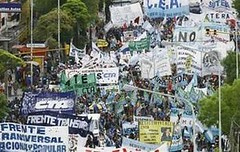
If you look carefully, you might catch a glimpse of Venezuelan President Hugo Chavez among the crowd. Chavez promised to leave the summit in between sessions to participate in an alternative People's Summit. Along with the former Argentinian football star Diego Maradonna, Chavez will lead a protest march against W. Story from The Independent (UK) via Common Dreams. The Independent writer asks, "Can you imagine one of the leaders at the G8 summit slipping out between sessions, through the security cordon, to join in a street demonstration of bearded anoraks against the summit's most powerful participant...?"
The People's Summit was held from November 1 through 5; it ended yesterday. You can read some reports about it here (a Canadian site).
Lone Primate sent me this link about some smart Canadians.
America and the U.S. government are less popular in Canada today than any time since polls were first conducted in this country in the 1930s. To find similar anti-American sentiment, you'd probably have to go back to the federal election of 1911, when Wilfrid Laurier's espousal of trade reciprocity with the United States cost him re-election.Back in February, I posted a photo of smart Germans, and of course I used to blog about smart New Yorkers all the time. Today, here are some smart Argentinians, protesting against W before the fourth Summit of the Americas in Mar del Plata, Argentina.
The public-opinion trends do not augur well. In 1981, the year Ronald Reagan was inaugurated, seven per cent of Canadians told us they had an unfavourable opinion of the U.S., while 10 times that proportion (72 per cent) reported a favourable impression of our southern neighbour. Today the proportion reporting an unfavourable impression is 48 per cent, and the proportion reporting a favourable opinion is down to 50 per cent.
We are talking here of America as a country, not the administration of George W. Bush. Favourable opinion of the United States has been eroding gradually over the years, but its decline accelerated sharply when W. was first elected in the fall of 2000. And if his Republican administration was unpopular in 2000, it was anathema in 2004.
In 2000, 29 per cent of Canadians would have voted for Mr. Bush had they had the opportunity. Forty-eight per cent would have voted for Democratic candidate Al Gore. By 2004, Mr. Bush was down to 15 per cent in Canada, and John Kerry would have garnered 70 per cent of the Canadian vote. George W. Bush is probably the least popular president of the United States in Canada since James Madison led his country in the War of 1812.
If you look carefully, you might catch a glimpse of Venezuelan President Hugo Chavez among the crowd. Chavez promised to leave the summit in between sessions to participate in an alternative People's Summit. Along with the former Argentinian football star Diego Maradonna, Chavez will lead a protest march against W. Story from The Independent (UK) via Common Dreams. The Independent writer asks, "Can you imagine one of the leaders at the G8 summit slipping out between sessions, through the security cordon, to join in a street demonstration of bearded anoraks against the summit's most powerful participant...?"
The People's Summit was held from November 1 through 5; it ended yesterday. You can read some reports about it here (a Canadian site).
11.05.2005
november
Still no sign of that famous Canadian winter. Yesterday it reached a balmy 17 degrees here in the GTA. For you Fahrenheit readers, that's about 62 F, lovely weather for November. (Lovely weather for any time if you ask me!) I went for a long walk, this time following the Waterfront Trail west instead of east.
I've just about reached the limit of Waterfront Trail I can explore in comfortable walking distance from our house, making a one-hour loop. Soon I'll have to start driving to different spots on the trail and walking from there. Depending on the weather, this might happen next Spring.
I bought a whole set of trail maps from the Waterfront folks. Yes, I know you can print out sections from .pdfs, but I wanted the entire trail. It would cost more in ink cartridges than it would to purchase them, and the quality wouldn't be as good. They came in a spiral binder with a plastic cover.
As the leaves fall, I'm making plans for winter exercise, either buying a treadmill or joining a pool. I can exercise at home with no problem, and if I'm just going to walk on a treadmill and use weights, I'd just as soon skip the driving and do it at home. Only one thing could sufficiently motivate me to get in my car to exercise, and that's swimming.
I'm in the midst of investigating my swimming options. The Mississauga YMCA has a pool, and it's not far from me; there are also pools at two nearby high schools that have some public hours. I'll be checking those out soon.
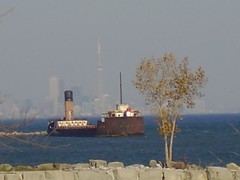
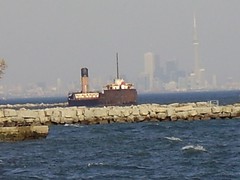
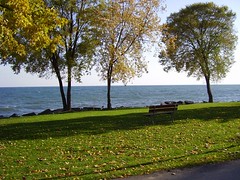
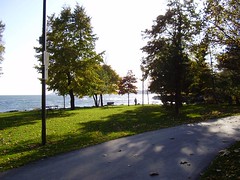
Meanwhile, here are some scenes from yesterday's walk.

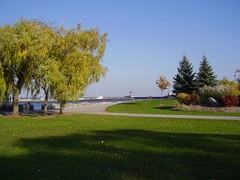
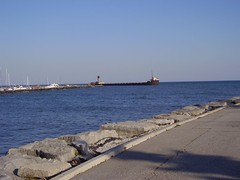
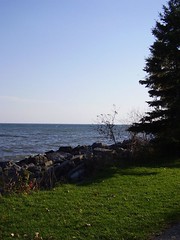

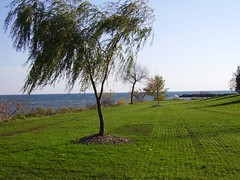
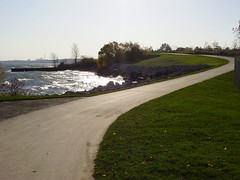
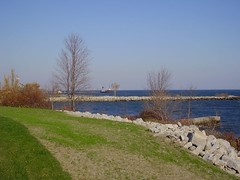
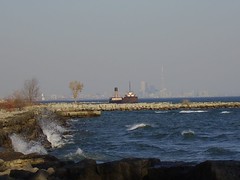
Many streets in Port Credit end at little parks like this,
and the parks connect with the Waterfront Trail.

I love cute little houses like this.
They're plentiful around here, scattered among the McMansions.
I've just about reached the limit of Waterfront Trail I can explore in comfortable walking distance from our house, making a one-hour loop. Soon I'll have to start driving to different spots on the trail and walking from there. Depending on the weather, this might happen next Spring.
I bought a whole set of trail maps from the Waterfront folks. Yes, I know you can print out sections from .pdfs, but I wanted the entire trail. It would cost more in ink cartridges than it would to purchase them, and the quality wouldn't be as good. They came in a spiral binder with a plastic cover.
As the leaves fall, I'm making plans for winter exercise, either buying a treadmill or joining a pool. I can exercise at home with no problem, and if I'm just going to walk on a treadmill and use weights, I'd just as soon skip the driving and do it at home. Only one thing could sufficiently motivate me to get in my car to exercise, and that's swimming.
I'm in the midst of investigating my swimming options. The Mississauga YMCA has a pool, and it's not far from me; there are also pools at two nearby high schools that have some public hours. I'll be checking those out soon.
Meanwhile, here are some scenes from yesterday's walk.
Many streets in Port Credit end at little parks like this,
and the parks connect with the Waterfront Trail.
I love cute little houses like this.
They're plentiful around here, scattered among the McMansions.
11.04.2005
what i'm watching: 22 minutes, royal canadian air farce
This Hour Has 22 Minutes is funnier than Royal Canadian Air Farce.
So far I've seen three episodes of 22 Minutes, and they've all made me laugh. Air Farce is batting .000. I haven't laughed once.
I hope this means I can still be Canadian? Please don't send me back there.
So far I've seen three episodes of 22 Minutes, and they've all made me laugh. Air Farce is batting .000. I haven't laughed once.
I hope this means I can still be Canadian? Please don't send me back there.
zealotry
In a recent comment, Kyle_From_Ottawa posted a link to an essay examining anti-Americanism, nationalism and the difference between hating what a government does and hating its people. The author also looks at how the rabid right uses that confusion to its advantage.
As we frequently discuss anti-Americanism here at wmtc - how to define it, whether it's plentiful in Canada - you might want to take a look. It's worth reading.
As we frequently discuss anti-Americanism here at wmtc - how to define it, whether it's plentiful in Canada - you might want to take a look. It's worth reading.
"quietly imploding"
I get so tired of hearing the Canadian health care system slandered by Americans who don't know what the hell they're talking about. It's not like they make valid points that can be discussed and debated. They simply don't know what they're talking about, because they are informed solely by myths.
As onomatopoeia said (I recently quoted him here): "Sure the Canadian system has its own problems, but if you want to know what those problems are, ask any Canadian, not an American."
The way most Americans talk about Canada's health care, you'd think everyone south of the 49th parallel had affordable, accessible, expert care. We know far too many lack the first two criteria. What about the third?
From the Washington Post, with thanks to Redsock:
As onomatopoeia said (I recently quoted him here): "Sure the Canadian system has its own problems, but if you want to know what those problems are, ask any Canadian, not an American."
The way most Americans talk about Canada's health care, you'd think everyone south of the 49th parallel had affordable, accessible, expert care. We know far too many lack the first two criteria. What about the third?
From the Washington Post, with thanks to Redsock:
Americans pay more when they get sick than people in other Western nations and get more confused, error-prone treatment, according to the largest survey to compare U.S. health care with other nations.Read the article here.
The survey of nearly 7,000 sick adults in the United States, Australia, Canada, New Zealand, Britain and Germany found Americans were the most likely to pay at least $1,000 in out-of-pocket expenses. More than half went without needed care because of cost and more than one-third endured mistakes and disorganized care when they did get treated.
Although patients in every nation sometimes run into obstacles to getting care and deficiencies when they do get treated, the United States stood out for having the highest error rates, most disorganized care and highest costs, the survey found.
"What's striking is that we are clearly a world leader in how much we spend on health care," said Cathy Schoen, senior vice president for the Commonwealth Fund, a private, nonpartisan, nonprofit foundation that commissioned the survey. "We should be expecting to be the best. Clearly, we should be doing better."
Other experts agreed, saying the results offer the most recent evidence that the quality of care in the United States is seriously eroding even as health care costs skyrocket.
"This provides confirming evidence for what more and more health policy thinkers have been saying, which is, 'The American health care system is quietly imploding, and it's about time we did something about it,' " said Lucian L. Leape of the Harvard School of Public Health.
The new survey, the eighth in an annual series of cross-national surveys conducted by Harris Interactive for the fund, is the largest to examine health care quality across several nations during the same period. The survey was aimed at evaluating care across varying types of health care systems, including the market-driven U.S. system and those that have more government controls and subsidies.
The survey, published in the journal Health Affairs, questioned 6,957 adults who had recently been hospitalized, had surgery or reported health problems between March and June of this year.
secrets and lies
This is another post in my periodic series about Wal-Mart, and the disgusting, anti-human business practices of the US's largest employer. (My first Wal-Mart post was here, here's one that started a discussion, and here's a recent JibJab cartoon. There's a bunch of others, too. If you're a Wal-Mart Watcher, you can search the archives.)
Last week, I received this email from Wal-Mart Watch:
Last week, I received this email from Wal-Mart Watch:
On Wednesday, the New York Times broke the story of a secret Wal-Mart Board of Directors memo obtained by Wal-Mart Watch. Today, just 24 hours later, millions of people around the world are discovering the true ruthlessness of Wal-Mart's business practices.Here's how to get involved. And of course, spread the word.
Wal-Mart tries hard and spends an unbelievable amount of money to make us believe that they treat their workers like family. We've all seen the television commercials and will see many more in the days and weeks ahead. But we've shattered this myth once and for all.
The secret memo reveals the complete disregard - if not outright hostility - with which Wal-Mart's executives view their more than 1.3 million employees in the US. It confirms facts that Wal-Mart has long denied, including that 46% of the children of Wal-Mart's U.S. employees are uninsured or on Medicaid.
To remedy Wal-Mart's healthcare crisis, the memo lays out plans to:
- Cut spousal benefits
- Hire more part-time employees and encourage faster turnover
- Discourage older and unhealthy people from working at Wal-Mart by requiring more jobs to require physically challenging tasks such as collecting carts and stocking shelves
Read the secret Wal-Mart memo here and join the discussion about it on our blog.
We leaked the memo to the New York Times on the heels of a media blitz by Wal-Mart about its latest plan to offer more affordable employee healthcare benefits. But as this memo proves, yet again, Wal-Mart is ignoring the true crisis of their uninsured and underinsured employees. It's more than a moral crisis, it's one that costs you and all American taxpayers billions each year.
11.03.2005
missing pieces
Hey, it's wmtc's second hockey-related post! (I'm counting my Don Cherry post.)
I read in today's Toronto Star that a former NHL coach and general manager has made what are usually called "startling revelations" in his new autobiography.
More significant, to me, is Demers's admission that he and his mother were abused by Demers's father. Every adult - especially every man - who speaks out about childhood abuse helps to fight domestic violence. Demers, whether he realizes it or not, is reaching out to other abuse survivors, as well as to abusers. Making the overlooked connection between abuse and educational success is positively brilliant.
I especially admire and appreciate this openness when it's found in the world of professional sports. It's a priceless opportunity to reach men, and to make a small crack in the armour of traditional masculinity that causes abuse.
New York Yankees manager Joe Torre has also spoken openly of the abuse he and his mother survived. Torre has made domestic violence his own cause, starting a foundation that raises awareness, does outreach, and helps survivors.
To people involved in the anti-violence movement, Torre's work is monumental. Forty years ago, no one ever spoke openly about childhood and familial abuse. Only twenty-five years ago, it was still often referred to as "wife-beating," and regarded as aberrant behaviour of the lower classes. Athlete foundations generally raise money for non-controversial causes like cancer research. That Torre can use his high profile to join the fight against domestic violence is both a sign that our world has changed, and a great leap forward.
Never doubt the courage it took for Torre and Demers to admit they were beaten - and to ask other men to check their own violent impulses. Never doubt how much it means to other male survivors who are listening. I promise you the stadiums are full of them.
For more information on domestic violence, try here, here and here.
I read in today's Toronto Star that a former NHL coach and general manager has made what are usually called "startling revelations" in his new autobiography.
Jacques Demers, a coach and later a general manager in the NHL for 15 years, admits he is illiterate.Hidden illiteracy among adults is more common than you might think - at least in the US it is. Taking a quick look online, I found lots of sites promoting adult literacy, so it must be an issue in Canada, too.
That and other revelations about the life of one of the NHL's more colourful coaches is revealed in a biography in French released yesterday called Jacques Demers En Toutes Lettres, which roughly translates as "Jacques Demers From A To Z."
The book was written by Journal de Montreal desk editor and former Montreal Canadiens beat writer Mario Leclerc.
Demers said at a gala book launch that his inability to read and write resulted from an impoverished childhood. His father beat and psychologically abused Demers and his mother.
"All I wanted from my father was to treat me with love," Demers said. "Not to beat me up when I did something wrong. Not to beat up my mom. It really hurt me because he took away my childhood.
"The other thing I wanted to say was that if I could not write or read, it was because I had so much of a problem with anxiety because of the things going on in the family. I couldn't go to sleep at night. I'd go to school and I couldn't learn anything.
"So the message is, leave the kids alone. Don't beat them up. They're defenceless. Don't beat up their mom in front of the kids."
It is remarkable that Demers was able to coach the Quebec Nordiques, the St. Louis Blues, the Detroit Red Wings, the Montreal Canadiens and the Tampa Bay Lightning, where he was also general manager in the late 1990s, without being able to read or write.
Only a few people knew of his problem. He finessed his way through most of it, he says in the book, by asking secretaries and media relations people to write letters for him, saying his English wasn't good enough.
More significant, to me, is Demers's admission that he and his mother were abused by Demers's father. Every adult - especially every man - who speaks out about childhood abuse helps to fight domestic violence. Demers, whether he realizes it or not, is reaching out to other abuse survivors, as well as to abusers. Making the overlooked connection between abuse and educational success is positively brilliant.
I especially admire and appreciate this openness when it's found in the world of professional sports. It's a priceless opportunity to reach men, and to make a small crack in the armour of traditional masculinity that causes abuse.
New York Yankees manager Joe Torre has also spoken openly of the abuse he and his mother survived. Torre has made domestic violence his own cause, starting a foundation that raises awareness, does outreach, and helps survivors.
To people involved in the anti-violence movement, Torre's work is monumental. Forty years ago, no one ever spoke openly about childhood and familial abuse. Only twenty-five years ago, it was still often referred to as "wife-beating," and regarded as aberrant behaviour of the lower classes. Athlete foundations generally raise money for non-controversial causes like cancer research. That Torre can use his high profile to join the fight against domestic violence is both a sign that our world has changed, and a great leap forward.
Never doubt the courage it took for Torre and Demers to admit they were beaten - and to ask other men to check their own violent impulses. Never doubt how much it means to other male survivors who are listening. I promise you the stadiums are full of them.
For more information on domestic violence, try here, here and here.
11.02.2005
open
Congratulations, Ontario, on taking a big step towards basic equality and civil rights. Adopted people in Ontario now have the same right to know their background as everyone else.
My old post about this is here. From today's Star:
My old post about this is here. From today's Star:
Supporters sobbed, cheered and embraced one another yesterday as the Ontario government finally passed controversial legislation to unseal the province's adoption records after what proponents of the bill consider 80 years of secrecy and shame.
New Democrat member Marilyn Churley, a birth mother and long-time champion of changes to Ontario's adoption laws, bowed her head and wiped away a tear as the votes were counted, aware that her 10-year battle for change was at an end.
"This is a very emotional issue, partly because it's an issue that we've been working on for so long and it's finally come to pass," a flushed and beaming Churley said after the legislation passed third reading by a substantial 68-19 margin.
Social Services Minister Sandra Pupatello, the principal architect of the legislation, walked across the floor of the legislative chamber after the vote to embrace her NDP rival, whose own numerous efforts to get a similar bill passed always seemed to fail on the cusp of a vote.
"We worked a long time to get it right," Pupatello said later.
But it will take months to spell out the mechanics of how adoptees and birth parents alike will be able to access original or current birth certificates and the vital details they contain.
There have been 250,000 adoptions in Ontario since record-keeping first began, with nearly 73,000 names listed on a voluntary provincial registry.
In several months, the province will launch an intensive ad campaign across Canada and in neighbouring U.S. states to alert people to the changes to adoption law, Pupatello said. The new bill won't be proclaimed into law for another 18 months.
The changes will allow adoptees to learn their original name and birth parents the current name of the child they gave up. Such details can prove to be key information to tracing their ancestry and ultimately locating and reuniting a long-lost parent and child.
All 19 votes against the legislation came from the Opposition Conservatives, who want a so-called disclosure veto allowing anyone to keep their records sealed if they so desired.
The passage makes Ontario the fourth province to open its adoption records, joining British Columbia, Alberta and Newfoundland. But Ontario remains the only province in Canada without a disclosure veto.
The legislation allows parents and adoptees alike the option to request they not be contacted, but to keep their records sealed they would need to prove to a tribunal that unsealing their files would cause harm.
Conservative Leader John Tory, who voted for the legislation in principle when it came to second reading, said the privacy measures in the final bill simply aren't enough.
"They're wholly inadequate in that they force people in extraordinary circumstances to come forward and beg and plead for their privacy rights," he said.
One adoptee has vowed to fight the law in court, saying it violates his Charter right to privacy.
Subscribe to:
Posts (Atom)