9.11.2009

shut up and vote

During my first year or so in Canada, I was repeatedly mystified by hearing, over and over, how the populace did not want an election. We don't want a Christmas election, we're too busy with the holidays. We don't want a summer election, we're all at the cottage. We don't want a winter election, it's too cold to go out and vote. We don't want another election, we just had one 18 months ago.

For the life of me, I could not understand it. I once asked readers what this meant. Were people really so busy with Christmas plans that they couldn't spare a few minutes to vote?

Readers told me, no, that wasn't it. It's that their minds are elsewhere. They don't want their family celebrations interrupted. They are out of the country, in warmer climes. They will punish the party that calls an unnecessary election. (If only that had happened in 2008!) They cannot focus on the important issues at hand, can't study their ballots and decide who to vote for. (You can see the answers on this old post.)

The answers did nothing to clarify the issue for me.

You know where you stand on various issues, right? Which party comes the closest to your point of view? Vote for them. No?

It took me a while to realize that Canadians complain about elections. Period. It doesn't matter when they happen or why. Canadians and the media that purport to reflect their views whine about elections. I still don't know why, but I no longer attempt to figure it out.

A corollary to this are the Liberal partisans who defend their party's spinelessness and lack of principles by declaring that an election is unnecessary "at this time". Whenever I would cry out in frustration over Dion or Ignatieff playing coalition partner to the Harper Conservatives, inevitably, a Liberal blogger would stop by to deliver the familiar refrain: "There's no point in having an election just for the sake of an election. It's not the right time. When it's the right time, the Liberals will bring down the Government."

But three crucial words were always omitted. "When it's the right time for the Liberals."

I liked Rick Salutin's take, especially regarding the media's complicity and the transparent hypocrisy of "making Parliament work".

Come on, Canadians. Just shut up and vote.
Suck it up, Canada: What are we – shoppers or citizens? A portion of each, I suppose. But it's fatal to confuse the roles, as seems to be happening with all the whinging and whining over "another" election that "nobody" wants.

Prime Minister Stephen Harper was the first to moan in, right after Liberal Leader Michael Ignatieff announced his intention to pull the plug on the Conservatives' minority government. Iggy had a list of plausible enough reasons that would more likely lead you to ask him Why did you wait so long? than What for? The PM's response was that he hasn't met "a single Canadian" who wants an election, which may only reveal the limited range of his contacts.

Yet many in the news media echoed it. I think at random of Suhana Meharchand on CBC Radio's phone-in last Sunday, chortling over the silliness of another election. I may have gone humourless, but I don't really get it.

In a vital democracy, like ancient Athens or the Iroquois confederacy, people were involved in politics continually. Under our system, politics more or less equals elections, so you could call frequent elections our form of participatory democracy. It keeps citizens engaged and parties on their toes. Under a stable majority, everyone goes to sleep for four years. Do you think we'd have had even the minimal action we've seen from Mr. Harper on the economy or on withdrawal from Afghanistan if he'd had a majority?

But everything turns upside down if you treat politics as a shopping trip – I don't waaant an election – rather than the ongoing duty of each citizen. It's like newscasters saying, "Thanks for watching," as if we tune in to do them a favour, rather than from our need as citizens to be informed. Citizenship isn't a consumer choice that you may or may not make. People can opt out of it, but then they lose the right to complain, and it's a mingy choice to make if you think of kids and others affected by actions taken in the name of us all.

Besides, if these whiners really don't want an election and prefer Parliament "to work," why did so many of them object to a coalition last winter? It was the very definition of making Parliament work in a minority situation. I don't think minority governments are inherently unstable; I'd call them inherently alert. The current one has indeed been unstable since it's so distant from the majority of members in the House and voters in the country. But, say, a Liberal minority could well find enough common ground with the Bloc and NDP to enact many things that most citizens would value.

It's the snickering and eye-rolling among media opiners that I find most offensive, as if their stance is so sophisticated. In fact, they function as dupes for a rotten status quo, helping to keep power in the hands of those who can afford to pay for it by getting others, like the party bosses, to fulfill their wishes. There is wreckage to be dealt with out there, lives are still being destroyed, although the recession is supposed to be all but over. My little strip of College Street in Toronto now has a solid row of abandoned small businesses such as we've not seen in previous crises. It's become a street of broken dreams. Add the fact that voting numbers are declining, which the pseudo-wit of the moaners tends to glamorize. The downward trend reduces the constituencies to which politicians must attend, and ratchets up the electoral clout of the resolute pressure groups, such as evangelicals and gun owners.

If there is a problem with another election, it's that voting is all we're ever offered to satisfy our political impulses, and it is a repetitive and intrinsically shallow exercise. But this implies that we should vote for those ready to expand the arena of democratic participation so that we need not shoehorn the entire human political drive into the narrowness of elections.

war resister fleeing homophobic persecution appeals to federal court

This happened while I was away, but perhaps you missed it, too.
A lesbian who deserted the U.S. army argued before the Federal Court in Ottawa on Tuesday that she should be allowed to remain in Canada as a refugee.

Pte. Bethany Smith, also known as Skyler James, is seeking a judicial review of a decision by the Immigration and Refugee Board to reject a refugee claim. Smith said she feared for her life due to the treatment she received in the army as a result of her sexual orientation.

"I had to endure not only verbal and physical harassment, but death threats and harassment letters on my door every day," Smith told reporters Tuesday outside the court. Following the hearing, she said she was staying positive and hoping for the best.

Smith, who now lives in Ottawa, said she was treated as "less than human" by other soldiers at the base in Fort Campbell, Ky., after they saw her holding hands with another woman at a local mall and found out she was a lesbian. One soldier who worked with her on the base's fleet of vehicles would pick her up, shake her and throw her to the ground on a daily basis, she told CBC News.

"There were sergeants standing around laughing with him," she added.

She also received anonymous hate mail at her door every night, she said, including one letter that warned: "We will suffocate you in your sleep."

Smith later learned that a gay soldier had been beaten to death in his bed with a baseball bat at the Fort Campbell base in 1999.

Discharge denied

Fearing for her life, she asked her first sergeant for a discharge, which is usually granted automatically to soldiers who admit to homosexuality.

"He told me straight up, 'We'll figure out the paperwork when we get back from deployment," she recalled. At the time, Smith was scheduled to be sent to Afghanistan.

Her lawyer, Jamie Liew, suggested the military went against its own policies because it needed more soldiers for its overseas deployments.

After being denied a discharge, Smith, who was 19 years old at the time, drove to the border at Cornwall, Ont., with another soldier. The War Resister Support Campaign, a group that has helped other U.S. deserters, helped her settle in Ottawa.

"I have a new home here and a new family … friends and a job," she said. "Everything I have here is set up as if I was born here, and being ripped out of this environment would change everything."

If Smith returns to the U.S., Liew believes that in addition to threats to her life, Smith would face military charges of desertion, absence without leave and indecency.

"Because it is a crime to be engaging in homosexual activity under the military criminal provision," Liew said.

She alleged that the U.S. military judicial system is "not up to par" with Canadian and international human rights standards.

"Why should we allow people to be sent back to be put through a process that is not fair?"

Smith said military cases are decided by tribunal members drawn from the accused's own unit — "The same people who are causing you problems."

Other U.S. deserters have failed in their appeals to Canadian courts, and some are serving prison terms after being deported. However, Liew said that shouldn't have any bearing on Smith's case.

"Bethany is coming with an extremely different story. She's coming because of the way her life was threatened because of her sexual orientation."

Most other deserters who have sought refugee status in Canada said they fled to avoid being deployed to the war in Iraq, as they opposed the war.

If the Federal Court rules in Smith's favour, she will be able to make her case again before a different IRB member, said Liew. She said the previous refugee board decision erred by not dealing with whether Smith would be persecuted if she returns to the U.S.

9.10.2009

home and happy

It was horrible waking up at 5:00 a.m. but once we got out of the hotel, everything went smoothly. Albuquerque to Atlanta to Buffalo, and out of that crazy country, back to civilization. Now I can turn my attention to school - which I start on Monday! - and the upcoming election and try to catch up on war resister news.

One interesting thing about traveling through US airports - "interesting" in the train-wreck kind of way - is that CNN is always on. I don't watch any US TV news, I haven't in years, so seeing what CNN is telling the nation to obsess on is always eye-opening. Eye-opening in the head-shaking kind of way.

So, despite my best efforts to ignore it, I learned that a US Congressperson heckled the President of the United States, calling him a liar. And I saw who was asked to comment on this, from James Carville to Susan Molinari to a "popular conservative blogger".

I'm not a huge Obama fan, but if Congresspeople are going to publicly denounce the POTUS as a liar, we've got to crank up the wayback machine and get the Dems heckling, too.

I'm happy to be home. The dogs did great. We have video of Tala - our dogsitter put her on YouTube! I'll post it as soon as I watch it myself.

grants to acoma to albuquerque, part 2

Wednesday, September 9, continued

The rest of the day got kind of crazy, one of those days where one thing after the next goes wrong. Despite the difficulties, we plunged ahead. I'd rather do what I want to do and deal with whatever discomforts arise. Spending my precious vacation doing nothing is a last resort only.

We had discussed the possibility of a brief visit to El Malpais National Monument, depending on how much time we spent at Acoma Pueblo. Now that didn't seem possible, especially since the major sites at that park - ice caves, bizarre lava rock formations and some others - are not near the highway.

When we arrived in Albuquerque last week, we passed their minor league baseball park just outside the airport, and looked online at the team's schedule. The only night we could go was Wednesday, the last night of the trip - and they were home! So the possibility of going to an Isotopes game was on our mind too. (As you may surmise, the team was named after the baseball team from The Simpsons, and appropriate for Albuquerque.)

So being too late for El Malpais (Spanish for "bad country"), we thought we'd do the visit to Acoma Pueblo, then drive to Albuquerque, check in at our hotel near the airport, have dinner, and go to the ballgame. A good plan.

Too bad for that good plan, because as I was looking at the map, I saw the words "Petroglyph National Monument" right next to Albuquerque. What?! We hadn't even looked at attractions near Albuquerque, so we had completely missed this. I read about it, and I wanted to go. Really wanted to go.

Now, had we left Acoma with an immediate intention, we could have easily done both Petroglyphs and baseball, with time in between to check in and maybe get some dinner. But we weren't that organized or efficient yesterday. We thought we left something in the last hotel room - searched for it in our bags - went back to ask about it - stopped in a store - took a highway with roadwork - and time was dwindling.

I didn't want to give up the Petroglyphs Park. My love for baseball is well known, but I felt like I could see minor league ball on many occasions. The chance of seeing these petroglyphs felt more special. The three locations - glyphs, baseball and airport hotel - were all very near each other. I decided we could do both.

On the way to Albuquerque, around 4:00 in the afternoon, I got a sharp, burning pain in my eye, I believe from sunscreen. Usually this is uncomfortable but short-lived. This time it was very painful and continued. Stupidly, I rubbed my eye - a lot - undoubtedly rubbing the irritant all through my eye and deeper into it. It was painful, I couldn't see, and it wouldn't stop.

Petroglyph National Monument has three sections - a visitors centre, a short driveable area where you can stop at intervals to see glyphs near the road, and a longer hike, Rinconada Canyon, where hundreds of glyphs are visible. Entrance to the drive-able part stops at exactly 4:30, and you can stay in until exactly 5:00. In retrospect, this would have been the portion to skip. Good old retrospect. Never there when you need her.

We got to the visitors centre at 4:25. The Ranger must have thought I was some kind of stressed-out Type A case, as I cut off her welcoming spiel to ask if we could still get into the driving area. She called ahead and told the Ranger at the site we were coming, and we pulled in at 4:35. Entrance fee: one dollar per car.

This driveable area had 3 or 4 different concentrations of petroglyphs. They were neat, but they only increased my desire to see the Rinconada Canyon area. Allan didn't think we were doing that hike, but I knew better.

It was 1.25 miles (about 2 kms) each way, on flat, sandy ground. Keep in mind my eye is still horribly painful. My vision is limited and blurry. My sprained ankle feels all right, with the elastic support and my hiking boots, but I now have blisters on both feet. But you know what? Fuck it. If I threw in the towel and went to the hotel without seeing it, I'd feel much worse.

The entire area, from Grants to Albuquerque, was once full of volcanic activity. Huge stretches of the area are filled with dark black boulders, formed by lava, with green scrubby desert growth around and in between. Rinconada Canyon is composed of this dark rock. Up close, you can see thousands of tiny holes in the rocks, formed by gas bubbles as the lava cooled.

It was a flat hike, but not easy, because of my physical discomfort and because of the sand. To your right is a steep hill made of black boulders, to your left is desert, then another black hill in the distance, so you're walking into a horseshoe-shaped canyon. It was actually a good time of day to be out there, as the sun was setting and the temperature cooling. With my eye and feet hurting, I don't think I could have tolerated the desert sun, too. (In fact, several runners passed us, clearly local people out for their evening run. What a location to do that!)

Every so often, maybe every 50 steps or so, there would be another couple of petroglyphs on the rocks. The white or yellowish carvings stand out on the black, making them easily visible. There's graffiti, also - some old, from Spanish settlers, others more modern. Sometimes people draw graffiti to imitate the glyphs - which is annoying, and brings up questions of authenticity, and why that matters.

We read and heard that the trail ends at the highest concentration of petroglyphs in the state, one of the highest concentrations of ancient carvings in a natural setting in North America. So we continued walking.

I saw a big-eared hare, the colour of the desert except for his white cotton-puff tail, and once in the distance we heard coyotes yipping. We saw a few tiny lizards, and dozens of black millipedes.

At the end of the hike, there were rocks covered in dozens of glyphs, and everywhere I looked, I spotted another. Even with my various discomforts, I was thrilled. Maybe a bit more thrilled because it took a bit of doing to get there.

I told Allan we should get back fast, and maybe we'd only miss a pitch or two. He didn't know I still intended to go to the game, and was pretty happy. We walked the 1.25 miles back as quickly as I could. We used the melting ice in our cooler to wash up a bit, squirmed into clean clothes in the car, did some fancy driving (I am the master navigator!) and walked into Isotopes Park in the top of the first. Alright!

The Isotopes are the AAA affiliate of the Los Angeles Dodgers, which was cool for me, as I have a little thing for the Dodgers. They were playing the Memphis Redbirds, the St Louis Cardinal's triple-A team. This was actually the first game of the first round of Pacific Coast League playoffs. (At which point I learn that the PCL now includes teams from all over the country.)

The Isotopes play in a beautiful new park, and I would have been having a ball, if my eye wasn't still burning and tearing. I've been through two eye injuries, both as a child, one of them quite scary. I wasn't relishing the thought of another, but I also knew that I needed to keep the eye closed in order for it to soothe and heal. I got a wet paper towel from the washroom, and holding it over my closed eye lid helped a lot.

We chatted a bit with an Isotopes fan sitting in front of us. When he heard where we were from, one of the things he asked was, "How do you find the spicy food?" Interesting. He seemed like a knowledgeable baseball fan, so it was fun to chat about the Dodgers.

Then a few things happened.

Allan got a foul ball - his first ever!

It started to rain.

There was a HUGE thunder clap. Everyone jumped out of their skin, and the players ran off the field.

It started to pour.

We stood under an overhang and tried to keep watching. I was ready to leave.

There was a triple play. There was a triple play! We hardly saw it. The third out was disputed. A fan near us was running around holding up three fingers, repeating, "That was three outs! That was three outs!" The umps ruled the third play was indeed an out, and the crowd went crazy.

Allan got a foul ball! There was a triple play!

It started to rain insanely hard, lightning and thunder. It didn't seem to be letting up. Our car was parked far away.

And may I add that a certain someone would have sent us walking into the night in the complete wrong direction? But the Master Navigator knows the way, at least 99% of the time. There was no point in running. At this point I would only end up with at least another sprained ankle or worse. So we walked doggedly through the pouring rain, probably a quarter-mile to our car. It was the kind of drenched where all you can do is laugh.

And in a strange side benefit, the water flushed out my eye, which finally stopped hurting. (It's very puffy and red, but no longer hurts.)

We made it to the car and somehow found our airport hotel, not far away. We were soaked down to our underwear - and then had to pack everything up and return the rental car for an early-morning flight.

Some of our petroglyphs photos are here (both from Petroglyph National Monument and Chaco Canyon).

grants to acoma pueblo to albuquerque, part 1

Wednesday, September 9

This turned out to be one of the crazier days we've had on a vacation, but somehow we managed to do everything we wanted, and mostly in good spirits.

We passed on the ubiquitous free breakfast buffet at the hotel in favour of returning to El Cafecito, the local joint where we had dinner the night before. Turns out it's easy to order anything without the hot sauce; you simply say "no chile". Here in New Mexico, "chile" is what I would call hot sauce. If you don't specify, it's ladled heavily over everything. So when the server asked if I wanted red or green chile on my huevos rancheros, I said no chile, and that was fine. The food was great and the people were super friendly.

After breakfast we had to stop in a supermarket for a few things, so we drove through a residential area, a quiet, working-class neighbourhood, many yards complete with well tended dogs. Wherever we go, we are always looking at dogs.

The one thing we knew we wanted to do that day was visit Acoma Pueblo, also known as "Sky City". There are about 20 pueblos in New Mexico - Native American villages where you can learn about the culture, see exhibits, and buy art and crafts made by residents. Most of the pueblos, if not all, also operate casinos, which you see advertised on billboards on every highway. But the casinos are in separate locations from the pueblos themselves.

All the tourist information that you see here lists instructions for proper behaviour when visiting pueblos. The rules are pretty self-evident to any respectful person, but I'm sure they're necessary for many dimwits. You're cautioned that ceremonial dances are religious ceremonies, not entertainment events, and to not walk into someone's home without asking their permission. The only rules that might not be obvious are around photography and video, but everything is clearly posted (multiple times) and your hosts remind you verbally.

I imagine all the pueblos are interesting and each is probably unique. Given our limited time, we knew we would visit only one, and Acoma jumped out as a fascinating location. Acoma Pueblo is located on the very top of a huge mesa. For most of its existence, it was only accessible by steep stone steps. Now a paved road is a concession to modernity, but access is strictly limited.

We followed signs off the highway and drove a long, winding road onto the Acoma reservation. The road winds up a mountain, from which you can see a breathtaking view: a huge, sweeping valley dotted with giant sandstone rock formations and mesas. Across the valley from you is the mesa that is home to the pueblo, but it's not visible from there. The sky is beyond enormous. I felt like a tiny ant. At this overlook, signs are posted to not video, and to not take photographs unless your camera is registered. We didn't know what that meant, but we refrained.

From there, we wound down the mountain, across the valley floor, among the giant orange rocks. On the other side of the valley, we parked at a cultural centre. It's a beautiful building, designed to echo both the adobe of the region and the ancient sites like we saw at Chaco.

I think that from everything you read, all the rules and warnings, first-time visitors are a little tense and don't know what to expect. Everyone at the cultural centre is very warm, friendly and welcoming, perhaps extra so to defuse tensions. Maybe this is my imagination, but I doubt it.

There's a fee for entry, and a small fee to register your camera. After that, you can take still photography only. From there you board a bus that takes you up the mesa. The driver and the guide were both really friendly. Our guide did the "where is everyone from" thing - visitors in this group were from all over the US, California to New Jersey, and as far away as Germany. At the top of the mesa, our guide introduced himself, giving both his English name, Gary, and his given name in his own language. He went over the rules again, almost apologetically: "A long time ago someone messed up, and now you all have to pay for it."

The pueblo tour was fascinating. I took notes and although I don't usually blog what I learn on a tour, this time I will. If this is not your cup of tea, please skip to the second set of * * * *s.

* * * *

Gary told us he is from the Eagle clan, and he inherited his name from his mother, as the Acoma are a matrilineal people. He has a "big name" from his mother and a "small name" from his father's side. Property is inherited from mother to youngest daughter, the thought being the youngest will outlive the others. When a couple marries (after the union is approved by the tribe), the young man moves out of his parents' home, into his wife's home. He can live there until she decides otherwise. Divorce proceedings consist of her placing his possessions on the street outside the house.

Acoma is 637 feet off the ground, and the ground is 6500 feet above sea level. The tribe is comprised of about 3600 people, but the pueblo itself has only 20-25 full-time residents, about 10 families. Four or five families live in one house, and a house is typically one room. A stalk of corn grows outside each house, a tradition that harkens back to the days when a tribe member placed a few kernels of corn outside each house to announce the day to plant. One or two houses still have a window made of mica - a slab of the mineral two inches thick. You can't see through it at all, but it lets in light.

The oldest part of the pueblo dates back to 1150 AD. Houses were built three storeys high. In the winter the top floor was for food storage, because it was coldest, the bottom floor for cooking, to help heat the residence rooms in the middle. In the summer, the floors were reversed - top for cooking and bottom for storage.

Even though the society is matrilineal, the tribal leader who serves as the government is always a man. He is chosen by all the elders, and he cannot refuse to serve - it is his duty to serve for one year. There are three feast days - St. Stephen Day, Christmas (a multi-day celebration) and the day a new leader is chosen.

Although guidebooks say the remote mesa location was chosen for defensive purposes, the pueblo says that was only a minor consideration, saying, "This is the place that was prepared for us." The people called up to the top of a mesa, heard nothing in return, and moved on. Another mesa, another call, silence. Then they found a mesa, called up, heard an echo: "This place is prepared for you." That is roughly transliterated as "Ha-ak Ah Meh," called Acoma by the Spanish.

Gary also pointed out, in the distance, the mesa where the Acoma originally made their home. Long ago, there was some sort of catastrophe - I didn't catch what it was - and everyone had to be evacuated. A woman and her granddaughter got stranded on top. The road was impassable, either from flood or from snow, and they could not be rescued. Rather than slowly starve to death, they chose to jump off the mesa. From that point on, the mesa was no longer touched by humans. No one is allowed to go there - ever - to honour the memory of those two.

From the pueblo, you see breathtaking views of the valley floor. For hundreds of years, the only way up or down was a stone staircase. You can still descend this way, but Gary cautioned against it for people afraid of heights or confined spaces. I was too insecure about my ankle to chance it. (Allan is afraid of heights.) The pueblo guarded their staircase against the Spanish and would never have let them in. "We were like, no way this guy in a brown dress is coming up here!" As the story goes, people were leaning over to see the masses of Spanish soldiers and horses. One girl leaned too far, and fell over the edge, landing in the small pond and surviving. The Spanish priest pulled her out, and some observers labeled it his miracle. Thus the people allowed the priest up the ladder, into their lives. He stayed for 26 years, and it's hard to say that any good came of it.

The first road to the pueblo was built in 1928 for the filming of a movie, then improved several times, including once by US actor John Wayne. Two of the movies filmed there were supposed to take place in Africa!

Pueblo residents can build with any material and any style they want, although people hope that their neighbours will stick with adobe and adobe brick, and eschew concrete blocks and aluminum siding. The only thing residents can't do is sell their homes or their land. Any tribal member who wants to live in the pueblo can do so.

There's no running water, and no electricity hookup. There are two catch-basins for water, used for cooking and cleaning. Drinking water comes from a separate catch-basin on the valley floor, and is brought up the mountain, now by truck, in the past by hand. Gary said the water on the valley floor is rainwater (no springs), filtered by rock and very pure. Some residents have generators: watching NFL football seems to be deciding factor.

We saw a stone oven, one of the few things positives that were adopted from the Spanish. (Horses were another. The Spanish language was once mandatory, but Gary made it a point of saying that no Acoma speak or write Spanish there anymore.)The Spanish actually adopted the ovens from the Moors and the Basque people. And we saw these same type of ovens in Newfoundland, brought by the French people, taken from the Basque. Neat, eh?

Cedar wood is put into the oven, burned to charcoal, then the ashes are cleaned out with a special broom, then dough put in for bread, or corn for roasting. Cedar is used for cooking, cottonwood for heat, because of the difference in how they burn. A lone cottonwood tree beside a catch-basin is jokingly referred to as "Acoma National Forest".

The catch-basins in the pueblo are home to tadpoles and tiny horseshoe crabs. The people don't kill either animal, and instruct their playing children not to touch them. The tadpoles turn to frogs, and "frogs bring the rain," and the horseshoe crab is too tiny to eat. "It's just an animal that has chosen to live among us. We do not bother him."

At several points, Gary emphasized that "our children are just like any other children" or "we are just like everyone else". When he was growing up, no one had locks on their doors, now everyone needs them; there have been several break-ins with expensive pottery stolen. He attributed this to that "people have lost all respect for everything and everyone" - simple, but not untrue. He also addressed the ongoing struggle against addiction, and said he was proud to tell us he was nine years sober.

We saw the kiva, where only men go to meditate and pray - and where they used to pray in secret. A guard would be posted outside the holes in the wall, and give a signal when a Spanish priest was near, and the men would go quiet.

Although we only stopped by the kiva, we spent a long time inside the church and cemetery, where photography is strictly forbidden. If you're familiar with Willa Cather's short story, "Death Comes To The Archbishop," this is the cathedral the story is based on - and according to the Acoma, it's a true story.

In the cemetery, people are buried four layers deep. Faces carved into the wall look into the cemetery as witnesses. Women carried the dirt in bags from the valley floor while men built the stone wall. A hole in the wall allows the unknown souls who are buried beneath to continue their journey to the next life.

The church was built with forced labour, and the bodies of the people who died building it are buried in the walls and floors. For that reason, during a famous pueblo revolt, the altar was burned but the church itself was spared. Huge wooden beams hold the ceiling, all hand carried from a distant mesa, and never allowed to touch the ground. Horses were available, but the Spanish forbid the Acoma to use them. The church took 11 years to build; the walls are seven feet thick. Inside the church, native symbols like corn, rainbows and parrots mix with images of saints and the stations of the cross.

Gary recounted a brief outline of the Spanish attempted conversions of the Acoma. In 1699, he said, "the people accepted Christianity. They didn't embrace it, it didn't envelop them. But they accepted it." That made peace.

* * * *

We had read in the guidebook that the big festival day of Acoma Pueblo was September 2, The Feast of San Esteban (St. Stephen) - just one day before we arrived in Santa Fe. On those days, admission is free, there are dances in the plaza, and all the residents invite tourists into their home to eat and drink. Gary made a point of telling everyone in the group that he would be more than honoured, if we were ever there on September 2, if his family could feed us. He said the only requirement would be wearing "big appetite clothing," because of the abundance of the feast. He invited us several times, and apparently this is what happens in every pueblo on feast days. I thought that was really cool.

Throughout the tour, tables are set up outside people's homes. If the artist is not already there, he or she comes outside when the tour comes by. You can continue listening to the tour, or take a little break to look at the work and ask the artist questions. At certain times of day, a "craft guide" will take interested shoppers around to the various tables to focus on just that.

We lingered at many of the craft tables. I love pottery and much of this work had me drooling. Some of the work was inexpensive and fairly basic. Those pieces are still made by hand, but they're produced from commercial clay with commercial paint. The work may be interesting looking or pleasant, but it's broad and basic. Other work, however, is made completely by hand. The artist makes the clay out of soil, gathers plants and makes her or his own dye, uses a yucca frond for a paintbrush, and antelope antler for etching. The patterns are very intricate and fine, sometimes mind-bogglingly so. The pieces are shaped by hand, without a potter's wheel, but are so perfectly shaped and balanced, it's hard to believe they were not made on a wheel.

These are quite expensive, and really out of our range. They are positively a steal compared to buying this kind of pottery in Santa Fe, and I would always prefer to buy directly from an artist or craftsperson; who knows what the retail stores pay for their work? But even so, I can't afford $200 or $300 for a small piece of pottery. If the artists we liked had been able to accept Visa, I'm sure I would have caved, but it's cash only. (Many artists said they accept a personal cheque, which seems to put them out of touch with current practices.) A few take Visa for the most expensive items, but for what I would have wanted, it was cash only, so an easy decision.

We did buy something, though - a beautiful decorative piece in the shape of a white, howling dog, painted with Acoma symbols and symbols of the desert. We also bought an inexpensive gift for my mom and beaded earrings for me.

Because we lingered to shop, we took the bus back to the centre with our guide, but without the rest of the group. This gave me an opportunity to ask him what was on my mind. I was wondering how he felt about his people being Catholic, given the brutal methods by which that religion was introduced to them, and given that it's the religion of their former oppressors. (I didn't use that word, but I doubt he would have quibbled with it.)

He said he had been in the seminary and came close to becoming a priest. But when it came time for his vows, he would have had to give up his ancestry, his own spirituality, his family history. And he couldn't do it. Now he said he practices his own religion, the religion of his people. He said he'll go to church if someone really wants him to, but he'd rather not. This didn't really answer my question, but it was the answer I got.

Back at the centre, we had something to eat and drink in the parking lot, then wandered quickly through the pottery exhibit, and spent time in the gift shop. It was the classy variety of gift shop, with a big book section and good jewelry. We bought a book about the pueblo, and... another pair of earrings for me. These are beautiful, made of Southwestern stone, and supposedly, hopefully, made by a local craftsperson. At the very least, I figure the money goes to support the pueblo, and that's worth it.

On the way back, as we drove through across the valley, we had to stop for a herd of sheep that were spilled out over the road. It reminded me of Colca Canyon, in Peru, where we frequently had to stop for herds of alpaca. When we reached the scenic overlook, now we were authorized to take photos, because our camera was registered with the pueblo. I guess they don't want people coming to their land and using it for scenic photography without giving them something in return. I can understand that. I suppose the no video rule is to prevent people from selling videos of their tours and ceremonies, and to preserve it as an "in situ" experience.

Some of our photos from Acoma Pueblo are here.

9.09.2009

great date

Hey, I just realized today is 09/09/09. Think of me tonight at 9:09. See you later.

and still they criticize

This morning I received this comment from "Wendy" on an old post:
How are you going to just "move" to Canada? I'm always astounded how Americans think it's easy to move to Canada. I'm a Canadian citizen with dual citizenship and I can tell you that it's not easy to just move to Canada; it takes years and years of paperwork and requirements.

No kidding, Wendy? Do tell! You mean it's going to take me from early 2003 when we submit our applications until late summer 2005 when we move? You mean it's going to cost all the many thousands of dollars we spent, all the forms we filled out, all the requirements we met?

You mean it's going to be such a long process that my blog will come to serve as a hub for other USians making the same move? Do you mean the 11,000 of us who "just moved" to Canada in 2006?

Is that what you mean?

Oh, I guess not. Because you didn't bother to read a word of this blog before posting your snide remark.

Perhaps the reason you are "always astounded" is because you are doing too much talking and not enough listening.

farmington to chaco to grants, part 2

Chaco Canyon to Grants

Two of the best sites on the canyon loop road are next to each other, connected by a trail along the rock face where dozens of petroglyphs are visible. We spent a long time at the first "pueblo" - the modern name for these sites - walking up and down and around the ruins, reading about what the areas were used for, and looking for the details the interpretative information points out.

The sites were occupied from roughly 800 to 1200 AD. The Anasazi continued to add on and develop the sites over those hundreds of years, so like the great cathedrals of Europe or the Egyptian pyramids these great houses were continual works-in-progress. The Anasazi collected rainwater during the brief, intense summer rains, stored it and used it in irrigation systems for fields. They built scaffolding and ladders onto the giant rock faces, and used the cliffs as a sturdy fourth wall for buildings. They built two and three storeys high - they built a giant raised platform on which to build their great centre. They did all this without the benefit of metal tools or the wheel, but with stone tools and their great human brains.

After seeing one side of these adjoining sites, we went back to the car for some food and water, and to reapply sunblock. When we got to the visitors' centre there was some cloud cover, and we thought we might luck out with a cloudy day. But once at the sites themselves, the clouds had burned away. They sky was brilliant blue, and the sun was baking down on us. "It's a dry heat," as the cliche goes, so I find it way more tolerable than being out on a thickly humid day. Compared to our recent walk in Boston, where we were both absolutely drenched in perspiration, we were completely dry. But hot. Very, very hot.

After a break, we walked on the petroglyph trail. If you've been reading this blog for a while, you know I love petroglyphs. I find it absolutely thrilling to see these communications from the ancient world. On this one wall, there are supposedly thousands of glyphs, although in various states of erosion and visibility. we saw maybe 20 or so, plus some graffiti from the last 200 years.

At the other large site, the sun was becoming too much for me. Anytime I saw a tiny spot of shade created by the shadow of a wall, I would wedge myself into it to get some relief. Also, this was the third great house site we had seen, and it is a bit redundant. After a while I just couldn't tolerate the heat any more. Allan kept exploring while I trudged back to the car and tried to cool down. He walked down steep steps and through a series of low doorways, room after room of some subterranean store house, once filled with thousands of piece of pottery, turquoise, carvings and other art and artifacts.

After a while, we continued down the canyon loop. The first three sites on the road are the most impressive. The rest are smaller sites, worth noting but without as much to see. At one stop, the interpretative info directs your sight to the very top of the huge cliff, where you see stone steps. This is so high up, it is simply mind-boggling to think people built a staircase in the nearly vertical rock race. The Anasazi had an elaborate system of roads that connected their different great houses. They liked the roads to be as straight as possible. If there was a cliff in the path, they didn't go around it, they went over and down it.

Apart from the nine-mile loop, the rest of Chaco Canyon is accessible by hiking trails and deep backcountry exploring. Hiking and camping in this area must be only for the very experienced - it's such a forbidding environment. It also must be incredibly gratifying. Not something I ever could or would have done, but amazing to contemplate.

After we finished the loop, sitting in the visitors centre' parking lot, I was curious about one site we skipped. Right off the parking lot is a trail head that takes you to a ruin purposefully left as-is, not reconstructed at all, and past that, a trail to a wall with petroglyphs. Having rested in the car, out of the sun, longer than Allan, and after washing up in the washroom, I felt ready for another short hike. It was only one mile (1.6 kms) round trip, and the chance to see more glyphs pulled me in.

I took the camera and walked out on the trail, while Allan went to the visitors centre to ask about a creative driving plan out of the site.

From that trail, the view of the Fajada Butte was spectacular; the walk was worth it for that alone. I stopped only briefly at the ruins site, then continued on to the petroglyphs. The trail became very rocky and farily steep, steeper than I might normally do on my own. It was very hot. I took it slow, and picked my way upwards. There was no one else around. Eventually I saw the little upwards arrow indicating there were petroglyphs. I couldn't immediately find them...I was looking, looking...and then ah-ha!. A wall covered in symbols, the most spectacular petroglyphs I've seen in their original setting. It was thrilling. I stood soaking them in.

As I descended, I kept stopping to look back. Had I known where the petroglyphs were, I could have seen them through most of the climb up. I kept turning around to see from how far away they were visible. The walk back was hot but pretty quick, and I passed several people going in the other direction. I was so lucky to be there by myself.

Back at the visitors' centre, Allan was surprised to see me so soon. He had collected more information about the site, especially about the Fajada Butte. He also had a productive conversation with the Park Ranger at the desk about the best route on the dirt roads to our next town. The Ranger told Allan he was envious of our drive, that he encourages people to take the dirt roads and experience the view and the terrain. The only danger (so Allan learned) is thunderstorms and flash floods. When we come to a ravine where water is present, you are supposed to stop the car and walk into the water. Often it's much deeper than it looks. By walking in, you can judge whether or not to drive through or to wait while it recedes. Either way you'll be waiting - but one way you'll be waiting with your car under water.

We took off on the dirt road, this time confidently bumping away. It was after 5:00 at this point, and we were grateful to have our cooler of food and whatever water we had left. We passed a lot of cattle, a few ranch buildings (mostly long tin pre-fab structures), and only a few other vehicles (mostly small trucks). The land was undulating and covered in sage brush, occasionally punctuated by sandstone hoo-doos.

In the distance, there were enormous mesas - flat-topped mountains. Mesa is Spanish for "table" and the tops of these mountains are as flat as tables. But huge - they dominate the horizon. The sky was dramatic, deep blue with huge puffy white clouds. The bottoms of the clouds appear completely flat, like they are sitting on an invisible plain. So the tops of the mesas and the bottoms of the clouds appear parallel to each other.

At the intersection to another dirt road, we saw a big wooden table with a sign "self service". We've seen corn and tomatoes sold this way, in front of a farm, with a jar for your money - but this was jewelry. Simple bead necklaces and bracelets, with a mason jar in the middle, a hand-written note inside saying CASH REGISTER. On the wooden table, someone had written "Please Do Not Steal". We took a few pictures and left a dollar.

We drove for about two hours on dirt and semi-paved roads, and when we met the big highway we were only a few miles from the town we wanted, Grants. Had we taken the highways, it would have been 5 hours or more, and not nearly as memorable.

In Grants we found a room, took looong hot showers, and drove down the street for a New Mexican meal. El Cafecito ("little cafe") is a local joint, with a tiny, inexpensive menu and very friendly people. The food is delicious, but really too spicy for us. We each ordered a combination plate of enchilada, chimichango and taco, which comes with rice and beans and sopapillas (yummy puffy fried dough) for about $8, the most expensive plate on the menu.

The server asked "red or green chile?". Green is the hotter of the two, so we ask for red, but it's ladled on your food with a heavy hand. Even the red chile requires a lot of rice, sopapillas and water to get through it, and we couldn't eat the enchilada at all, it made my eyes water. If we get one more New Mexican meal before we leave, we're going to try asking for no chile, meaning no sauce. It might be like trying to get a well-done steak in Paris.

On the road between El Cafecito and the motel there were a few local hangouts. Allan and I used to love to stop into local bars for a beer wherever we traveled, but now we just laugh at the thought. After a long, hot day of hikes and drives, a shower and dinner, the only thing I could think of was sleep. Allan was hoping to catch some Red Sox on the laptop, but he forgot about the time difference, and the game was over by the time we got back. But we won, hallelujah, because the Rangers did, too.

Some of our photos of Chaco Canyon are here.

farmington to chaco to grants, part 1

Farmington to Chaco Canyon

We headed out of Farmington early, with food and ice in our little styrofoam cooler and lots of water. We knew we had to be self-sufficient heading into Chaco, and that we wouldn't be near any stores or restaurants until night.

We started out on the same road that took us to Bisti, then realized we had mis-remembered or mis-calculated or something, and we wouldn't pass access to Chaco from that road. The site itself is remote, and access to it is very limited. All the options on the main roads seemed pretty grim - hours and hours of driving just to get to a road where Chaco was still hours away. But according to our map, there seemed to be a way to cross the desert area between the major highways. This would mean dirt roads, sometimes unmarked, but we have a good map, and it seemed do-able... so we did it.

I was driving and Allan was navigating. Sometimes the road was completely rutted, and I bumped along at 15 mph, but sometimes it was hard-packed dirt, and I could get up to a whopping 35 mph. The road was undulating hills, and signs cautioned you not to cross an incline if water was present at the bottom. There were storm clouds in the distance, but our road was completely dry.

As far as we could see on every side was desert - brown earth and short, scrubby sagebrush. The sky was enormous all around us all sides. Sometimes there were small rock formations, wind-eroded into weird shapes. We passed a lot of cattle, scattered around an area, eating. This has been interesting, as often there doesn't seem to be a ranch anywhere in sight, so these cows must have a very wide range. As we were landing in Albuquerque, I caught a hideous glimpse of a feed lot. It was vile, a glimpse of torture. To see these cows out on the range, eating desert grasses, made me feel good.

As we made our way across, we came to an area that was much greener - still desert, not irrigated, but the grasses and brush were much denser, almost lush in desert terms. The air was aromatic with sage! With the windows down, driving through, the aroma filled the whole car. We stopped for a few pictures - Allan saw a snake (I could tell from his face and his sudden backwards motion that it had to be a snake) - and I pulled off a few sage needles and crushed them between my fingers. The scent was so rich and delicious. (I don't know if the bits of plant I pulled off are called leaves or needles or something else. They're dry and hard, and resemble pine needles. Someone reading will know.)

I slowly inched the car along, and Allan continued to match up our location to the map. Each time another dirt road intersected ours when we thought it would, we cheered. After an hour or so, we came to the main highway, the one we had taken up to Farmington the previous day. We were all kinds of proud of ourselves!

After that it was a short drive down to the access point to Chaco, then 25 miles or so of rough, bumpy, dirt roads to the visitors centre. It's a long, winding desert road, and as you drive, the land becomes more austere - more dry, less green - and the scenery becomes more dramatic. By the time you reach Chaco - a long way in - you are dwarfed by enormous walls of red and blond sandstone - huge cliffs that rise up from the desert floor. It is an awesome sight.

At the entrance to Chaco Culture National Historic Park, there is an enormous butte, standing on its own like a sentinel. This is called the Fajada Butte, and it's a sacred site. We later learned that people used to climb it regularly, and in the late 1970s, it was discovered to be a solstice marker. (It took the white folks a few centuries to figure it out.) After that, visiting increased so much that rocks were shifting and sacred markers were being eroded. The Park Service and Native representatives had to decide whether or not to reconstruct the damaged areas, and eventually decided to stabilize it, but not move any stones.

Now, thankfully, access is limited to researchers and native people only. On the top of the butte is a carved spiral, flanked by the image of a dagger - repeated four times. The position of the dagger shows where the sun lands on the butte for winter solstice, summer solstice, vernal equinox and autumnal equinox.

This is what greets you as you enter Chaco Canyon. It's intense.

* * * *

The visitors' centre has interpretative information about the people who built Chaco, who we call the Anasazi, which means Ancient Ones in the Navajo language. Many different native peoples trace their ancestry to the Anasazi, especially the Hopi. The relationship between the Navajo and the Anasazi is unclear, but the Navajo also revere this site and their oral tradition connects them to the Anasazi.

The Anasazi had already abandoned this site by the time the Spanish came through. The land has since been invaded by subsequent waves of settlers, "explorers," grave-robbers, adventurers, researchers, scientists, and combinations thereof. It's now a UNESCO World Heritage site.

The visitors' centre was well done and very respectful, as all National Parks are now. We bought a little souvenir for ourselves and a gift for our dogsitter. I also bought a bunch of postcards. At the various wedding festivities, we told people we were going to Chaco, to great enthusiasm from our nieces and nephews, who are very spiritual. The mother of the bride also gave us great directions and hints on getting there. So we thought everyone might like to see that we made it.

Also in the visitors' centre, you pay a small admission fee - $8 per vehicle, and it's good for 4 days! An amazing bargain.

From there, you set out on a nine-mile loop of paved road that takes you through the canyon. Access to each ruin site is marked, there's a parking area and a portable loo, and interpretative guides.

When you first see the Anasazi ruins in front of the giant sandstone cliffs, it is breathtaking. I mean that quite literally - I gasped.

The buildings were "great houses," giant centres for ceremony, community meetings, trade, government and even some residential areas. These centres were built on human-made platforms, raised up 20 feet from the desert floor. They had hundreds of rooms, many with two and three storeys! Some had second-story balconies, which were still intact in the early 1900s. (Modern people scavenging for timber destroyed the beams.)

The intact masonry is incredible - flat rocks and mortar, often laid out in symmetrical, repeating patterns. Some sites have been restored from the original stone, others are left as they were found.

One of the most interesting parts of the ruins are the kivas, a modern Indian term for a spiritual centre. The kivas at Chaco are round subterranean areas, built deep into the ground, with a bench built into the round wall. In the centre of the circle are huge pits, used for fires and ceremony. These ancient kivas were originally roofed with enormous vaulted ceilings.

As you hike around and up and down the sites, the giant rock cliffs are always towering above you. One thing that makes Chaco so special is the combination of natural wonder and human-made wonder. The setting itself is awe-inspiring, and walking among these treasures of the ancient world is also awesome, and the combination is thrilling.

To be continued.

Some of our photos of Chaco Canyon are here.
Some petroglyph photos from Chaco are here.

9.08.2009

meanwhile, back at home ...

[redsock guest post]

We had a fantastic day at Chaco Canyon -- and some nifty map reading that saved us a few hours of extra driving -- but L will elaborate tomorrow. In the meantime, we received some pictures from S, who is hanging out with Tala and Cody.

pups sept 09 02

pups sept 09 06 cody sherrol

pups sept 09 04 tala hose

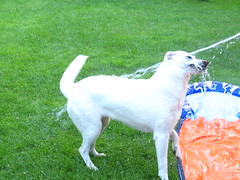
As many of you may recall, Tala loves water-dispensing devices.

today! help stop the deportation of u.s. war resister rodney watson

Call, fax, write, email! US war resister Rodney Watson has been ordered to leave Canada by Friday, September 11 - despite the clear direction of the Canadian Parliament, reflecting the beliefs of the majority of Canadians.

Raise your voice in protest. Details here.

9.07.2009

farmington, new mexico, later the same day

Sunday, September 6, Santa Fe

Sunday turned out to be a bit of a bust, but it was great to spend more time with some family, and it couldn't have hurt to rest my ankle a bit more.

The brunch was spectacular, then we rested at our casita for bit. When we spoke to our host, we learned she was giving us the additional night at half price. She's clearly not going to have any new reservations on the Sunday of Labour Day weekend, and there's no possibility of walk-in traffic. (The casita is in a residential neighbourhood with no sign.) So she must have been glad to get our call, and we were glad to get hers.

We headed back into town and nothing worked out. We couldn't get an internet connection (bookstore closed, library closed, no freebies to pick up), then the historic sites I thought we'd see closed while we were searching for internet. We ended up driving around, getting tired, and just killing time until dinner.

It was a big dinner with a lot of wine and a lot of people. I was hoping for a high-end Southwestern-style meal, but unfortunately for me, my sister and her husband (our hosts) don't care for Southwestern cuisine, so we were at a steakhouse. The whole thing was nice, but also too much; I was very tired and a bit uncomfortable. But really, I'm not complaining. If we had left after the brunch as we originally planned, I'm sure I would have been too tired to do much anyway.

We collapsed right after dinner, and this morning we packed up and hit the road. Allan went off in search of a styrofoam cooler, so we can take food and cold water with us. We love not having to find a place for lunch, both for the self-sufficiency (especially in remote, sparsely-populated areas) and the budget. Once we had the cooler, we were all set.

Monday, September 7, Santa Fe to Farmington

We headed north out of Santa Fe, towards Taos, then took a small east-west highway though mountainous country, towards Interstate 550. Traveling west on this smaller road, the terrain became very dramatic. There were huge bluffs and rock formations in the near and far distance - tan and red rocks jutting up out of the scrubby desert land. I saw some strange rock formations that I thought might be human-made, possibly ruins.

We passed many ranches and houses, and sporadically saw cattle or horses grazing. It's hard to believe that people actually live in this land, surrounded by these dramatic cliffs and bluffs and giant rock formations. At one point the land flattened out, but we were still in the mountains - like an antiplano. We passed the tiny towns of Barranca, Gallina, Regina and La Jara, really just post offices and a general store, an address for the distant ranchers.

The scenery was so dramatic - and so unexpected. I don't know what I thought northwestern New Mexico would look like, but I didn't realize it would look like this. We stopped frequently to take pictures, so when I have them on Flickr, maybe this post will be more interesting!

Once on Highway 550, we were driving through a vast desert. The cliffs and bluffs were way off in the distance. There are tan earth and scrubby sagebrush as far as you can see, ending in distant mountains, and the occasional bizarre rock formation. The sky is enormous. Having grown up in the Northeast US, I find it amazing to be able to see so far to the horizon on all sides.

Almost all the land in this area is either Native American reservations or part of the energy industry (either oil or natural gas). Every once in a while there is a "trading post," a sad little grocery store with an elderly Native woman behind the counter. Northwest New Mexico is the land of the Navajo Nation.

We drove to Farmington, an energy-industry town, and the nearest large town to Chaco Canyon (formally named Chaco Culture National Historic Park). We unpacked the car and checked our email, the first internet connection we've had in days. The dogs are doing great! Our new dogsitter is having a great time with them. She even sent some pictures.

Out of Farmington we headed south towards the Bisti Wilderness Area, driving on a small highway cutting straight through the desert. Every so often there are turnoffs to dirt roads leading to churches or pueblos - reservation towns. And every so often, there is a shock of dark green, as you pass irrigated farmland. All around is brown earth and light green tufts of sagebrush, then suddenly that is punctuated by a large farm tract. I can't imagine how much water these farms use. But better to use all that water to grow food than for golf courses.

We found the turnoff to Bisti, and drove several miles down a gravel road to a small parking turnoff. Bisti is a "badlands" area of dry, barren land, baking sun and bizarre rock formations. There are no marked trails or facilities of any kind. We parked the car, put on plenty of sunblock, took our water and our camera, and walked out into the desert.

Here I realized that the rock formations I had seen on the way up, which I thought might be human-made, were hoo-doos, sandstone rock formations created by wind erosion. Some of them are charcoal gray, almost black, some are red, and some are yellowish tan. Many of the rock formations look like giant mushroom caps, or domes without buildings underneath.

The ground is very soft, like hard sand or soft clay. Closer to the rock formations, the ground is strewn with shards of red, black or white rock, and as you walk up or climb one, the pieces get larger - you're seeing the erosion all around you. I walked up a small, horn-like projection, and my boots sunk in as I climbed. I could pull up a handful of the rock, or kick pieces down with my boots, that's how soft it is.

In some areas, there are larger, harder rocks, falling all around each other like some collapsed cathedral town. We clambered around a little, and when it seemed too strenuous for my ankle, Allan continued up without me. Even on these hard rocks, you can see the effects of the wind, like a million thumbprints, or random pictograph etchings. We also walked in some dry creekbeds, where a little bit of water remains, making a clayey mud.

It was very hot and dusty. The desert stretches on in all directions. There was another car in the parking area, but we saw no one else as we walked. The whole area had a surreal quality to it. It's hard to believe something like this exists. As a child I saw the Badlands in South Dakota, and also Brice National Park, both spectacular rock formations. But having seen a bit more of the world since then, these things impress me even more.

Some good photos of the Bisti Wilderness are here.

We walked for about an hour and a half. I tried to be careful about my ankle, and my good hiking boots helped a lot. When it started to hurt too much, we headed back.

After stopping in the room to shower and change, we headed into Farmington for dinner. We had three ideas from the guidebook, and fortunately for us, the first two places were closed for Labour Day. The third was a true gem.

Three Rivers Eatery and Brewery is the kind of place every town should have, yet is such a rare find. The building itself used to be the town's pharmacy and general store, built in 1912. They offer a huge, varied menu - fresh, homemade food - fast and friendly service - and they brew their own beer! Beer comes in sizes from a six-ounce tasting glass to a jug or keg. We tried an amber ale, a raspberry wheat, a honey ale and a milk stout; all were excellent.

The food was outstanding. To me, there is nothing like very simple food, perfectly done. And it's a rare find. You might frequently order a salad, or a sandwich, or a burger and fries, and it might taste all right, but how often is it really perfect, every element of it is exactly right? That's what the Three Rivers does.

To top off this excellent dinner, the bill was minimal. (By New York or Toronto standards, it was downright cheap). On the way out, we were admiring these neat "growlers", beer jugs with the restaurant's logo, for sale in a cooler. I thought the jug would be great to put flowers in, or colored stones, or even pennies. We were obscenely full, so we couldn't even think of drinking the beer. Allan wondered if we could buy an empty one, so I went up to the bar to ask.

L: "Excuse me. Would I be able to buy an empty jug?"

Server: Quizzical look. You can take an empty one if you like.

L: I can?? Are you sure?

Server: Looks as if I am from another planet. Sure. G'head.

L: Thank you!!

Now I'm in bed with my foot elevated, a bag of ice on my ankle. Tomorrow is Chaco Canyon, probably the highlight of the trip, non-wedding category.

Sign seen in Santa Fe: "It started here. Let's end it here." Picture of mushroom cloud.

Some of our photos from Bisti are here.

Some general photos while driving are here.

stop the deportations! tuesday, september 8: national call-in day

Tuesday, September 8: call-in day to stop the deportation of US Iraq War Resister Rodney Watson

The minority Conservative government is deporting US war resister Rodney Watson back to the US, where he faces punishment for refusing to redeploy to Iraq.

Rodney, who currently lives in Vancouver, served a year in Iraq and when his contract was unilaterally extended, he refused a second deployment to Iraq. He has been ordered to leave Canada on September 11, 2009. "I realized the war had nothing to do with 9/11 or helping Iraqis or stopping terrorists," said Watson. "It's all about guarding oil for the U.S."

Canada's Parliament, supported by a majority of Canadians, has voted twice demanding that the Harper government stop the deportations and allow US Iraq war resisters to stay. Stephen Harper admitted in 2008 that the Iraq war was "absolutely an error" but his government has deported two war resisters to jail in the US for refusing to participate in the war.

On September 8, phone, fax or e-mail Minister of Immigration Jason Kenney to demand that he respect the democratic will of Parliament, and immediately stop the deportation of Rodney Watson and the other war resisters. Remind him that 64% of Canadians want U.S. Iraq war resisters to stay.

Even if you have phoned or emailed in the past, take a moment to do so again – Rodney faces jail time if deported, it is urgent that Canadians speak out to stop this injustice.

Please PHONE, EMAIL, FAX or WRITE A LETTER to:

• The Hon. Jason Kenney, Minister of Citizenship and Immigration
Citizenship and Immigration Canada
Ottawa, Ontario K1A 1L1
Fax: 613.992.1920
Phone: 613.954.1064 (Ministry office) or 613.992.2235 (Parliamentary office)
email: minister@cic.gc.ca AND kenney.j@parl.gc.ca

Please cc the opposition party leaders:

• Liberal party leader Michael Ignatieff: ignatm@parl.gc.ca
• Bloc Québécois leader Gilles Duceppe: ducepg@parl.gc.ca
• NDP leader Jack Layton: laytoj@parl.gc.ca

farmington, new mexico

Thank you all very much for your thoughts and good wishes about my stupid ankle. I'm much better now, walking with a limp and possibly all right for some hiking. We finally have internet access after several days without. But I've been writing blog posts offline to post when possible. So to catch up...

Saturday, September 5, Santa Fe

While online at the Collected Works bookstore, I got email from our dogsitter with an excellent report. She’s having fun with the dogs, Tala is getting a lot of exercise, Cody hasn’t been anxious or frightened, and all is well. Hooray!

From there we drove down to Canyon Road, the famous art gallery strip of Santa Fe. Having seen the hyper-commercial crush of the downtown plaza area, I was expecting a similar atmosphere on Canyon Road, but was very pleasantly surprised.

There are dozens of art galleries along a narrow street, many with sculpture gardens in the front or alongside. It has a very authentic, non-commercial feel. Of course all the art is for sale, but as buying original art is a big purchase, the gallery owners don't have commercial expectations from most of the passers-by. All the doors are open, the owners greet and welcome you, and you can just wander through and enjoy.

You couldn't possibly go into every gallery, there are way too many. We just wandered into whichever caught our eye. In the middle of the strip, there's a Friends (Quaker) Meeting House with peace and anti-torture signs on the outside. I was happy that every tourist that comes to Canyon Road will see those signs.

There's a famous tapas place on the strip, very old and authentic, called El Farol. We were headed there when I heard the unmistakable panting and jiggling of a trotting dog behind me. I turned around to check it out, and see a beautiful tan pit bull trotting along, wearing a collar but not on a leash, and a woman walking beside it holding a small dog in her arms.

She said, "This is a lost soul! I don't know who he belongs to." She was clearly a bit afraid of the breed. We stopped to check it out, and the dog could not have been friendlier – instant greeting, ears down, tail wagging, happy as can be. Allan read her collar: "Nellie," with a phone number. Once we knew Nellie's name, she was super happy and friendly, wiggling and wagging and just the sweetest thing.

Allan got the phone number from Nellie's collar, and I called while he steered her off the sidewalk. While I was calling, the woman thanked us and quickly walked away. What we didn't realize is that she was a gallery owner coming back to her shop. I left a voice mail for the dog's owner, while we sat on the steps in front of the gallery wondering what to do. We couldn't just leave her to wander around. Not knowing the laws of the state of New Mexico, I was not going to call animal control services – if there are anti-pit-bull laws, Nellie might be destroyed, no questions asked.

As we were deliberating, the same woman reappeared from the gallery with a leash. She suggested we hook Nellie to the railing. She’d be safe, we could call the owner again and say where the dog is, and we could leave. There was a nice spot in the shade to which Nellie was only to happy to be tethered. The gallery owner got her some water, I made another call, and we headed down the street for tapas.

El Farol is wonderful – very good tapas in a very authentic Spanish atmosphere. The building itself has been a bar or catina since 1835. We were munching and sipping when my phone rang. It was the father of the Nellie’s owner. His son is at work but asked him if he could go over and get the dog. I explained where Nellie was, and we said he’d come out.

Fifteen or 20 minutes later, he called again. From the patio of El Farol, I could see him on his phone, and he said the dog wasn’t there, or he couldn’t find her. Allan took off down the street; Nellie was there (of course). The man borrowed the gallery owner’s leash to get Nellie in his truck, Allan said goodbye to Nellie, returned the leash and came back to the patio. A few minutes later we saw the man drive by, with Nellie at the window.

No surprise, the man told Allan that Nellie is an escape artist who is constantly getting loose and showing up in various places. That makes me so sad and worried, as the look of her breed will work against her. But she’s a beautiful and friendly dog. I hope Nellie has a long happy life of escapes, adventures and returns.

After a completely unnecessary second glass of wine and more tapas, we headed further away from downtown, towards Museum Hill. Several Santa Fe museums, all built with the same brown adobe look, are grouped together a few miles out of downtown, on a rise with a beautiful vista of desert foreground and distant mountains. I wanted to at least have a quick look at the Museum of International Folk Art.

Allan and I both really like folk art, and I read this place is very special. (If you find yourself in Baltimore, don’t miss the Visionary Museum!) There was an exhibit of Indonesian art that makes up puppet theatre, through which great epics such as the Mahabarata are told. There were puppets, instruments, props, and a brilliant interactive digital companion through which you could access more information about the characters, construction, story, music, and such. (There is also a Hispanic heritage wing, but it was closed for an exhibit change.)

We only looked briefly at the Indonesian exhibit, because the main attraction there is the Girard Wing, which displays the museum’s permanent collection. It’s an incredible array of folk art – processions, kitchen scenes, religious scenes, dia de los muertos art, masks, fiestas – you name it. This had to be really brief because of time constraints, but I was very glad we went.

Then we hustled back to the room to change, and called a cab to take us to the ceremony. We had already decided not to drive home from the wedding, so we could drink and not worry about finding our way back through dark streets and DWI checks.

The wedding was at the Randall Davey Audubon Center, which is built on a mesa surrounded by magnificent mountain views. You couldn’t have dreamt up a more perfect setting. For a moment during the ceremony, a hummingbird was hovering near the flower-covered marriage arch.

The wedding ceremony was the most moving I have ever witnessed. Both partners are very spiritual, and they’re also both in the healing arts. They met in massage therapy school, and are in Santa Fe to attend acupuncture school; she is also an herbalist.

The ceremony was a reflection of their spirituality and the deep partnership they share. It was a multifaith ceremony, bringing in Christian, Jewish and Buddhist elements, poetry, and an awesome set of vows that they each read to each other. Two female reverends, Universalists, presided. Everyone witnessing the gathering was so moved, even me, and I eschew legal marriage (for myself) and have exactly no spirituality. It was truly a celebration of the two human's unique and beautiful love for each other, and their desire to support each other as individuals within their partnership.

After the ceremony, we hitched a ride with some cousins back to Bishop’s Lodge for a great party. It was very special to spend time with our cousins from Florida, who we rarely see, my brother’s closest friends, who I haven’t seen in decades, and other extended family.
Everyone was asking about my ankle, the many health professionals there offering me all kinds of painkillers and giving advice.

I was trying to stay off my feet as much as possible, but at one point the dance floor was too much to resist. I’m not going to dance Hava Nagila at my nephew’s wedding?! The hell I’m not. So I completely abused my ankle for a while, then sat outside talking with various people. It was really an amazing night.

At one point at dinner, my sister spontaneously announced, How about everyone here, our table, has dinner together tomorrow night? I was disappointed to say we were leaving after the Sunday brunch. But a short consultation later, Allan and I decided to shift our plans and stay for that dinner. It’s my sister and brother-in-law, a niece and nephew, our Florida cousins and another cousin who I only see at these large events, and who recently lost his wife to cancer. I also rarely see my niece and nephew from my sister (the ones I usually talk about are my brother’s kids). So a change of travel plans seemed more than worth it for this great opportunity. We weren’t sure we could keep our casita for an additional night, but we figured we work that out somehow.

We cabbed back to our little house, to try and get some sleep before waking up very early on Sunday.

Sunday, September 06, Santa Fe

We started the day by meeting Judy and Cassie (my sister and her daughter) back at Bishop’s Lodge for horseback riding. I hadn’t been on a horse in so long, possibly since our trip to Yosemite National Park in the late 1980s. I’ve wanted to ride on other vacations, but it just never worked out. But as a kid I used to go 8 or 10 times a summer, and we’d ride on our Western family vacations whenever possible. I love being close to an animal, out in the quiet of nature. I find it so peaceful and just so much fun.

The wrangler was excellent, helping me mount from the left side so I could avoid putting weight on my injured ankle. There were six of us in the group – Allan, me, Judy, Cassie and two people we didn’t know – plus the wrangler. She gave us a brief lessons, which was a great refresher for me, and was more sensitive to the needs of the horses than many instructors I have seen. Then we rode off into the hills.

The world here is brown and green, much greener than many parts of the southwest, because of 7,000-foot elevation brings more rainfall. There are scrubby, low-lying bushes – juniper and sage are the only ones I can identify – and tiny flowering cacti, close to the ground. Some of the sage is in bloom, the distinctive lavender colour of the American west.

Once we climbed up onto a ridge line, we could see the Sangre de Cristo mountains in the distance, the last US ridge of the Rocky Mountains. Jennifer (the wrangler) pointed out a distant hill that’s in Colorado, as well as the Los Alamos Laboratories. In the near distance we could see huge vacation homes, built in the brown adobe Southwest style, with huge picture windows.

The trail was full of steep ups and downs, which is fun and sometimes a tad scary. It was wonderful to be on a horse again. I was also really happy for my sister. She used to be an accomplished rider, and I’ve been encouraging her to get into it again. She has both time and money, but motivational issues and depression have been holding her back from doing much of anything. I am hoping that a morning on horseback might serve as a kick-start.

Getting off the horse was interesting! Sore muscles, jelly-legs and groaning abounded. I wonder what I’ll feel like tomorrow!

We went back to my sister’s room at the Lodge to change, and around that time learned from our host that the casita is indeed available another night (which turned out to be half price!). Next up was the brunch, which was relaxed and informal, but totally extravagant in terms of food and service. We took a little break from the group meals and ate by ourselves, but also spent a lot of time hugging and gushing over groom, bride, their siblings, parents, in-laws, friends and such.

Santa Fe is packed today – it’s Sunday and there’s a huge fiesta in town. We’re not into street fairs, especially in the baking sun. We headed back to the casita to write and re-plan our next few days. I’ve been writing this in word, hoping that I’ll have an internet connection at some point to paste it into blogger.

[We just popped into our hotel room in Farmingon to post this, and are off for a hike among native ruins, if my ankle can take it. I will write more later tonight.]

Some of our photos from Santa Fe and Canyon Road are here.

9.05.2009

santa fe, new mexico

Friday, September 4, Santa Fe, New Mexico

I should be sightseeing right now, maybe checking out the galleries on Canyon Road, or poking around the beautiful shops, or wandering through one of Santa Fe's many museums. Instead, I'm sitting in bed with my foot on a pillow with a bag of ice on my ankle.

It hurts. A lot. But that's nothing compared to my disappointment that I may not be able to walk and hike on this vacation.

Yesterday was a long travel day, as expected, but everything went perfectly smoothly. Drive – fly – wait – fly – drive. No delays, a minimum of annoyances, good directions. We pulled into the driveway of our casita, put down our bags and forced ourselves to go back out, hoping to get to the Trader Joe’s we passed before it closed. Perfect timing – we got our coffee and tea, and a few things for breakfast, just before closing time. Then back to the little house to collapse.

Allan had the option of joining the groom and his male friends for the enlightened-male version of a bachelor party, but he was too wiped out. I thought that would be the case.

Just before bed, we discovered we don't have an internet connection, even though the place is supposed to have one – yet another in a long line of travel accommodations where that's the case. Also before bed, we got a Red Sox score – they won. And then I was out like a light.

This morning we had breakfast here at the casita, then decided to head downtown early in search of internet. There was a Starbucks, but it was very crowded and not set up for hanging out with a computer. Good thing, too, because just down the street we found the Complete Works, a beautiful, airy bookstore. We needed a map of the state, and while buying it I asked if there was a place nearby with internet. The very friendly, helpful bookstore guy suggested we sit in their little café area and gave me the store’s password. So we took turns getting online and browsing, and I bought a book because I felt we should.

It was still very early, so we were debating how to spend the morning. Later on we were going to meet my sister and brother-in-law to do something in town together. We were on our way to sit in the plaza when my ankle turned over and I was suddenly in tremendous pain. No hole, no missed step, no nothing. My foot just turned over and it hurt. The kind of pain where you are temporarily blinded and instantly sweaty and nauseated.

I couldn't walk at all. Allan helped me sit on the curb. Several people asked us if we needed help or a call to 911. Eventually I was able to get up, and Allan helped me hobble over to the plaza to sit and think what to do next.

At first I was determined to continue as if nothing had happened – and tried, several times. No. You try to fight with your body, your body will always win.

Eventually we came up with a plan, bought some ice – later went back out for an elastic compression sock – and now here I am.

Allan has been taking care of me, and trying to console me, and just being all-around great. I tried to talk him into going into town and meeting up with some of our people, but he will have none of it. He's more content to sit here with a book than seek out anything else to do.

Right now I am sick at the thought of this vacation being ruined. We can't afford this trip in the first place, but since we had this Very Important Wedding to attend, and an opportunity to spend time with family, we planned other fun things around it. The thought of spending the week doing nothing is extremely unappealing. Doing nothing is great sometimes, but that’s not what I came to New Mexico for.

Maybe I'm worrying prematurely. Maybe this will all pass very quickly. But my own history of joint problems, and the balloon-like swelling around my ankle doesn't bode well for that theory.

* * * *

The wedding is at Bishops Lodge, a well known Santa Fe resort ranch and spa. The wedding party and many wedding guests are staying there, but it's well out of our price range, and not really our cup of tea anyway. So we've rented a casita - Spanish for "little house" – from Two Casitas. It's a lovely large studio with an efficiency kitchen, a patio and a hot tub, in a residential area only a few minutes from downtown.

All the houses here are low, one-story adobe structures, the natural sand-colour, not whitewashed. Some have high wooden gates, sometimes with tile insets. It's really different. I've been to the southwest US before, but as a child with my parents, and probably didn't see residential areas.

Santa Fe is one of the oldest cities in the United States, currently celebrating its 400th birthday. Downtown Santa Fe is all adobe – much of it probably simulated adobe at this point. But the city plan is still the original streets. The downtown is completely tourist-oriented – an enormous number of shops selling pottery, jewelry, clothes, art, gifts, you name it, all with either a Southwestern, Native American or Hispanic (their word, not mine) motif, with a huge corresponding number of cafes and restaurants. There are many historic and cultural sites mixed in, but the overwhelming impression is shopping.

The city is famous for Canyon Road, the third largest art market in North America. I hope to see it...

Saturday, September 5, Santa Fe

After spending the afternoon treating my ankle, I was able to put my shoe over the compression sock and hobble to the rehearsal dinner. The restaurant was outdoors, in an inner courtyard, a beautiful setting with lights strung up in trees. Most people seem to have gotten here many days ago, taking their vacation first and ending on the wedding, going back after Labour Day weekend. So people are talking about how great Santa Fe is, the perfect weather, the desert, etc. etc.

It was wonderful to see everyone and get a little caught up. I didn't do too much schmoozing from table to table, not being too mobile, but did manage a little socializing. Since I love the wedding couple so much, it's no surprise that I like their friends so much, too. It was especially wonderful to sit with both my siblings and their respective partners.

My brother and sister-in-law, parents of the groom, are in heaven. My nephew D is the first of all our nephews and nieces to get married. His partner E has been part of our family for many years; this wedding is a celebration of what we already know.

One of my nieces (sitting next to me) had baseball scores on her iPhone, so we learned the Sox lost and the Rangers, our wild card rivals, won. Even Allan and I are realizing the division is all but impossible now. But the Sox haven't been eliminated, so there is still hope.

Today, if I can do it, we're going to see a little of Canyon Road, and tonight's the wedding. This morning my ankle is very swollen, but hurts much less. Of course, that’s upon waking, when it's been resting for eight hours. We'll see.

Some of our photos from Santa Fe and Canyon Road are here.

9.03.2009

travel day

I was hoping to blog yesterday, but never found the opportunity. Getting ready for a vacation, a wedding (plus other family gatherings), and school at the same time has been very challenging! But at last I think it's all come together.

Today will be a long travel day. There's just no easy way to get from Toronto to Santa Fe. We drive to Buffalo, fly from Buffalo to Atlanta, fly from Atlanta to Albuquerque, then pick up a car and drive to Santa Fe. But I don't stress about those things; in fact, I enjoy them. For me the vacation starts as soon as we leave the house.

When I went to California earlier this year, I flew non-stop from Toronto. There was no real savings in flying from Buffalo, plus that flight wouldn't have been direct. But to Santa Fe, flying from Buffalo is a no-brainer: Delta from Buffalo $275, Air Canada from Toronto, $800. That's round-trip, per person. Air Canada is just begging anyone who lives near the border to fly from the US.

Our new dogwalker is spending the week with Tala and Cody. I feel good about her, I think she'll be great.

For those interested, I'll be blogging about our adventures in New Mexico. See you soon!

9.01.2009

michael vick served no time for animal cruelty. not one single day.

I would normally re-write this in my own words, but I can't. When I think about the torture, terrorizing and sadistic extermination of dogs, I can't write, I can't think, I can't function.

Michael Vick, a murderer, is playing professional football again. Upon his return to the field, he received a standing ovation from Philadelphia Eagles fans. Football fans all over the US are claiming "he did his time," and now deserves a second chance.

He did not, and does not.

I read this on Facebook, and I'm running it as-is. CAUTION! Contains horrific animal-cruelty details.
For everyone that has participated in the Victimization of Vick with all of the comments of "He did his time, he paid for his crimes" - think again.

Perhaps, you should be aware of the facts of this case and more informed of the actual "crime" this man paid of his debt to society. Perhaps, you would then think twice before complacently handing out your second chance arguments and support.

If your mind still forms the argument of "We all make mistakes" - perhaps you will feel differently knowing that children are sporting dog masks to football games mocking the dead victims of his crimes. Laughing - joking - making fun - in support of their great idol with their parents right behind them screaming "To hell with Dogs - we love Vick".

If this would not lower your head in shame, then I fear for the monsters this has unleashed in division across this United States in support of this great American hero.

Michael Vick "did his time" for Federal Racketeering, he served his prison sentence for Federal Racketeering - ONLY.

The crimes, the heinous acts and crimes of Animal Cruelty - Michael Vick plead "Not Guilty".

In a brokered Plea Agreement, the charges of Animal Cruelty were dismissed. Thus, unpunished were these crimes, by this man, against humanity.

The known, proven, admitted crimes of murder, rape, and torture of innocent defenseless beings was thrown out - dismissed - in the Plea Agreement.

The crimes in which, Michael Vick, systematically, prepared, planned, participated and executed, repeatedly, against these animals, was left unpunished in the legal justice system.

This is a known public record of fact.

Below are the opinions of Michael Vick's deserved second chance by Bad Rap's Tim Racer and Donna Reynolds.

Tim Racer -
It is no mystery that Michael Vick wants another chance at the game, the money, and the fame that he once possessed. I am all about forgiveness and second chances – when one is truly remorseful . There is of course a world of difference between feeling badly about a wrong doing, and feeling badly about being caught. Who knows where Roger Goodell stands on this? I am disappointed that there has to be so much time spent to make such a seemingly simple decision about whether this man should ever play the game again. He ran a major felony dog-fighting operation since he first became a professional ball player – for his entire six year career. He fought and he killed countless innocent animals, some by repeatedly slamming their skulls and spines into the ground until they broke. What exactly does it take to be released from the NFL?

Twenty three months in prison does not make a sick (in the truly medical sense of the term) individual like Vick, better. Mike has teamed up with the HSUS to to good things now. His agents made it so. Good move. Maybe that will help him play again.

For those who believe Vick has paid his dues, I would have to differ. He has not and will not spend a single day behind bars for animal cruelty as his federal charges were for racketeering. And as for remorse, Vick pled NOT GUILTY to animal cruelty charges at his state trial – and it was dropped in a plea deal. How can this man be remorseful for his crimes if he does not even believe he was cruel to animals?

Donna Reynolds -
I admit I'm stuck on this one because I just can't get myself away from the swimming pool in Vick's yard. I first learned about it while riding in the back seat of a federal agent's car that sweltering Tuesday back in Sept 07. The agent was assigned with escorting us to the various Virginia shelters so we could evaluate "the evidence" otherwise known as 49 pit bulls - now known as cherished family pets: Hector, Uba, Jhumpa, Georgia, Sweet Jasmine and the rest. I'm not sure if sharing insider information with us was kosher, but you know how driving down long country roads can get you talking. I imagine she just needed to get some things off her chest. She said she was having trouble sleeping since the day they exhumed the bodies on the Moonlight Road property. She said that when she watched the investigators uncover the shallow graves, she was compelled to want to climb in and pick up the decomposing dogs and comfort and cradle them. She knew that was crazy talk, and she was grappling with trying to understand such a surprising impulse.

Her candor set the tone for this entire saga. Everyone we worked with was deeply affected by the case. The details that got to me then and stay with me today involve the swimming pool that was used to kill some of the dogs. Jumper cables were clipped onto the ears of underperforming dogs, then, just like with a car, the cables were connected to the terminals of car batteries before lifting and tossing the shamed dogs into the water. Most of Vick's dogs were small - 40lbs or so - so tossing them in would've been fast and easy work for thick athlete arms. We don't know how many suffered this premeditated murder, but the damage to the pool walls tells a story. It seems that while they were scrambling to escape, they scratched and clawed at the pool liner and bit at the dented aluminum sides like a hungry dog on a tin can.

I wear some pretty thick skin during our work with dogs, but I can't shake my minds-eye image of a little black dog splashing frantically in bloody water ... screaming in pain and terror ... brown eyes saucer wide and tiny black white-toed feet clawing at anything, desperate to get ahold. This death did not come quickly. The rescuer in me keeps trying to think of a way to go back in time and somehow stop this torture and pull the little dog to safety. I think I'll be looking for ways to pull that dog out for the rest of my life.

So that's where I'm at. A second chance for Vick? An HSUS sponsored spokesman for ending torture? In my mind's eye Vick is still in the shadows at the side of that pool. As many times as this scene plays out my head, he hasn't yet moved towards that dog to pull him out. Not there yet.

*Bad Rap Statements Courtesy of: Bad Rap Vick Dog Blog/Behind the scenes*

Copyright 2009 Shelley Bright - Tucsondogexaminer@gmail.com

Bad Rap Blog

Bad Rap Vick Dogs Blog

september 22: "emergency monologues" to benefit war resisters support campaign

On Tuesday, September 22, join the War Resisters Support Campaign for a special performance of "The Emergency Monologues". This one-man show was a big hit during the recent Toronto Fringe Festival. I've heard it's very funny, very dark, and very good.

Tickets are $20, or $10 with valid student ID. There'll be a cash bar, and all proceeds will go to the War Resisters Support Campaign, for legal and other emergency expenses.

* * * *

MORGAN JONES PHILLIPS presents:

THE EMERGENCY MONOLOGUES: Tales of the bizarre, ridiculous and irksome side of being a paramedic in an unidentified urban city

"Phillips neatly mixes humour and personal commentary with some dead-serious topics. He's a charming storyteller and knows how to improvise if the occasion arises, though the material would probably work better over a few shared drinks than in the theatre." -Jon Kaplan (NOW Magazine)

"If you've ever heard a siren in the night and wondered where it was going, The Emergency Monologues is your answer... Fascinating, gruesome, and laugh-out-loud funny." -Chris Earle (Second City)

WHEN: Tuesday, September 22, 8:00 p.m. / Doors open 7:00 p.m.

WHERE: The Steelworkers Union Hall, 25 Cecil Street, Toronto (parking available)

HOW MUCH: $20 or $10.00 with valid student ID

WHY: LET THEM STAY!