4.19.2009

ten years of cody

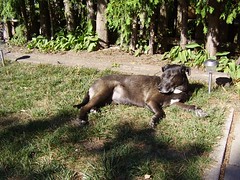
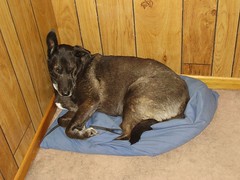
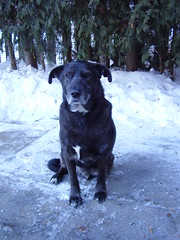
A few months ago, we celebrated the two-year anniversary of adopting Tala. Today is the ten-year anniversary of our adopting Cody.

Cody now is probably older than any of our dogs ever were. We think she was between one and two years old when we got her, probably almost two, so that makes her around 12. For a rescue, especially a larger dog, that's quite senior.

I've been sad about Cody lately, wondering if today is our last Cody Day. But she's doing well, enjoying her life, and we're enjoying every day with her.

Cody is an odd duck. I sometimes say she's a cat dressed up in a dog costume, the least "doggy" dog I've ever known. She's strange, quirky - and so sweet.

* * * *

Cody's been through a lot; she's a survivor. Someone found her living on one of the busiest streets in Jackson Heights, Queens. A man selling "meat on a stick" - that's what it's called! - threw a chunk of meat into traffic so she would chase it. A woman saw that, corralled Cody, and took her home. She was ten pounds overweight - the only dog I've ever heard of who was an overweight stray.

The woman who rescued Cody already had four rescued dogs in her small apartment, and she wasn't managing well. She hung up some signs, hoping to place a few of them for adoption.

We lost our first dog - the beloved Gypsy, a dog in a million - in November 1998, and by early 1999 we could no longer stand to see her little friend Clyde so lost and lonely. We needed to adopt a friend for Clyde. I started looking into some breed rescue - I believe this was pre-Petfinder - when Allan saw a sign at work that brought us out to Queens.

Cody was dirty and depressed. She was the last one in the crowded apartment, and she spent her days on a leash tied to a doorknob. We met another dog from the same household who was healthy and high-spirited, but Cody needed us more. Also, Clyde was a very strong alpha terrier, and we thought Cody would be a better fit.

Poor Cody! April 19 was not a very fun day for her. First some strangers put her in a car and drive for an hour. Then she walks for almost an hour, over the George Washington Bridge. (It was my mother's car and we had to return it, then walk home.) Cody had never walked very much, plus the trucks on the bridge are noisy and scary. (There's a pedestrian lane, it's safe, but she didn't buy that.) Then it got worse!

When we got home, I held Cody's leash while Allan went up to get Clyde. Clyde immediately knew what was going on, and set about punishing Cody. She would jump up and nip Cody's face - over and over. This went on for three days. Cody had little pock marks all over her face where Clyde had nipped off her fur.

After three days, Clyde accepted Cody as her slave, and Cody was grateful for the privilege.

Cody adored Clyde. She lived for Clyde's attention. Cody was much bigger than Clyde, and she liked to put her mouth around Clyde's entire head, a show of affection. Clyde, the alpha, was outwardly indifferent to Cody, as she had been to Gypsy; that's how alpha dogs are. But they had a great time together.

We thought it was the beginning of a new era, changing from Gypsy and Clyde to Cody and Clyde.

Four months later, while we were on a baseball road trip, Clyde became very ill. She hung on until we got home, and died two days later.

Gypsy and Clyde were together for nearly 10 years, and we lost them both within 8 months of each other.

[Long pause here.]

Then it was only Cody.

Cody and Clyde had played together constantly. But alone, at the dog park, Cody would just wander around by herself, never playing with other dogs. (She's still like that.) If any dog ever needed another dog to be happy, it was the young Cody.

And we needed another dog, too! Cody was so quiet and dull, it was hardly like having a dog at all.

In December 1999, on the phone with my sister, I said, "I think we're ready to get another dog. The next stray that crosses my path is ours." A week later, I found Buster.

For the next six years, Cody was the constant, faithful, adoring companion to an emotionally disturbed, medically unstable pit-mix.

Our move from New York City to Canada was traumatic for Cody. She huddled in a cave of boxes for ten hours (plenty of stops, as Buster was on high doses of prednisone at the time!). Towards the end, an ironing board crashed down. She hated us.

Cody was depressed for two weeks after the move. But after she snapped out of it, she discovered the joys of a backyard, neighbours (she lived for the sound of our next-door neighbour's gate opening, so she could run over to say hello), walking by a lake, and of course... sticks.

Ten weeks later, we lost Buster.

[Long pause here.]

Then, again, it was only Cody.

Strangely (to me), Cody was never depressed after Buster's death. She settled in to her only-dog life, and seemed very happy. Her life actually improved, as without our special-needs boy, we could do more, and Cody could often come along.

But Cody just isn't enough dog for us. It was a full year after Buster's death before we were ready to think about getting another dog, but a few months after that, along came Tala.

Cody's life was ruined. For a while. But dogs are pack animals, they want to live with other creatures, and eventually Cody accepted Tala as part of her pack. Today, they love each other, in that asymetrical dog-love way: Tala loves Cody and Cody permits her to do so. But since the arrival of Tala, Cody is healthier - she's lost weight, gained muscle, is more active, more spry.

As I write this, I hear them playing in the backyard outside my window. Those playful grunts and growls are the sweetest sounds.

* * * *

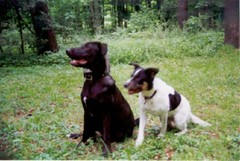
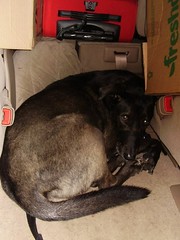
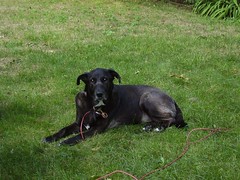
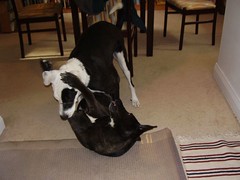
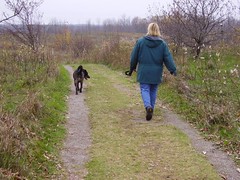
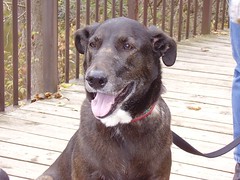
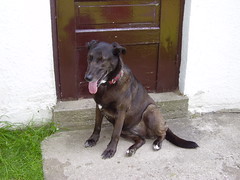
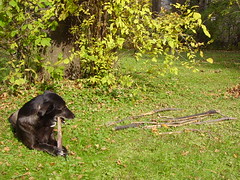
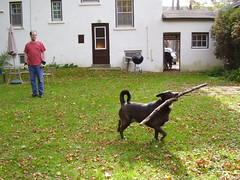
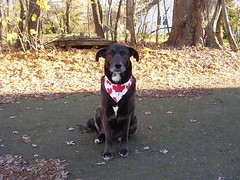
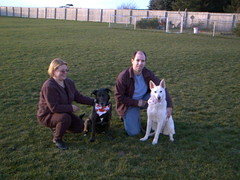
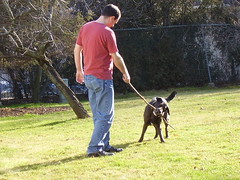
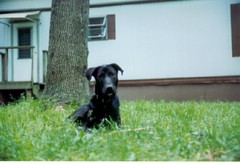
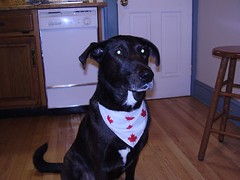
Allan put together a little photo retrospective of our life with Cody.


First pics of Cody, Upstate New York, 1999
cody upstate


Cody and Clyde, Summer 1999

clyde & cody 02


Cody and Buster, New York City

sit_stand

cody_sad_eyes


cmtc (cody moves to canada)

drive_north 007


First Nap in Canada

drive_north 022


Port Credit Yard

moving in 014


Playing with Buster

pups at play 002


Forks of the Credit, October 2005

fork of the credit 03

fork of the credit 09


US Thanksgiving in New Jersey, November 2005
canadian cody 002


Cody in Winter

cody backyard snow 007


wmtc1 (2006)

wmtc party 6.17.06 009

wmtc party 6.17.06 001


Sticks!

cody raking leaves 002

cody raking leaves 008


US Thanksgiving, 2006

thanks nj 07


We Meet Tala

tala016


Cooksville Backyard

new house 01.04.07 012


More Sticks!

dogs in the sun 08


EZ-Bake Cody

dogs in the sun 05


Snow, February 2008

backyard snow feb 07 08 024

tala cody backyard snow2 007


Mid-Hike Treats

elora gorge 29 april 08 011


August 2008

tala & cody august 08


Dirt Dog

cody dirt 004

tala cody autumn 2008 055


January 2009

tala cody snow jan 09 062

4.18.2009

in which i vow to stop eating tuna in any form

I'm sorry I didn't do this sooner, but there's no time like the present. WWF media release dated April 14:
Mediterranean bluefin tuna stocks collapsing now as fishing season opens

As the Mediterranean's bloated fishing fleets ready themselves for the opening of the bluefin tuna fishery, WWF has released an analysis showing that the bluefin breeding population will disappear by 2012 under the current fishing regime.

Global conservation organization WWF reveals that the population of breeding tunas has been declining steeply for the past decade – and will be wiped out completely in 3 years if fisheries managers and decision-makers keep ignoring the warnings from scientists that fishing must stop.

"Mediterranean bluefin tuna is on the slippery slope to collapse, and here is the data to prove it," said Dr Sergi Tudela, Head of Fisheries at WWF Mediterranean. "Whichever way you look at it, the Mediterranean bluefin tuna collapse trend is dramatic, it is alarming, and it is happening now.

"WWF has no choice but to again urge the immediate closure of this fishery."

The population of tunas that are capable of reproducing – fish aged 4 years or over and weighing more than 35kg – is being wiped out. In 2007 the proportion of breeding tuna was only a quarter of the levels of 50 years ago, with most of the decline happening in recent years.

Meanwhile, the size of mature tunas has more than halved since the 1990s. The average size of tuna caught off the coast of Libya, for example, has dropped from 124kg in 2001 to only 65kg last year. Data gathered by WWF show that this pattern has been observed across the entire Mediterranean.

Before the age of large-scale industrial fishing, individual tunas could even weigh in at 900kg. The loss of these giant tunas – able to produce many more offspring than medium-sized individuals – has a disproportionately high impact on the reproduction of the species.

The huge overcapacity of fishing fleets, catches that far exceed legal quotas, pirate fishing, the use of illegal spotting planes to chase the tunas, under-reporting of catch, fishing during the closed season, management measures disregarding scientific advice – and the insatiable appetite of the world’s luxury seafood markets – have all contributed to this dramatic decline.

"For years people have been asking when the collapse of this fishery will happen, and now we have the answer," added Dr Tudela. "Mediterranean bluefin tuna is collapsing as we speak and yet the fishery will kick off again tomorrow for business as usual. It is absurd and inexcusable to open a fishing season when stocks of the target species are collapsing."

WWF is calling for the immediate closure of the Mediterranean bluefin tuna fishery to give the species a chance to recover, while continuing to encourage consumers, retailers, restaurants and chefs to join the global movement to avoid the consumption of the imperilled fish.

There is also growing support to suspend international trade of Atlantic bluefin tuna by getting it listed on Appendix I of the Convention on International Trade in Endangered Species of Wild Fauna and Flora (CITES) when contracting parties meet in early 2010.

From Christian Science Monitor: Can the world act fast enough to save the disappearing tuna?

greenwald on obama and the torture memos

Greenwald nails it. See original for links and updates.
Numerous commentators are objecting to the idea that Barack Obama deserves credit for his release of the OLC torture memos yesterday in light of his accompanying pledge that CIA officials relying in good faith on those memos won't be prosecuted. Chris Floyd is one who articulates that objection quite well and, as is always true for Chris, his criticisms are well worth reading. Many others -- including Keith Olbermann, Jonathan Turley, John Dean and Bruce Fein -- yesterday lambasted Obama for his anti-prosecution stance. Since I gave substantial credit to Obama yesterday for the release of the memos and believe even more so today that he deserves it (despite finding the anti-prosecution case as corrupted and morally bankrupt as ever), I want to return to the issue of Obama's actions.

Purely as an analytical matter, releasing the OLC memos and advocating against prosecutions are two separate acts. It's perfectly coherent to praise one and condemn the other. There is an unhealthy tendency to want to make categorical, absolute judgments about the persona of politicians generally and Obama especially ("I like him"/"I don't like him"; "I trust him/I don't trust him") rather than case-by-case judgments about his specific acts. "Like" and "trust" are sentiments appropriate for one's friends and loved ones, not political leaders. A politician who does something horrible yesterday can do something praiseworthy tomorrow. Generally bad people can do good things (even if for ignoble reasons) and generally good people can do bad things. That's why I care little about motives, which I think, in any event, are impossible to know. Regardless of motives, good acts (releasing the torture memos) should be praised, and bad acts (arguing against prosecutions) should be condemned.

Beyond those generalities, I think the significance of Obama's decision to release those memos -- and the political courage it took -- shouldn't be minimized. There is no question that many key factions in the "intelligence community" were vehemently opposed to release of those memos. I have no doubt that reports that they waged a "war" to prevent release of these memos were absolutely true. The disgusting comments of former CIA Director Mike Hayden on MSNBC yesterday -- where he made clear that he simply does not believe in the right of citizens to know what their government does and that government crimes should be kept hidden -- is clearly what Obama was hearing from many powerful circles. That twisted anti-democratic mentality is the one that predominates in our political class.

In the United States, what Obama did yesterday is simply not done. American Presidents do not disseminate to the world documents which narrate in vivid, elaborate detail the dirty, illegal deeds done by the CIA, especially not when the actions are very recent, were approved and ordered by the President of the United States, and the CIA is aggressively demanding that the documents remain concealed and claiming that their release will harm national security. When is the last time a President did that?

Other than mildly placating growing anger over his betrayals of his civil liberties commitments (which, by the way, is proof of the need to criticize Obama when he does the wrong thing), there wasn't much political gain for Obama in releasing these documents. And he certainly knew that, by doing so, he would be subjected to an onslaught of accusations that he was helping Al Qaeda and endangering American National Security. And that's exactly what happened, as in this cliché-filled tripe from Hayden and Michael Mukasey in today's Wall St. Journal, and this from an anonymous, cowardly "top Bush official" smearing Obama while being allowed to hide behind the Jay Bybee of journalism, Politico's Mike Allen.

But Obama knowingly infuriated the CIA, including many of his own top intelligence advisers; purposely subjected himself to widespread attacks from the Right that he was giving Al Qaeda our "playbook"; and he released to the world documents that conclusively prove how that the U.S. Government, at the highest levels, purported to legalize torture and committed blatant war crimes. There's just no denying that those actions are praiseworthy. I understand the argument that Obama only did what the law requires. That is absolutely true. We're so trained to meekly accept that our Government has the right to do whatever it wants in secret -- we accept that it's best that most things be kept from us -- that we forget that a core premise of our government is transparency; that the law permits secrecy only in the narrowest of cases; and that it's certainly not legal to suppress evidence of government criminality on the grounds that it is classified.

Still, as a matter of political reality, Obama had to incur significant wrath from powerful factions by releasing these memos, and he did that. That's an extremely unusual act for a politician, especially a President, and it deserves praise. None of this mitigates any of the bad acts Obama has engaged in recently -- particularly his ongoing efforts to shield Bush crimes from judicial review by relying on extreme assertions of presidential secrecy powers -- but, standing alone, his actions yesterday are quite significant.

As is obvious from everything I've written over the past three years, I think the need to criminally prosecute those who authorized and ordered torture (as well as illegal surveillance) is absolute and non-negotiable (and, as I wrote earlier today, in the case of torture, criminal investigations are legally compelled). A collective refusal to prosecute the grotesque war crimes that we know our Government committed is to indict all of us in those crimes, to make us complict in their commission.

Criticisms directed at Obama and Holder for advocating immunity for CIA officials who relied in "good faith" on DOJ memos (a mere subset of the government criminals) is absolutely warranted. But, it is not Obama's sole responsibility -- or even his decision -- to prosecute. As a strictly legal matter, that is a decision for the Attorney General, independently, to make; it is Eric Holder who has the obligation to enforce the law, independent of anything Obama wants or says and regardless of what public opinion demands.

But more crucially, it is also the responsibility of the citizenry to demand that this happen. What Obama did yesterday -- whether by design or not -- provided the most potent tools yet to create the political pressure for prosecutions. As Kevin Drum makes clear, no decent human being reading those memos would be anything other than repelled by what was in them. Polls already found that large percentages of Americans, majorities even, favor investigations and/or prosecutions for Bush crimes. The onus is on those who believe in the rule of law to find ways to force the government to criminally investigate whether they want to or not (this petition demanding that Holder appoint a Special Prosecutor is a very good place to begin, though it will require much more than just petitions).

The most criticism-worthy act that Obama engaged in yesterday was to affirm and perpetuate what is the single most-destructive premise in our political culture: namely, that when high government officials get caught committing serious crimes, the responsible and constructive thing to do is demand immunity for them, while only those who are vindictive and divisive want political leaders to be held accountable for their crimes. This is what Obama said in affirming that rotted premise:
This is a time for reflection, not retribution. . . . But at a time of great challenges and disturbing disunity, nothing will be gained by spending our time and energy laying blame for the past. Our national greatness is embedded in America's ability to right its course in concert with our core values, and to move forward with confidence. That is why we must resist the forces that divide us, and instead come together on behalf of our common future.

That passage, more than anything else, is the mindset that has destroyed the rule of law in the U.S. and spawned massive criminality in our elite class. Accountability for crimes committed by political leaders (as opposed to ordinary Americans) is scorned as "retribution" and "laying blame for the past." Those who believe that the rule of law should be applied to the powerful as well as to ordinary citizens are demonized as the "forces that divide us." The bottomless corruption of immunizing political elites for serious crimes is glorified in the most Orwellian terms as "a time for reflection," "moving forward," and "coming together on behalf of our common future."

Regardless of the reasons, it is clear that Obama will not single-handedly eliminate the immunity from the rule of law which the political class and other elites have arrogated unto themselves. If anything, as his comments yesterday reflect, he is likely to affirm and defend that immunity (and, obviously, he personally benefits from its ongoing vitality). Demanding that political leaders be subjected to the rule of law -- and finding ways to force the appointment of a Special Prosecutor -- is what citizens ought to be doing. Either we care about the rule of law or we don't -- and if we do, we'll find the ways to demand its application to the politically powerful criminals who broke multiple laws over the last eight years. Obama's release of those torture memos yesterday makes that choice unambiguously clear and enables the right to choice to be made.

Join the ACLU in demanding accountability.

4.17.2009

women's rights are human rights

Many thanks to Giselle Portenier of Toronto for this excellent letter in yesterday's Globe and Mail.
I am concerned about continued references in the press and by government ministers to "women's rights" when discussing atrocities committed against women in Afghanistan and elsewhere - honour killings, rape, executions, female genital mutilation, enslavement (MPs Furious Law Stifling Women's Rights Passed - April 15).

We don't cite "men's rights" when we talk about torture in Abu Ghraib, or "men's rights" when we report on political assassinations of men.

The United Nations Declaration of Human Rights makes no distinction between "men's rights" and "women's rights." They're just fundamental, basic, human rights.

Abuses committed against women are not issues of "women's rights." They are abuses of women's human rights. It's just one extra little word, but it goes a long way in affirming just where we, as human beings, stand on these issues.

Giselle Portenier
Toronto

"no pet left behind"

To follow up on my question here, Ren's Pet Depot in Oakville carried the ramp we were looking for. They didn't have any in stock, but they ordered it for us. It came in yesterday, and it's great! It's lightweight, telescopes for different uses (car, patio, etc.), and has a great surface for paws. It's this one here.

Predictably, Cody was afraid of it at first, but with encouragement, treats, and having no choice as we blocked her attempts to get around it, she's learning to use it.

Many thanks to James, M@, David H and others who had ideas on the ramp. I also want to highly recommend Ren's, a large, independent pet supply store with good prices and a knowledgeable staff. Dharma Seeker said they sell food to the local animal shelter food at cost, another reason to support them. I think we'll switch from PetSmart to Ren's whenever possible.

The ramp is made by SolvIt Products, a company who declares "No Pet Left Behind". They make steps, travel carriers, bicycle trailers and even strollers so animals can be with their people.

One time, long ago, I was waiting to cross a street in New York City, and beside me was a woman out for a run, pushing a three-wheeled stroller, the kind people use to run with their kids. But strapped in the stroller was a beautiful, very old, German Shepherd. I thought it was such a great idea. At that age, the dog could really only go outside to do its business and hobble back inside. It would be stuck in an apartment all day. This way, it got fresh air and sunshine, got to see the world and spend time with its person, without taxing its old joints. The woman and I chatted a bit; I remember her saying, "When they're this age, every day is a gift."

I've been wondering how we'll all go for hikes this summer. Maybe a stroller is in our future?

Cody post coming soon.

cody ramp april 09 002

cody ramp april 09 002

three things to do to help save wolves

Three things to do.

1. Please watch this.

2. Then read this.
Science, Mythology, Hatred, and the Fate of the Gray Wolf
By Verlyn Klinkenborg

For the past few weeks, I've been trying to find a way to accept the decision by Ken Salazar, the new secretary of the interior, to remove the gray wolf from the endangered species list in Idaho and Montana.

It was a relief to have a sensible conversation with newly appointed interior officials after eight years of hearing almost nothing but distortion and duplicity from the top figures in the department. It was also a relief to hear them say, in describing the way they reached this decision, that they were simply following the guidance of career scientists. And yet I still can’t accept it.

The reintroduction of wolves in the Rocky Mountain West has been an overwhelming success. It began with 65 wolves in 1995 and 1996, and the population has now reached approximately 1,600 across the region, with about a hundred breeding pairs. The numerical standards of the original recovery plan have been more than met, and there is new evidence, according to Interior Department scientists, that enough intermingling is taking place among separate populations to ensure a healthy genetic diversity.

Unfortunately, very little has been done to change the behavior of humans — who drove wolves to the brink of extinction. The way the wolf has been delisted, this time, is a reminder that what we are really doing when we protect endangered and threatened species is managing our own species.

Under the proposed delisting for Idaho and Montana (wolves in Wyoming will remain on the endangered list), the wolf will be protected by state management plans that more or less acknowledge the wolf’s right to exist.

C. L. Otter, the Republican governor of Idaho, has pledged "to continue our policy of responsibly managing wolves for a viable, sustainable population that can coexist with our ungulate herds, our livestock and our people." The very first step in "responsibly managing" wolves will be a wolf hunt.

And Mr. Otter's idea of coexistence between wolves and humans doesn't bear examination. He has said he'd be the first in line for a wolf hunting license, and he has also said he favors reducing the wolf population in Idaho to 100, way below the current level of more than 800 and well below the number required by the state management plan.

When it comes to wolves, federal law has been protecting what is, fundamentally, a mythic species. And when it ceases protecting them, they will be exposed to the worst aspects of that myth — a deep, ancestral hostility to wolves based on ... nothing.

Wolves do not kill humans. They are responsible for a minuscule number of livestock deaths in the West — less than domestic dogs — and there are federal and state programs specifically designed to compensate ranchers who lose stock to wolves.

To hunters, killing wolves is both an end in itself and a way of reducing their predation on elk and deer. And it is more than that. Killing a wolf is also a way of participating in the myth of the West. That myth nearly drove the species to extinction.

I would be happy to see wolves taken off the endangered species list if they were not hunted. It is that simple. Their reintroduction has been an unequivocal boon for the ecosystem — the return of a top predator to a system that is biologically unbalanced without it. There is more than enough game for wolves and humans to share. There are adequate protections for ranchers. There is every good reason to try genuine coexistence. No one shoots a wolf to keep from going hungry.

So far the political pressure in the West is too great to allow this. And that, in the end, is the trouble with Mr. Salazar’s decision. It may indeed have been based on the science, and on the numbers called for in the recovery plan. But that plan surely needs revaluation, and in any case the administration clearly was not eager to defend it. The announcement was made on a Friday (like so many Bush-era decisions) and without much warning to environmental groups. Several of those groups have now filed suit to block that delisting.

Mr. Salazar — a Coloradan and a rancher — now faces the very difficult task of making certain that Idaho and Montana adhere to the letter of their management plans. As for the wolves, they have been brought back only to be killed again.

3. Then add your voice to The Big Howl.

Thank you!

polar bears in newfoundland

If you read wmtc when Allan and I were in Newfoundland, you may remember my friend "NCF," Newfie Campaign Friend. We met NCF's mom - who insisted we stay for dinner and spend the night - and visited the birthplace of her grandmother, which just happens to be a National Historic Site, the Cape Bonavista Lighthouse.

NCF sent me these photos, sent to her from a friend back home. They were taken around Bonavista Bay, Newfoundland. Click to enlarge.

polar1

polar10

polar2

polar3

polar4

polar6

polar7

polar8

polar5

polar11

polar9


I didn't find any stories online about this incident, but it is mentioned in a CBC story about another polar bear sighting in Central Newfoundland:
Conservation officers caught two polar bears over the weekend — one in Cape Freels near Lumsden, the other in Bonaventure on the Bonavista peninsula.

Rebecca Jeffery, a wildlife biologist with the Newfoundland and Labrador government, said at the end of March that while sightings of polar bears may be up, that doesn't mean there are more; they might just be moving in areas where they are more likely to be seen.

4.16.2009

recession, resistance, revolution, part two

Here's the rest of the great talk given by Pam Johnson, a member of International Socialists. (Part one is here.)

* * * *

[Pam outlined the ways that leadership from socialists helped workers fight back, often with organizational skills and critical-thinking perspectives. She briefly mentioned some of the organizations on the left at that time.]

Toledo Auto-Lite, 1934

One place where the presence of Marxists provided a lead was in Toledo in 1934, when a strike was called at Toledo Auto-Lite, an important factory in the burgeoning auto industry sector.

Two members of a group called the American Workers Party, who were organizing the unemployed, sent unemployed volunteers to reinforce picket lines. The strengthened lines provoked the company to file for an injunction restricting picketing.

At the urging of the American Workers Party members, the strikers decided to defy the injunction. The police began making arrests, but this only led to the picket numbers growing. Workers from other factories joined the strikers and the unemployed on the picket lines, as the strike came to be seen as a battle affecting the whole of the Toledo labour movement. Thousands joined the pickets lines, and pickets and police fought a pitched battle.

The giant crowd outside imprisoned 1,500 strike breakers inside the factory. Auto-Lite barricaded its doors and turned off the lights. From the roof and upper-story windows deputies rained tear gas bombs on the people in the streets below.

The crowd replied with a seven-hour barrage of stones and bricks. The strikers improvised catapults out of inner tubes and bombarded the factory through the night, breaking every window.

The National Guard arrived the following day to rescue the besieged scabs. The workers were in no mood to submit and the fighting continued, driving the guardsmen back to the factory gates with a hail of bricks. They responded with bayonet charges and when this failed they opened fire, shooting two pickets dead, both unemployed. Still the fighting continued.

At last, on May 31 with the Toledo Central Labour Union threatening a general strike, the company agreed to shut the plant. The troops were withdrawn and negotiations got under way. On 2 June the union won recognition and a wage increase. This victory would turn the tide in the auto industry, 19 auto plants would be organized before the end of 1934.

Ted Selander, one of the strike leaders, said,
I don't think there was any real difference between the Toledo Auto-Lite strikers and the workers involved in many of the lost strikes in the United States at that time. In practically every strike, the rank and file always displayed courage. The difference was in the leadership and their strategy and tactics. In nearly every strike the militancy of the rank and file was muzzled, many times snuffed out from the top.

Teamsters Rebellion, Minneapolis, 1934

Another place where there was a significant breakthrough for labour was in Minneapolis in 1934.

A small group of workers in non-unionized coal yards, primarily members of the Trotskyist Communist League, had been organizing truck drivers with warehouse workers toward an industrial union. In 1934, they called a strike for better conditions and pay, drivers in 67 out 69 yards in the city struck. The city was dependent on coal as fuel and with yards shut down business everywhere was grinding to a halt.

Employers hired scab drivers and the tactic that decided the strike was "the militant use of cruising picket squads". Instead of trying to maintain stationary pickets at 67 yards, the union put its men in cars and trucks and they patrolled the streets looking for scab trucks. They knew the routes, intercepted and stopped scab trucks, dumping their loads into the road. After three days, the employers surrendered.

Following on this success, the militants pushed for organizing the trucking industry across the city. After their defeat in the coal yards, the employers also began to organize: they formed a group called the Citizens Alliance...

The union knew that a strike would require closing the market district and prepared... With the aid of the Cooks and Waiters Union, volunteers were ready to serve food to 4,000 to 5,000 people daily. The union established its own medical centre - staffed by sympathetic doctors, nurses and volunteers - to treat those injured in the struggle, to prevent them from being taken to hospitals, then arrested there.

Once again they relied on "cruising picket squads", operating their own repair shop to keep dozens of cars and trucks on the road. The union headquarters itself was guarded by men "equipped with tommy guns" to deter vigilante attacks. The pickets were unarmed and included members of the Women's Auxiliary. Brutal beatings by police and deputised volunteers left many seriously injured. After this women were withdrawn from picket duty and pickets were armed with clubs.

The union prepared for confrontation and hid 600 men in the AFL hall, unnoticed by the police. When fighting broke out between pickets and police, instead of the pickets receiving a beating, 600 men armed with clubs marched to their assistance, taking the police completely by surprise. When the police brought in reinforcements the union motored in its reserve of 900 men from union headquarters and broke the police lines by the simple tactic of driving a truck through them.

Several more attempts by police - with support from the vigilante Citizens Alliance and the mayor - to break the strike were unsuccessful. The governor of Minnesota declared martial law, sent in 4,000 national guard, arrested the strike leader - and still the strikers would not back down.

At this point, a daily paper was being produced to counter the anti-union and red scare screeds of the local press. Finally Roosevelt was pulled into the struggle, threatening to cut off relief to local banks that did not release credit to employers to satisfy the strikers demands. The employers capitulated and the strikers won.

It was a huge victory that led to thousands of truckers across the US joining the Teamsters.

Farrell Dobbs wrote in his Trotskyist classic, Teamster Rebellion, "Seldom anywhere...has there been such a well-prepared strike". The teamsters rebellion is a incredible example of what is possible in an economic downturn and against all odds.

[Pam mentioned other victories that she didn't have time to go into: the 1934 west coast waterfront strike, which began with longshoremen in San Francisco and spread down the entire coast of California, including a four-day general strike in San Francisco, and the strikes of textile workers in the Northeast. Those clothing workers are my spiritual ancestors. Some of them were my actual ancestors.]

By late 1934 Roosevelt and the conciliatory leadership of the AFL were able to get ahead of the strike wave and damp it down. Although struggles would continue, there would not be the same kind of momentum and political clarity generated in 1934.

The successful struggles of 1934 paved the way for great sit-down strikes in Flint [Michigan] in 1936-37, entrenching industrial unionism, development of tactics such as flying pickets, building solidarity across sections and with unemployed people, and the legacy of effective leadership in the face of attacks and repression.

Canadian auto workers, Oshawa, 1937

The strike wave in the US was reverberating in Canada, which was also severely hit by the Great Depression. A significant strike at General Motors in Oshawa would pave the way for industrial trade unionism, which would be cemented in a strike wave following WWII.

In 1936, auto workers at General Motors in Oshawa - ignoring the existing but ineffectual employee's association - formed a union. Late in 1936, sit-downs occurred, with the union organizing secretly, as it was still illegal.

In January of 1937, General Motors declared the highest profits in its history in Canada and simultaneously announced that its Oshawa employees would receive their fifth consecutive wage cut in five years; a month later, the company announced a speed-up of the production line. The combination of these events precipitated the Oshawa strike, which coincided with the dramatic victory in February 1937 of the UAW in Flint Michigan.

Events in the Oshawa GM plant moved quickly. Two hundred and fifty men in the body shop struck first, and several Canadians contacted the UAW in Detroit to request organizational assistance. UAW organizer Hugh Thompson arrived on February 19 and signed up 4,000 GM employees within a month into the new UAW Local 222.

The UAW's affiliation with the newly formed Congress of Industrial Organization (CIO) ,a labour federation that rivaled the AFL, caused some problems locally. Thompson was unable to rent a local hall for a membership meeting until "the union announced it would hold its meeting at the busiest corner in Oshawa at noon on Saturday" - and got the hall.

The company refused to recognize the union. The workers refused to give up their union or its connection with the UAW. On April 18, 1937, the strike began.

Opposition to a "foreign union" persisted in the community, and also came from most of the Ontario press and from all levels of government - especially Mitchell Hepburn's Liberal government in Ontario. The Premier vowed that the CIO would never gain a foothold in Canada, and he decided to break the union. Hepburn's opposition resulted from his concern that, 'what is wrong with the CIO unions is not their foreign origin, nor their lawlessness and sit-down tactics, but their effectiveness."

Despite Mayor Alex Hall's assurances to him that the strikers were peaceful and that law and order prevailed, Hepburn sent in 400 policemen whom the press dubbed "Sons of Mitches". He instructed the Welfare Department to withhold relief from strikers (who received no strike pay) and their families. He opposed any assistance in settling the strike from the federal Department of Labour's conciliation service.

The Premier's forceful intervention in the dispute precipitated the resignation of two cabinet ministers -- Attorney General Arthur Roebuck and Labour Minister David Croll; Croll stated that his place was "marching with the workers rather than riding with General Motors." The strikers were also supported by the Cooperative Commonwealth Federation (CCF), Canada's left-wing party at the time.

The strike held out. Hepburn and General Motors capitulated. Auto workers won a wage increase, reduced hours, breaks and the recognition of their union.

The 1937 Oshawa strike of GM employees was the first major breakthrough for industrial unionism in the mass production industries in Canada. It changed workers' relationship with management in the auto industry; it stimulated unionization in the auto and other industries; it created confidence and a new consciousness among many workers in the community, politicizing them.

* * * *

Pam went on to draw some parallels between the Depression of the 1930s and our present situation. Of course we have not reached the depths of that Depression (yet?), and in those days there was no social safety net.

But both crises were caused by the boom and bust nature of capitalism.

Both then and now, workers who did not create the crisis were made to bear the brunt of it.

Then and now, governments have been quick to prop up business, but offer little or nothing to struggling workers.

And today, here in Canada, union leadership and the NDP have been largely silent.

Once again, the people will have to lead and the leaders can then follow.

recession, resistance, revolution, part one

This week I attended another talk organized by the International Socialists. I wrote about my first experience with this group here, and posted the talk I heard here. This was the second meeting I attended.

These talks have been very interesting and educational, but beyond that, it's been so enriching for me to find this group, one that I'm so comfortable with both socially and politically. Talking with one of the members - who is also a leader of the War Resisters Support Campaign - I realize (as I suspected) that my prior bad experiences with socialist groups was not at all unique.

In the past, the groups I checked out were either purely theoretical, not activists at all, or frighteningly authoritarian, or puzzlingly dogmatic. People would ignore or even defend repressive regimes if they were supposedly leftist. And the dynamics of group themselves were often exclusionary or autocratic or hierarchical.

My friend told me when she casting around for a socialist group to get involved with, she would ask each organization about its stance on gay rights. She is gay, and was active in the movement from a young age. But this was the late 1970s, and group after group failed the litmus test. Only IS clearly articulated an unequivocal stance on gay rights.

This is group is democratic, egalitarian, inclusive, and geared towards activism. In some ways, finding them feels like coming home.

Here's the talk given this week by Pam Johnson: "1930s: Recession, Resistance, Revolution". If you enjoy hidden history - the history most of us didn't learn in school - you may appreciate this.

* * * *

1930s: Recession, Resistance, Revolution

We have been regularly hearing the current economic crisis being compared to the great depression of the 1930s. Hundreds of thousands of people have lost jobs, homes and pensions.

In the 1930s, like today, although workers did not create the crisis they were made to pay with their livelihoods or if they had a job with ever harsher working conditions.

We can see a similar situation developing today. Despite finance minister Jim Flaherty calling this is a mild recession and the business press saying recovery is just around the corner, the reality is that ordinary people are struggling and at the moment the end is not in sight.

In the face of the misery of the great depression of the 1930s there was also a massive fightback by workers and the unemployed that significantly changed the face of organized labour and brought us gains like a social safety net that we still enjoy - or, more accurately, that we are fighting to hang on to today.

Tonight we're going to look at some of the ways workers fought back. I'm going to talk about what was going on among workers, especially the fight for industrial trade unions in workplaces. Phil [the other speaker that evening] will talk about how communities and the unemployed were organized to fight.

The situation of trade unionism in the lead-up to the Great Depression

Although the Great Depression was a global phenomenon it was harshest in North America, particularly in the US. An active period of radicalism after WWI had expanded trade unions. But by the mid-1920s employers unleashed an offensive of intimidation and violence that led to a decline in trade union membership.

The result was a low level of trade unionism by start of the Depression. Also, trade unions that existed were still based on the craft union model in which workers were organized based on their occupation, which meant that workers in the same workplace might be in different unions.

Also, workplaces were open shops, meaning that there could be a mix of unionized and non-unionized workers. Obviously this provided the employer with easy opportunities to divide workers against each other.

The umbrella union federation at the time was the American Federation of Labour, the AFL. It supported the craft union model and was not militant, preferring to work with employers and the government.

Depression conditions - years of deepening unemployment

So, at the start of the depression in 1929, trade unions were weak. And by 1933 millions were unemployed and those with jobs were subject to speed-ups, wage cuts, extended hours on threat of being fired.

The US elected Roosevelt president in 1932 on a promise of a "New Deal" — basically government stimulus to the economy. Roosevelt was no particular friend to workers but in the effort to stabilize capitalism he offered a sop to workers in 1933, when he introduced the National Industrial Recovery Act. It included a clause that gave employees the right to organize and collectively bargain with employers through representatives of their own choosing. Roosevelt's intent was to prop up the conciliatory AFL, and dampen worker militancy, but the act had the opposite effect, electrifying the working class who demanded to form industrial unions putting the idea of the open shop under attack.

In 1933, one of the worst years of the depression, after years of harsh conditions, pent up anger exploded. There was a wave of strikes across the country with demands for industrial unions and better working conditions. In July of 1933, there were 300 strikes in the US; in August there were another 400.

These strikes received no support from AFL, which called for letting Roosevelt take care of things. Some craft union leaders publicly denounced the strikes. The strike wave was met by a vicious campaign of attacks by employers using vigilantes and private police and abetted by local police and politicians. The scenario was often that vigilantes would break up meetings and pickets lines, beating workers. Local police would "arrive late" and arrest the beaten workers for disturbing the peace.

It was clear government paid only lip service to workers rights because they did nothing to stop the violence. Just to give you a sense of the level of brutality unleashed on strikers, by 1934, 55 strikers had been killed and hundreds beaten.

The Role of the Left

By 1934, the massive strike wave was starting to be pushed back by repression. But in 1934, there were several significant strikes that would turn the tide back to radical engagement and in the process transform the labour movement.

In all cases these strikes were led by militants carrying socialist politics and organizing at the level of the rank and file. They stepped into a contradictory situation - a radical mood that was turning to despair, plus the vacuum of leadership. A Trotskyist from that period recalled it as a time when "one leftist among a thousand workers was enough to give the group direction and stimulus".

On one occasion:
We hired a hall that seated 30 people and gave out leaflets inviting workers of a certain shop to a meeting. Of the 275 employees more than 200 turned up; we had to adjourn to a nearby parking lot, where all the workers present signed application cards.

It was, he remembered:
An exhilarating time for young radicals. When I got on the bus, strangers were talking freely about how the union drives were going in their shops. I have never seen anything like it before or since. This must be, I thought to myself, how things are during a revolution.

* * * *

Part two, coming very soon. (This time I mean it!)

4.15.2009

jason kenney hides from supporters of war resisters in his hometown

Collette Lemieux, Campaigner and peace activist from Calgary, writes:
Jason Kenney was supposed to be in Calgary today [Tuesday, April 14] to speak to members of the Chamber of Commerce during the lunch hour. We organized a picket outside of the building.

About 10 people came out on a very wintery feeling day (I had to brush snow off my car and the wind was gusting to 50 km/h). We all had signs and we handed out all 150 of our leaflets from 11:15 a.m. to 1 p.m. A few people stopped and signed the petition as well.

There was a lot of media who showed up: CBC radio, Calgary Herald, Metro, CTV, CityTV, Canadian Press and 660 News (local right-wing radio). . . .

So you'll note I said "supposed to be". Well, he didn't actually show up while we were there. He was supposed to speak at 12:30 and do a media scrum at 1:00 but his plane was delayed and he didn't make it. I think he didn't want to meet with us. : )

They asked if we had tried to arrange a meeting with him... I have a good story about calling his constituency office and the woman who answered was rude and dismissive.

This story on CTV Calgary focuses on the protest; this Canadian Press story from the Winnipeg Free Press also mentions the issue.

uncle of slain canadian soldier is a hero for peace

Thank you, thank you, thank you to Mario Blais, uncle of Karine Blais, for speaking out against Canada's military presence in Afghanistan.

Karine Blais was 21 years old, and thanks to Canada's misguided foreign policy she'll never see 22. Blais was the 117th Canadian soldier killed in Afghanistan since Canada entered the war in 2002.

Blais's uncle, also described in some stories as her godparent, has the courage to call the death of his beloved niece "pointless," to not publicly pretend her death had anything to do with peace, freedom, or the safety and security of Canadians. He said:
I am against it. I was against it and I am even more against it today. I wonder what we're doing there. ...

I knew the Russians couldn't win over there so I don't think the Canadian army could win over there. I was more in favour of the blue helmets, peacekeeping missions, not front-line missions.

Canada, You have lost your way. Your children are dying. Lay down your arms.

4.14.2009

jason kenney should resign because...

Before the last federal election here in Canada, I asked readers to finish this sentence: "We don't want another Harper Government because...". It was a long list.

Now here we are, one prorogue and one massive Liberal cave-in later, still labouring under this endless so-called minority government. It's frustrating for so many reasons.

These days much of my anger focuses on Jason Kenney, Minister of Citizenship, Immigration and [ha!] Multiculturalism. (I prefer Olivia Chow's more accurate title, Minister of Censorship and Deportation.) The man is a disgrace to Canada, and an embarrassment to the Conservative Party. He should be fired or resign.

Kenney has been at the epicenter of a series of decisions that expose the Harper government's racist, xenophobic, exclusionary ideology. There's talk that Kenney is positioning himself for a run at the party leadership. The inner workings of the Conservative Party of Canada aren't a topic of concern on wmtc - unless they want to split back into the two parties from whence they came. Stephen Harper has clearly lost control of the yes-men that surround him, but whether Kenney has run amok or if his mouth runs with the blessing of Prime Minister Fisher-Price doesn't matter to me.

Here's what matters.

  • Kenney cut government funds to the Canadian Arab Federation, because they express support for Hamas and Hezbollah, which Canada classifies as terrorist organizations. Nowhere have I seen the government accuse the CAF of being a terrorist organization, only that they express support for the democratically elected leaders of the Palestinian people. That is censorship. That is bigotry.

    The CAF itself has an active immigrant settlement program, including an English as a Second Language program...

  • So naturally, Kenney declared that immigrants who don't speak one of Canada's official languages "well enough" should be denied citizenship.

  • Banning British MP and peace activist George Galloway was outrageous...

  • But it was also in keeping with the government barring entry to other peace activists, most notably Ann Wright and Medea Benjamin, which has been going on for two years, and continues to this day. Ann Wright was scheduled to speak at the opening session of a student peace conference at Toronto's Ryerson University, just before George Galloway's scheduled appearance. Wright appeared by video, because she is denied entry into Canada.

  • The government's continuing denials of an emergency passport to Abousfian Abdelrazik (Canadian citizen) is maddening and indefensible...

  • ...but completely in keeping with its refusal to bring home Omar Khadr (Canadian citizen) - while somehow managing to get Brenda Martin (Canadian citizen) back in Canada. Why is that, I wonder?

  • Deporting war resisters, against the will of Parliament and the majority of the Canadian people, also falls under this category. War resisters oppose a racist war of aggression. War resisters represent peace, and the vision of an international world not divided by racism, nationalism and hatred.

    There are many ways to finish the sentence, "Jason Kenney should resign because...". What am I missing?
  • 4.13.2009

    from manitoba: let them stay

    Two newspapers in Manitoba - The Central Plains Herald Leader and the Portage Daily Graphic - have picked up Paul Copeland's excellent piece in support of war resisters. If you agree that US war resisters should be allowed to remain in Canada, and you live in Manitoba, perhaps you will write a letter to the editor with your views. Addresses below.

    In case you didn't see this the other day, here's a re-run.
    Iraq War resisters should be allowed to stay in Canada
    by Paul Copeland

    The Harper government attempts to justify deporting U.S. Iraq War resisters with a familiar, but untrue, narrative. They say that unlike during the Vietnam War, U.S. soldiers are now volunteers and are not considered refugees by the United Nations. They say refugee applications are evaluated fairly on their own merits, and there is no need to create a separate program for U.S. Iraq War resisters.

    All these statements are false.

    Firstly, not all Vietnam War resisters were conscripts, and many Iraq War resisters are redeployed against their will. Vietnam War resisters included draft dodgers who fled before induction, those who accepted their draft notice and were inducted, and those who voluntarily joined the military services. After a brief political struggle in 1969 concerning those who came to Canada after induction, Canada welcomed both groups without distinction. Although current war resisters volunteered and some completed their service, many found themselves involuntarily redeployed to Iraq. Programs of Stop-Loss and Individual Ready Reserve recall soldiers after they have been discharged. Many soldiers, like Jeremy Hinzman, have had their applications for conscientious objector status denied.

    Secondly, it is not true the UN does not consider war resisters refugees. Section 167 of the UNHCR Handbook on Procedures and Criteria for Determining Refugee Status states: “a deserter or draft-evader may also be considered a refugee if it can be shown that he would suffer disproportionately severe punishment for the military offence on account of … political opinion”. After being deported, war resister Robin Long was sentenced to 15 months in prison, the harshest punishment so far for resisting the Iraq War, partly because of his political statements about the war. Multiple Federal Court of Canada decisions have granted stays of removal on the grounds U.S. war resisters who have spoken out against the war would suffer differential punishment.

    Section 171 of the UNHCR Handbook states: “where the type of military action, with whom an individual does not wish to be associated, is condemned by the international community as contrary to basic rules of human conduct, punishment for desertion or draft-evasion could … in itself be regarded as persecution.” This is precisely the position in which Iraq War resisters find themselves, refusing, like Canada under Prime Minister Jean Chretien, to participate in a war condemned by the international community.

    Thirdly, while war resisters who have applied for refugee status may be treated the same as every other applicant, the government’s blanket opposition to war resisters as revealed in public comments by Immigration Minister Jason Kenney — who labeled them “bogus refugee claimants” — led the Canadian Council for Refugees to rebuke the Minister because such a statement gives “the strong appearance of political interference” and “threaten claimants’ right to an unbiased decision.”

    And to date, where U.S. war resisters have attempted to access the humanitarian and compassionate grounds application process, instead of their claims being decided fairly, the majority of these individuals have received negative decisions that are almost identical word for word.

    The final argument of the government is they do not believe in creating a program to allow war resisters to apply for permanent residence. But the majority of Canadians do, and Parliament passed a motion to that effect last June. Rather than listen to Parliament, the government has been deporting war resisters to punishment in the U.S., justifying government actions with a series of false arguments.

    It is time for the Conservatives to stop making false claims, and to start respecting the will of Parliament. Iraq War resisters should be allowed to apply for permanent resident status and remain in Canada.

    Paul Copeland is a co-founder of the Law Union of Ontario, a previous co-president of the Association in Defence of the Wrongly Convicted and Life Bencher (director) of the Law Society of Upper Canada.

    To respond: editor.dailygraphic@shawcable.com or editor@cpheraldleader.com.

    the big howl: help save wolves

    In a few weeks, unless we stop them, the US will remove wolves from the list of federally protected species, opening up a killing season. Secretary of the Interior Ken Salazar is following the policies of the past administration, rather than President Obama's stated intention of using a science-based approach to environmental policies. Six hundred wolves could pay the price.

    My heart aches from the injustice - the simple wrongness - of wolf slaughter. Why? Why is the US sanctioning the killing of wolves?

    Are wolves endangering humans? No. Wolves avoid humans, their chief predators. Even people who live and work in protected areas rarely - if ever - catch a glimpse of a wolf in the wild.

    Are wolves threatening other endangered wildlife? No. Wolves help keep elk, deer and other ungulate populations healthy and under control.

    Are wolves simply in humans' way? Wolves occasionally kill livestock. That is, sometimes a wolf will kill an animal that a human owns - an animal a human is going to kill for its own profit. That could be thought of as one of the hazards of ranching. In the US, thanks to the strong anti-wolf ranching lobby, if a wolf kills livestock, the rancher is compensated.

    Wolves also kill animals that humans want to hunt for their own pleasure. Wolves need to kill elk to eat and live. Humans want to kill elk for fun. So humans want to kill wolves to better make the world into their own personal playground. Humans can live without recreational hunting, or with fewer targets to shoot. Exterminating an animal so humans have more opportunity to exterminate other animals is perverse.

    But those reasons are excuses. The underlying reason behind wolf killing is ignorance. Bigotry. Throughout human history, the wolf has been feared and vilified, portrayed as a cold-blooded killer, a demon. Perhaps that was once necessary to human survival. Perhaps it was simply part of human mythology.

    Either way, we know better now. There's no rational reason to kill this highly intelligent, social animal. It does us no harm. It serves an important role in the complex ecosystem in which it lives. And as humans were the wolf's only enemy - we killed massacred them on every continent - we owe them our protection.

    Only decades ago, there were almost no wolves left in North America. But as pro-wolf activism and education gained strength, better policies began to triumph over ignorance, and the species has made a stunning comeback.

    All that is now threatened. From the NRDC:
    In just a few weeks, the mass killing of wolves could begin in Idaho and Montana -- and not even newborn wolf pups and their nursing mothers will be spared.

    We cannot stand by while this slaughter unfolds. On May 4, the wolf's federal protection will be lifted, and government agents will be free to open fire. After that, the states will launch public hunts, targeting wolves.

    We must act now to call off the guns!

    That's why NRDC is launching The Big Howl campaign to mobilize Americans everywhere to protect wolves in the Northern Rockies from the crossfire.

    Add your voice now to our campaign. Tell Interior Secretary Salazar to reverse his decision to kick wolves off the endangered species list.

    This is absolutely the wrong time to rip away federal protections from these struggling wolves. Over the past year, the wolf population in Yellowstone National Park has declined by 27 percent, with more than 70 percent of wolf pups succumbing to disease.

    One pack alone lost all 24 of its pups!

    If the federal protections are lifted on May 4 as planned, newborn wolf pups and their nursing mothers traveling outside national parks will be in the line of fire.

    That's why NRDC and our partners are filing suit in federal court to block this disastrous policy. But we must do more: we must raise a nationwide outcry that the Obama Administration cannot ignore.

    And so we're calling on everyone who cares about wolves to take part in The Big Howl campaign.

    Please call on the Interior Department to go back to the drawing board and submit this cruel plan to the kind of rigorous scientific review the Obama Administration has promised.

    This campaign is not only for people in the US. The earth belongs to all of us. The creatures of the earth don't recognize national or state boundaries, and when it comes to helping them, neither should we. Public outcry has made a difference in the past, and it can now. Please sign.

    NRDC's Save BioGems Campaign focuses on areas in Alaska, California, Utah, Alberta, Chile and Costa Rica, with special campaigns for rainforests, polar bears and wolves. Check them out. They do good work.


    wolf10


    wolf08_pair

    peru sets example for u.s. citizens

    You may have heard that, last week, the Supreme Court of Peru sentenced that country's former president, Alberto Fujimori, to 25 years in prison. That's hopeful, exciting - and enviable - news.

    Author James McEnteer offers his perspective about how Norteamericanos might learn from Peru's example.
    Peru's Supreme Court sentenced former Peruvian President Alberto Fujimori to twenty-five years in prison last week for creating death squads during his presidency - from 1990 to 2000 - which murdered dozens of people. More than seventy thousand people died during Fujimori's reign in the war between his iron-fisted administration and Maoist guerilla groups, the "Shining Path," and the "Tupac Amaru Revolutionary Movement."

    After a fifteen-month trial, the presiding judge, Cesar San Martin, said, "The charges have been proved beyond all reasonable doubt." The court found that Fujimori targeted various political opponents for kidnapping and assassination. Fujimori was also found guilty of killing fifteen people, including an 8-year-old boy, at a suburban Lima barbecue.

    Earlier Fujimori received a six-year prison term for ordering an illegal search. He still faces two corruption trials. He resigned from office while in Japan, which granted him political asylum because of his Japanese ancestry. In 2005 he left Japan for Chile, apparently to re-launch his Peruvian political career. He was detained there and extradited to Lima to face trial in 2007. Why did Fujimori abandon his Japanese safe haven? Was he deluded by a messianic belief that he could get away with anything, as he had for a decade as president?

    The Lima judicial proceeding represents a major milestone, the first trial of a democratically elected head of state in his own country. It was also courageous, considering Peru's violent past and Fujimori's continuing popularity. His daughter is a member of the legislature and intends to run for the presidency in 2011. She has vowed to pardon her father if elected.

    Equally courageous are the recent trials of Argentina's former military leaders, who presided over the disappearances of up to thirty thousand Argentine citizens in the 1970s and 80s. In 2005 the government of President Nestor Kirchner removed legal protections that had shielded abusers of power from prosecution, allowing their cases to proceed.

    Trials of former Argentine government officials accused of state-sponsored terror (kidnapping, torture and murder) have not simply stirred up painful memories. Trial witnesses have disappeared. Judges and prosecutors have been threatened with death unless the trials are stopped.

    Apologists say the brutal tactics of the military regime were necessary to combat terrorist threats. That defense should chill the hearts of U.S. citizens, since that is precisely Dick Cheney's rationale for the illegal kidnappings, torture and detentions without charge - our very own "dirty war" - that became U.S. policy in the Bush years.

    Peru and Argentina understand that unless they identify and condemn the abuses of power committed by their own governments, their current and future regimes will lack legitimacy. "The past is not dead. It's not even past," as William Faulkner said. To pretend otherwise is to implicate current and future governments - of Peru, Argentina or the United States - in those crimes and abuses.

    It took an outsider - a Spanish judge named Baltasar Garzon - to indict the notorious Chilean dictator Augusto Pinochet. Enabled by Henry Kissinger and the CIA, Pinochet took power in a bloody coup on September 11, 1973, murdering the democratically elected President Salvador Allende. The Chilean justice system was too cowed and compromised by Pinochet's bloody reign of torture and murder to act against him, even after he left office.

    Garzon's indictment caused Pinochet's brief detention in England in 1998. He was finally indicted in his own country in 2000, but died of natural causes at 91 in 2006 before he went to trial. Accused of assassinations, kidnappings, tortures, murders and drug trafficking, Pinochet told investigating judges: "I don't remember, but it's not true. And if it were true, I don't remember." (His words are reminiscent of Ronald Reagan's testimony during his Iran-Contra deposition.)

    Garzon lamented that "justice was too slow," in Pinochet's case. Now he has written a 98-page complaint accusing former Attorney General Alberto Gonzales and five other ex-Bush officials (John Yoo, William Haynes, David Addington, Jay Bybee and Douglas Feith) of constructing a system that allowed torture in violation of international law. Garzon accepted jurisdiction because several Spanish citizens at Guantanamo allegedly suffered torture. Will justice be too slow in this case too? Will Americans be content to let Spanish courts do their legal dirty work?

    Congressman John Conyers recently released a report entitled: "Reining in the Imperial Presidency," detailing a long list of possible Bush executive branch violations of the Constitution, human rights and the public trust. The Conyers report says: "The Attorney General should appoint a Special Counsel... to determine whether there were criminal violations committed pursuant to Bush Administration policies that were undertaken under unreviewable war powers, including enhanced interrogation, extraordinary rendition, and warrantless domestic surveillance." Conyers is very late with this, but better late than never.

    As Mark Danner wrote recently in The New York Review of Books: "There is a sense in which our society is finally posing that ‘what should we do' question. That it is doing so only now, after the fact is a tragedy for the country..." How big a tragedy? Secretary of State Colin Powell's chief of staff, Lawrence Wilkerson, noted earlier this month, that "the U.S. leadership became aware... very early on...that many of the [Guantanamo] detainees were innocent of any substantial wrongdoing, had little intelligence value and should be released."

    But Wilkerson says that - after the incompetence the administration displayed during 9/11 and the Iraq invasion - Donald Rumsfeld and Dick Cheney were adamant that no more mistakes be admitted. "Moreover," writes Wilkerson, "the fact that among the detainees was a 13 year-old boy and a man over 90, did not seem to faze either man..." Wilkerson waited seven years to reveal these realities, a shameful injustice. But it would be a far greater injustice never to reveal them at all. Does anyone doubt that a serious investigation of human rights violations by Gonzalez, Woo, Feith, Bybee, Addington and Haynes will lead to Rumsfeld and Cheney?

    There's more, but I can't bring myself to post something that implies that torture by US policy was specifically a Rumsfeld-Cheney innovation, and has now "withered and died". Such ignorance of history is sad and dangerous - or purposeful. (McEnteer is not saying that, he is quoting someone else who does.) But read on.

    4.12.2009

    one world

    Someone who just friended me on Facebook has this amazing picture for an avatar.

    one world


    The inclusion of the paw just knocked me out.

    let them stay letter in toronto star

    An excellent letter in support of US war resisters in Canada in the Toronto Star.
    In November 2006, I had the opportunity to shadow Academy Award winning writer/director Paul Haggis on his new film, In the Valley of Elah, which is based on a true life story of a young soldier, Richard Davis, who returns to the U.S. from the Iraq war only to be killed by his co-soldiers.

    It was filmed largely in Albuquerque, N.M. where there is a large Veteran's Association Hospital. We moved throughout the city shooting on location and I met many young soldiers who had been on multiple tours of duty in Iraq. Some had been physically injured and were trying to adapt to life without a leg, or various other physical ailments. Others, suffering from post traumatic stress disorder, were trying to cope with the emotional impact of war, which is far more insidious. PTSD plays out in the form of alcohol and drug abuse, suicide attempts and wife abuse. I witnessed all. I looked into the eyes of these 20-something boys and girls and saw how their lives were destroyed by the war.

    When I arrived in Albuquerque I had a similar perspective to Conservative MP Laurie Hawn: these people chose to be soldiers and fight in the war; they were not drafted. But my perspective changed when I met the soldiers.

    Many of these kids choose the military to support their young families and build a life. Many did not have the education to find another job or the financial resources to start their own businesses. U.S. patriotism tells them that they are doing the right thing by serving their country and acting bravely. Signing up was acceptable and honorable.

    But their personal experiences in war led them to question their own actions. They understood the human cost on the Iraqi side and also the affect on their own families. They should have been supported and permitted to leave the military. Instead most were forced back for a second or third tour. The American soldiers who have come to our country have done so for the most honourable reasons – to not participate in a needless war – and yet now we are penalizing them. They deserve our support. The Canadian people's voice must be heard.

    Dawn Kuisma, Toronto

    Many thanks to Ms Kuisma for sharing her experience and the evolution of her thought. If you haven't seen "In The Valley of Elah," it is an excellent movie - very disturbing, in an important way.

    we movie to canada, wmtc annual movie awards, 2008-09

    Another baseball season begins, another movie season ends. Last year I blogged a list and ratings of our previous two years of movie viewing, so I guess a tradition was born.

    Here's last year's post, in which I rated movies according to famous Canadians. This year I'll rate movies based on something I enjoy while watching them.


    The Red Wine. My favourite thing to sip while watching a movie. These are the very best movies we saw in the 2008-2009 Movie Season.

    The Diving Bell and the Butterfly (Le Scaphandre et le Papillon)
    Fugitive Pieces
    Man on Wire
    Milk
    Persepolis
    Sweeney Todd: The Demon Barber of Fleet Street
    When the Levees Broke: A Requiem in Four Acts
    The Visitor


    The White Wine. These don't rise quite to the level of best of the best, but they're excellent movies, and well worth seeing.

    Before the Devil Knows You're Dead
    Burn After Reading
    Ben X
    It's a Free World...
    Omagh
    Run, Fat Boy, Run
    Sir! No Sir!
    Vicky Cristina Barcelona


    Good beer out of a very cold bottle. These are solid movies, enjoyable or interesting or funny, as the case may be. I have some criticisms, but each movie does what it sets out to do. If I'm choosing movies wisely, most titles will fall under this category.

    Be Kind Rewind
    Beautiful Thing
    Charlie Wilson's War
    Dan in Real Life
    Death at a Funeral
    Dreamland
    Fay Grim
    Flawless
    49 Up, including extras
    Futurama: The Beast with a Billion Backs
    Get Smart
    The Grand
    Hamlet 2
    Honeydripper
    James Bond 22: Quantum of Solace
    Lars and the Real Girl
    Lust, Caution (Se, jie)
    Reservation Road
    Standard Operating Procedure
    Stop-Loss
    Taxi to the Dark Side
    Vantage Point
    Who Killed the Electric Car?


    What, we're out of wine? This is not good. I can watch the movie, but I don't like it. These are mostly failures, but not completely awful.

    The Assassination of Jesse James by the Coward Robert Ford
    Religulous
    There Will Be Blood
    Up the Yangtze
    Where in the World is Osama bin Laden?


    The Budweiser. Undrinkable, unwatchable.

    Appaloosa
    Breakfast with Scot
    I'm Not There
    Radiant City

    4.11.2009

    poll: "this brings into very clear light how tenuous the support is for this" war

    Canadians have had it with this pointless war in Aghanistan.
    Canadians' tepid support for the combat mission in Afghanistan would turn icy should the Afghan government proceed with a law allowing marital rape, a new poll suggests.

    A proposed family law code for Afghanistan's Shia minority would make it illegal for women to refuse to have sex with their husbands, and would require that they get approval from a male relative to leave the house.

    A survey by The Canadian Press/Harris-Decima suggests 40 per cent of Canadians support the Canadian military mission in Afghanistan. But should the family law code be enacted, the poll suggests opposition to the mission would rise to roughly 75 per cent.

    Jeff Walker, senior vice-president of Harris-Decima, said that at that level of opposition, it would be difficult for the Harper government to maintain its commitment to keep combat troops in Afghanistan until 2011.

    "This brings into very clear light exactly how tenuous the support is for this effort in Afghanistan," he said.

    The controversial code has been passed by Afghanistan's national assembly but has not yet been enacted. International outrage has forced the government of President Hamid Karzai to promise a review of the proposed law.

    The review is expected to take two to three months and the Canadian government, among others, is demanding that the contentious clauses be removed. However, critics fear Mr. Karzai is simply postponing enactment until after his country's presidential election in August.

    Even without the code controversy, Canadian support for the Afghan mission appears weak. The poll suggests 55 per cent nationwide oppose it.

    Respondents were three times more likely to strongly oppose the mission (27 per cent) than strongly support it (nine per cent).

    Opposition to the mission was highest in Quebec (71 per cent) while support was strongest in Alberta (55 per cent).

    Mr. Walker said support for the mission is based — at least in part — on a belief that Canada is helping to improve the lot of women, whose rights had been severely restricted under the oppressive Taliban regime.

    "If that's now off the table, I think it fundamentally changes the way many Canadians look at the rationale for being in Afghanistan altogether and these numbers just prove that," he said.

    Mr. Walker added that it may not even matter if the code is never enacted. The damage may have been done by the fact that Mr. Karzai, a supposed western-backed moderate, thought it was acceptable until an international outcry forced him to make a strategic retreat.

    "I'm not even sure that backing off helps," Mr. Walker said. "If it was politically expedient, [Mr. Karzai] seems like he would go there. That's not good for public support in Canada."

    Note that even in Alberta, support for the war in Afghanistan polls at only 55%. Liberals, you want to win the next election? Promise to fix EI, and to get Canada out of this pointless war. Then do both.

    the future of women's basketball is wearing a hijab

    "Enlightening the Clothesminded," by Selena Roberts in Sports Illustrated.
    How does she do it? In the face of triple teams, with defenders all but linking their arms like paper dolls, Bilqis Abdul-Qaadir is able to exploit the limited daylight she gets and average 42 points a game.

    How does she do it? Passing Rebecca Lobo's 17-year-old Massachusetts high school mark of 2,710 career points is about as easy as bumping Julie Andrews off the hilltop, and yet Bilqis graciously eclipsed the legend in January on her way to becoming the first player in state history -- male or female -- to score 3,000 points.

    How does she do it? For the last four seasons --beginning one year after her 43-point varsity debut as, yes, an eighth-grader -- the 5-foot-3 1/2 Bilqis has played for New Leadership Charter School in Springfield in full Muslim dress, arms and legs covered beneath her uniform, wearing a head scarf, or hijab.

    Bilqis doesn't mind remarks rooted in curiosity; it's the questions out of ignorance that she meets with a confident rejection. "When some people come at me with, 'Oh, is that a tablecloth on your head?' -- it's like, really, don't," Bilqis (pronounced Bill-KEACE) said last Thursday, the day she ended her high school career with 51 of the Wildcats' 57 points in a regional Division III quarterfinals playoff loss. "If you're going to have that kind of question, don't ask me. But some people are truly honest in asking a question, like, 'Oh, I don't want to be rude, but why do you wear that?' That's the kind of question I'd rather answer."

    Read the story here.

    This is the kind of story I used to try to pounce on for girls' and kids' magazines. Not enough venues, too many writers, too few hits, and I mostly let it go. But stories like this still make me drool.

    we visit the ago

    When we first moved to this area, two of Toronto's major museums were both closed: the Royal Ontario Museum (the ROM), and the Art Gallery of Ontario (the AGO), were both being redesigned by famous architects.

    So during my first year here, when I was very into exploring Toronto, I didn't see either of those. I did enjoy watching the progress of the Michael Lee-Chin Crystal at the ROM, and I did see a small exhibit at the AGO while most of the museum was closed, but both were generally inaccessible.

    Then my focus shifted to exploring Mississauga, then to the surrounding regions of Ontario, and I started having more of a life here, and I left the rest of Toronto to discover when I get to it.

    Yesterday, taking advantage of the only stat holiday that actually falls on one of our day-job work days, we visited the AGO. I find it ridiculous that the Christian holiday of Good Friday is a national holiday, but it is very nice to have an extra day off together.

    I have some criticisms of the new ROM, but I really like the building, especially the visual explosion it makes on the streetscape. But although I usually love Frank Gehry's work, I find the exterior of the AGO disappointing. It looks oversized - hanging too far over the sidewalk and feeling too homogeneous and monolithic - and I dislike the transparent cladding, which looks to me like cheap Lucite. (Photos here and here.)

    The interior, however, is wonderful - light and airy, sleek but still warm. Some photos of the interior from various people's Flickr pages: here, here, and here.

    At the AGO, we spent some time in the beautiful Galleria Italia, enjoyed the Henry Moore plaster casts and the African collection, and wandered through some rooms of European paintings. I'm afraid that growing up with New York City has spoiled me for art museums, setting my standards too high, but the Art Gallery of Ontario is very nice.

    One thing I really liked is that some rooms are arranged thematically, rather than by chronological period or style. One room displayed women depicted by male artists beside work by female artists, another was still lifes from all different styles and periods, a third was a collection on the theme of discovering diversity. This is unusual for an art museum, and an idea rich with possibilities. I noticed, too, that the explanatory texts were very very accessible and non-jargony, another great idea.

    We had lunch at the bar at Frank restaurant, which was excellent. Beginning with a long walk with the dogs in the morning, and a Red Sox game at night, it was a lovely day off.

    2009 f-word blog awards

    Thank you very much to Alison at Creekside, for nominating we move to canada for Best Political Blog in the 2009 Canadian F-Word Blog Awards.

    There are so many great Canadian feminist bloggers, and I'm very honoured to be included among them. That will be all from me about the F-Word Blog Awards.

    why not let them stay? current conservative arguments demolished

    The Conservatives' arguments against letting US war resisters stay in Canada are lame and getting lamer by the minute. Conveniently ignoring that Parliament has now voted twice to let them stay - conveniently ignoring a little thing called democracy - they are currently focusing on two things.

    One, I call "but they volunteered": Vietnam was different, those were conscripts, that's why Canada took them in, these people volunteered.

    And two, Obama will save them. Bush is gone, Obama is going to end the war in Iraq, and under an Obama administration, the war resisters won't be punished harshly.

    Shine a light on either of these excuses and they melt faster than snow in June.

    Let's look first at "but they volunteered".

  • Know your history. Not all the Americans who came to Canada during the Vietnam War were avoiding conscription. Many had volunteered for military service. When they saw what was really happening in Vietnam, they decided they could not participate. They deserted the military and came to Canada. And Canada allowed them to stay.

    Here's one man who is testament to these facts, and there are many others.

  • More recently, many Americans joined the National Guard in order to help their country in times of national emergency – and were then deployed to Iraq. They never volunteered to fight in Iraq, but had no legal option to refuse deployment. That cannot be considered volunteering.

  • Many soldiers were promised that they would not see combat because they had families with young children. They were also deployed, and had no legal option to refuse.

  • Some soldiers volunteered after the September 11th terrorist attacks. After deployment to Iraq, they discovered they had been misled about the purpose of the war. They had no legal option to separate from the military.

  • Some soldiers served their entire tour of duty and were honourably discharged, then were involuntarily re-enlisted, a practice known as "stop-loss". That cannot be considered volunteering.

  • Under international law, a soldier has not only a right to refuse to participate in human rights abuses and war crimes, but a duty. Many former US soldiers seeking refugee in Canada witnessed abuses against prisoners and civilians. It is their right and duty to refuse to participate, irrespective of how they joined military service.

    Now that we've demolished that excuse, let's turn to excuse number two: Obama.

  • No matter what Obama plans to do in the future, the war in Iraq is going on right now. Is a Commander In Chief of the US armed forces going to absolve deserters during an ongoing war? The idea is preposterous. Progressive people who imagine this are fantasizing. Conservatives who raise this issue are either lying or extremely ignorant.

  • Changes in the civilian justice system do not effect the war resisters. If deported back to the US, war resisters will not stand trial in civilian court - they will be court martialed. That is, they will be tried and judged by their accusers, the military. As some southern USians say, it's all over but the shoutin'. During these court martial, the only thing in question is the sentencing: how long the jail time, and what kind of discharge.

  • Robin Long is now serving a 15-month sentence in a military brig. His original sentence was 30 months, but peace-activist lawyer James Branum managed to have it reduced. Daniel Sandate, who was AWOL in Canada and turned himself in, was sentenced to eight months. James Burmeister, who also turned himself in, was sentenced to 9 months.

    A US soldier who murdered four Iraqi civilians for no reason was sentenced to seven months.

    Indeed, there is a large and growing body of evidence showing that AWOL soldiers who speak out against the war are being punished more harshly than the many soldiers who quietly desert and don't voice their political opinions or moral beliefs.

    * * * *

    Those are the only responses necessary to the "Obama will save them" non-argument. But if you are speaking to a Canadian who mistakenly views the Democrats as the party of peace, consider this: Obama has advanced a military budget that is $21 billion larger than the Bush military budget. Secretary of Defense Robert Gates - meet the new boss, same as the old boss - has called for eliminating certain expensive weapons systems, but the overall budget he's asking for and will receive is larger than his previous budget.

    Once upon a time, when the Soviet Union collapsed, we talked about a "peace dividend" - all the money that could now be diverted from the military into the general US budget. Then terrorism replaced communism as the excuse du jour. US military budgets don't get smaller. They only grow.

    Bush's DoD budget was $513 billion budget. Obama's is $534 billion. On top of that, Obama will ask Congress for yet more funds - probably $75.5 billion more - to wage war against Iraq, Afghanistan and Pakistan.

    Is this a party of peace?

    * * * *

    Next time you hear Canada should deport war resisters because they volunteered, and can deport them because they won't be harshly punished anyway, you'll know what to say.
  • u.s. equal marriage perspective from the aclu

    I got this in an email from the ACLU, and thought it was worth sharing - a perspective on the recent same-sex marriage victories in the US.
    Some week. The Vermont legislature voted to let same-sex couples marry, and the Iowa Supreme Court decided that it is unconstitutional not to let same-sex couples marry. Together, these two events are a much needed shot in the arm for marriage.

    Iowa is the first win in a flat state without an ocean view. And the decision was unanimous. Vermont is the first time a state legislature has opened marriage, and it did it by a stunning veto override.

    Iowa and Vermont don’t entirely erase the damage from losing the Proposition 8 vote in California last November. They don’t have either the cultural or economic influence that the Golden State has. Still, there’s nothing like winning and winning big.

    One of the nice things about Vermont is that it more or less puts an end to the idea that marriage is the creature of “unelected judges.” This is two-thirds of the state legislature.

    The Iowa Supreme Court decision is the third from a state high court to treat government discrimination against gay people generally as a serious constitutional problem (the other two are the California and Connecticut marriage cases). All three courts say that a long history of discrimination driven by prejudice should make courts suspicious anytime the government singles gay people out. We now have something we’ve been working toward for years; a body of case law we can use to attack discrimination.

    What truly sets the Iowa decision apart is a passage in which the Court addresses head-on what it says is the “unspoken” reason why many support the exclusion: religious opposition.

    The Court says that while many oppose marriage for religious reasons, religion cannot justify a law excluding gay people from marriage. “State government can have no religious views,” the opinion says, “either directly or indirectly expressed through its legislation.” “This proposition,” the Court goes on to say, “is the essence of the separation of church and state.”

    That proposition ought to be obvious, but in the last 25 years, it seems almost to have disappeared from civic discourse in America. It took guts for the Iowa court to say what virtually no other government official has been willing to admit. By bluntly pointing out that religion has driven much of the debate and reminding other courts and legislatures of their obligation not to enshrine religion in law, the Court gave a deeply practical rationale for insisting that marriage exclusions either be based on rigorous logic and evidence or be struck down. And it is that down-to-earth honesty that will, I believe, make this a deeply influential opinion.

    More here.