5.12.2008

why i blog

With deepest apologies to George Orwell, one of my great writing heroes.

Why I Blog

  • I find it an extremely valuable writing discipline. Blogging helps me write every day. Writing every day primes the pump for my life as a writer.

  • It is very useful to write for an audience. Instead of writing in a notebook and ending up with a bunch of half-formed ideas, knowing that someone is reading helps me write more clearly, which means it helps me think more clearly.

  • On the other hand, it is very difficult and time-consuming to get columns or essays published. My work was published before I started blogging, and continues to be. But writing without the need to attract an editor frees me from having to construct a complete, publishable essay tailored to a specific audience.

    Thus, somewhere between the personal notebook of vague ideas and the slaved-over, multi-drafted essay for possible publication, lives my blog post.

  • For self-expression. I have a need to write. I have had this need all my life.

  • To share information I find interesting, noteworthy or valuable.

  • For community. We've met most of our friends in Canada through this blog. Other people have met each other (independent of me) through wmtc.

  • To help people interested in emigrating to Canada. People email me for information all the time. I can't always answer their questions, but I can try to point them in the right direction, and I can at least offer support. Many Canadians were incredibly helpful and supportive to me and Allan in our journey. I try to do the same for others.

  • To learn. I ask questions, I put forth ideas, people of similar viewpoints offer more information and direct me to other sources.

  • To have a record of my experience, first as an emigrant, then as an immigrant, and one day as a Canadian citizen.

    Not Why I Blog

  • To gather a spectrum of viewpoints on a particular topic. Because I don't tolerate all viewpoints and opinions on wmtc, I am frequently criticized for being close-minded. The truth is I see a lot of different viewpoints. I just don't want them on my own blog. It would ruin the experience for me. A new friend of wmtc recently described my blog as a "safe space"; for me that affirmed I was doing the right thing.

  • To debate. I dislike debate for its own sake. I find it tiresome and tiring, a misuse of my limited time and energy. My preferred method of learning is to read and consider. I will read and consider anyone's opinion, but I won't be baited into an argument. When I forget that, I am always sorry.

    There are hundreds of thousands of blogs and message boards on which people can debate any topic under the sun. Readers seeking that type of experience would do well to avoid wmtc.

  • To bait others into an argument. See above.

  • So that other people can use my blog as a soapbox. And lest any friend of wmtc be paranoid, I welcome long comments from wmtc readers and discussions among readers. I'm referring to people who don't read my blog but think it might be a good place to direct other people to their own blogs, or to spout their opinions on any unrelated topic.

  • For money. I love being paid for my writing, and if blogging helps me land a paying assignment, that's beautiful. But the blog itself has to stay noncommercial in order for it to remain completely independent, and to retain its value to me.

  • Because I have nothing better to do.

    * * * *

    I don't want to turn this into a meme, but if anyone reading this would like to write about why they blog, I'd be happy to read (and post) the link.
  • 5.11.2008

    a step towards justice for jamie leigh jones

    A US judge has taken a stand for justice and accountability over unchecked corporate power. Jamie Leigh Jones, who was gang-raped when she was a KBR employee in Iraq, will have her case heard in court, not by arbitration.
    A Houston woman who says she was gang raped by co-workers at a Halliburton/KBR camp in Baghdad won a major court battle late Friday when a Texas judge ordered that she can bring her case to court instead of forcing her into secretive arbitration proceedings with Halliburton and KBR.

    "We are ecstatic that [District Judge Keith Ellison] had the courage to uphold justice in this case," Jamie Leigh Jones' attorney Todd Kelly said after the decision.

    Jones says that after she was raped by multiple men at a KBR camp in the Green Zone, the company put her under guard in a shipping container with a bed and warned her that if she left Iraq for medical treatment, she'd be out of a job.

    Jones returned from Iraq following her alleged rape in 2005. She was the subject of an exclusive ABC News report in December, which led to Congressional hearings.

    After months of waiting for criminal charges to be filed, Jones decided to file suit against Halliburton and KBR.

    KBR had moved for Jones' claim to be heard in private arbitration, instead of a public courtroom, as provided under the terms of her original employment contract.

    Ellison, however, wrote in his order Friday that Jones' claims of sexual assault, battery, rape, false imprisonment and others fall beyond the scope of her employment contract.

    "The Court does not believe that Plaintiff's bedroom should be considered the workplace, even though her housing was provided by her employer," Ellison wrote.

    Ellison did, however, rule that a sexual harassment claim that Jones included in her case against her supervisor in Texas would have to be decided in arbitration.

    Halliburton, which has since divested itself of KBR, has said it is improperly named in the suit and has referred calls to KBR.

    In arbitration, there is no public record nor transcript of the proceedings and Jones' claims would not have been heard before a judge and jury.

    Background here, here, here and here. Jamie Leigh Jones' foundation is here.

    more u.s. veterans now dying by suicide than in combat

    Eighteen American war veterans kill themselves every day. One thousand former soldiers receiving care from the Department of Veterans Affairs attempt suicide every month. More veterans are committing suicide than are dying in combat overseas.

    These are statistics that most Americans don't know, because the Bush administration has refused to tell them. Since the start of the Iraq War, the government has tried to present it as a war without casualties.

    In fact, they never would have come to light were it not for a class action lawsuit brought by Veterans for Common Sense and Veterans United for Truth on behalf of the 1.7 million Americans who have served in Iraq and Afghanistan. The two groups allege the Department of Veterans Affairs has systematically denied mental health care and disability benefits to veterans returning from the conflict zones.

    The case, officially known as Veterans for Common Sense vs. Peake, went to trial last month at a Federal Courthouse in San Francisco. The two sides are still filing briefs until May 19 and waiting for a ruling from Judge Samuel Conti, but the case is already having an impact.

    "Shh!"

    That's because over the course of the two week trial, the VA was compelled to produce a series of documents that show the extent of the crisis effecting wounded soldiers.

    "Shh!" begins one e-mail from Dr. Ira Katz, the head of the VA's Mental Health Division, advising a media spokesperson not to tell CBS News that 1,000 veterans receiving care at the VA try to kill themselves every month.

    "Our suicide prevention coordinators are identifying about 1,000 suicide attempts per month among the veterans we see in our medical facilities. Is this something we should (carefully) address ourselves in some sort of release before someone stumbles on it?" the e-mail concludes.

    Read "The Truth About Veteran Suicides" by Aaron Glantz.

    protesting the pill: anti-choicers prove my point again

    Many bloggers are writing about Protest The Pill Day, first brought to my attention by Jen (of Keep Insite Open), via Joe. My. God. Since I don't link to wingnuts, I'll link to JMG instead: go here to read a bit about it, including Dan Savage's response.

    The anti-choicers will be protesting oral contraceptives on the anniversary of the Griswold decision. Yes, they are protesting the prevention of unwanted pregnancies.

    I've been involved in the pro-choice movement for almost 30 years. (It's always easy for me to date my activism: 1980 = Ronald Reagan.) In all that time, I have seen again and again how the primary concern of the anti-abortion-rights movement is not stopping abortions. It is controlling women's lives. Punishing women for having sex. Punishing women for being independent. And curtailing that independence in any way they can.

    To state the patently obvious, if the anti-choicers were concerned with reducing the number of abortions that are performed, they would promote contraceptive use. They would champion quality sex education. They would understand oral contraceptives - which, although not for everyone, are an extremely effective method of pregnancy prevention - as the modern miracle that they are. And they would hail Griswold as a huge step towards reducing the necessity and prevalence of abortion.

    The Pill is a contraceptive. It prevents pregnancy. It is not an abortofacient: it does not induce abortions. But the anti-choicers hate Griswold, and they hate The Pill. Why? Because The Pill gave women sexual freedom.

    Griswold is, without a doubt, one of the most important steps towards women's equality and freedom in US history. It is at least as important as Roe v. Wade. Leaving aside complicated Constitutional questions about the right to privacy, the short story is that Griswold legalized birth control, or made it illegal for a state to stop a married woman - a married woman! - from obtaining birth control. That opened the door for other important decisions that expanded reproductive rights, and so, women's equality.

    Here in the beginning of the 21st Century, it may be difficult for us to relate to what The Pill represents. For a woman to be able to control her reproduction - in advance, without involving anyone else in the decision-making, in complete privacy, by herself for herself - changed everything.

    People can discuss and debate whether sexual freedom is in itself a positive goal and whether oral contraceptives can be a healthy choice. (I say: Yes and Yes!) But whether or not any individual woman chooses to avail herself of these options, the fact remains they are options. If women have independent access to birth control, they can make these choices for themselves, just as men always have.

    * * * *

    In 2005, on the 40th anniversary of Griswold, Shira Saperstein of the Center for American Progress wrote:

    On June 7, 1965, the U.S. Supreme Court announced a critical, life-changing legal victory for women in the United States. In Griswold v. Connecticut, the Court ruled that married women have a constitutional right to privacy that allows them to obtain contraception. Ironically, forty years later, women are still fighting to exercise that right: in courtrooms, legislatures, and even pharmacies, obstacles to reproductive freedom continue to this day.

    Mrs. Estelle Griswold, executive director of the Planned Parenthood League of Connecticut, fought long and hard against Connecticut's outmoded laws banning the sale or use of birth control. The Connecticut ban, enacted in 1879 under the sponsorship of Connecticut state legislator P.T. Barnum of Barnum & Bailey Circus fame, had withstood years of legislative and legal challenges. Finally, in November 1961, Mrs. Griswold and her colleagues challenged the ban directly, opening a clinic in New Haven that offered family planning counseling and services. For this act of civil disobedience, Griswold and her colleague, Dr. Lee Buxton, a Yale obstetrician, were arrested, convicted and fined $100 each. Four years later, their appeal led to the Supreme Court victory that for the first time recognized a constitutional right to privacy in matters of marital intimacy and reproduction.

    Griswold led the way for a string of other decisions in which the right to contraception was extended to unmarried women (Eisenstadt v. Baird, 1972) and to minors (Carey v. Population Services International, 1977), from contraception to abortion (Roe v. Wade and Doe v. Bolton, 1973), and from reproductive rights to sexual rights (Lawrence v. Texas, 2003), where Justice Kennedy wrote of "an emerging awareness that liberty gives substantial protection to adult persons in deciding how to conduct their private lives in matters pertaining to sex."

    These decisions – and others that rely on and expand them – have been fundamental to advancing human rights in the United States. For only with the freedom to decide whether, when, and with whom to have sex, and whether, when and with whom to have children, can other human rights – economic, social, cultural, and political – be fully realized.

    However, in celebrating the Griswold decision this month, we must acknowledge that this victory was always incomplete and is now at great risk.

    Saperstein goes on to detail a few of the many ways reproductive freedom has been diminished or destroyed for women in the US, especially low-income women.

    * * * *

    Fortunately, most people understand that birth control is a necessary and important part of life. The good thing about Protest The Pill Day is that it will help more people see the anti-choicers for what they really are.

    5.10.2008

    housecleaning

    I just updated my blogroll, checking to see who is still blogging, and if they are, still linking to wmtc.

    My blog reading is so erratic that I prefer to list who links to me, as opposed to who I read.

    If you link to this blog and I don't link to you - assuming you'd like a link - please let me know.

    Update: Also, if you haven't received an invite to wmtc3 - and you can be in the Toronto area on June 7 - and you'd like to meet a bunch of bloggers and other good people - email me!

    a new moran emerges

    The Moran is dead! Long live the Moran!

    If you're unfamiliar with the Original Moran, Orcinus has the link.

    Found through several people at Vast Left Wing Conspiracy.

    lost history: african-american hockey in canada

    Did you know there was an African-American hockey league in Canada? They played from 1895 until 1925, and were innovators of the game. The original players were mostly the descendants of runaway slaves.


    A former co-worker of mine from New York found me online and, knowing that I now lived in Canada, sent me these fascinating video clips. One of her cousins, a man named Herbert Carnegie, played in this league. When I looked up his name, I learned that Carnegie was the first African-Canadian hockey player to be offered an NHL contract.

    As part of this year's Black History Month, ESPN aired "Black Ice," a film based on a book of the same name by George and Darril Fosty.


    My friend's own family history is fascinating, as her family goes back many generations in Harlem. Her grandfather was part of this very famous photo of a gathering of jazz musicians taken on a Harlem sidewalk.

    She sent me these clips months ago, and they've been sitting in my inbox ever since. I hope you enjoy them as much as I did.

    to many americans, cyclone news is déjà vu

    Hmmm, where have I heard this before?
    It is increasingly clear that the junta that rules Myanmar is not able, or willing, to save its own people. The generals first failed to alert the public after warnings from India that a cyclone was bearing down on the country. After the terrible disaster, with the death toll at 60,000 and amid fears that disease could push the number to 100,000, the generals have thrown up obstacles to relief efforts – cherry-picking aid offers and barring the entry of disaster-relief workers.

    An unelected regime allowing its own people to perish rather than accept international aid after a natural disaster. Does this sound familiar?

    The Burma/Myanmar cyclone may have affected more people, but most of the damage caused by Hurricane Katrina was preventable.

    Update: See comments for details and copious links.

    * * * *

    How you can help:

    Direct Relief International

    World Vision Canada (a Christian organization)

    Canadian Red Cross / Croix-Rouge canadienne

    Doctors Without Borders

    These groups and many others are trying to break the junta's blockade. They all need funds to continue their efforts.

    5.09.2008

    where are the canadians?

    I don't usually quote people from the world of business, but this jumped out at me.
    The world would listen, if only Canada would speak up.

    One of Canada's most successful entrepreneurs, Jim Balsillie, served up strong words for the country last night, saying that when it comes to foreign relations and global leadership, Canada should be doing more on the international stage.

    "It's not that the Canadian voice isn't valued, I assure you that's not it," the co-chief executive of BlackBerry-maker Research in Motion Ltd. said at the annual gala dinner of The Canadian Press.

    "It's that we're not there. It's not that people aren't prepared to receive us, we're not voicing," he said. "They never say 'we don't want to hear what you say,' they say, 'where are the Canadians?' "

    This made me think: where are the Canadians? "Holding the bully's coat?" Or standing up for peacemakers?

    Non-Canadian readers are undoubtedly less familiar with Jim Balsillie; many probably have not heard of him. Balsillie's company, Research In Motion, makes the Blackberry. He's also famous for bidding for NHL franchises, and he funds a think-tank, among other things. Here he is on Wikipedia.

    southern ontario mini-vacation

    Friends, baseball (most of it on the winning end), driving, dogs, a waterfront park and a long walk in the woods. Plus decent weather. What more can you ask for from a four-day holiday? We really had a lot of fun.

    We spent a lot of time with Gito and Mrtew of Wondrous Canadian Renewal. We've known each other online for years, but this was the first time we met in person. The guys re-arranged their work schedules to hang out with us, and were the most amazing hosts. Seriously, I felt like I was at a bed-and-breakfast, Casa de Gito. We took walks, ate enormous amounts of sushi and other lovely meals that Gito cooked, watched "Corner Gas", went to Point Pelee, endlessly admired their house, and fell in love with Fang and Trouble, their two American Eskimo dogs.

    This was also the first time we had heard the whole story of how Gito and Mrtew came to be a newly Canadian, married couple. I knew they had worked hard to be together, thanks to the idiotic, discriminatory US immigration laws. But I never knew just how bad it was, and what they went through. I know it's a story that many same-sex couples relate to, such as our friends Tom and Emilio. Thank goodness for Canada. (And yet another reason we have to make sure Canada stays Canada.)

    Gito and Mrtew live in a beautiful neighbourhood in Windsor, much like our old neighbourhood of Port Credit, but without the the tear-downs and the constant construction of McMansions, at least not yet. The area is full of big, mature trees and lovely old 1950s homes, and is very near the river, the way Port Credit is on the lake.

    windsor detroit may 08 067


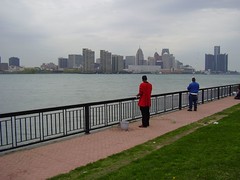
    The nicest thing about Windsor was the magnificent riverfront park. It runs for miles, with walking and bike paths, beautiful landscaping and a large sculpture garden. People fish off the railing; apparently on weekends the path is packed with fisherpeople. You can see the Ambassador Bridge and the Detroit skyline, which is impressive and beautiful.

    windsor ontario riverfront park

    windsor ontario riverfront park


    We drove through some old neighbourhoods with gorgeous old homes, laughed at the ugly new faux estates, and saw the downtown.

    The best part of Windsor was actually our friends' home. They are designers and photographers, and their home looks like something out of an interior design magazine. I often look at 1960s and 70s retro furniture and wonder how people make it work in real life. Now I know.

    Their house is filled with crazy rotary phones, model cars (and trucks, airplanes, starships, construction equipment...), and retro technology like calculators and electric razors displayed the way we less imaginative folks put pottery or glassware on a shelf. It's playful and fun and amazing.

    It's also a warm home filled with the love of two adorable dogs, two birds, a tankful of tropical fish and two very happy people.

    * * * *

    We saw three games in Detroit's Comerica Park. Although I wish the Tigers still played in beautiful, historic Tiger Stadium, Comerica is a lovely, downtown ballpark, beautifully done.

    comerica park detroit michigan


    In my travels, I've learned that every trip has a regret: something you dreamed of seeing that is closed for renovation, or the ferry has stopped running for the winter, or you realize it's a three-day journey and you only have one day left. Even short road baseball road trips have a regret.

    For the second game, we got to the park early to watch the Red Sox take batting practice. Our ace closer, Jonathan Papelbon, was standing right in front of us, holding court for another of our pitchers (who we also love) Hideki Okajima, and another man, possibly Jeemer's translator.

    Drawing diagrams with his toe in the warning-track dirt, Papelbon was earnestly passing along some intricate knowledge. Although we're not sure of what - possibly gambling. We were close enough to have heard every word, but the new ballparks all have music blasting during batting practice - goddess forbid we could just enjoy the quiet sounds of baseball - so we only caught a word or two. Okajima was signing baseballs, especially for (apparently) Japanese fans who had come to see him. Another pitcher, David Aarsdma, was also signing autographs.

    The regret? We didn't bring our camera that day.

    The Red Sox won the first two games. In the third, the Tigers took a lead, the Red Sox came back to tie it, but Detroit won in the bottom of the 9th. The Sox won the fourth game (we were already home for that one), but seeing two wins in three games is terrific.

    And for the first game, we hung out with my blog-friend Nigel Patel. I thought we were just meeting before the game for a quick chat, but Nige scored a ticket and managed to sit with us. Much fun!

    * * * *

    Yesterday, the last day of the trip, we drove in two cars out to Point Pelee National Park. With Pelee Island, in Lake Erie, this is the southernmost point in Canada, the same longitude as Rome and Barcelona. Point Pelee is full of wetlands, so it's a haven for many species of birds. We happen to be there during a bird festival, so the park was full of birders sporting binoculars, guides and all manner of equipment.

    We walked on a long boardwalk out onto the marshlands...

    point pelee ontario


    ...then took a shuttle tram down to the point...

    point pelee ontario


    ...and walked back up along a beach trail.

    point pelee ontario


    The point, a sand spit, sometimes extends for a mile or more into Lake Erie. This time it was completely under water.

    The trail is full of cacti. Cactus, in Canada!

    point pelee ontario


    I had hoped to also visit Pelee Island Winery, but it turned out that's an all-day project. The ferry is 90 minutes each way, and runs infrequently. We'll do it on another visit.

    point pelee ontario
    Our new friends.


    More photos here.

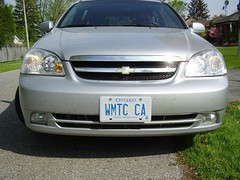
    new plates!

    Check it out!

    wmtc02


    This is no licence plate generator. This is our car.

    wmtc01


    We wanted "wmtc" by itself, but it was already taken. But for second choice, we're very happy with it.

    5.05.2008

    baseball road trip

    We are off to Detroit, to see the Red Sox play the Tigers for three games.

    We've been to Tiger Stadium, Detroit's beautiful, historic ballpark, which now sits dormant, but not to Detroit's new downtown park. Comerica makes ballpark number 21 for us together, and 22 for me.

    While in the neighbourhood, we'll meet up with my long-time blog-friend Nigel Patel, who lives in the Detroit area. "Nige" and I have been reading each other's blogs a long time. I'm excited to meet him!

    We'll also meet and spend time with our even longer-time blog-friends Wondrous Canadian Renewal. Gito and Juan have generously invited us to stay with them in Windsor, Ontario, just over the river from Detroit. Before we return on Thursday, we hope to visit Point Pelee National Park and Pelee Island, the southernmost point in Canada, and where my favourite Ontario wine comes from.

    Have a great week, and I will try to check in when I can.

    5.04.2008

    young me, now me

    Have you seen this?

    People submit a photo of themselves as a child, then a current photo of themselves in the same pose. There's something very touching about it.

    "they can't kill us all"

    Buckdog remembers Kent State.

    May 4, 1970.

    more naomi wolf: "things proceed fairly routinely"

    More from Naomi Wolf's The End of America. I promise I won't reprint the whole book.
    Both Italian and German fascisms came to power legally and incrementally in functioning democracies; both used legislation, cultural pressure, and baseless imprisonment and torture, progressively to consolidate power. Both directed state terror to subordinate and control the individual, whether the individual supported the regime inwardly or not. Both were rabidly antidemocratic, not as a side sentiment but as the basis of their ideologies; and yet both aggressively used the law to pervert and subvert the law.

    . . . .

    If it is too emotionally overwhelming to think of Italy and Germany, you can consider the more recent fates of Indonesia, Nicaragua, Chile, Uruguay, Paraguay, and Guatemala, all of which suffered widespread state terror and the activation of many of the ten steps that I describe, as leaders sought to subdue the people.

    The same ten steps have shut down democracies all over the world at many different times. And these steps are no secret: After all, Mussolini studied Lenin; Hitler studied Mussolini; Stalin studied Hitler; and Chinese communist leaders studied Stalin, and so on. Indeed the United States has helped develop a training center, the School of the Americas (now renamed the Western Hemisphere Institute for Security Cooperation), to train various procapitalist Latin American leaders in the theory and practice of violent dictatorship.

    . . . .

    It's easy to look around at America in 2007 and choose to believe that this warning is overheated: After all, we are for the most part doing what we have routinely done. We are going online into a vibrant Internet world; clicking through hundreds of TV channels; enjoying Hollywood films; reading bestsellers that present views across the political spectrum. The courts are ruling, newspapers are publishing exposes, protest marches are being planned about the war; a presidential race is underway.

    But there are plenty of examples of a shift into a dictatorial reality in which, for several years, while the basic institutions of freedom are targeted and rights are eroding, daily life still looks very normal – even, for many people, pleasant.

    Americans tend to think of the shift to fascism in scary set-pieces: the boots on the stairs, the knock in the middle of the night, the marching columns, the massive banners waving over city streets; a Leni Riefenstahl film all the time, or an unrelieved scene of citizen terror with crematoria smoking in the distance. We are so used to seeing depictions of the most sensational aspects of totalitarian societies – the gulag, the death camps – that we don't pay much attention to the fact that there is often an incremental process that led those societies to become places where such things could happen.

    The view that fascism looks from the start like a nationwide prison camp rather than a fairly normal society can be comforting when facing an argument like mine. It's natural to wish that the two realities were so categorically different that, of course, "It couldn't happen here."

    But as would-be dictators consolidate power, if they are training their sights on a democracy, things proceed fairly routinely in many areas in the earliest years. In the beginning, the horror, as W. H. Auden put it, is usually elsewhere, taking place while other people are going about their normal daily round. Peasants in Italy celebrated their harvest festivals in 1919 in Naples when Mussolini's arditi were beating bloody the local communists in Milan. Journalist Joseph Roth, the star columnist for the Frankfurter Zeitung, filed glitzy reports on urban style and nightlife, on architecture and the avant-garde; he and his colleagues dwelt on the latest fashions and described the trendiest watering holes. As Roth rebutted rising anti-Semitism in print, Hitler was consolidating power around himself. Victor Klemperer, a Jewish professor of French literature who kept a diary throughout the rise and fall of the Third Reich, cared for his garden, did repairs on his car, chatted with his Nazi neighbors, went to the movies with his wife, even as he became increasingly aware of persecution, arrests, theft of property, and new discriminatory laws; even as he was certain of an inevitable catastrophe. That's what people do.

    The neon lights were flashing outside nightclubs in Vienna right through the Anschluss. British travelogues for Italy and Germany from the 1930s depict jolly fascists sharing a nice Marsala with the writers in an osteria. More recently, the day after the 2006 military coup in Thailand, tourists were posing for snapshots next to armed guards; sunbathers will still at the beach.

    In 2004, I spent the spring and summer working to help elect John Kerry, even though I already knew I was leaving the US for Canada. It wasn't that I loved Kerry as a candidate, or even that I was unconvinced of the corrupt US election system. I felt compelled to do whatever I could to help, in case I was wrong.

    In that group, I worked closely with a woman who was changing her career - changing her entire life - to become a full-time activist. After the campaign, when we talked about where we were going next, she told me she was "dedicating her life to be part of the Resistance". We looked at each other with tears in our eyes, both thinking the same thing. Those words, "the Resistance" carried such a heavy historical echo.

    I told her I was moving to Canada. She was happy for me; she said, "We need people everywhere. If all else fails, we'll need people on the other side". I realize now that those were the first seeds of my desire to help US war resisters.

    Of course, we have to make sure Canada stays "the other side".

    moyers on the racist double standard

    You know I don't blog about the US elections. But I have blogged about the rampant sexism surrounding the campaigns. Today it's the racism in those same campaigns, brought to you by the always thoughtful and truth-telling Bill Moyers, which I found through Common Dreams.

    Moyers thinks and writes a lot about race, with directness and understanding, with sympathy but without condescension. Every once in a while I read something he's written, and I think, why aren't I reading him all the time?

    Here is Moyers' "Beware The Simplifiers". Emphasis and added links are mine.
    I once asked a reporter back from Vietnam, "Who's telling the truth over there?" "Everyone, he said. "Everyone sees what's happening through the lens of their own experience." That's how people see Jeremiah Wright. In my conversation with him on this broadcast a week ago and in his dramatic public appearances since, he revealed himself to be far more complex than the sound bites that propelled him onto the public stage. Over 2000 of you have written me about him, and your opinions vary widely. Some sting: "Jeremiah Wright is nothing more than a race-hustling, American hating radical," one viewer wrote. A "nut case," said another. Others were far more were sympathetic to him.

    Many of you have asked for some rational explanation for Wright's transition from reasonable conversation to shocking anger at the National Press Club. A psychologist might pull back some of the layers and see this complicated man more clearly, but I'm not a psychologist. Many black preachers I've known — scholarly, smart, and gentle in person — uncorked fire and brimstone in the pulpit. Of course I've known many white preachers like that, too.

    But where I grew up in the south, before the civil rights movement, the pulpit was a safe place for black men to express anger for which they would have been punished anywhere else; a safe place for the fierce thunder of dignity denied, justice delayed. I think I would have been angry if my ancestors had been transported thousands of miles in the hellish hole of a slave ship, then sold at auction, humiliated, whipped, and lynched. Or if my great-great grandfather had been but three-fifths of a person in a constitution that proclaimed, "We the people." Or if my own parents had been subjected to the racial vitriol of Jim Crow, Strom Thurmond, Bull Connor, and Jesse Helms. Even so, the anger of black preachers I've known and heard about and reported on was, for them, very personal and cathartic.

    That's not how Jeremiah Wright came across in those sound bites or in his defiant performances this week. What white America is hearing in his most inflammatory words is an attack on the America they cherish and that many of their sons have died for in battle - forgetting that black Americans have fought and bled beside them, and that Wright himself has a record of honored service in the Navy. Hardly anyone took the "chickens come home to roost" remark to convey the message that intervention in the political battles of other nations is sure to bring retaliation in some form, which is not to justify the particular savagery of 9/11 but to understand that actions have consequences. My friend Bernard Weisberger, the historian, says, yes, people are understandably seething with indignation over Wright's absurd charge that the United States deliberately brought an HIV epidemic into being. But it is a fact, he says, that within living memory the U.S. Public Health Service conducted a study that deliberately deceived black men with syphilis into believing that they were being treated, while actually letting them die for the sake of a scientific test. Does this excuse Wright's anger? His exaggerations or distortions? You'll have to decide or yourself. At least it helps me to understand the why of them.

    But in this multimedia age the pulpit isn't only available on Sunday mornings. There's round the clock media — the beast whose hunger is never satisfied, especially for the fast food with emotional content. So the preacher starts with rational discussion and after much prodding throws more and more gasoline on the fire that will eventually consume everything it touches. He had help — people who for their own reasons set out to conflate the man in the pulpit who wasn't running for president with the man in the pew who was.

    Behold the double standard: John McCain sought out the endorsement of John Hagee, the war-mongering Catholic-bashing Texas preacher who said the people of New Orleans got what they deserved for their sins. But no one suggests McCain shares Hagee's delusions, or thinks AIDS is God's punishment for homosexuality. Pat Robertson called for the assassination of a foreign head of state and asked God to remove Supreme Court justices, yet he remains a force in the Republican religious right. After 9/11 Jerry Falwell said the attack was God's judgment on America for having been driven out of our schools and the public square, but when McCain goes after the endorsement of the preacher he once condemned as an agent of intolerance, the press gives him a pass.

    Jon Stewart recently played a tape from the Nixon White House in which Billy Graham talks in the oval office about how he has friends who are Jewish, but he knows in his heart that they are undermining America.
    This is crazy; this is wrong -- white preachers are given leeway in politics that others aren't.

    Which means it is all about race, isn't it? Wright's offensive opinions and inflammatory appearances are judged differently. He doesn't fire a shot in anger, put a noose around anyone's neck, call for insurrection, or plant a bomb in a church with children in Sunday school. What he does is to speak his mind in a language and style that unsettle some people, and says some things so outlandish and ill-advised that he finally leaves Obama no choice but to end their friendship. We are often exposed us to the corroding acid of the politics of personal destruction, but I've never seen anything like this - this wrenching break between pastor and parishioner before our very eyes. Both men no doubt will carry the grief to their graves. All the rest of us should hang our heads in shame for letting it come to this in America, where the gluttony of the non-stop media grinder consumes us all and prevents an honest conversation on race. It is the price we are paying for failing to heed the great historian Jacob Burckhardt, who said "beware the terrible simplifiers".

    Nice, eh?

    5.03.2008

    "the end of america", extended excerpt

    I recently began reading The End of America: Letter of Warning to a Young Patriot, by Naomi Wolf. It is a short book, written in a clear, straightforward voice. It can be thought of as a pamphlet in the tradition of Thomas Paine's "Common Sense".

    Wolf shares and bolsters my view of the United States as a post-democratic state, a nation in which many of the necessary precursors to authoritarianism are already in place.

    While most people I know are enthralled by the political circus in the US (even if they are disgusted by short-term tactics), I remain doubtful that there will be a legal, democratic change of government. I am somewhat expecting "something to happen". What that something is - what form it will take and when it will take place - I can't say. I have no knowledge of the future. But I believe I am looking at the present with unclouded vision.

    As I read The End of America I immediately place it in context with two other books I have read and blogged about: Philip Roth's The Plot Against America and Jared Diamond's Collapse. I blogged about Plot Against America here and here. I blogged about Jared Diamond in about a million places.

    Roth's book follows a period of US history with exact precision.
    Then something different happens: the Republicans do not nominate Wendell Willkie to challenge Franklin Delano Roosevelt's bid for an unprecedented third term. They nominate Charles Lindbergh. Lindbergh: hero, celebrity, friend of the Nazis, virulent anti-Semite. (This is true, too, except he wasn't nominated.) During the campaign, Lindbergh keeps his most objectionable sentiments under his hat, and the media - then known as "the press" - goes along for the ride. Lindy seduces the public with his plain-spoken charm, and runs on one simple promise: I will keep the US out of another war.

    He wins. FDR goes home to Hyde Park. A Nazi-sympathizer sits in the White House. It begins.

    I am finding this book so gripping, so terrifying, and so completely believable, that I have to keep reminding myself that it didn't happen this way. I keep thinking, thank god I'm in Canada already, before this happens. Obviously, that's part of Roth's point.

    I think of Collapse for a different and related reason. Throughout history and across cultures, when resources are scarce, the people who control those resources resort to more extreme measures to consolidate and strengthen that control. We are already seeing war and genocide stemming from the control of resources. Wondering what else we will see is an exercise so scary I can barely contemplate it.

    From Naomi Wolf, The End Of America, introduction. I've removed the footnotes, but every fact is cited.
    I am writing because we have an emergency. Here are U.S. news headlines from a two-week period in the late summer 2006:

    July 22: "CIA WORKER SAYS MESSAGE ON TORTURE GOT HER FIRED." Christine Axsmith, a computer security expert working for the C.I.A., said she had been fired for posting a message on a blog site on a top-secret computer network. Axsmith criticized waterboarding: "Waterboarding is torture, and torture is wrong." Ms. Axsmith lost her job as well as her top-secret clearance, which she had held since 1993. She fears her career in intelligence is over.

    July 28: "DRAFT BILL WAIVES DUE PROCESS FOR ENEMY COMBATANTS." The Bush administration has been working in secret on a draft bill "detailing procedures [for] bringing to trial those it captures in the war on terrorism, including some stark diversions from regular trial procedures. . . . Speedy trials are not required. . . Hearsay information is admissible . . . the [military] lawyer can close the proceedings [and] can also order 'exclusion of the defendant' and his civilian counsel." Those defined as "enemy combatants" and "persons who have engaged in unlawful belligerence" can be held in prison until "the cessation of hostilities," no matter when that may be or what jail sentence they may get.

    July 29: "THE COURT UNDER SIEGE." In June 2006, the Supreme Court ruled that denying prisoners at Guantanamo judicial safeguards violated the Geneva Conventions and U.S. law. The Supreme Court also insisted that a prisoner be able to be present at his own trial. In response, the White House prepared a bill that "simply revokes that right." The New York Times editorial page warned, "It is especially frightening to see the administration use the debates over the prisoners at Guantanamo Bay and domestic spying to mount a new offensive against the courts."

    July 31: "A SLIP OF THE PEN." U.S. lawyers issued a statement expressing alarm at the way the president was overusing "signing statements." They argued that this was an exertion of executive power that undermined the Constitution. Said the head of the American Bar Association, "The threat to our Republic posed by presidential signing statements is both imminent and real unless immediate corrective action is taken."

    August 2: "BLOGGER JAILED AFTER DEFYING COURT ORDERS." A freelance blogger, Josh Wolf, 24, was jailed after he refused to turn over to investigators a video he had taken of a protest in San Francisco. Jane Kirtley, a professor of media ethics and law at the University of Minnesota, said that, although the jailing of American journalists was becoming more frequent, Mr. Wolf was the first American blogger she knew of to be imprisoned by federal authorities.

    August 2: "GOVERNMENT WINS ACCESS TO REPORTER PHONE RECORDS." "A federal prosecutor may inspect the telephone records of two New York Times reporters in an effort to identify their confidential sources..." according to The New York Times. A dissenting judge speculated that in the future, reporters would have to meet their sources illicitly, like drug dealers meeting contacts "in darkened doorways."

    August 3: "STRONG-ARMING THE VOTE." In Alabama, a federal judge took away powers over the election process from a Democratic official, Secretary of State Worley, and handed them over to a Republican governor: "Party politics certainly appears to have been a driving force," argued the Times. "The Justice Department's request to shift Ms. Worley's powers to Governor Riley is extraordinary." When Worley sought redress in a court overseen by a federal judge aligned with the Bush administration, she wasn't allowed her chosen lawyer. It was "a one-sided proceeding that felt a lot like a kangaroo court. . . " cautioned the newspaper. She lost.

    Why am I writing this warning to you right now, in 2007? After all, we have had a Congressional election giving control of the House and the Senate to Democrats. The new leaders are at work. Surely, Americans who have been worried about erosions of civil liberties, and the destruction of our system of checks and balances, can relax now: see, the system corrects itself. It is tempting to believe that the basic machinery of democracy still works fine and that any emergency threatening it has passed — or, worst case, can be corrected in the upcoming presidential election.

    But the dangers are not gone; they are regrouping. In some ways they are rapidly gaining force. The big picture reveals that ten classic pressures — pressures that have been used in various times and places in the past to close down pluralistic societies — were set in motion by the Bush administration to close down our own open society. These pressures have never been put in place before in this way in this nation.

    A breather is unearned; we can't simply relax now. The laws that drive these pressures are still on the books. The people who have a vested interest in a less open society may be in a moment of formal political regrouping; but their funds are just as massive as before, their strategic thinking unchanged, and their strategy now is to regroup so that next time their majority will be permanent.

    All of us — Republicans, Democrats, Independents, American citizens—have little time to repeal the laws and roll back the forces that can bring about the end of the American system we have inherited from the Founders — a system that has protected our freedom for over 200 years.

    I have written this warning because our country — the democracy our young patriots expect to inherit — is in the process of being altered forever. History has a great deal to teach us about what is happening right now — what has happened since 2001 and what could well unfold after the 2008 election. But fewer and fewer of us have read much about the history of the mid-twentieth century — or about the ways the Founders set up our freedoms to save us from the kinds of tyranny they knew could emerge in the future. High school students, college students, recent graduates, activists from all walks of life, have a sense that something overwhelming has been going on. But they have lacked a primer to brief them on these themes and put the pieces together, so it is hard for them to know how urgent the situation is, let alone what they need to do.

    Americans expect to have freedom around us just as we expect to have air to breathe, so we have only limited understanding of the furnaces of repression that the Founders knew intimately. Few of us spend much time thinking about how "the system" they put in place protects our liberties. We spend even less time, considering how dictators in the past have broken down democracies or quelled pro-democracy uprisings. We take our American liberty for granted the way we take our natural resources for granted, seeing both, rather casually, as being magically self-replenishing. We have not noticed how vulnerable either resource is until very late in the game, when systems start to falter. We have been slow to learn that liberty, like nature, demands a relationship with us in order for it to continue to sustain us.

    Most of us have only a faint understanding of how societies open up or close down, become supportive of freedom or ruled by fear, because this is not the kind of history that we feel, or that our educational system believes, is important for us to know. Another reason for our vagueness about how liberty lives or dies is that we have tended lately to subcontract out the tasks of the patriot: to let the professionals — lawyers, scholars, activists, politicians — worry about understanding the Constitution and protecting our rights. We think that "they" should manage our rights, the way we hire a professional to do our taxes; "they" should run the government, create policy, worry about whether democracy is up and running. We're busy.

    But the Founders did not mean for powerful men and women far away from the citizens — for people with their own agendas, or for a class of professionals — to perform the patriots' tasks, or to protect freedom. They meant for us to do it: you, me, the American who delivers your mail, the one who teaches your kids.

    I am one of the citizens who needed to relearn these lessons. Though I studied civics, our system of government was taught to me, as it was to you, as a fairly boring explication of a three-part civil bureaucracy, not as the mechanism of a thrilling, radical, and totally unprecedented experiment in human self-determination. My teachers explained that our three-part system was set up with "checks and balances," so that no one branch of government could seize too much power. Not so exciting: this sounded like "checks and balances" in a bureaucratic turf war. Our teachers failed to explain to us that the power that the Founders restrained in each branch of government is not abstract: it is the power to strip you and me of personal liberty.

    So I needed to go back and read, more deeply than I had the first time around, histories of how patriots gave us our America out of the crucible of tyrants, as well as histories of how dictators came to power in the last century. I had to reread the stories of the making and the unmaking of freedom. The more I read these histories, the more disturbed I became.

    I give you the lessons we can learn from them in this pamphlet form because of the crisis we face.

    Like every American, I watched the events of September 11, 2001, with horror. Then, like many, I watched the reactions of the administration in power at first with concern, then with anxiety, and then, occasionally, with shock. I started feeling that there was something familiar about how events, at times, were unfolding.

    Because of the déjà vu I was starting to feel when I read the newspaper every day, I began to take a second look at how leaders in the past had cracked down on societies over which they had gained control; I looked with special attention at what had happened when a leader brought about a shift from a pluralistic, democratic society to a dictatorship.

    Historical Echoes

    I began to think of these examples as "historical echoes" — not proof that someone influential in the administration had studied the details of mid-twentieth-century fascism and totalitarianism, but certainly suggestive.

    What was it about the image of a mob of young men dressed in identical shirts, shouting at poll workers outside of a voting center in Florida during the 2000 recount, that looked familiar? What resonated about the reports that Bush supporters in the South were holdings organized public events to burn CDs by the Dixie Chicks? (CDs are actually quite hard to burn, and produce toxic fumes.) What seemed so familiar about an organized ideological group shaming an academic for saying something unpopular — and then pressuring the state government to get the university president to fire that professor? What was so recognizable about reports that FBI agents were stopping peace activists at airports? Why did the notion of being "greeted as liberators" feel so familiar, and phrases such as "hiding in spider-holes" sound so familiar?

    These events may seem to have historical echoes because they actually are mirrored in history.

    No one can deny the skill of fascists at forming public opinion. I can't prove that anyone in the Bush administration studied Joseph Goebbels. I am not trying to. All I am doing is noting echoes.

    As you read you may notice other parallels — usually in the details of events. The Bush administration created a policy post-9/11 about liquids and air travel. Increased security restrictions led to airport security guards forcing some passengers to ingest liquids: A Long Island mother, for instance, was forced to drink from three bottles filled with her own breast milk prior to boarding a plane at JFK. Other adult passengers have been forced to drink baby formula. In Benito Mussolini's era, one intimidation tactic was to force citizens to drink emetics and other liquids. German SS men picked this up: they forced Wilhelm Sollmann, a Social Democrat leader, for instance, to drink castor oil and urine. Of course baby formula is not an emetic. But a state agent—some agents are armed—forcing a citizen to ingest a liquid is a new scene in America.

    In 2002 the Bush administration created and named the "Department of Homeland Security." White House spokespeople started to refer to the United States, unprecedentedly, as "the Homeland." American Presidents have before now referred to the United States as "the nation" or "the Republic," and to the nation's internal policies as "domestic."

    By 1930 Nazi propagandists referred to Germany not as "the nation" or "the Republic" — which it was — but rather as "the Heimat" — "the Homeland." Homeland is a word that memoirist Ernestine Bradley, who grew up in Nazi Germany, describes as saturated with nationalist power: "Heimat is a German word which has no satisfactory equivalent in other languages. It denotes the region where one has been born and remains rooted... Longing to be in the Heimat causes the incurable disease of Heimweh." Deputy Fuhrer Rudolf Hess, introducing Hitler at a Nuremberg rally, said, "Thanks to your leadership, Germany will be attainable as the Homeland — Homeland for all Germans in the world." A Department of Domestic Security is simply a bureaucracy, capable of mistakes; a department protecting our "Homeland" has a different authority.

    In 2001 the USA PATRIOT Act let the federal government compel doctors to give up confidential medical records without a warrant demonstrating probable cause. Your previously private interaction with your doctor is now subject to state scrutiny. (Nazi law in the 1930s required German doctors to disclose citizens' previously private medical records to the State.)

    In 2005 Newsweek reported that Guantanamo prisoners had seen the Koran being flushed down toilets. Under pressure from the White House, the magazine ran a correction: It had not interviewed direct witnesses to the practice. But human rights organizations did confirm accounts of similar abuses of the Koran. (In 1938, the Gestapo forced Jews to scrub out the toilets with their sacred phylacteries, the tfillin.)

    Amnesty International reports that U.S. interrogators torment prisoners in Iraq by playing heavy metal at top volume into their cells night and day. (In 1938, the Gestapo tormented imprisoned Austrian premier Kurt von Schuschnigg by keeping the radio on at top volume, night and day.)

    An Iraqi human rights group complained that, in 2004, U.S. forces seized the innocent wives of suspected insurgents and held the women hostage in order to pressure their husbands to turn themselves in. (In Joseph Stalin's Russia, secret police took hostage the innocent wives of dissidents accused of "treason," to pressure their husbands to turn themselves in.)

    When the United States invaded Iraq, Vice President Dick Cheney promised that we would be "greeted as liberators." (When the German army occupied the Rhineland, Nazi propaganda asserted that the troops would be welcomed as liberators.)

    President Bush argued that the prisoners in Guantanamo Bay could be treated harshly because they were not covered by the Geneva Conventions. (Nazis asserted that the troops invading Russia should treat the enemy especially brutally, because they were not covered by the Hague Conventions.)

    After 9/11, then-National Security Advisor Condoleezza Rice and Vice President Cheney coined a new phrase: America was now on a "war footing." Superficially, it was a stirring word choice. But if you thought about it, it was also kind of an odd word choice, because America was not actually at war. What is a "war footing"? (Nazi leaders explained, after the Reichstag fire, that Germany, which was not actually at war, was from then on a permanent "kriegsfusz" — literally, a "war footing.")

    The Bush White House "embedded" reporters with U.S. military units in Iraq. Uncritical coverage of the war expanded considerably. (National Socialist propaganda officials embedded reporters and camera crews with their own armed forces: Filmmaker Leni Riefenstahl was embedded with Nazi troops in Poland; U.S. correspondent William Shirer drove with German units into occupied France.)

    The Bush administration unloads coffins of dead American soldiers from planes at night and has forbidden photographers to take pictures of the coffins. (National Socialists unloaded the coffins of the German war dead at night.)

    The White House announced, beginning in 2002, that there were terrorist "sleeper cells" scattered throughout the nation. A "sleeper cell," press reports explained, was a group of terrorists that had merged into ordinary American life, waiting, perhaps for years, for the signal to rise up and cause mayhem.

    A wave of reporting asserted that the FBI had located a sleeper cell in Lodi, California. After an informant had been paid hundreds of thousands of dollars to spy on Muslims, the FBI detained a Muslim father and son, Umer Hayat, and his son, Hamid Hayat. The two men explained that they had confirmed an imaginary sleeper cell in order to end a terrifying series of interrogations.

    Another much-publicized sleeper cell identified four Muslim men in Detroit. Attorney General John Ashcroft claimed that the men had had advance knowledge of 9/11; federal authorities charged that they were part of a "sleeper cell plotting attacks against Americans overseas," as news reports put it. The Justice Department heralded the arrests as one of its biggest hits in the War on Terror.

    The phrase "sleeper cell" entered deeply into the American unconscious, even becoming the plot of a 2005 TV movie. But in 2006, Richard Convertino, the prosecutor of the Detroit case, was indicted on charges of trying to present false evidence at the trial, and concealing other evidence, in his attempt to back up the government's theory about the men. All charges were dropped against the men and the Justice Department quietly repudiated its own case. But you probably didn't hear about that, and the creepy sleeper-cell narrative stayed in the atmosphere to trouble your dreams.

    Sleeper cell was a term most Americans had never heard before. It is a phrase from Stalin's Russia, where propagandists said that imaginary cells, consisting of agents of "international capitalism" — that is, us — had been sent by the U.S. government to infiltrate Soviet society. These secret agents would pose as good Soviet comrades, living quietly among their neighbors, but just awaiting the day when, at a signal, they would all rise up to commit mayhem. When the 2006 terrorist plot against U.S.-bound planes was uncovered in London, an FBI official gave a much-quoted sound bite: "If this plot had actually occurred, the world would have stood still." FBI guys don't usually speak in cadences of dark poetry. (Of his plans in 1940, Hitler said, "The world will hold its breath.")

    These echoes are worth noticing — but are not ultimately that important. What is important are the structural echoes you will see: the way dictators take over democracies or crush pro-democracy uprisings by invoking emergency decrees to close down civil liberties; creating military tribunals; and criminalizing dissent.

    Those echoes are important.

    * * * *

    So I read about Mussolini's Italy in the 1920s; Stalin's Russia and Hitler's Germany in the 1930s; I read about East Germany in the 1950s and Czechoslovakia in the 1960s and Chile in 1973, as well as about other Latin American dictatorships; I read about Communist China in the late 1980s and early 1990s.

    The countries I looked at were very different, of course, and the violent dictators had a broad range of ideologies. Stalin imposed totalitarianism over a communist state, itself built upon the ruins of a toppled monarchy. Mussolini and Hitler both came to power legally in the context of fragile parliamentary democracies. East Germany and Czechoslovakia were communist systems and China still is; and General Augusto Pinochet closed down Chile's young democracy in a classic Latin American military coup d'etat.

    Violent dictators across the political spectrum all do the same key things. Control is control. In spite of this range of ideological differences, profound similarities in tactics leap off the pages. Each of these leaders used, and other violent dictators around the globe continue to borrow, the same moves to close down open societies or crush dissent.

    There are ten steps that are taken in order to close down a democracy or crush a pro-democratic movement, whether by capitalists, communists, or right-wing fascists. These ten steps, together, are more than the sum of their parts. Once all ten have been put in place, each magnifies the power of the others and of the whole.

    Impossible as it may seem, we are seeing each of these ten steps taking hold in the United States today.

    But America is different! I can hear you saying.

    There is no guarantee that America is different if Americans fail to take up the patriot's task.

    At times in our own history our commitment to freedom has faltered. The Alien and Sedition Act of 1798 made it a crime for Americans to speak critically — to "bring into contempt or disrepute" — of then-President John Adams and other U.S. leaders. But Thomas Jefferson pardoned those convicted under these laws when he took office.

    During the Civil War, President Lincoln suspended habeas corpus, effectively declaring martial law in several states: Close to 38,000 Americans were imprisoned by military authorities during the war—many for simply expressing their views. But when the war ended in 1865, the Supreme Court ruled that it had been unconstitutional for military tribunals to try civilians.

    In 1918, labor leader Eugene Debs was arrested for giving a speech about the First Amendment; he got a ten-year jail sentence. Raids swept up hundreds of other activists.42 But after World War I ended, the hysteria subsided.

    During World War II, the Justice Department rounded up 110,000 innocent Japanese-Americans and imprisoned them in camps. When the war was over, these innocent Americans were released as well.

    Anti-communist anxiety led the nation to tolerate the McCarthy hearings; but the pendulum swung back and Senator Joe McCarthy himself was condemned by his colleagues.

    I am describing the movement of "the pendulum" — as in the American cliche, "The pendulum always swings back." We are so familiar with, and so reliant upon, the pendulum. That is why you are so sure that "America is different." But the pendulum's working depends on unrestricted motion. In America, up until now, the basic checks and balances established by the Founders have functioned so well that the pendulum has always managed to swing back. Its very success has made us lazy. We trust it too much, without looking at what a pendulum requires in order to function: the stable framework that allows movement; space in which to move; that is, liberty.

    The pendulum cannot work now as it has before. There are now two major differences between these past examples of the pendulum's motion and the situation we face today.

    First, as Bruce Fein of the American Freedom Agenda and writer Joe Conason have both noted, previous wars and emergencies have had endpoints. But President Bush has defined the current conflict with global terrorism as being c permanent alteration of the constitutional landscape.

    The other difference between these exam when prior dark times unfolded in America, was that the rule of law was intact. Legal torture, as you will see, acting in concert with the erosion of the rule of law, change what is possible.

    So, because I was looking at something unprecedented in our nation's history, I had to read the histories of many forms of state repression, including the most extreme.

    I had to include Nazi Germany in my scrutiny of repressive governments. Many people are understandably emotionally overwhelmed when the term "Nazism" or the name "Hitler" is introduced into debate. As someone who has lost relatives on both sides of my family in the Holocaust, I know this feeling. I also know that there is a kind of intellectual etiquette, an unwritten rule, that Nazism and Hitler should be treated as stand-alone categories.

    But I believe this etiquette is actually keep what we have to learn right now. I believe we honor the memory of the victims of Nazism with our willingness to face the lessons that history - even the most nightmarish history – can offer us about how to defend freedom.

    In looking at other violent dictatorships, including Germany's, I am not comparing the United States in 2007 to Nazi Germany, or Bush to Hitler. The two nations and leaders inhabit different worlds. There will not be a coup in America like Mussolini's March on Rome or a dramatic massacre like Hitler's Night of the Long Knives. But certain threads are emerging that have connections to the past. I am calling your attention to important lessons from history about how fragile civil liberties are, and how quickly freedom can be lost. I ask you to quiet your understandable aversion long enough to walk with me through the material I have to show you.

    The ten steps to dictatorship are basic.

    In September 2006, military leaders staged a coup in Thailand, which had been a noisy democracy. In a matter of days, the coup leaders ticked through many of the ten steps, as if they had a shopping list. In a sense they did.

    They deployed armed guards in residential neighborhoods, sent lawmakers home, shut down the free press, took over the state-run television, threatened critics with arrest, put new limits on travel, restricted protest, and discontinued the Parliamentary rule of law. Thailand was a police state within a matter of days.

    We are seeing each of the basic ten steps being put into place here in the United States today - more quietly, more gradually, and sometimes more elegantly; but each is underway.

    My sense of alarm comes from the clear lessons from history that, once certain checks and balances are destroyed, and once certain institutions have been intimidated, the pressures that can turn an open society into a closed one turn into direct assaults; at that point events tend to occur very rapidly, and a point comes at which there is no easy turning back to the way it used to be.

    The fascist shift does not progress like a diagonal line rising steadily across a chart. Rather, it progresses in a buildup of many acts assaulting democracy simultaneously, that then form a critical mass — what writer Malcolm Gladwell would call a "tipping point." The pressure from this set of assaults suddenly pushes the nation into a new and degraded reality. The turning points can be mapped as vertical lines — the point at which prisoners lost the right to habeas corpus, for instance, is one — which then plateau into the nation's new normal. The nation acclimates; then this process begins again at that greater level of suppression.

    What got to be really scary in my reading was how predictable events become, once you are familiar with the blueprint. By the beginning of August, 2006, for instance, it seemed like a good bet that the Bush administration would soon move on from the detainee bill that it had been secretly preparing to seek Congressional authorization for creating a prison beyond the rule of law where torture could take place. This was accomplished by October of 2006.

    In September of 2006,1 thought that it was likely that some of the first prisoners to be tried in Guantanamo by the new military commission system would be white and English-speaking. Indeed, that happened by April of 2007. It also seemed probable that White House spokespeople would begin to use terms such as treason, espionage, subversion, and aiding the enemy to describe criticism, press scrutiny, dissent, and even simple departure from alignment with White House goals. From the blueprint, I thought it was unsurprising when the administration started to criminalize speech in new ways. This began to happen in earnest by May of 2007.

    When the U.S. Attorney scandal came to light in March of 2007 and there was still little information, because I had been reading a biography of Goebbels, I remarked to a friend, "I bet the attorneys were in swing states." By the next week, it had been confirmed that most of them were in fact in swing states. All this supposition was not rocket science; it was simply that each of these is a classic move in the playbook of a fascist shift.

    Everything changed in America in September of 2006, when Congress passed the Military Commissions Act. This law created a new legal reality that heralds the end of America if we do not take action. Yet most Americans still do not understand what happened to them when that law passed.

    This law gives the president - any president - the authority to establish a separate justice system for trying alien unlawful enemy combatants. It defines both "torture" and "materially supporting] hostilities" broadly. The MCA justice system lacks the basic protections afforded defendants in our domestic system of laws, in our military justice system, or in the system of laws used to try war criminals—Nazi leaders got better civil liberty protection than alien enemy combatants, as did perpetrators of genocide like Slobodan Milosovic. And persons accused by the president (or his designees) of being alien unlawful enemy combatants are forbidden from invoking the Geneva Conventions, a treaty that represents the basic protections of justice common to all civilized nations. The United States has signed the Geneva Conventions and agreed to abide by them, and this repudiation is a radical departure from our traditions. Under the MCA, the government can used "coerced" interrogation to obtain evidence. Finally, and perhaps most damagingly, the MCA denies unlawful alien enemy combatants the right to challenge the legitimacy of their confinement or treatment. So, while the MCA provides all sorts of rules that the military is supposed to follow, it will be difficult, if not impossible to hold anyone accountable for breaking those rules.

    But this is not all. The president and his lawyers now claim the authority to designate any American citizen he chooses as being an "enemy combatant"; and to define both "torture" and "material support" broadly. They claim the authority to give anyone in the executive branch the power to knock on your door, seize you on the street, or grab you as you are changing planes at Newark or Atlanta airports; blindfold you and put earphones on you; take you to a cell in a navy prison; keep you in complete isolation for months or even years; delay your trial again and again; and make it hard for you to communicate with your lawyer. The president claims the authority to direct agents to threaten you in interrogations and allow into your trial things you confessed to while you were being mistreated.

    The president claims the authority to do any of those things to any American citizen now on his say-so alone. Let me repeat this: The president asserts that he can do this to you even if you have never committed a crime of any kind: "enemy combatant" is a status offense. Meaning that if the president says you are one, then you are.

    Human rights groups raised the alarm early on about what this law might mean to the many innocent foreign detainees who had been swept up in the machinery of Afghan prisons and sent to Guantanamo. Some Congressional leaders have warned us about what this law might do to our own soldiers, if they are taken as POWs. But most ordinary citizens did not understand what Congress had done - not to anonymous, possibly scary, brown people on a faraway island, but to them. Most Americans still do not understand.

    Last September, concerned about the legal arguments being put forward by the Department of Justice, I called a friend who is a professor of Constitutional law.

    "Does the administration assert that the president can define anyone he wants to as an 'enemy combatant'? Including U.S. citizens?" I asked.

    "Yes," he replied.

    "And does it argue that courts must defer to the government's assertions that someone should be held as an enemy combatant, even when it presents no direct evidence?"

    "Yes," he replied.

    "So doesn't that mean they are saying that now any of us for any reason he decides can be seized off the street and imprisoned in isolation for months and interrogated?"

    "Yes," he said.

    "So why isn't anyone saying that?"

    "Some people are. But a lot of people probably think it would just sound crazy," he replied.

    [from Chapter one, The Founders and the Fragility of Democracy]

    To U. S. citizens in the year 2007, the very tide of this book should be absurd. It is unthinkable to most of us that there could ever be an "end of America" in the metaphorical sense. But it is when memories are faint about coercive tactics that worked to control people in the past that people can be more easily controlled in the present.

    When I say that the Bush administration has used tactics that echo certain tactics from the past, I am making a conservative argument. You will have to look at the echoes I note and decide for yourself what to make of them. We know that Karl Rove seeks the goal of a permanent majority. A permanent majority is easier to solidify for the future if democracy's traditional challenges to power are weakened or silenced.

    I won't insult Republicans by calling this goal a "permanent Republican majority," although Rove calls it by that name. Most Americans — Republican, Independent, or Democrat — are patriots and believe in the Founders' vision. I have to assume that one reason for this assault on democracy is to secure the "permanent majority" status of a far smaller group, or rather of several smaller groups, driven by motives of power and money: the great power represented by access to an executive that is driving an agenda unthreatened by the people's will, and the vast amount of money that has begun to flow from a condition of uninterrupted domestic surveillance and open-ended foreign hostilities.

    Authoritarianism, Fascism, Totalitarianism: Some Definitions

    Are any of these terms legitimate for this discussion?

    I have made a deliberate choice in using the terms fascist tactics and fascist shift when I describe some events in America now. I stand by my choice. I am not being heated or even rhetorical; I am being technical.

    Americans tend to see democracy and fascism as all-or-nothing categories. But it isn't the case that there is a pure, static "democracy" in the white squares of a chessboard and a pure, static "fascism" in the black squares. Rather, there is a range of authoritarian regimes, dictatorships, and varieties of Fascist state, just as there are stronger and weaker democracies — and waxing and waning democracies. There are many shades of gray on the spectrum from an open to a closed society.

    After the definitions, Wolf touches on each of the ten steps by which a democracy falls and an authoritarian regime rises.

    Read this book. It is happening. It is happening now.

    u.s. delists wolves, and the slaughter begins

    Only 30 days after the US government stripped gray wolves of protection under the Endangered Species Act, the National Resources Defense Council reports that 37 wolves have been slaughtered.

    Hundreds more are being targeted by Wyoming, Idaho and Montana, the states that have been waiting for permission to kill these magnificent creatures that do them no harm.

    The NRDC and 11 other environmental and wildlife groups are trying ever legal means to stop the killing and restore the wolf's protected status. From an NRDC email alert:
    The court action comes not a moment too soon. Eyewitness reports of the latest wolf-killing rampage have been heartbreaking to people all over the world who care about wildlife.

    On the very day that these wolves lost their Endangered Species protection, a crippled wolf named "Limpy," one of the most photographed wolves in Yellowstone's famous Druid Peak pack, was shot to death when he ventured outside the park.

    Another wolf was stalked for over 35 miles by snowmobile before being overtaken and shot. Another was found dead on the side of the highway, his still-warm body torn apart by bullets.

    And, tragically, at least four female wolves have been killed just prior to the denning season, which could doom some of the region's wolf pups.

    Wolves simply cannot outrun these relentless attacks. Their last, best hope now rests with the life-saving reprieve that NRDC is seeking in federal court.

    Americans are being urged to contact their Congresspeople to protest this slaughter. Donating to the groups mounting the legal battle is also a way to help.

    My most recent post on wolves is here.

    child slavery in china

    From Reuters:
    Thousands of children in southwest China have been sold into slavery like "cabbages", to work as labourers in more prosperous areas such as the booming southern province of Guangdong, a newspaper said on Tuesday.

    China announced a nationwide crackdown on slavery and child labor last year after reports that hundreds of poor farmers, children and mentally disabled were forced to work in kilns and mines in Shanxi province and neighboring Henan.

    "The bustling child labor market (in Sichuan province) was set up by the local chief foreman and his gang of 18 minor foremen, who each manage 50 to 100 child labourers," the Southern Metropolis Newspaper said.

    "The children generally fall between the ages of 13 and 15, but many look under 10," it added.

    The newspaper said 76 children from the same county, Liangshan, had been missing since the Chinese Lunar Year festival in February, 42 of whom had already left the region to work.

    "The youngest kids found in the child labor market were only seven and nine years old," it said.

    According to a contract exposed by an undercover reporter, a child laborer is paid 3.5 yuan ($0.50) an hour and must work at least 300 hours a month.

    "These kids are robust and can do the toughest work," a foreman was quoted as saying, as he pulled a scrawny girl to stand beside him, the paper said.


    And meanwhile, guess where the uniforms for Team Canada are being made?

    When I wrote about not watching the Olympics because of China's rampant human rights abuses, I was slammed for... well, what wasn't I slammed for. Western hypocrisy, because you're only allowed to be outraged if you come from Ideal World Where Everyone Is Perfect. Ineffectiveness, since not watching the Olympics will not in itself solve the world's problems. Politicizing the supposedly apolitical Olympics, which are awarded to countries to curry trade and political favours. Arrogance, because boycotting China supposedly implies I think the US is just grand. Bigotry, because China is in Asia and I am white.

    Not watching the Beijing Olympics and Paralympics is a symbolic action. Just like the torch relay is a symbol, and protests against it symbolic, too. Like standing for a national anthem, or remaining seated.

    Not watching the Olympics, in itself, solves nothing. But if I don't watch the Olympics, and I tell you why, perhaps you will talk about it around your dinner table or on your own blog. Perhaps more people will learn about what is happening in China.

    If enough people don't watch the 2008 Summer Olympics because they are being held in Beijing, perhaps the IOC and Beijing will notice.

    Surely it's not sufficient. But just as surely, it's worth doing.

    5.02.2008

    war resister james burmeister needs your help

    James Burmeister is a war resister who was living in Ottawa for almost a year, before surrendering to the US military in March. (For more background, I blogged about James here and here.)

    * * * *

    After working at Wal-Mart and fast-food restaurants in Eugene, Oregon, James joined the military. His recruiter told him he would build schools and support Iraqis who were establishing democracy.

    In Iraq, James was assigned to a "small kill" team. Their duty was to place a fake camera on a pole with a sign labeling it US property, then shoot anyone who touched it. James, whose task was to provide perimeter security for the small-kill team, never got over his disgust for the tactic.

    After he was wounded by a roadside bomb - suffering traumatic brain injury, hearing loss and facial wounds - the Army sent James to Germany to recover. When it was time to go back to Iraq, he went to Ottawa instead.

    After 10 months in Canada, James turned himself into the military, and was put in the brig in Fort Knox, Kentucky. He was held in a heavy-security facility for almost a month.

    After pressure from the public and James' congressperson, the Army transferred James to a more "casual" facility, where he is still being held. James continues to suffer from the effects of traumatic brain injury and severe PTSD. The Army's response: keep him medicated. It's not helping.

    James' family believes the Army is preparing to send James to Germany for court martial and probable imprisonment, to reduce his contact with supporters and activists. This is contrary to the Uniform Code of Military Justice, but it's a tactic that has been used against several war resisters, most notably Agustin Aguayo.

    If you want to help, James' family requests you take the following actions.

    Call Fort Knox, Kentucky. Request that PFC James Burmeister be released as soon as possible. Express concern for his medical condition (brain injury and PTSD). Demand that the Army make public its intentions regarding James's court martial.

    Demand that James Burmeister be released with a medical discharge. James' military service should be properly recognized, so he can obtain veterans benefits to help pay for the medical treatments he requires. Calls can be directed to Major Pitcher (502.624.6247) and Seargent Tua (502.624.0068).

    Write a letter of support to James' Congressman. Tell him you are concerned about James not getting the medical attention that he needs. Letters can be mailed to: The Honorable Peter DeFazio, 405 East 8th Avenue #2030, Eugene, OR 97401, USA. Fax: 541.465.6458. You can also call the Congressman's office at 541.465.6732.

    * * * *

    If this story interests you, and you can be in Toronto on May 21, join us for A Conversation with US War Resisters in Canada, moderated by CBC host Andy Barrie.

    u.s. military jails overflowing with war resisters

    At this week's meeting of the War Resisters Support Campaign, a new resister joined the circle. Also present was a resister who is back in Canada after serving time in a US military brig. He went back to the US to visit his family and was picked up on a traffic violation. A license check revealed his AWOL status, and it went from there.

    Both of these young men told us that the US military jails are overflowing with "UA"s, as they called them - servicepeople who went AWOL and were caught. Jail conditions are horrible, although our newest resister told us he didn't care, as it was suicide to do anything else.

    By some reports from very credible sources, there are as many as 25,000 AWOL US soldiers out there. I can't substantiate that, but even if that figure is slightly inflated, it's clear that large numbers of US military personnel are resisting this terrible, useless war.

    Many people in the peace movement, myself included, believe that the most effective way we can work for peace is by supporting veteran and military peace groups. Iraq Veterans Against the War, Courage To Resist and, in Canada, the War Resisters Support Campaign top this list. Since officially there is no draft in US, and since the US government is immune to democracy, to some extent, only the armed forces themselves can end this war.

    It must be incredibly difficult to stand up for personal conscience from within the military. Coercion and punishment - mental, physical and financial - are the norm. Thinking for oneself is anathema. But every military person who takes a courageous stand against the Iraq War strengthens the resolve of every other person who is having second thoughts. IVAW has chapters all over the US, including on several military bases. We've heard that after Winter Soldier: Iraq & Afghanistan was broadcast on the internet and throughout the alternative media, applications for IVAW membership skyrocketed.

    Yesterday in comments on my brief May Day post, M@ linked to this story from the SFGate:
    Dockworkers with the International Longshore and Warehouse Union walked off the job at ports up and down the West Coast, including Oakland and San Francisco, calling for an end to the war. Union officials estimated the number of workers at 25,000 while maritime officials placed the number closer to 10,000.

    Anti-war protesters, joining dockworkers and other labor leaders, marched down the Embarcadero from Fisherman's Wharf to Justin Herman Plaza, where a rally drew several hundred protesters and onlookers.

    This morning I saw this on the IVAW website:
    A message of solidarity

    On May 1, 2008, the International Longshore & Warehouse Union of San Francisco resolved to halt work for 8 hours and shut down ports along the west coast in protest against the U.S. occupation of Iraq. The General Union of Port Workers in Iraq also resolved to halt work for one hour in order to demonstrate opposition to the continued occupation of their country. Under a Saddam Hussein-era law, one of the few that was not altered by U.S. ambassador and Coalition Provisional Authority head Paul Bremer, it remains illegal for public sector workers to unionize in Iraq. Iraqi union workers are frequently threatened with harassment and violence by Iraqi government forces and several major union leaders have been assassinated in recent years.

    To: Members of the International Longshore & Warehouse Union, San Francisco, Members of the Port Workers Union of Iraq

    From: Iraq Veterans Against the War

    Iraq Veterans Against the War stands in solidarity with you against the illegitimate and immoral U.S. occupation of Iraq. Our respect for the principles upon which this nation was founded compels us to speak out against our government's policies in Iraq and demand that our brothers and sisters in arms be immediately withdrawn. There can be no peace or security for Iraq or for the United States until the Iraqi people are allowed to determine their own destiny, free of foreign interference in their internal affairs. There can be no true democracy in Iraq or in America unless the inherent right of workers to freely assemble is protected. Throughout history, the right of men and women to determine their own destiny has been secured only through struggle. As Americans who have not forgotten our history, we stand proudly with you.

    In Solidarity,
    Kelly Dougherty
    Executive Director
    Iraq Veterans Against the War

    Next up, what you can do to support one war resister who needs our help.

    5.01.2008

    may day

    I almost forgot my annual May Day post!

    May 1 is the international workers' holiday, celebrated almost everywhere in the world except the US, Canada and South Africa.

    This May Day website from Alberta has some great links about the history of the day, and how it became a workers' holiday.

    Today is a day to recognize your common bond with all working people, to reflect on our shared dignity and worth, and the need for all people to earn a living wage.

    Update: By "celebrated almost everywhere in the world," I meant officially recognized as a national holiday.

    let them stay: a conversation with u.s. war resisters, featuring andy barrie

    The War Resisters Support Campaign will hold a public event on May 21 that promises to be a memorable evening.

    CBC radio host Andy Barrie, who came to Canada as a conscientious objector to the Vietnam War, will moderate "A Conversation with US War Resisters in Canada". It will be a town hall- style event, featuring a dozen or more Iraq War resisters answering questions from Andy and from the community. It's an opportunity to see into the heart of war resistance - to find out why these people joined the U.S. military, why they left, and what they hope for in Canada.

    "A Conversation with US War Resisters" will take place at Innis Town Hall on the University of Toronto campus. If you can be in Toronto the night of May 21, this promises to be a memorable evening.