We're making progress every day.
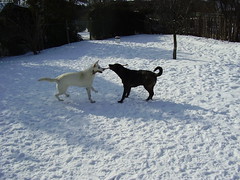
Cody is adjusting, Tala is calming down a little bit, and we're settling into the beginnings of a routine. The two of them play great together outside; inside, Cody is less bothered, less belligerent, more tolerant. And Tala is actually learning to leave her alone.
On Tuesday we re-learned the first three rules of managing a young dog's boundless energy: exercise, exercise, exercise. We went to Jack Darling, Mississauga's biggest and best leash-free dog park. A fierce wind was whipping off the Lake and the ground was hard-packed, icy snow. It was cold, but worth it.
Tala immediately forgot her name and pretended not to know us, but who can blame her, the first time she's let loose in a huge field with 30 new dogs to check out. They ran and played for a long time, and when we couldn't take the wind anymore, we managed to corral Tala. She spent the rest of the day peacefully lounging around, a huge difference from her usual non-stop playfulness.
This morning we went to the vet, to have Tala's stitches (from neutering) removed and get a few minor things checked out. She's scratching a lot, and probably has some skin allergies. After the vet, it was back to Jack Darling, and they're both snoozing away right now.
The park, on Lakeshore between Port Credit and Clarkson, is a little too far away for us to go regularly. There's a small dog run at nearby Garnetwood Park, and of course there's our backyard, which also helps.
We had a terrific time with D, gabbing, listening to music, cooking, eating, drinking. We watched Martin Scorsese's "Bob Dylan: No Direction Home," which we own but Dave hadn't seen, and which we had to pause a few hundred times to discuss. D left this morning, and tomorrow it's back to work and real life.
2.08.2007

breaking news: ehren watada will not go to jail
The court martial of Lt. Ehren Watada has ended in a mistrial. A new trial has been scheduled for... March 19! Does that date sound familiar? It's the fourth anniversary of the US invasion of Iraq. Nice touch, judge!
Watada's lawyers, however, believe a retrial is "very unlikely", and will argue that jeopardy attaches. Eric Seitz explains here.
See Courage to Resist for updates.
A mistrial is not the ideal outcome, but it sure beats a guilty verdict and jail time.
Watada's lawyers, however, believe a retrial is "very unlikely", and will argue that jeopardy attaches. Eric Seitz explains here.
See Courage to Resist for updates.
A mistrial is not the ideal outcome, but it sure beats a guilty verdict and jail time.
2.06.2007
our home in native land
Our friend and nephew D - musician, massage therapist, and all around cool guy - arrived last night from western Massachusetts. It's too cold for any city exploring, so we're sticking close to home - playing with pups, having Dim Sum in Mississauga, making dinner together.
Speaking of cold, I'm enjoying listening to Canadians one-up each other on the weather. "You think this is cold? When I lived in Winnipeg..." I think anything colder than minus 15 qualifies as cold. I don't mind it, but it is cold. I save my complaining for the summer.
* * * *
I really liked this. I especially love that it was a 13-year-old girl!
Speaking of cold, I'm enjoying listening to Canadians one-up each other on the weather. "You think this is cold? When I lived in Winnipeg..." I think anything colder than minus 15 qualifies as cold. I don't mind it, but it is cold. I save my complaining for the summer.
* * * *
I really liked this. I especially love that it was a 13-year-old girl!
A 13-year-old Alberta girl made history at centre ice in Calgary's Saddledome on Saturday night when she became the first person to sing O Canada in Cree at an NHL game.
Akina Shirt, who lives in Edmonton but is originally from the Saddle Lake First Nation about 120 kilometres east of Edmonton, sang the national anthem before the Calgary Flames took on the Vancouver Canucks.
Shirt said she learned the Cree version of the anthem a year ago.
I had to work extra hard in learning the words and practising it and I eventually memorized it and it just comes natural," she told CBC News.
Shirt sang to a sold-out crowd in the Saddledome and in front of hundreds of thousands of Hockey Night in Canada viewers.
She's gained a reputation as a lucky charm since she started out singing the anthem for the Saddle Lake Junior B Warriors — each time she has opened a game, the home team has won.
Saturday night was the first time she opened for a professional hockey matchup. And sure enough, the Flames beat the Canucks 4-3.
Shirt said the chief of the Saddle Lake First Nation told the Flames that they should have her sing the anthem.
2.05.2007
on supposedly liberal people supporting hillary clinton
I've always said that a woman will be elected President of the United States during my lifetime, and it will kill me, drive me insane, because I won't be able to vote for her. I've always assumed the first female US President will be the American Margaret Thatcher. How would a woman break through the sexist stereotypes, prove she was tough enough, "man enough" to be President? By being a hardcore conservative Republican.
Hillary Rodham Clinton's hat in the presidential-hopeful ring doesn't change this assessment, for two reasons. One, she can't win, and the Democrats are even bigger fools than I think they are if they nominate her. And two, she doesn't deserve to win, because she's not liberal: she's a hawk.
First: she can't win. Just as people around the world loved Bill Clinton, his international popularity far outstripping what he enjoyed in the US, here in Canada, people imagine that Hillary Clinton will sail into office. Most Canadians I speak with have no idea that a large percentage of the American public views Hillary Clinton as a filthy, slimy She-Devil. I can't remember a politician who is loathed as deeply as H. R. Clinton is. Liberals' and progressives' hatred of George W. Bush pales in comparison to conservative and reactionary hatred of Clinton. They're so much better at hate than we are.
This hatred, of course, isn't warranted. I only wish it were! If Clinton was even a fraction of the radical leftist the reactionary media makes her out to be, I'd be thrilled. Their hatred is misguided, and it's sexist. But it exists, and Clinton's campaign and the media distortions that are sure to accompany it will only fuel the fire. Nothing Clinton can say or do on the campaign trail will change that, because, after all, the right's hatred of Hillary Clinton is based on fantasy. The woman those people love to bash doesn't even exist.
Dyed-in-the-wool Democrats will vote for Clinton, but they'll vote for any donkey versus any elephant. So if we assume the Democrats must go after the swing voter, and the Democrats nominate Hillary Clinton, we should all just save our time and money and put the Republican in office right now. (We can do that anyway, since 2008 will be as stolen as 2004 was, but that's another story...)
Second: she shouldn't win. I'm frankly amazed - and disgusted - by how many supposedly liberal Americans support Hillary Clinton. People, have you all forgotten?? She supported the war on Iraq! She supported the invasion, she supported the war, she supported the occupation. She changed her position only recently, when it was politically safe to do so.
How can anyone who opposes the US war on Iraq vote for someone who supported it?
Although Clinton has since backed away from her support of the war (and lies about her former support), now that it's politically expedient to do so, she continues to support the occupation - and says "no option can be taken off the table" when dealing with Iran.
If you haven't followed Clinton's backpedaling path when on Iraq, it's understandable, as she was purposely pretty quiet on this divisive issue. To get you up to speed, here are some primers: Code Pink has been bird-dogging Clinton on the war, and you can listen to the results here. From AntiWar.Com, here's a story called "Hillary May Be Presidential Material, After All - On Iraq and Israel, she's a perfect neocon" and another go from the bird-doggers.
Writer and blogger Bob Harris puts it as well as I've seen it anywhere:
Let me put it another way. If Hillary Clinton had the exact same record, had made the exact same statements, but had the letter (R) beside her name instead of a (D), would you vote for her? And would you vote for her because she's a woman?
I'd be willing to bet that we could find a Republican with the exact same voting record as Hillary Clinton. I admit I haven't done this - I have no intentions of spending my time combing through US Senate voting records - but anyone who wants to bet and do the work, you're on.
Another enlightening exercise is to compare US Senator Hillary Clinton to Canadian Prime Minister Stephen Harper. You know, the Harper that some Canadians claim is a baby Bush? The Harper that some people fear will hand Canada over to the neocons, lock, stock and privatized health care? Many people on both sides of the 49th would be surprised to learn that Clinton and Harper have similar stances on most issues, and on some, Clinton is further to the right. You don't have to take my word for it, the great NDP Blogger Idealistic Pragmatist has done the homework.
Some progressive bloggers who I really like are supporting Clinton's candidacy. I've responded that we need progressive people first. If they can also be women, great, but peace and justice must take priority over any feminist or gender solidarity. But we need women, they say. And at what cost, I ask. Will US soldiers (and Iraqi civilians) be any less dead if a woman orders the killing than if a man does?
Others have suggested that if progressive people put Clinton in office, she will be obligated to listen to us. I ask: how's that been working out for you so far? Have the Democrats you've helped put in office felt obligated to listen to you recently? Ever? In your lifetime? If Clinton were elected, it would be the so-called centre - the conservative swing voters - she would owe, not us.
And is there any evidence that she'd feel obligated to the voters at all? Or just to the corporate money that financed her campaign? During the run-up to the war, Clinton's office was flooded with calls and faxes urging, begging and demanding that she vote no to authorizing Resident's war powers. It was estimated that callers against the war outnumbered those for the war by 3 to 1. She voted yes.
Still, Clinton continues to draw the rage of the neocons (even though she is often indistinguishable from them) and the gushing admiration of liberals. She continues on a hawkish path that she thinks will win her votes, while allowing the right's hatred of her to fool liberals into thinking she is one of them. Now that is the work of a brilliant politician.
I want to see a female US President so badly that I see stars. I salivate over it. I yearn for it down to my chewed-up fingernails.
But a woman in the White House is less important than the direction the US takes. A woman in the White House is less important than ending this terrible war, than freeing the prisoners at Guantanamo, than not launching a war against Iraq.
If the choice was between, say, Katherine Harris and Dennis Kucinich, who would you vote for?
Hillary Rodham Clinton's hat in the presidential-hopeful ring doesn't change this assessment, for two reasons. One, she can't win, and the Democrats are even bigger fools than I think they are if they nominate her. And two, she doesn't deserve to win, because she's not liberal: she's a hawk.
First: she can't win. Just as people around the world loved Bill Clinton, his international popularity far outstripping what he enjoyed in the US, here in Canada, people imagine that Hillary Clinton will sail into office. Most Canadians I speak with have no idea that a large percentage of the American public views Hillary Clinton as a filthy, slimy She-Devil. I can't remember a politician who is loathed as deeply as H. R. Clinton is. Liberals' and progressives' hatred of George W. Bush pales in comparison to conservative and reactionary hatred of Clinton. They're so much better at hate than we are.
This hatred, of course, isn't warranted. I only wish it were! If Clinton was even a fraction of the radical leftist the reactionary media makes her out to be, I'd be thrilled. Their hatred is misguided, and it's sexist. But it exists, and Clinton's campaign and the media distortions that are sure to accompany it will only fuel the fire. Nothing Clinton can say or do on the campaign trail will change that, because, after all, the right's hatred of Hillary Clinton is based on fantasy. The woman those people love to bash doesn't even exist.
Dyed-in-the-wool Democrats will vote for Clinton, but they'll vote for any donkey versus any elephant. So if we assume the Democrats must go after the swing voter, and the Democrats nominate Hillary Clinton, we should all just save our time and money and put the Republican in office right now. (We can do that anyway, since 2008 will be as stolen as 2004 was, but that's another story...)
Second: she shouldn't win. I'm frankly amazed - and disgusted - by how many supposedly liberal Americans support Hillary Clinton. People, have you all forgotten?? She supported the war on Iraq! She supported the invasion, she supported the war, she supported the occupation. She changed her position only recently, when it was politically safe to do so.
How can anyone who opposes the US war on Iraq vote for someone who supported it?
Although Clinton has since backed away from her support of the war (and lies about her former support), now that it's politically expedient to do so, she continues to support the occupation - and says "no option can be taken off the table" when dealing with Iran.
If you haven't followed Clinton's backpedaling path when on Iraq, it's understandable, as she was purposely pretty quiet on this divisive issue. To get you up to speed, here are some primers: Code Pink has been bird-dogging Clinton on the war, and you can listen to the results here. From AntiWar.Com, here's a story called "Hillary May Be Presidential Material, After All - On Iraq and Israel, she's a perfect neocon" and another go from the bird-doggers.
Writer and blogger Bob Harris puts it as well as I've seen it anywhere:
...the Iraq war is one of the deadliest, stupidest, and most criminal foreign policy mistakes of our lifetimes. (Just making that list is a major accomplishment, btw, considering Guatemala, East Timor, Cambodia, etc.) And Hillary, despite her recent weaseling -- sorry, triangulation is the term of art -- vigorously supported Bush's Iraq adventure from the start.There are Democratic faithful who say that Clinton is only doing what any viable candidate for President has to do, because no one with too strong an anti-war stance could get elected. If that's what you're going to settle for, how can we hope to end the war? If that's what you're going to settle for, how can the Democratic party ever be anything but a slightly more moderate Republican party?
In the wake of 9-11, it wasn't just George W. Bush telling the world "every nation has to be either with us or against us." It was Hillary, as you can hear for yourself.
In October 2002, during the debate about giving Bush authorization to invade Iraq, it wasn't just Dick Cheney telling the world in that Saddam Hussein had links to Al-Qaeda. It was Hillary, from the floor of Congress.
And in February 2005, it wasn't just John McCain claiming that democracy was taking root in Iraq, and that the insurgency was in its last throes. It was Hillary, standing right at John McCain's side. . . .
If this were a just world, not one person who authorized Bush to invade Iraq would ever be re-elected to anything, and the prime engineers of this mess would be going to jail instead of Fox News desks. And if this were a just world, Hillary would be held in almost as much contempt by people opposed to this war as Bush, Cheney, and the rest of Team Chimpy.
Let me put it another way. If Hillary Clinton had the exact same record, had made the exact same statements, but had the letter (R) beside her name instead of a (D), would you vote for her? And would you vote for her because she's a woman?
I'd be willing to bet that we could find a Republican with the exact same voting record as Hillary Clinton. I admit I haven't done this - I have no intentions of spending my time combing through US Senate voting records - but anyone who wants to bet and do the work, you're on.
Another enlightening exercise is to compare US Senator Hillary Clinton to Canadian Prime Minister Stephen Harper. You know, the Harper that some Canadians claim is a baby Bush? The Harper that some people fear will hand Canada over to the neocons, lock, stock and privatized health care? Many people on both sides of the 49th would be surprised to learn that Clinton and Harper have similar stances on most issues, and on some, Clinton is further to the right. You don't have to take my word for it, the great NDP Blogger Idealistic Pragmatist has done the homework.
Some progressive bloggers who I really like are supporting Clinton's candidacy. I've responded that we need progressive people first. If they can also be women, great, but peace and justice must take priority over any feminist or gender solidarity. But we need women, they say. And at what cost, I ask. Will US soldiers (and Iraqi civilians) be any less dead if a woman orders the killing than if a man does?
Others have suggested that if progressive people put Clinton in office, she will be obligated to listen to us. I ask: how's that been working out for you so far? Have the Democrats you've helped put in office felt obligated to listen to you recently? Ever? In your lifetime? If Clinton were elected, it would be the so-called centre - the conservative swing voters - she would owe, not us.
And is there any evidence that she'd feel obligated to the voters at all? Or just to the corporate money that financed her campaign? During the run-up to the war, Clinton's office was flooded with calls and faxes urging, begging and demanding that she vote no to authorizing Resident's war powers. It was estimated that callers against the war outnumbered those for the war by 3 to 1. She voted yes.
Still, Clinton continues to draw the rage of the neocons (even though she is often indistinguishable from them) and the gushing admiration of liberals. She continues on a hawkish path that she thinks will win her votes, while allowing the right's hatred of her to fool liberals into thinking she is one of them. Now that is the work of a brilliant politician.
I want to see a female US President so badly that I see stars. I salivate over it. I yearn for it down to my chewed-up fingernails.
But a woman in the White House is less important than the direction the US takes. A woman in the White House is less important than ending this terrible war, than freeing the prisoners at Guantanamo, than not launching a war against Iraq.
If the choice was between, say, Katherine Harris and Dennis Kucinich, who would you vote for?
2.04.2007
hunger among us
I've been reading a lot about poverty, hunger and massive income inequality in the GTA, in Ontario and in Canada in general.
There's the ongoing fight for the $10 minimum wage in Ontario (as of February 1, it is $8.00), an increasing income gap between immigrants and those born in Canada, and reports of hunger and malnutrition among people still suffering from Mike Harris's draconian cuts to public assistance and housing, which have never been restored. Meanwhile, the Bank of Montreal lays off 1,000 workers while posting record profits ($2.7 billion in 2006, up 11% from 2005) and paying out an $8.1 million compensation package to CEO Tony Comper.
Many Canadians like to imagine that only American corporations use such irresponsible, short-sighted business strategies. Many Canadians imagine their country to be a just, compassionate, and humane society. Canada shouldn't be a good place to live only relative to the United States. It should just be.
There's the ongoing fight for the $10 minimum wage in Ontario (as of February 1, it is $8.00), an increasing income gap between immigrants and those born in Canada, and reports of hunger and malnutrition among people still suffering from Mike Harris's draconian cuts to public assistance and housing, which have never been restored. Meanwhile, the Bank of Montreal lays off 1,000 workers while posting record profits ($2.7 billion in 2006, up 11% from 2005) and paying out an $8.1 million compensation package to CEO Tony Comper.
Many Canadians like to imagine that only American corporations use such irresponsible, short-sighted business strategies. Many Canadians imagine their country to be a just, compassionate, and humane society. Canada shouldn't be a good place to live only relative to the United States. It should just be.
ehren watada's court martial to begin tomorrow
Tomorrow, February 5, the US Army will begin the court martial of Lt. Ehren Watada, the first officer to refuse deployment to the war in Iraq.
The military trial will be held in Ft. Lewis, Washington, about 50 miles south of Seattle. There will be an all-day rally and vigil outside the base, as well as events nationwide in support of Watada. As always, you can go to Courage To Resist to learn what you can do to stand beside this brave man.
The redesigned Courage To Resist site also makes it easier to read about many other courageous war resisters: Agustin Aguayo, Ivan Brobeck, Kyle Snyder, Suzanne Swift, Ricky Clousing, Darrell Anderson, Mark Wilkerson, Katherine Jashinski.
The military trial will be held in Ft. Lewis, Washington, about 50 miles south of Seattle. There will be an all-day rally and vigil outside the base, as well as events nationwide in support of Watada. As always, you can go to Courage To Resist to learn what you can do to stand beside this brave man.
The redesigned Courage To Resist site also makes it easier to read about many other courageous war resisters: Agustin Aguayo, Ivan Brobeck, Kyle Snyder, Suzanne Swift, Ricky Clousing, Darrell Anderson, Mark Wilkerson, Katherine Jashinski.
wheels in motion
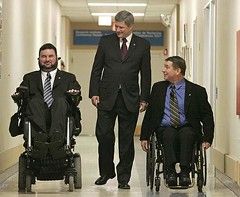
Prime Minister Stephen Harper has announced that his government will contribute $30 million over five years to a national network that will focus on spinal cord injury research and rehabilitation.
The funding commitment will mostly go to Rick Hansen's Foundation for Spinal Cord Injury Translational Research Network, a Canadian team that speeds the link between research discoveries and practical applications in the field of spinal cord injury - something that is badly needed.
Harper also announced that some funds will go towards rehab, mobility and improved independence for people currently living with spinal cord injury.
Cure can be a controversial subject in the disability community. Too much focus on "fixing" disabilities and not enough on living with them, and making the world more livable for them, is bound to meet with disappointment and protest. If there is a cure one day - if paralysis from spinal cord injury is eliminated - it would change the world on the scale of eradicating polio or smallpox. But people living with SCI can never give up the daily battle to be integrated into mainstream life.
In the photo above, Harper is standing between Rick Hansen and Steven Fletcher.
Hansen, former Olympic and Paralympic athlete, who has raised millions of dollars and immeasureable oceans of awareness through his foundation and the Man In Motion tour. I have a soft spot for Rick Hansen - and did before I even realized he was Canadian - because he competed in the 1984 Olympics, the first Olympics to feature wheelchair racing as an exhibition sport. I have interviewed dozens of athletes with disabilities who name Rick Hansen as their original hope that life could go on after their injury.
Fletcher is a Conservative MP in Winnipeg, the first quadriplegic to be elected to the House of Commons. I'm slated to write about him this year for New Mobility magazine. How will I write about a member of Stephen Harper's government? We shall see.
2.03.2007
pupdate 3
Big progress on the friendship front! Yesterday Cody and Tala played in the backyard, happily and without incident. Tala didn't bark in Cody's face, Cody didn't growl. Cody even initiated play a few times. They did the same this morning.
Relations inside the house are touchier, but also have progressed. Cody isn't growling as much, and Tala is respecting Cody's space more. Cody still seems depressed and annoyed, but less so.
Things are also progressing on the training front. Tala will have her PhD by the end of the month.
Relations inside the house are touchier, but also have progressed. Cody isn't growling as much, and Tala is respecting Cody's space more. Cody still seems depressed and annoyed, but less so.
Things are also progressing on the training front. Tala will have her PhD by the end of the month.
what i'm reading: pierre berton
I've started Pierre Berton's The Promised Land: Settling the West 1896-1914, the book that follows Klondike. From the prologue:
In The Promised Land, Berton reveals evidence that contradicts the public image of both men. Dafoe apparently has been a legend in the media, with a heroic image as an independent and incorruptible editor in the days before such a thing existed. And indeed it did not exist. Dafoe's popular image was based on one incident in which his publisher - who was Clifford Sifton, although that fact was concealed for many years - allowed him his independence. And that incident stands out in a decades-long career in which Dafoe, like every other editor, wrote and ran what his publisher - who was usually a politician - told him to.
If you read, as I do, about the turn of the last century - the late 1800s to the early 1900s - you quickly learn two things, and you learn them over and over. In this sense I see that Canadian history is exactly the same as American history.
One, there was no such thing even resembling an objective press. Imagine 20 newspapers that are all Fox News, each blatantly doing the bidding of a different political party.
News stories read like editorials. Reporters wrote what their political bosses told them to write, and editors could be bought for a small fee, or, if they were very influential, for a large one. Bribery was the grease that kept the machine running, and patronage, in the form of advertising, was the glue that held it all together.
The second thing you immediately learn is that there were no such thing as fair elections. Voter turnout was massive - maybe 500% or 1000%, as people were usually paid to vote more than once.
Back to our Slavic immigrants. They were subject to fierce religious prejudice, of course, Catholics in a Protestant world. The Methodists, Presbyterians and Baptists joined forces for the crusade. As one principal crusader put it, "...the interest of the state lies in doing all it can to assimilate these and other foreigners and make of them Canadians. They should be put into the great Anglo-Saxon mill and be ground up; in the grinding why lose their foreign prejudices and characters."
But, Berton writes, things did not work out that way.
This is a book about dreams and illusions, escape and survival, triumph and despair. It is also a book about foolish optimism, political cunning, naivete, greed, scandal and opportunism. It is a book about the search for Utopia, the promise of a Promised Land, and so it treats of hope, fulfilment, and liberation as well as drudgery, loneliness, and disenfranchisement. What we are dealing with here is a phenomenon rare, it not unique, in history: the filling up of an empty realm, a thousand miles broad, with more than one million people in less than one generation. [Ed note: the native peoples already had been forced to relocate for the building of the trans-Canada railroad.]So far I've been introduced to such outsized figures in Canadian history as Clifford Sifton, the Minister of the Interior and the architect of Canada's first immigration policy, and John Wesley Dafoe, his editorial lackey. In American history terms, Sifton, called the Napoleon of the West, compares to Robert Moses, the Master Builder. Clifton's reach was longer than Moses's, but his reign didn't last as long.
This, then, is the story of the creation of a state within a state and the resultant transformation of a nation. There are grafters in this tale and hard-nosed politicians and civic boosters with dollar signs in their eyes; but there are also idealists, dreamers, and visionaries.
In The Promised Land, Berton reveals evidence that contradicts the public image of both men. Dafoe apparently has been a legend in the media, with a heroic image as an independent and incorruptible editor in the days before such a thing existed. And indeed it did not exist. Dafoe's popular image was based on one incident in which his publisher - who was Clifford Sifton, although that fact was concealed for many years - allowed him his independence. And that incident stands out in a decades-long career in which Dafoe, like every other editor, wrote and ran what his publisher - who was usually a politician - told him to.
If you read, as I do, about the turn of the last century - the late 1800s to the early 1900s - you quickly learn two things, and you learn them over and over. In this sense I see that Canadian history is exactly the same as American history.
One, there was no such thing even resembling an objective press. Imagine 20 newspapers that are all Fox News, each blatantly doing the bidding of a different political party.
News stories read like editorials. Reporters wrote what their political bosses told them to write, and editors could be bought for a small fee, or, if they were very influential, for a large one. Bribery was the grease that kept the machine running, and patronage, in the form of advertising, was the glue that held it all together.
The second thing you immediately learn is that there were no such thing as fair elections. Voter turnout was massive - maybe 500% or 1000%, as people were usually paid to vote more than once.
In today's context, reports of political meetings at the turn of the century are hilarious, and it is difficult to believe that anybody but the faithful took them seriously, if, in fact, they read them at all. The newspaper's candidate - who was so often its publisher - was praised to the heavens. He invariably spoke to a large and deliriously enthusiastic crowd, who, it was reported, greeted his every statement with prolonged cheers. Incisive, clear-headed, totally convincing, he demolished his opponent, was was portrayed as a pathetic puppet, dancing to the tune of his party's machine. The day before the election each paper announced unreservedly that the candidate of its choice would sweep the polls and decimate the opposition. If he lost, the paper would explain that he had never had a chance because of rampant bribery on the part of the winner. . . .Along with the major politicians and reformers of the time, this book is also introducing me to the first non-Anglo-Celtic immigrants to English Canada. These were Polish and Ukrainian people, termed "Galicians" in those days. They were escaping from grinding poverty and serfdom in the Austro-Hungarian Empire. They were swindled, cheated and betrayed at every turn, and the subservience ingrained from generations as serfs made them easy marks. They met with rampant prejudice and discrimination in a time when no one called it that.
The amount of newspaper space devoted to politics was awesome. Speeches were reported verbatim and often ran to several columns. Banner headlines, otherwise reserved for an earthquake or railway disaster, trumpeted each candidate's qualities and his opponent's shortcomings. A newcomer reading the Regina Leader, the Winnipeg Telegram, or the Edmonton Bulletin might easily have concluded that politics was a game that obsessed every man, woman and child on the prairies.
This was far from the truth. . . . Everybody, save for a small coterie of heelers and hacks, was far more concerned with clearing the land, ploughing the new fields, working a homestead, and making a living. The Machine got out the vote, but it was a five-dollar bill, a bottle of whisky or the promise of a job that brought an apathetic public to the polls.
At the turn of the century there were no discussions about "roots," no talk of "multiculturalism," little pandering to national cultures, and certainly no reference to a Canadian mosaic. The key word - the only word - was "assimilation." Assimilation meant conformity: in dress, in language, in customs, in attitudes, in religion. It meant, in short, that every immigrant who arrived in the West [i.e. Western Canada] was expected to accept as quickly as possible the Anglo-Celtic Protestant values of his Canadian neighbours. These attitudes were held almost universally and at every level of society. . . .Whenever I read about the first wave of immigration to the US and Canada, it reinforces my belief that race is a social construct only, that the very concept of race is human-made. Once upon a time, there was thought to be a "Mediterranean race", a "Slavic race" and a "Jewish race". Now those people are thought of as white. Today people are called "biracial" when one parent is dark-skinned and one light-skinned - despite the fact that both parents' heritage probably contains both black and white people. There's supposed to be a Latin race and an Asian race - yet look at how many cultures and nationalities that covers, and aren't most Latinos also white or black or both? It's all nonsense.
Everybody agreed that certain races could not be assimilated and had no place in Canadian society. Orientals, East Indians, and Blacks were not wanted. Anti-Semitism was universal, as the stereotyped caricatures in the newspapers make clear. And the press did not engage in racial niceties: Negroes were niggers; Orientals were Chinamen; Jews were sheenies.
Could the Galicians be assimilated or would their presence mongrelize the nation? That was the crux of the controversy from the moment of their arrival. It was generally held that they were an inferior race; that was not the argument. The question was whether or not they could be turned into "white" Canadians.
Back to our Slavic immigrants. They were subject to fierce religious prejudice, of course, Catholics in a Protestant world. The Methodists, Presbyterians and Baptists joined forces for the crusade. As one principal crusader put it, "...the interest of the state lies in doing all it can to assimilate these and other foreigners and make of them Canadians. They should be put into the great Anglo-Saxon mill and be ground up; in the grinding why lose their foreign prejudices and characters."
But, Berton writes, things did not work out that way.
Nobody has asked the Galicians whether or not they wished to be ground up in the great Anglo-Saxon mill. They clung tenaciously to their religion; indeed, the presence of Roman Catholic and Greek Orthodox churches in the rural prairies acted as a spur to the retention of language and culture. Certainly, many were anxious to learn English and even more anxious that their children learn it. It is ironic that in this desire they were often frustrated by the lack of good teachers in their communities. But they also wanted to retain their original language, and this they did to a remarkable degree, producing an impressive body of prose and poetry in their own tongue. . . .I've only just started this book, but I can tell it's going to be fascinating.
The newcomers and their children managed to become Canadians while retaining a pride in their heritage, as the Scots did, as the Icelanders and others did. By the First World War, when immigration ceased, the talk of assimilation began to abate. By the 1920s, the term "Galician" had died out. By then most Canadians were beginning to understand the difference between Poles and Ukrainians, for by then Polish and Ukrainian social and political clubs were scattered across the West. The time was coming when Canadians of every background would be referring to the Canadian Mosaic and indeed boasting about it as if it had been purposely invented as an instrument of national policy to preserve the Dominion from the conformity of the American Melting Pot.
2.02.2007
what i'm watching: wordplay
We saw "Wordplay" last night, the movie about the New York Times Crossword Puzzle.
Clearly inspired by and modeled on "Spellbound," about the National Spelling Bee, and "Word Wars," about competitive Scrabble play, Wordplay - objectively, as a movie - is the weakest of the three. But for me it was so enjoyable.
There are great scenes of New York City, including Central Park during The Gates exhibition. My heart was flooded with New York City love and longing. There's Ken Burns, talking about why the New York Times Crossword is New York:
But I suppose I enjoyed the movie so much because the New York Times Crossword Puzzle was part of my life for so many years. I was completely addicted. That was before blogging, and email, and dogs, and all the other things that now take up my time. I used to spend a fair portion of my Sunday on the Puzzle, and I'd go back to it dozens of times during the week. I never went for speed - never worked in pen - and often did not finish the whole thing. But I loved it.
I don't do it anymore. I went cold turkey.
I also like movies such as this because I love learning about people who are passionate about, and completely immersed in, something unusual and non-mainstream. It's a window onto a world outside of commercial, consumer culture, a world that exists solely for its own sake. There's fame and glory on the tiniest of scales, but mostly there's a simple, unexplainable passion for this one thing.
It's also fascinating to me how human beings can be competitive about absolutely anything. I'm not competitive at all - probably an over-developed survival instinct - so it's amazing for me to see these people doing something I enjoy and am fairly good at, but in an entirely different way.
One other thing about this movie, a non sequitur. One of the competitors profiled happens to be in a same-sex relationship, and that is just a casual fact of his profile. I appreciate this everywhere I see it. It shouldn't be noteworthy, of course, but the fact remains that it still is. I love to see same-sex couples included in mainstream advertising (Ikea broke a barrier that way) or included in topics completely unrelated to sexual orientation, with their orientation or same-sex couple status neither highlighted nor ignored. I believe every instance of that is progress.
If you haven't seen "Spellbound" or "Word Wars", those are both better movies. ("Spellbound" is great.) But if you love the New York Times Crossword Puzzle, see "Wordplay".
And since someone will ask, I don't do Soduko. I can't enjoy anything with numbers. Although I supposedly have very poor spatial relations, I'm great at jigsaw puzzles. Not sure how that works.
Clearly inspired by and modeled on "Spellbound," about the National Spelling Bee, and "Word Wars," about competitive Scrabble play, Wordplay - objectively, as a movie - is the weakest of the three. But for me it was so enjoyable.
There are great scenes of New York City, including Central Park during The Gates exhibition. My heart was flooded with New York City love and longing. There's Ken Burns, talking about why the New York Times Crossword is New York:
"It's the sense of grids. You know, it's all about boxes. You live in a box, and you ride in a box to go to work in a box. Then we have this wonderful newspaper that's boxy-shaped that has in it this page, which is my favorite page in the whole newspaper. And there are a set of boxes in which you kind of practice the wordplay of this particularly exquisite language."There are really nice interviews with famous people who are also addicted to the Times puzzle - Jon Stewart, Bill Clinton, two members of the Indigo Girls - and there's even a baseball angle, albeit one that some wmtc readers do not appreciate.
But I suppose I enjoyed the movie so much because the New York Times Crossword Puzzle was part of my life for so many years. I was completely addicted. That was before blogging, and email, and dogs, and all the other things that now take up my time. I used to spend a fair portion of my Sunday on the Puzzle, and I'd go back to it dozens of times during the week. I never went for speed - never worked in pen - and often did not finish the whole thing. But I loved it.
I don't do it anymore. I went cold turkey.
I also like movies such as this because I love learning about people who are passionate about, and completely immersed in, something unusual and non-mainstream. It's a window onto a world outside of commercial, consumer culture, a world that exists solely for its own sake. There's fame and glory on the tiniest of scales, but mostly there's a simple, unexplainable passion for this one thing.
It's also fascinating to me how human beings can be competitive about absolutely anything. I'm not competitive at all - probably an over-developed survival instinct - so it's amazing for me to see these people doing something I enjoy and am fairly good at, but in an entirely different way.
One other thing about this movie, a non sequitur. One of the competitors profiled happens to be in a same-sex relationship, and that is just a casual fact of his profile. I appreciate this everywhere I see it. It shouldn't be noteworthy, of course, but the fact remains that it still is. I love to see same-sex couples included in mainstream advertising (Ikea broke a barrier that way) or included in topics completely unrelated to sexual orientation, with their orientation or same-sex couple status neither highlighted nor ignored. I believe every instance of that is progress.
If you haven't seen "Spellbound" or "Word Wars", those are both better movies. ("Spellbound" is great.) But if you love the New York Times Crossword Puzzle, see "Wordplay".
And since someone will ask, I don't do Soduko. I can't enjoy anything with numbers. Although I supposedly have very poor spatial relations, I'm great at jigsaw puzzles. Not sure how that works.
pupdate 2
Signs of progress! This morning Cody is slightly less annoyed and slightly more tolerant of her new sister. A little less growling, a little more tail-wagging, a little more sniffing without incident. I'm taking this early progress as a very good sign.
Tala is amazing. She is sweet and affectionate, inquisitive and insistent, annoying as hell, smart and beautiful. She's a sponge for love, wants to play constantly, and is learning the ropes of her new life astonishingly quickly. She's exactly the dog we wanted.
Tala's essential dogness reminds us why Cody hasn't been enough dog for us. I like to say Cody is a cat dressed up in a dog costume. Her affection for us - and her level of interest in being around people and dogs - is more like a cat's than a dog's. After losing The World's Highest Maintenance Dog, Cody's low-key personality was very welcome. But that only worked for so long.
Today is my first day alone with both dogs while Allan is at work. (I'm taking a sick day.) How crazy will I be by the end of the day?
Tala is amazing. She is sweet and affectionate, inquisitive and insistent, annoying as hell, smart and beautiful. She's a sponge for love, wants to play constantly, and is learning the ropes of her new life astonishingly quickly. She's exactly the dog we wanted.
Tala's essential dogness reminds us why Cody hasn't been enough dog for us. I like to say Cody is a cat dressed up in a dog costume. Her affection for us - and her level of interest in being around people and dogs - is more like a cat's than a dog's. After losing The World's Highest Maintenance Dog, Cody's low-key personality was very welcome. But that only worked for so long.
Today is my first day alone with both dogs while Allan is at work. (I'm taking a sick day.) How crazy will I be by the end of the day?
peacetakescourage.com
Check out this terrific website: Peace Takes Courage. It's smart, thorough, sober, well-designed - and steadfastly on the side of justice.
In fact, it's so well done, that it might surprise you to learn the blogger is a mere 16 years old.
Thanks to Allan for the tip on Lowery's site. Thanks to Ava Lowery for being who she is.
In fact, it's so well done, that it might surprise you to learn the blogger is a mere 16 years old.
At 5 feet 4 inches, with wavy red hair, braces and a cat named Kiko, 16-year-old Ava Lowery hardly seems like a girl who has angered some people enough to call her "a traitor" and a "terrorist" who's responsible for "emboldening the enemy."Ava Lowery is the kind of person I love to write about - a young person with brains, guts and initiative - a leader. I'd like to try to interest a teen magazine in her story. My experience with the glossy teen mags tells me it's probably a waste of time, but it's worth a shot.
That she has been the victim of vicious threats -- one e-mail to her Web site stated she needed "to die" and "get raped while your corpse rots in the sun" -- seems, upon meeting her, surreal. "I'm just a normal teenager," she says, turning on her computer in her room while Kiko sprawls on her bed. . . .
"I don't represent any group," Ava says in response to accusations that she's a front for a leftist organization or, as one e-mail accused, a "parrot" for liberal parents.
With two uncles who've served in Iraq and the first Gulf War and a "conservative" granddad who's a Vietnam veteran and former Pentecostal minister, Ava says matter-of-factly: "I speak for myself."
At the age in which most kids count their lucky stars for finally being old enough to drive, Ava feels proud of the fact that, as she calculates it, "I get 30,000 hits a day," -- the number of Internet users who visit her Web site, PeaceTakesCourage.com.
Thanks to Allan for the tip on Lowery's site. Thanks to Ava Lowery for being who she is.
2.01.2007
pupdate
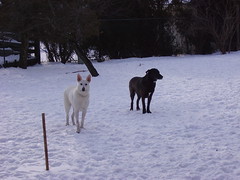
Pup + update = pupdate! Too corny?
In the last 24 hours, here are some sights and sounds that Tala experienced for the first time: TV, music coming from a stereo, dishwasher, alarm clock, people walking outside (she lived in a very rural area), cars warming up on driveways, and various beeps and clicks from a computer.
She is fascinated by them all! The cutest was the TV. She stood in front of the set, ears way up, cocking her head from side to side, then stood right in front of the speaker, staring. She's not afraid of anything, doesn't freak out, she just looks rapt.
I'm feeling bad for Cody, she's clearly not enjoying any of this yet. Allan reminds me - and rightly so - that it's way too early to make any judgments or pronouncements.
When we first brought Cody home, Clyde, our little terrier mix, beat her up for three solid days. Clyde would jump up and nip at Cody's face; Cody had little pockmarks where she was missing fur all over her face and head. Clyde wouldn't let her eat (we had to feed Cody in the bathroom with the door shut), wouldn't let Cody lie down anywhere in her sight. It was brutal. Then, after three days, Clyde accepted Cody as her slave, and all was well. It takes time, and it simply hasn't been long enough to see how this new pair will shake down.
Meanwhile, all these complicated dominance dances are going on, and I suspect many more that are invisible to us. Tala barks in Cody's face a lot, and Cody stands stock-still, baring her teeth, making fierce growling noises. Any of you who have met the sweet, meek Cody would be shocked to see her looking so fierce and feral. It's a good thing we know it's nothing to worry about, cause it looks pretty scary.
Tala also circles around Cody - a wide circle, giving her plenty of room, but always facing her. Round and round she goes with a happy, playful look on her face, then she darts in real fast, makes a swipe at Cody's tail - always the tail, never the face - and darts out again.
This morning in the backyard, Cody showed the first signs of playing with Tala. She was still wary - and afterwards, she resumed her snarling - but it might have been a breakthrough.
On the plus side, they walk on-leash great together. Tala is already comfortable with the Halti, and will sit quietly while we put it on. We're putting her in the crate and leaving her alone for a couple of hours every day, to get her accustomed to that.
In the last 24 hours, here are some sights and sounds that Tala experienced for the first time: TV, music coming from a stereo, dishwasher, alarm clock, people walking outside (she lived in a very rural area), cars warming up on driveways, and various beeps and clicks from a computer.
She is fascinated by them all! The cutest was the TV. She stood in front of the set, ears way up, cocking her head from side to side, then stood right in front of the speaker, staring. She's not afraid of anything, doesn't freak out, she just looks rapt.
I'm feeling bad for Cody, she's clearly not enjoying any of this yet. Allan reminds me - and rightly so - that it's way too early to make any judgments or pronouncements.
When we first brought Cody home, Clyde, our little terrier mix, beat her up for three solid days. Clyde would jump up and nip at Cody's face; Cody had little pockmarks where she was missing fur all over her face and head. Clyde wouldn't let her eat (we had to feed Cody in the bathroom with the door shut), wouldn't let Cody lie down anywhere in her sight. It was brutal. Then, after three days, Clyde accepted Cody as her slave, and all was well. It takes time, and it simply hasn't been long enough to see how this new pair will shake down.

Meanwhile, all these complicated dominance dances are going on, and I suspect many more that are invisible to us. Tala barks in Cody's face a lot, and Cody stands stock-still, baring her teeth, making fierce growling noises. Any of you who have met the sweet, meek Cody would be shocked to see her looking so fierce and feral. It's a good thing we know it's nothing to worry about, cause it looks pretty scary.
Tala also circles around Cody - a wide circle, giving her plenty of room, but always facing her. Round and round she goes with a happy, playful look on her face, then she darts in real fast, makes a swipe at Cody's tail - always the tail, never the face - and darts out again.
This morning in the backyard, Cody showed the first signs of playing with Tala. She was still wary - and afterwards, she resumed her snarling - but it might have been a breakthrough.
On the plus side, they walk on-leash great together. Tala is already comfortable with the Halti, and will sit quietly while we put it on. We're putting her in the crate and leaving her alone for a couple of hours every day, to get her accustomed to that.
molly ivins
Molly Ivins is dead: another voice for justice silenced by cancer.
I have a friend right now in the final stages of her ten-year battle with breast cancer. It's very scary, on so many levels.
Friend of wmtc James sent me this tribute written by Ivins's editor, Anthony Zurcher.
This is Molly Ivins's final column, "Stand Up Against the Surge". She is worth reading, and remembering.
I have a friend right now in the final stages of her ten-year battle with breast cancer. It's very scary, on so many levels.
Friend of wmtc James sent me this tribute written by Ivins's editor, Anthony Zurcher.
This is Molly Ivins's final column, "Stand Up Against the Surge". She is worth reading, and remembering.
1.31.2007
can anyone answer a reader's questions about student loans?
If anyone has any info for "BS" from the US, she would be most appreciative. Email copied with her permission.
...we both have massive student loan debt to pay off.I told "BS" that wmtc readers were unlikely to interpret her question that way. And later, she said...
Our main concern is that my boyfriend owes much more than I do and his deferment period will end around the time that we expect to move to Toronto. He has also exhausted the income sensitive repayment period that is allowed on his loans.
It's a long story, but he basically consolidated his undergrad and graduate school loans at a time when the interest rate was exceptionally high, so now the amount that he owes is more than double the original loan amount and we're worried that he won't be able to make the regular payments.
It's going to be a tough situation, since neither of us make a lot of money and then there's the exchange rate to consider. We're not flakes and don't want to come off that way, but we need to know what the reality is going to be if he can't pay off his loans and we're living in another country.
Some countries have reciprocal agreements regarding student loan debt, but we haven't been able to find any info online as to whether there's a reciprocal agreement between Canada and the U.S. and I'm not even sure where you're supposed to find this sort of information.
If there is, then we need to know what the details of that agreement are, who takes responsibility for administering the debt, and if there is a possibility of renegotiating the terms of the loan.
If there isn't an agreement and my boyfriend ends up defaulting on his loan, then we need to know what that means for us as Canadian residents, whether it will affect our ability to become citizens, if it will affect our Canadian credit record, etc.
I'd appreciate it if you could ask around or maybe post something about it on your blog. . .
I don't want it to come off like we're moving to Canada so that we can blow off our student loans and live high on the government hog. We just want to settle down in a country that reflects our political and cultural values, and that certainly isn't the United States.
The most important thing is that we find some firsthand information from reliable sources. Every time the subject comes up with people here, they usually respond with a combination of horror and paranoia.If you can help, or know someone who can, please give a shout, either in comments or by email. Thanks.
We've heard everything ranging from sober estimates that we'd have to file for bankruptcy in Canada, to warnings that Canada will deport us if my boyfriend defaults on his American student loans, and even shadowy reports of people being arrested at the airport when they return to the U.S. to visit family, etc. We don't believe any of this, since most of it's ludicrous and the people who've offered this
"advice" have never even step foot in Canada, or have any idea what they're talking about. [Ed note: gee, that sounds familiar...]
We're willing to prepare for the worst, but like I said, we need to know what that reality is before we start freaking out. I'm just amazed that it's been so difficult finding official information on the subject, unless of course we're missing
something completely obvious. Hopefully one of your readers will be able to point us in the right direction.
maher arar did not receive an apology
Getting on with a little backlog of topics I wanted to blog about...
I was pleased and relieved that Stephen Harper, on behalf of the Canadian government, finally apologized to Maher Arar. But when I read the actual text of the apology, I was disappointed - and annoyed.
That is not actually an apology.
The government says it's an apology, and Arar and his representatives have accepted it as such. But it is not, in fact, an apology.
An apology must include an acknowledgement of wrongdoing and an expression of regret. In other words, an apology must say "I (or in this case, we) did this" and it must say "we are sorry".
A true apology would have stated: "...for the role that Canada played in the terrible ordeal..."
Harper's statement is the governmental equivalent of the neutral "I'm sorry you feel that way," or the passive "I'm sorry that harm was done to you". There is no admission that Canada did play a part in the "terrible ordeal". In fact, the statement implies that perhaps it did not. Perhaps there is another valid point of view.
I'm interested in truth-telling, and in forgiveness, and how the two work together. Without truth-telling, true reconciliation cannot take place. And without reconciliation, there will always be a gap - an abscess - in the healing.
Of course I understand that Mr Harper's statement was a legal document, negotiated and crafted in order to settle a lawsuit. I'm also not implying that the Liberal government under whose watch this occurred would have done any differently; I really have no idea about that. And finally, of course I am relieved - and frankly, impressed - with the difference between how Canada has handled this and how the United States has. (The US has treated some of its own citizens even worse.)
Nevertheless, we've seen what truth-telling can accomplish, even on a governmental and national level. South Africa taught us that. I'm disappointed that Stephen Harper's government chose not to take that route.
* * * *
In a related story, I liked this essay about Dr Monia Mazigh, Maher Arar's wife. She is quite possibly the reason Arar is alive today - and the reason we know about "extrordinary rendition" in the first place.
I was pleased and relieved that Stephen Harper, on behalf of the Canadian government, finally apologized to Maher Arar. But when I read the actual text of the apology, I was disappointed - and annoyed.
"On behalf of the government of Canada, I wish to apologize to you, Monia Mazigh and your family for any role Canadian officials may have played in the terrible ordeal that all of you experienced in 2002 and 2003."...for any role Canada may have played in the terrible ordeal that all of you experienced..."
Although these events occurred under the last government, please rest assured that this government will do everything in its power to ensure that the issues raised by Commissioner O'Connor are addressed.
I trust, having arrived at a negotiated settlement, we have ensured that fair compensation will be paid to you and your family.
I sincerely hope that these words and actions will assist you and your family in your efforts to begin a new and hopeful chapter in your lives."
That is not actually an apology.
The government says it's an apology, and Arar and his representatives have accepted it as such. But it is not, in fact, an apology.
An apology must include an acknowledgement of wrongdoing and an expression of regret. In other words, an apology must say "I (or in this case, we) did this" and it must say "we are sorry".
A true apology would have stated: "...for the role that Canada played in the terrible ordeal..."
Harper's statement is the governmental equivalent of the neutral "I'm sorry you feel that way," or the passive "I'm sorry that harm was done to you". There is no admission that Canada did play a part in the "terrible ordeal". In fact, the statement implies that perhaps it did not. Perhaps there is another valid point of view.
I'm interested in truth-telling, and in forgiveness, and how the two work together. Without truth-telling, true reconciliation cannot take place. And without reconciliation, there will always be a gap - an abscess - in the healing.
Of course I understand that Mr Harper's statement was a legal document, negotiated and crafted in order to settle a lawsuit. I'm also not implying that the Liberal government under whose watch this occurred would have done any differently; I really have no idea about that. And finally, of course I am relieved - and frankly, impressed - with the difference between how Canada has handled this and how the United States has. (The US has treated some of its own citizens even worse.)
Nevertheless, we've seen what truth-telling can accomplish, even on a governmental and national level. South Africa taught us that. I'm disappointed that Stephen Harper's government chose not to take that route.
* * * *
In a related story, I liked this essay about Dr Monia Mazigh, Maher Arar's wife. She is quite possibly the reason Arar is alive today - and the reason we know about "extrordinary rendition" in the first place.
Mazigh's relentless fight to rescue her husband saved not only Arar, but was pivotal in rescuing Canada both from disgrace and succumbing to practices that would transform the relationship between the Canadian citizen and the state from one of relative trust to fear.The writer compares Mazigh to Laura Secord, about whom I know very little. But I know that Monia Mazigh is a hero.
In the Arar case, Canada as a country had started down a dark path. We must be vigilant to ensure that justice is quickly restored. We owe it to ourselves to punish the offenders, and to celebrate the heroes.
As long as Canadian citizens refuse to surrender the rule of law in favour of some agenda-laden promise of security, they will be able to restrain these would-be hijackers.
Mazigh understood that, and she understood that the brilliance of the rule of law is that before the law all are considered equal.
Ultimately the state must serve those who act within the law and prosecute those who violate it, even if they hold government offices and wear the state's uniform.
Too few Canadians appreciate just how powerful the rule of law makes them, and so too often allow themselves to be trodden upon.
Those who would abuse the power of the state, as CSIS and the RCMP did, count upon such meekness.
To their chagrin, Mazigh was neither ignorant nor meek.
ancient stones
Did you see this?
I was fortunate enough to visit Stonehenge when you could still walk amongst and touch the stones. The next time I was there, with Allan, it was all roped off. We also went to Avesbury and other sites on Salisbury Plain, and it was still great. But there's nothing like standing among such ruins, placing your hands on them, feeilng that connection with the distant past.
If you ever have an opportunity to visit Ireland, don't miss a trip to Newgrange, a neolithic passage tomb, older than Stonehenge, older than the Egyptian pyramids, that you can walk inside. Newgrange is in Ireland's Boyne Valley, home to many other neolithic sites. Like Stonehenge, Newgrange is oriented towards winter solstice, but in a very complex way.
Every time I see stories like this, I want to take off for somewhere. Now I want to go back to England to see this unearthed village. This wanderlust plagues me.
New excavations near Stonehenge have uncovered hearths, timbers and other remains of what archaeologists say was probably the village of workers who erected the monoliths on Salisbury Plain in England.For anyone who loves ancient sites as I do, that area of England is a gold mine. This is a really exciting development.
The archaeologists announced yesterday that the 4,600-year-old ruins appear to form the largest Neolithic village ever found in Britain. The houses at the site known as Durrington Walls were constructed in the same period that Stonehenge, less than two miles away, was built as a religious center, presumably for worshipers of the sun and for their ancestors.
Mike Parker Pearson, a leader of the excavations from the University of Sheffield, said the discoveries last summer supported the emerging recognition that the ring of standing stones and earthworks at Stonehenge was part of a much larger religious complex.
In a telephone conference conducted by the National Geographic Society, Dr. Parker Pearson said a circle of ditches and earthen banks at Durrington Walls enclosed concentric rings of huge timber posts, "basically a wooden version of Stonehenge."
The excavations exposed not only the timber circle but also a roadway paved with stone leading to the Avon River, about 500 feet away, which was similar to a river road from Stonehenge. The evidence, Dr. Parker Pearson said, "shows us these two monuments were complementary" and that "Stonehenge was just one-half of a larger complex."
I was fortunate enough to visit Stonehenge when you could still walk amongst and touch the stones. The next time I was there, with Allan, it was all roped off. We also went to Avesbury and other sites on Salisbury Plain, and it was still great. But there's nothing like standing among such ruins, placing your hands on them, feeilng that connection with the distant past.
If you ever have an opportunity to visit Ireland, don't miss a trip to Newgrange, a neolithic passage tomb, older than Stonehenge, older than the Egyptian pyramids, that you can walk inside. Newgrange is in Ireland's Boyne Valley, home to many other neolithic sites. Like Stonehenge, Newgrange is oriented towards winter solstice, but in a very complex way.
Every time I see stories like this, I want to take off for somewhere. Now I want to go back to England to see this unearthed village. This wanderlust plagues me.
tala comes home
Everyone is sleeping - Allan in bed, Cody on her mat next to the bed, and Tala in her crate in the middle of the bedroom. But I must have had too much coffee yesterday, 'cause I'm wide awake. What better time to get caught up than 3:15 a.m.
Yesterday was exhausting, but very joyous. I had an early-morning appointment, then we hit the road. Cody was in the back seat, of course.
We were very fortunate with the weather - since we were driving into western New York State, serious snow country, it could have been an issue, but we only saw some flurries, and mostly it was clear. It's about three hours from our place to Churchville, New York.
We met the trainer at the Husky Rescue house, and let Cody and Tala run around in the backyard together. Cody was wary, as she always is with dogs she doesn't know. But it gave them a chance to smell each other and for Cody to feel a tiny bit more comfortable.
The trainer, who has also been Tala's foster mom for three months, demonstrated the commands Tala knows. Tala is obviously intelligent and eager to learn. We just nodded our way through the demonstration, knowing we would soon employ our own methods.
These folks do amazing, life-saving work, rescuing hundreds of dogs from abuse, neglect or certain death in US shelters. They pay for medical care and neutering, they socialize and train the dogs, and they take great care to find each dog a loving, secure home. I admire and appreciate their work tremendously.
We just feel their training methods are unnecessarily harsh. They don't hit and yell - it's not that bad. But their training involves a lot of jerking on a choke chain (which they refer to as a "training collar"), and intimidation and physical dominance to force the dog to obey.
We don't believe any of that is necessary. We've learned extremely effective training techniques that are based on positive reinforcement, love and trust. This philosophy is grounded in the knowledge that a dog is not a machine that can obey every command, every time. When you're working with a dog - especially a young dog, who is really only a child - and the dog loses concentration, you take a break and pick up the training session later.
A sweet, happy, young dog like Tala doesn't need to be bullied into submission. She'll learn her place in the family by example, by the hundreds of things we'll do and she'll observe in her daily life. (And if she did have a dominance or aggression problem, those methods might make it worse - we've seen that, too.)
Based on our first meeting with the Husky Rescue folks, we knew there was no point in discussing any of this. In fact, if we had, we might not have been given Tala. I already had the feeling they're not convinced we can handle her. So we decided to politely watch the demonstration of how to "make" Tala obey, knowing that this would be the last time Tala would have to put up with that.
Up to now, Tala's leash training has involved a lot of pulling and jerking on a choke chain. But waiting for her at home was her brand new "Halti" head collar, the most humane and effective method of walking (and training) a dog I've ever seen. We have sworn by Haltis for nearly 20 years, since they were first invented by a veterinarian and sold only through mail-order. These collars literally changed my life, making it possible for me to walk our very strong, very big Shepherd-Husky mix - the beloved Gypsy - without having my shoulder pulled out of the socket.
Later, at home, Allan tried to remove Tala's choke collar, and it barely fit it over her head. It must have been put on when she was first rescued - and completely emaciated - and they never got her a larger size. There was a raw pink ring around her neck. The choke collar went in the trash, and Tala had her first walk with the new Halti.
So back in Churchville, we waited out the trainer, finished the paperwork, and got ready to go. This was also Tala's foster mom, so I know it must have been sad for her. Fortunately she has seven dogs of her own!
Two weeks ago - in between moving and the Ice Hotel - we went shopping for new-dog supplies, including a barrier for the car. We never needed that in New York City! So Cody kept her comfy spot in the back seat, right behind us, and Tala travelled in the hatch back behind the barrier. Cody is an excellent passenger - you don't even know she's in the car - and it wouldn't be fair or safe to stick both dogs in the back seat together.
Tala's trainer looked at the arrangement and said, "In ten minutes, she'll be in the back seat," and "You know she'll bark the whole way home". Tala spent 95% of the ride looking out the window, fascinated by the trucks going by on the highway. A few times, at the beginning, she tried to put her face through the barrier to check out Cody. After all, she was curious! I said, "Uh-uh, Tala - off," Cody gave her a quick growl and a dirty look, and Tala popped off to look at more trucks. The whole "incident" took five seconds. She never barked once.
Here's something we learned yesterday that really surprised us: Tala had never been inside a house! Ever! Since being rescued, she's lived in a kennel - a lovely, clean, large kennel, but still, never a home. When we pulled onto the driveway yesterday evening, we knew that everything Tala would experience would be new and exciting to her.
She wasn't at all frightened or intimidated. She was happy, eager, excited, hyper-alert. She skittered around smelling everything. When she'd jump up to get a better look at something, we told her a sharp "Off!" and she stopped. Her attention span was shorter than a flea's, her head whipping around at every little noise.
Cody was wary, and intimidated. We had to encourage her to come in the room, to lay on her own mat, to eat dinner. But she also stood up for herself. When Tala was too encroaching, Cody backed her off with a quick growl. I don't know how long it will take for Cody to like Tala and bond with her. I know it will happen, but I don't know when.
It looked like Tala had never seen stairs before. She didn't seem to know how to walk up or down stairs, or even what they were for. She would awkwardly walk up to the landing, walk around in a circle, then walk back down - not realizing the stairs actually went somewhere!
Both dogs had dinner, and ran around in the backyard, then Tala watched with fascination as we heated up our own dinner and ate at the table. She had clearly never seen such a thing before.
Then she had her first walk with her new Halti. Predictably, she shook her head around and pawed at her face a little, annoyed by the strangeness. A moment later, she settled down - and had her first walk without being choked. That device is a little miracle.
Later in the evening, she spent a lot of time staring out of the living room window. We have a big picture window with a clear view to the street, and she was rapt. I'm sorry I was too tired to get the camera, but I have a feeling there'll be plenty of opportunities for that shot.
After another quick out in the backyard, and lots of praise for doing what she was supposed to outside, we introduced Tala to the "treat before bed" ritual. She was totally confused. What is this? Why are you giving it to me? What am I supposed to do with it...?
We had to coax Cody into the bedroom, but I was very relieved that she took her spot next to my side of the bed. That's relatively new for her. Naturally, it used to be Buster's spot, and Cody only claimed it a few months ago. (I hated not having a dog next to me at night!) I was hoping Cody would still sleep next to me, despite Tala's presence. At least last night she did. Tala wasn't overly thrilled about getting in her crate, but she soon settled in and curled up for the night.
This is going to be quite a week.
Now it's 4:20 and I think I can go back to sleep. I hope to blog about non-personal, non-dog subjects again. One day.
Yesterday was exhausting, but very joyous. I had an early-morning appointment, then we hit the road. Cody was in the back seat, of course.
We were very fortunate with the weather - since we were driving into western New York State, serious snow country, it could have been an issue, but we only saw some flurries, and mostly it was clear. It's about three hours from our place to Churchville, New York.
We met the trainer at the Husky Rescue house, and let Cody and Tala run around in the backyard together. Cody was wary, as she always is with dogs she doesn't know. But it gave them a chance to smell each other and for Cody to feel a tiny bit more comfortable.
The trainer, who has also been Tala's foster mom for three months, demonstrated the commands Tala knows. Tala is obviously intelligent and eager to learn. We just nodded our way through the demonstration, knowing we would soon employ our own methods.
These folks do amazing, life-saving work, rescuing hundreds of dogs from abuse, neglect or certain death in US shelters. They pay for medical care and neutering, they socialize and train the dogs, and they take great care to find each dog a loving, secure home. I admire and appreciate their work tremendously.
We just feel their training methods are unnecessarily harsh. They don't hit and yell - it's not that bad. But their training involves a lot of jerking on a choke chain (which they refer to as a "training collar"), and intimidation and physical dominance to force the dog to obey.
We don't believe any of that is necessary. We've learned extremely effective training techniques that are based on positive reinforcement, love and trust. This philosophy is grounded in the knowledge that a dog is not a machine that can obey every command, every time. When you're working with a dog - especially a young dog, who is really only a child - and the dog loses concentration, you take a break and pick up the training session later.
A sweet, happy, young dog like Tala doesn't need to be bullied into submission. She'll learn her place in the family by example, by the hundreds of things we'll do and she'll observe in her daily life. (And if she did have a dominance or aggression problem, those methods might make it worse - we've seen that, too.)
Based on our first meeting with the Husky Rescue folks, we knew there was no point in discussing any of this. In fact, if we had, we might not have been given Tala. I already had the feeling they're not convinced we can handle her. So we decided to politely watch the demonstration of how to "make" Tala obey, knowing that this would be the last time Tala would have to put up with that.
Up to now, Tala's leash training has involved a lot of pulling and jerking on a choke chain. But waiting for her at home was her brand new "Halti" head collar, the most humane and effective method of walking (and training) a dog I've ever seen. We have sworn by Haltis for nearly 20 years, since they were first invented by a veterinarian and sold only through mail-order. These collars literally changed my life, making it possible for me to walk our very strong, very big Shepherd-Husky mix - the beloved Gypsy - without having my shoulder pulled out of the socket.


Later, at home, Allan tried to remove Tala's choke collar, and it barely fit it over her head. It must have been put on when she was first rescued - and completely emaciated - and they never got her a larger size. There was a raw pink ring around her neck. The choke collar went in the trash, and Tala had her first walk with the new Halti.
So back in Churchville, we waited out the trainer, finished the paperwork, and got ready to go. This was also Tala's foster mom, so I know it must have been sad for her. Fortunately she has seven dogs of her own!
Two weeks ago - in between moving and the Ice Hotel - we went shopping for new-dog supplies, including a barrier for the car. We never needed that in New York City! So Cody kept her comfy spot in the back seat, right behind us, and Tala travelled in the hatch back behind the barrier. Cody is an excellent passenger - you don't even know she's in the car - and it wouldn't be fair or safe to stick both dogs in the back seat together.

Tala's trainer looked at the arrangement and said, "In ten minutes, she'll be in the back seat," and "You know she'll bark the whole way home". Tala spent 95% of the ride looking out the window, fascinated by the trucks going by on the highway. A few times, at the beginning, she tried to put her face through the barrier to check out Cody. After all, she was curious! I said, "Uh-uh, Tala - off," Cody gave her a quick growl and a dirty look, and Tala popped off to look at more trucks. The whole "incident" took five seconds. She never barked once.
Here's something we learned yesterday that really surprised us: Tala had never been inside a house! Ever! Since being rescued, she's lived in a kennel - a lovely, clean, large kennel, but still, never a home. When we pulled onto the driveway yesterday evening, we knew that everything Tala would experience would be new and exciting to her.
She wasn't at all frightened or intimidated. She was happy, eager, excited, hyper-alert. She skittered around smelling everything. When she'd jump up to get a better look at something, we told her a sharp "Off!" and she stopped. Her attention span was shorter than a flea's, her head whipping around at every little noise.
Cody was wary, and intimidated. We had to encourage her to come in the room, to lay on her own mat, to eat dinner. But she also stood up for herself. When Tala was too encroaching, Cody backed her off with a quick growl. I don't know how long it will take for Cody to like Tala and bond with her. I know it will happen, but I don't know when.
It looked like Tala had never seen stairs before. She didn't seem to know how to walk up or down stairs, or even what they were for. She would awkwardly walk up to the landing, walk around in a circle, then walk back down - not realizing the stairs actually went somewhere!
Both dogs had dinner, and ran around in the backyard, then Tala watched with fascination as we heated up our own dinner and ate at the table. She had clearly never seen such a thing before.
Then she had her first walk with her new Halti. Predictably, she shook her head around and pawed at her face a little, annoyed by the strangeness. A moment later, she settled down - and had her first walk without being choked. That device is a little miracle.
Later in the evening, she spent a lot of time staring out of the living room window. We have a big picture window with a clear view to the street, and she was rapt. I'm sorry I was too tired to get the camera, but I have a feeling there'll be plenty of opportunities for that shot.
After another quick out in the backyard, and lots of praise for doing what she was supposed to outside, we introduced Tala to the "treat before bed" ritual. She was totally confused. What is this? Why are you giving it to me? What am I supposed to do with it...?
We had to coax Cody into the bedroom, but I was very relieved that she took her spot next to my side of the bed. That's relatively new for her. Naturally, it used to be Buster's spot, and Cody only claimed it a few months ago. (I hated not having a dog next to me at night!) I was hoping Cody would still sleep next to me, despite Tala's presence. At least last night she did. Tala wasn't overly thrilled about getting in her crate, but she soon settled in and curled up for the night.
This is going to be quite a week.
Now it's 4:20 and I think I can go back to sleep. I hope to blog about non-personal, non-dog subjects again. One day.
Subscribe to:
Posts (Atom)