| Evil! |
3.05.2024
the ballad of polly bee: in which newbie homeowners learn things they didn't want to know, but turn annoyance into opportunity
11.03.2022
something new: in which i defend pit bulls challenge bigotry without losing my cool
I was at a nail salon. Not an upscale spa, a loud, basic, ramshackle kind of nail salon. Two women sitting side by side for pedicures were speaking loudly and drowning out all the other noise.
Loud Woman One was telling the whole salon about her upcoming trip to San Francisco, where her grandchild lives. She was listing all the things to do in San Francisco. Then she was telling the whole salon about traveling with her dog.
Loud Woman Two says, loudly, "You know what dogs I hate? I hate pit bulls. They are horrible dogs. They bite people. They kill people."
My head jerked up. I stared in their direction.
San Francisco Tour Guide said, "Well, the thing about pit bulls is, sometimes, if they have good parents, they might be OK. My daughter's ex-boyfriend had a pit bull. He got him when he was a puppy, and he trained him very well, and it's a very sweet dog now. He also has a Min Pin, and the Min Pin weighs 12 pounds, and you know what, that little dog is the boss."
Breed Bigot says, "That dog is probably not really a pit bull. If it was, it would be horrible and vicious."
I tried to look away.
I wasn't sitting near them and I wasn't involved in the conversation (although they were talking loudly enough for everyone in the room to hear).
I tried to look away.
But I felt sick. I literally felt sick to my stomach. I knew if I didn't say something I'd feel sick all day.
I called over to them, "Pit bulls are no more dangerous than any other dog. You're repeating myths and lies."
They continued talking, oblivious.
I tried again. "Excuse me! Excuse me, what you're saying about pit bull dogs is not true. It's bigotry. It's like saying, 'All Koreans are this,' or 'All Black people are that'. Pit bulls are ordinary dogs. They are often the victims of abuse."
Breed Bigot wouldn't look at me. She turned her face away.
Tour Guide said, "It's like I was saying, good parents make good dogs."
I said, "I hear what you're saying. I agree." I looked at Breed Bigot, but she was refusing all eye contact. "I'm sorry to interrupt, but you're repeating lies. What you're saying is bigotry. It's wrong." I stared at her. "Statistics show that pit bulls do not bite more than any other dog."
Tour Guide said, "Do you know down in the US, which dogs bite the most? Golden Retrievers. It's because there are so many of them there, so they are where most of the bites come from. So you see, statistics can say anything."
Ignoring the idiocy of this statement, I said, "I hear what you're saying. Thank you."
Then I stopped.
I let Tour Guide have the last word.
I apologized to the person doing my nails, and ended the conversation.
So what's new?
In the past, I would have gone right over to them, gotten in their faces. Raised my voice. Expounded on the virtues of pit bulls and their victimization. And I don't know what else. Because when I'm in that zone, I can't think. I'm pure anger.
Then in those old days, I might have been slightly (but only slightly) embarrassed afterwards, depending on how far I went. I might (or might not) apologize for going too far. But a younger version of myself could be counted on to let loose. It never felt like a choice.
So here I am. I'm 61 years old, sixtyfuckingone years old, and I have finally figured out how to speak up without attacking. I can finally control my emotions enough, manage my anger enough, keep my composure enough, to speak up without making a scene.
I still haven't figured out how to shut up completely, and I'm sure I never will. But at least I didn't bite her head off.
7.27.2022
the game report: an update that is not completely analog
Back in December of last year, I blogged about starting a game night at home, rotating every-other week between games and music. I was super happy about it.
Seven months later, I can report mixed results -- mostly mixed because my partner really doesn't like games. This has always been a source of frustration for me. For some reason (unknown to me) he decided to give it a try, but doing something you really don't like on a regular basis is not much fun.
It hasn't been a total washout. Plus... we've become addicted to a new-to-us videogame.
Not a gamer, but I love games
We don't have a gaming system and generally don't play videogames -- not because I'm opposed to them (or think they're evil, as some people seem to), but because I know I would find videogames incredibly addictive. I'd rather use my screen time watching movies or series. But there have been some exceptions.
Sometime in the early 2010s, we stumbled on Angry Birds on our Roku. We really enjoyed it and played the full game (with no power-ups) for three stars. Recently, I tried to get the newer Angry Birds Reloaded on our AppleTV. It wouldn't play properly, and apparently it never has on AppleTV, for anyone, ever.
But while trying to make that work, we stumbled on Badland. Now we're hooked. At least I am. Allan claims to be ambivalent, but he looks pretty hooked to me.
The internet tells me Badland is an adventure/platforming game. You guide a character (called a clone) through a series of challenges (called checkpoints). Each checkpoint requires different strategies and you have to figure out what they are. This is the kind of simple but challenging game I enjoy.I love Badland's steampunk-style graphics and sound effects. It's very challenging and endlessly frustrating, which of course makes it very satisfying.
Although I am addicted to Badland, I don't want to play it alone. Allan and I play as a team, taking turns, or handing off the controller when a checkpoint gets too frustrating. Sometimes we'll watch a one-hour episode of a series, then play Badland for the rest of the evening.
Allan and I have three nights each week together, and I'm confining my videogame play to those. Althought this conflicts with my movement towards digital minimalism, I'm enjoying it too much to care.
Tabletop games: how we fared
Here are the games we played and the results - good, bad and mixed.
- Qwirkle. This is the game we've played the most because it's the one Allan likes best -- or at least dislikes least. It's fast, fun, a little challenging but not mind-bending. A good combination of luck and strategy.
- Ticket to Ride. This is my favourite of the new games we acquired. There are decisions to make and things to think about, yet it moves along quickly. I'm hoping Allan will still agree to play it once in a while.
- Pandemic. This game appears to be impossible to win, at least with two players. It's a cooperative (not competitive) game, and I want to play it with all hands -- Allan and I together playing six different players. Allan finds it too much work. I understand that, as I've been introduced to board games that I feel that way about. I'm holding out hope that we will play again, or will play with friends/visitors.
- Sherlock Holmes, Consulting Detective. This was the game I was most looking forward to, and it's turned out to be a total bust. It's beautifully designed, and the story and clues are very well written. But the entire game consists of reading (voluminous) clues -- and nothing else. There are no actions or decisions or movement. Just a lot of reading. It feels more like an assignment than a game. This was an expensive disappointment. I now also see that reviews of board games may be not be useful to me, as this game got rave reviews.
- Banagrams. I love anagrams, but it turns out you can get too much of a good thing. I play (and am obsessed with) the New York Times' Spelling Bee daily, and I also play Wordscapes, and that's plenty of word games for now. It's possible when I finish Wordscapes -- I'm on level 5,400-something out of 6,000 -- I'll like Banagrams more.
- Rummikub. I looked for games that are similar to Qwirkle, and ended up with Rummikub. Azul was also in the running, but the price was prohibitive. We haven't played this one yet, and I'm looking forward to it.
3.22.2022
in which i accommodate another quirk of small-town life: how to hand-wash a pea jacket
There are two hardware stores and two pharmacies, but to buy dog food, we have to drive to the next town, 40 minutes away. There's a self-serve dog wash, but no laundromat.
The absence of a laundromat is significant: there are many people in our community who don't live in nice homes with their own washers and dryers, plus a sizeable number of hikers, fishers, and sailors, who come into town to re-stock. It appears that there was once a laundromat -- one of the many empty and abandoned storefronts -- but it hasn't been in business for at least 15 years.
There is also no drycleaner in the entire North Island. Now that my work attire is even more casual than it was in a suburban library, and Allan works from home, we seldom need a drycleaner anymore. And now I'm careful not to buy any clothes that can't be washed at home. Drycleaning is expensive and bad for the environment, so this is a nice thing to give up.
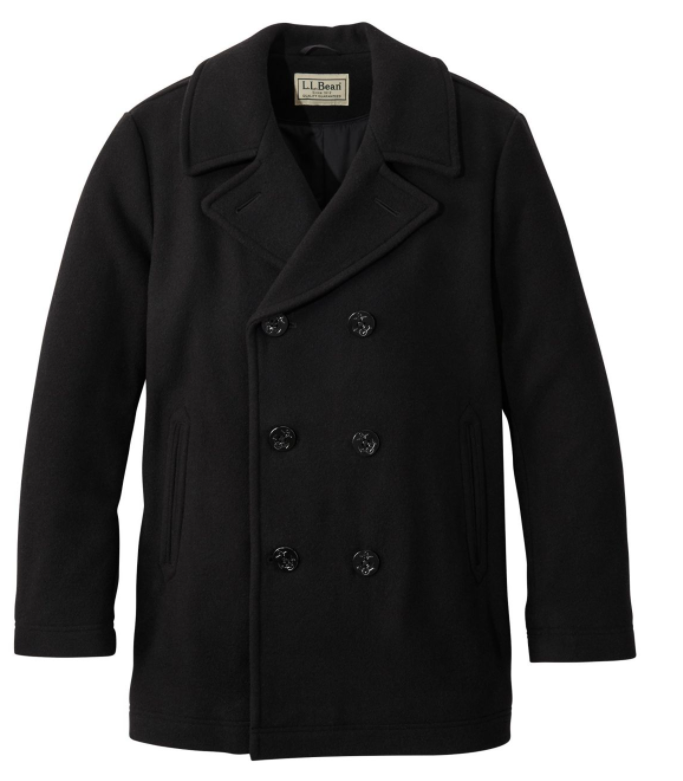
But then there is my pea jacket. I love my pea jacket. It's a quality garment, in great condition, and could last a very long time. I only need a winter-weight jacket two or three weeks out of the year now. (My big warm parka gets even less use!) So I have no need to replace the pea jacket any time soon.
I would normally have the jacket drycleaned once a year. But that's no longer an option. So the jacket had been looking less and less fresh. Then it went from not fresh to dirty. And dirtier. It really needed a refresh, and I didn't know what to do.
The internet told me it was possible to hand-wash a pea jacket. I was nervous! Would it shrink? Would it get horribly wrinkled? Would it take a month to dry? And would it really get clean?
I'm pleased to say the answers were: no, no, no, and yes. Here are the steps I followed.
1. First I had to find a container big enough to hold a jacket without smushing it, and to allow good flow of water. I used the bathtub.
2. Then I used a lint roller on the jacket and pulled off random dog hair.
3. I put on rubber gloves.
4. I stoppered the drain, and ran cold water into the tub, adding a handwash soap powder. I have Soak, which is awesome (thank you SFYS!), but I didn't think it would be strong enough. I also have some Forever New, and decided to use that. I'm not one to measure things like that, I just poured in some amount and swished it around in the cold water.
5. When the tub was about half full, I submerged the coat in the water. I laid it flat on the bottom of the tub, unbuttoned, with the sleeves on the sides.
6. I set a timer for 15 minutes. Most instructions for handwashing clothes suggest soaking for 15 minutes, so I went with that.
7. When the timer rang, I opened the drain, periodically running the water to let the suds drain.
8. Then, keeping the jacket lying flat, I ran cold water into the tub, and also used a flexible shower attachment to rinse the jacket. I was very pleased to see that the water was very dirty!
9. I rinsed the whole tub repeatedly, each time letting the water re-fill so the jacket was a bit submerged, then letting it drain. The water was less dirty with every rinse.
10. After five rinses, the water was clear -- not dirty, not sudsy.
11. I put a few towels on the bathroom floor, lifted the jack from under the sides -- cradling it so no part was hanging -- and laid it on the towels. This is very important! If you handwash anything made of wool, and hang it while it's wet, the entire garment will stretch out -- and it will never go back into shape. I learned this the hard way with a beautiful sweater my mother made me, in ancient times, pre-internet.
12. After laying the jacket flat on the towel-covered floor, I used dry towels to squeeze out some water, doing one sleeve or one panel at a time. I also carefully turned over the jacket and pressed a dry towel into the fabric on the back. Then I left the jacket on the floor with the bathroom window open.
13. When it became inconvenient to have the bathroom floor covered by a wet pea jacket, I cradled the jacket again and put it on top of a clothes drying rack, careful to place the sleeves flat on the body of the jacket, not hanging down.
14. I left the jacket there for several days, turning it over, turning it inside-out, opening it, and so forth, as it dried. In a few days it was completely dry.
The result: it looks great! The jacket looks fresh and clean. All the dirt and stains are gone, and it's not wrinkled at all.
The only minor negative is the jacket now smells slightly like Forever New. I am very scent-sensitive, and normally use only fragrance-free products. I didn't realize Forever New has a mild scent; for bras and other small hand-washables, it's never been a problem. I might put the jacket back in the tub for another rinse or two, to reduce the smell.
All in all, this was not difficult, and the results were excellent. Thank you, internet!
1.17.2022
most useless and annoying advice ever: it's cheaper if you make it yourself
| I did not make this myself. |
You can make that yourself, so much cheaper.
I've heard this so often and from so many people, one might think everyone in Canada was crafting everything by hand. Which would not explain the crowds buying cheap merchandise in Canadian Tire.
Similarly, in certain Canadian circles, there is disdain for hiring someone for any personal or home labour. Snow shoveling, house cleaning, dogwalking, lawn care. Oo-hoo, look at you, throwing money away instead of picking up a shovel! It seems I am finally old enough for people to give me a pass on this one. The hidden joys of aging!
I find this "you can make it cheaper yourself" mentality annoying on so many levels. One, it's my money. I can spend it however I want, and I'd rather do so without your judgement. Two, isn't your time worth anything? My time is more valuable than money. Money can be earned, but time is a nonrenewable resource. (Yes, I know this is a privilege.) Three, mind your own business!
Perhaps this is not a Canadian thing at all. I don't know if people dole out this "advice" throughout the rest of the US. But I can tell you no one does in New York City!
Long before the pandemic forced everyone inside, New Yorkers had everything delivered to their apartments. Since everyone walks or takes public transportation everywhere, deliveries are a way of life. So is paying for convenience. New Yorkers eat at restaurants or takeout almost every night of the week. They drop off their laundry. They hire dogwalkers. They rent car shares. And most of all, they have everything delivered. It's not an easy city to live in. Everyone who can afford to buys every convenience possible. And nobody ever tells you how you could make things more cheaply yourself.
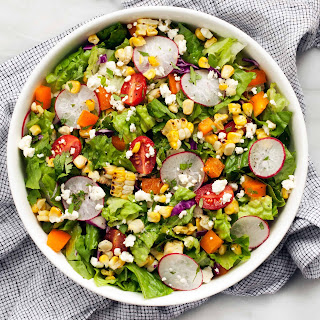
Like Elaine Benes, I love a "big salad". In fact, one of my favourite meals are salads with lots of different ingredients. I love chopped-salad restaurants, and happily spend $16 or $18 to choose 10 different ingredients tossed in freshly-made, creative dressing. I am not often in an area with these restaurants, but when I am, I enjoy this very much.
Big salads are something I will never make for myself. I cook a lot, and I do quite a lot of other food prep. We do sometimes have a protein salad for dinner, but it's much more simple: lettuce, tomato, mini cucumber, chicken, cheese. I'm the only big salad fan in the house, plus, it's just too much effort.
In our previous suburban home, there were no restaurants that offered big salads. The closest we came was when Whole Foods opened a Mississauga location, but a salad bar is not the same. And of course there is nothing like this in my tiny little town now.
But now big salads have come to supermarkets! This has been a great development for me. I take a packaged salad kit, add a hardboiled egg and some grated cheese, and I have the perfect dinner. If I have some leftover grilled chicken or salmon on hand, I throw that in instead of the egg.
This is one of my favourite meals and it helps me eat more vegetables -- more raw vegetables, which is even better. The only downside is there is a lot of plastic waste. This disturbs me... but not enough to stop buying the salads.
But salad kits are expensive!
In my experience, if you mention salad kits -- or if a busybody sees you buying a few in the supermarket -- or if you look for information online about a salad kit... You can make that cheaper yourself!
Is this even true -- can you make the salad more cheaply yourself? I don't know. I haven't tested this claim, because I don't care. But some years ago, I wondered if Whole Foods' delicious, expensive tuna salad would be less expensive to make at home, and discovered it was only slightly more expensive to buy than to create. Sometime after that post, the store's prices went up, and later I started using less expensive tuna (for environmental reasons), so the balance would have changed. But the assumption that the prepared tuna salad was vastly more expensive than homemade was incorrect.
The salad kit I ate for dinner last night contained: white cabbage, red cabbage, kale, romaine lettuce, shredded carrots, cilantro, crispy noodle strips, and slivered almonds, and dressing. I added an egg and a bit of grated cheese.
- If I had made this myself, how much cheaper would it be? It's not a $6.00 salad versus a free dinner. After I'm done buying all those ingredients, what have I spent?
- Unless I used two entire heads of cabbage, an entire head of lettuce, and an entire bunch of kale within the upcoming week -- which I won't be able to do -- some of the vegetables will go bad. I would be wasting money and wasting food.
- I can buy all different flavour combinations of salad kits, and eat different ones whenever I like. Having variety helps me maintain a healthy diet.
- And finally -- but most importantly -- making this salad myself is too much effort for the end result. Everyone has (or should have) a personal time vs money formula. I would much rather spend $6 than make this complicated salad myself, and if I had to make it myself, I wouldn't eat it.
In short, it's a no-brainer: healthy, convenient food that I enjoy is worth the price of the kit.
I don't care if I could make it cheaper myself!
10.04.2021
gardening and games, but not piano: three things going on with me
![]() |
| Maybe next year: borscht. |
You may recall that I tried to plant my little gardenette, as we used to do in southern Ontario, here in northern Vancouver Island. I was not successful.
The area we cleared became well grown over with weeds, and that was fine for now.
Months later, to my surprise, I spotted some red stalks among the green. Beets! One beet plant survived and grew. I harvested one tiny beet.
While I was showing the beet to Allan, he spotted a tomato plant growing amid the ruin. This gives me hope! As baseball fans have said for generations: wait 'til next year!
#pianofail?
I began piano lessons in March 2020, right after the covid shutdown went into effect. I practiced diligently and consistently for 16 months. As long as I was learning and making progress, no matter how small (and progress was only small), I enjoyed it.
[Piano posts: why it is interesting and significant that i own a piano, in which i begin re-learning how to play piano, using pianote, reflections on a year of piano lessons by a dedicated (and untalented) student.]
After a year, small, incremental progress became tiny. Minute. Microscopic. Gradually, progress dwindled off, then stopped altogether. I understand about learning plateaus, but this plateau seemed permanent. No matter how much I tried, it seemed I had hit an impenetrable wall.Learning is full of frustration. I know that. But in this, I must ask if I've reached the limits of my ability. No matter how much I practiced or what I tried, I was no longer advancing. And because I was no longer advancing, piano went from a difficult but satisfying challenge, to pure frustration.
In June of this year, I started practicing less, and by July, stopped altogether.
First I took a little time off, then weeks stretched into months... and I stopped. This winter, I'm going back to jigsaw puzzles.
I have a lifetime membership to Pianote, so I can return anytime. We'll see.
My games addiction is back, big-time
I love games. For me, games of all types are completely addictive. Once I start playing a game I like, time disappears. I always have to drag myself away.
In my 20s and 30s, I thought that any time I spent playing games was a total waste. I was freelancing, and maintaining discipline was very important. I used to say I had to be busy at all times to justify my existence, and I was only partly joking. Games were an addiction to be avoided.
After being diagnosed with fibromyalgia (after seven years of misdiagnosis), I gradually came to understand the need for downtime, and built it into my life. I also started recognizing the value of giving myself space for whatever I wanted to do -- without the need to justify it. So here I am.
I'm not a gamer. I don't go anywhere near videogames. Not because I think they're evil or a waste of time, but because it's a door I don't dare open. My brief experiences with videogames led me to believe that if I had a proper game system, I'd never watch a movie or a series again. My series/movie time is relaxing and restorative in a way that videogames wouldn't be. So I don't allow myself to go there.
I very rarely get to indulge my love of board games, as my partner has no interest. Considering all the awesome tabletop games out there these days, this is very sad! I would love to have a weekly music-and-game night. But no.When I began piano lessons, I dropped puzzles, feeling that I don't have time for both. So now, it's back to puzzles. Jigsaw puzzles might drag me away from my phone games.
9.12.2021
from the archives: all over the world, i tell people where to go
That may seem like an odd thing to track -- unless you're well-established as a magnet for The Lost. Not the spiritually lost. The physically lost and uncertain.
On this trip, we remembered three times: near the dog park in Berkeley, on a street corner in San Francisco, in a parking lot in Portland. It's possible there were others we didn't note and forgot. We shared a laugh: it still happens.
It is not lost on me that for my second (or third?) career, I chose a profession where I help people find information. I'm pretty sure I used this, in much shortened form, on my graduate school application essay. (Little did I know I could have written gibberish and been accepted. Are you a live body who will pay tuition? You're in!)
Being asked for directions during my first trip to Portland reminded me of an essay I once wrote -- really just a piece of an essay that I tinkered with now and again, back in pre-internet days when we wrote things and sent them to people who might publish them. I'll use this occasion to publish it myself.
Hello, my name is Laura and I give directions.
I don't wear a button, but I might as well. Everywhere I go, people ask me for directions.
It is a rare subway trip in my own city that I am not approached. "Does this train go to Grand Central?" "How do I get to Columbus Circle?" It happens just as frequently when I travel. I had been in San Francisco less than an hour when I car pulled up beside me, passenger window rolled down, inquiring face at the window. In Italy and France, natives and tourists alike asked me the way. On a deserted highway in rural Mississippi, in a tiny village in upstate New York, in the middle of rush hour in Chicago. They pick me out of crowds, cross the street, flag me down. They want directions, and they want them from me.
When I talk about this phenomenon, people think I'm exaggerating. That is, until they spend time with me. An old friend and I were doing errands on the Upper West Side when a woman stopped me: "Is there a crosstown bus on this street?" My friend said, "I see you're still in demand."
I've given much thought to why this is. I suppose, as a short woman, I don't appear threatening or intimidating. Perhaps as an alert city-dweller, I look alert and confident. The very first time I can remember being asked for directions may provide a clue. I was in college -- on the first day of classes, freshman year. I was nervously rushing to class, wondering where on earth I was going and what on earth I was doing, when a young woman tapped my arm: "How do you get to College Hall?" I burst out laughing. "I have no idea! I'm a freshman!" "Wow!" she said, impressed. "You really look like you know where you're going." Together, we held her map and tried to determine where we were. But it made my day. No, it made my month. Hey, I look like I know where I'm going.
It's a responsibility I take very seriously. If I don't have the requested information, I feel like I've let someone down. (Even worse is the occasional realization that I've given someone wrong directions.) I wait while people search for pens. If the person is interested, I'll give several alternatives. I tailor my directions to their needs: Can they walk a long distance? Are they in a rush? Would they rather save the price of a token, and see the city on foot? More than once, I've told tourists that we were headed in the same direction, and took them myself.
Yes, I have walked around New York City with strangers. And, obviously, I talk to strangers all the time. Aren't I afraid? The answer is no -- and that's probably the biggest reason I am asked for directions so frequently. Contrary to what many people believe, for an adult with common sense, talking to strangers is not a high-risk business. Quickly, expertly and mostly unconsciously, I size up the inquirer, using the cues that we all use every moment of our public lives. How close are they standing? Do they appear to be headed somewhere? Where's my bag, my wallet? 99% of the askers are lost, or at least unsure of the way. When I encounter that 1%, I move away, just like anyone else.
That last paragraph now seems silly and unnecessary. But leaving aside my urge to edit, re-reading this reminded me of two episodes that didn't make it into this draft.
Near Rockefeller Center, a Japanese man stopped me. I had a very hard time understanding his English; his guidebook was in Japanese. I did get that he was looking for a bookstore, possibly a Japanese bookstore? I tried several times to work out what he meant, but finally had to say I didn't know. More than a year later, I saw an article about a famous Japanese-language bookstore in the area (and have since discovered it's part of a chain). I was so annoyed at myself for not being able to help this man! I hope he found the store.
A more amusing episode took place on the subway platform at Columbus Circle. I was on my way to my weekend word-processing job, and a family of four approached me. They were decked out head-to-toe in brand-spanking-new Yankees gear -- hats, t-shirts, water bottles, the works. The dad asked me when the next train to Yankees Stadium would arrive.
I told him there was no way to know when it would arrive, but if they were going to the Stadium, they were on the wrong platform. "This is the downtown platform. You need to go up the stairs, over to the uptown side," I said, gesturing through the path they should follow. "Then take the D train. It should say 'Uptown and the Bronx'."
To my astonishment, the man replied, "No, this is the train we need. I just want to know what time it is due."
So many things wrong with this sentence! Where to begin!
I wasn't a librarian yet, so I wouldn't have called him sir. But I was polite, far more polite than many New Yorkers would have been. "Hey, I live here, and I go to Yankee games all the time. I promise you, you're on the wrong platform. You need to go over there, to the uptown side. Also, there is no train schedule, especially on the weekend. They come when they come. Also, the game isn't until 1:00. You won't be able to get in the Stadium, and the area will be deserted."
Maybe he couldn't appear to be wrong in front of his kids. Maybe... who knows! But he insisted. And he yelled at me! Seriously, the man yelled: "This is the train to the Yankees! Do you know the schedule??"
At that point I could only scoff in his face. "Suit yourself." I shrugged my shoulders. "Have a nice day."
My train arrived, and I left. Later I shared a good laugh with a friend who I went to games with. I wonder what happened to that family that day.
The moral of the story: when a New Yorker gives you directions, don't argue.
1.06.2021
greetings island: the best e-card site you've never heard of
Tl; dr: Greetings Island is the best e-greeting-card site.
* * * *
I love greeting cards -- birthdays, anniversaries, thank yous, "glad you're my friend". I used to love spending time choosing unusual and relevant cards for family and friends. No Hallmark drivel, and no holidays that are meaningless to me -- but lots and lots of birthdays and thinking-of-yous.
I also used to send winter-season cards to a lot of people. My partner and I would carefully choose what card would represent us that year, and every year the list got longer and longer... At some point our list was out of control, and card-sending became a huge chore. Time to cut back! Or maybe to end the practice?
When we moved to Canada, and I discovered that Papyrus products, my card of choice, were outrageously expensive here. On a month when I had a lot of birthdays on my calendar, the price of cards alone, without postage, could easily top $30! Of course the practice of sending cards is environmentally unfriendly, so this was a good excuse to drastically reduce. I decided to send paper cards only to elderly relatives who wouldn't see cards online.
But then... the e-card issue. Most sites are loaded with ads. That's a deal-breaker for me. So my quest for a great e-card site began.
I used Jacqui Lawson cards for a while. The cards, based on Lawson's art, are animated and accompanied by music. At $24/year, it was a good deal, but the cards are all of a similar style, and I got tired of it.
I used Punchbowl for a while. Their selection is good, but their pricing model doesn't work for me. Punchbowl has three paid levels -- right now it's $3, $5, and $7 per month -- but only the highest level is ad-free. I think advertising-free cards should be the most basic paid benefit, even if it's the only benefit. And $7/month is more than I want to spend on cards.
This year I did a big survey of e-card sites, and combed through many "best e-card sites of 2020" posts. Most sites were objectionable for various reasons. I thought about using a general design site like Canva, but for me, that's too wide a field -- too much work. I need something more specific.
For me, $32/year -- $2.60/month -- is a very good deal. There is also a free (ad-supported) version with fewer options for personalization.
In addition to sending cards online -- either through the site, by email, or through social media -- Greetings Island lets you download and print your card. This is still a good option for a workplace or someone on your list who is not internet-friendly.
I hope Greetings Island keeps their card selection updated. It would be nice to continue using it for at least several years.
2.07.2020
and let others do for you: interdependence, and the strength to be vulnerable
I've heard many people say this. I don't know if I ever said this myself, but as a teen and then young adult, I definitely tried never to ask for help, and seldom would allow myself to accept any. When I needed help of any kind -- physical, financial, emotional -- I would feel uncomfortable and deeply indebted, for relatively small actions.
In New York City, where, like millions of New Yorkers, I didn't own a car, if someone gave me a ride home, I would thank them profusely. Years later, living in Mississauga, I offered people rides home all the time, and realized it was not that big a deal. The same goes for being asked to stay for dinner, or being offered a cup of tea or a glass of wine in someone's home. A simple act of friendship or kindness, especially from someone I didn't know very well, seemed like Such A Big Deal.
This is certainly one area where our world makes it more difficult for men. Asking for help is weak, and weakness is for pussies, and men must constantly prove that they are not pussies -- that they are not female. After all, isn't that what all the jokes about men not asking for directions are about?
But people of all genders have issues with this. We want to appear strong and independent. We want to think we are self-sufficient.
Perhaps the biggest and most self-destructive example of this is the shame people feel about accepting social assistance, including using a community food bank. The idea of being needy, of being a recipient of help rather than a donor, is so deeply shaming for so many people, including those who support the idea of social welfare.
* * * *
By my observations, most people want to help others. Finding a wonderful gift for someone you care about, and seeing their face light up with appreciation, or being able to make someone's day easier with a simple errand or help carrying something -- even sharing an umbrella with someone who's getting soaked on a sidewalk -- these things make us happy. It's why we volunteer. Why we advocate for others. It's why we love stories about people buying coffee for strangers, why we rush to donate to disaster relief. We want to help.
How many of us realize that on the flipside of that desire to give, there is an obligation to accept? To allow others to express that human impulse. To give in return that gift of your face lighting up, or the knowledge that you made their day easier.
I now believe that we give by giving and we give by accepting.
I actually think that thought in someone else's words -- Bob Dylan's, from the song "Forever Young": May you always do for others and let others do for you.
"And let others do for you." I've thought a lot about those lyrics. I've wondered, why would Dylan include that in his benediction? (Let's assume in this case it wasn't solely because they fit the meter or completed a rhyme!)
I think Dylan understood that we are mutually dependent on each other -- and that we should be, that it's a preferred state of being. That by knowing how to both give and receive, we are more fully human.
* * * *
I first started thinking about this when I was writing about disability issues. I regularly interviewed people who used wheelchairs, and occasionally other adaptive aids. Most were very independent and valued that independence highly. But here are some comments that stayed with me.
Early on in my foray into this field, a man who was blind and also used a wheelchair said to me, "We place a high premium on independence in our society. I don't find that healthy -- for anyone." (He was a pretty independent guy, too.)
Two, I did a story on recreation options for quadriplegics. A lot of the folks I spoke with had become quads from accidents while ski racing, rock-climbing, motorcycle racing, and other outdoor-adventure activities. Now they were the same thrill-seeking adrenaline junkies, but paralyzed. One of my interviews was with a super-active guy who was a quad, and who continued to scuba, skydive, and whatever else. He said, "People are so funny about this. I say, I scuba dive, and they ask, Do you need any adaptive equipment for that? And I'm like, I'm human, and I'm under water, so, yeah."
Three, on several occasions I interviewed a woman named Brooke Ellison. Ellison is an incredibly smart woman, very engaged with the world, and also a deeply compassionate person. She's a high-level quad, meaning she has very little body functioning, and without modern medical technology, she would not have survived her accident. She graduated with high honours from Harvard University by attending with her mother.
Brooke talked about interdependence. She said that because she was physically dependent on people for all her basic needs, she felt very strongly about giving back. She echoed the visually impaired man I mentioned above, by saying that the whole concept of independence was overrated or maybe misplaced -- that society's premium on independence is somewhat of a facade, because we are all interdependent on each other.
These comments lodged in my mind. Adaptive equipment? I wear glasses. Custom orthotics. Prescription meds. When you think about it, a warm winter coat and gloves are adapative equipment for us humans. Seen that way, how many of us live without any adaptations?
Who among us is not interdependent? I depend on my partner for little things, like opening jars and reaching high cabinets, and really big things... like love, acceptance, and emotional support. I depend on my family and my friends, and I hope they depend on me.
* * * *
I'm going to throw in one more story, or at least the punchline of a story. This happened in the early 90s. I had a bad experience at work, and was dressed-down by a boss at a very vulnerable time -- and I burst into tears. (Still the only time I've cried in front of a boss or supervisor.) As soon as I did, this man's attitude immediately changed. The whole power dynamic of the room changed. We ended up talking more as equals, and the meeting ended on better terms. But I was so embarrassed, and angry at myself. I felt humiliated that I had showed such weakness, that he was able to bring me so low, and I let him see that.
After the fact, I debriefed with co-worker. She surprised me with a completely different take on the incident: "He was coming at you from an inhumane place. You had a human response, and he in turn responded in a human way. You gave him a gift. You helped him recover his compassion."
This made a huge impression on me. (That woman, who I worked with only briefly, then never saw again, had a great impact on me. Who knows who we've helped with a kind word at the right time, in a way we might not even be aware of.)
Which brings us back to Dylan's wish for us: May you always do for others and let others do for you.
These experiences, taken together as something more than the sum of the parts, have caused a change in my attitude towards asking for help. I help people, sometimes deliberately, sometimes perhaps unknowingly. And people help me in much the same way -- and that's the way it should be. They're not necessarily the same people -- and it doesn't matter, because we're all interdependent.
* * * *
This essay has been sitting in drafts for many weeks, and during that time, I had an unusual experience. So if you're still reading, please indulge me in one more story.
Not long ago, totally unexpectedly and in a room full of people, I heard something that triggered my PTSD. This is so unusual for me that I think it might be a first: my PTSD happens in private, in the middle of the night.
Rather than derail this post, I'll save the details of the experience for another post. For now, suffice to say that a stranger showed me great kindness and compassion, and I was able to accept it -- and it felt like a triumph. So much so that I was able to name my fear out loud to others, which was very difficult to do. And as often with the difficult bits, it felt really powerful. I was able to tell other people -- in person, not in writing -- that I had a PTSD episode, and thank them for their help.
And I didn't feel guilty or ashamed or like I had burdened anyone or like I was weak or... anything. And although I was very grateful for the kindness and strength of this woman, I didn't feel embarrassed or indebted.
Then a funny thing happened: people praised my strength. Someone said "You had the strength to be vulnerable."
It's easier to pretend to be strong than it is to be honest. It's easier to run from the feelings -- to lash out, or to drink or drug over them, or to grit our teeth and ride it out -- than it is to stop and allow yourself to feel the feelings, and then be honest about what you experienced.
I'm not a superhero. I've run from feelings, I've lashed out, I've tried to obliterate them, I've done plenty of teeth-gritting. Every human has done this. But a few times, when it felt safe, I've exposed my feelings -- and this was very good.
When I was a child, I was fortunate to visit many wonderful National Parks with my parents. If there was a tour or talk being given by a park ranger, we always went. My father always asked questions. I remember being embarrassed by this: I thought it made him appear ignorant. But my father explained that asking questions is a sign of intelligence -- that when you ask questions, you're thinking, you're making connections, you're being smart. I soon observed that this was true, and I never again felt embarrassed to ask a question.
This is a similar dynamic, a seeming paradox. We associate vulnerability with weakness, but really, to allow oneself to be vulnerable, to be emotionally honest, requires inner strength.
A human gave me the gift of compassion and support, with no questions asked and nothing expected in return. And maybe... maybe I gave a gift that day, too.
1.24.2020
how do you hold a fork and knife? or, in which i discover my table manners are american
My mother drilled this into me and my siblings. My family was not overly big on table manners, but taking that extra moment to put the knife down, and transfer the fork before putting food in your mouth, was considered a critical lesson.
I recently overheard two people -- Canadians -- talking about this. One of them said, in mock horror, "Do you transfer?" And the other replied in an are-you-crazy voice, "No, I do not transfer!"
I thought, did my mother teach me wrong? Have I been using some crude, impolite technique to eat my food -- all my life?
I heard this conversation a while ago, and finally remembered to look it up online. To my astonishment, the fork-transferring method of eating is considered American, and the non-transfer method is considered European, or as some people still call it, Continental.
I found various stories on this, such as "Put a Fork in It: The American way of using fork and knife is inefficient and inelegant. We need a new way. in Slate and Business Dinner Etiquette: American vs. Continental Style Dining on Workology.com.
Canadian culture is sometimes British-based and sometimes American-based, and I don't know where fork-and-knife usage falls on the British vs. American spectrum. So wmtc readers, how do you use your knife and fork -- transfer or not transfer?
2.02.2019
"use it in good health"
12.23.2018
true confessions, or will laura buy new window treatments for a house that doesn't need them
I don't care much about clothes, shoes, bags. I don't buy expensive cosmetics or skin-care products. As long as I have what I need, I'm good. It's easy to watch my spending about any of those.
But. There's always a but, right? I love home things. Towels, linens, dinnerware. Rugs. Shelves. Lamps. Organizers. (I could go on.)
Why window treatments? I love colour, and curtains or shades add big swaths of colour to a room, totally changing the way a space looks and feels. (I could go on.)
I didn't buy them on impulse; I thought about it for a couple of weeks. My mother encouraged me to go for it, but she didn't know what they cost. Allan, who is more frugal than I am, went along without a peep. I'll never understand why.
The windows needed something, of that there is no doubt. But why didn't I buy inexpensive curtains at Ikea or Home Outfitters? That would become my default setting for "I need to fix up this rental without spending a lot of money". Yet I didn't even consider that. I just plowed ahead and bought the beautiful, two-colour, honeycomb fold, Hunter Douglas, fabric blinds.
And we lived in the house 14 months, and then had to move.
We took down the blinds. I saved the hardware and wrapped up the blinds in bubble wrap, and I've been moving them from rental to rental ever since, hoping that one day, some rental somewhere, will have the same size windows. (I've also tried -- multiple times -- to sell them on Craigslist and Kijiji, for a small fraction of their cost.)
Since then, we've lived in too many places. First there was the sewage flood, then the greedy landlord, then the big move west. For each place, I bought some inexpensive curtains, or else bought fabric and had curtains made. I spent very little money and significantly changed the look of the room, exchanging ugly PVC blinds -- and in one case heavy velvet curtains with a heavy coating of dust -- with big swaths of colour that pulled together all the other colours in the room. Very little money, big results.
And now my long story finally arrives at the present: the lovely old house we are renting in Port Hardy. For the first time ever, we have moved into a house with nice window treatments: fabric vertical blinds in the kitchen, dining, and family/living rooms, and fabric black-out curtains, complete with matching and good-looking rods, in all the bedrooms. There are even nice thin blinds in all the bathrooms. All quality, all matching, all in good condition.
And all beige. Sandy. Approximately number 13 on this.
On the day we arrived -- literally on our first walk-through of the house! -- I saw the blinds and curtains and thought, beige. I thought, Those would be great if they were a better colour.
I'm know I won't do it. I'm pretty sure I won't do it.
10.14.2018
how the media (invisibly) props up capitalism and other hidden biases
Cost of the CrashThese letters brought to mind some concepts that I enjoyed thinking about in
To the Editor:
In his review of “Crashed,” by Adam Tooze (Aug. 12), Fareed Zakaria asserts that “the rescue worked better than almost anyone imagined.” He notes there was no “double-dip recession” and growth returned “slowly but surely.” But this misses what was the major criticism of the “rescue.” It merely hit the re-set button — keeping the big banks solvent. Meanwhile, the stimulus did little to put people back to work. It was not the double-dip recession that critics feared but a long sluggish recovery that failed to affect the majority of the people.
For example, it took six years (2009-15) for the unemployment rate to return to the pre-recession number. The share of income received by the top 1 percent had been 23 percent before the recession. After falling to 18 percent in 2010 it jumped back to 22 percent by 2015. Meanwhile, as late as 2015, the bottom 99 percent of the population had only recovered two-thirds of the income they had lost. Zakaria should have added a few words to his assertion that the rescue worked: It worked for the top 1 percent, not for the rest of us.
MICHAEL MEEROPOL
SPRINGFIELD, MASS.
The writer is an emeritus professor of economics at Western New England University.
♦
To the Editor:
Fareed Zakaria’s review of Adam Tooze’s “Crashed” is an approving account of an approving book. But what was “saved” was “the economy,” not humans.
Yes, the government and others acted to prop up banks. But humans lost twice: Houses and savings were savaged, while banks, their executives, and the rich, as usual, won. And in a further irony, they used taxpayer money to save “the economy” and the banks. Yes, some of it was repaid from those financial institutions, using money deposited in them by humans.
And the endless greed spawned by free market capitalism and lax regulations, which created the crash in the first place, gets mentioned simply in passing.
PHILLIP GORDON
CASTRO VALLEY, CALIF.
When something is everyday ordinary, commonplace, accepted as normal, it becomes invisible. How can we discuss and analyze, and perhaps challenge, its influence? First we have to make it visible.
Gender roles are the perfect example of this. From the colour of a baby's room, to the toys they play with, the stories they see and hear, and a million other data streams, humans are taught gender roles and expectations. Sure, this has loosened up a bit for some segment of society, but in the overall scheme, it is still largely true. Expectations of gender roles are as invisible as the air that baby breathes. We are thoroughly indoctrinated from the moment we are born. If we want to challenge gender roles, we first have to name the many ways those roles are taught and reinforced. We have to make the invisible visible.
This in turn leads me to think of something Allan and I talk about a lot: how anything progressive or leftist is labeled "political" -- and declared inappropriate in many settings -- while pro-government and pro-military displays are thought to be natural and not political. Military displays at sporting events: neutral. Sitting down during the national anthem: political. Honouring "fallen heroes": natural. Honouring anyone who is a vocal opponent of war: political.
Once you are aware of these hidden biases, you see them everywhere. In one iSchool project, I had to choose a classification system, describe it, then use a different method to classify the same things, and show how assumptions and biases were transformed through the use of a different classification system. I analyzed the way clothing is classified by L.L.Bean, and proposed a gender-free alternative.
I think this hidden bias thing should be a regular wmtc feature, for capitalism, and for war. Or maybe it already is?
(Whoo-hoo, I'm blogging again!)
3.28.2018
in which i discover jordan's cereal and need to tell everyone about it
Allan, who does our food shopping, went on the hunt for a cereal that would satisfy all the requirements: whole grain, crunchy, tasty, not overly sweet, and reasonably healthy. Plus I prefer clusters to flakes. It would also be good if the cereal didn't cost $10.00 a box.
This is how I discovered Jordan's Morning Crisp granola, and it has made me very happy.
Morning Crisp is crunchy.
Morning Crisp is delicious.
Morning Crisp comes in a variety of yummy flavours: Wild About Berries, Simply Strawberry, Maple Pecan, Bursting with Nuts, Dark Chocolate (!), and Honey Nut.
Morning Crisp is made from all natural ingredients, with no artificial colours, flavours, or preservatives, and it contains lots of whole grains. Look:
The only thing not great is palm oil. But look at this.
|
|
For those of us who regulate our sodium intake, this is amazing. Jordan's contains more sugars, but my overall sugar consumption in a day is very low. Sodium is a greater concern for me -- and it's a massive difference.
Jordan's is a British company. The Jordan's Canada website is not functioning, but their Facebook page is here, and you can follow them on Twitter. I will tweet them this post.
9.19.2017
do workplace-based tv shows make people dissatisfied with their jobs?
You can see why the workplace is ripe for use as a setting. It allows writers to bring a very diverse group of characters, with widely disparate backgrounds, strengths, and expectations, into a situation where they must work together, for better or worse. The diversity and the need to work together is believable, if often not truly realistic.
But inevitably, as the show continues, the workplace becomes a surrogate family. In both Bones and Suits, many characters have no other family, or have only a small scrap of family left, or are estranged from whatever family they have. Each backstory is credible in itself; finding so many of those stories in one place, not so much.
But at least the Bones writers put some thought into why these workmates become so close -- indeed, whey they are closer than most families. Yes, the characters work in a highly collaborative setting, where individual expertise is only valuable insofar as it serves the whole. And yes, in their work, they are constantly confronted with the fragility of life and the spectre of mortality. But even accounting for those factors, the preternatural intensity of the relationships only makes sense because the characters have no other families.
In a separate sphere, we know that feelings of physical inadequacy are often triggered by unrealistic images of youth and beauty promoted in all kinds of media. We know that many people become depressed around Christmas, New Years, and Valentines Day, when we are surrounded with unrealistic images of family, social life, and romance, respectively.
So I wonder, do people feel inadequate because their workplaces don't resemble these TV teams, not even a little? Do people feel inadequate because most of their relationships are less intense than the relationships on these TV teams? Do some people wish their workplace resembled these shows more? Do they seek to become inappropriately close to their workmates, because they believe this is possible, or even normal, in working life?
Postscript: The title of this post is Impudent Strumpetesque.
Post-postscript: I intentionally spelled New Years and Valentines Day without apostrophes. I want to start a trend.
3.12.2017
should we give up our voip phone and only have cell phones? help me decide.
![]() |
| The ancient technology I grew up with, including the colour. |
We use a VoIP phone -- have done so since 2002 -- which is why I say "home phone" rather than "landline". Our home phone is not a landline.
I've blogged about VoIP in the past: it's reliable, very inexpensive, and easier to use than Skype.* I also like the flat-rate monthly fee that includes all the bells and whistles. The only catch is that if your internet connection or power goes down, you have no phone, so it's best to have a cell phone as a backup.
![]() |
| Then we graduated to this. |
![]() |
| And now this. But they suck. |
Recently our phone -- the hardware, not the service -- began to die, yet again. I find that no matter what brand I buy, the hardware (like everything else these days) is cheaply made crap that only last a few years. So, rather than buy yet another portable phone system, I'm thinking of getting rid of our home phone altogether.
I think no one under the age of 30 (or is it 40?) has a home phone or even thinks about the concept of it. But before I cancel Vonage, I want to be sure. Do we still need our home phone? What do you think?
* I also blogged about a crazy ordeal I had moving from Vonage US to Vonage Canada. And I notice in that post I still liked Rogers!
1.07.2017
update from the land of the missing white dog
Somehow I have gone from abject grief to poignant acceptance quicker than I expected. I have no idea why this is. With each dog we have said goodbye to, eventually I get to a place where, thinking of them, I feel sad but at peace -- fortunate to have had their love, assured that we did everything we could for them, and a kind of happy-sadness at their memories. My heart still aches for Tala, but somehow I'm at peace with it.
Everyone is asking about Diego. He is doing really well. He seemed "off" for a couple of days -- he seemed to be waiting for Tala to come home. For all we know, he still is. But he has quickly adapted to a new routine, and seems almost like his usual happy self.
I miss the howling, and the rough-housing. I wonder if Diego misses it, too.
I'm grateful that I was home for almost a full week before we suddenly had to say goodbye to Tala. If I had been out of the house at work and union meetings, I would have missed precious time with her. I'm also grateful that the decision was completely obvious. As soon as we saw the chest x-rays, we knew.
I'm having trouble reconciling myself to why we didn't help her sooner. She was having some symptoms, but we attributed them to her chronic spine condition and to age, never imagining something else was going on. She was struggling for a few weeks. But was she suffering? The thought of one of my animals suffering is unbearable for me. My brain tells me we did everything we could, and even if we didn't, we can't go back and re-do it. But my heart is not fully on board.
Tala's death has made me think about all love and all mortality. I'd say this is a sign of age, but in fact each time I lose someone I love, I feel this way. Our ability to love is infinite, but the creatures we love are always finite. And since we human animals are aware of our own mortality, we know that our love will lead to loss. But love we must.
I envy those people who believe in an eternal afterlife. When I say goodbye to someone I love, I realize what a beautiful fiction that is.
10.24.2016
i look forward to the day when no one wears a fitbit anymore
Pre-Fitbit, I often didn't know if people were exercising at all! Imagine! I might be speaking to someone who was getting enough exercise, and I wouldn't even know it! Unless the subject came up, I wouldn't know how many steps they had walked that day! What a scary thought.