10.31.2015

what i'm watching: m*a*s*h re-watch update: still funny and other observations (updated)

Back in August, I started re-watching M*A*S*H end to end on Netflix. I promised updates... and here we are. (tl;dr: it's great.) Random thoughts below.

A huge number of M*A*S*H episodes have no plot whatsoever, but are a series of unconnected scenes or vignettes. These aren't clip shows, as the scenes have not aired before.

For many years Allan and I have called any TV show comprised of vignettes and framed by narration "Hawkeye writes home". We both remembered M*A*S*H frequently using this structure, with Hawkeye writing a letter to his father. Turns out there's a reason we remembered it: it's used all the time. In the first season alone, there were three Hawkeye-writes-homes, two narrated by Hawkeye and another by Henry Blake. This remains a constant from season to season: Radar writes to his mom, Henry Blake writes to Lorraine, BJ writes to Peg, Colonel Potter writes to his wife. In most shows I would call it lazy writing, but here the writing is so good, I just go with it.

Every episode of M*A*S*H has two distinctly different parts, with two different feels: the operating room and everywhere else. The distinction is achieved by what must have been a very bold move in its day: there's no laugh track in the OR. (Much is written about this online; producer Larry Gelbart talks about it here.) In the absence of canned laughter, Hawkeye's bon mots are revealed as grim, gallows humour. Hawkeye's and BJ's commentary on Frank Burns' inferior surgery techniques becomes deadly serious.

In Season 3, the episode "O.R." is set only in the OR - which means that there's no laugh track at all, for the entire show. It's extremely fitting, as the episode is not funny: it's an indictment of war. (There's some good commentary on this episode, including a quote from Gelbart, here.)

Season 4 ends with a famous episode called "The Interview," in which a journalist - apparently an actual war correspondent playing himself - interviews the cast. It's another Hawkeye-writes-home, written by Gelbart himself, shot in black-and-white, with no laugh track - also with no laughs. This episode is clearly not intended to be funny.

When I started this re-watch, I wondered if these serious episodes would be maudlin or overly sentimental. They are not. They are hard-hitting and heartbreaking.

I know that M*A*S*H was a commentary on the Vietnam War, but I didn't remember how far it went as a commentary on all wars generally. One way this is achieved is by having serious, honourable characters make anti-war statements. Colonel Potter, who fought in both World Wars, will often comment on the waste, the futility, the brutality, the unfairness of war. He is an honest and revered figure, a career soldier, yet he understands war only as a necessary evil - and often questions the necessary part. Pro-war statements, on the other hand, only come from buffoons - Frank Burns, Colonel Flagg, and other bit roles.

The future-famous-actor cameos ended early. Since my last M*A*S*H post, only Alex Karras and Mary Kay Place have appeared. Mary Kay Place (who I adore) was absolutely unrecognizable, but I'd know her voice anywhere. She also co-wrote the episode. Of course, there might have been guest appearances by people who were known in real time, but wouldn't necessarily be remembered by a 21st Century viewer.

Here's something that dawned on me slowly: the most important character of the show isn't Hawkeye, it's Radar. Walter "Radar" O'Reilly is the thread that ties all the characters and scenes together, the one character who has reason to interact with every other character, in any setting. Over the seasons, Radar's character develops with both humour and pathos, and Gary Burghoff's performance is brilliant. When I watched M*A*S*H in real time, as a child, I was always confused by Radar's age: other characters talked about him like he was a teenager, even a kid, yet he was clearly an adult. I mean, he was balding! Watching it now, I still note his hairline, but it's very clear that the character is meant to be a young person.

And finally, a note about M*A*S*H's theme music. There's no cold open, and the show opening with those first minor-key notes, as the helicopters hover, preserves a plaintive feel. The music builds as the medical staff race to receive the wounded. The music is sad, and urgent, and very effective. In the first four seasons, however, one note was bothering me. Literally one note. As strange as this might seem, the final note of the theme music was out of place. It sounded comical, with almost a zany sitcom feel, more fitting for Gilligan than Hawkeye. It bothered me in every episode. Then, amazingly, in Season 5, the note is gone. Apparently I'm not the only person who heard an incongruity in this note. The producers cut one note from the theme music, and that changes the viewer's expectations from sitcom to serious.

Update. How annoying! I just found some notes I made with more inconsequential M*A*S*H information. It doesn't warrant its own post, so...

I was wrong about the disappearance of the guest stars. I spotted John Ritter, Terry Garr, Robert Alda (Alan's father), and Michael O'Keefe. I'm thinking that many other small parts were played by actors who were known in their day.

In one episode, Colonel Henry Blake remarks that they watched a double feature: "The Blob" and "The Thing". Now, The Blob holds a very special place in my life; perhaps I will blog about it at some point. The original The Blob came out in 1958. The Korean War began in 1950 and ended in 1953.

For "The Thing", the only similar title I found was the 1951 "The Thing from Another World." Making up a title, no problem. Using the title of a real film that wasn't out yet... you can bet the producers got cards and letters about that one.

My other observations, I've decided to hold for a post about re-watching TV shows from the 1970s.

10.25.2015

what i'm reading: dead wake: the last crossing of the lusitania by erik larson

On May 7, 1915, the gigantic luxury ocean liner Lusitania - an engineering marvel, the fastest ship of its era - was hit by a torpedo shot from a German "U-boat" submarine. The ship had nearly completed its crossing from New York and was in sight of the Irish coast.

Eighteen minutes later, the Lusitania had sunk. 1,198 passengers and crew, including three German stowaways, were gone. Only six of the ship's 22 lifeboats had been launched. Many passengers drowned because they had put their life-jackets on wrong, so their feet waved in the air while their heads were held underwater. The passenger list included an unprecedented number of infants and children, including several large families. 764 people survived, including the ship's captain.

Before reading Erik Larson's Dead Wake, I knew nothing about this incident. I might have vaguely known that it had something to do with World War I, perhaps not even that. So for me, this book was a revelation, and I think most readers would agree.

Larson tells the story through multiple perspectives, cutting in short chapters between the ship, the U-boat, Woodrow Wilson's White House, and the top-secret British naval intelligence office. Despite the known outcome, Larson builds suspense masterfully. The first-person accounts of Lusitania passengers, and dozens of perfectly placed details, paint a very vivid picture.

I found the chapters on the German side particularly fascinating. Most of us know something about travel on the glorious ocean liners of that era, from all the Titanic lore. But I'm sure I'm not alone in knowing nothing about submarine technology of that time. The conditions on the U-boats were beyond grueling, and so dangerous that early forays were suicide missions. Reading Dead Wake, I developed an unexpected sympathy for the U-boat captain and crew, despite knowing that they were preying on undefended civilians. This is a tribute to Larson's considerable skill.

Larson is an absolute master of literary nonfiction. He established his reputation in 2003 with Devil in the White City, about a hunt for a serial killer during the Chicago Exposition of 1893. I haven't read his other books, but White City is a true page-turner, and Dead Wake is even better.

Many things about the sinking of the Lusitania remain unsolved and controversial. To those ends, Larson presents new evidence suggesting that British naval intelligence knew, and possibly even expected, the attack, but allowed it to happen to give the United States a pretext for joining the war then raging in Europe and elsewhere. According to this review, Lusitania buffs will encounter nothing new. But how many of us are Lusitania buffs? For everyone who is not, this book will be richly rewarding.

10.20.2015

meet the new boss and etc.

Well, here's something I never expected: the Harper Conservatives get booted out, and I'm not celebrating.

I'm happy they're gone, of course. And some spectacular assholes lost their seats. But on the other hand, Canadian voters in 100 ridings wanted to keep them in power. And more importantly, almost every Member of Parliament who I felt good about is out.

We have a lot of work to do.


10.11.2015

#elxn42: fear, frustration, disbelief, and hope

Although I haven't been blogging much (or at all) about the upcoming Canadian federal election, I've been thoroughly and utterly obsessed by it for months. These last weeks have brought an almost intolerable level of suspense and frustration. I've been expressing that on Facebook, rather than here on wmtc - small bursts of agony, links to share, commiseration. Seesawing emotions, trying to keep hope alive and despair at bay.

If seat projections are to be believed, only a month ago, the New Democratic Party was mopping the floor with blue and red. We would see Canada's first NDP government. It might even be a majority! The Harper Conservatives would limp in at dead last.

Fast-forward to last week, and - again, if polls are to be belived - the NDP has lost a huge chunk of seats, to the gain of both the Conservatives and Liberals.

The generally accepted explanation for this is Stephen Harper's disgusting anti-niqab campaign. Supposedly Harper waved Islamophobia, racism, and xenophobia in the face of Canadian voters, and they ran screaming away from the NDP into the arms of the tried-and-true blue team. Orange crush turned into orange crash.

I simply don't believe it.

I don't believe this niqab nonissue resonated so strongly with so many Canadians that they would actually change their voting preference. I believe that most Canadian voters understand that a woman covering her face during a citizenship ceremony, as she does daily, is not actually an election issue.

So: are the polls to be believed?

Many sources point out that polling is based on an antiquated model. Pollsters call landlines, which already selects a demographic. Caller ID narrows it down even further. So polling information is gleaned from people with landlines who are willing to answer their phones and willing to answer questions. Online polls are basically useless.

Making it even crazier, many voters are (supposedly) influenced by these polls. People are willing to vote NDP if it looks like the NDP can win. So-called strategic voters obsess on voting Liberal, as if they can predict what everyone else is going to do.

This excellent editorial in The Hill Times suspects the Canadian electorate is insane, and incapable of imagining what real change would look like.
A wise man once defined insanity as the act of “doing the same thing over and over and expecting different results.”

Being that our political pendulum seems to be swinging back toward old faithful (the Libservatives) I’m going to go ahead and suggest the Canadian electorate start facing some cold, hard facts. Namely, that our country may very well be insane.

As much as we liken ourselves a wiser and broader-minded breed than our neighbours down south, Canada has been oscillating back and forth, back and forth, between two primary governing parties since 1867. Just two.

And though these two parties like to think of themselves as different as night and day, in many ways, they’re one in the same. Don’t believe me? Indulge me for a moment...
Are the polls and seat projections wrong? Are they wrong on purpose? If you noted the media meltdown after Jeremy Corbyn was elected Leader of the Labour Party in the UK, it's not out of the question. Tom Mulcair is no Jeremy Corbyn, but an NDP government would be a herald of change, of people pushing back the corporate hegemony. Why would the corporate media want that?

Was the NDP majority government in Alberta - can you believe I just typed that?! - predicted? Was the 2011 Conservative majority predicted? Was the first NDP Official Opposition predicted? I find a lot of conflicting answers to these questions.

I have some problems with Tom Mulcair. I don't agree with absolutely everything he says. But if he will deliver on promises, if he will take us in the direction of the NDP platform, we may just see "the Canada of our dreams".

Some good stuff:

Globe and Mail editorial: The niqab is a distraction. Voters should focus on real issues.

Chatelaine: I'm Muslim and I'm sick of hearing about the niqab

The Common Sense Canadian: Niqab defence might cost Trudeau and Mulcair, but they're right

Paula Simons, Edmonton Journal: Don't like the niqab? Don't wear one.

The Sun (The Sun!!): NDP popularity a sign of voters' optimism

The Beaverton (Canada's answer to The Onion): Unemployed Canadians so happy to see politicians addressing the niqab again

John Cruickshank, publisher of the Toronto Star (a must-read): The niqab crisis: by the numbers

Don't-Be-A-Fucking-Idiot.ca, Created By A Human Being Who Gives A Shit: A SWEARY
ANGRY YET ACCURATE REPORT ON STEPHEN HARPER'S TIME IN OFFICE
(NSFW!)

And finally, VOTE THAT FUCKER OUT!!, definitely NSFW.

excellent selection, price, and service from canada computers

Allan has been using Canada Computers & Electronics for a while, but for some reason, I was not onboard. I thought they were a small outfit that wouldn't have a good selection or good prices. Wrong! They have a full selection, very good prices, and excellent customer service.

Right after we moved, we needed three computer-related purchases in a row. When it rains, it pours, eh?

First my computer wouldn't connect to the internet, and we suspected it needed a new wireless card. At the store, we didn't have the right information, and bought the wrong one. Allan returned it the next day, very easily, and came home with the correct card (which was less expensive).

Next, setting up our TV and Roku, we couldn't get a decent connection. It's a good thing we already knew that Roku works great, or we would have thought the whole streaming thing was crap. In the last two places we lived, the distance from router to Roku was much greater, and our connections were always fine. Now we're in a smaller space, the router is much closer to the Roku, and we can barely connect. We find this very strange!

I did some research online, and thought we should try a wifi range extender. Back to Canada Computers: another good selection and very good price. (The range extender solved the problem, and we intend to buy a second one, to cover both our wireless networks, the ISP and the VPN.)

Then, most annoyingly, my external hard drive failed. That's my backup, all my photos, my own writing clips, and whatever else. Yup, I failed to backup my backup. Photos from trips are also on CD, and some are on Flickr, so it wouldn't be a total loss. But it wouldn't be fun.

We went straight to Canada Computers. They told me how their data recovery service works: a minimum of $20, and if they can't recover the data, they'll let you know and you can collect the drive, no further cost; if they can recover it, it's $80 per hour for labour, and usually runs around $200. I expected to pay around $200, so that seemed fine. I also had to buy a new external, someplace for them to save the data if they could recover it. (It's been an expensive move!)

Two days later, they called to say the data was recovered. When we picked it up, we were very pleased to be charged only $80, the minimum one hour of labour. That kind of honesty gives me a really good feeling about going to Canada Computers again.

Also, although I always call them "Canada Computers," the store is actually "Canada Computers & Electronics". They sell TVs, home appliances like refrigerators, and small appliances like coffee makers and toasters. Their staff actually knows about the products they sell, and their prices are competitive. Good bye, Best Buy and Future Shop!

10.10.2015

things i heard at the library: an occasional series: #19

A mother and her young son enter the library, returning a big stack of books for beginning readers. A conversation is already in progress. Imagine this in a voice - no, a whine - of pure sadness.

"But why do I have to return it?"

"Because it's not yours. It belongs to the library."

"But it's the best book ever."

I hustled over. I assured him he could take it out again, as long as no one was waiting for it. "Can I please see the book?" He reluctantly handed it over, near tears.

It was an easy reader with lovely Eric Carle-esque illustrations... a nonfiction book about spiders! I renewed for him. "Here you go." His face lit up.

Mom said, "You will have to return it eventually, you know."

Boy: "But whyyyyyy?"

Mom: "Because it belongs to the library."

Me: "I bet I could find other books that you would love just as much."

He looked very skeptical. "This is the best book ever."

10.08.2015

a gray rug, a black kong, a happy white dog

We need to get rugs or carpet runners for Tala; she's slipping on the wood floors when she and Diego play. But with one heavy shedder and one heavy drooler, we're not too keen on buying nice rugs. While looking for something else at Ikea, we found a rug they were promoting: $17! They're not bad looking, either.

I put the rug down, Tala immediately ran down the hall, retrieved her squishy bone toy from my office, ran back, and settled in for a chew. She saw that rug and she knew exactly what she wanted.


For $17 each, we can cover a good portion of the floor with these babies, and make Tala very happy.

10.06.2015

votepopup: voter education at the library

On the long list of anti-democratic policies the majority Harper Government has enacted, the Orwellian-named Fair Elections Act ranks near the top. More properly called a voter suppression law, the Act effectively disenfranchise tens of thousands of Canadians.

The Council of Canadians has taken the issue to court, including an ongoing Charter Challenge, but those won't affect the upcoming election. That means there's only one way to lessen the effects: voter education. 

Last night at the Malton Library, we contributed to that effort, with #VotePopUp, a voter education program for new Canadians. 

Some weeks ago, I learned that one of our libraries had hosted this program, and jumped onboard. I worked with an amazing community organizer, who has a bit of funding from Samara Canada and Elections Canada, and copious amounts of know-how through the Peel Poverty Action Group and her own nonprofit, Building Up Our Communities.

I promoted the program through various community organizations in Malton, and by chance it was scheduled on the same night as a newcomer ESL class, known here as LINC: Language Instruction for Newcomers to Canada. These programs have been hit hard by Conservative and Liberal budget cuts (do you see a pattern here?), but thanks to dedicated teachers and social workers, they survive.

So last night, 39 adults crowded into a room in the Malton Community Centre to talk about voting. 

Why vote? Am I eligible to vote? Where do I vote? What ID do I need? How do I mark the ballot? ... and a few dozen similar questions were answered. Many of the students have voted in their original countries and are very keen to do so in Canada. Many of their original countries make voting much easier; others, more difficult. 

The program is completely nonpartisan, of course. By another excellent coincidence, there is an all-candidates meeting in Malton tonight, the night following the program. We were able to distribute flyers and explain what would happen at that meeting.

The presenter had prepared a mock ballot, and students chose the issue most important to them: jobs, transit, education, healthcare, and so on. Jobs won by a landslide. Using that, I was able to demonstrate how this would tie in with an all-candidates meeting: "What will your party do to bring more jobs to my community?" 

The library is the perfect place for a program like this. Our customers can use free, public computers to register to vote or look up their polling station. They can ask experts for free (and friendly!) help. They can use their library cards as a piece of voting ID. The public library is all about democracy and levelling the grossly unfair playing field. Voter education is naturally a piece of that picture.

9.28.2015

bernie sanders, the pope, and the politics of amnesia

I see a lot of excitement online, in places like Common Dreams and The Nation, and in my Facebook feed, about Bernie Sanders, supposedly remaking US politics, and Pope Francis, supposedly remaking the Roman Catholic Church.

About Sanders, I shake my head and wonder why long-time Democrat voters do not see him and his candidacy for what it is. About the Pope, I wonder why progressive people allow themselves to care.

Sanders is the new Dean

Bernie Sanders has been praised as a maverick, an independent, and a socialist. All of which may have been true at various points in his political career.

Right now Sanders is running for President as a Democrat. He is not spearheading a movement to build a new alternative. He is not refusing corporate funding and appealing to the grassroots. He is not "challenging politics as usual," as headlines in progressive news sites often say. He is seeking the Democratic nomination, which means he will play within the boundaries of that game.

And that game demands that Bernie Sanders not run for president. I suspect it's already a done deal: that in return for firing up progressive voters and helping them to believe that their cause is the Democrats' cause, he has already been offered a cabinet position, should Hillary become POTUS. I'd be shocked to learn that this is not the case.

However, whether or not there is already a backroom deal in place, we can be assured that Bernie Sanders will not be the Democratic presidential nominee. No matter the size of the crowds at his appearances, no matter the polls. The nominee is not chosen based on crowds, nor on polls.

Just as we have always been at war with Eastasia, there has always been a Bernie Sanders. His name has been Dennis Kucinich, and Howard Dean. His name has been Jesse Jackson, and Paul Wellstone. He exists to reassure and corral the liberal vote. He does his part, then fades away, as the "electable" candidate is tapped for the big show.

I recently saw this headline: Sanders and Trump Offer Two Roads Out of Establishment Politics—Which Will We Follow?. In what way does Sanders offer a "road out of establishment politics"? During his tenure in Congress, he has voted with the Democrats 98% of the time. Sanders is seeking the Democratic candidacy and Trump is seeking the Republican candidacy. What is anti-establishment about that?

Francis is not the new anything

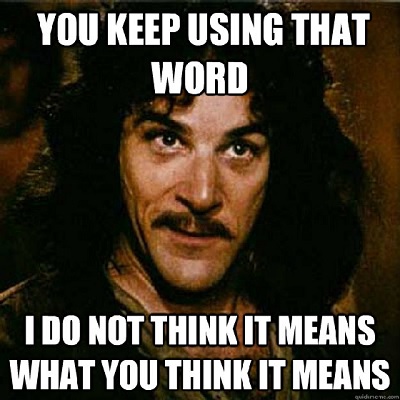
And then there's the "radical pope". If ever there was a time for the "you keep on using that word" meme, surely it is when the word radical is applied to the leader of the largest hierarchy on the planet.

In what way is this pope radical? He has said some things. He has made some statements.

Pope Francis has declared that Catholic priests will temporarily be allowed to absolve the sin of abortion without obtaining special permission from a bishop. And media hailed this as the Church softening its stance on abortion!

Absolution? The Pope should be begging our forgiveness for the untold number of women who have died from illegal abortions, the orphans and desperately poor children whose mothers were denied contraception, the families forced into poverty by the Church's own policies. The Church offers a brief amnesty for women who exercised their human rights? Fuck you.

Pope Francis has made some statements against unchecked capitalism and in sympathy with the world's poor. Has the Church renounced its immense, tax-exempt wealth in order to feed the hungry world?

"God weeps," said this Pope, at child sexual abuse, and similar statements of contrition that survivors have heard from two popes before him. Pope Francis praised his bishops' handling of the sex abuse crisis, only to back down after an outcry from survivors and advocates. One more "carefully choreographed" statement. One more nothing. If survivors themselves had not risen up and demanded the world hear them, the Church would still be playing whack-a-mole with pedophile priests.

Pope Francis has acknowledged that LGBT people are human beings, and perhaps will not suffer eternal damnation for leading their own lives. Gee thanks, Pope.

There is no doubt that Pope Francis has changed the tone of a tone-deaf institution that is decades, if not centuries, behind the times. Because liberation movements - of women, LGBT people, indigenous people, sexual abuse survivors - have changed our very world, the Church was finally forced to acknowledge modernity.

But he has altered nothing of substance, and certainly has not moved one iota towards radical change.

This pope name-dropped the great radical leader Dorothy Day, much as every US politician quotes Martin Luther King, Jr. But besides his speeches in the US, what did Pope Francis actually do? He canonized Father Junípero Serra, a Spanish priest who was actively complicit in the genocide of indigenous peoples of North and South America.

Yet this change of tone and some heartfelt conciliatory speeches are enough for the media - including much alternative media - to hail Pope Francis as a Great Bringer of Change.

Mass amnesia

I watched in wonder as liberal USians hailed Obama as the Great Bringer of Change, then had their hearts broken, as per usual. Yet now, less than a decade later, they appear to be hypnotized again.

Bernie Sanders will not save us. Pope Francis will not save us. We are the people we have been waiting for. If we want radical change, we have to band together and create it ourselves. Idle No More. Occupy Wall Street. Fight for 15. The member organizations of 350.org. Food Inc. No One Is Illegal. Marinaleda. Los Indignados. And a million other groups - groups without names, groups without media coverage - groups of people, acting collectively. This is the way forward.

Vote for Sanders in the primaries. Then dutifully vote for Hillary for president. And wonder why nothing ever changes.

9.27.2015

the great weed of 2015?

You will not be surprised to learn that Allan and I own a lot of books. And CDs. And even LPs! Many, many hundreds of each. We have culled our collection a bit over the years, out of necessity, but living in houses for the past 10 years, we expanded again without much thought.

Now here we are in an apartment. It's a large apartment, to be sure, but we no longer have extra rooms where we can stash as much stuff as we like. And neither of us wants to fill up every inch of wall and floor space with books and music. 
 
Thus we are contemplating weeding our own library. And this is very strange. 

Books are us. Or are they?

When I was in my 20s, I wanted to own every book I'd ever read. I was one of those people who believed that my personal library was a statement about myself. I needed to proudly display my politics and my tastes through my bookshelves and records. I loved seeing other people's libraries, and loved when people perused mine. I can recall that when we found ourselves in the home of a new friend, we would soon be looking through their books and music.

For many years, we loved amassing as large a music collection as we possibly could. Allan wrote about music, and we were inundated by freebies. At the time it seemed like the coolest thing in the world. Music would just appear! On our doorstep! For free! Eventually the piles and piles of CDs irritated me. But still, free music! 

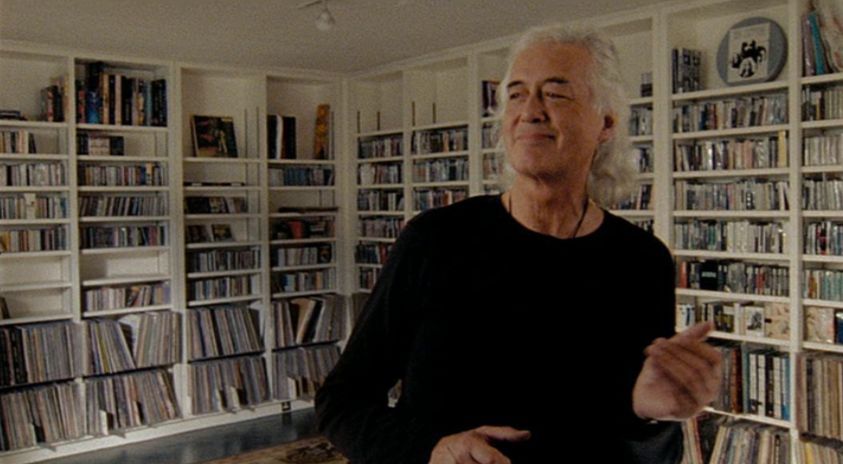
We both still drool over huge, beautiful libraries. When we watched "It Might Get Loud," we had to pause to stare in wonder at Jimmy Page's gorgeous music collection on what must be custom-made shelves. 

Now we're talking about weeding our CDs by as much as half. Allan has a huge amount of digital music, but we both recognize we listen to only a small fraction of what we own. 

Do as the digital natives do?

The whole concept of a library being a personal statement has been erased by the digital age. Most people under a certain age have never owned a physical medium of music. The sharing ethos of the internet has led to things like BookCrossing, BookMooch, Read It Foward, and Little Free Libraries.  

How this affects writers and musicians is another story, and a sad one. But somehow all these readers and listeners manage to form their identities and communicate their points of view without owning a whole bunch of stuff that sits on a whole bunch of shelves. 

I don't know if this is a function of working in a library and having ready access to so many books, or just a general change in my desires. I was much more materialistic when I was younger. But I don't know what's driving this urge to purge.

Here, a minimalist writes about breaking the sentimental attachment we feel towards our books. I'm not sure I'm ready for that. But it suddenly doesn't seem as important to have all these books. 

what i'm reading: the doubt factory, a young-adult thriller by paolo bacigalupi

A thriller about public relations? And for teens? It sounds improbable, and The Doubt Factory by Paolo Bacigalupi is an improbably terrific book. Marrying a somersaulting plot with heart-pounding suspense to an unabashed political agenda and a hot love story, Bacigalupi has delivered a stunning youth read.

On the political front, we contemplate "the place where big companies go when they need the truth confused. . . . when they need science to say what’s profitable, instead of what’s true.” All the tricks of the trade - astroturfing, fronts, false flags, sock puppets, money funnelling, stealth marketing, planted news, and outright false data - are touched on, along with the human damage they cause.

And the political is nothing if not personal. Alix leads the good life of a private school girl in Connecticut, and is forced to confront the possibility that her privilege is built on other people's pain. That pain is impossible to miss, when she meets a group of homeless kids, all orphaned, one way or another, by her father's handiwork.

Pharmaceuticals, pesticides, fossil fuels - you name it, Alix's dad has helped confuse the public, shield wrongdoers, and ultimately cause the death of thousands, while a few brave class-action litigants are painted as selfish and greedy, and those who say otherwise are branded as conspiracy kooks.

Alix is attracted - perhaps dangerously so - to a young man who turns out to be the leader of a radical group focused on exposing her father's complicity in all that suffering. Betrayal lurks behind every door, but who will betray, who will be betrayed, and who will be exposed?

My only minor complaint is that the political agenda gets a teensy bit preachy at times. Preachy politics in fiction are usually a dealbreaker for me, but with The Doubt Factory, I was so hooked by the plot and the suspense that I didn't mind. More importantly, I don't think young readers would give it a second thought.

9.19.2015

what i'm reading: soul made flesh: the discovery of the brain and how it changed the world

The ancient Egyptians, when preparing a body for mummification, carefully preserved the heart, liver, lungs, and other vital organs in special canisters, now known as canopic jars. The brain was yanked out and throw away as trash. A millennium or two later, human knowledge of the workings of the brain was every bit as erroneous and incomplete.

Until the 1600s, no one knew what the brain did or what function it served. Even William Harvey, the pioneering British scientist who discovered the circulatory system, believed the heart was the centre of human thought and consciousness. Less enlightened but highly influential schools of thought postulated that the human body contained four souls: animal, vegetable, rational, and material. Other theories counted up to seven souls. Descartes and Hobbes, those pillars of the Age of Reason, believed in an anatomy that contained at least a few souls.

At the beginning of the seventeenth century, no one knew what the brain did, and no European had ever seen an intact human brain. By the time the century had ended, the most common conceptions of man, god, and the universe had been upended and replaced.

Soul Made Flesh: The Discovery of the Brain and How It Changed the World by Carl Zimmer is the story of that scientific revolution, a fascinating, complex tale of the birth of neuroscience. The relatively unknown and unheralded Thomas Willis, part of the group of scientists and philosophers known as the Oxford circle, brought the brain and its functions into the fore, and began scientific method into the bargain. Zimmer tells the story against a historical and social backdrop of English civil war, regime change, and religious persecution.

Willis was the first person to accurately draw the brain and other organs, and the book is illustrated with reproductions of Willis' original drawings. He was the first person to draw connections between the brain and conditions such as epilepsy and migraines. He was the first person to bring scientific method to bear on human illness.

People frequently say "The more things change, the more things stay the same," expressing the belief that throughout history, the details may change, but basic humanity does not. Soul Made Flesh exposes the fallacy in this thinking. In a pre-scientific age, people interpreted their world in completely different ways than we do now. The questions they asked, and the arguments they defended, were as different from the questions of our time as those of the believers of Zeus or Quetzalcoatl.

I recommend this book with one caveat. Seventeenth century Europeans had very different ethics and mores than we do. Willis and his fellow scientists performed experiments on live animals, and more than a few humans whose lives were not thought valuable, such as condemned prisoners. I am not squeamish about medical details, but my compassion for animals made parts of this book difficult to read.

a historic opportunity for residents of peel region: vote ndp on october 19

In the upcoming federal election, Peel residents have an opportunity to make a real difference for ourselves, our neighbours, and all of Canada. We can support a platform aimed at supporting working people, preserving and expanding public healthcare, restoring our democracy, and protecting our environment. We can vote NDP.

NDP candidates are running in all Peel ridings. For me, these five candidates stand out as stellar choices to represent our region.

Rosemary Keenan, running in Brampton Centre, is a longtime leader of the Peel Poverty Action Group and the Peel Sierra Club. She has had a long career as a teacher, school principal, activist, and community organizer. In other words, she's been working to improve life for working people in Peel for decades. As a member of a federal NDP government, she'll have a greater reach and more opportunity to make a difference.

Adaoma Patterson, running in Brampton West, is a long-time advocate for working and low-income people, and for public services. She's had a lead role in the Peel Poverty Reduction Strategy, and has worked (both as staff and committed volunteer) for key agencies like Ontario Works, United Way, YMCA, and the Caribbean Association of Peel.

Progressive people in my own riding, Mississauga Centre, have an opportunity to create real change by voting for Farheen Khan. Farheen has managed a women's shelter, and has raised more than $2,000,000 for progressive causes in Peel, and another $1,000,000 for international relief.

Like almost everyone I know in Peel, Farheen grew up in an immigrant household. Her story will be familiar to many: after immigrating to Canada, her parents’ credentials were not recognized, and they were forced to work multiple jobs just to survive. Farheen's experience working at a young age, experiencing both poverty and violence, led her to choose a life of community service.

In Mississauga Malton, where I work, NDP candidate Dianne Douglas has worked and volunteered for many organizations that improve life for residents of Malton. On my drive to work, I pass a huge billboard picturing the Liberal candidate, who wears the turban and beard that is a frequent sight in Malton. But what good is a turban and beard if you support the corporate status quo? Malton needs an MP who champions public service and healthy communities. That is Dianne Douglas.

Peel residents should be familiar with Michelle Bilek, who is running in Mississauga Erin Mills. Michelle is an educator, a community activist, an advocate for women, children, and low-income and homeless people. As a young person, Michelle experienced homelessness, and worked her way through two university degrees. Among her activities, she is a member of Peel’s Regional Diversity Roundtable and of the advisory board of the Homelessness Partnership Strategy.

These are not the only NDP candidates running in Peel. If you live in Mississauga, Brampton, or Caledon, you can scroll through this list of NDP candidates running in Ontario to find your candidate.

In the past, most of Peel Region had been represented in Parliament by Liberal MPs. That all changed in 2011, when the Liberal Party suffered its historic collapse, and most Peel ridings flipped to the Harper Conservatives. But those dreadful results had a silver lining, and it was orange. In 2011, the New Democratic Party won historic levels of support in Peel. On October 19, 2015, we have the opportunity to strengthen that support, and elect NDP MPs throughout the region.

Unlike Conservatives, who believe in making life easy for banks and oil companies, the NDP will build and strengthen public support so that all working people have an opportunity, not only to survive, but to thrive.

The NDP is the only party that gets all its support from working people and labour unions, the only party not supported by major corporations. That tells us something right there. The Conservatives are spending five times as much as the NDP in this election. How should our election be decided: by voters, or by money?

If you're not sure where you vote, or you're unsure if you're registered to vote, you can check here: Elections Canada.

9.13.2015

sunrise from the 19th floor

19th floor, central Mississauga, facing east.
For locals, this is from the corner of Hurontario and Burnhamthorpe.

You can see a bit of Lake Ontario on the right.


Toronto is not that close. I'm zooming in. Here's the actual foreground.

9.12.2015

things i heard at the library: an occasional series: #18

As I've mentioned, my current library is located in a community centre. Here's an example of why that's so great.

A customer came to the desk, an older man, speaking heavily accented English, clutching a piece of paper.

It was difficult to figure out what he wanted. He kept repeating, "They said the library would help me. I have to apply online. They said the library would help."

The paper turned out to be a Record of Employment. From my own experience, I know this is the first step in applying for Employment Insurance. Asking questions, I learned that he had worked as a machinist for 35 years and had been laid off. It sounded like the good people at Service Canada told him he could apply for Employment Insurance online. "I told them, I am not online, and they said, go to the library, they will help you." It's possible that Service Canada was just trying to get rid of him.

I asked him, "Have you been to Malton Neighbourhood Services, down the hall?" He had not. "Come with me, I'll take you down there."

We walked together to Malton Neighbourhood Services. I told the person at the desk, "I'm with the library. This gentleman needs some help applying for EI. He has his ROE." She told him to take a seat, we shook hands, and I returned to the library.

Laid off after 35 years, that must be so difficult. Maybe we made it a tiny bit easier.

Malton Neighbourhood Services had their budget cut to the bone this year. Yet another reason to not vote Conservative.

9.08.2015

the other side of waste management in peel: shocking lack of recycling in apartment buildings

Goodbye, old friends
In the 10 years I've lived in Mississauga, I've always been impressed with Peel Region's recycling and trash management. Now that I live in an apartment, I'm seeing another side of those services, and it's not pretty.

First, there's no "green bin" - organics - recycling. I've grown so accustomed to throwing all food waste, coffee grinds, tea bags, tissues, wet paper, dog fur, and other organics into the green bin, it feels very strange and wasteful to toss these in the trash.

Instituting an organics recycling program for apartment buildings would be challenging, but other cities with denser populations do it, so it must be possible. I don't know if Toronto is still in the pilot phase or if green-bin recycling has been rolled out to the whole city, but at least it's begun. On the Peel Region waste management website, I find no information that anything like this in the works. (I will tweet this post to Peel, so maybe I'll learn more.)

Starts like this...
Second, and perhaps most importantly, recycling in the building requires an extra step, somewhat time-consuming (in a short-term, selfish kind of way). And there is no incentive to take that step.

For houses in Peel, there is a two-bag standard for trash. Anything over two bags requires a tag; tags cost $1.00. At the same time, recycling is simple. You keep a large blue bin handy somewhere, toss items in it, and leave it at the curb on pick-up day. It's very easy to determine what's recyclable and what's not, either online (an easy wheredoesitgo.ca redirects) or through the booklets Peel distributes to every household.

...ends like this...
Many people, especially those in large households, do buy tags. In our last house, because there were tenants in the basement (that is, two households), we often needed one tag. And many people skirt the issue in creative and less-green ways. But generally speaking, the two-bag standard, the minor cost and inconvenience of garbage tags, and the ease of recycling, combine to keep household trash to a minimum.

Here in our apartment building, it's exactly the opposite. When you move in, building management distributes large carry-bags and information about recycling... full stop. A flyer notes that recycling is mandatory in Peel, but no one monitors or accounts for how much trash any household tosses down the chute. There's only one recycling room for the entire 20-story building, and it's on the first floor. The minor inconvenience of a separate trip for recycling plus no disincentive for trash must equal a much lower diversion rate.

...and this.
And indeed, when I toss the dog-waste bag into the building's dumpster, I see bags of household trash clearly containing bottles, cans, jars, and all manner of recycling. I find this so depressing!

In one sense, apartment living is greener than living in a house. Apartment-dwellers take up less space, use less energy, and don't have water-sucking lawns. But if the majority of residents are not recycling, it's a very different picture.

In order to increase recycling rates, recycling must be easy, and there must be a disincentive to not recycle. For most people, simply helping to take care of the environment by producing less trash is not enough.

Our building is 35 years old, which is old for Mississauga. I realize that when these buildings were constructed, recycling was not a consideration (although it could have been), so there's no extra room on each floor, as you will find in newer buildings. The room with the trash chute is little more than a closet, so there's no room for blue bins. Still, is there not some way to encourage recycling? To make it less cheap and easy to throw everything away? There must be examples from other cities and counties from which Peel could learn.

9.05.2015

in which we (re)adjust to apartment life

On August 30, 2015, we marked 10 years of life in Canada.

On August 31, we moved from our rented house to a high-rise rental apartment, likely our last move for a very long time.

The move itself was an absolute nightmare, a Murphy's Law Spectacular. I don't even want to bore you with the details. It just sucked.

My mom is here for her annual visit, which does not suck, and in fact is very wonderful.

Pupdate

The dogs are doing well, a bit better day by day. The move was extremely stressful on Tala, involving four trips in the car, almost 24 hours of activity, and endless confusion. The following day she seemed old and frail.

Both dogs were not themselves at first. The first morning when I took out Diego's leash, he was actually unsure and afraid! He had never been walked first thing in the morning before!

I reminded myself that although Allan and I knew we were moving for months, for the dogs it came out of the blue. They were confused and a little shook up. But each day they seemed a bit better, a bit more like themselves. It's been five days and they're almost there.

La Universidad del Diego

Diego has been absolutely amazing. About 80% of the time he doesn't react to other dogs at all. Maybe another 10% he barks once, but without seeming agitated. And there are still some situations where he barks and pulls and does seem agitated, but we can very quickly regain his attention, having him sit or lay down for treats.

Our awesome trainer says that we'll get to a point where other dogs never stress Diego, where the presence of strange dogs on leashes makes him happy because he knows he will earn praise and treats. I would have once laughed at that idea, but not anymore. I never believed we would get as far as we have. I was afraid that walking him around other dogs would be a continuous nightmare. So if K says we can do it, I'm willing to try!

The ongoing training means we need to walk the dogs separately for a while. We were dreading the work involved, but so far it's not so bad. If we're both home, all four of us go out together. When only one of us is home, that person takes them out separately.

Diego is especially great on the elevator! He sits or lays down and stays - gets treats - until we say let's go. We let the door open, then wait a second or two, then give the let's go command. He never charges out when the door opens. That's a first for us. In New York our dogs were out like a shot.

Dog City

The building is full of dogs. There are at least six dogs on our floor alone, maybe more. Seemingly every time we're out, we see people walking dogs we've never seen before.

The best thing about a building full of dogs is that everyone is super chill. People with dogs wait for each other to exit and enter the side door, giving each other space, knowing it will prevent confrontations. We wait for them, they wait for us, it's all easily worked out.

Diego, like many dogs, reacts to people when they are afraid of him. He's been known to bark menacingly or even lunge at people on the sidewalk when they are afraid of dogs. (This was part of my motivation for training.) But in this building, no one bats an eye at our dogs. If Diego barks once or twice at another dog, the person walking it doesn't freak out; they just lead their dog away as we lead ours in the other direction.

This, I find, is a Canada vs New York thing. People here are more patient, more considerate, and generally less likely to make a fuss. (And if they do make a fuss, it's not to your face!)

Life on Floor 19

The apartment itself is fabulous, without a doubt the best apartment we've ever lived in. Three bedrooms, two full baths, sweeping views with lots of green, the Toronto skyline and the lake in the distance (pics to follow on the first clear day). In addition to a big closet in every room, there are three gigantic storage rooms. New Yorkers have kitchens and bedrooms the size of these storage rooms.

We totally lucked out snagging a three-bedroom, two-bathroom. We're very accustomed to each having our own office, and we're grateful for not having to give them up. And I'm relieved I can continue to have my own bathroom!

The building is extremely clean and well-maintained, with beautiful landscaping and flowers galore. Repairs happen almost instantly. Residents here are somewhat frustrated with slow, cranky elevator service, but all five elevators are being replaced and upgraded, one at a time.

There is still plenty to adjust to. I've yet to come home from work hungry and tired and have to walk two dogs separately. I haven't done laundry yet. And I've been too busy unpacking to miss the backyard.

But all in all, life is good.

8.26.2015

in which i help a skunk and it kind of says thank you

My apologies to wmtc readers who saw this on Facebook, but this story must be recorded on this blog!

Yesterday morning the dogs were barking at the back door, really going nuts, and not settling down. Checking to see what was going on, I got quite a surprise. A skunk with a container stuck on its head was running in circles, frantically trying to get the thing off. What to do?? I wanted to help it, but I'm not keen on getting skunked! Our dogs have been sprayed many times over the years; our suburban landscape is full of skunks.

Watching this poor creature run wildly around the lawn was so horrible. I called Allan to lure the dogs away from the door, then ran outside with a broom. I thought I could knock the container off the skunk's face from a distance, then get inside before he could hurt me. I hit the container with the broom several times, but it wouldn't come off. The whole time I was muttering, please don't spray me please don't spray me please don't spray me...

Finally I trapped the little guy in a corner with the broom, grabbed the container and pulled - but it was tightly wedged around the skunk's neck and would not budge. I realized the poor thing might have been stuck in the container all night, or even for days.

There was only one thing to do. I took a deep breath, held onto the container, and lifted the skunk in the air. We use an ex-pen to keep the dogs away from one part of the yard, and I held the container on the other side of it, shaking the container over and over, with the skunk dangling from it!

After maybe 10 shakes, the skunk finally fell out. I ran in the other direction... and promptly tripped over the garden hose, falling on my hands and knees on the patio. Ouch! But I got in the house unsprayed. I'm guessing the poor creature was weak and disoriented, dehydrated and hungry, so it had no defense left.

Some people found this story comical, even hilarious. Believe me, it didn't feel funny at the time.