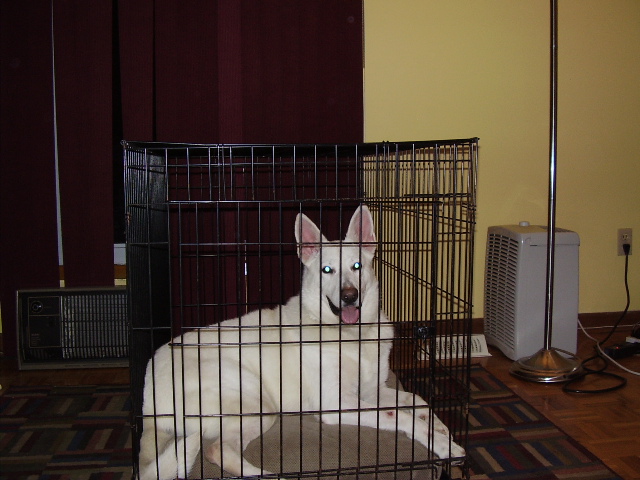
So who is this fluffy white dog with the skinny little face and the radar-tower ears who came to live in Canada? (That's a song, you know. I sing it to her...)
She is very sweet and super affectionate, exactly what I was craving, living with Cody, the dog-who-is-really-a-cat. Tala loves to be hugged and snuggled, she's always happy to be petted and stroked, she's only too happy to shower you with kisses.
She's very smart, and loves to do training. Those same smarts also make her a little devil. Dumb animals, like dumb children, are easier to control, but not nearly as much fun. Tala very quickly learns what we want, and if it's not something she also wants, she learns how to get around it. When she resists, it isn't because she doesn't understand; it's because she has a mind of her own.
For example, she's crated at night and when we're not home. (It's a kennel crate, so she can see out of all sides, and it's right in the middle of the bedroom floor.) If it's bedtime and we ask her to "go on in" (our oldest command, back from Gypsy and Clyde), she trots right in and lies down. When the dogwalkers ask her to go in, she also obeys, because she knows they have to leave. But if Allan and I are going out without the dogs, Tala plants herself in a downstairs corner, the farthest distance possible from the stairs and the crate, and stares stubbornly out, immobile. She knows we won't leave if she's not crated, so this is her simple solution to prevent us from leaving. Once we either chase her upstairs or entice her up with a treat, she walks into the crate, resigned.
Tala is very friendly, but she has many enemies. The vacuum, the broom, the snow shovel and the iron are all on Tala's Enemy List. Her nemesis, the Maximum Evil Genius, is the handheld cordless vacuum. The dishwasher is under investigation, but is showing signs of joining the dark side. Allies are closets (every closet is a walk-in when you're Tala), garbage cans, and our desks, which she likes to sit under.
Tala's a great watchdog, another asset I was looking for, since Cody loves all visitors, and would be just as happy to be visited by burglars as anybody else. Tala's actually too good a watchdog, barking fiercely every time a doorbell rings on TV, or when a squirrel dares to hop across her lawn.
Like most dogs and cats, she loves to look out the window. We have a big picture window, facing the street, in both the living room and the bedroom. Upstairs there are vertical blinds and she pokes her head through the slats. Cody does this only rarely, but Tala is on sentinel duty several hours every day.
She had a few health problems, nothing major, and very common when you adopt a rescue. But it seems that our terrible experiences with Buster have left me a little gun-shy. I was worried - fearful that a minor illness would snowball into something life-threatening. I still recall the day we came up to see the house in Port Credit, and Buster got sick that morning. That was the beginning. I have to work harder to remember all the little minor illnesses that all our other dogs had over so many years, that were normal occurrences and easily solved.
Of course everyone wants to know how Cody is doing. Cody is... coping. I think she was happier without Tala around, but I don't think she's suffering. She seems to have aged a few years in the last month, but maybe she just seems older and slower compared to the white ball of energy.
I may have mentioned that when we first brought Tala home, Cody spent three days snarling and growling at her. Anyone who knows the sweet, mild, laid-back Cody would have been shocked to see her teeth fully bared and hear the vicious sounds rumbling out of her throat. That gradually stopped. Tala quickly learned to leave Cody alone - not to eat her food or bother her when she's eating (one stern "NO" from me seems to have done it, permanently), not to try to steal her treats, and not to try to play with her inside. They play together outside, all kinds of complicated keep-away games and tug-of-war, but when Cody is inside, she doesn't want to be bothered.
The only time Tala slips up is in the morning. She's full of energy, and it just spills over. Cody's like me before I've had my coffee. I won't bite your head off, but I will move away and expect you get the point.
We're really happy to be a pack of four again. It must be our natural state of equilibrium. At least once a day, either Allan or I announce "I love Tala" or "Tala is such a great dog" or "isn't Tala great?"
3.09.2007

3.08.2007
it's been too long...
...since I've posted a picture of Tala!

Tomorrow, more about Tala and how great she is.
Tomorrow, more about Tala and how great she is.
notice anything different?
Did anyone notice there are different photos in the banner? I think not.
The photos will change every few weeks as I change banners. They're not drastically different. Each is a Toronto skyline, one of my favourite NYC buildings, and one local photo.
I like the idea, but it doesn't seem to have made a big impression.
The photos will change every few weeks as I change banners. They're not drastically different. Each is a Toronto skyline, one of my favourite NYC buildings, and one local photo.
I like the idea, but it doesn't seem to have made a big impression.
the museum of sounds
A story on the CBC website alerted me to the latest additions to the Library of Congress Recording Registry.
The registry was begun in 2000, to preserve sound recordings were at risk of being lost through deterioration or changing technology. Every year the Librarian of Congress chooses various sounds to add to the collection, based on both expert recommendations and nominations by the public.
This year's inductees include several favourites of mine, from Allen Ginsberg and Franklin Roosevelt, to Charley Patton, Jelly Roll Morton, and Mick and Keith. It also includes something I intensely dislike, but I won't tell you which that is.
More about the registry, and a brief explanation of each 2006 choice is found here at the Library of Congress website.
I love the idea of sound preservation, which I discovered through Alan Lomax, and his efforts to preserve (and sometimes unethically profit from) a huge variety of indigenous American sounds.
If this also interests you, you might enjoy seeing the complete list of the National Recording Registry.
The registry was begun in 2000, to preserve sound recordings were at risk of being lost through deterioration or changing technology. Every year the Librarian of Congress chooses various sounds to add to the collection, based on both expert recommendations and nominations by the public.
This year's inductees include several favourites of mine, from Allen Ginsberg and Franklin Roosevelt, to Charley Patton, Jelly Roll Morton, and Mick and Keith. It also includes something I intensely dislike, but I won't tell you which that is.
2006 National Recording Registry (in chronological order)
"Uncle Josh and the Insurance Agent," Cal Stewart (1904)
"Il mio tesoro," John McCormack, orchestra conducted by Walter Rogers (1916)
National Defense Test, September 12, 1924 (1924)
"Black Bottom Stomp," Jelly Roll Morton’s Red Hot Peppers (1926)
"Wildwood Flower," The Carter Family (1928)
"Pony Blues," Charley Patton (1929)
"You're the Top," Cole Porter (1934)
"The Osage Bank Robbery," episode of "The Lone Ranger" (December 17, 1937)
Address to Congress, December 8, 1941, Franklin D. Roosevelt (1941)
Native Brazilian Music, recorded under the supervision of Leopold Stokowski (1942)
"Peace in the Valley," Red Foley and the Sunshine Boys (1951)
Chopin Polonaise, op. 40, no. 1 ("Polonaise militaire"), Artur Rubinstein (1952)
"Blue Suede Shoes," Carl Perkins (1955)
Interviews with William 'Billy' Bell, recorded by Edward D. Ives (1956), representing the Edward D. Ives Collection held at the Maine Folklife Center, University of Maine, Orono, Maine and the Archives of Traditional Music at Indiana University, Bloomington, Indiana
"Howl," Allen Ginsberg (1959)
"The Button-Down Mind of Bob Newhart," Bob Newhart (1960)
"Be My Baby," The Ronettes (1963)
"We Shall Overcome," Pete Seeger (1963) recording of Pete Seeger's June 8, 1963, Carnegie Hall concert
"(I Can't Get No) Satisfaction," Rolling Stones. (1965)
"A Change is Gonna Come," Sam Cooke (1965)
"Velvet Underground and Nico," Velvet Underground (1967)
"The Eighty-Six Years of Eubie Blake," Eubie Blake (1969)
"The Wailers Burnin’," The Wailers (1973)
"Live in Japan," Sarah Vaughan (1973)
"Graceland," Paul Simon (1986)
More about the registry, and a brief explanation of each 2006 choice is found here at the Library of Congress website.
I love the idea of sound preservation, which I discovered through Alan Lomax, and his efforts to preserve (and sometimes unethically profit from) a huge variety of indigenous American sounds.
If this also interests you, you might enjoy seeing the complete list of the National Recording Registry.
3.07.2007
if you are a woman on this planet...
If you are a woman on this planet, you are more likely to be poor, more likely to be a victim of violence, more likely to be voiceless and more likely to be exploited. You are less likely to have access to education, services or corridors of power.
. . .
When we look at those who earn less than $1 a day globally, 70 per cent are women. Of the 80 million children who aren't in school, most are girls. Every day, 1,400 women die needlessly in pregnancy and childbirth. One in five women will be a victim of rape or attempted rape in her lifetime. Women are overrepresented among the 8,000 people who die every day as a result of the AIDS pandemic, mostly in the world's poorest countries.
More than half the world's food is produced by women, rising to 80 per cent in many developing countries, yet tradition, laws and discrimination mean many women cannot own land, access credit or control the fruits of their labour. It is women and girls who have first felt the brunt of climate change as they spend a growing number of hours each day walking ever farther to fetch water and firewood.
. . .
As Canadians, we pride ourselves on the progress we've made to recognize and promote women's rights and equality among women and men. But our record is spotty at best. Women in Canada, too, are more likely to be poor, earn less than men and find themselves the victim of violence. The horrific experience of the disappeared women of Vancouver, Edmonton and elsewhere haunts us.
Women with whom we work in Zimbabwe, in Guatemala, in Ethiopia can't quite believe that in a country as rich as Canada we have women in aboriginal communities and elsewhere across this country who can't exercise their right to access basic services. They wonder how they can overcome huge barriers in their own countries when they see a country such as Canada stepping back from its obligations to ensure women's rights are respected.
The removal of equality from the mandate of the Status of Women department, the gutting of its budget and the closure of most offices sends a chill down the spines of women around the globe who are committed to ending discrimination. Equally disturbing is the prohibition on federal funding to support advocacy and campaigning on women's rights. These actions, after eliminating the Court Challenges program that played such a key role in protecting women's and minority rights, send exactly the wrong signal to the world about Canada's commitment to promoting full respect for women's rights.
When combined with the reversal of the national child-care program and other actions, it seriously undermines Canada's progress toward meeting its obligations under the United Nations Convention to Eliminate all Forms of Discrimination against Women.
Tomorrow is International Women's Day. Read this column by Robert Fox, executive director of Oxfam Canada.
what's that floating in my river? the multicultural balancing act
A big story in Canada recently revolved around the ejection of a girl wearing a hijab from a soccer field in Quebec. Although opinion is always divided on these issues, it seemed to me that most public opinion was opposed to the referee's decision, and FIFA's unfortunate decision to allow it to stand in the name of local ref autonomy.
A similar type of story, though lesser known, is being played out in the Ontario's Peel Region, where I live. As part of their traditional worship, Hindu people have been "leaving offerings" - flowers, statues, jewelry - in the Credit River and other creeks in the area. In addition, people have been releasing the ash remains of cremated bodies into the river.
In the past, it was more common to send ashes to India, to be released into the Ganges. But now the Hindu people of Peel often have little connection to India. They are Canadians, and they want the ashes of their loved ones to be released in Canada.
What to do? One person's offerings are another person's pollution. People need to freely practice their religion, and it's their unequivocal right to do so. But dumping - placing, offering - things into the waterways is harmful, and illegal. In response, many Hindu people are leaving the offerings secretly, at night.
Hindu leaders in Mississauga want to work with the local government to find a compromise - a place where the community can release ashes into the water safely and legally.
It's an interesting problem, and if not unique to the Peel Region, certainly not something you'd hear about in most North American communities.
Toronto Star article here.
A similar type of story, though lesser known, is being played out in the Ontario's Peel Region, where I live. As part of their traditional worship, Hindu people have been "leaving offerings" - flowers, statues, jewelry - in the Credit River and other creeks in the area. In addition, people have been releasing the ash remains of cremated bodies into the river.
In the past, it was more common to send ashes to India, to be released into the Ganges. But now the Hindu people of Peel often have little connection to India. They are Canadians, and they want the ashes of their loved ones to be released in Canada.
What to do? One person's offerings are another person's pollution. People need to freely practice their religion, and it's their unequivocal right to do so. But dumping - placing, offering - things into the waterways is harmful, and illegal. In response, many Hindu people are leaving the offerings secretly, at night.
Hindu leaders in Mississauga want to work with the local government to find a compromise - a place where the community can release ashes into the water safely and legally.
It's an interesting problem, and if not unique to the Peel Region, certainly not something you'd hear about in most North American communities.
Toronto Star article here.
...and the other truth that was revealed
In my anger over the (unsurprising) revelations at Walter Reed Army Hospital, I forgot to mention something very important. Fortunately two wmtc readers conspired to remind me.
When James noted that the wingnut spin on this debacle is "this proves the government can't run health care," M@ noted that the reality is quite the opposite. The short-term culprit here is privatized services, run for profit, through contracts handed out by patronage. The federal government is being run like Boss Tweed New York, but now tax cuts are handed out instead of turkeys.
Some bloggers who've teased out the whole IAP/Walter Reed/Weightman story are Liberal Avenger and Unbossed. I recommend reading both those great posts.
Paul Krugman addressed the larger issue in a recent column, brought to you by the good folks at truthout.
When James noted that the wingnut spin on this debacle is "this proves the government can't run health care," M@ noted that the reality is quite the opposite. The short-term culprit here is privatized services, run for profit, through contracts handed out by patronage. The federal government is being run like Boss Tweed New York, but now tax cuts are handed out instead of turkeys.
Some bloggers who've teased out the whole IAP/Walter Reed/Weightman story are Liberal Avenger and Unbossed. I recommend reading both those great posts.
Paul Krugman addressed the larger issue in a recent column, brought to you by the good folks at truthout.
When Salon, the online magazine, reported on mistreatment of veterans at the Walter Reed Army Medical Center two years ago, officials simply denied that there were any problems. And they initially tried to brush off last month's exposé in The Washington Post.Read Krugman's column here.
But this time, with President Bush's approval at 29 percent, Democrats in control of Congress, and Donald Rumsfeld no longer defense secretary - Robert Gates, his successor, appears genuinely distressed at the situation - the whitewash didn't stick.
Yet even now it's not clear whether the public will be told the full story, which is that the horrors of Walter Reed's outpatient unit are no aberration [emphasis mine]. For all its cries of "support the troops," the Bush administration has treated veterans' medical care the same way it treats everything else: nickel-and-diming the needy, protecting the incompetent and privatizing everything it can.
What makes this a particular shame is that in the Clinton years, veterans' health care - like the Federal Emergency Management Agency - became a shining example of how good leadership can revitalize a troubled government program. By the early years of this decade the Veterans Health Administration was, by many measures, providing the highest-quality health care in America. (It probably still is: Walter Reed is a military facility, not run by the V.H.A.)
But as with FEMA, the Bush administration has done all it can to undermine that achievement. And the Walter Reed scandal is another Hurricane Katrina: the moment when the administration's misgovernment became obvious to everyone.
The problem starts with money.
3.06.2007
in the scandal over walter reed, a basic truth is revealed
Now that the world knows something about how wounded American veterans are treated at the US's flagship veteran's hospital - the good one, the one with the funding - many of us in the peace movement can't help but think: we knew this all along. This is what we've been trying to tell you all these years.
Of course we didn't know the exact location of the most disgusting hospital building (the now-notorious Building 18), or the specifics of the degradation (mold, vermin, cockroaches). But we've known that there is little funding and support for the scores of grievously injured men and women returning from Iraq and Afghanistan, because the United States government doesn't give a shit about them. They call the veterans heroes and pose with them for photo-ops when it's useful. Other than that, who gives a shit. Put asticker magnet on your car and call it a day.
Ever visit a VA hospital in the US? I have. They're disgusting. Under-staffed, under-funded, dirty, they are places of last resort. There are some great programs coming out of VA hospitals, like support groups and wheelchair sports teams, but those are the work of veterans or advocacy groups, not the Veterans Administration.
I'll repeat something I have written in various forms over and over again.
And do you know what? It was ever thus.
Here's something else I've posted before. From Lord Arthur Ponsonby's, Falsehood in Wartime: Propaganda Lies of the First World War, published in 1928.
Through time, and through history, young men (and now woman, too) have been called upon to give up their bodies, their lives, their limbs, their eyesight, their sanity, for the furtherance of someone else's profit and power. Read (or re-read) All Quiet On The Western Front, and think about how little has changed.
Of course we didn't know the exact location of the most disgusting hospital building (the now-notorious Building 18), or the specifics of the degradation (mold, vermin, cockroaches). But we've known that there is little funding and support for the scores of grievously injured men and women returning from Iraq and Afghanistan, because the United States government doesn't give a shit about them. They call the veterans heroes and pose with them for photo-ops when it's useful. Other than that, who gives a shit. Put a
Ever visit a VA hospital in the US? I have. They're disgusting. Under-staffed, under-funded, dirty, they are places of last resort. There are some great programs coming out of VA hospitals, like support groups and wheelchair sports teams, but those are the work of veterans or advocacy groups, not the Veterans Administration.
I'll repeat something I have written in various forms over and over again.
Of all the hypocrisy and lies perpetrated by the US government, for me the worst, the absolute lowest, is the shameful treatment of the armed forces. Lie to these people, betray their trust, cut off their options so the military is one of the only ways to get an education, use them for propaganda - then spit them out. Cut funding for the ongoing medical treatment they'll need long after their dues have been paid, give their families only partial benefits because they were reservists, deny them even proper protection in combat - it's a long list.
And do you know what? It was ever thus.
Here's something else I've posted before. From Lord Arthur Ponsonby's, Falsehood in Wartime: Propaganda Lies of the First World War, published in 1928.
1: We don't want war
2: The enemy bears all the responsibility.
3: We are not waging war against a people, but against an evil leader.
4: We are fighting for a noble cause, not for material interests.
5: The enemy commits atrocities.
6: The enemy is using weapons that are not permitted.
7: Our losses are limited, the enemy's losses are high.
8: The artists and intellectuals support our cause.
9: Every war is a 'holy war'.
10: Anyone who calls the propaganda into question is a traitor.
Facts must be distorted, relevant circumstances concealed, and a picture presented which by its crude colouring will persuade the ignorant people that their Government is blameless, their cause is righteous, and that the indisputable wickedness of the enemy has been proved beyond question. A moment's reflection would tell any reasonable person that such obvious bias cannot possibly represent the truth. But the moment's reflection is not allowed; lies are circulated with great rapidity. The unthinking mass accept them and by their excitement sway the rest. The amount of rubbish and humbug that pass under the name of patriotism in war-time in all countries is sufficient to make decent people blush when they are subsequently disillusioned.
Through time, and through history, young men (and now woman, too) have been called upon to give up their bodies, their lives, their limbs, their eyesight, their sanity, for the furtherance of someone else's profit and power. Read (or re-read) All Quiet On The Western Front, and think about how little has changed.
3.05.2007
follow-ups
It occurred to me that I should follow up on my posts about my problems with Zip.ca and Vonage. Since I publicly complained about both companies, I should also make their responses public.
After life settled down a bit, after moving and bringing Tala home, I printed both blog posts, wrote a cover letter updating the situation, and mailed them - paper mail is still the most effective way to file a complaint - to both companies. Here are the results.
First, Vonage. As I've said before, I love VoIP, and Vonage generally has been great. It's reliable, full of great little extras, with simplified flat-rate billing, at an extremely reasonable price. Everything you need is self-managed through the website, and very easy to use.
My issue was unusual - which in no way excuses the crazy runaround I endured, but does make it extremely unlikely that you'd encounter the same problems. In fact, unless you're trying to change from a US account to a Canadian account, you're guaranteed not to.
But indeed, I did have those problems, and they weren't minor.
So I mailed my cover letter and blog post to both the president of Vonage US and the president of Vonage Canada. A few days later, I received a long voicemail from the head of Vonage Canada's "executive response team". The message was a long apology, with assurances that the company took my complaint very seriously (he said my letter had been copied and forwarded to every department!), and that they were taking steps to ensure nothing like this ever happens again. Apparently my request wasn't that difficult after all, and could have been easily accommodated.
He went on for quite some time, and also tried to reach me the next day. I finally left him a return voicemail, so that he would stop calling. I don't feel the need to talk about it, and would rather not spend the time on the phone. But I do appreciate that he was trying to contact me.
Finally, he credited our account with two months worth of free service. Considering the extent of the problem and how many times he apologized, I actually thought two months was inadequate. But I'm glad I successfully lodged my complaint, and I'm glad the company paid attention. Now my service is back to normal, and all is well.
Zip.ca was not as simple, but then, it was a different kind of issue.
First customer service repeatedly told me that the problem wasn't happening, even going so far as to try to prove that it wasn't (although they couldn't actually do that). After getting no satisfaction from their customer service drones, I asked how I could contact the head of customer service. They refused to give me an email address, and said that "Zip.ca does not accept complaints through the postal mail". (So what, if they get a letter, they send it back?) They insisted that the only way to contact the company is through the web-based complaint form. That's impossible, of course.
After much wrangling, I obtained a paper mailing address. I also gave in and did what they suggested: I put the manager's name in the subject line of the complaint form.
The customer service manager responded promptly. She apologized for the service not being everything I wanted it to be, and explained from Zip's perspective why Zip cannot meet Netflix's standards. And, true to Zip form, she suggested that I am part of the problem: "As mentioned, we are addressing this concern from our end, but request that you assist us and yourself in maximizing the value of this service."
In general, she took the correct approach: she apologized, thanked me, explained the issue from the company's perspective, and was honest about the possible outcomes. Idealistic Pragmatist, who has complained to Zip about the same issue, noted that it was the first time Zip actually admitted that their service was less than ideal. That's something. However, I felt that the crux of their response was to ask me to lower my expectations.
So, to recap.
I recommend Vonage without reservations. I still love them. If you have a high-speed internet connection and use a home phone, Vonage is great.
[You know what, I shouldn't say I recommend Vonage without reservations. Their service is excellent. But if you do have problems, they're not the best at resolving them. For me, that has only happened twice in seven years, and both times I was asking for something a little out of the ordinary. But I should be completely honest, so that's my one caveat.]
If you see a lot of movies, I'd recommend Zip, with reservations. It's best if you don't particularly care in what order you see your choice of movies. They're not as good as Netflix, but they're alright.
After life settled down a bit, after moving and bringing Tala home, I printed both blog posts, wrote a cover letter updating the situation, and mailed them - paper mail is still the most effective way to file a complaint - to both companies. Here are the results.
First, Vonage. As I've said before, I love VoIP, and Vonage generally has been great. It's reliable, full of great little extras, with simplified flat-rate billing, at an extremely reasonable price. Everything you need is self-managed through the website, and very easy to use.
My issue was unusual - which in no way excuses the crazy runaround I endured, but does make it extremely unlikely that you'd encounter the same problems. In fact, unless you're trying to change from a US account to a Canadian account, you're guaranteed not to.
But indeed, I did have those problems, and they weren't minor.
So I mailed my cover letter and blog post to both the president of Vonage US and the president of Vonage Canada. A few days later, I received a long voicemail from the head of Vonage Canada's "executive response team". The message was a long apology, with assurances that the company took my complaint very seriously (he said my letter had been copied and forwarded to every department!), and that they were taking steps to ensure nothing like this ever happens again. Apparently my request wasn't that difficult after all, and could have been easily accommodated.
He went on for quite some time, and also tried to reach me the next day. I finally left him a return voicemail, so that he would stop calling. I don't feel the need to talk about it, and would rather not spend the time on the phone. But I do appreciate that he was trying to contact me.
Finally, he credited our account with two months worth of free service. Considering the extent of the problem and how many times he apologized, I actually thought two months was inadequate. But I'm glad I successfully lodged my complaint, and I'm glad the company paid attention. Now my service is back to normal, and all is well.
Zip.ca was not as simple, but then, it was a different kind of issue.
First customer service repeatedly told me that the problem wasn't happening, even going so far as to try to prove that it wasn't (although they couldn't actually do that). After getting no satisfaction from their customer service drones, I asked how I could contact the head of customer service. They refused to give me an email address, and said that "Zip.ca does not accept complaints through the postal mail". (So what, if they get a letter, they send it back?) They insisted that the only way to contact the company is through the web-based complaint form. That's impossible, of course.
After much wrangling, I obtained a paper mailing address. I also gave in and did what they suggested: I put the manager's name in the subject line of the complaint form.
The customer service manager responded promptly. She apologized for the service not being everything I wanted it to be, and explained from Zip's perspective why Zip cannot meet Netflix's standards. And, true to Zip form, she suggested that I am part of the problem: "As mentioned, we are addressing this concern from our end, but request that you assist us and yourself in maximizing the value of this service."
In general, she took the correct approach: she apologized, thanked me, explained the issue from the company's perspective, and was honest about the possible outcomes. Idealistic Pragmatist, who has complained to Zip about the same issue, noted that it was the first time Zip actually admitted that their service was less than ideal. That's something. However, I felt that the crux of their response was to ask me to lower my expectations.
So, to recap.
I recommend Vonage without reservations. I still love them. If you have a high-speed internet connection and use a home phone, Vonage is great.
[You know what, I shouldn't say I recommend Vonage without reservations. Their service is excellent. But if you do have problems, they're not the best at resolving them. For me, that has only happened twice in seven years, and both times I was asking for something a little out of the ordinary. But I should be completely honest, so that's my one caveat.]
If you see a lot of movies, I'd recommend Zip, with reservations. It's best if you don't particularly care in what order you see your choice of movies. They're not as good as Netflix, but they're alright.
3.04.2007
lest we forget: make lists
Since September 11, 2001, so much has happened, and so quickly, that it's impossible to keep track of all the lies, deceit, brutality, hypocrisy and terror unleashed by the junta in Washington. It all blends together into a terrible blur.
Whenever I find lists enumerating those high crimes and misdemeanors, I try to read and save them. Will Pitt's sentence (which I posted earlier today) is such a list. I once compiled a short list of civil rights abuses against American citizens, by no means complete.
I notice many essays on Common Dreams and truthout are forms of lists. You know how we make lists in our personal lives to remember what we need to do? These lists serve the same function for our collective memories. We're all reminding ourselves and each other what's been broken, and what needs to be repaired.
And we need reminding. If there's one thing I've learned from writing about disability issues, it's that human beings are endlessly adaptable. Most human beings can adapt to almost anything. This is essential for personal survival, but it can be doom for the survival of the world and the forms of life we cherish.
As we adapt, we forget how things used to be. Then those in power rewrite history, and that becomes our new collective memory. People like George Orwell, and Milan Kundera, and Nadine Gordimer, and Noam Chomsky, and Amy Goodman, and Ted Rall, and Naomi Klein, and a million others, are all about helping us remember. We have to remember. We have to borrow a tired slogan too often associated with war: Never Forget.
* * * *
Today the New York Times has run a to-do list for the United States. They note that the list "sadly, is hardly exhaustive". I'm reprinting in its entirety.
How can anyone read this and not see that the United States has become an authoritarian state? You think because you can write a letter to your local newspaper, because Keith Olbermann hasn't been arrested, you think because there's such a thing as Election Day, that we're safe? Read this list, and ask yourself, is the work of a democracy?
Whenever I find lists enumerating those high crimes and misdemeanors, I try to read and save them. Will Pitt's sentence (which I posted earlier today) is such a list. I once compiled a short list of civil rights abuses against American citizens, by no means complete.
I notice many essays on Common Dreams and truthout are forms of lists. You know how we make lists in our personal lives to remember what we need to do? These lists serve the same function for our collective memories. We're all reminding ourselves and each other what's been broken, and what needs to be repaired.
And we need reminding. If there's one thing I've learned from writing about disability issues, it's that human beings are endlessly adaptable. Most human beings can adapt to almost anything. This is essential for personal survival, but it can be doom for the survival of the world and the forms of life we cherish.
As we adapt, we forget how things used to be. Then those in power rewrite history, and that becomes our new collective memory. People like George Orwell, and Milan Kundera, and Nadine Gordimer, and Noam Chomsky, and Amy Goodman, and Ted Rall, and Naomi Klein, and a million others, are all about helping us remember. We have to remember. We have to borrow a tired slogan too often associated with war: Never Forget.
* * * *
Today the New York Times has run a to-do list for the United States. They note that the list "sadly, is hardly exhaustive". I'm reprinting in its entirety.
How can anyone read this and not see that the United States has become an authoritarian state? You think because you can write a letter to your local newspaper, because Keith Olbermann hasn't been arrested, you think because there's such a thing as Election Day, that we're safe? Read this list, and ask yourself, is the work of a democracy?
The Bush administration's assault on some of the founding principles of American democracy marches onward despite the Democratic victory in the 2006 elections. The new Democratic majorities in Congress can block the sort of noxious measures that the Republican majority rubber-stamped. But preventing new assaults on civil liberties is not nearly enough.
Five years of presidential overreaching and Congressional collaboration continue to exact a high toll in human lives, America's global reputation and the architecture of democracy. Brutality toward prisoners, and the denial of their human rights, have been institutionalized; unlawful spying on Americans continues; and the courts are being closed to legal challenges of these practices.
It will require forceful steps by this Congress to undo the damage. A few lawmakers are offering bills intended to do just that, but they are only a start. Taking on this task is a moral imperative that will show the world the United States can be tough on terrorism without sacrificing its humanity and the rule of law.
Today we're offering a list — which, sadly, is hardly exhaustive — of things that need to be done to reverse the unwise and lawless policies of President Bush and Vice President Dick Cheney. Many will require a rewrite of the Military Commissions Act of 2006, an atrocious measure pushed through Congress with the help of three Republican senators, Arlen Specter, Lindsey Graham and John McCain; Senator McCain lent his moral authority to improving one part of the bill and thus obscured its many other problems.
•
Our list starts with three fundamental tasks:
Restore Habeas Corpus
One of the new act's most indecent provisions denies anyone Mr. Bush labels an "illegal enemy combatant" the ancient right to challenge his imprisonment in court. The arguments for doing this were specious. Habeas corpus is nothing remotely like a get-out-of-jail-free card for terrorists, as supporters would have you believe. It is a way to sort out those justly detained from those unjustly detained. It will not "clog the courts," as Senator Graham claims. Senator Patrick Leahy of Vermont, the Democratic chairman of the Judiciary Committee, has a worthy bill that would restore habeas corpus. It is essential to bringing integrity to the detention system and reviving the United States' credibility.
Stop Illegal Spying
Mr. Bush's program of intercepting Americans' international calls and e-mail messages without a warrant has not ceased. The agreement announced recently — under which a secret court supposedly gave its blessing to the program — did nothing to restore judicial process or ensure that Americans' rights are preserved. Congress needs to pass a measure, like one proposed by Senator Dianne Feinstein, to force Mr. Bush to obey the law that requires warrants for electronic surveillance.
Ban Torture, Really
The provisions in the Military Commissions Act that Senator McCain trumpeted as a ban on torture are hardly that. It is still largely up to the president to decide what constitutes torture and abuse for the purpose of prosecuting anyone who breaks the rules. This amounts to rewriting the Geneva Conventions and puts every American soldier at far greater risk if captured. It allows the president to decide in secret what kinds of treatment he will permit at the Central Intelligence Agency's prisons. The law absolves American intelligence agents and their bosses of any acts of torture and abuse they have already committed.
•
Many of the tasks facing Congress involve the way the United States takes prisoners, and how it treats them. There are two sets of prisons in the war on terror. The military runs one set in Iraq, Afghanistan and Guantánamo Bay. The other is even more shadowy, run by the C.I.A. at secret places.
Close the C.I.A. Prisons
When the Military Commissions Act passed, Mr. Bush triumphantly announced that he now had the power to keep the secret prisons open. He cast this as a great victory for national security. It was a defeat for America’s image around the world. The prisons should be closed.
Account for 'Ghost Prisoners'
The United States has to come clean on all of the "ghost prisoners" it has in the secret camps. Holding prisoners without any accounting violates human rights norms. Human Rights Watch says it has identified nearly 40 men and women who have disappeared into secret American-run prisons.
Ban Extraordinary Rendition
This is the odious practice of abducting foreign citizens and secretly flying them to countries where everyone knows they will be tortured. It is already illegal to send a prisoner to a country if there is reason to believe he will be tortured. The administration's claim that it got "diplomatic assurances" that prisoners would not be abused is laughable.
A bill by Representative Edward Markey, Democrat of Massachusetts, would require the executive branch to list countries known to abuse and torture prisoners. No prisoner could be sent to any of them unless the secretary of state certified that the country’s government no longer abused its prisoners or offered a way to verify that a prisoner will not be mistreated. It says "diplomatic assurances" are not sufficient.
•
Congress needs to completely overhaul the military prisons for terrorist suspects, starting with the way prisoners are classified. Shortly after 9/11, Mr. Bush declared all members of Al Qaeda and the Taliban to be "illegal enemy combatants" not entitled to the protections of the Geneva Conventions or American justice. Over time, the designation was applied to anyone the administration chose, including some United States citizens and the entire detainee population of Gitmo.
To address this mess, the government must:
Tighten the Definition of Combatant
"Illegal enemy combatant" is assigned a dangerously broad definition in the Military Commissions Act. It allows Mr. Bush — or for that matter anyone he chooses to designate to do the job — to apply this label to virtually any foreigner anywhere, including those living legally in the United States.
Screen Prisoners Fairly and Effectively
When the administration began taking prisoners in Afghanistan, it did not much bother to screen them. Hundreds of innocent men were sent to Gitmo, where far too many remain to this day. The vast majority will never even be brought before tribunals and still face indefinite detention without charges.
Under legal pressure, Mr. Bush created "combatant status review tribunals," but they are a mockery of any civilized legal proceeding. They take place thousands of miles from the point of capture, and often years later. Evidence obtained by coercion and torture is permitted. The inmates do not get to challenge this evidence. They usually do not see it.
The Bush administration uses the hoary "fog of war" dodge to justify the failure to screen prisoners, saying it is not practical to do that on the battlefield. That's nonsense. It did not happen in Afghanistan, and often in Iraq, because Mr. Bush decided just to ship the prisoners off to Gitmo.
•
Prisoners designated as illegal combatants are subject to trial rules out of the Red Queen's playbook. The administration refuses to allow lawyers access to 14 terrorism suspects transferred in September from C.I.A. prisons to Guantánamo. It says that if they had a lawyer, they might say that they were tortured or abused at the C.I.A. prisons, and anything that happened at those prisons is secret.
At first, Mr. Bush provided no system of trial at the Guantánamo camp. Then he invented his own military tribunals, which were rightly overturned by the Supreme Court. Congress then passed the Military Commissions Act, which did not fix the problem. Some tasks now for Congress:
Ban Tainted Evidence
The Military Commissions Act and the regulations drawn up by the Pentagon to put it into action, are far too permissive on evidence obtained through physical abuse or coercion. This evidence is unreliable. The method of obtaining it is an affront.
Ban Secret Evidence
Under the Pentagon’s new rules for military tribunals, judges are allowed to keep evidence secret from a prisoner’s lawyer if the government persuades the judge it is classified. The information that may be withheld can include interrogation methods, which would make it hard, if not impossible, to prove torture or abuse.
Better Define 'Classified' Evidence
The military commission rules define this sort of secret evidence as "any information or material that has been determined by the United States government pursuant to statute, executive order or regulation to require protection against unauthorized disclosure for reasons of national security." This is too broad, even if a president can be trusted to exercise the power fairly and carefully. Mr. Bush has shown he cannot be trusted to do that.
Respect the Right to Counsel
Soon after 9/11, the Bush administration allowed the government to listen to conversations and intercept mail between some prisoners and their lawyers. This had the effect of suspending their right to effective legal representation. Since then, the administration has been unceasingly hostile to any lawyers who defend detainees. The right to legal counsel does not exist to coddle serial terrorists or snarl legal proceedings. It exists to protect innocent people from illegal imprisonment.
•
Beyond all these huge tasks, Congress should halt the federal government’s race to classify documents to avoid public scrutiny — 15.6 million in 2005, nearly double the 2001 number. It should also reverse the grievous harm this administration has done to the Freedom of Information Act by encouraging agencies to reject requests for documents whenever possible. Congress should curtail F.B.I. spying on nonviolent antiwar groups and revisit parts of the Patriot Act that allow this practice.
The United States should apologize to a Canadian citizen and a German citizen, both innocent, who were kidnapped and tortured by American agents.
Oh yes, and it is time to close the Guantánamo camp [emphasis mine]. It is a despicable symbol of the abuses committed by this administration (with Congress’s complicity) in the name of fighting terrorism.
ancient peru at the rom
The Royal Ontario Museum in Toronto will be exhibiting treasures from ancient Peru. I'm very excited about this! Our trip to this region of Peru was among the highlights of our trip, and that is really saying something.
I'm wondering, however, why the ROM refers to the origin of these treasures as "Sican". In Peru, it is "Sipan". We were there, and it is most definitely Sipan. Why this word Sican, I wonder? I will try to find out.
Meanwhile, the exhibit begins March 10. It will be my first time at the ROM.
* * * *
Update. Apparently there's Sipan and Sican. Although they have similar descriptions - both north coast, both Moche, both skilled in metallurgy - they were separate empires. Funny that in my Peru research I never came across Sican. I'll discover them in Toronto!
I'm wondering, however, why the ROM refers to the origin of these treasures as "Sican". In Peru, it is "Sipan". We were there, and it is most definitely Sipan. Why this word Sican, I wonder? I will try to find out.
Meanwhile, the exhibit begins March 10. It will be my first time at the ROM.
* * * *
Update. Apparently there's Sipan and Sican. Although they have similar descriptions - both north coast, both Moche, both skilled in metallurgy - they were separate empires. Funny that in my Peru research I never came across Sican. I'll discover them in Toronto!
one sentence
The always-excellent William Rivers Pitt has written a sentence that you should read. It's here at truthout.
ouch
Well, I had my first experience with a hospital emergency room in Mississauga. I'm fine, and feeling a little silly that I went to the hospital, but I guess that's how it is when it turns out nothing's wrong.
Walking the dogs yesterday morning, I slipped on the ice and fell. Hard. And my head hit the sidewalk - hard.
It's been warm during the day, the snow melts, then it's colder at night, everything freezes again, and in the morning the sidewalks are treacherous. There was a light dusting of snow obscuring the ice, and the next thing I knew, I was flat on my back. There's nothing quite like the sound of your own head slamming down on the pavement.
I wasn't knocked out, and I got up, found my glasses in the snow (all bent out of shape) and limped home. Allan took me to get my glasses fixed, but after he went to work, I had a horrible headache. Half my family is in the health professions, and I've known a few people with head injuries, so I know you have to take it seriously. I don't have a car on Saturdays (Allan drives to work), so I called a cab and went to Trillium.
What can I say? It was the same as hospitals anywhere. Much less crowded than an emergency room in New York City where half the people are there for primary health care, but more crowded than your doctor's waiting room. It was probably busier on a weekend when the walk-in clinics are closed, but it wasn't what I would call an overcrowded zoo.
I waited, I was seen, I was fine. I have a mild concussion, and today I feel like I had the most strenuous workout of my life. Every muscle hurts. But nothing worse than that.
As I said, I feel a little foolish that I went to the hospital. But if Allan had fallen, I would have said, Go. My sister (a nurse) said, if it were my child, I'd take them to the ER. So in my attempt to treat myself as well as I would treat others, I went.
The moral of the story is don't walk your dogs on the ice.
Walking the dogs yesterday morning, I slipped on the ice and fell. Hard. And my head hit the sidewalk - hard.
It's been warm during the day, the snow melts, then it's colder at night, everything freezes again, and in the morning the sidewalks are treacherous. There was a light dusting of snow obscuring the ice, and the next thing I knew, I was flat on my back. There's nothing quite like the sound of your own head slamming down on the pavement.
I wasn't knocked out, and I got up, found my glasses in the snow (all bent out of shape) and limped home. Allan took me to get my glasses fixed, but after he went to work, I had a horrible headache. Half my family is in the health professions, and I've known a few people with head injuries, so I know you have to take it seriously. I don't have a car on Saturdays (Allan drives to work), so I called a cab and went to Trillium.
What can I say? It was the same as hospitals anywhere. Much less crowded than an emergency room in New York City where half the people are there for primary health care, but more crowded than your doctor's waiting room. It was probably busier on a weekend when the walk-in clinics are closed, but it wasn't what I would call an overcrowded zoo.
I waited, I was seen, I was fine. I have a mild concussion, and today I feel like I had the most strenuous workout of my life. Every muscle hurts. But nothing worse than that.
As I said, I feel a little foolish that I went to the hospital. But if Allan had fallen, I would have said, Go. My sister (a nurse) said, if it were my child, I'd take them to the ER. So in my attempt to treat myself as well as I would treat others, I went.
The moral of the story is don't walk your dogs on the ice.
3.02.2007
the court philosopher
Arthur M. Schlesinger Jr., a great writer and historian, and an old-guard liberal, died this week at the age of 89.
Schlesinger was a Kennedy administration insider, and sometimes a Kennedy apologist. But he was a proud liberal to his dying day.
I met Schlesinger several times in 1992 and he seemed very old and frail then. I'm amazed he lived this long, and I'm sorry for his passing.
Here's the New York Times obituary.
* * * *
I used to have many connections that caused me to meet famous people. I didn't have these connections in order to meet famous people, it was just the way my life was. But they're all gone now; I've moved on and so have they. My famous-people-meets are growing old and stale.
Schlesinger was a Kennedy administration insider, and sometimes a Kennedy apologist. But he was a proud liberal to his dying day.
I met Schlesinger several times in 1992 and he seemed very old and frail then. I'm amazed he lived this long, and I'm sorry for his passing.
Here's the New York Times obituary.
* * * *
I used to have many connections that caused me to meet famous people. I didn't have these connections in order to meet famous people, it was just the way my life was. But they're all gone now; I've moved on and so have they. My famous-people-meets are growing old and stale.
political compass part 2
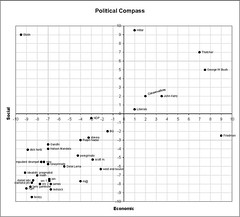
James plotted all our results on a graph. I asked him to also include Political Compass's placement of the 2004 US Presidential candidates and the parties in the 2006 Canadian election.
As West End Bound pointed out in comments, even the most conservative among us are still in the same quadrant as the NDP. No current wmtc reader who took the test is in the same sector as John Kerry, George W Bush or Stephen Harper.
But check out the Canadian Conservative Party and John Kerry, relative to each other. This is what I'm always trying to tell people! And do you see why I say Harper is not a Bush clone?
I know it's difficult to read. Click on the image to go to the Flickr page, then click on "all sizes" to see the original.
Many thanks to James for using his free time this way!
As West End Bound pointed out in comments, even the most conservative among us are still in the same quadrant as the NDP. No current wmtc reader who took the test is in the same sector as John Kerry, George W Bush or Stephen Harper.
But check out the Canadian Conservative Party and John Kerry, relative to each other. This is what I'm always trying to tell people! And do you see why I say Harper is not a Bush clone?
I know it's difficult to read. Click on the image to go to the Flickr page, then click on "all sizes" to see the original.
Many thanks to James for using his free time this way!
what i'm watching: ken burns, unforgiveable blackness
Last night we watched the rest of the Ken Burns film that I blogged about yesterday: "Unforgivable Blackness: The Rise and Fall of Jack Johnson". It was truly excellent.
It occurred to me that if you have never seen a Ken Burns film, this would be a perfect introduction to his work. At two 90-minute segments, the length is not intimidating - by Burns's standards, it's a short-short! - but it still works in the the signature Ken Burns style. Wynton Marsalis did the music, a who's-who of great actors did the voices - including Samuel L. Jackson reading Jack Johnson's words, Billy Bob Thornton and Ed Harris, among many others - plus the usual great interviews. The writer and critic Stanley Crouch is terrific, and James Earl Jones, who created the role based on Jack Johnson in the Broadway play "The Great White Hope," is a brilliant inclusion.
Above all, "Unforgivable Blackness" explores Burns's vision of the United States of America, in all its glory and all its insanity. In terms of racism and racist violence, the first decade of the 20th Century was probably the worst at any time since Emancipation. While Booker T. Washington was telling Negroes to work hard and keep their heads down, while lynchings were rampant, while newspapers depicted African Americans as clown-faced buffoons and referred to them in articles and editorials as coons and darkies, while most African Americans were denied the basic rights of citizenship - in the midst of this, one man declared he was free. One highly intelligent, supremely talented, and thoroughly confident man said, No. This is my country. I am free. I am a man. I will do as I please. How that man lived in that world, and how that world reacted to him, is revelatory.
"Unforgivable Blackness" is available for rent on a 2-DVD set. It includes a making-of feature, which, if you don't know how Burns makes his movies, will be a real treat.
It occurred to me that if you have never seen a Ken Burns film, this would be a perfect introduction to his work. At two 90-minute segments, the length is not intimidating - by Burns's standards, it's a short-short! - but it still works in the the signature Ken Burns style. Wynton Marsalis did the music, a who's-who of great actors did the voices - including Samuel L. Jackson reading Jack Johnson's words, Billy Bob Thornton and Ed Harris, among many others - plus the usual great interviews. The writer and critic Stanley Crouch is terrific, and James Earl Jones, who created the role based on Jack Johnson in the Broadway play "The Great White Hope," is a brilliant inclusion.
Above all, "Unforgivable Blackness" explores Burns's vision of the United States of America, in all its glory and all its insanity. In terms of racism and racist violence, the first decade of the 20th Century was probably the worst at any time since Emancipation. While Booker T. Washington was telling Negroes to work hard and keep their heads down, while lynchings were rampant, while newspapers depicted African Americans as clown-faced buffoons and referred to them in articles and editorials as coons and darkies, while most African Americans were denied the basic rights of citizenship - in the midst of this, one man declared he was free. One highly intelligent, supremely talented, and thoroughly confident man said, No. This is my country. I am free. I am a man. I will do as I please. How that man lived in that world, and how that world reacted to him, is revelatory.
"Unforgivable Blackness" is available for rent on a 2-DVD set. It includes a making-of feature, which, if you don't know how Burns makes his movies, will be a real treat.
3.01.2007
what i'm watching: sarah silverman tonight
"The Sarah Silverman Program" debuts in Canada tonight on The Comedy Network.
This show has a lot of potential. Many of us loved Silverman on the brilliant "Larry Sanders Show" (one of the greatest TV shows ever), "Greg The Bunny" and "Mr. Show", among other spots. She was hilarious in "The Aristocrats".
"The Sarah Silverman Program" co-stars Silverman's real-life sister Laura Silverman, the voice of the disgruntled receptionist on "Dr. Katz". Don't even tell me you don't know Dr. Katz.
This show has a lot of potential. Many of us loved Silverman on the brilliant "Larry Sanders Show" (one of the greatest TV shows ever), "Greg The Bunny" and "Mr. Show", among other spots. She was hilarious in "The Aristocrats".
"The Sarah Silverman Program" co-stars Silverman's real-life sister Laura Silverman, the voice of the disgruntled receptionist on "Dr. Katz". Don't even tell me you don't know Dr. Katz.
what i'm watching: unforgivable blackness
Last night we started watching "Unforgivable Blackness," Ken Burns's film about the boxer Jack Johnson.
Johnson was one of the greatest American athletes of all time, and in his day, undeniably the greatest. But what makes Johnson an irresistible historical figure was his complete refusal to live by the rules white society demanded of African American men in that era.
The most vivid example of this was his choice of partners. In a time when black men were killed because someone suggested they glanced at a white woman, Johnson openly lived and travelled with a succession of white women who called themselves his wife. He was the first African American popular icon, then was persecuted by the government, and eventually brought down.
Johnson's career and his life story perfectly expose the twisted logic and utter ludicrousness of Jim Crow America.
In the early 20th Century, boxing was one of the three major sports of the western imagination (along with horse racing and baseball). The title "Heavyweight Champion of the World" was the most coveted title for any individual athlete. It bestowed riches, fame and glory on its holder in a way unimaginable today.
Johnson defeated all African American opponents, and any white boxer who would step into a ring with him. But convention had it that no Heavyweight Champion would ever fight a black man. That would risk the title being held by a black man, and that could not be allowed to happen.
Johnson would not accept this, and he made it his life's quest to goad a Heavyweight Champion to meet him in the ring. When it finally took place, the match was viewed as a contest of supremacy between the "white race" and the "Negro race". The results sparked deadly riots throughout the country.
It's an almost unbelievable story, and I don't want to say too much about it, as watching Ken Burns unfold it for you is so fascinating and compelling. I'm an unabashed Ken Burns fan. I missed "Unforgivable Blackness" when it first ran on PBS, but with this Zip rental, I think I've now seen every film he's made. He never disappoints.
Johnson was one of the greatest American athletes of all time, and in his day, undeniably the greatest. But what makes Johnson an irresistible historical figure was his complete refusal to live by the rules white society demanded of African American men in that era.
The most vivid example of this was his choice of partners. In a time when black men were killed because someone suggested they glanced at a white woman, Johnson openly lived and travelled with a succession of white women who called themselves his wife. He was the first African American popular icon, then was persecuted by the government, and eventually brought down.
Johnson's career and his life story perfectly expose the twisted logic and utter ludicrousness of Jim Crow America.
In the early 20th Century, boxing was one of the three major sports of the western imagination (along with horse racing and baseball). The title "Heavyweight Champion of the World" was the most coveted title for any individual athlete. It bestowed riches, fame and glory on its holder in a way unimaginable today.
Johnson defeated all African American opponents, and any white boxer who would step into a ring with him. But convention had it that no Heavyweight Champion would ever fight a black man. That would risk the title being held by a black man, and that could not be allowed to happen.
Johnson would not accept this, and he made it his life's quest to goad a Heavyweight Champion to meet him in the ring. When it finally took place, the match was viewed as a contest of supremacy between the "white race" and the "Negro race". The results sparked deadly riots throughout the country.
It's an almost unbelievable story, and I don't want to say too much about it, as watching Ken Burns unfold it for you is so fascinating and compelling. I'm an unabashed Ken Burns fan. I missed "Unforgivable Blackness" when it first ran on PBS, but with this Zip rental, I think I've now seen every film he's made. He never disappoints.
2.28.2007
political compass
Long ago, with a very different readership, I blogged about political compass.
I haven't thought about it ages, but just yesterday MSS of Fruits & Votes mentioned it in comments. James, also in comments, re-took the test.
If you're not familiar with this tool, here's something about it from the website:
Political Compass doesn't want to say more until after you've taken the test, so I won't spoil it for them.
There are some fun categories on the site, showing the positions of the parties in the 2005 Canadian election and of the candidates in the 2004 US "election". Comparing the two graphs is particularly interesting - and, for me, reassuring.
Take the test here and tell us where you score on the quadrant. This is one time where it would be fun to have a few wingnuts around. Still, wmtc readers don't march in lockstep, so I'm curious to see where each of us fall.
My own results:
I haven't thought about it ages, but just yesterday MSS of Fruits & Votes mentioned it in comments. James, also in comments, re-took the test.
If you're not familiar with this tool, here's something about it from the website:
The old one-dimensional categories of 'right' and 'left', established for the seating arrangement of the French National Assembly of 1789, are overly simplistic for today's complex political landscape. For example, who are the 'conservatives' in today's Russia? Are they the unreconstructed Stalinists, or the reformers who have adopted the right-wing views of conservatives like Margaret Thatcher?
On the standard left-right scale, how do you distinguish leftists like Stalin and Gandhi? It's not sufficient to say that Stalin was simply more left than Gandhi. There are fundamental political differences between them that the old categories on their own can't explain. Similarly, we generally describe social reactionaries as 'right-wingers', yet that leaves left-wing reactionaries like Robert Mugabe and Pol Pot off the hook.
Political Compass doesn't want to say more until after you've taken the test, so I won't spoil it for them.
There are some fun categories on the site, showing the positions of the parties in the 2005 Canadian election and of the candidates in the 2004 US "election". Comparing the two graphs is particularly interesting - and, for me, reassuring.
Take the test here and tell us where you score on the quadrant. This is one time where it would be fun to have a few wingnuts around. Still, wmtc readers don't march in lockstep, so I'm curious to see where each of us fall.
My own results:
Economic left/right: -9.00
Social Libertarian/Authoritarian: -8.51
[far lower left quadrant]
2.27.2007
don't thank jack
Have you seen this badge on certain Canadian blogs? Under a picture of Jack Layton, it counts the days of the Harper government and says "Thanks, Jack!"
Oh yes, Ralph Nader is responsible for the Resident and Jack Layton, of all people, is responsible for Harper.
This is so stupid.
The thinking goes, I suppose, that if the New Democrats had propped up the Martin government, we'd be basking in the sunshine of a Liberal minority government right now, instead of toiling under the dark cloud of a Conservative blahblahblah.
I saw one of these badges this weekend (not the one I've linked to), and it was all I could do to restrain myself from posting one of Idealistic Pragmatist's greatest hits: "Jack Layton's Sinister Mind Control Experiment", in which our Ideal-Prag takes apart this lame non-theory brick by broken brick. If you've never read this, do yourself a favour and do so now. I'll wait.
OK, you're back? Now, do you know what? If Canada had proportional representation, there wouldn't even be a Harper government. There'd be a centre-left coalition that more closely matches what most Canadians want.
On that, more from Ms I Pragmatist.
People who call for the NDP to become the left wing of the Liberal Party are forgetting one part of what makes the Canadian system so much better than the US system. Look south. Do you really want a two-party system? We need more parties, not fewer parties. And we need a system that truly represents the electorate's choice.
One bright day in the future, I'll be able to vote in this new country of mine. And you can bet your last loonie I didn't save all that money and wait all those months and quit that great job and give up that rent-controlled Manhattan apartment to vote for the supposedly expedient party over the party that represents my own values.
Oh yes, Ralph Nader is responsible for the Resident and Jack Layton, of all people, is responsible for Harper.
This is so stupid.
The thinking goes, I suppose, that if the New Democrats had propped up the Martin government, we'd be basking in the sunshine of a Liberal minority government right now, instead of toiling under the dark cloud of a Conservative blahblahblah.
I saw one of these badges this weekend (not the one I've linked to), and it was all I could do to restrain myself from posting one of Idealistic Pragmatist's greatest hits: "Jack Layton's Sinister Mind Control Experiment", in which our Ideal-Prag takes apart this lame non-theory brick by broken brick. If you've never read this, do yourself a favour and do so now. I'll wait.
OK, you're back? Now, do you know what? If Canada had proportional representation, there wouldn't even be a Harper government. There'd be a centre-left coalition that more closely matches what most Canadians want.
On that, more from Ms I Pragmatist.
Jamey Heath's new book, Dead Centre: Hope, Possibility, and Unity for Canadian Progressives, makes five important points that every centre-left or left-wing Canadian needs to internalize:
1. Liberals tend to present the voters with laudable centre-left policies in their Red Books. But once elected with a majority--or, in Paul Martin's case, even with a minority--they veer right and refuse to deliver on most of their own best ideas. This has happened over and over again, and is undeniable.
2. When Canadian progressives are feeling anxious about the Conservatives, they tend to forget about the fact that they don't like what Liberal governments actually do, and vote Liberal indiscriminately.
3. Even worse, this tendency extends to ridings where the New Democrat has a better chance of winning than the Liberal, and so-called "strategic" voters end up electing scores of Tories in ridings that are actually Tory-NDP races.
4. Ontario is a region within Canada, not a microcosm of it--and while the Liberals may be the dominant choice of progressives there, this is not the case either in Québec or in the growing west. When we hear about the Liberals being Canada's sole natural governing party, forever and ever amen, that's Ontariocentrism talking, not reality.
5. Progressive voters who refuse to recognize these essential facts end up trying to exist in some warped universe in which Jack Layton is personally responsible for the Liberals' loss of their hegemonic grip on the country. This idea is not only demonstrably false, but because of #1, it actually perpetuates a situation that prevents progressives from getting what we want out of our government.
People who call for the NDP to become the left wing of the Liberal Party are forgetting one part of what makes the Canadian system so much better than the US system. Look south. Do you really want a two-party system? We need more parties, not fewer parties. And we need a system that truly represents the electorate's choice.
One bright day in the future, I'll be able to vote in this new country of mine. And you can bet your last loonie I didn't save all that money and wait all those months and quit that great job and give up that rent-controlled Manhattan apartment to vote for the supposedly expedient party over the party that represents my own values.
Subscribe to:
Posts (Atom)